Every leadership meeting starts with the same problem: a simple question, multiple answers, and no agreement on which number to trust.
In fact, 76% of business leaders feel pushed to back their claims with data, and 57% feel they’re competing with colleagues to prove value using numbers. When the numbers don’t align, meetings turn into debates instead of decisions.
This is where enterprise agentic analytics changes the conversation.
Instead of static dashboards or passive AI predictions, agentic analytics uses intelligent agents that understand business context, follow enterprise rules, and move beyond reporting into reasoning and action. But this only works when those agents operate on a governed, trusted data foundation.
That’s the problem platforms like OvalEdge are designed to solve. By establishing a shared enterprise data context, including definitions, lineage, quality, and access, organizations can finally deploy AI agents that analyze, predict, and act without creating more confusion or risk.
In this post, we’ll break down what enterprise agentic analytics really means, why governance is the prerequisite most teams overlook, and how autonomous analytics systems evolve from answering questions to driving confident, explainable decisions at scale.
What enterprise agentic analytics really means
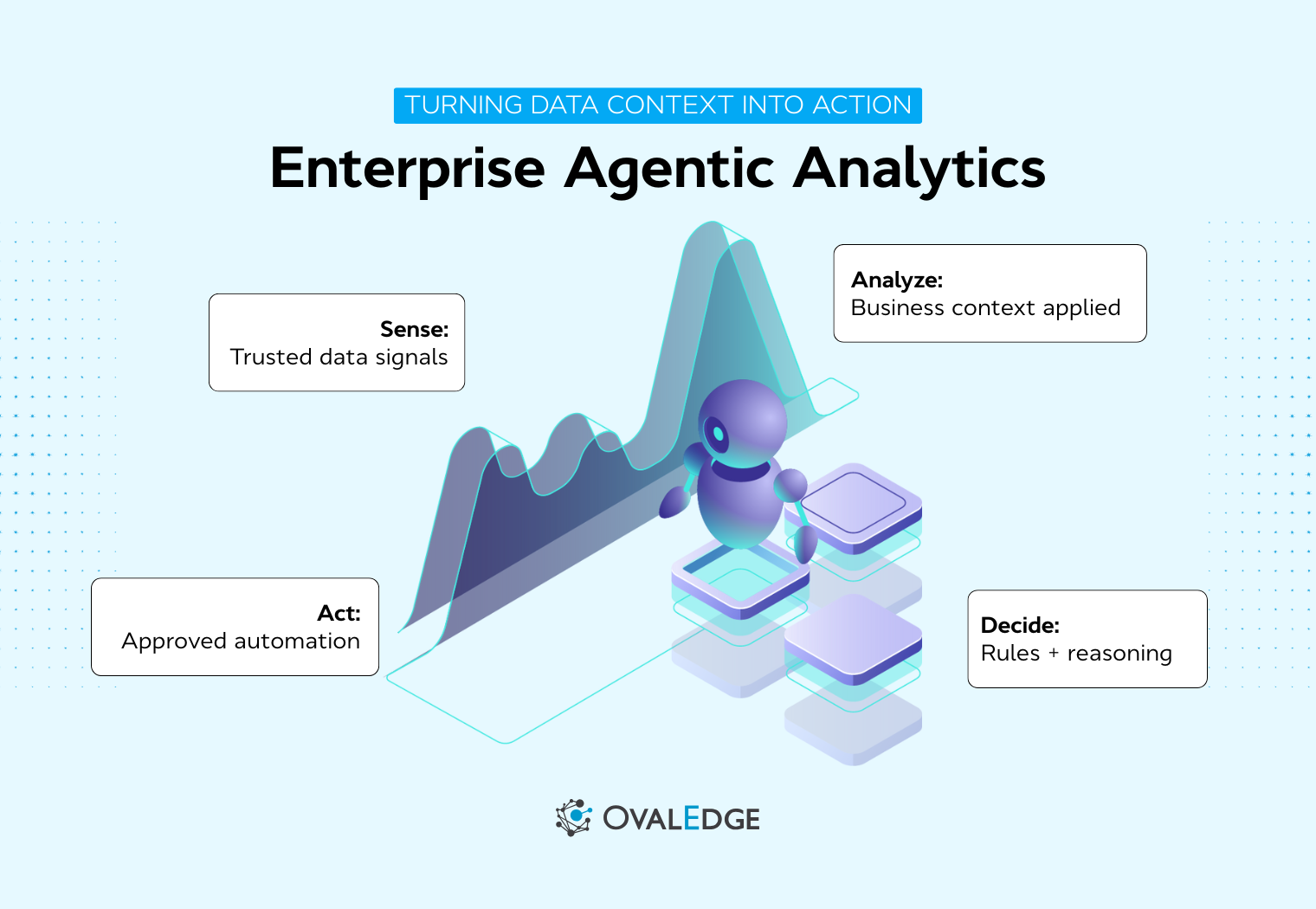
Enterprise agentic analytics uses AI agents to sense data signals, analyze context, recommend decisions, and execute approved actions within enterprise guardrails. This approach goes beyond dashboards by combining business definitions, data quality, lineage, access controls, and governance into every analysis.
Agents monitor metrics, explain changes, predict outcomes, and propose next steps using trusted enterprise data. Human approval, audit logs, and role-based permissions keep automation safe, compliant, and explainable while reducing decision latency across finance, sales, and operations.
That definition highlights an important shift. Enterprise agentic analytics is not just about smarter analytics outputs. It is about where those agents operate and what they are allowed to use when reasoning and acting.
At its core, enterprise agentic analytics combines two inseparable components:
-
A governed, high-quality enterprise data context that reflects how the business actually defines, measures, and controls data
-
Agentic analytics that reason, decide, and act using that trusted context rather than raw or assumed inputs
Most analytics platforms focus almost entirely on the second part. They invest in dashboards, machine learning models, and natural-language interfaces that answer questions quickly. But those tools quietly assume the data underneath is already clean, consistent, and universally understood.
In real enterprises, that assumption rarely holds. Definitions vary by team, metrics drift over time, and data quality changes daily. When agents are dropped into that environment without context, they do exactly what you would expect: they generate confident answers that do not align with how the business actually operates.
Enterprise agentic analytics starts earlier. It treats governance, definitions, and trust as first-class inputs to every analysis, not compliance steps added later. When agents understand approved metrics, known data limitations, ownership, and access rules, they can reason safely and explain their conclusions in business terms.
Without that foundation, analytics becomes fragile:
-
Agents may infer definitions instead of using approved ones
-
Insights may conflict across teams and domains
-
Predictions become difficult to defend
-
Automated actions introduce operational and compliance risk
This fragility is already showing up in the market.
Gartner predicts that more than 40% of agentic AI projects will be canceled by the end of 2027, largely due to weak governance, unclear business value, and unmanaged risk.
Context is not optional when agents are allowed to decide and act.
By grounding AI agents in a governed enterprise data context, enterprise agentic analytics turns automation into something leaders can trust, scale, and actually use to make decisions.
|
Also read: Agentic Analytics vs Traditional BI: Which One Should You Choose? |
Why enterprise agentic analytics is not the same as augmented analytics or decision intelligence
CIOs have seen analytics evolve before. Augmented analytics accelerated insight discovery through automation and natural-language queries, and enterprise decision intelligence added structure by connecting insights to decisions, scenarios, and business outcomes.
Both approaches improved how organizations analyze data, but they stop short of changing how decisions actually happen. Augmented analytics still relies on humans to interpret results, validate assumptions, and take action. Decision intelligence improves decision frameworks, but remains largely advisory. In both cases, analytics informs decisions, but does not actively participate in them.
Enterprise agentic analytics represents a different operating model. It introduces AI agents that do more than surface insights. These agents reason within approved business definitions, understand data quality and lineage, respect access controls, and recommend or execute actions inside enterprise guardrails.
The distinction is not better dashboards or smarter predictions; it is where the intelligence operates and what it is allowed to use. Enterprise agentic analytics moves analytics from answering questions to responsibly participating in decision-making, without bypassing governance, compliance, or human oversight.
|
Did you know? Gartner predicts that 40% of enterprise applications will feature task-specific AI agents by 2026, up from less than 5% just a year earlier. As agents become embedded across enterprise systems, analytics must evolve from passive reporting into governed, agent-driven reasoning and action. |
Before vs after: How analytics changes in practice
The shift to enterprise agentic analytics becomes clearer when you look at how analytics behaves before and after agents are grounded in a governed enterprise data context.
|
Traditional and augmented analytics |
Enterprise agentic analytics |
|
Dashboards and reports explain what happened |
Agents continuously interpret performance using the approved business context |
|
Analysts reconcile definitions across teams |
Definitions, metrics, and logic are enforced by default |
|
Data quality issues are discovered after insights are produced |
Agents factor data quality and freshness into reasoning |
|
Insights require manual validation and interpretation |
Recommendations include rationale, assumptions, and constraints |
|
Actions depend on follow-ups and human handoffs |
Approved actions can execute automatically within guardrails |
|
Governance is applied after analysis |
Governance is embedded before reasoning begins |
In the “before” state, analytics is reactive and fragmented: teams spend more time debating numbers than acting on them. In the “after” state, analytics becomes proactive, explainable, and operational, and decisions move faster because the context, rules, and trust are already built in.
This contrast sets the foundation for understanding why enterprise data context is not optional, and why agentic analytics only works when governance comes first.
What is an enterprise data context?
An enterprise data context is the intelligence layer that sits above raw data and makes analytics usable in the real world. It’s what allows both humans and AI agents to trust the answers they’re working with before taking action.
At a practical level, it provides clarity around questions every organization struggles with:
-
What does this metric actually mean?
-
Is the data reliable right now or in flux?
-
Who is allowed to see it, change it, or act on it?
-
How does this dataset connect to others across the business?
This is where enterprise data context goes beyond basic metadata. It isn’t just documentation stored in a catalog. It is operational intelligence that reflects how the business defines success, enforces rules, and manages risk on a daily basis. It captures definitions, quality signals, ownership, relationships, and policies in a way that analytics systems can actively use.
Without this context, AI agent analytics operate in the dark. Agents are forced to infer meaning, guess relationships, and treat all data as equally trustworthy. The result is fast answers that feel impressive but lack credibility.
|
This gap between impressive demos and real business impact is common. McKinsey found that while many teams see localized AI wins, only 39% of organizations report enterprise-level EBIT impact. Without a shared data context, insights struggle to translate into scalable, trusted decisions. |
With a shared enterprise data context in place, agents can reason with confidence. They understand what the business has approved, when data should be trusted, and where limits apply. That’s what turns analytics from a collection of numbers into something leaders can actually rely on to make decisions.
The key types of data context required
A trusted enterprise data context is made up of multiple context layers that give analytics agents the same grounded understanding experienced analysts rely on. Each layer addresses a specific trust gap, and together they allow agents to reason accurately, safely, and consistently at scale.
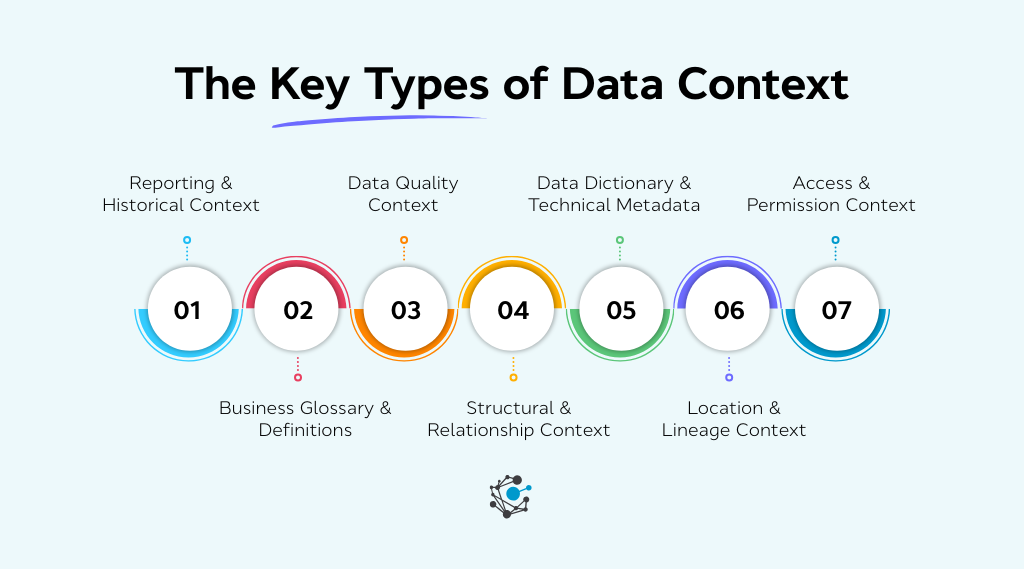
1. Reporting and historical context
Most enterprises already have years of embedded intelligence living inside dashboards, reports, KPIs, and scorecards. These assets reflect how the business has historically measured success, made trade-offs, and explained performance. Reporting and historical context include:
-
Existing dashboards, reports, KPIs, and metrics
-
Previously validated calculations and business logic
-
Institutional knowledge embedded in legacy reports
This context matters because analytics agents should inherit how the business already thinks, not invent new interpretations. When agents understand historical benchmarks and accepted logic, analytics becomes cumulative instead of contradictory.
2. Business glossary and definitions
Shared language is one of the most underestimated requirements for analytics trust. A business glossary ensures that terms mean the same thing everywhere they are used. This context includes:
-
Standardized definitions for metrics, dimensions, and terms
-
Approved formulas and calculation logic
-
Business-friendly language aligned across teams
Why it matters is simple. If “Revenue,” “Active Customer,” or “Churn” mean different things to finance, sales, and marketing, agentic analytics will confidently produce conflicting answers. Clear definitions give agents a single source of semantic truth.
3. Data quality context
Enterprise data is never static or perfect. Pipelines break, systems lag, and known issues exist at any given time. Data quality context allows agents to reason responsibly instead of treating all data as equally reliable. This context captures:
-
Known data quality issues
-
Freshness, completeness, and accuracy indicators
-
Anomalies, exceptions, and unresolved defects
Without quality signals, agents assume certainty where none exists. With them, analytics can adjust confidence, surface risk, or delay recommendations until data stabilizes.
4. Structural and relationship context
Understanding how data connects is essential for accurate analysis. Structural context prevents agents from guessing joins or inferring relationships incorrectly. This layer includes:
-
ER diagrams and table relationships
-
Join paths and cardinality
-
Hierarchies and dependencies
Why it matters is accuracy. Analytics agents must understand how data is structured across systems so insights reflect real business relationships, not accidental correlations.
5. Data dictionary and technical metadata
Technical metadata provides the lowest-level clarity needed for agents to interpret raw fields correctly. It explains what data actually represents, not just where it lives. This context includes:
-
Column meanings, data types, and units of measure
-
Source system information
-
Transformation and calculation logic
Without this layer, agents risk semantic errors such as misreading units, misinterpreting codes, or applying incorrect logic. Technical clarity keeps analytics precise and explainable.
6. Location and lineage context
Lineage answers the “where did this come from” question that leaders and auditors always ask. It shows how data moves, changes, and accumulates across the enterprise. This context tracks:
-
Where the data lives
-
How it moves across systems
-
What transformations occurred along the way
Trust depends on traceability. Humans need to explain where answers came from, and agents need lineage to justify conclusions and actions.
7. Access and permission context
Analytics does not exist outside enterprise security. Agents must respect the same rules humans follow, regardless of automation. This context defines:
-
Who can see which data
-
Role-based access controls
-
Approval workflows and usage restrictions
Why it matters is safety. Agentic analytics must enforce security and compliance by design, not bypass them in the name of speed.
Result: A governed enterprise data contextWhen all these layers come together, organizations gain:
This is agentic data governance. And it is the prerequisite for enterprise agentic analytics that leaders can trust, scale, and confidently act on. |
What agentic analytics can do with this context
Once a trusted enterprise data context is in place, analytics agents can finally operate at their full potential. This is where agentic analytics moves beyond reporting and prediction into something far more useful: continuous understanding, informed decision-making, and responsible action.
Each capability builds on the previous one, increasing both value and impact.
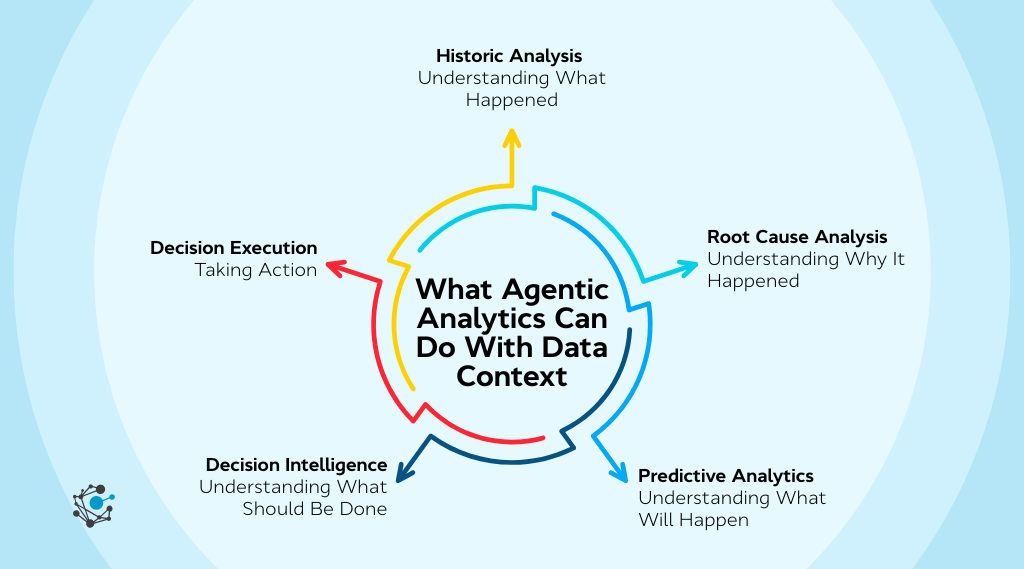
Historic analysis
With a full business and governance context, agents can answer complex, multi-step analytical questions that would normally require multiple dashboards or ad-hoc queries. Instead of returning raw tables or SQL logic, they explain what happened using approved business definitions.
Analytics becomes conversational, repeatable, and consistent across teams. Rather than recreating the same analysis in different tools, agents reuse shared context to deliver the same answer every time, grounded in how the business already measures performance.
Root cause analysis
Once historical patterns are understood, agents can go a step further and explain why changes occurred. Root cause analysis allows agents to trace metric movements back through lineage, relationships, and quality signals instead of relying on surface-level correlations.
Because agents understand approved definitions, joins, and dependencies, they can isolate contributing factors with precision.
For example, they can distinguish whether a revenue dip was driven by customer churn, pricing changes, delayed data, or upstream pipeline issues. This turns analytics from descriptive reporting into causal understanding, reducing guesswork and accelerating resolution.
Predictive analytics
When definitions are standardized and data quality is visible, agents can move confidently into prediction. They forecast trends, detect early signals, and surface anomalies without relying on inconsistent inputs or hidden assumptions.
The difference is explainability. Predictions are grounded in trusted data and clear logic, making them easier for teams to understand, challenge, and act on. This shifts forecasting from a black-box exercise to a shared, defensible capability.
Decision intelligence
Agentic analytics does not stop at insight. With context around business rules and constraints, agents can evaluate multiple scenarios and recommend next steps.
More importantly, they explain why a recommendation makes sense. Teams can see which data, rules, and assumptions were used, turning AI suggestions into informed starting points rather than opaque directives. Decision-making becomes faster without losing accountability.
Decision execution
The final step is action. Agents can trigger workflows, update downstream systems, and automate responses when conditions are met.
This closes the loop from insight to outcome. Analytics is no longer passive or delayed. It becomes proactive, operational, and embedded directly into business processes, while still respecting approvals, permissions, and audit requirements.
|
A concrete enterprise example Consider a global sales organization tracking quarterly revenue performance. An agent detects a shortfall against the forecast and traces the root cause to delayed contract renewals in one region, combined with known CRM data latency. Using approved definitions and lineage, it confirms the issue is operational, not demand-related. The agent then predicts continued impact if delays persist, evaluates policy constraints, and recommends targeted follow-ups for specific accounts. With approval, it triggers renewal workflows and alerts regional leaders. What once took days of manual analysis, reconciliation, and coordination happens in hours, with full transparency and control. Together, these capabilities transform analytics from something teams consult after the fact into something that actively supports how decisions are made and executed across the enterprise. |
Why this makes analytics trusted, high-quality, and human-usable
Enterprise agentic analytics works because it flips the traditional analytics model on its head. Instead of adding governance after insights are produced, it puts governance and context first, and lets agents operate within those boundaries.
That shift changes how analytics behaves across the organization. Humans stay firmly in control through definitions, policies, approvals, and oversight. AI agents work inside those rules, not around them.
As a result:
-
Answers are trusted because they are grounded in approved definitions, known data quality, and visible lineage
-
Insights are consistent because agents reuse shared context instead of recreating logic per request
-
Predictions are explainable because assumptions, inputs, and constraints are explicit
-
Actions are safe because permissions, approvals, and audit trails are enforced by design
This is what makes analytics usable by real teams, not just data specialists. Leaders can ask questions without worrying about conflicting numbers. Analysts spend less time reconciling reports and more time improving outcomes. Operational teams can rely on automated actions without fear of hidden risk.
AI does not replace human judgment in this model. It amplifies it by reducing friction, shortening decision cycles, and scaling consistent reasoning across the enterprise.
Platforms like OvalEdge support this approach by providing the governed enterprise data context that analytics agents rely on, not by acting as the agents themselves. OvalEdge aligns data cataloging, definitions, quality, lineage, and access controls into a shared foundation that both humans and AI systems can trust.
When analytics agents operate on this governed context, they reason and act using approved business logic instead of inferred assumptions. As a result, analytics moves from experimentation to something enterprises can confidently depend on, without compromising control, explainability, or accountability
If you want to understand how a governed enterprise data context enables safe, explainable analytics agents, booking a demo with OvalEdge can show how this foundation works without disrupting existing tools or teams.
Conclusion
Agentic analytics only works when AI agents operate inside a shared, governed understanding of the business. Without that foundation, automation moves faster, but decisions become harder to defend. With it, analytics turns into something leaders can confidently act on.
When teams engage with OvalEdge, the conversation usually starts by mapping the current data landscape, identifying gaps in context and governance, and showing how a unified data intelligence layer can support analytics agents without disrupting existing tools.
From there, it becomes clear how trusted context enables analysis, prediction, and action in ways leaders are comfortable standing behind.
If you want to see what this looks like in practice, schedule a call with OvalEdge and explore how governed data context enables agentic analytics that teams actually trust.
FAQs
1. How is enterprise agentic analytics different from traditional BI tools?
Enterprise agentic analytics focuses on autonomous reasoning and action, not static reporting. It enables AI agents to monitor data continuously, apply enterprise rules, and act on insights, whereas traditional BI primarily supports retrospective analysis and manual interpretation.
2. Do you need to replace your existing analytics stack to adopt agentic analytics?
No. Most organizations layer agentic analytics on top of existing BI, data warehouses, and operational tools. The key requirement is a unified data context that agents can use, not replacing systems already in place.
3. What roles are needed to support agentic analytics in an enterprise?
Agentic analytics requires collaboration between data governance teams, analytics leaders, and business stakeholders. Clear ownership of definitions, quality standards, and access policies is more critical than adding new AI-specific roles.
4. How long does it take to become ready for enterprise agentic analytics?
Readiness depends on the maturity of data governance and context. Organizations with established definitions, lineage, and access controls can move faster, while others may need phased improvements before safely enabling autonomous analytics capabilities.
5. Can agentic analytics work in regulated industries?
Yes, but only when governance is embedded by design. Role-based access, audit trails, approvals, and traceability are essential to ensure analytics agents comply with regulatory, security, and compliance requirements across industries like finance and healthcare.
6. What should enterprises evaluate before scheduling an agentic analytics demo?
Teams should assess whether their data definitions are consistent, lineage is visible, quality issues are known, and access controls are enforced. These factors determine whether agentic analytics will deliver trustworthy outcomes or create additional risk.
.png?width=1081&height=173&name=Forrester%201%20(1).png)
.png?width=1081&height=241&name=KC%20-%20Logo%201%20(1).png)