.png)
Business intelligence has long been the foundation of decision-making, with organizations investing heavily in dashboards and reporting systems to track performance.
Yet a familiar problem persists. Three years of BI investment, a stack of dashboards, and still, when leadership asks why a key metric dropped, the answer takes days or weeks to produce, if it arrives with confidence at all.
The tools are not broken. They are just built to report on what already happened, not respond to what is happening now.
According to McKinsey’s Master Data Management Survey 2024, 82% of organizations spend at least one day every week fixing data quality issues, which further delays the ability to act when it matters most.
Agentic analytics is built differently. Instead of waiting for an analyst to pull reports or validate numbers, AI agents continuously monitor data, detect meaningful changes, and either surface answers instantly or act on them automatically, all within governance rules defined by the organization.
It is the difference between looking at a dashboard and having a system that actively works in the background to support decisions. This comparison breaks down how agentic analytics and traditional BI differ in practice, across speed, accuracy, operational effort, and governance. It also outlines where traditional BI still fits, what needs to be in place before introducing autonomy, and how organizations are making the shift without losing the structure they have already built.
What is traditional business intelligence (BI)?
Traditional Business Intelligence (BI) refers to the systems, tools, and processes used to collect, store, and analyze historical data for reporting and decision support. It has long been the foundation of enterprise analytics, enabling teams to track performance through dashboards and structured reports.
Key features of traditional BI
Traditional BI typically relies on:
-
Centralized data warehouses: Structured, cleaned datasets stored for consistent reporting
-
Manual data preparation and reporting: Analysts or IT teams extract, transform, and prepare data
-
Human-driven interpretation: Business users explore dashboards to identify trends and insights
Challenges with traditional BI
While reliable, traditional BI introduces constraints that limit its effectiveness in fast-moving environments:
-
Low adoption despite high investment: Studies consistently show fewer than one in five employees regularly use BI dashboards, even when organizations invest heavily in them
-
Slow decision cycles: Insights depend on periodic reporting cycles, delaying action
-
Operational bottlenecks: Heavy reliance on analysts creates delays in answering business questions
-
Limited adaptability: Dashboards require manual updates when priorities or data sources change
In practice, BI scales infrastructure and reporting, but not decision velocity. This gap becomes more visible as organizations push for faster, data-driven responses.
What is agentic analytics?
Agentic analytics uses autonomous AI agents to continuously monitor data, detect patterns, and act on insights without waiting for a human to query a dashboard or run a report. Unlike traditional BI, which answers questions users already know to ask, agentic systems surface answers to questions the business has not yet formulated and execute responses within governance-defined boundaries.
For a more detailed look at how these systems are architected and deployed, our overview of agentic analytics covers the full framework.
Defining agentic analytics and its role in business
At its core, agentic analytics enables organizations to:
-
Process large volumes of data in real time: Continuously ingest and analyze data across systems
-
Uncover insights proactively: Detect changes, anomalies, and emerging trends without prompts.
-
Recommend and trigger actions: Align outputs with business goals and predefined rules.
This shifts organizations from reactive reporting to continuous, intelligence-driven operations.
Key features of agentic analytics
-
AI-driven predictive insights: Anticipate risks and opportunities before they impact performance
-
Real-time recommendations: Deliver decisions based on current conditions, not historical snapshots
-
Continuous learning: Improve accuracy as new data flows into the system
-
Iterative reasoning and context awareness: Retain context across interactions and follow-up queries, build on previous insights rather than starting from scratch
-
Governed autonomy: Operate within defined policies and control what data agents can access, what actions they can take, and when human review is required
How agentic analytics works: AI agents at play
AI agents operate as continuous, autonomous systems that manage the full lifecycle of data-driven decision-making.
-
Data ingestion and integration: Collect data from multiple sources, including databases, APIs, and streaming systems
-
Data preparation and analysis: Clean, normalize, and analyze data without manual intervention
-
Continuous monitoring: Track metrics in real time and detect anomalies or deviations
-
Decision support and action: Recommend next steps, such as optimizing inventory, flagging risks, or adjusting campaigns
This represents a shift from static dashboards to systems that continuously observe, learn, and respond. Instead of waiting for reports, teams are supported by systems that surface insights and act as conditions change, enabling faster and more confident decision-making.
For a full breakdown of what agentic analytics delivers in practice, see our analysis of the benefits of agentic analytics across enterprise functions.
The difference between the two approaches comes down to autonomy, speed, and what happens when conditions change. Here's how they compare across the dimensions that matter most for enterprise decision-making.
Comparison of agentic analytics vs. traditional business intelligence
Traditional BI and Agentic Analytics serve the same goal: helping businesses make better decisions, but they operate in fundamentally different ways. Traditional BI depends on human-led analysis, while agentic analytics uses autonomous AI agents to analyze data and act in real time.
|
Criteria |
Traditional Business Intelligence (BI) |
Agentic Analytics |
|
Autonomy |
Human analysts gather data, interpret dashboards, and generate reports. |
AI agents autonomously analyze data, detect patterns, and recommend actions without human intervention. |
|
Speed |
Insights arrive through periodic reporting cycles (daily, weekly, or monthly). |
Real-time insights and recommendations are delivered instantly as data flows in. |
|
Adaptability |
Dashboards and models require manual updates when priorities or data sources change. |
Continuously learns from new data and adapts insights automatically. |
|
Scalability |
Scaling requires additional infrastructure, licenses, and skilled analysts. |
Highly scalable; AI agents handle large data volumes without increasing manpower. |
|
Insights Quality |
Limited by human bandwidth and interpretation. |
AI uncovers deeper patterns and anomalies that humans may miss. |
|
Decision-Making Style |
Reactive, focused on historical performance. |
Proactive, focused on predicting outcomes and recommending next actions. |
|
Operational Overhead |
High due to manual reporting, data preparation, and dashboard maintenance. |
Low due to automated data processing and insight generation. |
|
Evolution Speed |
Slow to adjust to new business needs. |
Rapid, self-improving systems that evolve continuously. |
|
Governance & Auditability |
Governance is manual; audit trails depend on the BI platform and processes. |
An embedded governance layer where every automated decision is logged, traceable, and policy-driven. |
In short: Traditional BI tells you what happened. Agentic Analytics tells you what to do next.
What is decision intelligence, and where does it fit
Decision intelligence sits between traditional BI and agentic analytics. It combines data, analytics, and business context to guide decisions, not just generate insights.
At its core, decision intelligence connects three layers:
-
Data (from BI systems): Historical reporting, structured metrics, and dashboards
-
Analytics (predictive and diagnostic models): Explains why something happened and what might happen next
-
Decision logic (rules, context, and outcomes): Recommends actions based on business goals and constraints
Traditional BI focuses on visibility. Agentic analytics focuses on autonomy. Decision intelligence bridges the two by structuring how decisions should be made, even before full automation is introduced.
How decision intelligence builds on BI and agentic analytics
-
From BI
-
Uses governed, reliable data as the foundation
-
Retains reporting and compliance structures
-
From agentic analytics
-
Introduces real-time analysis and proactive recommendations
-
Moves toward automated execution
-
What it adds
-
Decision frameworks that define what actions are appropriate
-
Context-aware logic that aligns outputs with business priorities
Why decision intelligence matters during the transition
Most organizations are not ready to move directly from dashboards to fully autonomous systems. Decision intelligence provides a middle layer where:
-
Teams can validate recommendations before automating actions
-
Governance rules can be defined and tested.
-
Business users gain trust in AI-driven outputs.
It allows organizations to evolve from reporting to action in a controlled way, without losing visibility, accountability, or control over how decisions are made.
What to consider before switching to agentic analytics
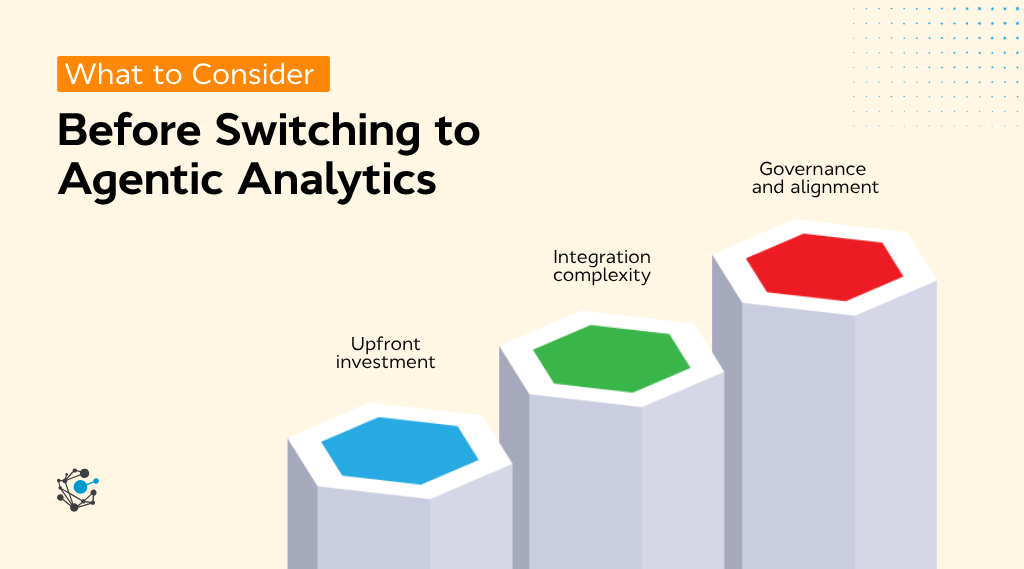
Agentic analytics introduces clear advantages in speed and autonomy, but adopting it requires more than just deploying AI models. Organizations need to evaluate three critical areas before making the shift.
Upfront investment
Moving to agentic analytics involves more than tool licensing. The investment typically includes implementation, model development or fine-tuning, and integration with existing data systems.
The most underestimated cost is often governance infrastructure, defining policies, access controls, and audit mechanisms to ensure AI-driven decisions remain compliant and traceable. Without this layer, the system may function technically but fail operationally.
Integration complexity
Integration depends heavily on the maturity of the existing data environment. Modern cloud-based data stacks with centralized pipelines and APIs tend to integrate more smoothly with agentic systems.
In contrast, legacy ERP systems, siloed databases, and fragmented architectures create friction, requiring additional transformation layers and orchestration efforts before AI agents can operate effectively.
Governance and alignment
Agentic systems act autonomously, which makes governance a foundational requirement, not an afterthought. Organizations need to define what data agents can access, what actions they are allowed to take, and when human intervention is required.
Without clear policies and auditability, teams risk deploying systems that generate decisions they cannot fully explain, trace, or trust. Strong governance ensures autonomy operates within controlled, business-aligned boundaries.
Bottom line: The shift to agentic analytics is not just a technology upgrade. It is an operational change that requires the right data foundation, integration readiness, and governance structure to succeed.
Applications of agentic analytics in enterprise use
Enterprises are under pressure to reduce the gap between insight and action. Agentic analytics addresses this by enabling systems that continuously monitor data, detect changes, and recommend or trigger actions in real time.
Unlike traditional analytics, which depends on periodic reporting, agentic systems operate continuously in the background, supporting decisions as conditions evolve.
How enterprises apply agentic analytics across industries
Agentic analytics is already being applied across industries to move from reactive reporting to continuous, decision-driven operations. Organizations are using it to monitor signals in real time, detect changes early, and act before business impact escalates.
1. Retail: Real-time inventory and demand optimization
Agentic systems track sales velocity, seasonal demand, and supply chain signals continuously.
-
Detect demand spikes and slow-moving inventory early.
-
Recommend replenishment or redistribution.
-
Adjust pricing dynamically.
Organizations applying this approach have seen reductions in stockouts and excess inventory by shifting from weekly planning cycles to continuous optimization.
2. Finance: Automated risk management and fraud detection
AI agents monitor transactions and financial signals in real time.
-
Identify anomalies as they occur.
-
Score risk dynamically.
-
Trigger alerts or recommended actions.
This enables teams to act before exposure increases, reducing fraud impact and improving response times.
3. Healthcare: Patient risk alerts and care optimization
Healthcare providers use agentic analytics to support proactive care.
-
Monitor patient vitals and clinical data streams.
-
Detect early warning signs.
-
Recommend next-best actions.
This improves intervention timing and helps prevent critical events before escalation.
In environments where agent access to patient or customer data must be tightly controlled, sensitive data discovery becomes a prerequisite for safe and compliant deployment.
4. SaaS and customer success: Churn prediction and revenue insights
Agentic systems analyze customer behavior across usage, engagement, and support interactions.
-
Identify churn signals early.
-
Recommend retention strategies.
-
Surface expansion opportunities.
Teams move from reactive churn analysis to proactive revenue protection.
5. Life sciences and pharma: Field force performance and territory optimization
In pharma and life sciences, field force performance is tightly linked to revenue outcomes and regulatory compliance. Agentic analytics enables continuous visibility into rep activity and territory coverage.
-
Monitor call activity, engagement frequency, and territory alignment in real time.
-
Detect underperformance against targets before reporting cycles close.
-
Surface alerts to managers with recommended corrective actions.
Instead of reviewing static dashboards after the quarter ends, leaders can intervene mid-cycle. Governance plays a critical role here, ensuring that sensitive healthcare data is handled with full auditability and compliance, while every recommendation and action remains traceable.
|
Bedrock data transformation initiative
A global enterprise working with OvalEdge (Bedrock initiative) used agentic-driven data management to streamline reporting and improve data usability.
This shifted teams away from manual reporting cycles toward faster, insight-driven decision-making.
Consulting firm analytics modernization
A consulting firm implemented agentic analytics to improve how internal and client-facing insights were generated.
The result was faster delivery of insights and improved client outcomes. |
The future of autonomous analytics in enterprises
As data volumes grow and decision windows shrink, enterprises can no longer rely solely on human-driven workflows. Agentic analytics is becoming a foundational layer of decision intelligence, supporting:
-
Automated business operations
-
Predictive planning
-
Self-correcting systems that improve continuously
Over time, autonomous analytics will shift from a competitive advantage to a baseline expectation, shaping how decisions are made across every function.
Agentic analytics and the evolution of self-service BI
Self-service BI was created to empower non-technical users—giving business teams the ability to explore data, build dashboards, and generate insights without relying entirely on analysts. It democratized access to reporting, but it still required users to know what questions to ask and manually interpret results.
How self-service BI is empowering non-technical users
Traditional self-service BI helps teams:
-
Access dashboards without waiting for IT
-
Pull reports independently
-
Visualize KPIs in a user-friendly interface.
But while these tools reduce dependency on data teams, they don’t remove the manual effort of exploring data, identifying patterns, or determining the right actions. Users still need analytical skills, time, and context to make decisions.
How agentic analytics enhances self-service BI
Agentic analytics takes self-service to the next level by shifting from user-driven insights to AI-driven intelligence. Instead of users searching for answers, AI agents proactively deliver them.
Agentic systems:
-
Analyze data continuously in the background
-
Detect patterns, anomalies, and opportunities automatically.
-
Deliver personalized recommendations directly to the business users
-
Remove the guesswork from interpreting dashboards.
For busy teams, this means insights arrive before the problem—or opportunity—fully appears.
Moving from traditional BI to autonomous systems
Transitioning from traditional BI to agentic analytics requires a mindset shift. Businesses must move from a world where analysts manually build dashboards to an environment where AI agents handle analysis, and users focus solely on decisions.
Key transition challenges include:
-
integrating autonomous systems with existing BI stacks
-
ensuring data quality for AI-driven workflows
-
aligning AI decision logic with team KPIs and governance guidelines
Key benefits include:
-
faster decisions
-
reduced reporting overhead
-
higher accuracy and adaptability
-
insights delivered directly to the people who need them
With the right planning, companies can evolve from static reporting to truly intelligent, self-adjusting analytics environments.
Top agentic analytics platforms
Once a governed data foundation is established, platforms can layer agentic capabilities on top, enabling real-time insights, automation, and decision support.
Below is an overview of leading platforms in the agentic analytics landscape:
1. OvalEdge
OvalEdge combines data governance, data management, and agentic analytics into a unified platform. It focuses on ensuring that AI-driven insights are built on trusted, well-defined data.
Key Features:
-
AI-powered data cataloging: Automatically classifies and organizes enterprise data
-
Automated data lineage tracking: Provides full visibility into data flow and transformations
-
Embedded governance layer: Ensures policies, access controls, and auditability are enforced
-
Autonomous decision support: Enables real-time recommendations based on governed data.
-
Seamless integration with enterprise systems: Connects with BI tools, data warehouses, and analytics platforms
2. GoodData
GoodData offers AI-powered analytics with embedded agentic capabilities focused on real-time insights and contextual recommendations.
Key Features:
-
Autonomous insight generation
-
Continuous learning models
-
Embedded analytics for product teams
-
Real-time KPI monitoring and anomaly detection
3. Domo
Domo integrates AI and automation into its analytics ecosystem, enabling workflow activation and operational decision support.
Key Features:
-
AI-driven data storytelling
-
Automated anomaly detection
-
Agent-led operational recommendations
-
Strong integrations across enterprise data pipelines
4. Scoop Analytics
Scoop Analytics provides an AI-driven analytics layer designed to function as a virtual data analyst.
Key Features:
-
Autonomous insight summaries
-
Natural language explanations
-
Auto-generated analysis narratives
-
Proactive pattern and trend detection
Key takeaway: Agentic analytics platforms are only as effective as the data foundation beneath them. Governance is not an added feature; it is the prerequisite that determines whether autonomous systems produce reliable decisions or amplify existing inconsistencies.
How to choose the right tool for your business
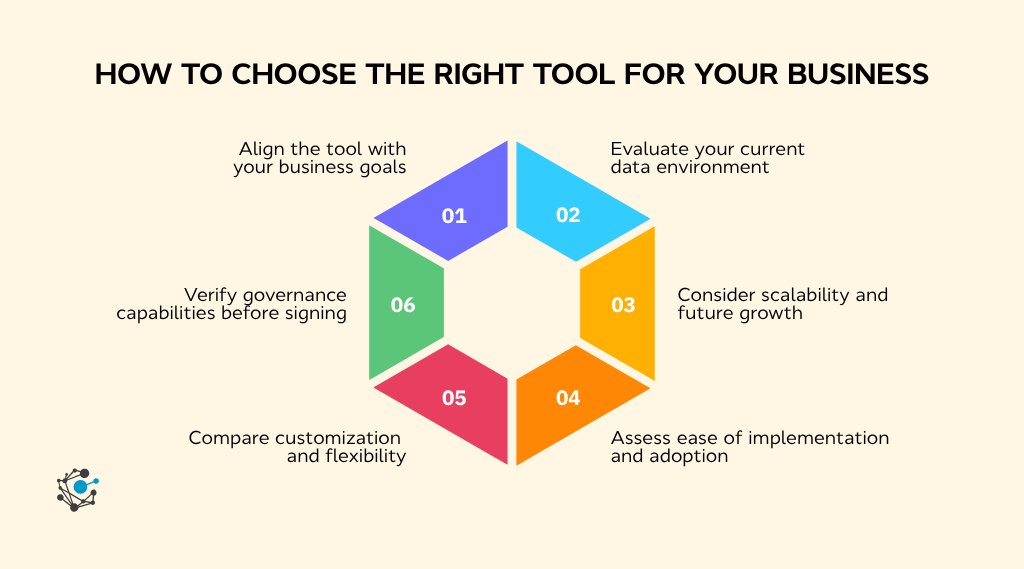
Before selecting an agentic analytics platform, companies should evaluate their BI maturity, data environment, and decision workflows. The goal is not just to adopt AI, but to ensure it delivers reliable, actionable outcomes.
1. Align the tool with your business goals
Start by defining what you want to improve: faster decisions, reduced manual reporting, or proactive insights.
If your priority is always-on KPI monitoring and anomaly detection, your requirements become more specific:
-
Continuous data ingestion and monitoring
-
Configurable alert thresholds
-
Proactive notifications when metrics deviate
-
Clear audit trails showing what triggered each alert and what action followed
Without these, real-time analytics remains reactive rather than operational.
Actionable tips:
-
Identify your top three analytics challenges
-
Map each challenge to a measurable outcome
-
Prioritize tools that impact revenue, efficiency, or speed
2. Evaluate your current data environment
Agentic analytics depends on a strong data foundation. If your data is fragmented, inconsistent, or poorly documented, AI-driven outputs will reflect those issues.
Actionable tips:
-
Audit where your data resides (warehouses, CRM, ERP, spreadsheets)
-
Check whether lineage, metadata, and access policies are defined
-
Ensure seamless integration with your existing data stack
3. Consider scalability and future growth
Your analytics needs will evolve. The platform you choose should scale without increasing operational complexity.
Actionable tips:
-
Evaluate performance at higher data volumes
-
Look for modular architectures
-
Review pricing models for long-term sustainability
4. Assess ease of implementation and adoption
Even advanced systems fail if teams cannot use them effectively, which is why many organizations invest in AI-powered self-service analytics platforms to improve accessibility and adoption.
Actionable tips:
-
Test usability through pilots or sandbox environments
-
Evaluate accessibility for non-technical users
-
Confirm the availability of onboarding and support
5. Compare customization and flexibility
Every organization has unique workflows and decision logic, and platforms that support AI-driven conversational analytics enable users to interact with data more naturally while aligning with business context.
Actionable tips:
-
Verify whether agent behavior and thresholds can be customized
-
Ensure alignment with internal KPIs and definitions
-
Check compatibility with existing processes
6. Verify governance capabilities before signing
Governance determines whether agentic analytics can be trusted at scale. This is often overlooked during evaluation, but it directly impacts adoption, compliance, and long-term reliability.
Key questions to ask:
-
Can every automated decision be audited and traced back to its source data?
-
Does the platform support end-to-end data lineage across systems?
-
How are agent access policies defined and enforced?
-
What does the audit trail look like for compliance and regulatory needs?
Without clear answers to these, organizations risk deploying systems that generate insights and actions they cannot fully explain or validate.
Key takeaway: Choosing an agentic analytics platform is not just about features. It is about ensuring the system can operate continuously, scale with your business, and remain governed, transparent, and aligned with how decisions are made.
Conclusion
Traditional BI remains valuable for structured reporting and compliance-driven workflows, but its manual processes and static dashboards limit its speed. Agentic Analytics goes further by using AI agents to deliver continuous, proactive recommendations, helping teams act in real time rather than waiting for periodic reports.
If your business prioritises human oversight and predictable reporting cycles, Traditional BI is still a fit. But if you need faster decisions, adaptability, and scalable intelligence, Agentic Analytics is the more future-ready option. And before adopting any autonomous analytics system, ensure your data foundation is strong.
A governance platform like OvalEdge helps you maintain trusted, well-managed data, critical for accurate AI-driven insights.
Ready to modernise your analytics stack or strengthen the data foundation needed for agentic intelligence?

Book a call with our team to explore the right path for your organisation.
.png?width=1081&height=173&name=Forrester%201%20(1).png)
.png?width=1081&height=241&name=KC%20-%20Logo%201%20(1).png)