Most analytics teams have the dashboards, the data warehouse, and the scheduled reports. The problem is timing. By the time someone pulls an insight and acts on it, the damage is already done.
Agentic analytics tools work differently. Instead of waiting for someone to ask the right question, they monitor your data, spot problems early, and recommend what to do next. Some go further and take action on their own.
That creates a new question: how do you keep an autonomous tool from doing something it shouldn't? We compared 9 platforms on AI depth, governance, and integration to find out.
What makes a tool "agentic" and not just AI-powered BI?
Most BI tools now ship with some form of AI built in, but that is not what this means. They'll auto-generate a chart, suggest a filter, or answer a natural language question about your data. That's useful, but it's not agentic.
An agentic analytics tool autonomously monitors enterprise data, reasons through anomalies, and takes governed action without waiting for a human query. It doesn't wait for instructions. It monitors your data on its own, identifies when something looks off, investigates the cause, and either recommends a next step or takes action directly.
The difference is autonomy. A BI tool with AI answers your questions faster. An agentic tool asks its own questions and follows up on them.
In practice, that means four things are happening in a loop:
-
Monitoring: The tool is continuously scanning connected data sources, not waiting for a scheduled report or a manual query.
-
Reasoning: When it spots something, it interprets the context and decides what matters and what doesn't.
-
Acting: It responds, whether that's sending an alert, kicking off a workflow, or adjusting a forecast.
-
Learning: It tracks outcomes and adjusts its own logic over time.
If a tool only does the first two, it's smart BI. If it does all four, it's agentic.
Also read → AI agents for analytics: how they work and where they fit
What are the top 9 agentic analytics tools in 2026?
We evaluated nine tools that fall into three groups:
-
Agentic analytics on a governed foundation: askEdgi sits on a data governance and semantic layer built for this purpose, with the Enterprise Context Graph carrying business definitions, lineage, and access rules under every answer.
-
Agentic BI platforms: ThoughtSpot Spotter, Tableau Next, Tellius, and Oxy extend existing BI or lakehouse stacks with an agent layer on top.
-
Enterprise workflow automation with an analytics angle: Beam AI, Savant Labs, Microsoft 365 Copilot, and Aisera cover cross-department operations where analytics is one input among many.
The list runs from the strongest fit for governed enterprise environments to specialized picks for specific stacks and use cases.
Agentic analytics tools at a glance
|
Tool |
Autonomy |
Governance model |
Semantic layer |
Integrations |
Best-fit buyer |
|---|---|---|---|---|---|
|
askEdgi |
End-to-end with human-in-loop approvals |
Native, runs on the Enterprise Context Graph |
Business glossary in the graph, shared with agents |
150+ pre-built connectors |
Regulated enterprises where compliance has veto power |
|
Beam AI |
End-to-end for cross-department workflows |
Added layer, deployment-controlled |
Not a semantic-layer product |
Airtable, ServiceNow, Sage, Copper |
Ops and RevOps teams automating cross-department processes |
|
ThoughtSpot Spotter |
Multi-step, embedded in business apps |
Row-level security, granular permissions |
Semantic modeling with human-in-the-loop |
Slack, Salesforce, ServiceNow |
Search-first analytics teams with semantic-modeling capacity |
|
Tableau Next |
Agent actions via Agentforce |
Salesforce trust layer |
Tableau Semantics |
Salesforce Data Cloud native |
Salesforce-committed organizations |
|
Oxy |
Code-native workflow orchestration |
Open-source, self-hosted controls |
Semantic retrieval layer |
Snowflake, BigQuery, Databricks |
Engineering-led teams on modern lakehouse stacks |
|
Tellius |
Automated root-cause discovery |
Standard RBAC, not native to the semantic layer |
Unified semantic layer |
BI and prep tool integrations |
Analytics teams needing "why" not just "what" |
|
Savant Labs |
Workflow automation for mixed data |
Centralized audit, RBAC |
No-code, not semantic-first |
300+ bi-directional connectors |
Analyst teams handling structured and unstructured data |
|
Microsoft 365 Copilot |
Autonomous within Microsoft apps |
Microsoft Purview and 365 compliance |
Microsoft Graph as the connective layer |
Microsoft 365 apps, Copilot Studio |
Microsoft-standardized enterprises |
|
Aisera |
Multi-step, cross-domain |
TRAPS framework, enterprise controls |
Domain-specific LLMs, not a shared semantic layer |
Broad enterprise app coverage |
Cross-functional automation across IT, HR, finance, support |
1. askEdgi by OvalEdge
Disclosure: askEdgi is built by OvalEdge. We've evaluated it by the same criteria as every other tool on this list.
askEdgi is OvalEdge's agentic analytics interface. It does not query a standalone BI layer or a disconnected semantic model. It queries through the Enterprise Context Graph, a governed metadata layer that connects the data catalog, column-level lineage, sensitive data classification, access policies, and business glossary into a single graph.
That architecture means every answer askEdgi returns carries its own lineage, knows which fields are sensitive, and respects access controls already defined in the catalog. No sync gap between what the agent can see and what governance says it should see.
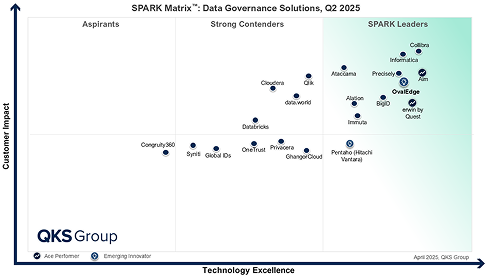
Analyst Recognition: OvalEdge was named a Niche Player in the 2025 Gartner Magic Quadrant for Data and Analytics Governance. Brands like Hallmark, Upwork, Gousto, and Naranja X run on the OvalEdge platform.
How it handles analytics autonomy
Users ask questions in plain English. askEdgi takes it from there:
-
Discovers relevant datasets across enterprise and public sources, even before ETL or warehouse setup is complete
-
Generates context-aware SQL or Python grounded in your catalog's metadata and business glossary, so answers align with how your organization defines its metrics
-
Returns results as interactive charts, tables, or narrative summaries with drill-down capability
-
Offers domain-specific "recipes" for finance, HR, supply chain, and compliance workflows that teams can customize and share
Teams evaluating it alongside Tableau Next or ThoughtSpot Spotter usually bring askEdgi in as the governed foundation those tools sit on. The agentic layer handles the querying; the catalog and context graph underneath handle the trust.
Also read →Agentic analytics use cases across finance, HR, and revenue-ops
How it handles governance
This is where askEdgi separates from every other tool on this list. Governance is the foundation, and not a feature added after the fact.
-
Access control, data lineage, and audit trails follow the query wherever the agent takes it
-
PII exposure is flagged before results are returned
-
Every output conforms to business glossary terms, so "customer" means the same thing across departments
-
The compliance team sees the full audit log for every query path
Most agentic platforms treat governance as a layer you add later. In finance, insurance, and manufacturing, that difference is the line between a useful insight and a compliance incident.
A Forrester Total Economic Impact study found that organizations using the OvalEdge platform achieved a 337% ROI over three years, with analyst productivity up 30% and sensitive data classification effort down 75%. Those numbers come from the same governed foundation that askEdgi runs on.
Where it fits and where it doesn't
Strongest for enterprise teams in regulated industries that already manage data through a catalog and need analytics to respect existing governance policies. Teams running a mature BI stack (Tableau, Power BI) typically pilot askEdgi as an agentic layer on top of what they have, not as a replacement. Pricing is enterprise-tier, not self-serve, so this is not the tool for a five-person startup.
Book a demo to run askEdgi against your own data and see what governed, traceable answers look like when the catalog, lineage, and agent share one context layer.
2. Beam AI
Beam AI is an enterprise agentic automation platform for building, deploying, and managing AI agents across end-to-end workflows. It is less BI-focused than other tools on this list and more oriented toward operational automation, where analytics is one input among many.
How it handles analytics autonomy
Beam's agents handle task execution across departments, not data exploration. They automate multi-step processes like invoice processing, ticket triaging, and record syncing. Key capabilities:
-
Pre-trained agents for healthcare, finance, and HR with domain-specific logic
-
AI Agent Hub for centralized management of agent tasks, memory, and performance
-
Native integrations with Airtable, ServiceNow, Asana, Sage, and Copper
-
Drag-and-drop templates and a reusable tools library for custom workflows
How it handles workflow automation
Beam's core value is orchestrating multi-step operational processes that span systems and departments. Agents connect to tools like ServiceNow, Airtable, and Sage, and execute end-to-end workflows (processing a claim, syncing CRM records, routing support tickets) without human intervention at each step. Pre-trained agents come loaded with industry-specific logic, so teams start from a working template rather than building from scratch.
Where it fits and where it doesn't
Suited for operations, RevOps, and shared-services teams automating cross-department processes. No verified user reviews on major software review sites, which makes third-party validation harder during procurement.
3. ThoughtSpot Spotter
ThoughtSpot Spotter is an agentic analytics platform built around natural-language search and semantic modeling. It acts as a virtual analyst embedded in tools like Slack, Salesforce, and ServiceNow, returning explainable, real-time answers across structured and unstructured data.
How it handles analytics autonomy
Spotter runs multi-step analysis chains, generates predictive forecasts, auto-corrects results, and suggests follow-ups based on what it finds:
-
Natural-language querying with multi-step reasoning across sources
-
Low-code embedding into ServiceNow, Salesforce, and custom platforms
-
Semantic modeling with human-in-the-loop feedback for improving accuracy
-
Transparent search logic so users can trace how the tool reached its answer
How it extends your BI stack
Spotter is designed to sit on top of an existing data warehouse or cloud BI setup, not replace it. The semantic model layer maps business terms to your underlying data, and the embedding framework lets teams access insights inside the SaaS tools they already work in. The value comes from making existing BI infrastructure conversational and self-serve rather than rebuilding it.
Where it fits and where it doesn't
Works well for organizations that want search as the primary analytics interface and can invest in semantic modeling upfront. G2 reviewers flag limited customization, and some metrics need external tools like dbt to function.
4. Tableau Next
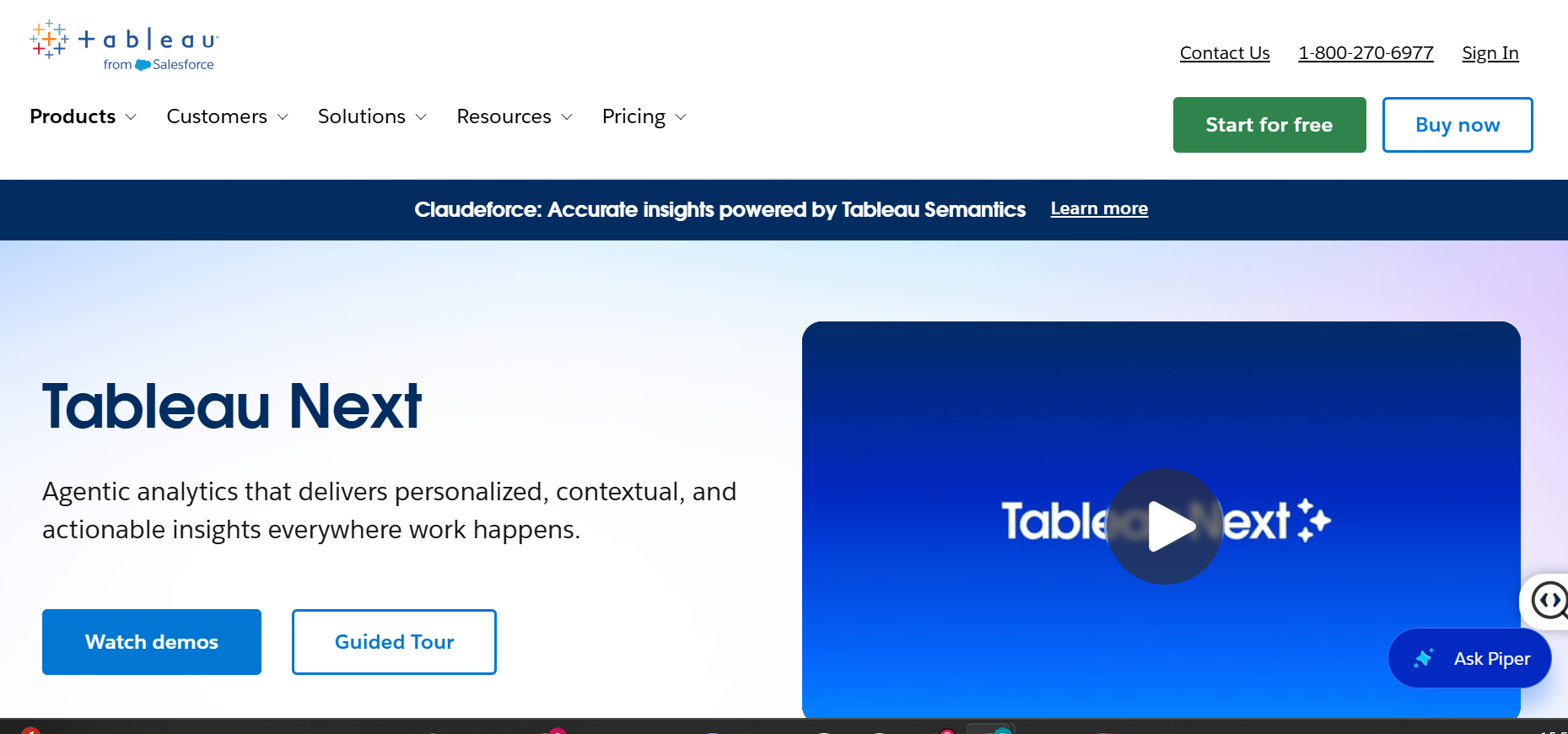
Tableau Next is Salesforce's agentic analytics platform, combining AI-powered insights, a unified data layer through Data Cloud, and workflow triggers via Agentforce. Purpose-built for teams already committed to the Salesforce stack.
How it handles analytics autonomy
Introduces always-on analytics agents through Agentforce that monitor dashboards, surface anomalies, and trigger workflows automatically:
-
Tableau Semantics adds trusted business logic to every query
-
Built-in actions let users trigger Salesforce workflows directly from insights
-
Open, API-first architecture supports embedding and modular builds
Users go from a data insight to a Salesforce action (updating a record, sending an alert, starting an approval) within one interface.
How it extends your BI stack
Tableau Next layers agentic capabilities on top of the existing Tableau visualization engine and Salesforce Data Cloud. The Tableau Semantics layer embeds business logic into queries so agent-generated insights follow the definitions your team has already set. For teams already running Tableau dashboards, this is an upgrade path rather than a migration. The insight-to-action loop through Agentforce is what separates it from a standard BI deployment.
Where it fits and where it doesn't
Built for Salesforce-native organizations. For teams on a different stack, value drops significantly. G2 reviewers flag high licensing cost, slow performance on large datasets, and a steep learning curve. Full agentic experience requires Data Cloud and Tableau Semantics configured, pushing time-to-value out by months.
5. Oxy
Oxy is an open-source, code-native agentic data intelligence platform built in Rust with Git-based version control. It lets teams ask, research, build, and automate analytics in natural language, and composes cleanly into modern data stacks without vendor lock-in.
How it handles analytics autonomy
Oxy goes deeper than question-and-answer. Its agents handle multi-step analytical workflows:
- Natural-language querying across enterprise data in plain English
- Deep research engine for causal analysis, hypothesis testing, and metric dependencies
- Workflow orchestration that automates recurring analytics and end-to-end reporting
- Semantic retrieval layer integrating with Snowflake, BigQuery, and Databricks
The open-source, composable architecture means teams can version-control their analytics logic the same way they version-control code.
How it extends your BI stack
Oxy is built to layer into engineering-led data stacks rather than sit beside them. The semantic retrieval layer plugs into Snowflake, BigQuery, and Databricks directly. The open-source, composable architecture means teams version-control their analytics logic the same way they version-control application code. There is no proprietary data layer to migrate into. For teams that treat their lakehouse as the single source of truth, Oxy extends it with agentic capabilities without adding a separate platform.
Where it fits and where it doesn't
Built for engineering-led data teams running lakehouse stacks who want AI-native analytics without commercial BI lock-in. Oxy launched in March 2025, so there are no verified reviews on any major review site yet. Procurement teams have to rely on GitHub and Discord for signal, and pricing beyond the open-source core is not publicly documented.
6. Tellius
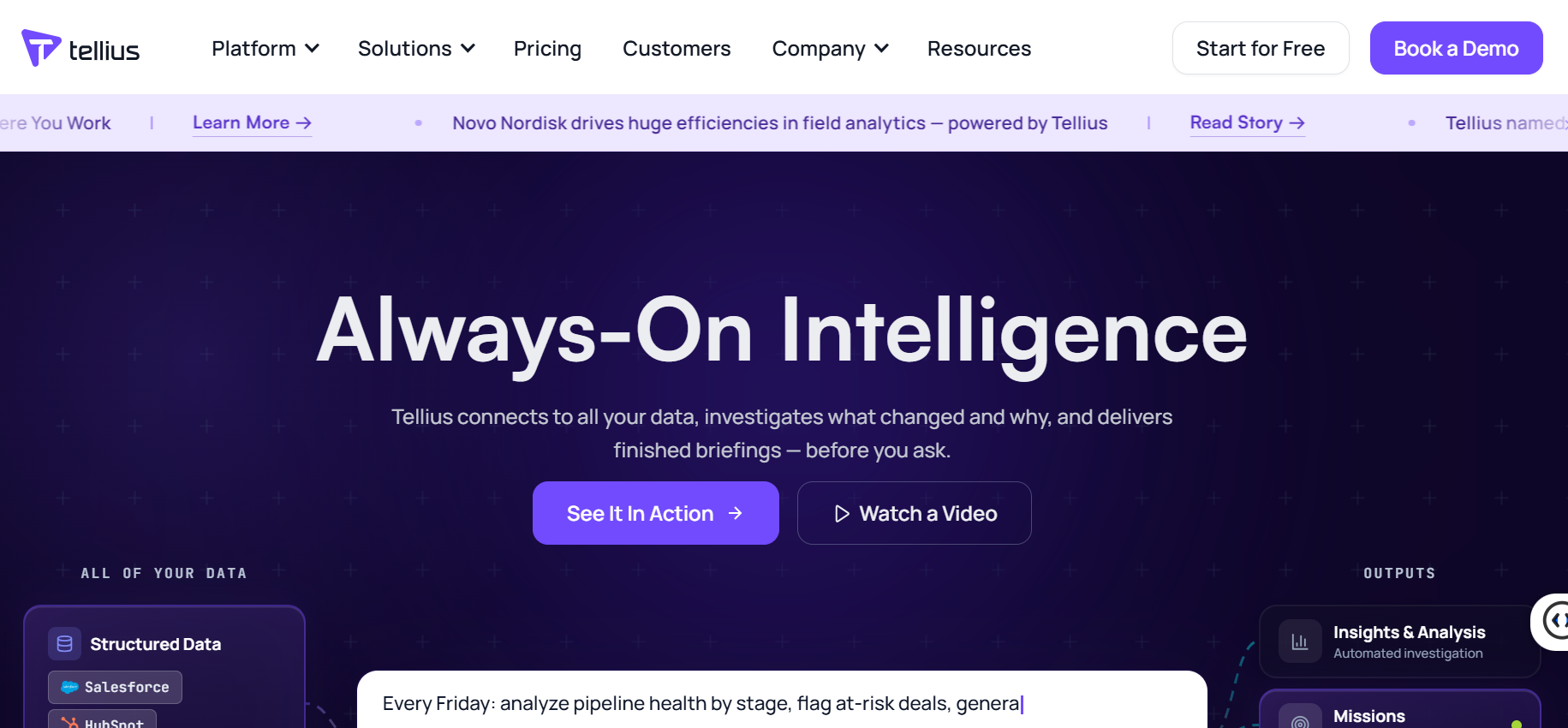
Tellius is an AI-powered analytics platform that combines natural-language querying with automated root-cause discovery. It is built for teams that need to understand not just what changed in a metric, but why.
How it handles analytics autonomy
Tellius stands out on diagnostic depth. Where most tools stop at answering a question, Tellius automatically investigates what drove the result:
-
Plain-English querying with instant answers across connected data
-
Automated identification of key drivers, trends, cohorts, and anomalies
-
GenAI-driven agents that convert insights into workflow actions without manual handoffs
-
Self-serve dashboards, narratives, and conversational queries in one workspace
The unified data and semantic layer integrates with existing prep and BI tools, so teams do not need to rebuild their stack to use it.
How it extends your BI stack
Tellius connects to existing data prep and BI tools through a unified semantic layer, so teams do not need to rebuild their stack to add agentic capabilities. The root-cause engine runs on top of whatever data infrastructure is already in place. Where a standard BI tool shows that revenue dropped 12%, Tellius surfaces why: which segment, which region, which driver. That diagnostic layer is the extension, not a replacement.
Where it fits and where it doesn't
Strongest for analytics and revenue-ops teams that need root-cause explanations of metric shifts, not just descriptive dashboards. G2 reviewers flag two recurring issues: performance lag and cost. One reviewer noted the query interface can be difficult for non-technical users, and setup becomes slower without a clean semantic layer already in place.
7. Savant Labs
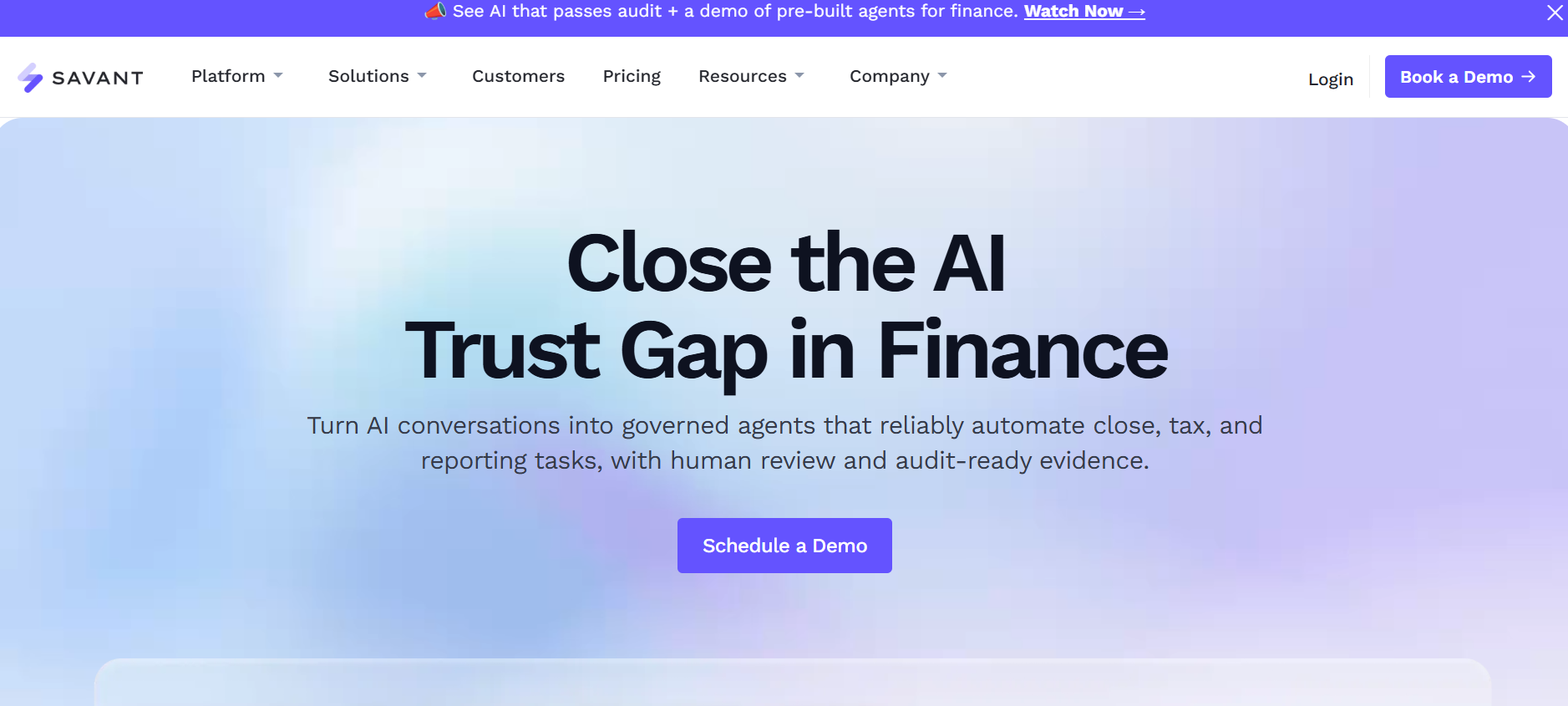
Savant Labs is a cloud-native, no-code analytics automation platform that uses AI agents to process both structured and unstructured data. It is built for analyst teams that want to automate workflows without waiting on engineering.
How it handles analytics autonomy
Savant's agents handle the full pipeline from raw data to structured output, including formats most analytics tools ignore:
- AI agents that read, transform, and analyze spreadsheets, contracts, and invoices
- No-code visual workflow builder for deploying governed analytics in minutes
- 300+ bidirectional connectors across cloud-native infrastructure
- Consumption-based pricing with no per-seat costs, keeping TCO predictable as teams scale
How it handles workflow automation
Savant focuses on automating the analyst's day-to-day pipeline: ingesting mixed-format data, transforming it, running analysis, and delivering structured output. The no-code builder lets analysts design and deploy these workflows without engineering support. Centralized auditing and versioning track every workflow change, so teams can trace what ran, when, and who modified it. The 300+ connectors mean most enterprise data sources plug in without custom integration work.
Where it fits and where it doesn't
Best for analyst-led teams handling a mix of structured and unstructured data who want end-to-end workflow automation without IT dependency or per-seat licensing. G2 reviewers flag a steeper learning curve than demos suggest and friction when linking tools or updating data. Documentation is still catching up, so it is worth piloting one workflow before going wider.
8. Microsoft 365 Copilot / Copilot Studio
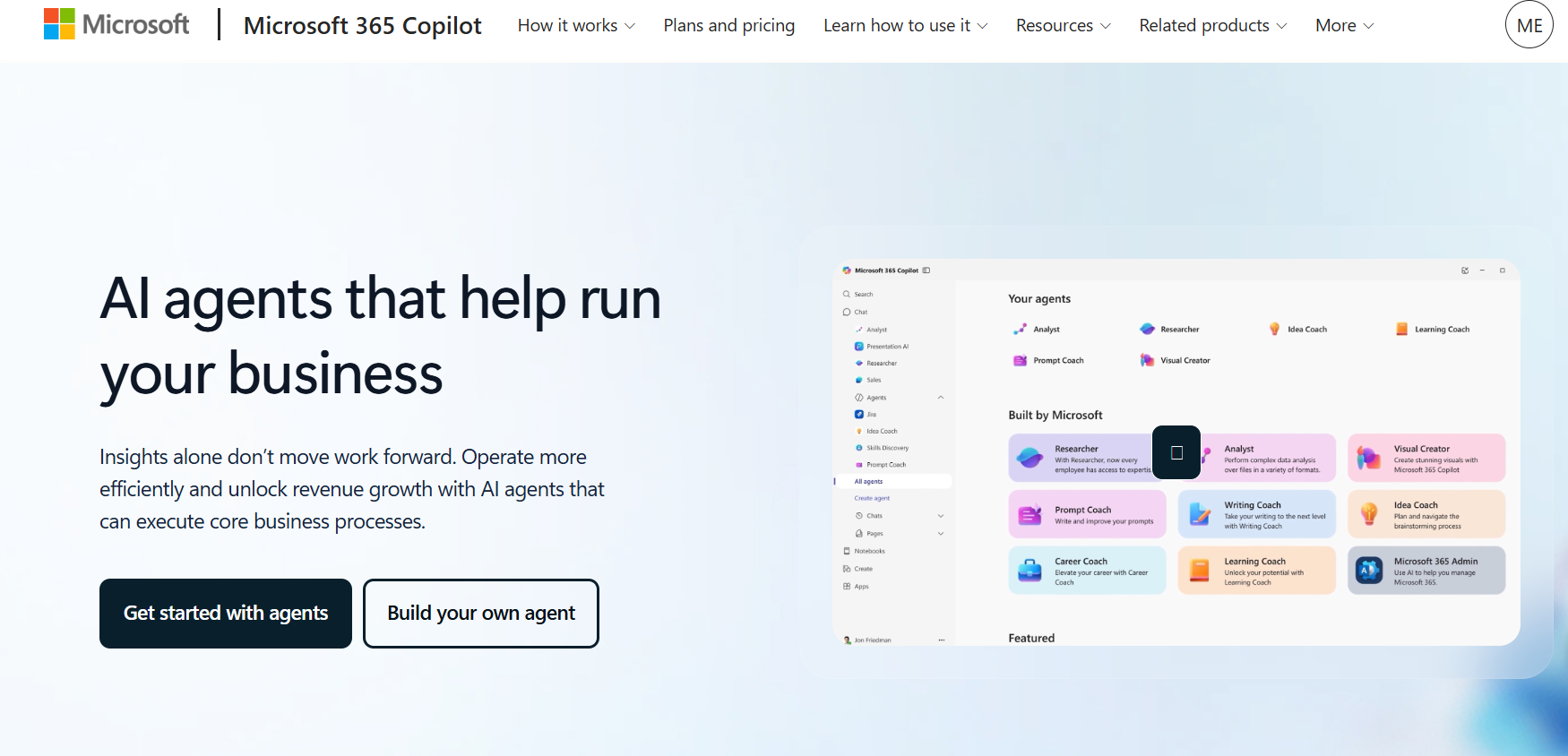
Microsoft 365 Copilot is an AI copilot embedded across Word, Excel, Outlook, and Teams, with Copilot Studio for building custom agents. It is the fastest path to agentic analytics for organizations already standardized on Microsoft.
How it handles analytics autonomy
Copilot works inside the apps employees already use rather than pulling them into a separate BI platform:
-
AI agents that autonomously process emails, analyze Excel data, and trigger workflows across M365
-
Copilot Studio for building custom agents against Microsoft Graph
-
In-context querying within Word, Excel, Outlook, and Teams without switching tools
The strength is reach. Every employee with a license has an AI assistant in their daily workflow, which lowers adoption friction significantly.
How it handles workflow automation
Copilot Studio is the automation layer. Teams build custom agents that connect to Microsoft Graph and automate cross-app workflows: pulling data from Excel into a Teams summary, routing an Outlook thread into an approval workflow, generating reports from SharePoint data. The agents run inside the M365 environment, so security and compliance inherit from the organization's existing configuration rather than requiring a separate governance setup.
Where it fits and where it doesn't
Built for Microsoft-first enterprises that want agentic analytics inside productivity tools, not a separate platform. On G2, reviewers flag ecosystem lock-in as the top concern: it works cleanly inside M365, less so outside. Advanced customization sits behind higher-tier plans, and hard quotas on agent messages can disrupt production workflows.
9. Aisera
Aisera is an enterprise agentic AI platform that automates workflows, resolves requests, and orchestrates multi-step processes across IT, HR, finance, and other business domains. It is the broadest cross-domain platform on this list.
How it handles analytics autonomy
Aisera's agents are designed for cross-functional task orchestration rather than data analysis. They plan workflows, adapt over time, and operate across multiple channels:
-
Domain-specific LLMs for IT, HR, finance, and procurement with pre-loaded logic
-
Hyperflows and pre-built workflows for rapid, low-code deployment
-
Multi-channel conversational AI across text, voice, images, and documents
-
Agents that learn from outcomes and adjust their own decision logic over time
How it handles workflow automation
Aisera's scale comes from covering multiple departments under one platform. Instead of separate automation tools for IT ticketing, HR requests, and finance approvals, Aisera handles all three with domain-specific agents that share the same orchestration layer. The TRAPS governance framework manages agent permissions and data access boundaries across all domains. Multi-channel support (text, voice, documents, images) means the agents meet users wherever the request originates.
Where it fits and where it doesn't
Best for large enterprises automating across IT, HR, finance, and support who want one agentic platform instead of separate tools per function. On G2, reviewers describe it as powerful but effort-heavy to set up. Tuning AI responses needs hands-on guidance, analytics feel limited in filtering and export, and opaque pricing slows procurement in mid-market deals.
What to evaluate when choosing agentic analytics tools?
The comparison table covers what each tool does. This section covers how to decide between them.
|
Evaluation criteria |
What to evaluate |
Green flag (Look for) |
Red flag (Avoid) |
|
AI autonomy |
How much does the tool act independently? |
Monitors data, detects issues, suggests or takes action, and handles follow-up questions without restarting. |
Answers one prompt at a time and behaves like a chatbot instead of an agent. |
|
Governance depth |
How are access controls, audits, and policies managed? |
Enforces governance at query time, maintains audit trails, flags PII, and standardizes business terms. |
Relies on static settings with no per-query audits or dynamic policy enforcement. |
|
Data integration |
How well does it connect and act across your data stack? |
Connects with databases, warehouses, and SaaS tools. Can update records, trigger workflows, and send alerts. |
Requires data migration or only reads data without enabling actions. |
|
Explainability |
Can you understand how it reached an answer? |
Shows data sources, logic, and decision paths behind recommendations. |
Provides answers without transparency into how they were generated. |
|
Deployment flexibility |
Can it run within your existing environment? |
Supports cloud, on-premises, or hybrid deployment while meeting security requirements. |
Requires cloud-only deployment or moving data outside your environment. |
|
Total cost of ownership |
What are the real implementation and scaling costs? |
Offers transparent pricing, predictable licensing, and low setup effort. |
Has unpredictable costs, complex setup requirements, or hidden add-on expenses. |
A practical way to estimate ROI before committing: benchmark the hours your team currently spends on manual data discovery, report reconciliation, and audit preparation.
Those three line items account for the bulk of recoverable time in most governance-aware analytics deployments. If the tool can cut even one of them by 30-40%, the business case usually clears finance review within a single quarter.
Also read → Know how agentic analytics tools treat catalog and lineage as one governance layer
When agentic analytics is not the right call?
Before committing to an agentic analytics platform, it is worth checking whether the foundation is ready. A few signals that suggest it is not:
-
The semantic layer is not settled yet. If finance and revenue-ops still argue about what "active customer" means, an agent will automate the argument faster. Fix the definitions first.
-
Governance is aspirational and not operational. Access rules in a spreadsheet, ownership that is implicit, data lineage that stops at the warehouse. An agentic tool inherits the governance you already have. If it is thin, the agent moves faster with thin governance.
-
The use case is a static dashboard. If leadership wants the same eight metrics refreshed every Monday, a scheduled report is cheaper and easier to audit. Agentic analytics earns its cost when the questions change.
-
Nobody owns the guardrails. An agent that acts inside your systems needs someone to define what "act" means, what needs approval, and what is off-limits. If nobody owns that, the pilot will drift.
The teams that get value quickly already have a governed foundation and know which decisions they want to automate. For everyone else, the first step is not a tool. It is the enterprise context graph the tool would run on.
Where to start with agentic analytics
Picking a tool comes down to three questions: how much of the work the agent can finish on its own, how seriously governance is handled, and whether it fits the data stack you already run. Weigh those against where your team actually gets stuck, and the shortlist gets short quickly.
If the answer to "where do we get stuck" is somewhere between ungoverned data and slow time-to-insight, start with the foundation. askEdgi runs on the same governance layer (catalog, lineage, access policies) that the rest of your analytics stack will eventually need, whether you pick it as your primary tool or as the governed base other tools sit on.
Book a demo and see askEdgi run against your data.