-Dec-31-2025-05-13-35-8590-AM.png)
A large enterprise spends weeks preparing for a quarterly financial review, only to discover discrepancies in its reports at the last minute. After scrambling through countless systems and databases, the team finds it nearly impossible to trace where the data errors originated.
They have no clear record of how their data moved, transformed, or was used across different platforms.
-
Data flow confusion: As data moves through various systems (sales, finance, and marketing), it’s transformed multiple times, each change impacting the final output.
Without tracking these movements, data can become unreliable, causing mistakes that affect critical business decisions.
-
Untracked transformations lead to errors: Every time data is cleaned, merged, or aggregated, it risks becoming distorted. Without proper lineage to document these steps, errors can slip through the cracks and remain undetected until it’s too late.
-
Compliance vulnerabilities: Regulatory standards demand that companies track and document their data flows. Without data lineage, organizations can’t demonstrate where their data came from, how it was used, or ensure it meets privacy and compliance requirements.
Many organizations underestimate the importance of data lineage, assuming it’s just another IT task or data management issue. In reality, it’s a critical component of effective data governance, ensuring accuracy, transparency, and regulatory compliance.
In this blog, we’ll dive into the best practices for implementing data lineage, helping you avoid costly errors, streamline your data processes, and maintain the integrity and trust of your data at every step.
What is Data Lineage?
Data lineage refers to the tracking and visualization of data as it moves through various systems, from its origin to its final destination. It provides a comprehensive view of how data is created, transformed, and consumed across different stages in a data pipeline.
Understanding data lineage ensures data accuracy, enhances transparency, and supports compliance by clearly documenting data flows, transformations, and dependencies.
This practice helps organizations maintain data integrity, troubleshoot issues, and meet regulatory requirements, ultimately fostering trust in their data-driven decisions and operations.
9 Data lineage implementation best practices
By following the right data lineage strategies, teams can track data flow seamlessly across systems, reduce operational risks, and enhance decision-making.
In this section, we’ll explore nine essential best practices for implementing data lineage that can help organizations optimize their data operations.
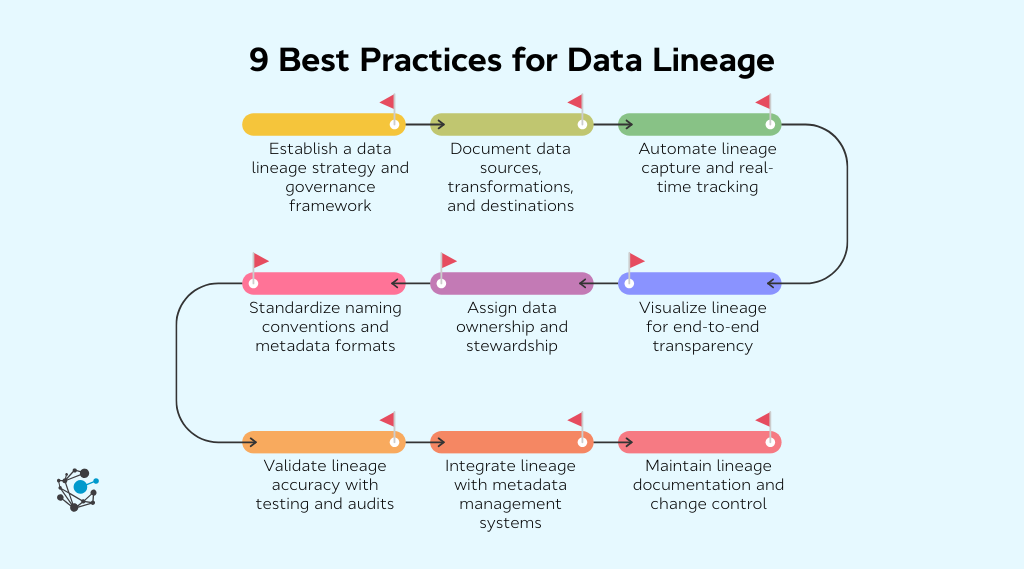
1. Establish a data lineage strategy and governance framework
One of the most foundational data lineage best practices is to begin with a well-defined strategy that aligns with your organization’s broader data governance framework.
Without a structured plan, lineage efforts often become fragmented, tool-centric, and disconnected from business outcomes. The result is inconsistent visibility into data pipelines, poor accountability, and increased risk during audits or incidents.
A strong lineage strategy should be driven by clear, organization-wide goals. These typically include
-
Regulatory compliance
-
Improved data quality
-
Operational transparency, and
-
Faster incident resolution.
But goals alone aren't enough. Your framework should also define how lineage data will be captured, who owns which parts of the process, and how updates will be maintained over time.
Key components of an effective lineage strategy include:
-
Purpose and scope: Identify what data domains (e.g., finance, customer, product) require lineage visibility. Prioritize critical assets that drive business decisions or are subject to regulatory oversight.
-
Ownership and accountability: Assign data stewards and technical owners for each dataset and transformation layer. These roles are responsible for ensuring lineage remains accurate, documented, and up to date.
-
Lineage framework standards: Establish consistent documentation protocols, naming conventions, and lineage modeling standards. This ensures that lineage is interpretable across teams and systems.
-
Governance alignment: Your lineage strategy should plug directly into your broader data governance program. This includes metadata catalogs, data quality initiatives, and policy enforcement mechanisms.
|
For instance, in highly regulated industries like banking or insurance, lineage is a compliance requirement. |
Under BCBS 239, banks must demonstrate end-to-end traceability of risk data. A governance-aligned lineage strategy enables them to map data from regulatory reports back to raw data sources, transformation rules, and even responsible stakeholders.
Without that structured approach, audit failures and reputational risk become real threats. Even in less regulated environments, lacking a strategic lineage foundation often leads to avoidable issues.
Teams may duplicate lineage efforts in silos, lineage graphs become incomplete, and critical upstream dependencies are missed. This results in longer incident resolution times and an erosion of trust in analytical outputs.
An effective data lineage strategy should be treated as a core pillar of your data governance program, equipped with policies, standards, and roles.
By aligning lineage with governance from the start, you reduce downstream confusion, enforce accountability, and create a maintainable foundation for enterprise data transparency.
2. Document data sources, transformations, and destinations
A core pillar of data lineage best practices is thorough documentation across the full data lifecycle from ingestion points to final outputs.
This includes three critical stages: data sources, transformation logic, and downstream destinations, each of which must be clearly recorded and kept up to date.
The first step is identifying data sources, which can range from transactional databases and streaming platforms to external APIs and flat files. Without knowing where data originates, teams lose the ability to validate its accuracy or investigate anomalies.
|
For instance, a data quality issue surfacing in a customer retention dashboard may actually stem from an upstream CRM export with inconsistent timestamp formats. If the data source isn’t documented, teams may misdiagnose the issue or apply a temporary fix without addressing the root cause. |
Equally important is mapping how data is transformed. This involves documenting all ETL and ELT logic, business rules, cleansing operations, joins, aggregations, and any conditional logic that alters the data.
In practice, this means tracking not only what transformation occurs but also where and how. Without transformation visibility, it becomes impossible to understand how raw data morphs into analytical output or what risks are introduced along the way.
Finally, the destinations such as data warehouses, business intelligence tools, and data science environments must be captured in lineage documentation.
These endpoints are often where data becomes most visible to decision-makers, and errors at this stage carry high reputational and business risk.
Comprehensive documentation not only supports traceability but also improves data governance, facilitates impact analysis during schema changes, and ensures audit readiness.
It gives stakeholders across the business, from compliance teams to data analysts, a shared, trusted view of where data comes from, how it changes, and where it ultimately lands.
3. Automate lineage capture and real-time tracking
As data environments grow more distributed and dynamic, relying on static or manual approaches to data lineage is no longer viable.
One of the most critical data lineage best practices is to automate the capture and continuous update of lineage metadata across all systems involved in the data lifecycle.
Manual tracking introduces several operational risks. It depends on tribal knowledge, which disappears with employee turnover. It creates delays when teams must manually reconstruct lineage during incidents.
It also leads to incomplete or outdated lineage diagrams that provide false confidence and hinder root-cause analysis.
To address these challenges, organizations are increasingly turning to automated data lineage tools that integrate directly into modern data stacks.
OvalEdge, for instance, extracts metadata and lineage insights directly from systems such as cloud data warehouses, ETL platforms, data orchestration layers, and business intelligence tools.
This automation allows for real-time or near-real-time visibility into how data flows and transforms as pipelines evolve, reducing the risk of errors and providing transparency across the entire data journey.
OvalEdge’s algorithms magically map data flow all the way to the column level, uncovering hidden connections between systems and delivering clarity at both the technical and business levels.
This level of automation supports continuous data monitoring, reduces the mean time to detect (MTTD) and mean time to resolution (MTTR) of issues, and fosters collaboration by giving teams a shared understanding of how their data assets are interconnected.
Importantly, automated lineage also enables compliance teams to meet regulatory expectations for traceability without excessive manual documentation.
For industries governed by data privacy laws like GDPR or HIPAA, the ability to instantly identify where personal data is sourced, how it is used, and where it is stored is essential to maintaining compliance.
To implement automated lineage effectively, organizations should:
-
Select tools that integrate natively with their existing data platforms
-
Ensure metadata extraction covers both technical and business-level transformations
-
Establish policies for maintaining lineage visibility as part of change management and deployment workflows
By embedding automation into their lineage framework, companies create a sustainable foundation for scalable, transparent, and resilient data operations.
4. Standardize naming conventions and metadata formats
A critical yet often underestimated best practice for data lineage is establishing and enforcing standardized naming conventions and metadata schemas.
Without consistency in how data assets are labeled and described, lineage diagrams quickly become fragmented, difficult to interpret, and prone to errors, especially in complex, multi-team, or multi-cloud environments.
Disparate naming conventions create ambiguity. A table named cust_info in one system and customer_details in another may refer to the same dataset but be treated as unrelated entities in lineage maps.
When metadata lacks standard formatting, automated lineage tools struggle to parse and connect data relationships accurately, which impairs traceability and auditability.
To address this, organizations should define a clear set of naming standards across key dimensions:
-
Tables, columns, and datasets: Use descriptive, consistent names that reflect business context (e.g., customer_order_summary rather than tbl1)
-
Metadata tags and classifications: Apply uniform labels for sensitivity, quality status, business domains, and data owners
-
Transformation steps and logic: Ensure business rules and calculated fields follow structured naming for traceability
Standardization also enhances discoverability. Analysts searching for customer revenue data in a catalog benefit from uniform naming that allows lineage tools to group related assets and trace upstream logic.
This becomes especially important in enterprise data catalogs and regulatory reporting, where mislabeling or misinterpretation can lead to data misuse or compliance failures.
To institutionalize this practice, organizations should embed naming and metadata standards into onboarding, development workflows, and CI/CD processes.
Data modeling tools should enforce naming rules, and metadata repositories should automatically validate format consistency during asset registration or schema updates.
By treating naming conventions and metadata standards as enforceable governance policies rather than informal guidelines, teams reduce confusion, improve cross-functional collaboration, and enable more reliable data lineage capture at scale.
5. Assign data ownership and stewardship
Without designated data owners and stewards, lineage initiatives lose momentum, documentation becomes outdated, and accountability breaks down, especially when issues arise in high-stakes reporting, compliance audits, or production pipelines.
Assigning stewardship is about more than naming a contact person. It requires defining specific responsibilities for maintaining the accuracy and completeness of lineage, ensuring timely updates as systems evolve, and acting as the bridge between technical teams and business stakeholders.
According to a 2023 Forrester Survey on Data Strategy & Insights, data governance frameworks define roles and responsibilities, including data ownership that supports data definitions, quality standards, and access control.
These elements are foundational for enterprise stewardship and accountability, ensuring that data is well-governed at both the technical and business levels.
Organizations should define two layers of stewardship:
-
Technical owners who understand how data is created, transformed, and stored. They are typically engineers or architects responsible for pipelines, integration points, and metadata systems.
-
Business stewards who understand the data’s purpose, meaning, and how it should be interpreted. They may be data analysts, product managers, or compliance officers.
This dual stewardship ensures that both the structural and contextual aspects of data are governed, which is critical for trustworthy lineage.
|
For example, a technical owner might update a lineage graph after a pipeline refactor, while a business steward ensures that the new transformation logic still aligns with regulatory definitions of financial metrics. |
Lack of ownership leads to serious operational bottlenecks. Data teams may hesitate to update or deprecate assets due to uncertainty about downstream impact.
Compliance officers may be unable to verify lineage paths during audits, delaying certification or exposing risk.
To avoid this, organizations should:
-
Include stewardship roles in data governance policies
-
Publish ownership responsibilities in metadata catalogs
-
Link stewardship to data quality KPIs and lineage accuracy metrics
-
Enable lineage tools to surface owner metadata within visual flows
Establishing and enforcing data ownership is essential to scaling reliable, traceable data operations in distributed, cloud-based environments. It ensures that lineage isn't just created but maintained, trusted, and usable across the entire organization.
6. Visualize lineage for end-to-end transparency
Effective data lineage visualization transforms technical complexity into accessible insights by providing a graphical representation of datasets, systems, and transformations.
This not only supports data teams in troubleshooting and changing impact analysis but also enables broader stakeholders like compliance officers, analysts, and product managers to understand and trust how data is generated and used.
The core challenge in most organizations is that data flows span diverse tools and environments such as ingestion layers, transformation engines, warehouses, and dashboards.
When lineage is buried in disconnected scripts or hidden inside ETL logic, even seasoned engineers struggle to trace dependencies or pinpoint where data breaks occur.
Without clear visualization, business stakeholders are left blind to how their reports are constructed, increasing the risk of misinterpretation or reliance on stale insights.
Visualizing lineage solves these problems by mapping datasets across every stage from raw ingestion (e.g., Kafka, APIs) through transformation layers (e.g., dbt, Airflow) to output systems (e.g., Tableau, Power BI).
A well-designed lineage view shows both upstream and downstream dependencies, highlighting what sources feed a dataset, which processes alter it, and which dashboards or models consume it.
This kind of transparency directly supports operational use cases such as:
-
Impact analysis: When a schema changes in a source system, lineage tools can immediately show which downstream assets are affected. This avoids breakages in reports or machine learning models.
-
Incident triage: If a report contains incorrect data, teams can visually trace its lineage path to identify if the issue is upstream (source ingestion), midstream (transformation logic), or downstream (visualization layer).
-
Data onboarding: New team members can explore lineage views to understand how key business metrics are computed, without needing to dive into code or ask for tribal knowledge.
Visual lineage is also key in regulated environments. Financial institutions and healthcare providers often need to demonstrate lineage to auditors, showing a clear trace from regulatory reports back to source systems.
Without visual lineage, documenting this for each audit becomes a time-consuming, manual task. With visualization, the process is faster, more accurate, and defensible.
To implement this practice effectively:
-
Choose lineage tools that offer bidirectional lineage (upstream and downstream)
-
Ensure visualizations support column-level detail and transformation metadata
-
Integrate lineage views within data catalogs to enhance discoverability and governance
-
Embed lineage visualization into workflow tools, enabling analysts and engineers to interact with lineage without context-switching
Lineage visualization is not just about drawing connections between datasets. It is about making those connections meaningful, discoverable, and actionable.
By giving every stakeholder a clear view into how data flows through your architecture, you enable better decision-making, reduce operational risk, and reinforce trust in the data that drives your business.
7. Validate lineage accuracy with testing and audits
While many organizations assume that once lineage is captured, either manually or via automation, it remains accurate, this assumption is a leading cause of trust breakdown in analytics environments.
In reality, data systems are dynamic. Pipelines are refactored, schemas change, new sources are added, and transformation logic evolves.
If lineage isn’t continuously tested and verified, it becomes disconnected from the actual data flow, leading to incorrect assumptions about dependencies, faulty impact analyses, and serious risks during compliance reviews.
The goal of lineage validation is to ensure that the documented lineage reflects how data actually moves, transforms, and is consumed across the architecture. Achieving this requires multiple layers of controls and verification mechanisms as follows:
-
Implement unit and regression tests for data transformations: Just as application code undergoes unit testing to verify logic, data pipelines should include tests that validate the correctness of transformations.
Tools like dbt (data build tool) allow engineers to write tests for each transformation step, ensuring that columns, joins, filters, and calculations produce expected results.
If a transformation test fails, it's a signal that the lineage path associated with that logic may be flawed or incomplete.
-
Enable lineage-aware monitoring and reconciliation reports: Automated reconciliation reports can help detect mismatches between upstream and downstream datasets.
|
For example, if the row count or key distribution in a downstream report deviates unexpectedly from its upstream source, it may indicate a missing or incorrect lineage link. These signals help surface silent errors that would otherwise go undetected. |
-
Maintain audit trails of lineage changes: Lineage is not static. Every time a new data source is onboarded, a pipeline is modified, or a schema evolves, lineage graphs need to be updated accordingly.
Maintaining audit trails that capture what changed, when, and who made the change allows teams to trace discrepancies and correct them quickly.
These audit logs are especially important in regulated industries, where showing historical lineage is often a compliance requirement.
-
Schedule periodic lineage audits: Regular lineage audits serve as a quality assurance mechanism for your lineage system. These audits can be quarterly or aligned with major release cycles.
Teams should manually review lineage maps, verify accuracy against actual pipeline configurations, and update or correct discrepancies. These lineage audits are critical in maintaining alignment between metadata and operational reality, especially in fast-moving data environments.
-
Validate lineage during change management workflows: Lineage validation should be embedded into your change management process. When engineering teams propose updates to ETL jobs or data models, part of the approval workflow should include verifying the accuracy and completeness of associated lineage updates.
This step ensures that lineage reflects the latest system state and prevents undocumented changes from cascading into downstream errors.
To effectively implement lineage validation, organizations should:
-
Use transformation testing frameworks to enforce logic accuracy
-
Leverage data observability tools that can highlight lineage drift or metadata mismatches
-
Schedule lineage review cycles tied to business-critical data domains
-
Track and audit changes using centralized version control or cataloging tools
Validating lineage is a foundational element of maintaining data trust. Without it, even the most detailed lineage diagrams become unreliable, creating risk and undermining confidence across analytics, compliance, and governance teams.
Testing and audits turn lineage from a static map into a reliable, operational asset.
8. Integrate lineage with metadata management systems
One of the most impactful data lineage best practices is integrating lineage information directly into your metadata management ecosystem.
When lineage is isolated from metadata, organizations miss out on a unified understanding of how data assets are related, governed, and consumed.
By combining lineage with metadata such as data definitions, classifications, business rules, and ownership, teams gain both visibility and context. This integration enables more powerful search, better data discovery, and more reliable impact analysis.
In most enterprise environments, data does not live in one place. Pipelines span ingestion tools, transformation layers, cloud data warehouses, analytics dashboards, and machine learning platforms.
Metadata about these systems, such as schema structures, data quality scores, and data sensitivity labels, is often siloed in spreadsheets or trapped within individual tools.
Without a centralized metadata repository, it's nearly impossible to trace how a field in a report was derived, who owns it, or whether it's compliant with internal or external policies.
Integrating lineage with a metadata management system solves this by bringing structural, semantic, and operational metadata together in one place.
This approach enables lineage-aware data catalogs where users can not only see a dataset’s source and downstream impact, but also understand its meaning, classification, and owner.
It also supports advanced governance use cases like policy enforcement and compliance monitoring.
9. Maintain lineage documentation and change control
Organizations often make the mistake of treating lineage as a one-time initiative to map data flows for audits or compliance. But in modern data architectures, where pipelines change frequently, and new sources are added regularly, lineage must evolve alongside the systems it represents.
Without a disciplined approach to lineage maintenance, the risks compound quickly. When documentation lags behind actual changes, data teams lose trust in lineage tools.
Root cause analysis becomes slower and more error-prone. Business users may base decisions on misaligned or outdated views of how data is processed. During audits, inaccurate lineage creates compliance exposure by obscuring how sensitive or regulated data is handled across environments.
To avoid these issues, organizations should treat lineage documentation as a living, governed asset (much like application code).
This means implementing structured change control, versioning, and governance protocols that ensure lineage remains accurate and aligned with the current state of data systems.
A reliable approach to maintaining lineage includes several interlocking practices:
-
Version control for lineage metadata: Track changes to lineage graphs and associated metadata using Git-based repositories or built-in versioning features of modern data catalogs. This allows teams to roll back changes, review historical data flows, and maintain an audit trail.
-
Change detection automation: Integrate lineage capture tools with CI/CD pipelines, so that any updates to ETL code, transformation logic, or schema definitions automatically trigger lineage updates. This minimizes manual intervention and ensures real-time accuracy.
-
Structured governance reviews: Include lineage validation as part of routine governance cycles, such as quarterly metadata audits or release reviews. This provides oversight and reinforces accountability across data stewards and engineering leads.
-
Change logs and annotations: Maintain detailed change logs that explain what changed, why, and who approved the update. Annotate lineage graphs with context about schema migrations, logic revisions, or policy updates to support historical understanding.
To embed this best practice effectively:
-
Ensure that data engineering and governance teams share responsibility for lineage maintenance
-
Automate lineage refreshes using metadata scanning and pipeline hooks
-
Create policies requiring lineage updates as part of change requests or data asset onboarding
-
Use lineage-aware tools that support version comparison, rollback, and impact visualization
Maintaining lineage is about sustaining trust in your data ecosystem. When changes are tracked, validated, and visible to all stakeholders, lineage becomes a reliable guide, not a disconnected artifact.
This is what transforms lineage from a compliance checkbox into a strategic asset that supports agility, governance, and confident decision-making.
Conclusion
A large B2B SaaS organization, servicing several Fortune 500 clients, is preparing to launch a new analytics feature for its platform. The sales team is excited because this feature is expected to drive significant revenue growth.
However, just before launch, they notice discrepancies in the data reports. The key metrics are either incomplete or inaccurate, creating doubts about the feature’s reliability. The clock is ticking, and they need answers fast.
The internal investigation reveals that the data flow is tangled across multiple systems, from the ingestion layer to the analytics dashboard, with various transformations along the way.
The team struggles to track where the data went wrong because they have no clear map of how data flows across systems or where it’s being manipulated.
This situation isn’t completely unique.
According to the State of Data & Analytics 2025 Salesforce Report, 54% of business leaders aren’t totally confident that the data they need is even accessible in the first place, and many of them cite persistent issues like accuracy, reliability, and relevance.
With no comprehensive data lineage, the company can’t quickly identify the source of the issue or determine who owns each step of the data process.
In this situation, data lineage would have provided a detailed, traceable map of every transformation, making it easy to pinpoint the error.
It would have identified the source of the data, the exact transformation steps, and the impacted systems, enabling teams to fix the problem quickly and confidently. Without it, the company wastes precious time, risking not only revenue but also its reputation with customers.
Struggling with data visibility and accuracy?

OvalEdge’s Data Lineage solution offers end-to-end traceability to ensure your data is always reliable.

Explore our feature comparison guide to see how OvalEdge can streamline data management, enhance governance, and resolve issues faster.
FAQs
1. What are the different types of data lineage?
Data lineage can be categorized into forward lineage (tracking data from source to destination) and reverse lineage (tracing data backwards from the destination to the source). Both types are crucial for understanding data flow and ensuring transparency.
2. Can data lineage and a data catalog exist without one another?
While they complement each other, a data catalog can exist without data lineage, but data lineage relies heavily on metadata from the catalog. Together, they provide a comprehensive view of data assets, governance, and transformation across systems.
3. Is automated data lineage more accurate than manual tracking?
Yes, automated data lineage provides real-time updates and minimizes human error. It ensures that data transformations and flows are consistently tracked across systems, while manual tracking may lead to outdated or incomplete lineage data, especially in dynamic data environments.
4. How does data lineage impact machine learning workflows?
Data lineage enhances machine learning workflows by providing clear visibility into how training data is sourced, transformed, and utilized. It helps ensure that the data used for models is accurate, consistent, and traceable, which is crucial for model validation and regulatory compliance.
5. How often should data lineage be updated?
Data lineage should be updated whenever there are changes to data sources, transformations, or destination systems. Ideally, updates should be automated through integration with data pipelines, but periodic manual reviews and audits should also be conducted to ensure ongoing accuracy and compliance.
6. Can data lineage be applied to unstructured data?
Yes, data lineage can be applied to unstructured data, though it is more complex. By mapping data sources, transformations, and destinations, even unstructured data like text, images, or logs can be tracked, enabling better governance, traceability, and management across various systems.
.png?width=1081&height=173&name=Forrester%201%20(1).png)
.png?width=1081&height=241&name=KC%20-%20Logo%201%20(1).png)