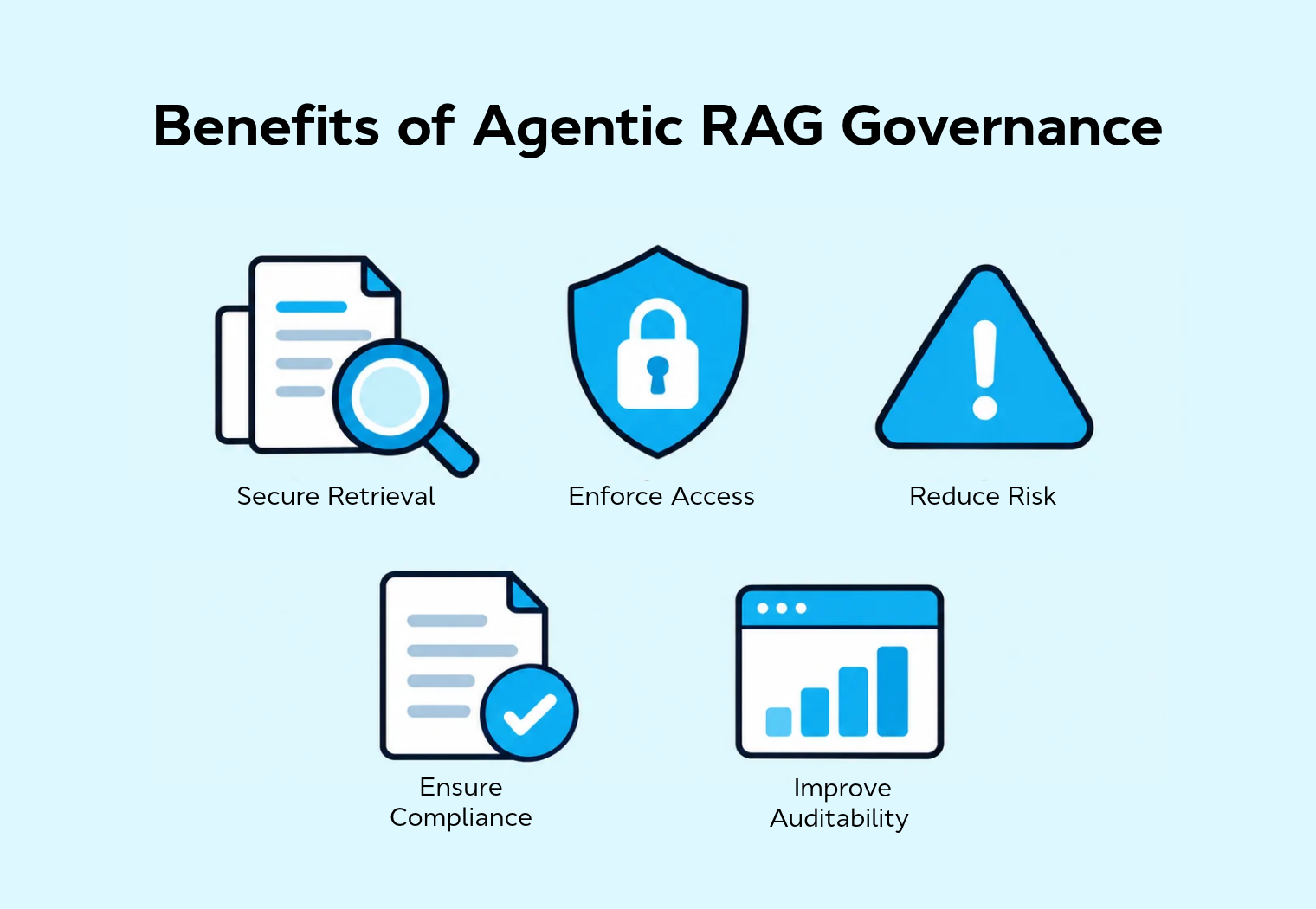
Agentic RAG governance is the set of controls and enforcement mechanisms that manage how AI agents retrieve, access, and act on enterprise data autonomously. Unlike standard RAG, where a human triggers a single retrieval and reviews the output, agentic RAG involves multi-step retrieval, tool use, and decision-making without human approval at every step.
Governance must operate at runtime, enforcing identity, permissions, data boundaries, and auditability on every retrieval.
An uncontrolled agent can surface sensitive data to the wrong user, retrieve conflicting definitions across data domains, or chain tool calls across systems it was never authorized to access. This post delivers a practical framework covering the five pillars of governed agentic RAG, regulatory mapping, and a phased implementation checklist.
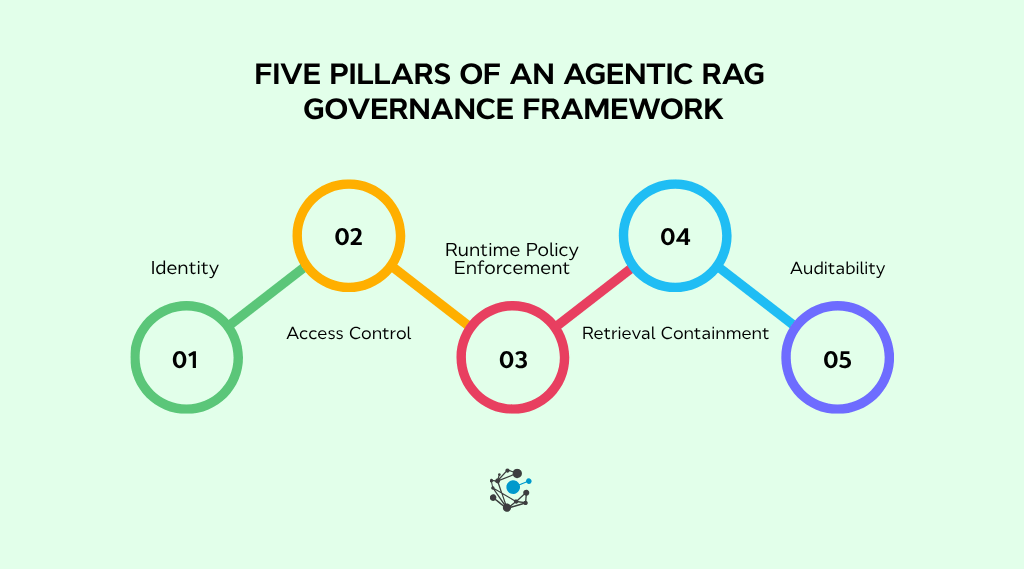
Five pillars of an agentic RAG governance framework
The shift from standard RAG to agentic RAG changes where governance decisions happen, and that determines which controls work and which ones break.
|
Dimension |
Standard RAG |
Agentic RAG |
|
Retrieval trigger |
Human query |
Autonomous agent decision |
|
Scope |
Single retrieval |
Multi-step, multi-source |
|
Tool use |
None |
APIs, databases, external systems |
|
Governance model |
Pre-deployment review |
Runtime enforcement |
An agentic RAG governance framework rests on five pillars, each addressing a specific control surface that standard pre-deployment reviews cannot reach.
-
Identity establishes who the agent is acting as and whose permissions the retrieval carries.
-
Access control defines what data sources, tools, and actions the agent can reach.
-
Policy enforcement constrains retrieval decisions at runtime with deterministic rules.
-
Containment determines what happens when an agent exceeds its authorized scope.
-
Auditability ensures you can reconstruct every retrieval path and decision after execution.
The first two pillars, identity/access and policy enforcement, form the foundation. Containment and auditability build on top and get dedicated sections below. Each pillar must operate at runtime, not just at deployment, because agentic RAG decisions happen during execution.
OvalEdge expert insight: Most teams start agentic RAG governance with access control. The harder problem is identity. Retrieval must carry the requesting user's permissions, not the agent's service account. Getting this wrong means every query runs at the agent's full privilege level.
Identity and access control for AI agents
Non-human identity (NHI) management is the first gap most teams discover. Every AI agent with retrieval access needs its own identity record with provisioned credentials, scoped permissions, and a defined lifespan. Without these, agents operate under shared service accounts with standing broad permissions, a pattern the OWASP Non-Human Identity Top 10 flags as a primary attack vector.
Three authorization models apply at retrieval time:
- RBAC (role-based access control) assigns permissions based on the user's role. It works for simple hierarchies but breaks down when different users in the same role need access to different data subsets.
- ABAC (attribute-based access control) evaluates user, resource, and environment attributes at each decision point, handling more granular scenarios where role alone is not enough.
- FGA (fine-grained authorization) enforces per-document or per-row access decisions at query time. This is the model required for regulated environments where fine-grained access control at retrieval time determines what an agent can surface.
The critical distinction across all three: authorization must be deterministic, not prompt-based. Prompt instructions are advisory. An agent can reason around them. Access decisions must execute before the model sees any content, using the requesting user's identity and the data's classification.
Consider Meridian Bank, where the FP&A copilot retrieves European net revenue data. The agent must carry Priya's (Head of FP&A) permissions, not a blanket service-account role. Retrieval respects data domain boundaries: the agent accesses European Retail Revenue data but cannot cross into Wealth Management data without explicit re-authorization.
Authorization is deterministic, enforced at the retrieval layer before the model receives any content. This is how agentic governance applies across enterprise data operations, not just retrieval.
Runtime policy enforcement and retrieval controls
Agentic RAG access control breaks down without enforcement at three points across the retrieval lifecycle.
- Pre-retrieval checks establish the baseline: Are data sources approved for agent indexing? Does the agent have permission to access this source? Is the data classified at a sensitivity level the requesting user can see? Do embeddings carry classification and lineage metadata from ingestion?
- During retrieval, enforcement shifts to scope monitoring. Is the retrieval staying within its defined data domain? Are PII fields being masked or excluded based on the user's clearance level? Runtime governance for agentic RAG means these checks execute on every retrieval call, not as a batch review after the fact.
- Post-retrieval validation catches what pre-retrieval checks cannot. Is the retrieved context certified and current? Has the output been sanitized for injected instructions?
Forrester's 2026 Security Survey found that 49% of security decision-makers flagged agentic AI as a concern, and post-retrieval validation gaps are a primary reason.
Agentic RAG security risks in autonomous retrieval
Standard RAG security focuses on protecting the data store and controlling who can query it. Agentic RAG security introduces risks that exist only because the agent makes retrieval decisions autonomously, chains multiple retrievals together, and delegates subtasks to other agents or tools.
Gartner projects that over 40% of agentic AI projects will be canceled by 2027, with inadequate risk controls cited as a primary cause.
1. The confused deputy problem in multi-agent chains
The confused deputy problem is the most concrete agentic RAG security risk, and the one most teams discover too late.
Agent A has access to customer financial data. Agent A delegates a subtask to Agent B, which has broader permissions because it was provisioned for a different use case. Agent B retrieves and surfaces data that Agent A's user should never have seen. The permission inheritance was never validated at the delegation boundary.
The root cause: downstream agents use their own credentials instead of inheriting the requesting user's permission scope. Each delegation in a multi-agent chain is a potential privilege escalation point.
The Cloud Security Alliance's 2026 research on AI agent governance frameworks found that more than half of enterprises adopting the NIST AI RMF still report governance gaps in multi-agent scenarios, what CSA calls "agentic sprawl."
For example: A revenue analysis agent delegates a sub-query to a data-profiling agent with admin-level access. The profiling agent returns customer names and account balances the requesting analyst should never see. The failure: the downstream agent used its own permissions, not the user's.
The mitigation is permission passthrough. Every agent in a chain must inherit and enforce the originating user's access scope, regardless of its own standing permissions. This is one of the compliance risks that emerge from autonomous agent actions and one that requires governance controls at the delegation layer, not just the retrieval layer.
2. Retrieval scope containment and data domain fencing
Agentic RAG risk management requires three containment mechanisms that prevent agents from retrieving beyond their intended boundaries.
Data domain fencing restricts agents to specific data domains. An agent authorized for revenue analytics cannot query HR compensation data, even if both datasets sit in the same vector store. Fencing must be enforced at the retrieval layer with deterministic rules, not through prompt-based instructions the agent can override.
Cross-tenant isolation prevents agents from accessing data across organizational boundaries in multi-tenant environments, where a single retrieval pipeline might serve multiple business units with different data access rights.
Retrieval depth limits cap the number of chained retrievals an agent can execute in a single task. Without them, an agent can follow retrieval chains indefinitely, accumulating data across domains through indirect paths.
Agentic RAG auditability and compliance
Can you prove to regulators, auditors, and leadership exactly what the agent retrieved, why it made that retrieval decision, and what it did with the data? If the answer is no, the deployment is not production-ready. Agentic RAG auditability requires provenance at every step, not just event logging.
1. Building provenance-aware audit trails
Every retrieval an agent executes should log five elements: what was retrieved (source, table, columns, rows), why it was retrieved (the agent's reasoning chain), whose permissions authorized the retrieval, what quality and certification signals were attached to the source data, and what the agent did with the retrieved data (passed to LLM, invoked a tool, or returned to user).
This is context provenance applied to agentic workflows. The audit trail must be tamper-resistant, queryable, and produce citable outputs so compliance teams can reconstruct the full retrieval path during an audit. Agentic RAG compliance depends on this traceability.
OvalEdge expert insight: Auditability in agentic RAG requires provenance, not just logging. Every piece of context the agent used must trace back to its source, owner, approval date, and quality certification. Without this, an audit trail shows what happened but not whether the data was trustworthy.
The operational gap most teams face is that their lineage and quality metadata live in separate systems from their retrieval infrastructure. Tracing every piece of context back to its source requires column-level lineage that connects retrieval logs to the upstream data pipeline, the business glossary definition that governs the field, and the data quality rules that certified it.
2. Mapping agentic RAG governance to regulatory frameworks
Governance frameworks built for agentic RAG already satisfy most regulatory requirements when implemented correctly. The mapping is practical, not academic.
|
Framework |
Key requirements |
How agentic RAG governance maps |
|
EU AI Act (Articles 12-14) |
Automatic logging, traceability, human oversight for high-risk AI |
Retrieval logging with provenance metadata; containment mechanisms that escalate to human review |
|
SOC 2 |
Security, processing integrity, confidentiality, privacy |
Identity and access control → security; policy enforcement → processing integrity; containment → confidentiality |
|
GDPR (Article 5) |
Data minimization, purpose limitation, right to explanation |
Agents retrieving personal data enforce minimization and purpose limitation at the retrieval layer |
|
OWASP NHI Top 10 + Agentic Top 10 |
Credential management, excessive permissions, confused deputy risks |
NHI identity records, scoped permissions, permission passthrough in multi-agent chains |
|
NIST AI RMF + SP 800-207 (Zero Trust) |
Never trust, always verify at every step |
Runtime enforcement at every retrieval step; deterministic authorization before model access |
The Cloud Security Alliance published a draft NIST AI RMF profile for agentic AI governance in March 2026. Teams evaluating AI governance frameworks that address enterprise-scale deployments should map their existing controls to these standards.
Why your data governance foundation determines agentic RAG success
Every pillar discussed above, identity, access control, policy enforcement, auditability, depends on a governed data foundation underneath. Without accurate classification, agents cannot enforce sensitivity rules. Without certified business definitions, agents retrieve conflicting meanings. Without lineage, audit trails end at the retrieval step and cannot trace back to the authoritative source.
Enterprise agentic RAG governance is not a layer you bolt onto retrieval after the fact. It starts with the data governance foundation your organization already has: catalog metadata, business glossaries, lineage maps, quality rules, certifications, ownership records, classifications, and access policies. The challenge is making that foundation queryable and usable by AI agents at runtime.
OvalEdge expert insight: The governance foundation most enterprises need for agentic RAG already exists: catalog, glossary, lineage maps, quality rules, and access policies. The gap is that this context lives in separate systems and cannot be queried by agents. Connecting and activating it is the single most impactful step.
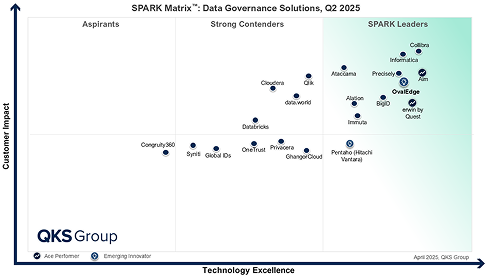
This is where platforms like OvalEdge deliver measurable impact. The Enterprise Context Graph connects and activates the existing governance foundation, catalog metadata, business definitions, lineage, quality signals, ownership, and policies into a queryable structure that agents use at runtime.
It does not build the foundation from scratch. It makes the foundation you already have usable for RAG governance for AI agents operating at enterprise scale.
From static governance to AI-queryable context
The shift from static governance to AI-queryable context is best understood through what happens without it.
Example: The FP&A copilot at Meridian Bank retrieves European net revenue. It needs more than the right table. It needs the approved definition of "net revenue" from the business glossary, the certified source (European Retail Revenue data product), the FX policy that applies from the policy registry, the data quality score from quality rules, and the owner who approved the data for AI consumption.
These artifacts exist across five separate systems. Without a connected governance layer, the agent retrieves the number but has no way to verify its meaning, freshness, or authorization status.
An Enterprise Context Graph connects these artifacts into a single queryable structure the agent accesses at runtime. The agent retrieves the data point along with its business definition, lineage, quality score, and access authorization in one governed context call.
Understanding the distinction between data lineage and provenance in governed retrieval is essential here. Lineage tells you where the data came from. Provenance tells you whether the data is trustworthy. Enterprise agentic RAG governance requires both.
Enterprise agentic RAG governance checklist
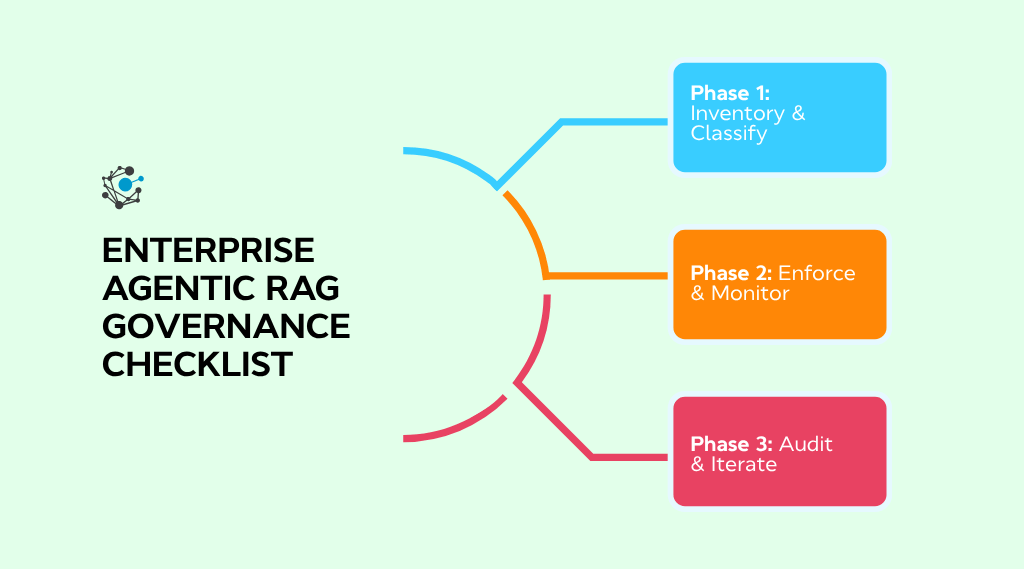
Teams deploying agentic RAG in production need a phased approach that builds governance incrementally rather than attempting to implement every control at once. This enterprise agentic RAG governance checklist maps to the five-pillar framework above and gives implementation teams a concrete starting point.
At OvalEdge, we believe data governance should not be rebuilt for AI. It should be activated. The catalog, glossary, lineage, and policy controls enterprises have already built are the raw material of governed agentic RAG. Connecting that existing foundation is what makes runtime governance reliable.
Phase 1: Inventory and classify
- Identify all agents with retrieval access to enterprise data sources.
- Map each agent's permission scope: data domains, tools, and authorized actions.
- Classify data sources by sensitivity level (public, internal, confidential, restricted).
- Verify that business definitions and data quality rules exist for every source agents can access.
Phase 2: Enforce and monitor
- Implement deterministic RBAC/ABAC at retrieval time, with user-level permission passthrough.
- Deploy pre-retrieval policy checks: sensitivity filtering, domain fencing, PII masking.
- Set retrieval depth limits for multi-step agent chains.
- Instrument logging for every retrieval: source, permissions, reasoning, and action taken.
Phase 3: Audit and iterate
- Build queryable audit trails with context provenance (source, owner, certification, quality score).
- Run periodic governance reviews: are agent permissions still appropriate? Have data classifications changed?
- Test confused-deputy scenarios before promoting agents to production.
- Map governance controls to regulatory frameworks (EU AI Act, SOC 2, GDPR, OWASP NHI Top 10, NIST AI RMF).
The foundation for all three phases is a connected, governed set of data artifacts that agents can query at runtime. Without governed access for AI agents at runtime, each phase requires manual integration work that scales poorly as agent deployments grow.
Conclusion
Agentic RAG governance becomes non-negotiable the moment agents move from sandbox to production. Every retrieval decision an agent makes, every tool it invokes, every delegation it hands to another agent, needs runtime enforcement of identity, permissions, and policies.
The five-pillar framework (identity, access control, policy enforcement, containment, auditability) gives teams a structured way to implement these controls without rebuilding their entire governance stack.
The teams that deploy governed agentic RAG reliably start from a connected data governance foundation. Classification, certified definitions, lineage, quality rules, and access policies already exist in most enterprises. The gap is activation: making that foundation queryable by agents during execution so governance operates at the speed of retrieval.
Schedule a demo to see how OvalEdge connects your existing data governance foundation into an AI-queryable Enterprise Context Graph that supports governed agentic RAG.