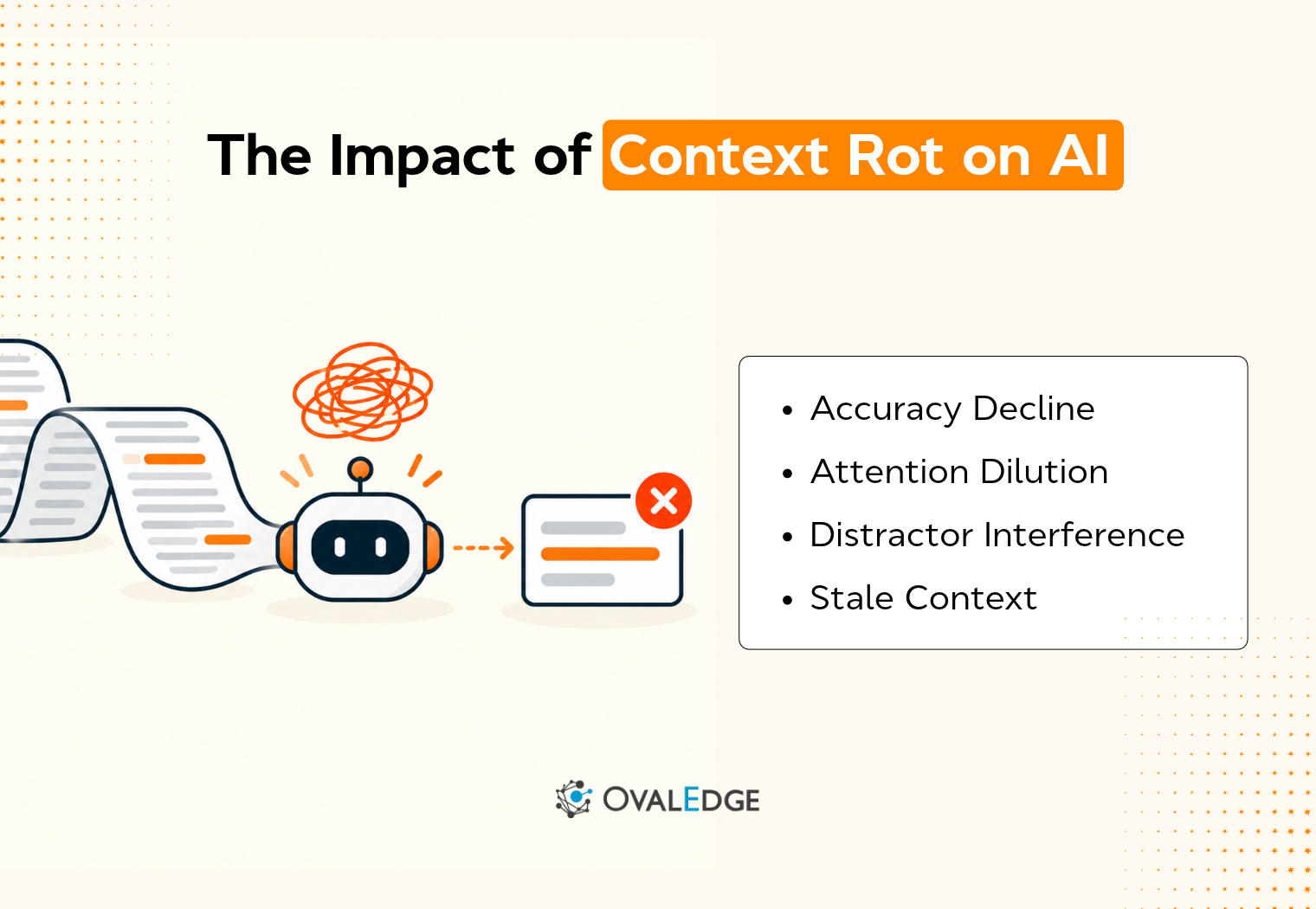
An AI system can retrieve the right information, follow the correct workflow, and still produce increasingly unreliable answers. As enterprise AI applications handle longer prompts, more retrieved documents, and extended agent interactions, the volume of context can become a source of performance degradation rather than an advantage. This problem, known as context rot, poses a growing challenge for teams moving large language models (LLMs) from controlled testing into production environments.
Context rot occurs when LLM output quality declines as input context grows, even when relevant information remains available within the context window. It affects retrieval-augmented generation (RAG) pipelines, coding agents, and enterprise AI workflows, often without triggering errors or exceeding token limits.
Understanding its causes, recognizing its early warning signs, and managing context quality are essential for building reliable AI systems that maintain accuracy as workloads grow.
What is context rot
Context rot is the measurable decline in LLM output quality that occurs as input context grows longer, even when the relevant information is present in the context window. The model has the right data but fails to use it effectively.
The core mechanism is straightforward: as token count increases, the model's ability to attend to and reason over all of the input degrades. Attention gets distributed more thinly. Relevant facts compete with irrelevant ones for the same fixed budget. Critical instructions get buried under growing volumes of accumulated content.
What makes context rot particularly dangerous is that it is a soft failure. The model does not crash or return an error. It produces a confident, plausible, wrong answer. From the outside, the system appears to be working normally. Output quality erodes gradually, and without targeted monitoring, most teams do not catch it until downstream decisions have already been affected.
Research confirms the problem is universal.
The Chroma 2025 long-context research report tested 18 models across nearly 195,000 LLM calls and found degradation in every single one, even on simple retrieval tasks.
The NoLiMa benchmark (Adobe Research, 2025) pushed further: 10 of 12 models dropped below half of their short-input baseline accuracy at 32,000 tokens. GPT-4o, one of the strongest performers in the study, still fell from 99.3% to 69.7% at that threshold.
Context rot applies equally to RAG systems, multi-turn agents, and any LLM workflow where context accumulates over time.
What causes context rot in LLMs and AI agents
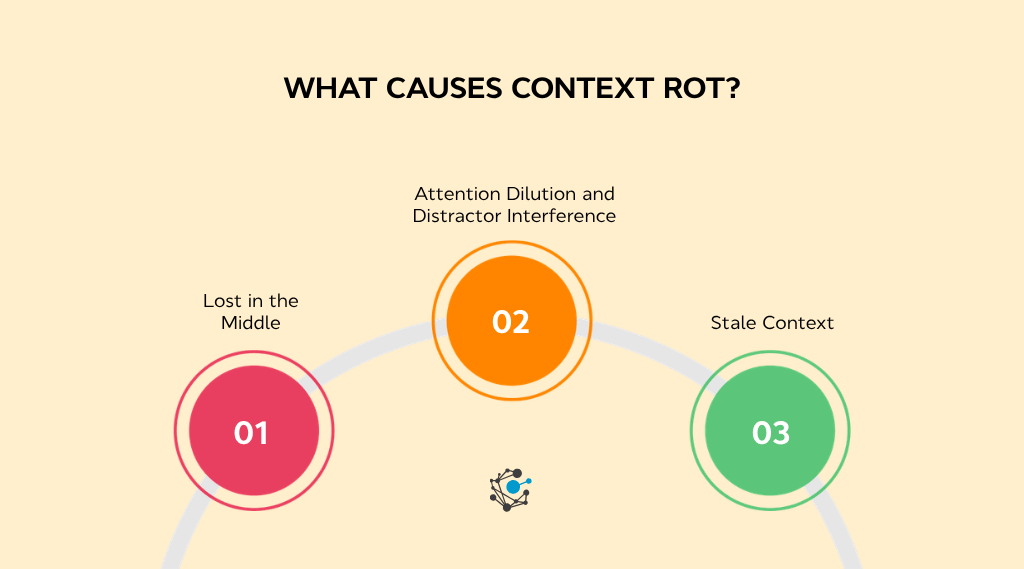
Context rot is the combined result of three forces: how transformer attention works under load, how irrelevant content competes with relevant content, and how agentic workflows accumulate stale history. Each cause reinforces the others, and addressing only one leaves the remaining two to continue degrading output quality.
1. The lost-in-the-middle effect
LLMs attend disproportionately to information at the beginning and end of long inputs. Content placed in the middle of the context window gets systematically underweighted.
The Stanford 2023 "Lost in the Middle" study (Liu et al.) documented the effect clearly: when researchers placed the same fact at position 1 in a set of 20 retrieved documents, models achieved roughly 75% accuracy. Moving that identical fact to position 10 dropped accuracy to approximately 55%. The information was identical. Only its position changed.
For retrieval-augmented systems, the implication is significant. Retrieved chunks arrive in an order determined by embedding similarity, rather than by attention-optimal positioning. A highly relevant passage can land in the middle of the prompt, where the model is least likely to use it. Position alone can determine whether a model applies a fact, regardless of how relevant it actually is.
2. Attention dilution and distractor interference
Softmax attention distributes budget across all tokens in the input. As token count grows, each individual token receives a smaller share of the model's attention. The information that matters gets less focus, because more tokens are competing for the same fixed resource.
Distractors make the problem worse. Semantically similar but irrelevant content actively misleads the model. An LLM cannot reliably distinguish "relevant-similar" from "irrelevant-similar" when both types of content share vocabulary, structure, and topic signals.
Retrieval quality matters enormously here. A RAG pipeline that pulls five loosely related chunks instead of two precise ones introduces distractors that compete directly with signal.
OvalEdge expert insight: Unclassified data sources amplify the distractor problem. When retrieved content lacks classification and quality metadata, the retrieval layer has no reliable way to filter by source-level relevance before content enters the prompt.
3. Stale context accumulation in agentic workflows
In multi-turn agent systems, context only grows. Failed tool calls, superseded instructions, outdated search results, and earlier conversation turns all remain in the window. Nothing gets removed automatically.
The compounding loop is predictable: errors trigger recovery actions, which add more tokens to the context, which introduce more noise, which cause further errors. Unlike a human conversation, where participants naturally forget irrelevant details, an LLM re-reads the entire transcript on every turn. Stale information competes equally with current information for attention budget.
Long-running sessions amplify the effect. Coding agents operating across dozens of tool calls, enterprise automation workflows spanning multiple data sources, and customer service agents managing complex multi-step cases all accumulate stale context at a rate that outpaces the relevance of what they retain.
Example: A healthcare analytics team deployed a RAG agent to answer clinical-trial compliance queries across 14 regulatory jurisdictions. Within three weeks, the agent began returning superseded protocol references from earlier conversation turns instead of current regulations.
Accumulated context had reached 40,000 tokens, and the model could no longer distinguish the most recent guidance from outdated versions that were never cleared from the window.
Organizations that already enforce lifecycle policies, freshness rules, and active data retirement at the source layer have a structural advantage here: stale content gets flagged or removed before it ever enters the context.
Context rot vs context window overflow
Context rot and context window overflow are two different failure modes. Confusing them leads to the wrong fix.
|
Dimension |
Context rot |
Context window overflow |
|
Type of failure |
Soft (silent degradation) |
Hard (API error or rejection) |
|
When it occurs |
Well before the token limit |
At or near the token limit |
|
Observable? |
No error; output quality drops |
Yes; the model rejects the input |
|
Root cause |
Attention dilution, positional bias, stale context |
Input exceeds maximum token capacity |
|
Fix |
Context pruning, isolation, governed retrieval |
Summarization, truncation, model upgrade |
Expanding the context window prevents overflow. It does not prevent context rot. Research consistently shows that models degrade on long inputs even when those inputs are well within the stated window. A 200,000-token window does not mean 200,000 tokens of reliable reasoning.
The distinction matters because teams that treat accuracy drops as a window-size problem will upgrade their model or increase the token limit, only to find that performance continues to degrade. The fix for context rot requires a data governance framework at the source layer, where teams control which data is authoritative, how it is classified, and which sources are trusted enough to enter the prompt.
At OvalEdge, we believe the fix for context rot starts at the data layer. Expanding model capacity without governing what enters the context treats the symptom while the root cause, unmanaged source quality, continues to compound.
How to detect context rot in production
Context rot is difficult to detect because it does not produce errors. The model keeps generating output. The quality of that output simply gets progressively worse.
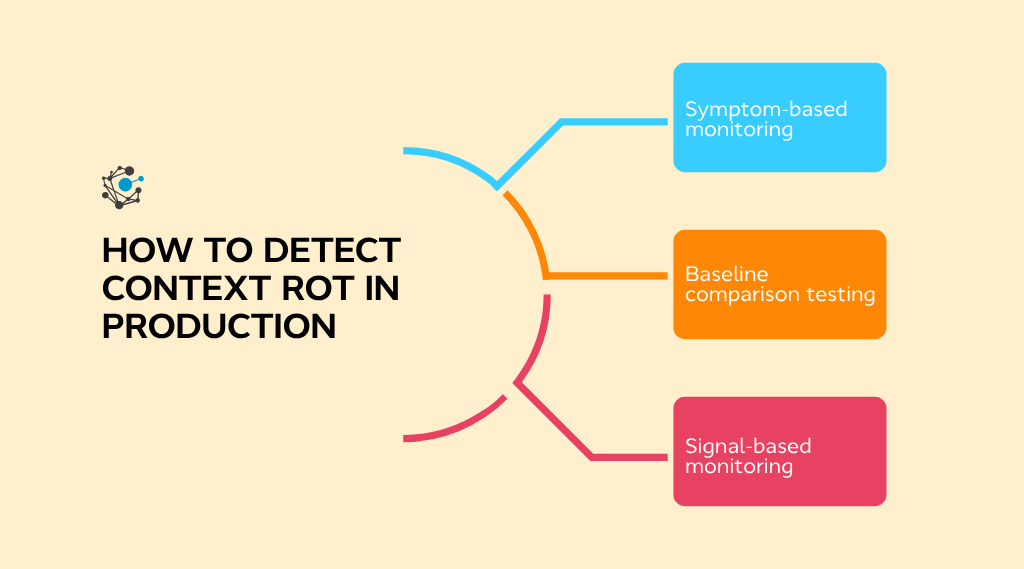
Three approaches, used together, give production teams a structured way to catch it:
1. Symptom-based monitoring
Track these signals across production sessions:
-
Ignored constraints or instructions that were followed earlier in the session
-
Repeated mistakes on tasks the model handled correctly in shorter sessions
-
Hallucinated facts that contradict information present in the context
-
Broken multi-step reasoning where intermediate steps go missing
-
Circular recovery loops where the agent retries the same failed approach
2. Baseline comparison testing
Run the same query in two settings: a fresh, short context with only the relevant information, and the full production-length context. If the short-context answer is significantly better, context rot is the likely cause. Running this test on a regular cadence across representative queries establishes a degradation baseline for each model and use case.
3. Signal-based monitoring
Track output consistency, task completion rates, and semantic drift across sessions of different lengths. Plotting accuracy against context length reveals the degradation curve for a specific model and workload, making it possible to set context budgets based on observed performance.
Pairing these curves with upstream data quality signals helps teams distinguish context rot from retrieval-quality problems before investigating further.
For example, a financial services RAG pipeline saw answer accuracy drop from 80% to 55% when context included more than 15 retrieved chunks. A baseline comparison test confirmed context rot rather than retrieval relevance as the cause.
Governed metadata and data quality signals from enterprise context platforms like OvalEdge help teams trace degraded outputs back to the source data, beyond the model itself. When the retrieval layer carries lineage and freshness metadata, teams can identify whether degradation stems from stale sources, redundant content, or genuine attention limits.
How to prevent context rot
Prevention requires controlling what enters the context rather than expanding how much context the model can hold. The research is detailed on this point: models with larger windows still degrade when the content inside those windows is noisy, stale, or poorly structured.
Three strategies work together to address the root causes: pruning and hygiene at the prompt layer, isolation at the orchestration layer, and governed metadata at the data source layer. Each targets a different layer of the problem.
1. Context pruning and retrieval hygiene
Retrieve less, with more precision. Filter retrieved content by relevance, recency, and scope before it enters the prompt. A tighter retrieval set with two highly relevant chunks will outperform a broad set with eight loosely related ones.
Compact conversation history at natural checkpoints instead of appending indefinitely. Replace the full transcript with a running summary that gets rewritten at each checkpoint. Place critical instructions at the start or end of prompts, where attention is strongest.
Use structured delimiters like XML tags and explicit section markers to help the model parse long inputs and distinguish instruction from data. Treat context tokens as a finite resource with a tight budget.
OvalEdge expert insight: Context pruning without source-level quality signals is guesswork. Pruning by token count removes content arbitrarily. Governed metadata from business glossaries, classification tags, and freshness scores lets teams prune by information value instead.
2. Context isolation with specialized subagents
Splitting complex tasks across narrow, focused agents is one of the most effective structural defenses against context rot. Each subagent receives a clean context window with only the information it needs for its specific subtask. The parent agent orchestrates the workflow and routes results, without carrying the full context of every subtask.
Isolation prevents cross-contamination between unrelated subtasks and keeps each agent's context short and focused.
Anthropic's documented approach to multi-agent architectures demonstrates the principle: decomposing a complex task into isolated subtasks, each with its own clean context, reduces the compounding degradation that a single, long-running agent would accumulate.
Each agent should handle a single task within a single focused context. Data governance platforms built around an Enterprise Context Graph make isolation practical at scale by delivering governed metadata, lineage, and access policies to each subagent without carrying the full history of the parent workflow.
3. Governed metadata for upstream context quality
Context rot can begin before the LLM ever sees a prompt. If the data sources feeding a RAG pipeline lack lineage, classification, and freshness signals, the retrieval layer pulls stale, redundant, or irrelevant content into the context. No amount of prompt-level pruning can fix what was already broken upstream.
Governed metadata acts as a quality filter at the source layer. Business glossaries ensure consistent terminology so the retrieval system does not pull in conflicting definitions. Column-level data lineage tells the retrieval system where data came from and how it was transformed. Sensitivity classification prevents restricted data from entering agent context. Access policies enforce who and what can retrieve specific datasets.
Most enterprises already hold these governed artifacts across catalogs, glossaries, lineage maps, classification systems, and access policies built through their data governance programs. An Enterprise Context Graph connects and activates this existing foundation into a single queryable layer, so retrieval systems can filter by governed quality signals rather than relying on raw embedding similarity alone.
The distinction is important: context hygiene at the prompt level is reactive. Governed metadata at the source level is preventive.
At OvalEdge, we believe context rot is as much a data governance problem as it is a model problem. Preventing it at scale requires governing the data before it reaches the model, beyond managing tokens after they arrive in the prompt.
Conclusion
Context rot is a systemic problem. It starts at the data source, compounds through retrieval, and surfaces in the model’s output as confident, plausible, wrong answers. Expanding the context window does not fix it. Adding more tokens to a degrading system accelerates the degradation.
The practical starting point is closer than most teams realize. Enterprises have already built much of the governed metadata that context-aware AI needs through their data governance programs: catalogs, glossaries, lineage, classification, quality rules, and access policies. The missing step is making that existing foundation machine-usable and queryable at retrieval time.
The Enterprise Context Graph connects and activates this governed foundation into a single layer that retrieval systems, agents, and analytical AI applications can query for trusted context. When a forecasting model, a risk-scoring pipeline, or a compliance agent draws on governed, traceable data context rather than raw, unmanaged content, the degradation loop that context rot depends on loses its fuel at the source.
Schedule a data governance demo to see how your existing governance foundation can keep AI context accurate and current.