Enterprise AI is only as effective as the context behind it. AI agents, copilots, and RAG applications need more than documents to produce reliable responses. They also depend on business meaning, metadata, ownership, permissions, and organizational policies to interpret enterprise information correctly.
As AI evolves from answering questions to executing tasks and workflows, context has become a critical enterprise capability.
According to a 2026 Cloudera survey of more than 1,200 IT leaders, only 7% of organizations consider their data fully AI-ready, highlighting that trusted context and governed data remain major barriers to enterprise AI adoption.
This challenge has accelerated the adoption of context management tools. Some optimize retrieval, memory, or orchestration, while others organize and govern enterprise knowledge for AI. This guide compares these approaches and explains how to choose the right solution for your organization.
What are context management tools?
Context management tools are software platforms and frameworks that collect, organize, retrieve, and deliver the information AI systems need to complete a task. Depending on the use case, they may manage metadata, documents, agent memory, retrieval pipelines, permissions, or runtime context to improve AI accuracy and relevance.
These tools operate across different layers of the AI stack. Some optimize context for individual AI applications, while others provide a shared enterprise foundation that supports analytics, copilots, and AI agents.
For example, an AI assistant answering a question about quarterly revenue can reference approved business definitions, certified datasets, and user permissions instead of relying only on retrieved documents.
Context management answers three critical questions:
-
What information does the AI system need?
-
Which information can it use?
-
How should that information reach the model?
Why do AI systems need context management tools?
Large language models understand language but not an organization's latest business rules, approved metrics, access permissions, or operational processes. Without this additional context, they may generate inconsistent, outdated, or unauthorized responses.
Context management fills this gap by supplying relevant enterprise information throughout the AI lifecycle, from business meaning and governance to retrieval and execution. This helps AI applications respond with greater accuracy while respecting organizational controls.
Key benefits include:
-
More accurate responses: Grounds AI outputs in current enterprise knowledge.
-
Consistent business meaning: Applies approved definitions for business terms and metrics.
-
Lower hallucination risk: References authoritative and traceable sources.
-
Secure information access: Enforces permissions, privacy controls, and governance policies.
-
Reusable AI foundation: Supports multiple AI applications without rebuilding context pipelines.
While RAG retrieves relevant documents, it does not determine whether they are authoritative, current, or approved. Context management complements retrieval by adding business meaning, governance, and trust before information reaches the AI model.
This is where an AI context layer becomes valuable, providing shared, governed context that AI assistants, copilots, and agents can use across applications.
The future of context management
As AI evolves from chatbots to autonomous agents, context management is becoming enterprise infrastructure rather than an application-level capability. Standards such as MCP are simplifying how AI systems access enterprise tools, while enterprise context layers make reusable business knowledge available across AI applications.
This shift enables organizations to scale trusted, governed AI without rebuilding context for every new use case.
What are the main types of context management tools?
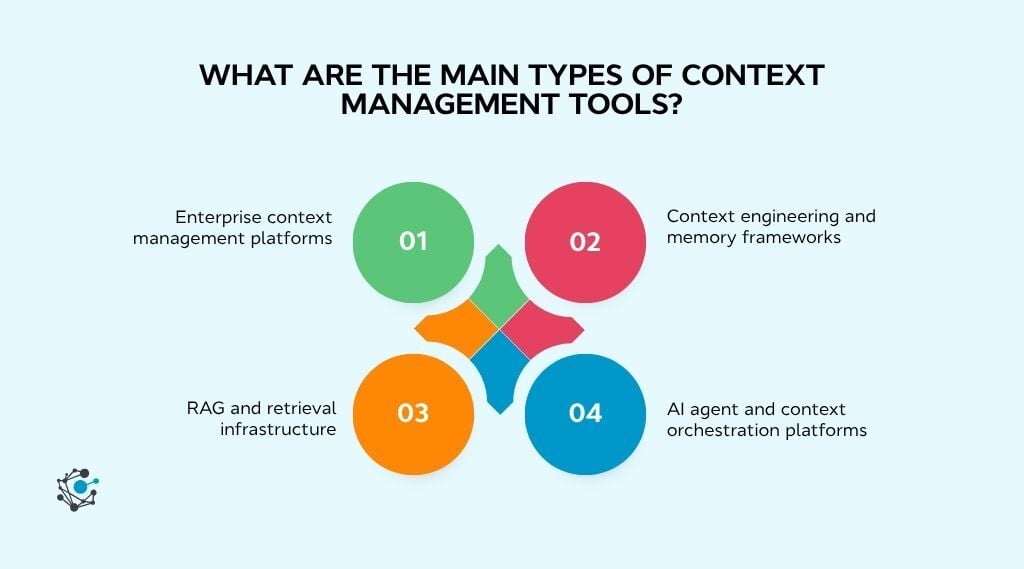
Not all context management tools solve the same problem. The right choice depends on the type of context your AI applications need. The four categories below address the most common enterprise AI requirements.
1. Enterprise context management platforms
Connect metadata, business definitions, lineage, ownership, and policies into a shared enterprise context layer.
Best suited for:
-
Enterprise AI
-
Governed analytics
-
Data discovery
-
Regulatory compliance
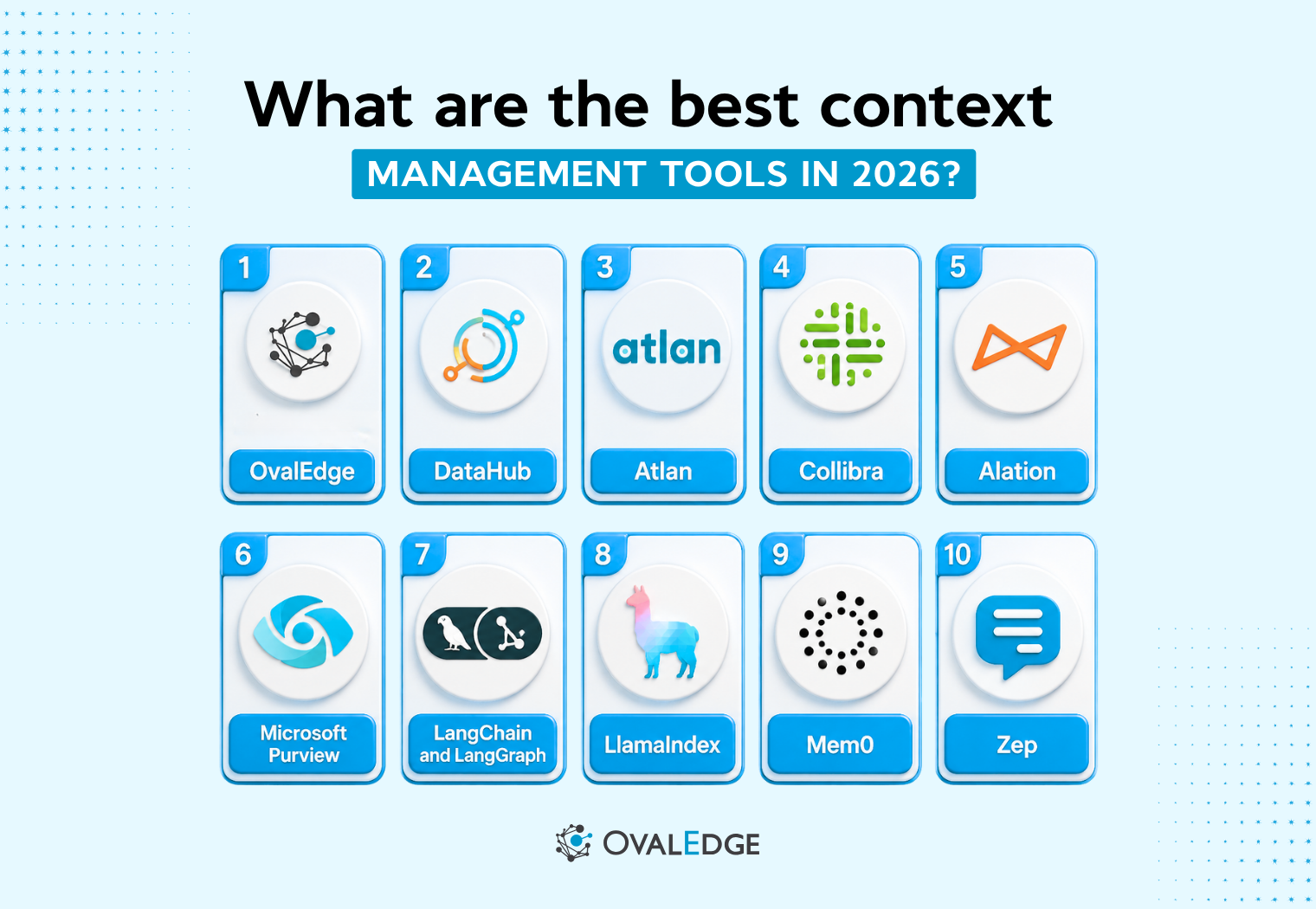
Representative tools: OvalEdge, DataHub, Atlan, Collibra, Alation, Microsoft Purview
2. Context engineering and memory frameworks
Manage the information that enters an LLM's context window, including conversation history, memory, and prompt state.
Best suited for:
-
AI assistants
-
Conversational memory
-
Context optimization
-
LLM applications
Representative tools: LangChain, LangGraph, LlamaIndex, Mem0, Zep, Letta
3. RAG and retrieval infrastructure
Retrieve relevant documents and data using vector search, embeddings, and hybrid retrieval.
Best suited for:
-
Semantic search
-
Knowledge retrieval
-
RAG applications
-
Document grounding
Representative technologies: Pinecone, Weaviate, Milvus, Chroma, Contextual AI
4. AI agent and context orchestration platforms
Coordinate models, tools, memory, and workflows to execute multi-step AI tasks.
Best suited for:
-
AI agents
-
Workflow orchestration
-
Tool calling
-
Multi-step reasoning
Representative tools: Relevance AI, Langflow, Flowise, Dify, cloud-native agent platforms
Which context management tool do you actually need?
Not every context management tool solves the same problem. Some improve retrieval, while others provide enterprise knowledge, preserve memory, or coordinate workflows. Before evaluating vendors, identify the primary challenge your AI applications need to solve.
|
Challenge |
Choose |
Best for |
|
AI doesn't understand your business context |
Enterprise context platform |
Governed enterprise AI Metadata, lineage, and policies |
|
AI cannot find the right documents or data |
RAG framework + vector database |
Semantic search Knowledge retrieval |
|
AI forgets previous conversations |
Agent memory platform |
Persistent memory Personalized interactions |
|
AI needs to coordinate tools and workflows |
Orchestration framework |
Multi-agent workflows Tool calling and automation |
Buyer tip: Start with the category that addresses your immediate challenge, then expand your AI stack as your use cases grow.
What features should context management software include?
Effective context management software should do more than retrieve information. It should organize, govern, and deliver enterprise knowledge in a way that AI systems can reliably consume.
When evaluating platforms, look for:
-
Broad enterprise connectivity
-
Business metadata and ownership
-
Relationship mapping
-
Lineage and trust indicators
-
Privacy and policy enforcement
-
Flexible retrieval options
-
AI and MCP integrations
-
Automation and auditing
Metadata provides the business context AI needs to interpret enterprise information consistently. Learn how Metadata Management helps build AI-ready context across the enterprise.
What are the best context management tools in 2026?
No single platform addresses every aspect of AI context. Some focus on enterprise knowledge, others specialize in retrieval, memory, or orchestration. The comparison below highlights how leading platforms differ so you can evaluate them based on your architecture and business requirements.
The comparison below includes leading context management tools across these different categories.
|
Tool |
Primary category |
Metadata & context |
Governance |
Agent memory |
RAG support |
Best suited for |
|
OvalEdge |
Enterprise context platform |
Strong |
Strong |
External |
Integrates |
Governed enterprise AI |
|
DataHub |
Enterprise context platform |
Strong |
Strong |
External |
Integrates |
Metadata-driven AI context |
|
Atlan |
Enterprise context platform |
Strong |
Strong |
External |
Integrates |
Collaborative data teams |
|
Collibra |
Data intelligence platform |
Strong |
Strong |
External |
Integrates |
Enterprise governance |
|
Alation |
Data intelligence platform |
Strong |
Strong |
External |
Integrates |
Data discovery and stewardship |
|
Microsoft Purview |
Governance platform |
Strong |
Strong |
External |
Ecosystem |
Microsoft environments |
|
LangChain & LangGraph |
Orchestration framework |
Limited |
Application- defined |
Supported |
Strong |
Custom AI agents |
|
LlamaIndex |
RAG framework |
Application-defined |
Application- defined |
Supported |
Strong |
Knowledge-intensive AI |
|
Mem0 |
Memory platform |
Memory- focused |
Limited |
Strong |
Supported |
Personalized AI assistants |
|
Zep |
Memory platform |
Temporal graph |
Limited |
Strong |
Supported |
Stateful AI applications |
How context management tools work together
Enterprise AI rarely relies on a single context management tool. Instead, organizations combine multiple technologies, with each layer performing a specific role during an AI request.
|
Step |
What happens |
|
1. User request |
A user submits a question or task to an AI application. |
|
2. Orchestration |
The orchestration layer selects the appropriate models, tools, and workflow. |
|
3. Retrieval |
The RAG layer searches relevant documents and structured data. |
|
4. Enterprise context |
The enterprise context platform enriches retrieved information with business definitions, lineage, ownership, certifications, governance policies, and permissions. |
|
5. Memory |
The memory platform adds conversation history, user preferences, and long-term context when needed. |
|
6. Response generation |
The LLM combines all available context to generate a grounded and explainable response. |
Rather than competing with one another, these technologies work together. The platforms below illustrate how each category contributes to a production AI stack.
1. OvalEdge
OvalEdge is an AI-powered data governance and catalog platform that transforms enterprise metadata into governed, AI-ready context. It connects business definitions, lineage, ownership, quality, privacy, policies, and AI governance into a unified enterprise context layer. This enables both people and AI systems to discover, interpret, and trust enterprise data consistently.
Best for
Organizations building enterprise AI, governed analytics, AI assistants, and data-centric AI agents that require trusted, enterprise-wide business context.
Key features
-
Enterprise context foundation: Connects metadata, business glossary, lineage, quality, policies, and AI assets into a unified context layer.
-
Automated metadata discovery: Scans and catalogs metadata across 150+ enterprise data sources with minimal manual effort.
-
Business meaning and trust: Standardizes business terms, certifies trusted assets, and connects business definitions to technical metadata.
-
Governance for AI: Enforces ownership, privacy, access controls, compliance, and AI governance policies before context reaches AI systems.
-
Natural language discovery: Enables business users and AI assistants to discover governed enterprise knowledge through askEdgi.
Pricing
Custom pricing based on deployment model, users, and enterprise requirements. Contact OvalEdge for a quote.
What makes OvalEdge different
Most context management tools focus on a specific layer of the AI stack, such as retrieval, memory, or orchestration. OvalEdge provides the governed enterprise context that complements these technologies by connecting business meaning, metadata, lineage, ownership, and policies into a trusted foundation for enterprise AI.
Rather than replacing retrieval or orchestration frameworks, OvalEdge enriches them with governed business context that helps AI systems produce more accurate, explainable, and compliant responses.
See how governed enterprise context powers AI
Learn how OvalEdge transforms metadata, business meaning, lineage, and governance into AI-ready context for copilots and AI agents.
Book a demo to explore the platform.
2. DataHub
DataHub is an open-source metadata platform that helps organizations discover, govern, and manage enterprise data through a connected metadata graph. It emphasizes active metadata, data lineage, and AI-ready context that can be consumed by developers, data teams, and AI applications. Its extensible architecture makes it popular among engineering-led organizations.
Best for
Engineering-driven enterprises that want an open, extensible metadata platform to support data governance, discovery, and AI-ready enterprise context.
Key features
-
Metadata graph: Connects datasets, dashboards, pipelines, AI assets, and documentation into a unified metadata graph.
-
Automated metadata ingestion: Supports extensive metadata ingestion through connectors and APIs across modern data platforms.
-
Lineage and impact analysis: Provides end-to-end lineage to understand dependencies and assess downstream impact.
-
Governance and discovery: Enables data cataloging, documentation, ownership, domains, and policy management.
-
AI integration: Supports APIs, MCP-based delivery, and integrations for AI assistants, RAG pipelines, and AI agents.
Limitations
-
Governance workflows and business stewardship capabilities may require additional configuration compared to commercial governance platforms.
-
Open-source deployments often require greater engineering effort for implementation and ongoing maintenance.
Pricing
DataHub offers a free open-source edition, while DataHub Cloud is available through custom enterprise pricing.
3. Atlan
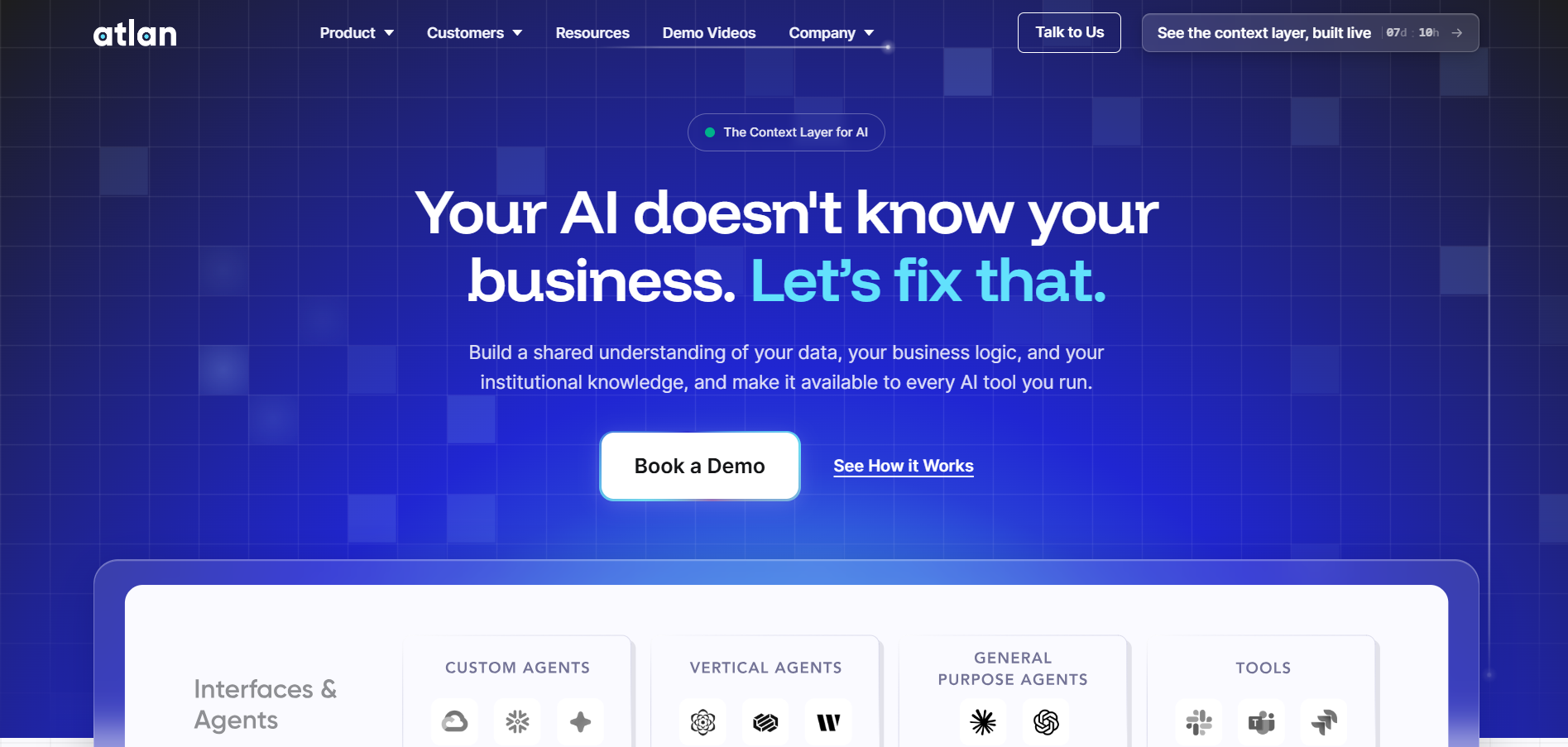
Atlan is a modern data catalog and active metadata platform that helps organizations discover, govern, and collaborate on enterprise data. It connects metadata, business knowledge, lineage, and documentation into a shared data context, making information easier to find and understand across teams.
Best for
Organizations looking for a collaborative metadata platform that improves data discovery, governance, and AI readiness.
Key features
-
Active metadata: Synchronizes metadata across cloud data platforms and business tools.
-
Data catalog: Centralizes data discovery with search, documentation, and collaboration.
-
Lineage and impact analysis: Visualizes data flows and downstream dependencies.
-
Business glossary: Standardizes business terms, definitions, and data assets.
-
AI integrations: Supports AI assistants, metadata APIs, and enterprise AI workflows.
Limitations
-
Advanced governance capabilities may require higher-tier licensing.
-
Best suited for organizations with a modern cloud data stack.
Pricing
Custom enterprise pricing. Contact Atlan for a quote.
4. Collibra
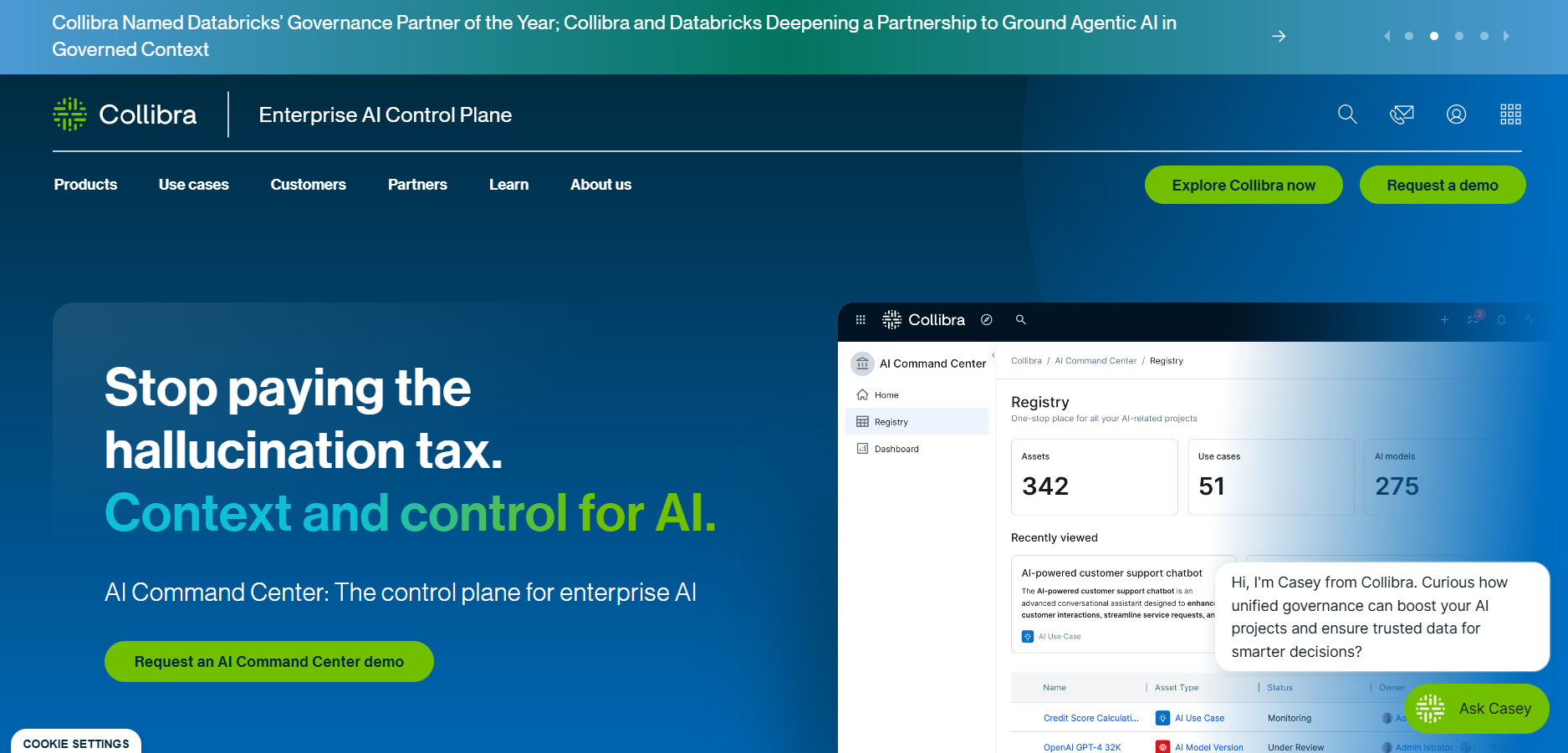
Collibra is an enterprise data intelligence platform that combines data cataloging, governance, lineage, privacy, and compliance into a unified solution. It helps organizations establish trusted data for analytics, regulatory compliance, and enterprise AI.
Best for
Large enterprises with mature governance programs and complex regulatory or compliance requirements.
Key features
-
Data catalog: Provides enterprise-wide data discovery and documentation.
-
Governance workflows: Supports stewardship, ownership, policy management, and approvals.
-
Data lineage: Tracks data movement and transformation across systems.
-
Privacy and compliance: Helps manage sensitive data and regulatory requirements.
-
AI governance: Supports trusted AI initiatives through governed metadata and policies.
Limitations
-
Implementation can be complex for smaller organizations.
-
Licensing costs may be high for organizations with limited governance needs.
Pricing
Custom enterprise pricing based on deployment and licensing requirements.
5. Alation
Alation is a data intelligence platform focused on helping organizations discover, understand, and govern enterprise data. It combines cataloging, behavioral analytics, stewardship, and governance to improve trusted data usage across business and technical teams.
Best for
Organizations prioritizing self-service data discovery and enterprise-wide data stewardship.
Key features
-
Enterprise catalog: Simplifies data discovery through intelligent search.
-
Behavioral intelligence: Uses data usage patterns to improve recommendations.
-
Business glossary: Maintains standardized business definitions and KPIs.
-
Data stewardship: Supports ownership, collaboration, and governance workflows.
-
Open integrations: Connects with major cloud platforms, BI tools, and data sources.
Limitations
-
AI context capabilities primarily focus on governed metadata rather than application memory.
-
Advanced capabilities may require multiple licensed modules.
Pricing
Custom enterprise pricing. Contact Alation for a quote.
6. Microsoft Purview
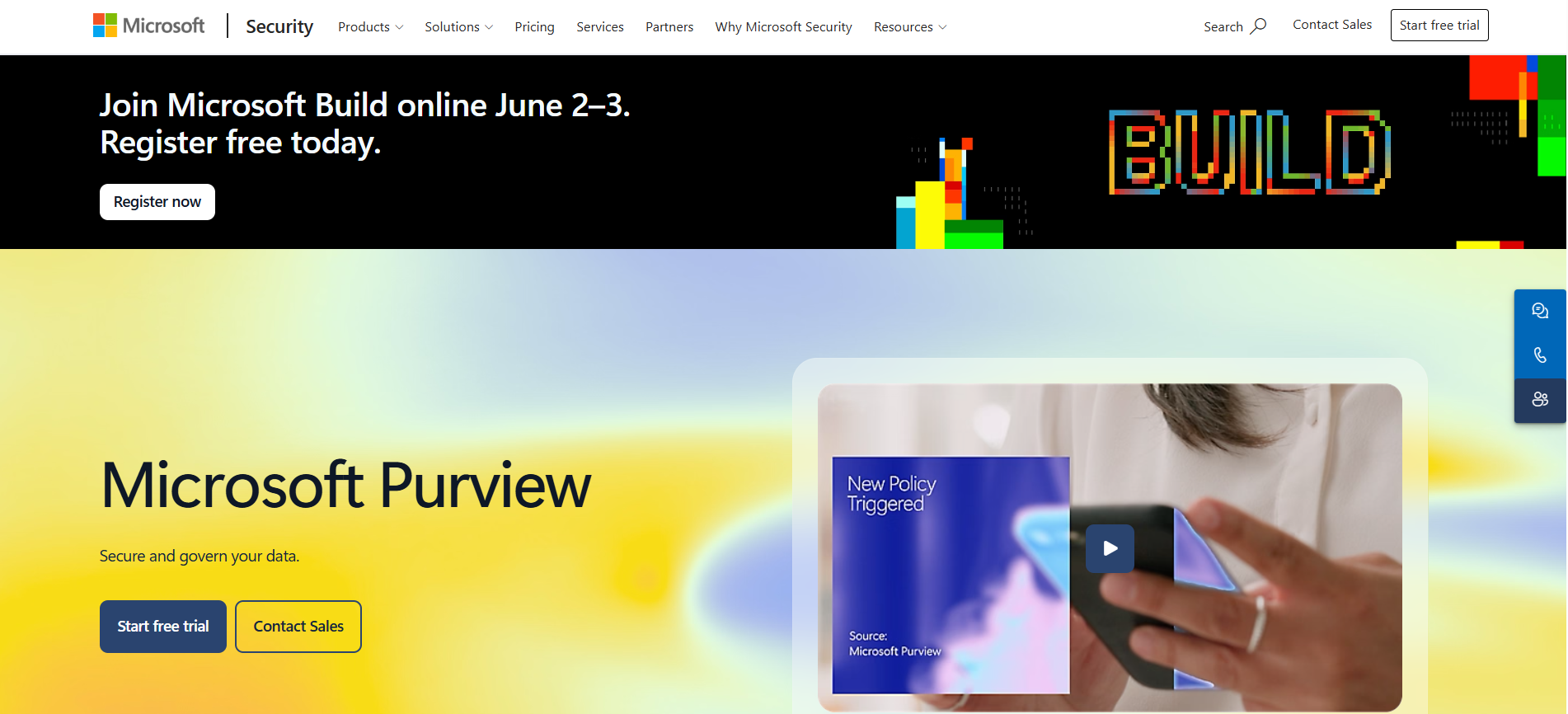
Microsoft Purview is Microsoft's unified data governance, catalog, and compliance platform. It provides metadata management, lineage, data classification, and compliance capabilities across Microsoft Azure, Microsoft 365, Fabric, and selected third-party data sources.
Best for
Enterprises heavily invested in the Microsoft ecosystem that want integrated governance and compliance.
Key features
-
Unified catalog: Discovers and catalogs data across Microsoft services.
-
Data lineage: Tracks data movement across Azure and Fabric environments.
-
Sensitive data management: Automatically classifies and protects sensitive information.
-
Compliance management: Supports governance policies and regulatory compliance.
-
Microsoft integration: Integrates natively with Azure, Fabric, Power BI, and Microsoft 365.
Limitations
-
Delivers the greatest value within Microsoft-centric environments.
-
Some capabilities for non-Microsoft platforms are less comprehensive than native integrations.
Pricing
Consumption-based and subscription pricing depending on Microsoft services used.
7. LangChain and LangGraph
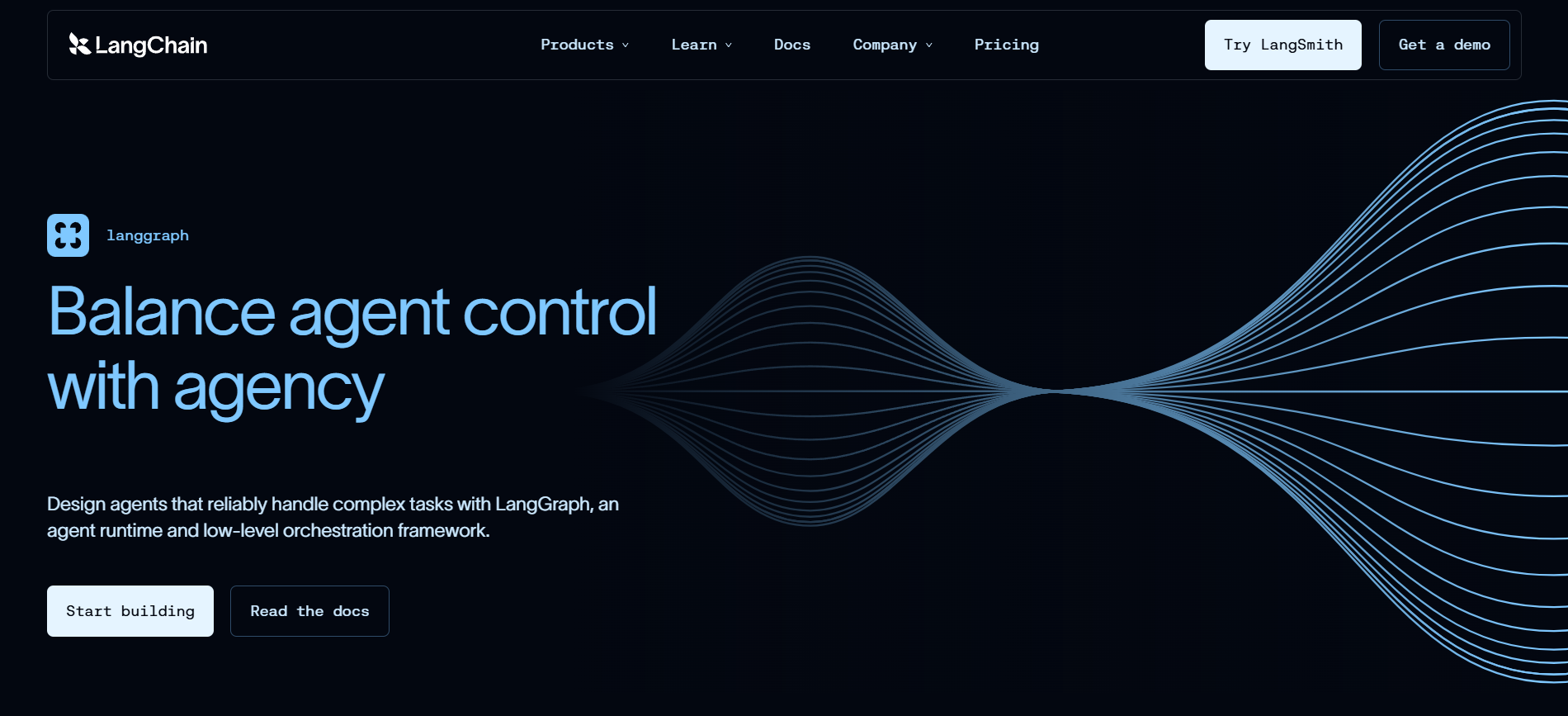
LangChain and LangGraph are open-source frameworks for building LLM-powered applications and AI agents. LangChain provides components for prompts, tools, retrieval, and model integrations, while LangGraph enables stateful, multi-step agent workflows.
Best for
Development teams building custom AI agents, copilots, and context orchestration workflows.
Key features
-
Agent orchestration: Coordinates tools, prompts, models, and workflows.
-
Memory management: Supports conversational memory and state management.
-
RAG integration: Connects AI applications with retrieval pipelines.
-
Tool integrations: Supports APIs, databases, search engines, and external services.
-
Workflow flexibility: Builds complex, multi-agent workflows with reusable components.
Limitations
-
Does not provide governed enterprise metadata or business context.
-
Requires external governance, catalog, and security platforms for enterprise deployments.
Pricing
Open source. Commercial enterprise offerings are available through LangChain.
8. LlamaIndex
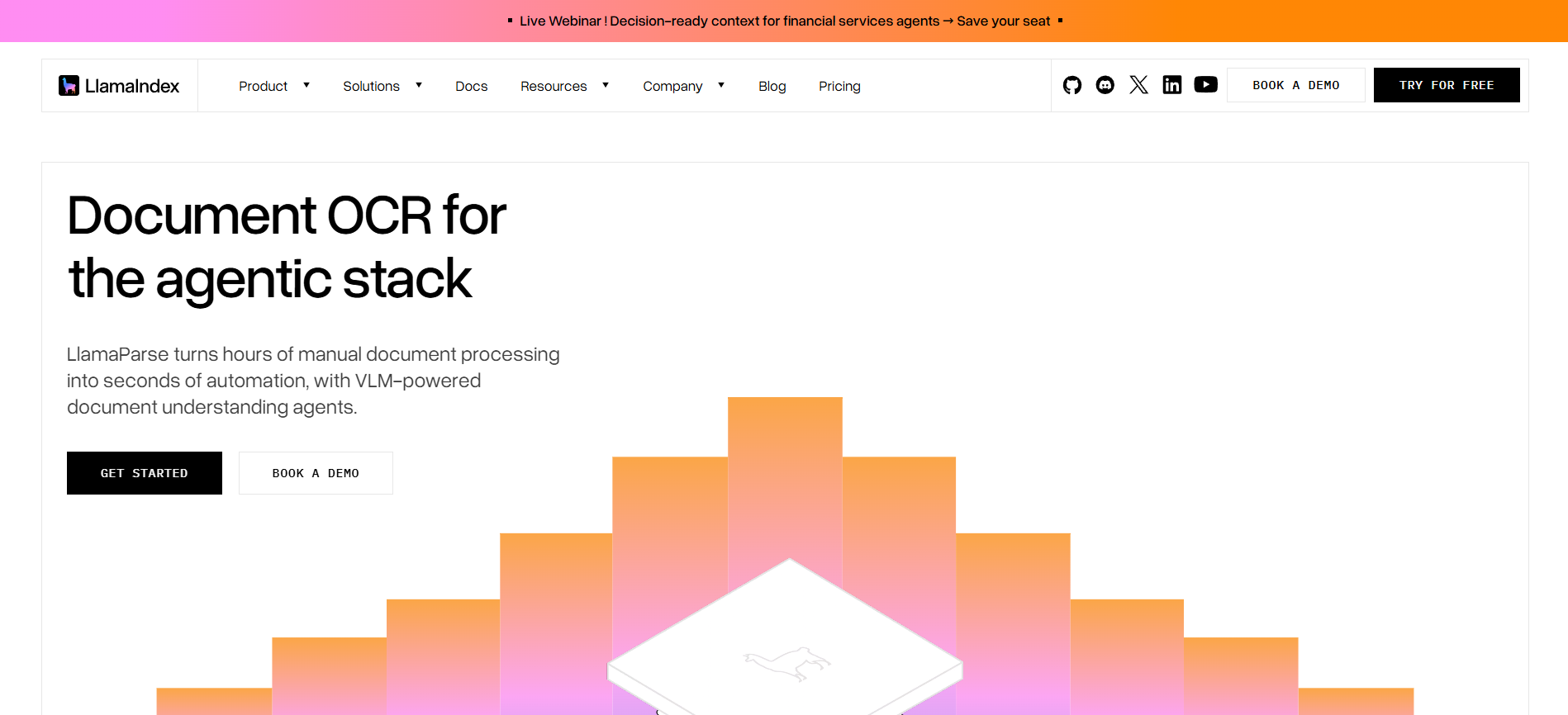
LlamaIndex is an open-source framework for connecting enterprise data with LLM applications. It focuses on document ingestion, indexing, retrieval, workflows, and agent development for knowledge-intensive AI applications.
Best for
Organizations building custom RAG applications and AI assistants powered by enterprise knowledge.
Key features
-
Data ingestion: Connects structured and unstructured enterprise data.
-
Indexing framework: Creates optimized indexes for efficient retrieval.
-
Retrieval pipelines: Supports hybrid search and advanced retrieval strategies.
-
Agent workflows: Provides components for AI agents and tool calling.
-
Developer ecosystem: Integrates with leading LLMs, vector databases, and cloud platforms.
Limitations
-
Focuses on application-level retrieval rather than enterprise governance.
-
Business glossary, lineage, and metadata governance require external platforms.
Pricing
Open source with commercial enterprise offerings available.
9. Mem0
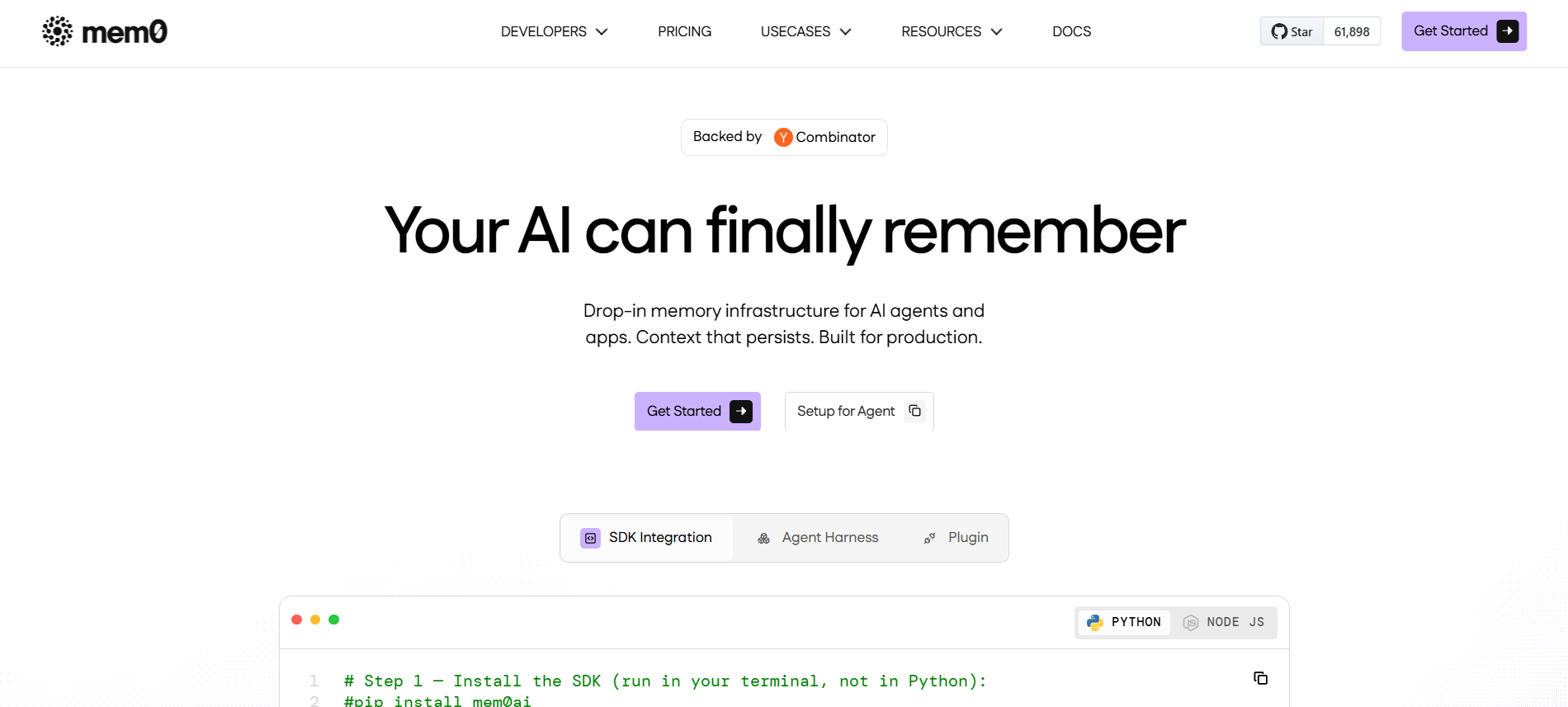
Mem0 is a memory management platform designed for AI applications and agents. It stores and retrieves user, session, and application memories so AI systems can deliver personalized and context-aware interactions over time.
Best for
AI assistants and applications that require persistent conversational memory and personalization.
Key features
-
Persistent memory: Stores long-term user and application memories.
-
Context optimization: Retrieves only the most relevant memories for each interaction.
-
Developer APIs: Integrates with popular AI frameworks and LLMs.
-
Personalization: Improves AI responses using historical interactions.
-
Memory management: Reduces unnecessary context while maintaining continuity.
Limitations
-
Focuses on agent memory rather than enterprise metadata governance.
-
Does not provide lineage, business glossary, or policy management.
Pricing
Offers a free developer tier with usage-based pricing for production deployments.
10. Zep
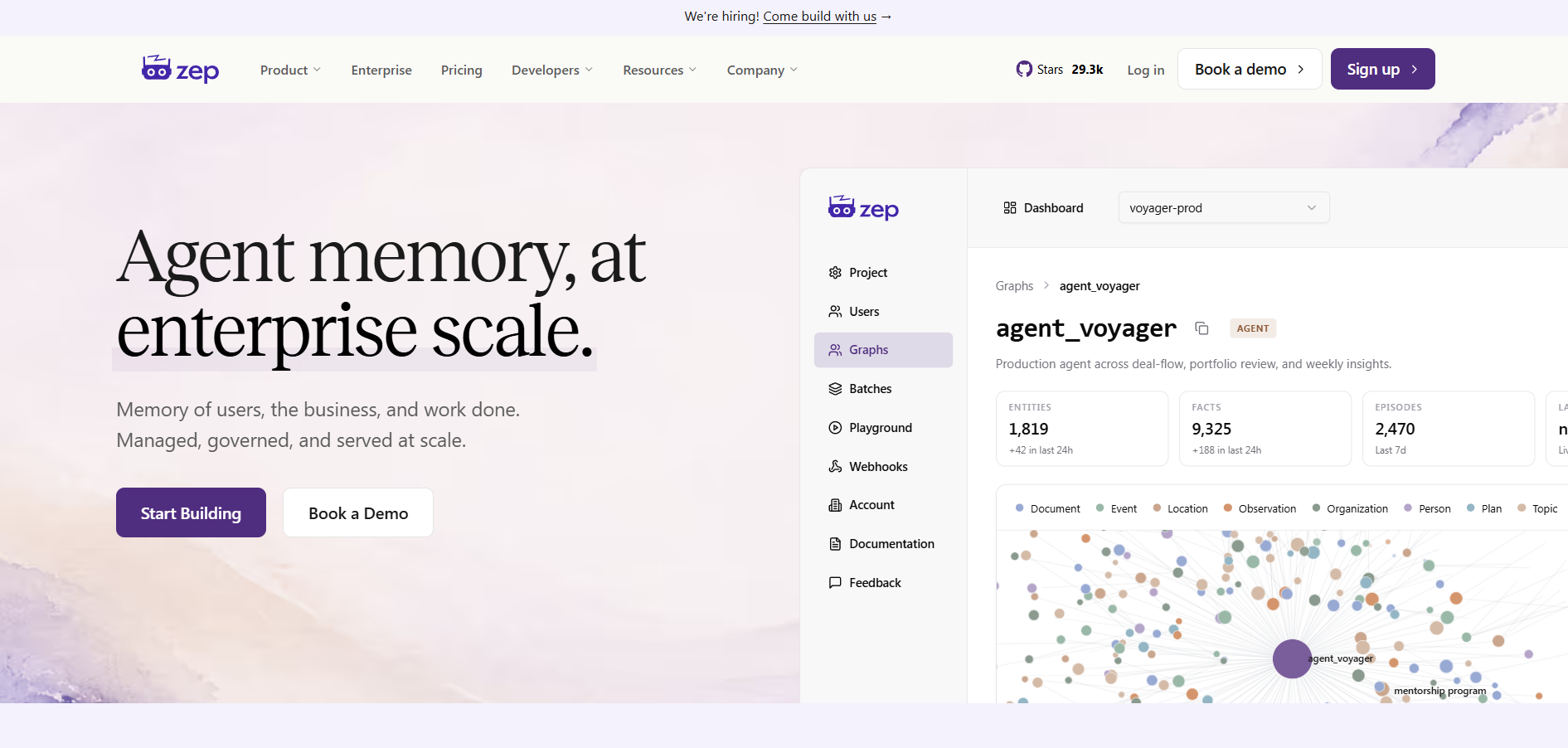 Zep is a memory and context platform that helps AI agents maintain long-term, temporal, and relationship-aware memory. It combines persistent memory with graph-based capabilities to help AI applications understand changing facts and user relationships over time.
Best for
Stateful AI agents and applications that require persistent, time-aware memory.
Key features
-
Temporal memory: Tracks how information changes over time.
-
Graph-based context: Connects related entities and interactions.
-
Session persistence: Maintains long-term conversational context.
-
Developer integration: Works with popular LLM frameworks and agent platforms.
-
Memory retrieval: Delivers relevant historical context during AI interactions.
Limitations
-
Designed for application memory rather than enterprise governance.
-
Requires complementary platforms for metadata management, lineage, and compliance.
Pricing
Offers cloud-based pricing with enterprise plans available on request.
Enterprise context management vs agent memory
Enterprise context management and agent memory complement each other but serve different purposes. Enterprise context provides trusted organizational knowledge, while agent memory preserves information from previous interactions.
|
Enterprise context management |
Agent memory |
|
Stores organizational knowledge |
Stores user interactions |
|
Shared across AI applications |
Individual to an agent or user |
|
Includes metadata, lineage, and policies |
Includes conversations and preferences |
|
Supports governance and compliance |
Supports personalization and continuity |
Enterprise context answers questions like "What does revenue mean?" or "Which dataset is certified?" Agent memory answers questions like "What did this user ask yesterday?" While both improve AI performance, enterprise context builds trust across the organization, whereas agent memory improves individual AI interactions.
How to choose the right context management tool
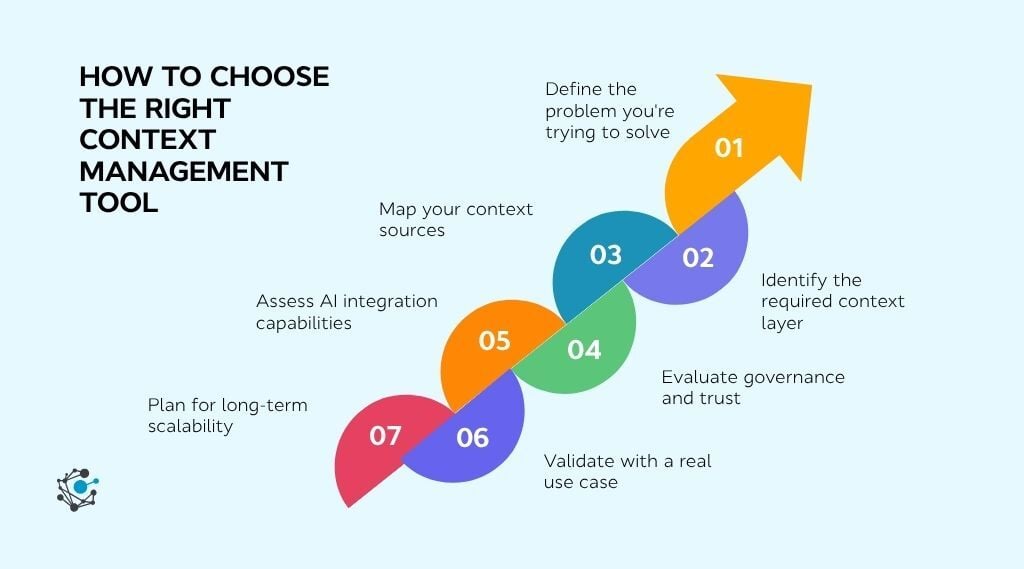
Not every context management tool solves the same problem. Before comparing vendors, identify the type of context your AI applications need and evaluate platforms against your long-term AI strategy rather than individual features.
1. Define the problem you're trying to solve
Determine whether your challenge is poor retrieval, fragmented metadata, inconsistent business definitions, weak governance, limited agent memory, or inefficient context orchestration. The right solution depends on the underlying problem.
2. Identify the required context layer
Select the platform that aligns with your primary AI use case today, while ensuring it can integrate with the broader AI ecosystem as your architecture evolves.
3. Map your context sources
List the data warehouses, databases, BI platforms, documents, business glossaries, policies, AI models, and business applications that must be connected. The broader your AI initiatives, the more important integration capabilities become.
4. Evaluate governance and trust
Look for capabilities such as business glossary, lineage, ownership, certification, data quality, privacy, access controls, and auditability. These features help AI systems use trusted and explainable enterprise context.
5. Assess AI integration capabilities
Verify that the platform integrates with RAG pipelines, AI agents, APIs, SDKs, MCP servers, and other AI development frameworks. This ensures enterprise context can be delivered where AI applications need it.
Trust depends on more than retrieval. Explore how AI Governance helps organizations apply policies, approvals, and compliance controls across enterprise AI applications.
Buyer tip: If your organization already uses LangChain, LlamaIndex, or a vector database, evaluate what enterprise capabilities are still missing. Development frameworks and retrieval tools help build AI applications, but they generally do not provide governed metadata, business definitions, lineage, policy enforcement, or reusable enterprise context.
6. Validate with a real use case
Run a proof of concept using a business scenario. Measure answer accuracy, context freshness, permission enforcement, implementation effort, and user adoption instead of evaluating only product features.
7. Plan for long-term scalability
Choose a platform that can scale across business teams, AI applications, and governance requirements. Automation, metadata discovery, and broad connectivity become increasingly important as enterprise AI adoption grows.
Buyer tip: Compare vendors based on the type of context they manage, not the number of AI features they advertise. Platforms designed for enterprise context, retrieval, memory, and orchestration serve different purposes and should be evaluated accordingly.
Conclusion
As enterprise AI matures, context has become just as important as the model itself. Selecting the right context management platform depends on your AI use cases, governance requirements, and long-term architecture.
Organizations that invest in trusted business context are better positioned to build AI systems that deliver consistent, explainable, and secure outcomes. Evaluating platforms through this broader lens creates a scalable foundation for long-term AI adoption.
Ready to operationalize context for enterprise AI?

 Book an AI Context Layer demo to see how OvalEdge transforms enterprise knowledge into AI-ready context for copilots, RAG applications, and AI agents.
.png?width=1081&height=173&name=Forrester%201%20(1).png)
.png?width=1081&height=241&name=KC%20-%20Logo%201%20(1).png)