-1.jpg)
Your AI agents are live, but they keep misreading business meaning. A forecasting agent uses last quarter's stale revenue definition. A churn analytics agent flags customers as active when they have already churned. A fraud detection agent double-counts transactions because two systems disagree on what "settled" means.
The fix sounds simple: give agents the right context. But the next question, should you build a context layer or buy one, is not one decision. A context layer breaks into four separable parts, and each part carries its own build-or-buy answer.
This guide covers what building costs, what buying costs, the five questions that settle the decision, and the hybrid pattern most enterprises land on.
Build vs buy context layer: the short answer
Build a context layer when context infrastructure is itself your competitive IP, and you can staff it as a permanent team indefinitely. Buy when governed context has to travel across more than one platform. Most enterprises buy the governed foundation and build only the use-case glue on top.
The framing works until you try to apply it to a real context layer, because the term covers four different capabilities, each with its own cost profile and risk.
Treat the whole thing as one build-or-buy call, and you either build parts that never needed custom engineering or buy parts a single platform can never fully cover. The real decision happens one level below the headline question.
|
Build in-house |
Bundle inside your data platform |
|
|
What you get |
Full control over architecture, roadmap, and every design tradeoff |
Governance features native to the platform you already run |
|
Time to first value |
Months, often a year or more, before it is production-ready |
Days to weeks, since it is already provisioned |
|
Ongoing cost driver |
Permanent engineering, security, and product headcount |
Lock-in that grows as policies and lineage accumulate in that platform |
|
Coverage |
As wide as your team can build and maintain over time |
Stops at the boundary of that one platform |
|
Best for |
Teams where context infrastructure is genuine product IP |
Estates that stay on a single platform for the long haul |
The table above hides the real question: what a context layer actually contains once you break it into its parts.
What you are actually deciding: the four parts of a context layer?
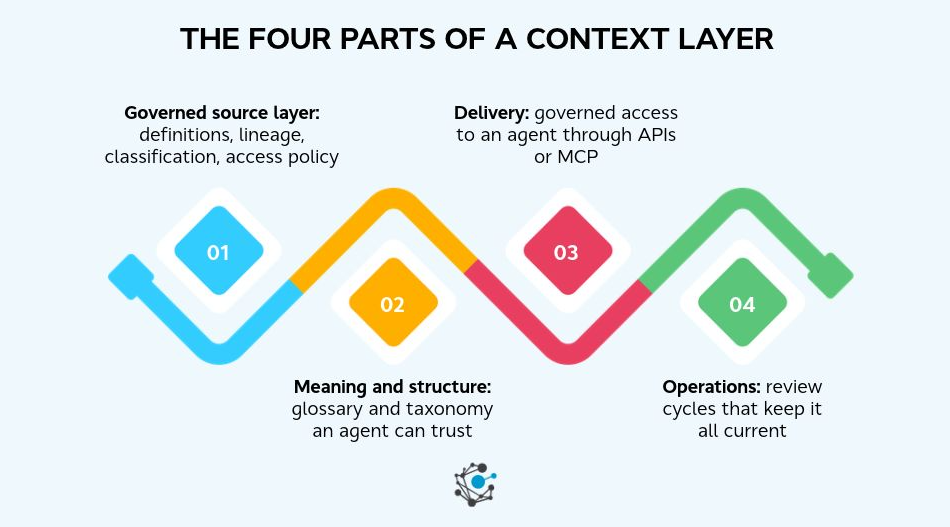
Most people say "context layer" as if it names one product you can shop for. It actually breaks into four separable capabilities, and the honest move is to buy some of them and build others.
The unified context layer buyers search for is really a set of connected governance artifacts (definitions, lineage, quality, ownership, and policy) made queryable for AI. Different vendors call this different things. What matters is that it breaks into four components, and each one carries its own build-or-buy answer.
The four components
1. Governed source layer
Business definitions, column-level lineage, sensitive data classification, named ownership, quality signals, and access policy. This is the trusted raw material everything else depends on. An agent without this layer cannot tell a correct answer from a confident guess.
Example: In banking, “high-risk counterparty” can carry different thresholds across credit, compliance, and trading desks. An agent pulling from any two of these sources blends definitions without flagging a conflict. The governed source layer is what catches the discrepancy before the agent produces a confident, contradictory answer.
2. Meaning and structure
The business glossary defines what a term means, and the taxonomy organizes those terms into categories and relationships. This is what lets an agent know that "churned customer" and "active customer" cannot both be true for the same account in the same month.
3. Delivery
How governed context reaches an AI agent at the moment it needs it. This includes APIs, protocol-based servers, and runtime interfaces that expose governed definitions, lineage, quality, and access controls to AI models and agents. This is the part most vendor pitches lead with, and it is also the smallest piece of the real problem. Delivery only works if what it delivers was already trustworthy.
4. Operations
Review cycles, versioning, monitoring, and the feedback loop that catches a definition before it drifts out of date. Skip this layer and the other three decay quietly, usually until an agent gives a stale answer with full confidence.
Which parts to build and which to buy
Each component of a context layer carries its own verdict. Here is how the build-or-buy call typically lands once you look at the four parts individually.
|
Component |
Typical verdict |
Why |
|
Meaning and structure |
Buy the glossary and the governed structure that connects it |
The glossary, taxonomy, and the structure that connects them to lineage, ownership, and quality belong in the governed layer. How one specific agent applies that meaning to one specific workflow is usually custom. |
|
Governed source layer |
Buy |
Definitions, lineage, classification, and access policy are large, standing investments. Most teams have already started one, and extending it beats rebuilding it |
|
Delivery |
Hybrid |
Governed access to the context graph through APIs or an MCP server is typically bought. The retrieval and orchestration logic for a specific agent is typically built. |
|
Operations |
Buy the tooling, staff the review |
Versioning and monitoring software is close to commodity. Someone inside your organization still has to own the review cycle. |
None of this starts from zero for most enterprises. A mature data catalog already holds a large share of the governed source layer, so audit your context layer architecture against what you already own before you price a build.
For the fuller case on activating that existing governance instead of rebuilding it, see the context layer most teams have already half-built.
What building a context layer in-house really costs
The build cost is never the number teams budget for at the start. It is the maintenance surface area you commit to owning indefinitely, long after the initial project ships.
Five specific cost lines make up that surface area, and teams routinely underestimate every one of them.
The five cost lines that teams underestimate
Five specific cost lines make up the maintenance surface area of an in-house context layer, and most teams underestimate every one of them before the first line of code ships.
1. Engineering headcount, permanently
Two to three infrastructure engineers, plus a slice of product, security, and UX time. This is not a project team that disbands at launch. It becomes a standing line item every year after.
2. Infrastructure operations
Running search, streaming, and orchestration infrastructure yourself means patching and scaling it for years, not standing it up once and walking away.
3. Connector maintenance
Every source is a connector your team builds, then keeps alive as APIs and authentication models change underneath it.
4. Access drift
Permissions your agents inherit go stale silently. Nothing crashes, so nobody notices until an audit flags it as a compliance exposure.
Example: A banking team renaming a core field in the source ledger needs to know which downstream regulatory reports depend on it and who owns each one. Without maintained access controls and lineage, nobody discovers the dependency until a compliance filing pulls stale data and a regulator flags the discrepancy.
5. Capability debt
This is the compounding cost of a path that cannot keep pace with how fast your agent use cases mature.
Most in-house builds are not abandoned because they fail at launch. They stall in month nine, when the same engineers who were meant to build agents spend their weeks on connector drift and stale permissions instead.
OvalEdge expert insight: The tell is headcount allocation. Once a dedicated engineer plus a slice of every analyst’s week goes toward maintaining what you already built instead of building what comes next, the build path has stopped paying for itself.
For contrast, Forrester’s TEI study of OvalEdge customers found up to 30 percent improvement in analyst productivity. That is an ongoing win a build team has to reproduce indefinitely, out of the same headcount pool it needs for new agent work.
Where does open source fit?
For many teams, building actually means running OpenMetadata, DataHub, or Amundsen instead of writing a platform from scratch. Doing that removes the license fee. It does not remove the maintenance burden, and self-hosting still leaves the compliance evidence work with you.
Managed open source is the honest middle ground. It keeps the metadata model and community while removing the upgrade and infrastructure load your team would otherwise carry. The differences between these platforms matter more than most teams expect, and our open-source data catalog comparison breaks them down.
Note: for a single-warehouse, engineering-led estate with no regulator asking questions, staying on open source is often the right call.
When building is genuinely the right call?
Building a context layer holds up under three honest conditions: context infrastructure is your product's competitive differentiator, you can staff it like a product with no planned end date, and your estate is small enough that connector coverage never becomes the bottleneck.
For example: Gorgias, a customer experience platform for e-commerce, built an internal AI agent that answers business questions by generating SQL against their warehouse. Their engineering team reports that SQL generation was never the hard part. Building the context layer underneath it was, spanning backend tables, event data, documentation, and business definitions. The real lesson is the scale of what a build team ends up owning.
What does buying a context layer platform really cost?
The license fee is never the real number, and everyone in a buy conversation already knows it. What often surprises people is that the fully loaded cost still lands well under what a permanent build team costs over the same years.
What sits above the license fee?
Four line items stack above that license fee, and each one shapes the real total more than the sticker price does. Let's look at each one.
1. Implementation
Connector setup, initial policy modeling, and glossary reconciliation against what you already have documented elsewhere.
2. Adoption
The line item almost every business case forgets. A governed layer nobody curates becomes a sunk cost, regardless of who built it.
3. Internal ownership
Light, but not zero. Someone still owns stewardship and review cycles once the platform is live.
4. Coverage you do not have to build
Buying gives you one governed layer that spans every system you connect, without asking your team to replicate that coverage platform by platform.
Before comparing vendor quotes, check how existing customers rate the platform you are evaluating. OvalEdge’s G2 reviews, for instance, consistently highlight time to value and connector coverage, two of the cost lines that matter most in a build vs buy decision.
When buying is the right call?
The case to buy a context layer gets strong under three conditions: your estate already spans more than one platform, your analytical AI agents need governed context that travels with them across systems, and time to first value matters more than deep customization.
Buying shifts the burden away from infrastructure, but the governance work does not disappear. Definitions still need named owners once the platform is live. The full cost model, including the line items most teams miss, is in our data catalog ROI breakdown.
The third path most comparisons miss: bundled platform-native context
A third option skips the build-or-buy question entirely: governance and context features already bundled inside a compute or storage platform you pay for, like Databricks Unity Catalog or Snowflake Horizon. Most build vs buy comparisons never mention it, which is a gap worth closing.
For a durably single-platform estate, bundling is genuinely the cheapest correct answer. Being upfront about that here is what makes the rest of this comparison worth trusting.
Bundling still comes with two real costs, though, and both tend to surface later than teams expect.
-
Coverage ceiling: Native governance covers its own platform well and stops at that platform's boundary. Add a second platform to the estate, and the governance graph stops at the first platform's edge. A connected governance graph that spans every system in the estate, not just one cloud’s native store, is what makes the multi-platform case work.
-
Lock-in that compounds: Switching cost rises as policies, lineage, and tags accumulate inside a proprietary store. The bundle path looks cheapest early and gets most expensive late.
If you want the specific pros and cons of each platform-native option, our context engineering platforms comparison breaks those down individually. This section covers the pattern across the category.
For example, an enterprise running Snowflake for its warehouse and AWS for its data lake finds that bundled governance covers one side cleanly and cannot see the other at all.
For a build vs buy enterprise context layer decision, bundling only holds up under one honest test: will your estate still be single-platform 24 months from now?
Build vs buy vs bundle: full cost and risk comparison
The short-answer table earlier compared build against bundle only, and the component table broke a context layer into its four parts.
This table puts all three paths side by side against the risks that actually decide a rollout: coverage, reversibility, and how a project tends to fail.
|
Cost or risk category |
Build in-house |
Buy a dedicated platform |
Bundle platform-native |
|
Engineering headcount |
Two to three permanent engineers |
Minimal, mostly implementation |
Existing platform team, nothing extra |
|
Integration and maintenance burden |
Entirely on your team |
Vendor-maintained connectors |
None, native to the platform |
|
Governance and compliance coverage |
As complete as you build it |
Broad, purpose-built |
Strong within the platform only |
|
Time to first value |
Months, often over a year |
Weeks to a couple of months |
Days to weeks |
|
Multi-platform reach |
Depends on what you connect |
Spans every connected system |
Stops at the platform boundary |
|
Deployment flexibility |
Fully yours to choose |
Varies by vendor |
Tied to that platform's model |
|
Reversibility and exit cost |
High, sunk engineering cost |
Low, if the architecture is open |
High, locked to that metadata store |
|
Most common failure mode |
Stalls around month nine |
Under-curated after go-live |
Blind spot at the platform edge |
Deployment flexibility deserves a closer look. Several dedicated platforms are cloud-only, which is easy to miss until a regulated, sovereign, or on-prem estate rules them out before cost even enters the conversation.
Reversibility does too. Build locks you into sunk engineering cost. Bundle locks you into a proprietary metadata store. Buying locks you in the least, but only if the architecture is genuinely open: interfaces you can call directly, and definitions and lineage you can export whenever you choose.
OvalEdge expert insight: Ask every vendor one question before you compare price. If we leave in two years, what leaves with us? The answer separates an open architecture from a rented one.
Five questions that settle the decision
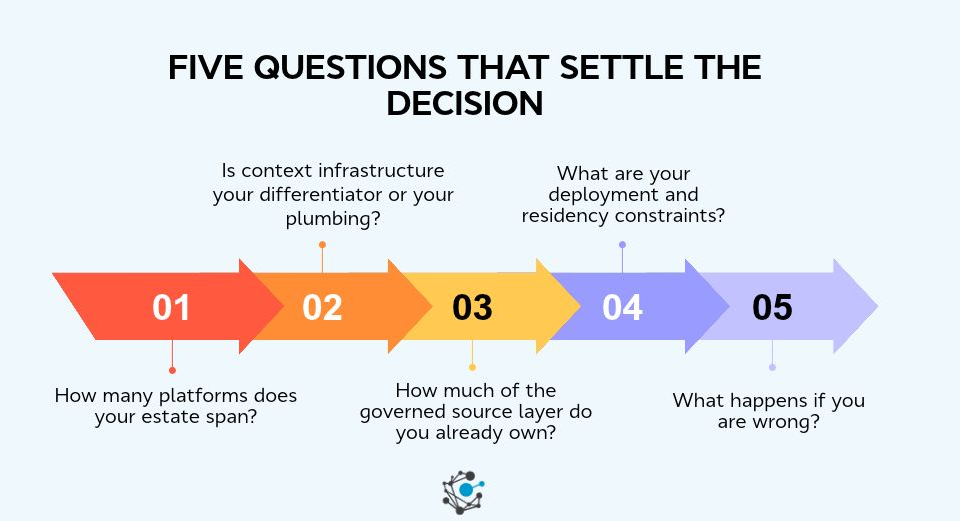
Skip the TCO spreadsheet until these five questions are answered, because the answers decide which spreadsheet you should even be building. Get these right and the build, buy, or bundle math becomes a formality.
Here are the five questions:
1. How many platforms does your estate genuinely span?
One platform, durably, points to bundle. Two or more points to buy or a hybrid.
2. Is context infrastructure your competitive differentiator, or your plumbing?
Only the first case justifies a build.
3. How much of the governed source layer do you already own?
Audit the glossary, lineage, classification, and ownership you already have before pricing anything new.
4. What are your deployment and residency constraints?
On-prem or sovereignty requirements eliminate cloud-only vendors before cost enters the conversation.
5. What happens if you are wrong?
Score each path on both entry cost and exit cost. The most expensive mistake is not choosing wrong. It is treating this as a one-time either-or decision instead of a split you revisit as the estate changes.
Enterprise data teams weigh lock-in against maintenance burden differently depending on their estate size, which is exactly why the scoring matters.
Scoring your answers
Three or more answers pointing to build means you are signing up to run a permanent product team. Three or more pointing to buy means the hybrid pattern below deserves a closer look than the build column does.
Who should be in the room matters as much as the scoring: data governance, platform engineering, and the AI team, with one accountable owner named. A context layer implementation moves fastest when that owner is named before the scoring exercise starts. Shared ownership without a named lead is how these decisions stall.
The hybrid path most enterprises land on
Most of the sections above describe pure paths, but pure paths are rare in practice. The pattern most enterprises actually land on is simpler: buy the governed foundation and the connective layer that makes it queryable, build the differentiating glue on top.
What to buy and what to build?
The hybrid pattern gets concrete here, split into one list to buy and one list to build.
Here are both the lists:
Buy: the standing infrastructure that looks the same across almost every enterprise:
- Governed source layer
- Connector coverage
- Sensitive data classification
- Lineage
- Policy enforcement
- Business glossary
- The Enterprise Context Graph that connects all of it into one structure analytical AI agents can query
This is exactly why it makes sense to buy it once instead of rebuilding it internally.
Build: use-case-specific retrieval logic, agent workflows, evaluation harnesses, and the domain-specific glue no vendor ships. This is where your actual differentiation lives, and it changes with every new agent you deploy.
The failed-build-then-buy trap
The costliest version of this decision is the one nobody plans for. A team ships roughly 60 percent of an internal context layer, stalls on schema drift and new source onboarding, and buys a platform anyway eighteen months later. The real cost ends up being build spend plus buy spend, paid in sequence, well beyond what either path alone would have cost.
There is a reliable tell before it gets that far: once a dedicated engineer, plus a slice of every analyst's week, is going toward maintenance instead of new work, the free option has already stopped being free.
A team running a homegrown catalog on Postgres and dbt docs is a common version of this. It holds up fine for about six months, then starts consuming a full-time engineer just to stay current, right as the business is asking it to cover more ground.
OvalEdge expert insight: The hybrid only works if the foundation you buy is open, and if the governed graph that connects it can be queried, exported, and pointed at agents outside the vendor’s own tools. If the graph is locked in, the glue you build on top is locked in with it.
What to check before you sign either way?
Whichever path you choose- build, buy, or bundle- the same capabilities have to exist somewhere before an agent can be trusted with a real answer.
Check for these before you sign anything:
-
Automated data inventory feeding a connected governance graph that spans every system you run, including legacy sources
-
Column-level lineage from source through to model or agent output
-
Sensitive data classification and fine-grained access control (column and row level)
-
Governed, permission-aware access built specifically for analytical AI agents through APIs or an MCP server
-
Approved business definitions with named owners and review cycles
-
A queryable governance graph that lets agents move from a business question to trusted data, with lineage, definitions, quality, and policy attached
-
Deployment options that match your residency and sovereignty rules (SaaS, customer-managed cloud, on-prem, or hybrid)
-
Exportable definitions, lineage, and policy
Pro tip: run this checklist against what you already own first. The gap list is your real build scope, and it is usually smaller than the vendor demo implies.
How OvalEdge fits the hybrid path
OvalEdge covers both parts of the hybrid: the governed foundation an enterprise has already started building through its data governance program, and the connective layer that activates that foundation for analytical AI through an MCP server.
Agents like Sift for sensitive data discovery, Curo for classification, and Nexus for cross-system curation handle the work that would otherwise become a permanent engineering line item in the build path. The use-case glue is the only piece your team builds.
Stop treating build vs buy as one decision
Build vs buy context layer was never one decision. It splits by component, and the honest split changes as your estate changes. Revisiting it is a normal part of the process, not a failure of the first choice.
Three verdicts hold up on their own. Build when context infrastructure is genuinely your product's IP. Bundle when your estate stays on one platform for good. Buy the governed foundation when context has to travel with your agents across systems.
Run the checklist above against what you already own, then book a demo to see where the gaps are.
.png?width=1081&height=173&name=Forrester%201%20(1).png)
.png?width=1081&height=241&name=KC%20-%20Logo%201%20(1).png)