.jpg)
Through 2026, Gartner expects organizations to abandon 60% of AI projects that aren't supported by AI-ready data. The number isn't the surprising part. In most enterprises, the foundation already exists.
Years of work went into governed data catalogs, business glossaries, lineage, and policies. AI agents just can't reach any of it coherently. So a finance copilot answers a Q3 ARR question from a table that was deprecated last quarter, while the certified definition sits in a glossary that the agent never sees.
A unified context layer fixes that. It's the activation surface that turns the governance an enterprise already owns into a trusted, machine-readable context for AI.
The shift here is about who consumes governance. Governance served people for years, and an analyst who hit a gap could fall back on judgment and memory. AI agents consume that same governance now, and they fill gaps with whatever context they can reach confidently.
What follows is what it is, how it differs from the tools it gets confused with, and how to build one without ripping anything out.
What is a unified context layer?
A unified context layer makes governed enterprise metadata usable by AI. It pulls together what already lives in the catalog, glossary, lineage tools, and policy engine, then serves it to AI agents through APIs and open standards, so every answer rests on context that the business has approved.
It activates four assets most enterprises already manage:
-
Technical metadata from catalogs, warehouses, and lakes
-
Business meaning from glossaries and semantic models
-
Trust signals from lineage, quality scores, and policies
-
Operational context from usage, ownership, and access patterns
These assets exist in most companies today, but they sit in separate tools people browse, not tools machines query. An analyst can click through three systems to confirm a number. An agent answering in real time cannot. A governed context layer brings them into one place; an agent can call the moment a question lands.
None of this means building a new system. The catalog, glossary, lineage, and policies stay where they are. A unified context layer keeps your governance program exactly where it is and makes it executable for AI, the surface that makes what you already run readable to agents.
The trouble starts when this layer gets confused with two things it is not: a data catalog and a semantic layer.
Unified context layer vs data catalog vs semantic layer
A data catalog is the governed foundation. A semantic layer delivers that foundation to BI. A unified context layer delivers it to AI. All three get conflated because they share one foundation, and only one of them is that foundation.
|
Dimension |
Data catalog |
Semantic layer |
Unified context layer |
|
Purpose |
Govern and inventory data |
Serve consistent metrics to BI |
Serve trusted context to AI |
|
Primary consumer |
Stewards and analysts |
BI users and dashboards |
AI agents and copilots |
|
What it carries |
Definitions, ownership, classifications |
Metrics and dimensions |
Definitions, lineage, policies, quality, usage |
|
What it doesn't |
Reach machines in real time |
Carry lineage, policies, or quality |
Replace the catalog or pipelines |
The table shows what each layer carries. The more useful question is which one you reach for, and that comes down to who needs the data.
People finding and trusting data need the catalog. It's the prerequisite for everything else, so a weak catalog is the first thing to fix.
Analysts needing consistent metrics across dashboards need a semantic layer. It resolves what a metric means for BI, and that's where its job ends. It was never built to carry the lineage, permissions, and quality signals an agent needs to act on a number safely.
AI agents answering from governed data need a context layer. It's the only one of the three that exposes trust signals to machines in real time.
Most enterprises already run the first two. The mistake is assuming the semantic layer will stretch to serve AI, or rebuilding a catalog that already exists. The next question is what's actually inside the context layer.
The anatomy of a unified context layer: 6 core components
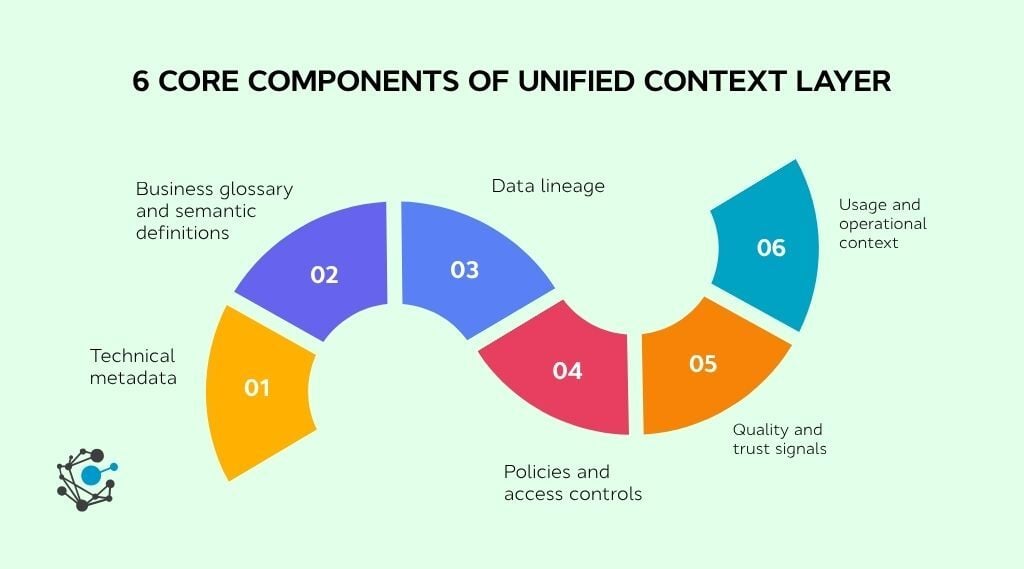
A unified context layer runs on six components, and a mature governance program already manages most of them. The work is exposing each one to AI agents instead of only to people. The six are technical metadata, the business glossary, data lineage, policies, quality signals, and usage context.
1. Technical metadata
Technical metadata is the structural record of your data: schemas, tables, columns, data types, refresh timestamps, and source identifiers. The catalog already holds it.
For AI, an agent has to know which table is canonical, when it last refreshed, and whether it's certified before it answers. Activation exposes that metadata through APIs that the agent queries at inference time, not just a screen a person reads. The agent stops guessing which of four similarly named tables to trust, because the catalog tells it.
2. Business glossary and semantic definitions
The business glossary holds the governed meaning of business terms: what counts as an "active customer," how "ARR" is calculated, and who owns each definition. Analysts treat it as a reference doc they open when unsure.
For AI, an agent needs that meaning at the moment of the query, not a wiki it never visits. Activation turns the glossary into a real-time lookup, so the agent resolves "ARR" exactly the way finance defined it. A governed catalog with an active business glossary, like the one OvalEdge maintains, becomes the context layer the moment it's opened to agents.
3. Data lineage
Data lineage maps how data moves: the upstream sources, transformations, and downstream reports tied to any table, parsed from SQL, dbt, ETL, and BI models. Your governance platform already builds these maps.
For AI, lineage does two jobs. It gives every agent answer a traceable path back to a verified source, so a reviewer sees exactly where a number came from. And it holds back hallucination, because lineage coverage becomes the measurable line between a governed answer and an agent improvising on whatever it scraped.
4. Policies and access controls
A sales copilot summarizes the pipeline for a regional VP and includes deal terms from a region she can't access. The policy existed in the governance platform. It never reached the agent.
Policies and access controls cover the classifications, masking rules, retention rules, and regulatory tags your team already manages. Activated, each policy travels with the asset the agent reads, so the agent respects the same access boundaries as the person asking.
No separate enforcement layer to build, and no copilot quietly leaking what a user was never cleared to see.
5. Quality and trust signals
An exec asks for last week's churn rate. The agent returns a confident number from a table that hasn't been refreshed in twelve days. The certification status existed. The agent never checked it.
Quality and trust signals include certification status, freshness SLAs, validation results, known issues, and deprecation flags. Once activated, agents prefer certified sources, flag uncertainty when data is fresh but unvalidated, and refuse to cite anything pulled from a retired table.
The agent learns the difference between a number it can stand behind and one it cannot.
6. Usage and operational context
Usage and operational context records how data actually gets used: who queries what, how often, and which dashboards depend on which tables. Query logs, BI telemetry, and catalog usage data already capture it.
For AI, usage signals tell an agent what the organization genuinely relies on. When two tables both claim to hold "revenue," the one that analysts query daily is far more likely canonical than the stale copy no one has touched in months. That signal hands the agent real judgment, so it picks the table that the business trusts.
The six-in-one request
These six don't fire one at a time. They work together on a single request.
Ask an agent, "What's our current ARR?" and one call to the context layer checks all six. The glossary says what ARR means. The metadata points to the right table and confirms it's fresh. Lineage shows where the number came from. Quality signals confirm the table is certified. Usage data picks the table people actually trust. Policies check that the person asking is allowed to see it.
No single component does the job alone. The glossary knows what ARR means, but not whether the data is fresh. Lineage shows where a number came from, but not who can see it. Put together, they turn six separate capabilities into one answer that the business can stand behind.
How OvalEdge sees it
Most of what the market now sells as a "context graph" or a brand-new context architecture is these six components, connected. OvalEdge's position is that you don't buy a new layer to get there. You start with the governance you already run, then connect it and open it to agents. Same outcome the hype promises, without the rip-and-replace.
The next question is how all six reach an agent in a single call.
How a unified context layer works: architecture and delivery to AI
A unified context layer works in three moves: it ingests metadata from the tools you already run, maps it into one connected model, and delivers that model to AI agents through APIs and MCP.
Ingest
Connectors pull metadata from catalogs, warehouses, BI, dbt, governance platforms, and data quality tools. Most active metadata setups already do this. What changes for AI is timing. The metadata refreshes continuously and stays queryable in real time, instead of landing in a monthly crawl that an agent can't wait for.
Map
The layer ties each technical asset to its business definition, attaches lineage and policies, and stamps it with quality and usage signals. The result is a connected model of how your data relates. This is the substance behind the "context graph" label, and the relationships are ones your platform already tracks, not a new structure to invent.
Deliver
APIs and the Model Context Protocol (MCP) form the agent-facing surface, the standard interface an agent calls to reach context. This sits on top of the connected model from the Map step, and it's the main piece most enterprises still have to add.
That's the runtime path: ingest, map, deliver. It explains how context reaches the agent. It doesn't explain how the agent knows to trust it. That's a separate job.
Where trust gets enforced
APIs, MCP, and RAG move the governed context to the agent. They don't make it trustworthy on their own. The trust comes from the governance underneath, and retrieval patterns like RAG ride on that foundation.
Governance review doesn't disappear in this model. It becomes machine-readable. If the agent's confidence drops below the threshold, if the query touches sensitive data, or if the source is fresh but unvalidated, the answer routes to a steward before it reaches the user. Steward decisions on definitions, certifications, and policies then propagate back in real time, so one approval reaches every agent automatically.
That covers how the layer runs. The harder question is how you build one from the governance you already have.
How to build a unified context layer
Building a unified context layer rarely means building new architecture. It starts with finding where business context already lives, across your catalog, glossary, lineage, policies, and stewardship work. Most of it is already there.
Before reaching for the most fashionable architecture, diagnose where meaning actually breaks. In finance reporting, the break is usually definitional. In catalog-heavy workflows, it is categorizational. In planning, it is relational. That diagnosis tells you which gap to close first.
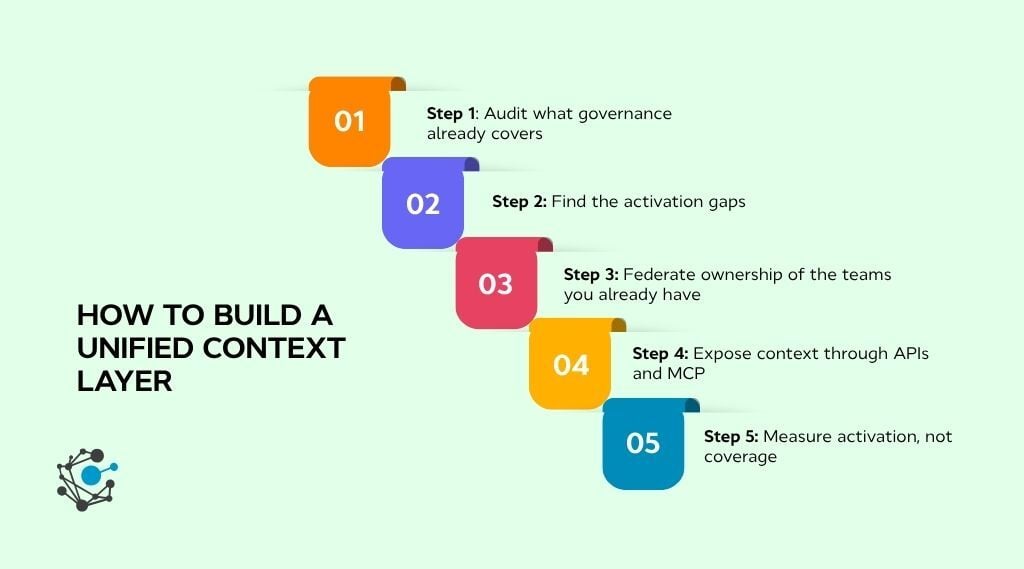
Step 1: Audit what governance already covers
Map what you own against the six components, then score coverage by domain instead of by component. Finance, customer, product, and HR each tell a different story. Most enterprises find the bulk of the foundation already in place, with the real gap in delivery to machines rather than in the governance itself.
Step 2: Find the activation gaps
The gaps are usually predictable: glossary terms not linked to technical assets, lineage that stops at the warehouse boundary, policies enforced in IAM but not in metadata, quality signals trapped in DQ tooling, and stewardship decisions recorded nowhere a machine can read. Pick one high-value domain, finance reporting or customer 360, and close its gaps end-to-end. Use that win to fund the next.
Working through your own activation gaps?
OvalEdge's Implementing Data Governance whitepaper lays out the foundation that this build process assumes you already have.
This doesn't need a new org. Domain teams keep owning definitions and certification. The platform team extends its pipelines and APIs to context delivery. The CDO office extends governance, policy, and audit to cover the AI context. Many enterprises name a context engineering lead to coordinate, but the ownership model doesn't change.
Step 4: Expose context through APIs and MCP
Build the interface agents call to reach context, since it's the only part governance doesn't already give you. MCP is becoming the default standard for that connection. Keep it API-first and interoperable, so a shift in AI tools doesn't strand you on a single platform.
Step 5: Measure activation, not coverage
Coverage tells you what governance exists. Activation tells you what reaches agents. Track five signals each quarter: lineage coverage, context freshness against SLAs, validation pass rate, agent task success, and hallucination rate. Agent success climbing while hallucination drops is the clearest proof that activation is working.
Building rarely starts from zero. The first real question is whether the governance platform you already run can stretch into AI activation at all.
Is your governance platform activation-ready?
The real question isn't which context layer tool to buy. It's whether the governance platform you already run can extend into AI activation. Most enterprises have a governed catalog, an active glossary, lineage parsing, and a policy engine in place, which is most of what activation needs.
Score your platform against seven criteria:
-
Active metadata that refreshes continuously, not on a fixed schedule
-
A governed business glossary with stewardship workflows and API access
-
Lineage that runs end to end across SQL, dbt, ETL, and BI
-
A policy and classification engine that stays attached to metadata wherever an agent reads it
-
Quality and certification signals exposed through an API
-
API-first architecture with MCP readiness
-
A composable design that plugs into your warehouse, BI, and AI stack instead of replacing them
Score well, and the decision changes shape. It stops being "what new tool do I need" and becomes "is my platform activation-ready." Platforms like OvalEdge are built around these criteria by design, so activation becomes an extension of your existing program rather than a new build.
See how OvalEdge activates your governance program for AI agents.
That settles the tooling question. What's left is the cost of waiting.
Conclusion
Every quarter spent waiting is a quarter of agents answering from whatever they can reach, with no way to separate a trusted source from a retired one. A wrong answer from one agent does not stay put. It propagates across reports, decisions, and downstream workflows at machine speed, and confidence in every AI answer the business ships erodes with it. AI raises what weak governance costs.
The organizations that pull ahead won't build the most context. They'll activate the governance they already own and put it in front of agents in a form machines can trust.
OvalEdge turns the catalog, glossary, lineage, and policies you already run into governed context agents can call in real time, so AI answers carry the trust your governance already enforces. See it on your own data.
Book a demo to activate your governance for AI.
.png?width=1081&height=173&name=Forrester%201%20(1).png)
.png?width=1081&height=241&name=KC%20-%20Logo%201%20(1).png)