.png)
Most organizations assume their AI governance challenge begins with the model. In reality, it begins with the context.
According to Economist Impact research cited in Evolv's AI Governance Statistics 2026 report, 88% of organizations are already using AI across business functions, yet only 8% have implemented a comprehensive AI governance framework.
This gap between AI adoption and governance is becoming one of the defining challenges of enterprise AI.
The real problem is not that AI agents lack context. It is that enterprises have never had a large-scale machine consumer of governance assets before. Business glossaries, data lineage, ownership records, quality indicators, certification workflows, and access policies were built to help people understand and trust data. AI agents now need those same assets, delivered and enforced at machine speed.
This article explores how an enterprise context layer for AI governance transforms existing governance assets into a trusted, machine-consumable context for AI systems.
What is an enterprise context layer for AI governance?
An enterprise context layer for AI governance is the governed layer that sits between an organization's data systems and its AI agents. It encodes what data means, who is allowed to use it, where it came from, and whether it can be trusted, then enforces those rules every time an agent retrieves information.
In practice, it turns governance assets the enterprise already owns, such as the catalog, glossary, lineage, and access policies, into a context that machines can consume safely at query time.
The five things a context layer encodes
A working context layer carries five critical types of context:
-
Semantic definitions: Establish what business terms and metrics actually mean.
-
Entity resolution: Ensure entities such as customers, products, and employees are consistently identified across systems.
-
Governance rules: Define what data an AI agent can access and under what conditions.
-
Data lineage: Record where data originated and how an answer was produced.
-
Memory: Preserve prior decisions and interactions so agents remain consistent over time.
These are not features bolted onto a tool. They are the foundational elements to which governance is applied. The reason this matters is simple.
According to a 2026 study by Cloudera and Harvard Business Review Analytic Services, only 7% of enterprises say their data is completely ready for AI.
The remaining organizations are asking AI systems to operate on context that was never designed or governed for machine consumption.
Where the context layer sits in the AI stack
The context layer sits between enterprise data and AI systems. It acts as a bridge, helping AI agents understand what data means, where it came from, who owns it, and whether it can be trusted.
Data Sources → Context Layer → AI Systems
-
Data Sources: Warehouses, lakes, databases, and business applications
-
Context Layer: Glossary definitions, lineage, ownership, quality signals, certifications, and governance policies
-
AI Systems: Models, copilots, and AI agents
The value is simple. The same governance assets that help people understand and trust data can also help AI agents. Instead of building separate governance frameworks for humans and machines, organizations can use the same trusted foundation for both.
Context layer vs. semantic layer vs. data catalog
These terms are often used interchangeably, but they solve different problems.
|
Layer |
Purpose |
What it provides for AI |
What it does not provide |
|
Semantic layer |
Standardizes business metrics and definitions |
Consistent business meaning and calculations |
Governance, access control, lineage, or trust signals |
|
Data catalog |
Organizes and documents data assets |
Metadata, discovery, ownership, and documentation |
Runtime enforcement of policies for AI agents |
|
Context layer |
Delivers governed context to AI systems |
Business meaning, lineage, ownership, quality signals, certifications, and access controls |
Does not replace the catalog or semantic layer; it builds on them |
A governed semantic layer for AI gives meaning. A context layer adds the trust, permissions, and runtime control that make that meaning safe for an agent to act on.
Why AI governance breaks without a context layer
Most enterprise AI governance frameworks govern the agent and ignore the data the agent reads. That single blind spot is where the failures start.
1. The governance gap: behavior is governed, knowledge isn't
Identity controls, permissions, and output filters all sit at the agent layer. The data feeding the agent often sits outside the governance program entirely.
In 2026, Gartner highlighted the growing importance of semantic context for AI agents. The research noted that schema-based data alone does not provide sufficient business meaning for agents to accurately understand and use enterprise information. Agents need access to business definitions, relationships, ownership information, governance policies, and other contextual metadata that help explain what data means and how it should be used.
The consequence is straightforward. A perfectly governed agent running on ungoverned data can still produce confidently wrong answers.
2. Systematic failure, not random hallucination
An ungoverned context does not cause occasional slips. It causes the same mistake every time. An agent pulling from a stale metric or a misclassified field fails identically on every query, and no behavioral guardrail catches it, because the agent is behaving exactly as designed.
This is the failure mode that survives a clean security review and still breaks in production, the way clinical and operational models quietly degrade once real-world data drifts away from the conditions they were tested in. The model is not broken. The context is.
3. The compliance and audit exposure
For regulated industries, an ungoverned context creates significant compliance and audit risks. Organizations increasingly need to explain how AI systems arrived at decisions, what data was used, and whether that data was approved, trusted, and appropriate for the task.
Without lineage, ownership, certification, and traceability on the data an agent consumes, that level of transparency becomes difficult to achieve. When an organization cannot demonstrate the source and governance status of the information behind an AI-generated decision, both compliance and auditability suffer.
Audit-ready AI is not simply a logging challenge. It starts with governing the data and context
4. The cost of getting it wrong
The business impact of an ungoverned context extends far beyond inaccurate answers. Organizations are increasingly discovering that AI success depends as much on data readiness as it does on model performance.
Gartner predicts that through 2026, organizations will abandon 60% of AI projects that are not supported by AI-ready data. The message is clear: even the most advanced AI systems struggle to deliver value when they lack trusted, well-governed context.
As enterprises scale AI agents, investment is shifting from model experimentation toward the governance, metadata, lineage, and semantic foundations that make AI outputs reliable, explainable, and trustworthy.
The two control surfaces: governing what agents can do vs. what they can know
As enterprises deploy AI agents at scale, governance must address two separate but equally important questions: what an agent is allowed to do and what information it is allowed to trust. Effective enterprise AI governance requires controls for both behavior and knowledge because securing actions alone does not guarantee accurate, reliable, or compliant outcomes.
At the heart of AI governance are two distinct control surfaces. One governs agent behavior. The other governs agent knowledge. Most governance frameworks focus heavily on the first and provide far less coverage for the second.
Agent-layer controls (governing behavior)
The agent layer governs what the agent does: non-human identity, scoped permissions, action limits, output policies, human-in-the-loop triggers, kill switches, and orchestration audit logs.
Agent security and identity vendors operate here, and this work matters. Its limit is structural, though. Every one of these controls acts after the data has already been consumed. They cannot repair a bad input. They can only constrain what the agent does with it.
Context-layer controls (governing knowledge)
The context layer governs what an AI agent knows. An agent may retrieve multiple datasets, definitions, policies, or business rules related to the same question. Governance determines which source is trusted, approved, and appropriate for the task.
The context layer provides that control through certification, lineage, business definitions, access controls, and policy enforcement. Together, these capabilities help ensure agents retrieve information that is trusted, traceable, and compliant.
Agent layer vs. context layer
The difference between these two control surfaces becomes clearer when viewed side by side.
|
Dimension |
Agent layer |
Context layer |
|
What it governs |
Behavior and actions |
Knowledge and inputs |
|
Failure it prevents |
Unauthorized or unsafe actions |
Confidently wrong answers |
|
Where failure originates |
Agent logic and permissions |
Ungoverned or ambiguous data |
|
Current framework coverage |
Well covered |
Mostly absent |
|
Who owns it |
Security and platform teams |
Data governance and CDO teams |
MCP and the delivery of governed context
The Model Context Protocol (MCP) is becoming a standard way for AI agents to connect to enterprise tools and data, making the MCP server an increasingly important interface between the agent and the business.
However, exposing data through MCP is not enough. Agents also need access to trusted business definitions, permissions, lineage, freshness indicators, and governance policies. Without this context, agents may retrieve data successfully but still use it incorrectly.
At OvalEdge, we view MCP as a delivery mechanism rather than a source of context. The value of an MCP connection depends on the quality, governance, lineage, ownership, and trustworthiness of the information being delivered through it.
This is why an AI-ready data catalog and governance layer matter as much as the protocol itself. MCP enables access. Governed context determines whether that access can be used safely, consistently, and responsibly.
How an enterprise context layer enforces governance at runtime
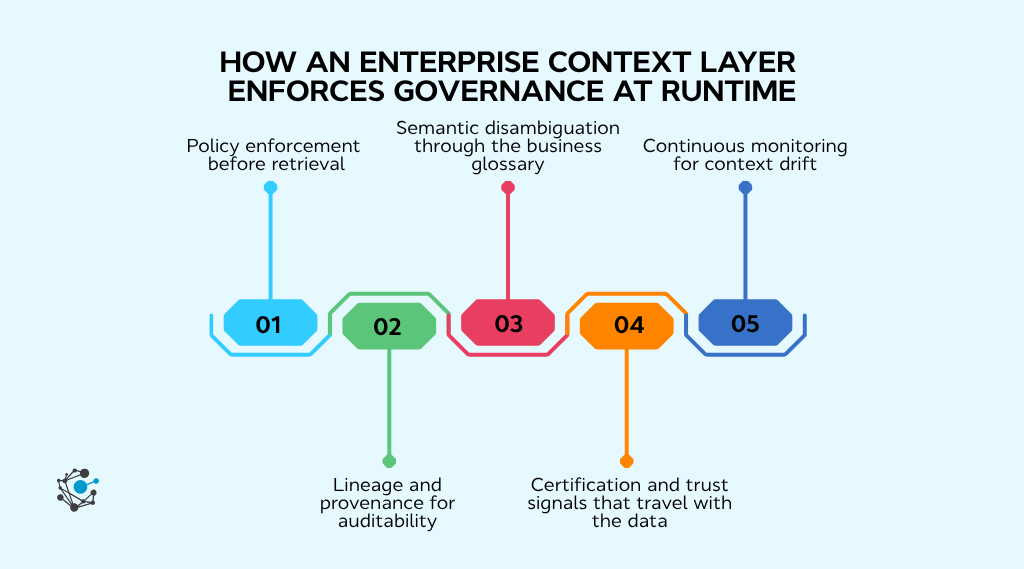
Governance only counts if it runs on every request. Here is what happens on a single agent query, capability by capability.
1. Policy enforcement before retrieval
Sensitivity tags, access rules, and usage constraints are evaluated before the agent receives any data. An agent with read access to one dataset does not inherit access to adjacent PII fields simply because it is an agent.
2. Lineage and provenance for auditability
Every value an agent cites traces back through each transformation to its source. An agent reports a revenue figure, and a data lineage trail shows the joins, filters, and source pipeline behind it. That traceability is what makes a decision auditable rather than merely logged.
3. Semantic disambiguation through the glossary
"Revenue" resolves to the finance definition, not whatever an upstream pipeline happened to label it, and "customer" stays consistent across systems. The business glossary enforces meaning at retrieval, so the agent is not left to guess.
4. Certification signals that travel with the data
Certification status, whether trusted, deprecated, or under review, moves with the data through every retrieval. Active metadata means an agent pulling a deprecated dataset surfaces a real-time governance flag, the exact check that catches silent degradation before it reaches a decision.
5. Continuous monitoring for context drift
Governance is ongoing, not a pre-launch checkbox. Alerts fire when certified datasets change or are deprecated, which is how teams catch quiet decay before it shows up in production output.
Example: How governance works on a single AI query
When an agent asks, "What was our recognized revenue last quarter?"
-
Policy check: Access controls verify that the agent can view the required financial data.
-
Glossary resolution: "Recognized revenue" is mapped to the approved business definition.
-
Certification check: Trusted, certified datasets are prioritized over unverified sources.
-
Lineage validation: The agent traces where the data came from and how it was transformed.
-
Response delivery: The answer is returned with a trusted, governed context behind it.
This is how policy, glossary, certification, and lineage work together to help produce accurate, explainable, and auditable AI outputs.
Ready to see the governed context in action? Book a demo to see how OvalEdge helps organizations deliver trusted business definitions, lineage, certifications, and governance controls to AI agents at runtime.
Building an enterprise context layer for AI governance: A practical framework
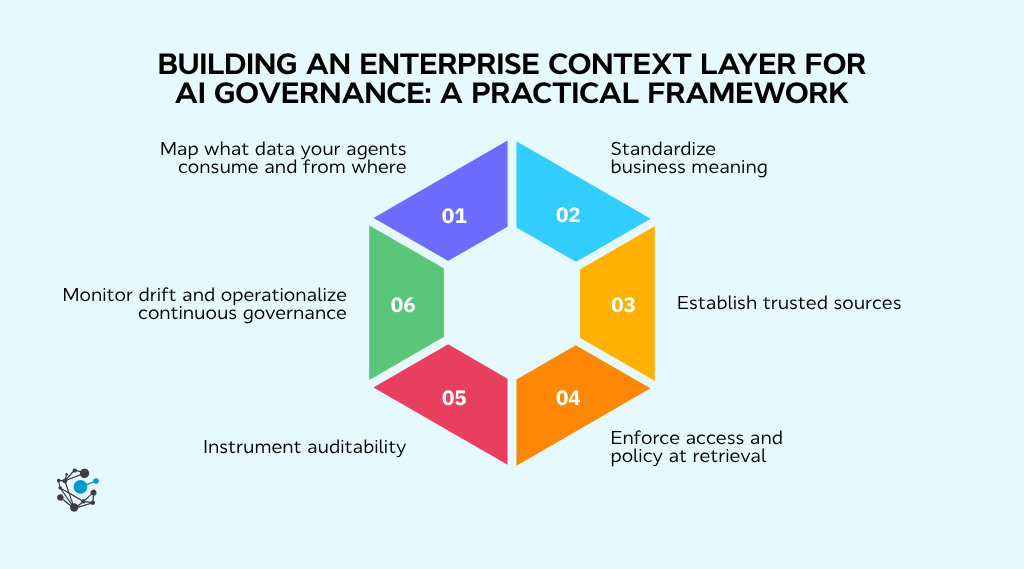
Building an enterprise context layer does not require replacing existing governance investments. Instead, it extends governance capabilities so they can be consumed and enforced by AI agents at runtime.
At OvalEdge, we believe most enterprises already possess much of the context their AI agents need. The challenge is rarely creating a new context. It is identifying trusted context, governing it, and making it accessible to AI systems when decisions are made.
Before getting started, organizations should establish an inventory of active agents and their data access paths, a catalog capable of certification and lineage, a non-human identity framework, orchestration-layer observability, and governance policies aligned with business and regulatory requirements.
Step 1: Map what agents consume and from where
Catalog every dataset, API, and tool agent's access at runtime, not just during deployment. Shadow agent access, where an agent queries data outside the visibility of the governance program, is often one of the biggest blind spots.
For example, a finance agent answering revenue questions may retrieve information from a data warehouse, CRM system, and forecasting platform. All three sources should be visible and governed.
Step 2: Standardize business meaning
Build business glossaries, metric definitions, and entity resolution rules so terms and metrics are interpreted consistently across systems. Ambiguity is a governance problem as much as a data quality problem.
For example, a finance agent should resolve "revenue" to the organization's approved definition rather than selecting between competing definitions used by different teams.
Step 3: Establish trusted sources
Assign ownership, certification status, and lineage to the data sources agents use. Sensitive, PII, and regulated fields should be identified and governed so agents retrieve information from approved and trusted assets.
For example, if multiple revenue tables exist across finance and sales systems, certification helps ensure the agent uses the approved source rather than an outdated or department-specific dataset.
Step 4: Enforce access and policy at retrieval
Apply governance policies to agent interactions at runtime. Every agent should operate with least-privilege access and retrieve only the information required for its task.
For example, a customer support agent may be allowed to access account information but restricted from viewing payroll records or sensitive financial data.
Step 5: Instrument auditability
Log the context behind every AI decision, not just the actions taken. Organizations should be able to trace the data, definitions, certifications, and policies that influenced an agent's response.
For example, when an agent reports a revenue figure, auditors should be able to identify the datasets, glossary definitions, and governance controls that contributed to the answer.
Step 6: Monitor drift and operationalize continuous governance
Establish alerts for changes to certified datasets, approval workflows for production context, and rollback capabilities when governance issues arise. Governance should operate as an ongoing control plane rather than a one-time review.
For example, if a certified revenue dataset is modified or deprecated, governance teams can review the change before it affects agent outputs across the organization.
Common pitfalls to avoid
Even well-designed AI governance programs can fail if a few foundational practices are overlooked. Common pitfalls include:
-
Treating governance as a one-time pre-deployment audit rather than an ongoing operational discipline.
-
Governing model behavior while ignoring the quality, trustworthiness, and governance status of the data being retrieved.
-
Sharing service-account credentials across multiple agents, which makes attribution and accountability difficult.
-
Logging agent actions without capturing the context, data sources, definitions, and policies that influenced those actions.
These issues often undermine traceability, trust, and compliance, even when other governance controls appear to be in place.
What to look for in a context layer platform
Not every data platform is designed to serve a governed context to AI agents. The capabilities that matter are the ones that help organizations control, explain, and trust the information agents consume at runtime.
Capabilities that matter
-
Active metadata keeps ownership, quality, sensitivity, and trust signals current, so governance decisions reflect the latest state of the data.
-
Column-level lineage enables auditability by tracing AI-generated outputs back to their original sources and transformations.
-
A business glossary establishes consistent business meaning so agents interpret metrics, entities, and terminology the same way across systems.
-
Certification management identifies trusted and approved data assets, helping agents prioritize authoritative sources over unverified ones.
-
Policy and access enforcement apply governance controls before retrieval, ensuring agents access only the data they are authorized to use.
-
MCP-native governance extends governance controls into agent runtime environments, allowing policies to travel with the context delivered through MCP connections.
-
Continuous monitoring detects data changes, governance risks, and context drift before they affect AI outputs.
How catalog-led platforms deliver the context layer
In practice, the data catalog often becomes the foundation of the context layer, serving as the infrastructure that AI agents query for business definitions, lineage, certifications, ownership information, and governance policies at runtime.
Platforms such as OvalEdge, Atlan, Collibra, and Alation all provide pieces of this foundation, though they differ in how governance is operationalized and delivered to AI systems.
At OvalEdge, capabilities such as Data Catalog, Business Glossary, Data Lineage, Data Quality, and Agentic Data Governance help organizations activate existing governance assets as a trusted context for AI agents rather than building a separate governance stack from scratch.
For a deeper comparison of how leading platforms approach governance, metadata, lineage, and AI readiness, see the OvalEdge vs. Alation vs. Collibra vs. Informatica comparison hub.
Conclusion
A context layer is the foundation that trustworthy AI depends on. Governing what an agent can do is important, but governing what it knows is what determines whether its outputs can be trusted, explained, and audited.
At OvalEdge, we believe most organizations already possess much of this foundation. Business glossaries, data lineage, metadata, certifications, and governance policies often exist today. The opportunity is to activate these assets as a live context layer that AI agents can consume at runtime.
The organizations building both behavioral controls and governed context will be the ones that can explain, audit, and stand behind AI-driven decisions. If an AI agent made a business decision today, could your team trace the context that influenced it?
Ready to see how existing governance investments can become a trusted context for AI agents? Schedule a demo to learn how OvalEdge helps organizations operationalize governance for AI.
.png?width=1081&height=173&name=Forrester%201%20(1).png)
.png?width=1081&height=241&name=KC%20-%20Logo%201%20(1).png)