.jpg)
Enterprise AI governance often starts with standard questionnaires, fixed model classifications, and periodic reviews. These methods provide a useful foundation, but they become less effective when the same model is deployed across different business functions, connected to new datasets, used by different populations, or given greater decision authority.
This growing need for more adaptive governance is reflected in McKinsey's Global AI Trust Maturity Survey 2025, which surveyed more than 750 leaders across 38 countries and found an average responsible AI maturity score of 2.0 out of 4.
The findings suggest many organizations have established core practices such as risk indicators, data quality guidelines, and incident response plans but are now ready to evolve toward more adaptive oversight.
An AI contextual governance framework supports that next step by applying controls according to each use case’s purpose, data sensitivity, impact, users, regulatory exposure, and autonomy.
What is AI contextual governance?
AI contextual governance is a risk-based approach that adjusts AI policies, approvals, monitoring, and human oversight according to the purpose, data sensitivity, users, decision impact, autonomy, and regulatory environment of each AI use case. Rather than assigning one permanent risk rating to a model, we assess it within the process where it operates.
A model summarizing public documents may need basic registration and monitoring. The same model requires stronger access controls when it processes customer data, while employment, lending, or healthcare use may require validation, accountability, and human review. Each use case becomes the primary governance record in a data catalog, connecting the model to its owner, users, data, policies, risks, controls, and approvals.
Why traditional AI governance frameworks fall short
Traditional frameworks often classify AI during development or deployment, then rely on periodic reviews. This approach assumes that AI systems, users, data access, and permissions will remain consistent after approval.
In practice, governance teams may not know when employees adopt unapproved tools or when an approved system begins operating outside its original scope.
IBM’s 2025 Cost of a Data Breach Report found that 63% of breached organizations either lacked an AI governance policy or were still developing one. Even among organizations with policies, only 34% regularly audited for unsanctioned AI use.
This leaves organizations with policies they cannot consistently verify or enforce. Model-level assessments may overlook differences between business uses, while annual reviews can miss new data, users, jurisdictions, integrations, and permissions. Contextual governance addresses these limitations by continuously matching controls to each use case’s current purpose, data exposure, impact, and authority.
Contextual governance vs model-level governance
Contextual governance does not replace model-level governance. It separates decisions that apply to the underlying model from decisions that depend on how that model is deployed within a specific business process.
|
Governance decision |
Model level |
Use-case or contextual level |
|
Model identity and provenance |
Record the provider, version, architecture, license, and training information |
Connect the approved model version to each business deployment |
|
Technical evaluation |
Test accuracy, robustness, bias, security, and known limitations |
Decide whether the evaluation results are sufficient for the intended use |
|
Business purpose |
Not determined at the model level |
Record the process, objective, users, affected parties, and expected outcome |
|
Data access |
Document general model requirements and restrictions |
Identify the actual data accessed, its sensitivity, quality, ownership, and permitted use |
|
Risk classification |
Record inherent technical limitations |
Assign risk according to the use case’s impact, autonomy, regulatory exposure, and potential harm |
|
Controls and approvals |
Apply baseline model requirements |
Set use-specific access, human review, monitoring, evidence, and approval requirements |
|
Change management |
Reassess when the model or provider changes |
Reassess when the purpose, users, data, tools, permissions, or authority change |
Model-level evidence should feed every use-case assessment, but the business context determines how that evidence affects risk and control decisions. A technically approved model may still be restricted or prohibited for a particular deployment.
What are the core components of an AI contextual governance framework?
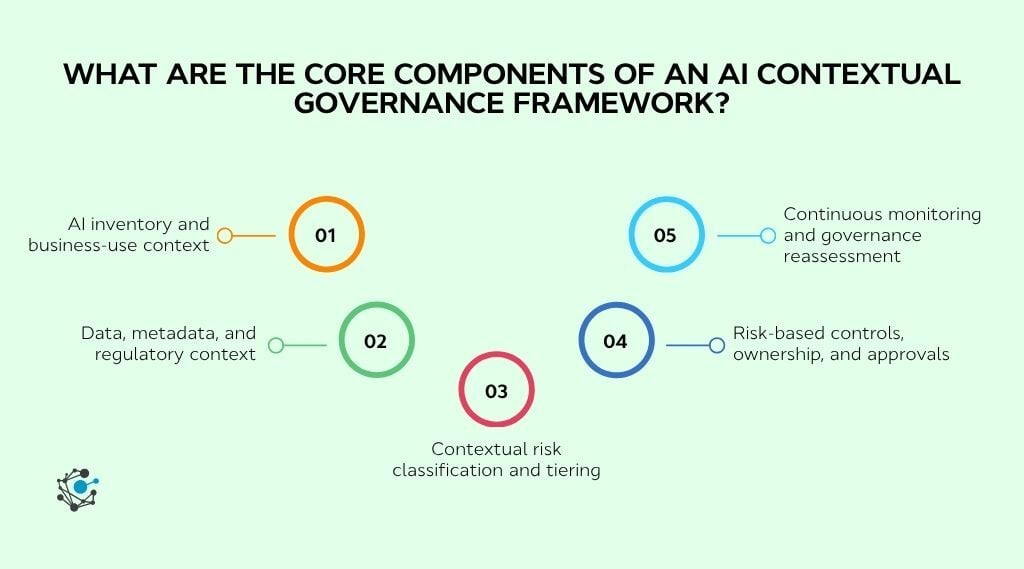
An AI contextual governance framework needs five connected components to support defensible decisions about risk, controls, ownership, and evidence. Together, they ensure that governance reflects how each AI use case operates
1. AI inventory and business-use context
The framework should maintain an inventory of models, generative AI applications, agents, copilots, embedded AI features, third-party systems, experiments, and shadow AI.
Each business deployment should have its own governance record, even when several use cases rely on the same model. That record should identify its purpose, owner, users, business process, expected outcome, affected parties, and consequences of failure.
This distinction matters because a model used for document summarization may require different controls when used for lending, employment, or healthcare decisions.
2. Data, metadata, and regulatory context
Each use case should connect to the data it trains on, retrieves, processes, and produces. Governance teams also need visibility into data sensitivity, quality, certification, ownership, permitted use, lineage, and applicable jurisdictions.
This context helps determine whether the data is suitable for the approved purpose and whether privacy, security, or regulatory controls apply. Risk assessments become less reliable when these relationships remain spread across questionnaires, spreadsheets, and policy documents.
3. Contextual risk classification and tiering
Risk should be assessed at the use-case level using consistent criteria. These may include potential harm, likelihood of failure, data sensitivity, decision impact, user scale, autonomy, reversibility, regulatory exposure, and human oversight.
The assessment should distinguish between inherent risk before controls and residual risk after controls. Tiers such as minimal, limited, moderate, high, and prohibited can then determine review depth, approval authority, and minimum control requirements.
4. Risk-based controls, ownership, and approvals
Each risk tier should map to a defined control set. Requirements may include documentation, data approval, testing, access restrictions, human review, legal assessment, monitoring, incident escalation, and audit evidence.
Every control should have a named owner, approval authority, evidence requirement, deadline, and exception process. Residual risk should be accepted by an accountable role rather than left as an informal team decision.
5. Continuous monitoring and governance reassessment
Governance should continue after deployment. Changes to data, users, permissions, jurisdictions, tools, model versions, autonomy, or regulations may alter the original risk assessment.
The framework should define which changes trigger reassessment. Depending on the result, teams may retain approval, add controls, restrict access, change the risk tier, suspend deployment, or retire the use case.
How does an AI contextual governance framework work across the AI lifecycle?
An AI contextual governance framework works as a continuous decision process. It does not end when a model is approved. Each stage should produce a clear outcome, assign responsibility, and create evidence for later review.
The lifecycle follows five steps:
Register → Contextualize → Classify → Control → Monitor and reassess
The AI use case is the main unit of governance. The same model may need different controls when its purpose, data access, users, or authority changes.
1. Register the AI use case
What it does: Registration creates a separate governance record for each business deployment. This should happen before the AI system is developed, purchased, tested, or deployed.
The record should identify the system or vendor. It should also state the business purpose, intended users, accountable owners, deployment environment, and expected actions. We should record whether the AI supports a decision, makes a decision, or acts on its own.
Governance decision: Decide whether the use can proceed. Otherwise, restrict it, prohibit it, or send it for a full assessment.
Evidence created: Create the use-case record and purpose statement. Record ownership, deployment status, and the initial review outcome.
2. Contextualize the AI use case
What it does: This step establishes how the AI will operate within the business. It focuses on the process being supported, the people affected, and the consequences of an incorrect output.
We should confirm whether human review is available. We should also determine whether an outcome can be challenged or reversed.
The data assessment should cover the information used to train, prompt, or support the AI. It should identify sensitive data, quality status, ownership, permitted use, and jurisdiction. Data lineage should show where the inputs came from and where the outputs are used.
For agents, the assessment should also cover memory, credentials, connected tools, and authority to change enterprise records.
Governance decision: Confirm that enough context is available. If key information is missing, pause the assessment until it is resolved.
Evidence created: Build the context profile and map the relevant policies. Record data relationships, accountable owners, and unresolved information.
3. Classify the use case's risk
What it does: Risk classification measures the exposure created by the specific use case. It should not assign one permanent rating to the underlying model.
The assessment should consider potential harm and the likelihood of failure. It should also account for data sensitivity, regulatory exposure, decision impact, user scale, autonomy, and human involvement. Reversibility and misuse potential should be included as well.
The framework should distinguish between two types of risk:
- Inherent risk: Exposure before controls are applied
- Residual risk: Exposure that remains after controls are applied
A practical structure may use five tiers: minimal, limited, moderate, high, and prohibited.
Governance decision: Assign the appropriate risk tier. That tier determines the review process, required controls, and approval route.
Evidence created: Record the risk score and classification rationale. Add the inherent-risk assessment and required control set.
4. Control the AI use case
What it does: This step converts the risk tier into specific requirements. The level of control should rise with the use case’s impact, sensitivity, and authority.
Minimal-risk use may require registration, ownership, and basic logging. Moderate-risk use may require formal validation, restricted access, human approval, and scheduled monitoring. High-risk use may require an impact assessment, independent review, continuous monitoring, and legal approval.
Each control should have a named owner. It should also have a deadline, evidence requirement, review frequency, and exception process.
Governance decision: Approve the use case or approve it with conditions. Where controls are insufficient, require remediation, restrict deployment, or reject the use.
Evidence created: Document the control plan and validation results. Preserve approvals, exceptions, deployment conditions, and residual-risk acceptance.
OvalEdge expert opinion: Permission to know is not permission to act. An AI system may be allowed to retrieve or summarize information without being allowed to update records, send communications, approve requests, or trigger workflows. Controls should reflect both the sensitivity of the data and the authority the system has to act.
5. Continuously monitor and reassess
What it does: Monitoring checks whether the original risk tier and controls still fit the use case. The model may remain unchanged while its operating context changes.
Reassessment may be required when the system gains new data or users. It may also be triggered by new permissions, tools, jurisdictions, model updates, performance issues, policy violations, incidents, or regulatory changes.
Governance decision: Keep the current approval when risk remains acceptable. Otherwise, add controls, reduce permissions, change the tier, suspend deployment, or retire the system.
Evidence created: Maintain monitoring and incident records. Document each reassessment, control change, suspension, or retirement decision.
AI governance in practice: Bank of Singapore’s SOWA
Bank of Singapore introduced the Source of Wealth Assistant, or SOWA, to help relationship managers prepare Source of Wealth reports during customer onboarding and maintenance reviews. The reports support regulated due-diligence processes and require evidence about how clients accumulated their wealth.
The published case does not describe its process using the five contextual governance stages. However, its implementation can be mapped to the framework.
-
Register: The bank defined Source of Wealth report preparation as a specific AI use case. The objective was to reduce manual document review and improve the consistency of reports without transferring final responsibility away from relationship managers and compliance reviewers.
-
Contextualize: The system processes sensitive documents such as financial statements, tax notices, property records, corporate filings, payslips, and evidence of business or investment activity. The bank also considered regulatory requirements, workflow integration, document quality, and the roles of relationship managers and internal review teams. Information remains within the bank’s private cloud.
-
Classify: Bank of Singapore does not publish a formal risk tier for SOWA. Under a contextual governance framework, the use case would require elevated oversight because it handles sensitive client information and supports regulated Know Your Customer and financial-crime compliance processes. This is an application of the framework, not a risk classification disclosed by the bank.
-
Control: The bank assessed outputs for accuracy, completeness, relevance, explainability, and industry benchmarking. Relationship managers review and refine AI-generated drafts before submission, while internal review teams retain responsibility for further assessment. The implementation also included an AI proofreading agent, human validation, senior governance oversight, and clear criteria for progressing from proof of concept to production.
-
Monitor: User feedback, hallucinations, document-extraction failures, and complex cases were recorded and used to refine the system. The bank also stated that its in-house AI tools undergo regular accuracy and bias reviews.
Following deployment, the time required to prepare a Source of Wealth report fell from as much as 10 days to about one hour. Human reviewers still retain final judgment, showing how AI can improve efficiency while controls remain matched to the sensitivity and regulatory impact of the use case.
How should AI agents be governed differently from LLM applications?
A standard LLM application may retrieve information, summarize content, or generate a response. An AI agent can also retain memory, choose tools, use credentials, update systems, and execute actions. These capabilities create additional risks that require separate governance controls.
|
Governance area |
Standard LLM application |
AI agent |
|
Primary function |
Generates or retrieves content |
Plans tasks and executes actions |
|
Tool access |
Limited or absent |
Calls APIs, applications, databases, or MCP servers |
|
Memory |
Usually session-based |
May retain persistent user, task, or decision history |
|
Permissions |
Primarily read access |
May receive write, update, send, approve, or execute authority |
|
Human oversight |
Reviews outputs |
May approve actions before or after execution |
|
Main controls |
Data access, prompt controls, testing, and output review |
Tool allowlists, scoped credentials, action limits, approval gates, rollback, and detailed logs |
An agent’s governance record should include its tools, credentials, memory, action authority, approval thresholds, and escalation rules. Tool access should follow least-privilege principles, and high-impact actions should require confirmation or human approval.
Persistent memory also requires retention, access, correction, and deletion rules. Agents should not reuse prior decisions or exceptions as precedent unless the information remains valid, approved, and relevant to the current task.
Adding a new tool, granting broader credentials, enabling persistent memory, or increasing autonomous authority should trigger reassessment. An agent is not automatically high risk, but its risk rises as its ability to affect systems, people, or financial outcomes increases.
How does metadata make contextual AI governance operational?
Metadata keeps contextual governance connected to current information about each AI use case, including its purpose, data, ownership, policies, users, and deployment conditions. When these records remain spread across questionnaires, spreadsheets, registries, and GRC systems, risk decisions become difficult to update or defend.
Metadata brings these records together as an enterprise context layer for AI governance, giving each type of information a clear governance purpose.
|
Metadata type |
Governance purpose |
|
Technical metadata |
Identifies models, datasets, systems, and integrations |
|
Business metadata |
Defines purpose, processes, terms, and accountable owners |
|
Classification metadata |
Identifies sensitive or regulated information |
|
Lineage metadata |
Shows where AI inputs originate and where outputs are used |
|
Quality metadata |
Indicates whether the data meets approved standards |
|
Policy metadata |
Connects use cases to rules and control requirements |
|
Operational metadata |
Records changes in access, behavior, and deployment |
A business glossary gives each AI use case a consistent business meaning. Data lineage shows where its inputs originate and where its outputs are used. Quality and certification metadata confirm whether the supporting data remains suitable for approved use.
How is governance metadata collected and kept current?
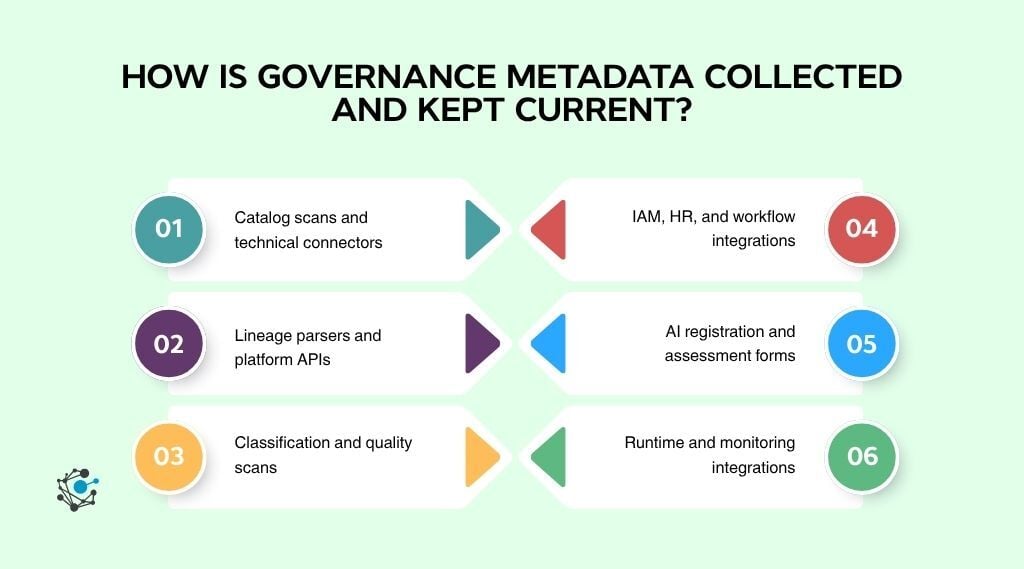
Metadata should come from governed source systems rather than relying entirely on manual questionnaires. Organizations can combine automated collection with business-owner input:
-
Catalog scans and technical connectors collect systems, schemas, datasets, dashboards, models, applications, and technical ownership details.
-
Lineage parsers and platform APIs identify data sources, transformations, AI inputs, integrations, and downstream output consumers.
-
Classification and quality scans update sensitivity labels, regulatory classifications, quality results, certification status, and policy violations.
-
IAM, HR, and workflow integrations reflect changes to owners, stewards, user roles, access rights, approvals, and exceptions.
-
AI registration and assessment forms capture business purpose, affected users, decision authority, risk rationale, and deployment conditions that cannot be inferred technically.
-
Runtime and monitoring integrations collect model versions, tool usage, permission changes, incidents, overrides, and other operational signals.
Each metadata field should have an authoritative source, refresh method, accountable owner, and last-updated date. Automated scans can maintain technical metadata, while owners should periodically attest to business purpose, accountability, and continued use.
Event-based updates should start governance workflows when material changes occur. Scheduled scans and stale-record alerts can identify metadata that has not been refreshed or confirmed within the required review period.
Best practices for implementing contextual AI governance
Contextual governance should apply the right level of oversight without forcing every AI project through the same review. The framework must remain consistent enough for defensible decisions while allowing controls to reflect each use case’s data exposure, impact, and autonomy.
Before selecting governance technology, we should define the use-case record, context fields, risk tiers, control requirements, ownership model, and reassessment triggers. Tooling should automate an agreed governance process rather than determine how risk is classified or accountability is assigned.
-
Govern the use case, not only the model: One model may support several business processes. Each deployment should have its own purpose, owner, risk tier, controls, and approval history.
-
Keep context assessments decision-focused: Collect only the information required to classify risk and assign accountability. The assessment should also support control selection and later review.
-
Standardize risk criteria and controls: Use common scoring factors and tier thresholds across departments. Each tier should map to a defined review process, minimum control set, and approval route.
-
Connect AI governance and data governance: Reuse existing classifications, lineage, quality records, ownership, privacy rules, and access policies. This avoids duplicate work and improves consistency between AI and data decisions.
-
Apply proportionate controls with clear accountability: Low-risk use cases should follow lighter workflows. High-impact systems should receive stronger validation, monitoring, and human oversight. Every use case should have one accountable business owner.
-
Automate reassessment and evidence collection: Define the changes that require a new review before deployment. Metadata events, approval records, and monitoring signals should create a traceable history and start workflows when the context changes.
Contextual AI governance should make oversight more precise, not more complicated. Teams should be able to see which controls apply, who owns them, what evidence supports the decision, and when the decision must be reviewed again.
When is contextual AI governance not enough?
Contextual governance determines which risks, controls, owners, approvals, and monitoring requirements apply to an AI use case. It does not perform every technical test or enforce every control at runtime.
Organizations may need complementary capabilities based on the use case’s risk tier:
|
Governance need |
Complementary capability |
|
Measure accuracy, bias, robustness, and task performance |
Model evaluation and validation tools |
|
Test prompt injection, misuse, data leakage, and adversarial behavior |
AI red teaming and security testing |
|
Filter unsafe inputs and outputs or block prohibited behavior |
Runtime guardrails and policy-enforcement tools |
|
Detect tool abuse, credential misuse, exfiltration, or abnormal agent activity |
AI security and runtime monitoring platforms |
|
Control identities, permissions, secrets, and privileged actions |
IAM, privileged access management, and API security |
|
Investigate incidents and coordinate remediation |
Security monitoring and incident-response systems |
Contextual governance should determine when these controls are required, who owns them, what evidence they must produce, and how the results affect approval or residual risk. The complementary tools then perform the technical testing, enforcement, or threat detection.
This positions contextual governance as the decision and coordination layer within a broader enterprise AI governance architecture.
How OvalEdge supports contextual AI governance
OvalEdge provides the metadata-driven foundation needed to connect AI systems with their business purpose, data, owners, policies, and operating context. This helps governance teams replace disconnected spreadsheets and policy documents with a governed view of every AI use case.
Want to explore this approach in more detail? Read our AI Governance Framework whitepaper to see how metadata, governance workflows, and enterprise context work together to operationalize risk-based AI governance.
Building on these principles, OvalEdge provides the capabilities needed to operationalize contextual AI governance at enterprise scale:
-
Centralizes AI and data inventory: Brings models, agents, applications, vendors, and related data assets into a governed inventory with ownership and deployment status.
-
Connects business context: Links AI use cases to glossary terms, business processes, owners, and stewards so teams assess risk using consistent definitions.
-
Surfaces data risk and trust signals: Combines classification, privacy context, data quality, and certification status to show whether AI inputs meet approved standards.
-
Maps lineage and dependencies: Traces data into AI systems and downstream processes so reviewers can assess source reliability and change impact.
-
Supports risk-based workflows: Connects policies, reviews, approvals, access controls, and exceptions to the relevant use case and risk tier.
-
Maintains evidence for reassessment: Uses automated metadata collection across 150+ connectors to preserve lineage, ownership, approvals, and activity history.
OvalEdge supplies the governed business, data, ownership, policy, and lineage context needed to operationalize risk-tiered AI governance. This metadata and workflow foundation helps teams determine which controls apply, preserve supporting evidence, and coordinate decisions across the broader AI governance stack.
Conclusion
AI governance will increasingly depend on how quickly organizations can adjust controls as business use, data access, and decision authority change.
A practical next step is to test the framework across a small group of representative AI use cases, then refine risk tiers, approval paths, and reassessment triggers based on what those pilots reveal.
OvalEdge supports this shift by connecting AI systems to business context, data lineage, ownership, policies, and governance evidence. When these records remain scattered across spreadsheets and disconnected tools, teams struggle to keep risk decisions current.
Book a demo with OvalEdge to build a more connected and responsive contextual AI governance program.
.png?width=1081&height=173&name=Forrester%201%20(1).png)
.png?width=1081&height=241&name=KC%20-%20Logo%201%20(1).png)