.png)
A company with a mature data governance program just deployed its first AI model. The obvious question follows: do we govern this the way we govern data, or is this something else entirely? The short answer is both.
This question is no longer hypothetical for most enterprises.
According to the Stanford AI Index Report 2025, 78% of companies were using AI in at least one business function in 2024, up from 55% the year before. Most of them already run some form of data governance.
Very few have a clear answer for what AI governance means on top of it.
Data governance and AI governance are related disciplines, but they are not interchangeable. They address different failure modes, apply at different stages, and carry different risks when they are weak. Treating them as the same program leaves gaps in both directions, and treating them as entirely separate programs means neither one gets the foundation it depends on. Neither covers what the other does, and treating them as the same program leaves real gaps in both directions.
This article walks through the definitions, key differences, where the two disciplines overlap, who owns each, and how they fit together within a coherent governance approach.
AI governance vs Data governance: The short answer
Data governance manages data assets, their quality, security, privacy, and access. AI governance manages AI systems' fairness, transparency, accountability, and model risk.
The distinction matters because the risks are different. Data governance asks: can this data be found, trusted, and used correctly? AI governance asks: Is this model behaving fairly, producing explainable decisions, and being monitored for drift?
A strong data governance program does not automatically answer those second questions, because it was never designed to. AI governance extends data governance. It does not replace it.
|
Data Governance |
AI Governance |
|
|
Manages |
Data assets and metadata |
AI models and systems |
|
Focus |
Quality, security, privacy, access |
Fairness, transparency, accountability, model risk |
|
Goal |
Trustworthy data |
Trustworthy AI outcomes |
|
Core risks |
Bad, exposed, or non-compliant data |
Bias, drift, hallucination, and unexplained decisions |
What is data governance?
Data governance is the system of policies, roles, and processes that keep an organization's data accurate, secure, well-defined, and usable. It controls how data is described, who can access it, and whether it can be trusted across the teams and systems that depend on it.
Consider a bank. It handles millions of customer records across dozens of systems. Data governance is what tells the bank exactly what data it holds, where it lives, how sensitive it is, who is authorized to see it, and whether the numbers in a regulatory report can be trusted. Every rule governing that environment, discovery, classification, access, quality sits under the data governance umbrella.
The discipline predates AI by decades. Most large organizations already have some version of it in place, with established roles like data stewards, data owners, and a CDO or data office setting policy. The frameworks are mature, the tooling is well understood, and the ownership patterns, while imperfect, are largely settled.
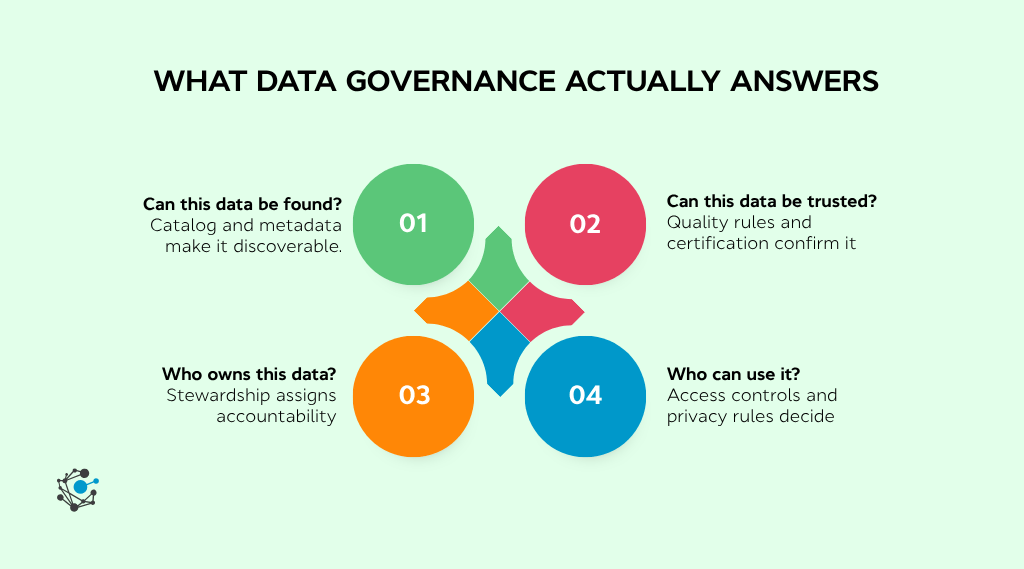
At its core, data governance answers four practical questions:
-
Can this data be found? Catalog and metadata management make assets discoverable and searchable across the organization.
-
Can this data be trusted? Quality rules, profiling, and certification establish whether a dataset is fit for use.
-
Who owns this data? Stewardship and ownership assignment create accountability for accuracy and decisions.
-
Who is allowed to use it? Access controls, privacy classifications, and policies enforce the right level of availability.
These capabilities form the foundation that everything downstream depends on, including AI.
What is AI governance?
AI governance is the system of policies, oversight, and controls that keep AI systems fair, transparent, accountable, and safe across their full lifecycle. It governs how models are built, monitored, and used, and who is responsible for the decisions they make.
Unlike data governance, AI governance is still a forming discipline. Ownership is unsettled, frameworks are relatively new, and most organizations are actively figuring out what it means for their specific context. What is clear is that it covers ground that data governance was never designed to address.
A complete AI governance framework spans four areas:
-
Bias and fairness: Ensuring models do not produce discriminatory or systematically skewed outputs across populations or use cases.
-
Explainability and transparency: Making model decisions interpretable enough for humans to review, audit, and challenge.
-
Model risk and monitoring: Tracking model performance over time, catching drift, and flagging degradation before it affects decisions.
-
Accountability and compliance: Establishing who is responsible for model outcomes and mapping controls to applicable regulatory requirements. The EU AI Act entered into force in August 2024 and began phasing in substantive obligations from February 2025. The NIST AI Risk Management Framework and ISO/IEC 42001, the international standard for AI management systems, give organizations additional structured approaches for building compliant, auditable AI programs.
Both frameworks signal where regulation is heading: toward mandatory documentation, risk classification, and ongoing oversight of AI systems, not just the data that feeds them.
AI governance vs data governance: Key differences
The two disciplines share a goal: making enterprise systems trustworthy, but they differ in what they govern, where they apply, and what compliance actually means in each context.
|
Dimension |
Data Governance |
AI Governance |
|
What's governed |
Data assets and metadata |
Models, algorithms, AI systems |
|
Primary focus |
Quality, security, privacy, access |
Fairness, explainability, model behavior |
|
Main goal |
Trustworthy, compliant data |
Safe, ethical, accountable AI |
|
Core risks |
Breaches, poor quality, non-compliance |
Bias, drift, hallucination, opaque decisions |
|
Lifecycle stage |
Data creation through retirement |
Model development through decommissioning |
|
What compliance means |
GDPR, CCPA, HIPAA, data residency rules |
EU AI Act, NIST AI RMF, model risk guidelines |
|
Typical owners |
CDO, data stewards, data owners |
AI governance lead, risk, legal, ML teams |
|
Maturity |
Decades of practice, settled frameworks |
Emerging discipline, frameworks still forming |
Three differences carry the most practical weight for teams building governance programs today.
-
First, the lifecycle is different. Data governance applies from the moment data is created or ingested. AI governance applies from the moment a model is designed and continues through deployment, monitoring, and retirement. These timelines overlap but do not align.
-
Second, the risk types are different. A data governance failure typically produces bad, missing, or exposed data. An AI governance failure can produce biased decisions at scale, model outputs nobody can explain, or regulatory violations tied to how a model was built and monitored, not just what data it used.
-
Third, maturity is different. Most organizations have years of data governance practice to draw from. AI governance programs are being stood up now, often without established templates, clear ownership, or tested controls.
Pro Tip: If the governance team is mapping AI controls to existing data governance processes, use the lifecycle stage column above to find where the two programs intersect and where they need separate workstreams.
Where AI governance and data governance overlap
The two disciplines are distinct, but they share significant common ground. Getting this part wrong, either by treating the overlap as full coverage or by ignoring it and running two completely separate programs, creates gaps and duplication.
The pattern is consistent: each overlap area is a data governance capability that AI governance points to a new problem. It reuses the infrastructure rather than rebuilding it.
|
Data governance capability |
How AI governance builds on it |
|
Data lineage |
Becomes the model audit trail. It shows auditors what data a model was trained on, where it originated, and how it moved before reaching the model. |
|
Sensitive data classification |
Keeps regulated data out of training sets and retrieval pipelines. A model cannot surface PII, financial, or health data that was tagged and blocked upstream. |
|
Business glossary and definitions |
Feeds models one certified definition per business term. The model inherits the approved meaning instead of choosing between conflicting sources. |
|
Data quality |
Sets the ceiling on model reliability. Models amplify the data they consume, so quality controls stop confidently wrong outputs at scale. |
Did you know: Many organizations already own the infrastructure both programs need. The gap is usually activation and coordination, not acquisition.
Does AI governance replace or extend data governance?
AI governance extends data governance. It does not replace it.
AI governance adds oversight for model behavior, fairness, and decision risk. But it depends entirely on the trustworthy, well-governed data that data governance provides. An organization cannot govern its AI well if it has not governed its data first.
Two mistakes show up repeatedly when enterprises start building AI governance programs.
The first is assuming that a mature data governance program already covers AI risk. It does not. Data governance was built to ensure data quality, privacy, and access. It was never designed to catch bias in a model's training set, monitor for performance drift, or explain why an algorithm produced a particular decision. Those require AI-specific controls layered on top.
The second mistake runs in the opposite direction: standing up AI governance on a weak data foundation. This produces confident oversight of unreliable inputs. A model risk committee reviewing outputs means very little if the underlying data has no quality controls, no certified definitions, and no lineage. The oversight looks thorough. The foundation is not.
AI data governance works best when treated as a new layer built on a solid base, not a replacement for it.
Who owns each: Roles and responsibilities
Ownership is where the two programs most visibly collide in practice, and it is where most organizations are still working things out.
Data governance has decades of established ownership patterns. The CDO or data office sets policy. Data governance teams manage day-to-day stewardship, classification, and quality within their domains. Data owners sit inside business units and carry accountability for the accuracy and fitness of their data assets. These roles are not always perfectly filled, but they are well understood.
AI governance ownership is a different story. It touches legal, risk, technical, and strategic functions simultaneously, in a way no single existing role was built to hold.
|
Responsibility |
Primary Owner |
|
Data quality, access, privacy |
CDO, data stewards, data owners |
|
Model risk, bias, and monitoring |
AI governance lead, risk, legal, ML teams |
|
Shared: lineage, sensitive data, compliance |
Both programs, coordinated |
The CDO frequently ends up spanning both because AI governance depends so heavily on the data foundation. That creates real accountability pressure on a single function.
There is also a regulatory dimension that many organizations underestimate: when an organization deploys a third-party AI model or a vendor-built system, the regulatory responsibility for that model's behavior stays with the deploying organization. Buying a model from a vendor does not transfer accountability for how it performs or what decisions it influences. That shifts significant governance work back to internal teams regardless of where the model was built.
Where AI governance actually runs: The data foundation you already have
Every AI governance requirement that touches data traces back to something data governance already does. The overlap above is not a coincidence. It is the same foundation pointed at a new consumer.
The market is generating significant noise around AI-native data layers and new categories purpose-built for AI governance. The quieter truth is that enterprises with strong governance programs already own most of what AI governance depends on. The gap is usually activation, not acquisition.
Activation is the harder half. Owning these capabilities is not the same as having them connected, current, and exposed in a form a model or retrieval pipeline can use. A glossary buried in a wiki still lets a model pick the wrong definition.
Classifying sensitive data once, without reapplying it to every new training set and retrieval pipeline, still leaves that data exposed. The capabilities exist. Making them usable by AI is the work most programs still have ahead of them.
OvalEdge Experts' Insights: Governance teams already hold the raw material for enterprise AI readiness. The catalog, glossary, lineage, and classification that AI governance depends on are not new capabilities to buy. There are existing capabilities to activate. Platforms like OvalEdge give AI governance programs the governed data foundation they need, so the program builds on infrastructure that is already in place rather than starting from scratch.
How to build a unified governance approach
Running data governance and AI governance as two completely separate programs creates duplication, gaps in ownership, and conflicting controls. The more practical approach is a unified model where data governance provides the foundation and AI governance extends it with model-specific controls.
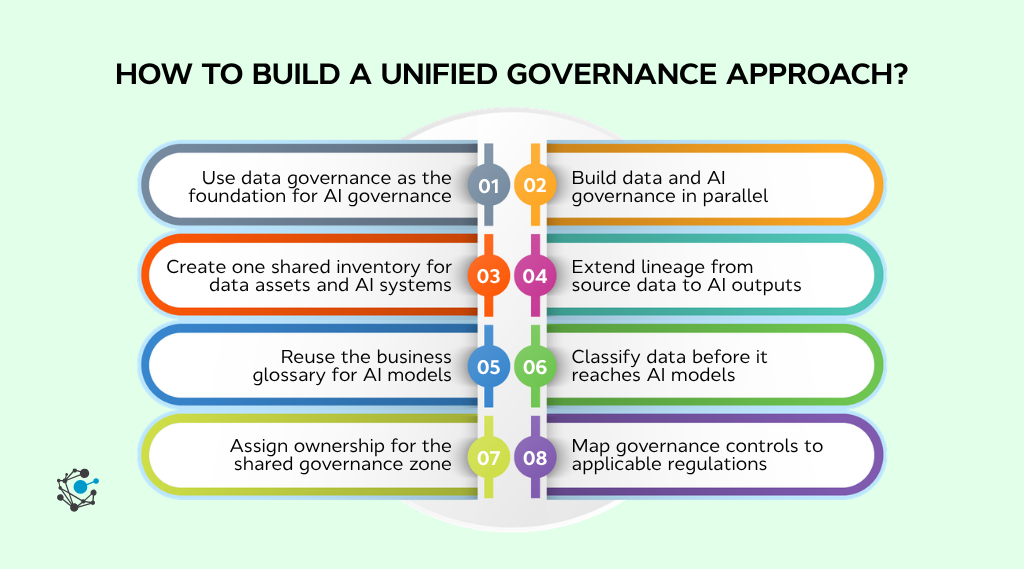
Eight steps to build that unified approach:
-
Treat data governance as the foundation, AI governance as the layer on top. The dependency flows in one direction. AI governance cannot compensate for weak data governance underneath it.
-
Develop both in parallel, not sequentially. Waiting for data governance to be "complete" before starting AI governance means the AI program runs ungoverned while teams wait. Build both tracks simultaneously.
-
Use one shared inventory for data assets and AI systems. Two siloed registries create two versions of the truth. A single inventory surfaces dependencies between data assets and the models that consume them.
-
Extend existing lineage to cover model inputs and outputs. The data governance and compliance value of lineage multiplies when it spans the full chain from source data through model training to decision output.
-
Reuse the business glossary so models inherit certified definitions. Do not let AI teams build parallel glossaries. Certified definitions should flow into the model context automatically.
-
Apply data classification before any data reaches a model. Classification is a prerequisite, not an afterthought.
-
Assign clear ownership for the shared zone. Lineage, sensitive data, and compliance sit between the two programs. Someone has to own that middle ground explicitly.
-
Map controls to the regulations that apply. The EU AI Act, NIST AI Risk Management Framework, and ISO/IEC 42001 each carry specific documentation, risk classification, and monitoring requirements. Map them early, not at audit time.
Watch Out — Shadow AI: Most unified governance programs account for the AI systems organizations knowingly deploy. Few account for the ones employees are already using without disclosing third-party AI tools, browser extensions, unauthorized LLM integrations, wired into workflows. Shadow AI sits outside both data governance and AI governance controls by default. Surfacing it requires the same discovery and classification capabilities that data governance already runs. Build shadow AI discovery into the unified program from the start, not as an afterthought when an incident surfaces.
Conclusion
AI governance and data governance answer different questions. One asks whether the data can be trusted. The other asks whether the model and its decisions can be trusted. Treating them as the same discipline leaves real gaps. Treating them as entirely separate programs creates duplication and conflicting ownership.
The more accurate picture is a dependency. AI governance runs on the data foundation that data governance builds lineage, certified definitions, quality controls, and sensitive data classification. Organizations that govern AI well are typically the ones that govern their data first and then extend that foundation deliberately. Those who skip the foundation end up with confident oversight of unreliable inputs.
The work is not buying a new stack for the AI side. It is connecting the two programs, closing the ownership gaps in the middle, and making existing governance infrastructure usable by AI systems.
Platforms like OvalEdge provide the governed data foundation that AI governance depends on, with catalog, lineage, business glossary, and data classification in one unified place.

To see how it works,  book a demo.
.png?width=1081&height=173&name=Forrester%201%20(1).png)
.png?width=1081&height=241&name=KC%20-%20Logo%201%20(1).png)