Most organizations have some version of data governance running. Policies are documented, roles are assigned, and a catalog might even be live. Yet reports still conflict, definitions still vary by team, and when something breaks, tracing the root cause takes longer than fixing it.
The missing piece is usually a strategy that ties governance work to business outcomes and holds the program accountable to measurable results. Without one, even a busy governance team struggles to show it's delivering value.
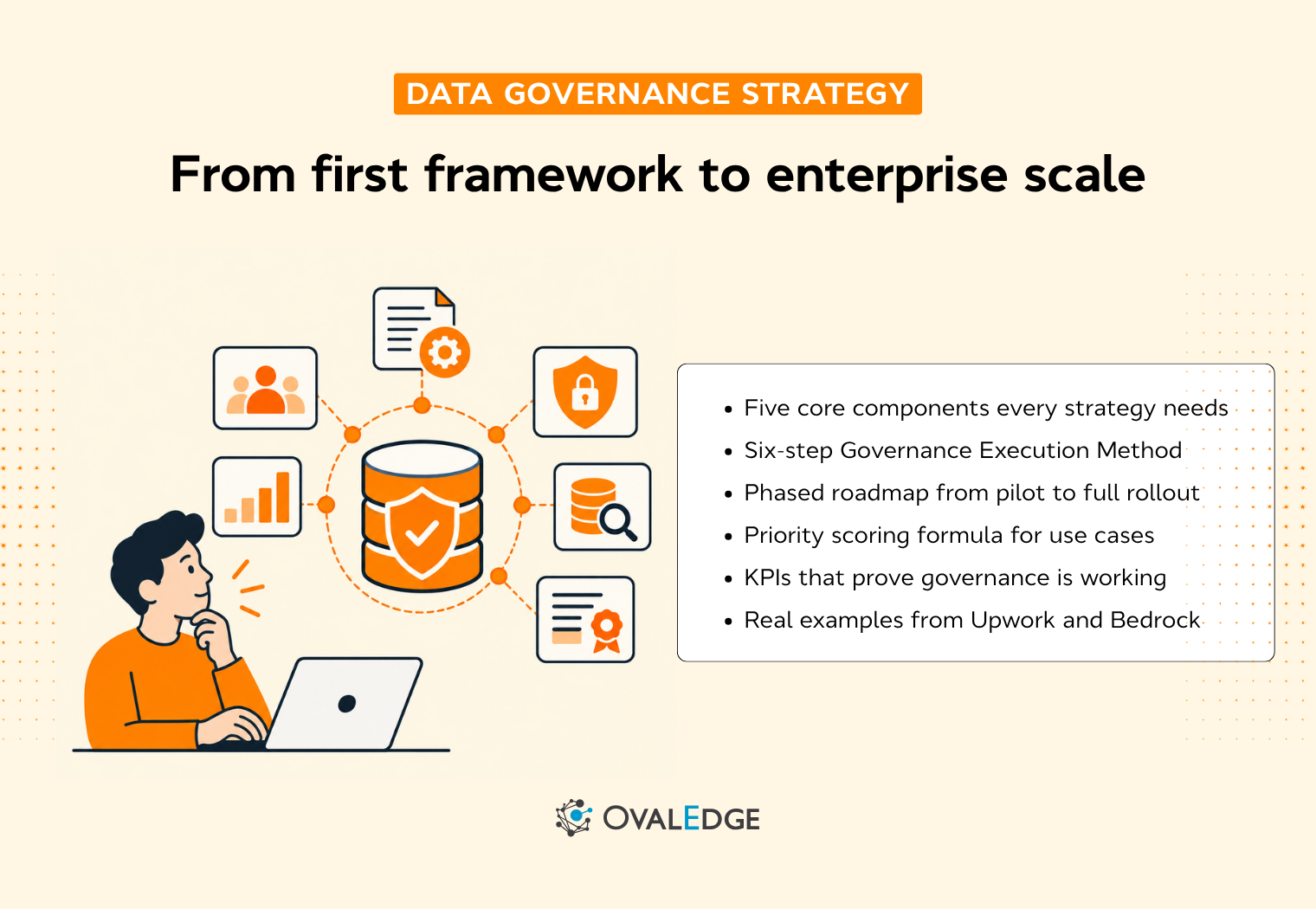
The guide covers the five core components of a governance strategy, a six-step execution method, a phased 90-day roadmap, and KPIs that prove governance value to leadership. Whether you're starting from scratch or trying to get a stalled program moving, the structure applies.
What is a data governance strategy?
A data governance strategy is a business-aligned plan that defines how an organization manages, protects, and derives value from its data assets. It covers five areas: who owns the data, what policies govern its use, how quality is measured, where metadata and lineage are tracked, and which business outcomes governance is designed to improve.
Why a data governance strategy matters
Gartner's data governance research estimates that 60% of organizations will fail to realize their AI investments by 2027 due to incoherent governance frameworks. The core issue is that most governance programs run without a strategy connecting their work to business outcomes.
Teams catalog data, assign roles, and write policies, but nobody measures whether those activities reduce compliance risk, improve reporting accuracy, or make AI outputs more reliable. A strategy forces that connection by defining what success looks like before the work begins, so governance teams can demonstrate value rather than just activity.
Data governance strategy vs. data governance framework vs. data governance roadmap
These three terms are often used interchangeably, but they describe different things.
|
Concept |
What it means |
What it answers |
|
Data governance strategy |
The business-aligned plan for governing data |
Why govern, and what outcomes matter? |
|
Data governance framework |
The operating structure for executing governance |
Who owns what, and how does governance work? |
|
Data governance roadmap |
The phased implementation plan |
What happens first, next, and later? |
All three work together. The strategy sets direction, the data governance framework creates structure, and the roadmap drives execution. A common mistake is jumping straight to framework or tooling without first agreeing on the strategy.
Also read: How to build a data governance roadmap in 5 phases
What are the core components of a data governance strategy?
A governance strategy without a clear foundation tends to collapse at execution. These five components form the structural backbone of any governance program that is built to last.
1. Business goals and governance priorities
Governance work that starts with tools or frameworks before agreeing on outcomes drifts. The first component anchors the program to specific business goals.
Common categories include revenue protection through reporting accuracy, risk reduction through policy enforcement, regulatory readiness for frameworks like GDPR, HIPAA, or BCBS 239, faster analytics adoption through trusted data, and AI readiness through certified, well-documented datasets.
A financial services firm might prioritize customer data, consent records, and risk reporting because those domains carry direct compliance and decision-making consequences. Governance priorities follow from the business case.
Deciding what to govern first
Most programs identify more candidate domains than they can fund in a year. Scoring each on three dimensions keeps the sequencing defensible when budget forces a choice.
|
Dimension |
What it measures |
|
Business value |
How directly the domain supports revenue, a board decision, or a named goal |
|
Regulatory risk |
The exposure created if the data is wrong, leaked, or unauditable |
|
Implementation effort |
The work required to catalog, define, assign ownership, and enforce policy |
Priority score = (business value × regulatory risk) ÷ implementation effort
Effort divides rather than multiplies, because the domain that proves value in six weeks earns an earlier slot than the one that takes nine months.
In the financial services example, consent records score high on value and risk and low on effort, so they go first. Lower-risk domains like marketing attribution move to later phases.
Proof point: Forrester TEI analysis
A Forrester Total Economic Impact study found that organizations using OvalEdge achieved 337% ROI over three years, with analyst productivity improving by up to 30%. The gains came from reduced time searching for and validating data, faster audit responses through centralized lineage and policy documentation, and fewer reporting conflicts from a shared business glossary.
A program that can cite independent third-party ROI evidence earns executive buy-in faster than one relying on internal estimates.
2. Data ownership and stewardship
Without clear accountability, governance produces documentation nobody follows. Ownership and stewardship define who is responsible for what and how data decisions get made when conflicts arise.
|
Role |
Responsibility |
|
Data owner |
Accountable for a specific data domain or asset |
|
Data steward |
Maintains definitions, quality standards, and usage guidance |
|
Data custodian |
Manages technical storage, access controls, and security |
|
Governance council |
Resolves cross-domain conflicts and approves policies |
Before assigning roles, organizations need to decide how governance authority is distributed. It can be centralized in a dedicated team, federated across business domains under shared guidelines, or structured as a hybrid where a central council sets standards while domain stewards handle day-to-day ownership. Most mature programs land on the hybrid model.
The model shapes the rest of the strategy: who writes policy, how fast exceptions get resolved, and whether a single metric definition survives contact with four business units.
|
Model |
Fits when |
What it does to the strategy |
|
Centralized |
A regulated enterprise faces a single auditor and needs one defensible answer per policy |
Standards move slowly but hold. Policy authority sits with one team, so exceptions escalate rather than multiply |
|
Federated |
Global business units run different systems, markets, and regulators |
Local speed improves. The enterprise glossary becomes the contract that keeps definitions comparable across units |
|
Hybrid |
A data mesh or domain-oriented architecture pushes ownership to the teams producing the data |
Domains own quality and definitions. The central council owns the standards, the platform, and the tiebreak |
The failure mode is picking a model that contradicts how the organization actually operates. Centralized governance in a genuine mesh becomes a bottleneck; federated governance without an enforced glossary produces competing definitions of the same metric.
How to choose a governance model
The choice between centralized, federated, and hybrid is not permanent. Most organizations start centralized and shift to hybrid as the program matures and domain teams take ownership.
Three signals it is time to shift:
-
Domain teams are creating their own definitions because the central glossary does not update fast enough.
-
Exception requests outnumber policy updates. When more time goes to granting exceptions than writing standards, authority needs redistribution.
-
Data mesh or domain-oriented architecture is in play. Centralized governance and decentralized data architecture will fight each other.
Choosing the wrong model initially is rarely the problem. Never revisiting the choice is the more common mistake. Schedule a model review every 12 to 18 months as the data estate and team structure change.
3. Data policies, standards, and controls
Policies are how governance becomes enforceable. Core areas include data access controls, classification by sensitivity or regulatory category, retention and archival rules, quality standards, privacy rules tied to regulatory requirements, exception handling, and audit trails.
The practical test for any policy: can a business user or data steward follow it without needing a data engineer to interpret it?
4. Metadata, glossary, and catalog foundation
Metadata, glossary, and catalog form the layer where governance becomes discoverable. Without a shared vocabulary and a catalog of what exists, policies have nothing to attach to.
Technical metadata covers structure, location, and schema; business metadata covers meaning, ownership, and usage context. A business glossary standardizes the definitions teams argue about most, such as "active customer," "net revenue," or "incident," and is often the highest-return early investment in a governance program.
The data catalog ties glossary, metadata, and lineage into a searchable, governed view of enterprise data assets.
At OvalEdge we believe: A catalog built only for discovery is no longer sufficient. AI agents and automated workflows need to know whether data is certified, who owns it, and what policies apply before they act.
5. Data quality, lineage, privacy, and trust controls
The final component covers the controls that make governed data reliably usable.
Data lineage tracks where data came from and how it transforms across systems, critical for impact analysis, audit readiness, and AI traceability. Quality monitoring catches issues before they reach reports or models.
Sensitive data classification identifies PII, financial records, and regulated content so access and masking controls apply correctly. Data certification marks specific datasets as trusted, giving analysts and AI systems a reliable signal about which sources to use.
Because of AI today, these same controls serve a second function: quality signals tell agents which datasets are reliable enough to use, and certification tells automated workflows which assets have been validated for deployment.
Why this matters for AI
AI models and analytics agents inherit whatever governance the underlying data carries. An unclassified record means a model cannot respect access controls. Untracked lineage makes it impossible to audit what fed a prediction. Quality rules that skip the upstream layer produce unreliable AI outputs.
Industry analysts increasingly frame governance strategy as AI readiness for this reason. Organizations building on agentic architectures need governance that travels with the data, embedded at the point of consumption.
Gartner's 2026 data and analytics predictions project that by 2030, half of AI agent deployment failures will trace back to insufficient governance enforcement at runtime.
OvalEdge Governance Agents classify sensitive data, create quality rules, and certify datasets so AI systems consume governed data by default.
How to build a data governance strategy and roadmap
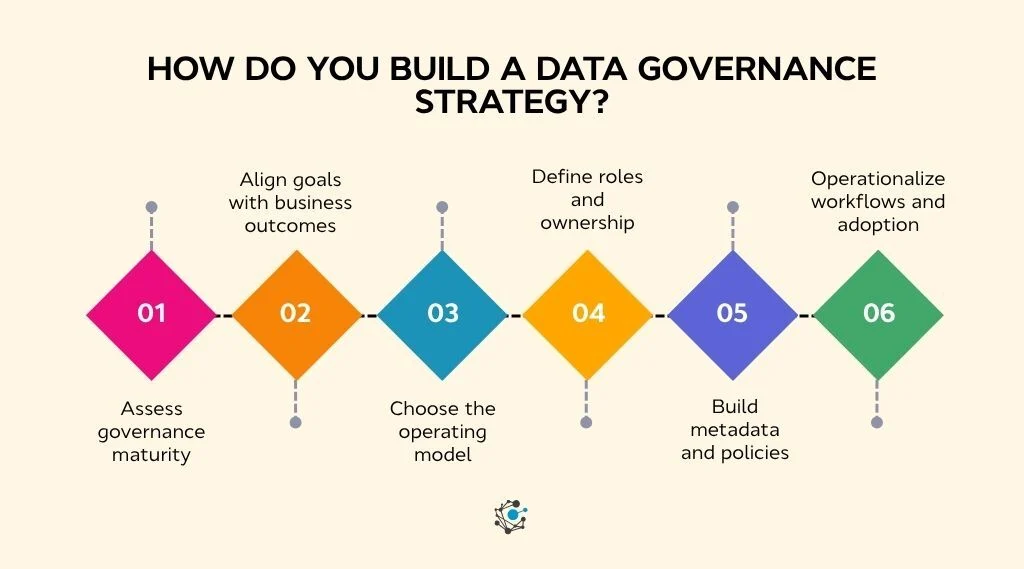
Strategy without a build sequence tends to stall at the first sign of organizational complexity. OvalEdge's Governance Execution Method addresses this with six phased steps that move from business alignment to measurable scale.
The method starts with a single domain, proves value, and expands only after results are in hand. It aligns with industry-standard frameworks, including theconnectors, which provides the most comprehensive reference model for data management disciplines.
Step 1: Align governance with business objectives
The first conversation in any governance program should not be about tools, frameworks, or org charts. It should be about which business problem governance is being built to solve.
Start with a specific outcome: reducing compliance risk in regulated data, improving the accuracy of executive reporting, establishing trusted datasets for AI workflows, or enabling self-service analytics without IT bottlenecks. Once the outcome is defined, governance priorities follow from it.
Executive sponsorship at this stage is essential. Without a business sponsor who connects governance investment to business value, most programs stall at the first cross-functional conflict over ownership or budget.
Step 2: Assess current data governance maturity
Before building the future state, teams need an honest picture of the current one. A maturity assessment surfaces gaps the strategy needs to close: missing ownership structures, undefined policies, poor metadata coverage, or unmonitored data quality. Draw on metadata scans, data quality profiling, stakeholder interviews, and a review of access controls and compliance pain points.
|
Maturity Level |
What It Looks Like |
Recommended Next Action |
|
Ad hoc |
No formal governance in place |
Identify critical data domains and assign initial owners |
|
Reactive |
Governance activates after incidents |
Document policies and assign accountability structures |
|
Defined |
Roles and policies exist, but aren't consistently followed |
Standardize workflows and close enforcement gaps |
|
Managed |
Governance is actively measured and tracked |
Automate cataloging, quality monitoring, and controls |
|
Optimized |
Governance is embedded in daily data work |
Scale AI governance and drive continuous improvement |
Step 3: Identify critical data assets and domains
Governance does not need to cover every dataset on day one. The goal is to identify where governed data produces the highest business value fastest. Common high-priority domains include customer data, financial and revenue data, patient records, employee data, and the reports executives use for key decisions.
Organizations deploying AI workflows should treat AI training datasets and the sources feeding analytical agents as priority governance targets. An ungoverned dataset that feeds a dashboard is a trust problem. The same dataset feeding an AI agent is a scaled trust problem, because the agent uses it repeatedly and automatically, without the judgment a human analyst would apply.
Platforms like OvalEdge use connectors to scan and catalog assets across data sources, making domain scoping faster than manual inventorying.
Step 4: Define roles, policies, and governance workflows
With priority assets identified, the next step is building the execution structure: who owns what, what rules apply, and how decisions move through the organization. In practice, that means assigning data owners and stewards to each domain, defining policy approval and escalation workflows, setting up access request processes, and building review cycles so policies and glossary terms stay current.
Defining the right roles and processes doesn't guarantee adoption. Resistance is common from teams that view governance as a compliance burden. Addressing it requires executive communication on why governance matters, early involvement of business users in workflow design, targeted steward training, and visible quick wins before asking teams to change how they work.
Step 5: Build the data governance roadmap
The roadmap turns the strategy into a sequenced execution plan. It defines what gets governed when, who is accountable at each stage, what success looks like at each milestone, and how the program expands after the pilot proves value.
Automation is essential at this stage for teams scaling metadata workflows and stewardship tasks without adding headcount at every expansion phase.
Step 6: Select technology, pilot, measure, and scale
Tool selection should come after strategy and scoping are in place. By this step, the team knows which domains matter, what workflows are needed, and what pilot success looks like.
When evaluating platforms, prioritize functional coverage. Look for a platform that handles cataloging, glossary management, lineage, quality monitoring, access workflows, and policy management in one environment rather than requiring separate tools stitched together.
For organizations with active AI initiatives, AI governance readiness is equally important. Confirm that the platform can certify datasets for AI use, expose governed context to automated workflows, and maintain audit trails for agent activity.
The pilot phase validates the strategy under real conditions. Measure adoption, quality improvements, policy compliance, and business user satisfaction against the KPIs defined in the roadmap. Use pilot results to refine the approach before scaling to additional domains.
Data governance roadmap template
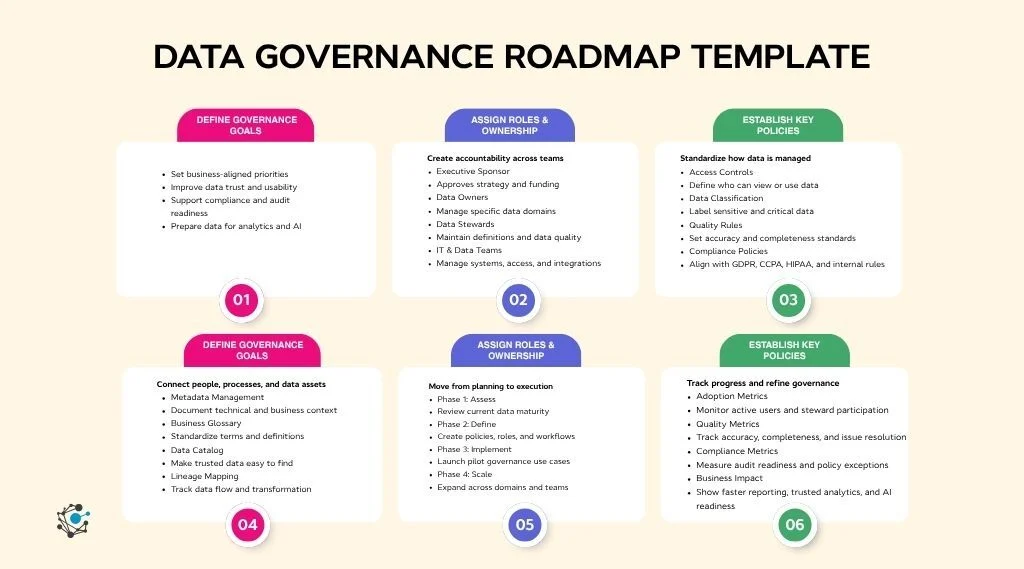
The table below is a framework teams can adapt based on maturity, complexity, and pilot scope. Timelines are indicative, but exit criteria are binding.
|
Timeline |
Focus |
Key Actions |
Exit criteria (advance only when all are true) |
|
0–30 days |
Discovery |
Identify goals, stakeholders, critical data domains, and current pain points |
Scope approved in writing. Executive sponsor named. Priority domain agreed by business and IT |
|
31–60 days |
Foundation |
Assign data owners and stewards, document policies, catalog priority assets, and define glossary terms |
Every priority asset has a named owner. Core policies approved by the governance council. Glossary terms for the priority domain signed off by their business owners |
|
61–90 days |
Pilot |
Launch governance workflows, certify datasets, monitor quality, and map lineage for the priority domain |
First domain certified end-to-end. Quality baseline measured and recorded. Lineage traced from the source to the reports business users actually open |
|
3–6 months |
Expansion |
Add adjacent domains, automate metadata workflows, expand quality rules, and access controls |
Stewards outside the pilot team resolve issues without central escalation. Quality scores are trending up against the baseline. Access requests running through the workflow rather than around it |
|
6–12 months |
Scale |
Extend governance across teams and systems, add an AI governance layer, and optimize KPIs |
Governance steps embedded in daily data workflows. AI and agent access are bound by the same policies as human access |
Phases that fail their exit criteria should not advance. A program at day 61 without named owners has not finished Foundation, and piloting on unowned data produces a certified dataset nobody maintains.
Partial progress is the norm: one domain clears the Pilot gate while another is still in Foundation. Running phases at different speeds works better than advancing the whole program on the weakest domain.
Quick note: Practitioners consistently warn against jumping to AI governance before the data governance foundation is solid
The consensus: make data findable, secure, and observable first. Everything else — automation, agent deployment, AI-specific controls — layers on top of that.
Common challenges in implementing a data governance strategy
Most governance programs fail in execution, usually for the same handful of reasons.
-
Trying to govern everything at once. Teams catalog every system, define every term, and assign every owner before the business sees value. Governing one high-impact domain well produces more durable results than governing ten poorly.
-
Lack of executive sponsorship. Governance crosses organizational boundaries. When ownership conflicts arise between departments or budget decisions need resolution, someone in leadership needs the authority to resolve them. Without that, programs stall.
-
Leading with technology. Data catalogs and lineage tools are implementation artifacts. Organizations that deploy them before establishing ownership, definitions, and policies end up with platforms that are technically live but organizationally ignored.
-
Role ambiguity. When data owners and stewards lack clear responsibilities, governance tasks fall through gaps or get duplicated. Defining roles before assigning them keeps accountability intact.
-
Low adoption from business users. A governance program that only IT understands is a governance program that only IT uses. Business users need governance workflows that fit into how they already work rather than a separate system layered on top.
Data governance strategy examples by use case
The right governance strategy varies by the problem it's built to solve. These three examples show how organizations in different situations scope, prioritize, and sequence their programs.
Example 1: Regulatory compliance in financial services
When Upwork, the global freelancing platform, needed to meet CCPA requirements, the governance strategy started with sensitive data discovery across 300+ data sources.
The team prioritized PII classification as the first governed domain, automated detection and tagging through the data catalog, and built API-driven workflows to handle Data Subject Access Requests without manual intervention. Daily monitoring jobs flagged classification gaps to data owners.
Success was measured by audit response time, policy exception rates, and sensitive data classification coverage. Upwork achieved CCPA compliance within weeks and expanded into lineage and broader data discovery from that foundation.
Example 2: Analytics trust in retail
When Bedrock, the commercial real estate firm, found that multiple teams were producing different versions of reports on the same data, and even basic terms like "property" meant different things across departments, the governance strategy started with the business glossary.
Their governance strategy started with the business glossary, standardizing definitions so every team worked from the same language. OvalEdge's data catalog, auto-lineage, and data quality rules gave the small governance team a structured system to enforce consistency without scaling headcount.
Success was measured by reduction in report conflicts, self-service adoption rates, and the percentage of dashboards sourced from certified datasets.
Example 3: AI readiness in manufacturing
A manufacturer deploying predictive maintenance models might find that model accuracy degrades over time because upstream sensor data has no quality controls or lineage tracking. A governance strategy for this problem would identify every dataset feeding AI workflows and govern those first:
-
Quality rules at ingestion catch bad data before it reaches a model.
-
Lineage tagging through transformation pipelines makes it possible to trace any prediction back to its source data.
-
Classification labels on each dataset let AI agents read governance status programmatically, so an agent pulling from an uncertified source gets flagged rather than silently returning unreliable results.
The outcome is a governed data layer underneath AI workflows, where model accuracy stays stable because the inputs are monitored, traceable, and certified.
Also read: How to build AI readiness for organizations in different industries
How to measure data governance strategy success?
Governance programs that can't demonstrate measurable outcomes lose executive support. Activity metrics like policies created or glossary terms defined measure effort without proving value. The KPIs below focus on business outcomes.
Leading indicators move within weeks and show whether governance is being adopted. Lagging indicators move over quarters and show whether adoption produced value. A program reporting only lagging metrics in month three looks like it has failed. One reporting only leading metrics in year two looks like it is stalling.
Leading indicators: adoption and coverage
|
Signal |
KPI examples |
|
Catalog adoption |
Active catalog users, catalog searches, asset views, glossary lookups per month |
|
Stewardship activity |
Steward participation rate, workflow completion rate, issue resolution time |
|
Coverage |
Sensitive data classification coverage, lineage coverage percentage, certified dataset count |
Lagging indicators: business outcomes
|
Outcome |
KPI examples |
|
Data quality |
Accuracy rate, completeness score, duplicate rate |
|
Data trust |
Certified dataset usage as a share of total, reduction in report conflicts, and user confidence surveys |
|
Compliance |
Audit response time, policy exception rate |
|
AI readiness |
Share of AI workflows running on certified datasets, time to approve a dataset for agent use |
A leading indicator that flattens is an early warning. Catalog searches falling while lineage coverage climbs usually means governance is being built for the governance team rather than its intended users.
Frame results for each audience: compliance teams care about audit readiness, analytics teams about data trust and discoverability, executives about risk reduction and AI readiness timelines.
How OvalEdge helps teams operationalize a data governance strategy
Building a governance strategy is the first step. Executing it across teams, domains, and data systems is where most programs stall.
OvalEdge's Enterprise Context Graph connects the five components covered in this guide (ownership, policies, metadata, quality, and lineage) into a single governed layer. The Governance Execution Method outlined above maps directly to the platform's workflow: define business outcomes, assign stewardship, enforce policies, and measure results from one place.
At OvalEdge we believe: Governance now serves two consumers: human analysts and the AI agents deployed on enterprise data. Your catalog, glossary, lineage, and quality rules are what makes AI safe and auditable at scale.
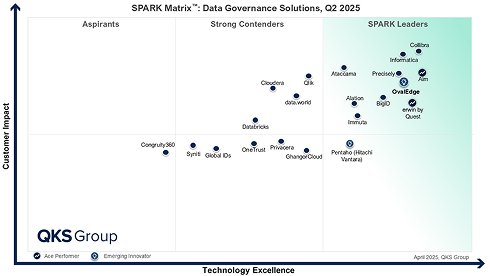
Organizations using OvalEdge have been recognized by Forrester (337% ROI over three years), SPARK Matrix (Leader), Gartner (Niche Player), and KuppingerCole (Leader).
Book a demo to see how OvalEdge turns your governance strategy into a running program.
.png?width=1081&height=173&name=Forrester%201%20(1).png)
.png?width=1081&height=241&name=KC%20-%20Logo%201%20(1).png)