As organizations scale their data platforms, data producers and consumers often operate with different expectations. A schema change can break downstream dashboards, critical fields may become unavailable, or data pipelines can fail when changes are introduced without proper communication.
Traditional governance policies establish standards, ownership, and accountability, but they often lack the operational controls needed to ensure those standards are consistently followed.
The challenge is reflected in governance maturity levels.
In its 2025 Data Governance Statistics and Facts article, Gitnux reported that only 14% of organizations have fully automated data governance processes.
Many teams still rely on manual enforcement and communication across increasingly complex data environments.
Data contracts in data governance help address this gap by formalizing expectations around schemas, data quality, ownership, service levels, and change management, enabling more reliable and governed data delivery at scale.
What are Data Contracts in Data Governance?
Data contracts are formal, machine-readable agreements that define how a data product should be structured, delivered, and maintained. They establish clear requirements for data producers and consumers, ensuring that datasets remain consistent, reliable, and fit for business use.
Data contracts definition
A data contract serves as a specification for a data product. Similar to how an API contract defines how applications interact, a data contract defines how data should be created, delivered, and consumed.
|
For example, a customer data contract may specify that customer IDs must be unique, email addresses must follow a standard format, and the dataset must be refreshed every 24 hours. |
A well-defined contract documents data structures, quality requirements, ownership responsibilities, service-level expectations, and change-management rules. By making these expectations explicit and machine-readable, data contracts help organizations automate validation, improve accountability, and reduce the risk of downstream data issues.
How data contracts formalize producer-consumer agreements
Data contracts establish a formal relationship between the teams that create data and the teams that consume it. Rather than depending on informal communication, both parties operate against a documented set of requirements.
For data producers, contracts define what must be delivered, including schema consistency, quality standards, and delivery schedules. For data consumers, contracts provide clarity on what data is available, how it is structured, and what level of reliability can be expected.
This shared agreement helps reduce misunderstandings, creates accountability, and provides a foundation for managing changes without disrupting downstream systems.
Data contracts vs traditional data governance
Traditional enterprise data governance focuses on defining policies, standards, roles, and accountability across the organization. Data contracts complement these governance activities by translating governance requirements into enforceable controls.
|
Traditional Data Governance |
Data Contracts |
|
Defines policies and standards |
Applies requirements to specific data products |
|
Establishes ownership models |
Documents producer and consumer obligations |
|
Provides governance oversight |
Enables automated validation and monitoring |
|
Focuses on governance frameworks |
Focuses on operational enforcement |
Governance establishes what the organization expects. Data contracts help ensure those expectations are consistently applied across day-to-day data operations.
Why data contracts matter in modern data governance
Data contracts help organizations bridge the gap between governance policies and day-to-day data operations. By defining clear expectations for data products, they make governance requirements more consistent, measurable, and actionable across the data lifecycle.
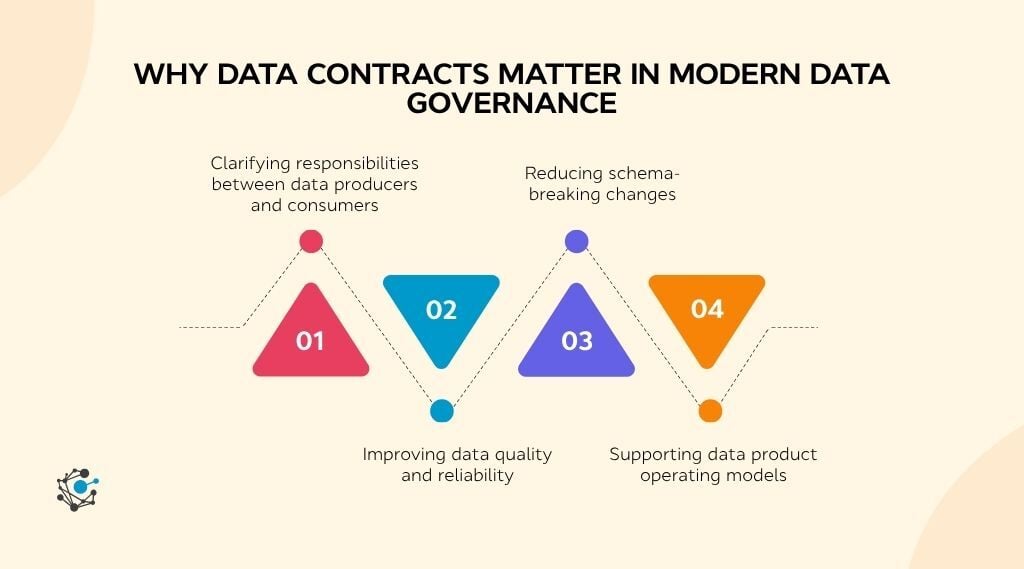
1. Clarifying responsibilities between data producers and consumers
Ownership gaps are a common source of data issues. When responsibilities are unclear, teams often struggle to determine who should resolve quality problems, approve changes, or communicate disruptions.
Data contracts establish accountability by documenting producer obligations, consumer expectations, and issue-management processes. This shared understanding improves collaboration and helps teams resolve problems more efficiently.
2. Improving data quality and reliability
Data quality issues often arise when standards are inconsistently applied across systems and teams. Data contracts help address this challenge by defining measurable expectations for data completeness, accuracy, freshness, and validity.
By setting quality requirements before data is delivered, organizations can identify issues earlier, improve consistency, and increase confidence in business decisions.
3. Reducing schema-breaking changes
Schema changes can disrupt reports, dashboards, pipelines, and applications that depend on stable data structures. Data contracts introduce a structured approach to change management by requiring changes to be reviewed, communicated, and validated before implementation.
This helps minimize downstream disruptions and improves the reliability of data delivery.
4. Supporting data product operating models
As organizations increasingly manage datasets as data products, clear expectations become essential for scalability and trust. Data contracts define how data products should be delivered, maintained, and consumed, providing a reliable interface between producers and consumers.
This consistency helps organizations scale governance across domains while improving confidence in shared data assets.
|
Pro tip: OvalEdge's Data Catalog and Business Glossary help support this approach by enabling teams to discover, understand, and govern data products consistently across the organization. |
Core components of a data contract governance framework
A data contract governance framework combines technical specifications, governance requirements, and operational controls that collectively ensure reliable and trusted data delivery. Successful frameworks do not focus solely on schemas or quality rules. They integrate accountability, service expectations, and enforcement mechanisms that support long-term governance objectives.
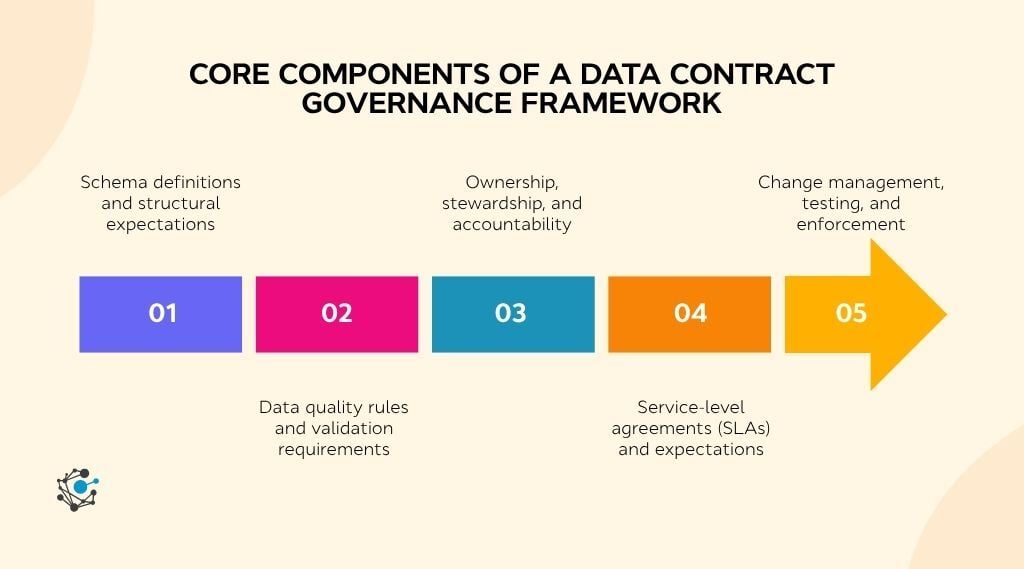
1. Schema definitions and structural expectations
The schema serves as the foundation of every data contract. It defines how data is structured, how fields are represented, and what consumers should expect when accessing a dataset.
Strong schema definitions typically include:
- Field names and descriptions
- Data types
- Required and optional attributes
- Accepted formats
- Compatibility requirements
Clear structural expectations help reduce ambiguity across teams. When producers and consumers share a common understanding of data structures, organizations experience fewer integration issues and downstream failures.
Schema governance becomes especially important in distributed environments where multiple domains publish data products independently. Consistent standards help maintain interoperability across the enterprise.
2. Data quality rules and validation requirements
Data contracts and data quality are closely connected. A contract without quality expectations provides only partial protection against operational risks.
Organizations commonly include requirements related to completeness, accuracy, freshness, consistency, uniqueness, and valid-value checks.
|
For example, a customer dataset may require email addresses to be present in 98% of records, duplicate customer IDs to remain below a defined threshold, and updates to occur within a specified time window. |
Embedding quality requirements into contracts enables automated validation before data reaches downstream consumers. This proactive approach reduces incident resolution costs and improves trust in analytics outputs.
3. Ownership, stewardship, and accountability
Governance programs depend on clearly defined ownership structures and data stewardship. Data contracts reinforce accountability by documenting who is responsible for maintaining, monitoring, and improving data products.
Key stakeholders typically include:
-
Data owners
-
Data stewards
-
Data producers
-
Data consumers
-
Governance teams
The contract should identify escalation paths, decision-making authority, and responsibility boundaries. When issues occur, teams can quickly determine ownership and take corrective action.
Organizations with mature ownership models often resolve quality incidents faster because accountability is clearly documented and consistently applied.
4. Service-level agreements (SLAs) and expectations
Data products require service commitments just like software products. Consumers need confidence that data will be available when expected and maintained at agreed performance levels.
Data contract SLAs commonly address:
-
Availability targets
-
Refresh schedules
-
Delivery timelines
-
Recovery expectations
-
Reliability commitments
|
For example, a finance reporting dataset may require updates by 6:00 a.m. daily with a 99.9% availability target. These commitments help establish trust between producers and consumers while creating measurable performance expectations. |
5. Change management, testing, and enforcement
One of the most valuable aspects of a data contract governance framework is its ability to govern change.
Without structured change management, organizations often experience unexpected disruptions caused by schema modifications or quality degradation.
Effective frameworks incorporate version control, contract testing, schema validation, change approvals, and automated enforcement to ensure governance requirements are consistently applied across data products.
According to engineering practices discussed by leading data platform teams at companies such as Airbnb, Netflix, and LinkedIn, automated validation significantly reduces production issues by identifying compatibility problems before deployment.
Governance is not a one-time exercise. Continuous validation and enforcement ensure contracts remain effective as data ecosystems evolve.
|
Best practice: OvalEdge's end-to-end Data Lineage capabilities can further strengthen change management by helping teams understand downstream dependencies, identify affected consumers, and assess the potential impact of contract modifications before implementation. |
How data contracts support data quality and governance
Data contracts improve governance outcomes by embedding quality, accountability, and compliance requirements directly into operational workflows. Instead of relying solely on policies and documentation, they create measurable controls that support consistent execution.
1. Enforcing quality rules at the source
Many organizations identify data issues only after they affect reporting, analytics, or operational processes. Data contracts help shift validation closer to the point of data creation, enabling teams to address issues before they spread across the data ecosystem.
Business outcomes:
-
Earlier detection of data quality issues
-
Reduced remediation costs
-
Faster issue resolution
-
More reliable analytics
2. Preventing downstream pipeline failures
Unmanaged changes can create disruptions across reporting, analytics, and operational systems. Data contracts introduce validation and review processes that help teams assess the impact of changes before they are deployed.
Business outcomes:
-
Reduced dashboard and reporting failures
-
Improved pipeline reliability
-
Lower operational risk
-
More predictable data delivery
3. Strengthening governance through automation
As data environments grow, manual governance processes become difficult to maintain. Data contracts support automated validation, compliance monitoring, and enforcement activities that help governance teams operate more efficiently.
Business outcomes:
-
Improved governance scalability
-
Reduced manual effort
-
More consistent policy enforcement
-
Better compliance visibility
4. Building trust in data products and analytics
Business users are more likely to adopt data products when expectations are transparent and consistently met. Data contracts provide a framework for documenting and validating those expectations across the data lifecycle.
Business outcomes:
-
Increased analytics adoption
-
Greater stakeholder confidence
-
Improved self-service data usage
-
Better business decisions
Implementing data contracts at scale requires visibility into data assets, ownership, lineage, quality, and governance processes. Book a demo to see how OvalEdge's Data Catalog, Data Lineage, Data Quality, Business Glossary, and Agentic Data Governance capabilities help organizations operationalize data contract governance across the enterprise.
How to implement data contracts in a data governance program
Successful implementation requires organizations to align governance policies, ownership models, quality standards, and technical enforcement mechanisms. Teams that want a broader rollout plan can pair these steps with our Implementing Data Governance framework. Starting with a focused approach helps teams demonstrate value and scale adoption more effectively.
Step 1: Identify critical data products and stakeholders
Begin with the datasets and data products that have the greatest business impact. Focus on assets that are frequently used across teams or support critical reporting, analytics, or operational processes.
|
For example, customer, sales, and financial datasets are often strong candidates because they have multiple downstream consumers and high business visibility. |
Step 2: Define schemas, quality rules, and SLAs
Document the expectations associated with each data product. This includes schema definitions, quality thresholds, refresh frequencies, and service-level commitments.
|
For example, a customer dataset contract may require daily updates, unique customer IDs, and a minimum completeness rate for key fields such as email addresses and contact information. |
Step 3: Assign ownership and governance responsibilities
Clearly define who owns, manages, and consumes the data product. Ownership should include data owners, stewards, producers, and escalation contacts.
Documenting responsibilities helps teams resolve issues faster and ensures accountability when contract violations occur.
Step 4: Automate contract validation and testing
Integrate contract validation into development and deployment workflows to detect issues before they reach production. Tools such as dbt, Soda, and Monte Carlo can help automate schema validation, quality testing, and monitoring.
|
For example, if a producer removes a required field, automated validation can identify the violation before it affects downstream dashboards or applications. |
Step 5: Monitor compliance and manage contract changes
Data contracts require ongoing governance. Establish processes for monitoring compliance, reviewing changes, managing versions, and updating contracts as business requirements evolve.
Regular monitoring helps organizations measure contract effectiveness, identify recurring issues, and continuously improve governance practices.
Common challenges in data contract adoption
Organizations often recognize the value of data contracts but encounter operational and governance challenges during implementation. Understanding these challenges helps teams develop realistic adoption strategies and avoid common pitfalls.
-
Lack of ownership and accountability: Unclear responsibilities often lead to delayed issue resolution, governance gaps, and inconsistent management of data products. Establishing clear ownership models early helps create a stronger foundation for adoption.
-
Managing contract changes at scale: As the number of data products grows, organizations must manage version control, cross-domain dependencies, and approval workflows. Automation becomes increasingly important as contract adoption expands.
-
Balancing flexibility with governance controls: Business requirements evolve rapidly, requiring organizations to balance agility with consistency. Effective governance focuses on creating guardrails that support innovation without introducing unnecessary complexity.
-
Integrating contracts across diverse data platforms: Most enterprises operate across cloud warehouses, data lakes, SaaS applications, streaming platforms, and legacy systems. Applying contracts consistently across these environments requires standardized governance practices and strong metadata management.
What successful data contract adoption looks like
Organizations with mature data contract practices experience fewer operational disruptions, faster issue resolution, stronger collaboration between data producers and consumers, and greater confidence in enterprise data.
Rather than relying on manual coordination, teams can manage data products using clearly defined expectations, repeatable governance processes, and automated controls.
How OvalEdge supports data contract governance
Effective data contracts require visibility, context, oversight, and operational governance capabilities. OvalEdge provides the foundational components needed to manage data products consistently across the enterprise.
How OvalEdge helps operationalize data contracts
-
Governance Workflows: Establish clear ownership, stewardship responsibilities, approval processes, and issue-resolution workflows to improve accountability.
-
Data Catalog and Metadata Management: Provide business and technical context that helps producers and consumers align on contract requirements.
-
Data Lineage: Enable impact analysis by identifying upstream dependencies, downstream consumers, and risks associated with schema changes.
-
Data Quality Monitoring: Validate quality expectations, detect contract violations early, and continuously monitor compliance.
-
Business Glossary: Create a shared understanding of business terms and definitions to reduce ambiguity across teams.
-
Agentic Data Governance: Automate governance workflows, policy enforcement, and monitoring activities to scale contract governance efficiently.
Together, these capabilities help organizations improve visibility, simplify data governance operations, manage change more effectively, and support reliable data delivery across distributed data environments.
Conclusion
Data contracts help organizations create a more structured and scalable approach to managing data products. By establishing clear expectations and operational controls, teams can improve collaboration, reduce risk, and support more consistent data delivery across the enterprise.
Achieving these outcomes requires more than documented agreements. Organizations need visibility into metadata, lineage, quality, and governance processes to manage data products effectively as complexity grows.
OvalEdge brings these capabilities together in a unified platform, helping organizations operationalize data contract governance and build stronger foundations for trusted, business-ready data.
Book a demo to see how OvalEdge can help streamline governance, improve data quality, and support scalable data product management.
.png?width=1081&height=173&name=Forrester%201%20(1).png)
.png?width=1081&height=241&name=KC%20-%20Logo%201%20(1).png)