-Jul-06-2026-01-01-30-3178-PM.png)
Conflicting business metrics remain one of the biggest barriers to trusted analytics.
In the 2025 article "Why Most Business Metrics Fail and How to Fix Them," Bryan Himsworth notes that over 60% of organizations report conflicting metrics across teams, resulting in reduced trust and slower decision-making.
When revenue, customer, or churn metrics vary across dashboards, business users lose confidence in reports, analysts spend time reconciling numbers, and AI applications inherit inconsistent business logic. As organizations expand self-service analytics and AI initiatives, the need for a consistent layer of business meaning has become more important than ever.
However, standardizing business definitions is only part of the solution. Organizations also need governance to ensure AI and analytics consistently apply the right business meaning in the right context. A well-designed semantic layer architecture brings these capabilities together by combining business definitions, reusable metrics, metadata, and governance into a trusted foundation for enterprise data consumption.
This guide explains how semantic layer architecture works, its core components, implementation best practices, and how OvalEdge provides the governance foundation that helps organizations deliver trusted analytics and AI at scale.
What is semantic layer architecture?
Semantic layer architecture is the design of a governed abstraction layer that sits between enterprise data systems and data consumers. It translates technical data structures such as tables, columns, joins, and calculations into reusable business terms, metrics, relationships, and policies, allowing BI tools, AI applications, dashboards, and APIs to use consistent business definitions.
It provides the structural framework that connects semantic models, reusable metrics, governance, and consumption interfaces into a unified architecture. Separating business logic from technical implementation, it enables organizations to deliver a consistent business context across analytics, AI, and downstream applications.
It is important to distinguish the semantic layer architecture from related concepts. It is not a BI semantic model, a data warehouse schema, a dashboard modeling layer, or a standalone business glossary. Instead, it brings these capabilities together to create a trusted layer of business meaning across the enterprise.
What is the role of the semantic layer in the modern data stack?
The semantic layer sits between the transformation layer and the tools that consume data. After data is collected from operational systems, centralized in a data warehouse or lakehouse, and transformed into analytics-ready models, the semantic layer translates those technical structures into business-ready definitions.
The typical flow is:
Source systems → Data warehouse or lakehouse → Transformation layer → Semantic layer → BI tools, AI applications, dashboards, APIs, and business users
Organizations can implement the semantic layer in different ways. Some use an embedded semantic layer within a BI platform, while others adopt a headless (universal) semantic layer that serves multiple analytics and AI tools.
Many also implement a warehouse-native semantic layer, where business definitions are managed close to the cloud data warehouse or lakehouse. Regardless of the implementation model, the goal is to deliver consistent, governed business definitions across every data consumer.
By separating business logic from reporting tools, the semantic layer allows every consumer to use the same governed metrics, relationships, and policies regardless of how or where the data is accessed.
This is closely related to how the business context layer in enterprise data platforms works at an architectural level, translating technical structure into business-ready meaning before data reaches any consumer tool. This creates a consistent foundation for self-service analytics, enterprise reporting, and AI-powered insights.
What challenges does semantic layer architecture solve?
Without a semantic layer, business definitions and calculation logic often become scattered across dashboards, reports, and analytics tools. Different teams may define the same KPI differently, resulting in inconsistent reporting and duplicated effort.
A semantic layer architecture addresses these issues by:
-
Standardizing KPI definitions across the organization.
-
Centralizing reusable business logic instead of embedding it in individual dashboards.
-
Improving trust in self-service analytics through consistent business terminology.
-
Providing a governed context for AI assistants and natural language queries.
-
Making metric ownership, lineage, and governance easier to understand and maintain.
-
Supports consistent business meaning across analytics and AI by connecting semantic definitions with governance.
What are the core components of the semantic layer architecture?
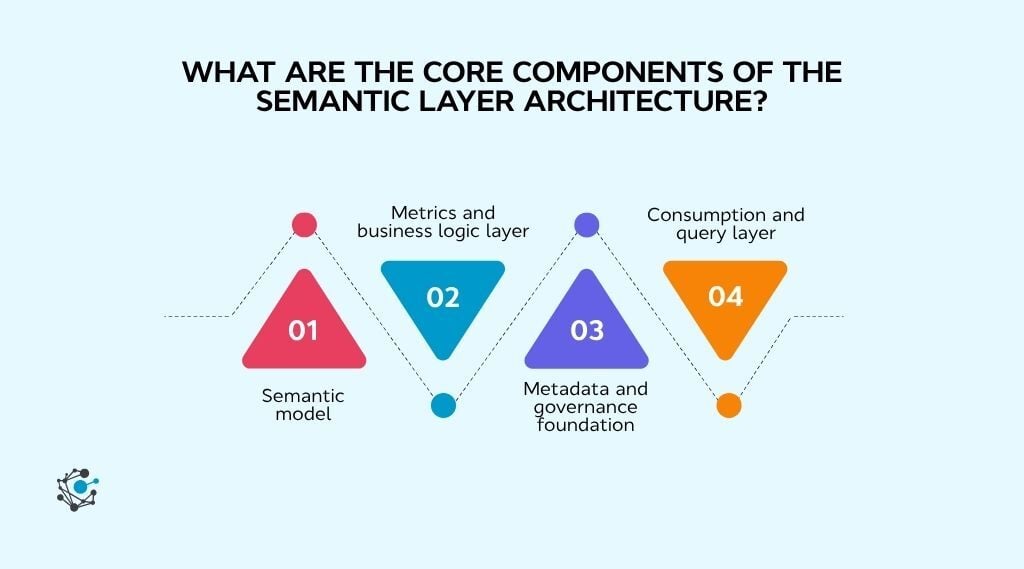
A semantic layer architecture brings together business meaning, governance, and technical access into a unified framework. While implementations differ across organizations, every effective semantic layer relies on four foundational components: a semantic model, a metrics and business logic layer, a metadata and governance foundation, and a consumption layer.
Together, these components ensure that business users, BI platforms, and AI applications work from the same trusted definitions rather than interpreting data independently.
1. Semantic model
The semantic model is the structural foundation of the architecture. It organizes enterprise data into business-friendly entities, relationships, and dimensions so users interact with familiar business concepts instead of complex database schemas.
Business entities typically represent core objects such as Customer, Product, Order, Account, Employee, Claim, or Transaction. The semantic model also defines how these entities relate to one another. For example, a customer places an order, the order contains products, and each product belongs to a category.
Dimensions provide additional context for analysis by organizing information into categories such as time period, geography, department, customer segment, or product line. Rather than requiring users to understand multiple joins across warehouse tables, the semantic model presents these relationships through a consistent business structure.
For example, a sales manager can analyze revenue by region, product category, and quarter without knowing how those dimensions are stored across the underlying data warehouse.
2. Metrics and business logic layer
The metrics and business logic layer standardize how business performance is measured. Instead of allowing every dashboard or analytics team to create its own calculations, this layer centralizes reusable KPI definitions that can be shared across the organization.
Each metric includes more than a formula. It defines filters, joins, aggregation rules, calculation windows, and exclusions to ensure consistent interpretation wherever the metric is used.
For example, Net Revenue may exclude taxes, discounts, and refunds, while Customer Churn may only include customers who have been inactive for a defined period. Once these rules are established, every BI report, AI assistant, and analytics application retrieves the same calculation instead of recreating it independently.
However, standardized metrics alone do not eliminate ambiguity. Different business domains may use the same business term while intending different meanings.
For example, a customer may represent a sales account, a billing account, an active product user, or a consolidated enterprise record, depending on the business context.
At OvalEdge, we believe this distinction is what makes semantic layer architecture enterprise-ready. The semantic layer explains what business concepts represent, while governance determines which business definition should be applied for a specific business scenario.
Together, they create a trusted foundation for analytics and AI. For a closer look at how this plays out specifically in AI contexts, see our detailed breakdown of the governed semantic layer for AI.
3. Metadata and governance foundation
The semantic layer becomes trustworthy only when it is supported by strong governance. The metadata and governance foundation connects business definitions with the operational information needed to understand, validate, and control them.
This foundation typically includes:
|
Governance capability |
Purpose |
|
Business glossary |
Standardizes business terms and KPI definitions. |
|
Metadata |
Connects business concepts with technical assets and documentation. |
|
Data catalog |
Makes semantic assets searchable and easier to discover. |
|
Data lineage |
Traces metrics back to their source systems and downstream reports. |
|
Data quality |
Validates the completeness, freshness, and reliability of data. |
|
Ownership and stewardship |
Establishes accountability for definitions and governance. |
|
Certification |
Identifies approved datasets, metrics, and dashboards. |
|
Access policies |
Controls who can view or query sensitive business information. |
Together, these governance capabilities ensure semantic definitions remain trusted, traceable, and consistently applied across analytics and AI initiatives.
OvalEdge's Data Governance Solution covers all of these layers in a single platform, connecting business glossary, lineage, certification, and access policy management so organizations don't need separate tools for each capability.
4. Consumption and query layer
The consumption layer exposes approved semantic definitions to the tools and users that rely on them for decision-making. It serves as the interface through which the governed business context is delivered consistently across the enterprise.
Instead of every consumer connecting directly to raw warehouse tables, they retrieve standardized definitions through the semantic layer using query engines, APIs, or platform integrations.
Common consumers include:
-
BI tools such as Tableau, Power BI, and Looker
-
Executive dashboards and operational reports
-
AI assistants and natural language analytics
-
Data science notebooks
-
Embedded analytics applications
-
Enterprise APIs and downstream business applications
Many modern platforms also support headless or universal semantic layer architectures, allowing the same governed metrics and business definitions to be reused across multiple tools instead of being tied to a single BI platform.
Together, these four components create an architecture that separates business meaning from technical implementation while ensuring analytics and AI systems consistently operate on trusted, governed data.
How the semantic layer architecture connects sources to BI and AI consumers
Semantic layer architecture acts as the bridge between enterprise data and the tools that consume it. Rather than allowing each BI platform, dashboard, or AI application to interpret raw data independently, it delivers a consistent layer of business definitions, metrics, relationships, and governance across the organization.
The process begins with data from operational systems, data warehouses, and lakehouses. After the data is transformed into analytics-ready models, the semantic layer maps technical assets to business entities and standardized metrics. Metadata, business glossary, lineage, quality, certification, and access policies enrich these definitions before they are delivered to downstream consumers.
As a result, every BI and AI consumer works from the same trusted business context instead of creating its own interpretation of enterprise data.
1. Benefits for BI
A semantic layer helps business intelligence platforms deliver consistent reporting by:
-
Reusing centralized KPI definitions across dashboards.
-
Eliminating conflicting metric calculations between teams.
-
Improving confidence in self-service analytics.
-
Reducing the maintenance effort of dashboard-specific business logic.
2. Benefits for AI
AI applications rely on business context as much as they rely on data. A semantic layer strengthens AI by making business knowledge more consistent and accessible across enterprise systems.
Analytics copilots primarily use the semantic layer to retrieve governed metrics and business definitions for natural language queries and reporting.
Autonomous AI agents have broader requirements, using the semantic layer alongside governance policies, access controls, lineage, and runtime context to make decisions and execute actions safely.
A semantic layer strengthens AI by:
-
Providing approved business entities and relationships.
-
Supplying standardized metrics instead of raw calculations.
-
Helping AI distinguish between multiple business definitions of the same term based on governance rules and business context.
-
Applying governance and access policies before data is consumed.
-
Improving the accuracy and explainability of natural language queries and AI-generated insights.
By separating business meaning from technical implementation, semantic layer architecture enables organizations to scale analytics and AI while maintaining consistency, governance, and trust across every consumer.
How to design a governed semantic layer architecture step by step
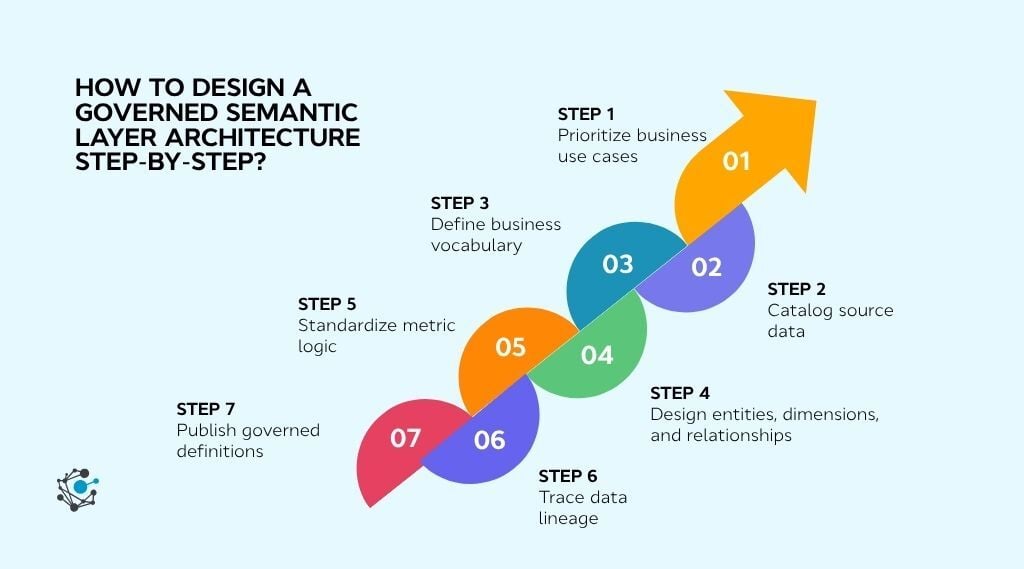
Building a semantic layer architecture is not about documenting every dataset in your organization. It starts with identifying the business questions that matter most and gradually connecting trusted definitions, metrics, and governance to the data that supports them.
The following steps provide a practical framework for designing a semantic layer that scales across analytics and AI.
Step 1: Prioritize high-value business use cases
Start by identifying the business decisions your semantic layer should support instead of modeling every available dataset. Focus on high-impact use cases such as executive reporting, customer analytics, financial reporting, compliance, or AI-powered insights.
Example: A retail company may begin by standardizing revenue, active customers, and inventory metrics before expanding to marketing and supply chain analytics.
Outcome: Business priorities drive the semantic layer, making adoption faster and delivering measurable value early.
Step 2: Catalog the source data
Identify the systems, datasets, reports, and dashboards that provide the data for your semantic layer. Capture metadata such as schemas, owners, classifications, relationships, and usage patterns to understand how business information is distributed across the organization.
Example: Customer information may exist in Salesforce, order details in SAP, and product data in Snowflake. Cataloging these assets creates a clear inventory before semantic modeling begins.
Outcome: A complete view of enterprise data reduces duplication and establishes the foundation for semantic definitions.
OvalEdge's Data Catalog automates this inventory work by connecting to 150+ data sources and capturing metadata, ownership, and classification in one place.
Step 3: Define the business vocabulary
Create standardized definitions for business terms and assign ownership for each one. Include synonyms, approved descriptions, and stewardship information so everyone interprets key concepts consistently.
Example: Define what qualifies as an Active Customer, Net Revenue, or Churn Rate, and specify which business team owns each definition.
Outcome: Business users, analysts, and AI applications reference the same language across the organization.
Step 4: Design entities, dimensions, and relationships
Define how business concepts connect inside the semantic layer. Identify core entities such as Customer, Product, Order, Account, or Transaction, then map their dimensions, hierarchies, and relationships.
Example: A Customer entity may connect to Orders, Products, Regions, and Time dimensions, with hierarchies such as Region → Country → City or Product Category → Product Line → SKU.
Outcome: Users can analyze data through business-friendly structures instead of navigating technical tables, joins, and schemas.
Step 5: Standardize metric logic
Centralize KPI calculations within the semantic layer instead of embedding them inside individual dashboards or reports. Define formulas, filters, aggregation rules, joins, calculation windows, and exclusions once so they can be reused everywhere.
Example: Calculate Monthly Recurring Revenue using one approved formula that is shared across finance dashboards, executive reports, and AI assistants.
Outcome: Every reporting tool and AI application uses identical business logic, improving consistency and reducing maintenance.
Step 6: Trace the data lineage
Connect business definitions to the source systems, transformation pipelines, and downstream reports they depend on. Lineage provides visibility into how data flows across the organization and helps teams understand the impact of changes.
Example: A revenue KPI can be traced from ERP transactions through transformation models to executive dashboards and AI-generated reports.
Outcome: Teams can validate the origin of business metrics, assess the impact of changes, and increase trust in reporting.
Step 7: Publish governed definitions
Make approved semantic definitions available to BI platforms, AI assistants, dashboards, APIs, notebooks, and other downstream applications. Before publishing, apply certification, ownership, and access policies so users know which metrics and datasets can be trusted.
Example: Publish a certified Customer Lifetime Value metric that is accessible through Tableau, Power BI, and an AI-powered analytics assistant.
Outcome: Every consumer works from the same governed business definitions, enabling consistent analytics and trustworthy AI across the enterprise.
Building a governed semantic layer requires more than standardized metrics. Book a demo to see how OvalEdge helps connect governance, metadata, and business context.
How does OvalEdge support governed semantic layer architecture?
OvalEdge operationalizes the governance capabilities that make semantic layer architecture effective. Connecting metadata, business glossary definitions, lineage, certification, quality, and policy controls into a unified platform helps organizations maintain a trusted business context across analytics and AI.
|
Semantic layer requirement |
How OvalEdge supports it |
|
Discover and organize data |
Data Catalog and Connectors |
|
Standardize business definitions |
Business Glossary |
|
Trace metrics to source |
Data Lineage |
|
Validate trusted data |
Data Quality and Certification Manager |
|
Govern access |
Data Access Management |
|
Operationalize governance |
Automation Engine and APIs |
How OvalEdge established a single source of truth in a data mesh environment
A global enterprise adopting a data mesh architecture wanted to maintain decentralized data ownership while delivering consistent reporting across business domains. Although each domain managed its own datasets successfully, business teams interpreted common metrics differently, making it difficult to establish a trusted view of enterprise performance.
Using OvalEdge, the organization built a governed semantic foundation by connecting technical metadata with business glossary definitions, mapping relationships across distributed data assets, and establishing end-to-end lineage for critical business metrics.
Governance workflows assigned clear ownership, certification identified trusted datasets and dashboards, and policy controls ensured business definitions remained consistent across domains. This enabled teams to reuse approved metrics across BI platforms while creating a trusted business context for future AI initiatives.
As a result, the organization achieved:
-
A single source of truth for enterprise reporting.
-
Consistent business definitions across multiple domains.
-
Greater trust in dashboards through certified, traceable metrics.
-
Faster access to governed data for analytics initiatives.
-
A scalable governance foundation that supported both BI and future AI use cases without compromising decentralized ownership.
This example demonstrates that a semantic layer delivers the greatest value when business definitions, governance, and metadata work together as a connected foundation rather than as isolated capabilities.
Conclusion
Building a semantic layer is an important milestone, but it is not the finish line. As organizations expand analytics and AI, success increasingly depends on connecting business definitions with the governance that determines how those definitions are applied across different teams, use cases, and technologies.
That makes the next step clear. Rather than treating semantic modeling as a standalone initiative, organizations should evaluate whether their metadata, business glossary, lineage, quality, certification, and governance processes work together as a unified foundation for trusted decision-making.
OvalEdge helps bring these capabilities together in a single platform, enabling organizations to build semantic layer architectures that remain consistent, governed, and ready for enterprise-scale analytics and AI.
Book a demo with OvalEdge to see how a governed semantic foundation can support trusted business intelligence and AI across the enterprise.
.png?width=1081&height=173&name=Forrester%201%20(1).png)
.png?width=1081&height=241&name=KC%20-%20Logo%201%20(1).png)