-Jul-06-2026-12-42-40-9250-PM.png)
Most data taxonomy tool comparisons lead with feature checklists and details that don't help you narrow your shortlist for a platform that has to prove governance, support multiple teams, and hold up at enterprise scale.
The platform should show who approved a classification change and when. It should let teams across data, governance, and analytics edit the same taxonomy together. And its pricing should hold up at your scale, not just in a pilot, especially when a regulated-industry auditor asks how a term got approved in the first place.
This guide covers 6 data taxonomy tools, split between governance-native platforms tied to ownership and lineage and semantic platforms built for taxonomists, evaluated against those three questions.
What is data taxonomy?
A data taxonomy is a hierarchical system for classifying an organization's data into categories, subcategories, and terms based on shared characteristics such as subject, sensitivity, or business function.
It gives every dataset a consistent place in a single structure, so teams and AI systems apply the same classification logic across the business rather than inventing their own.
Here’s a simple example for a company classifying customer data:
-
Category: Customer Data
-
Subcategory: Contact Information
-
Terms: Email Address, Phone Number, Mailing Address
Each level narrows the classification. The category groups data by subject, the subcategory groups it by type within that subject, and the terms are the specific fields a steward tags and governs.
What are data taxonomy tools?
Data taxonomy tools are software platforms that help organizations build, manage, and govern the classification systems used to organize enterprise data. They fall into two broad types.
1. Dedicated semantic platforms
They focus on building and publishing taxonomies, thesauri, and ontologies as their primary function.
2. Governance-native platforms
They manage taxonomy alongside business glossaries, data catalogs, lineage, and stewardship workflows, so classification stays tied to who owns each term and how it gets used.
The strongest platforms connect taxonomies to shared business definitions and governance, giving every team and AI system a common classification language instead of a list of labels nobody maintains.
Some organizations also need taxonomy tools for product catalogs, support content, or customer feedback. For that broader use-case coverage, see our guide to taxonomy management software.
Also read: Ontology management tools compares platforms built specifically for ontology authoring, including three of the vendors covered here.
6 best data taxonomy tools compared
Six data taxonomy tools, split between governance-native and semantic platforms, compared on the criteria that actually decide fit: audit trails, collaboration, and pricing.
|
Tool |
Type |
Governance & audit trails |
Collaborative team editing |
Pricing model |
|
OvalEdge |
Governance-native |
Approval workflows + version history built into governance layer |
Role-based stewardship review and approval |
Custom quote |
|
PoolParty |
Semantic platform |
Not publicly documented |
Collaborative taxonomy editor confirmed |
Custom, modular (pay per module) |
|
Synaptica |
Semantic platform |
Full audit log (who, what, when) + concept lifecycle states |
6 role types: Observer to Admin |
Custom quote |
|
TopBraid EDG |
Semantic platform |
Full version history + time-travel to any past decision |
Stakeholder review and sign-off workflow |
Custom quote |
|
Progress Semaphore |
Semantic AI platform |
Not publicly documented |
Not publicly documented |
3 tiers (Dev/Business/Enterprise), custom quote |
|
Data Harmony |
Taxonomy management platform |
Not publicly documented |
Not publicly documented |
Custom quote |
1. OvalEdge
Disclosure: We've evaluated OvalEdge by the same criteria as every other tool on this list.
OvalEdge is a data governance and catalog platform built around its Enterprise Context Graph, connecting taxonomy to lineage, catalog, quality, and access policy in one governed layer.
Governance, compliance & audit fit
Regulated teams need more than a taxonomy editor. They need proof of who approved each classification and when. OvalEdge handles this through a built-in stewardship workflow: Helm assigns an owner and steward to every term, each change moves through review and approval before production, and the full trail records who proposed, reviewed, and published it.
That trail sits in the same governance layer as lineage, catalog metadata, and access policy, so auditors can trace a classification from approval through to downstream reporting without pulling evidence from separate systems.
AI and analytics readiness
When a classified term reaches an AI agent, it carries its full governance context through OvalEdge's Enterprise Context Graph.
-
Governed MCP access delivers terms to agents built in Claude, ChatGPT, or custom frameworks with the owner, definition, lineage, and access rules attached, so the agent knows what the term means, where it came from, and who can use it before it reasons over the data.
-
Nexus maps relationships between classified terms and resolves synonyms across systems, so an agent working across finance and operations doesn't treat "net revenue" and "revenue after returns" as two different concepts.
Best fit: organizations that want taxonomy governed inside the same system of record as their business glossary, catalog, and lineage, instead of a standalone editor.
Less suited for: teams authoring formal OWL or SHACL ontologies at depth. They typically pair OvalEdge with a dedicated semantic editor for that modeling work.
Report: A Forrester Total Economic Impact study found OvalEdge customers cut metadata-cataloging effort 40% and sensitive-data tagging effort 75%, with analyst productivity up 30%.
Book a demo to see how OvalEdge's Enterprise Context Graph keeps taxonomy tied to lineage, catalog, and access policy as your data changes.
2. PoolParty

PoolParty Semantic Suite is a semantic technology platform from Semantic Web Company, used to build standards-based taxonomies, thesauri, and knowledge graphs.
Governance, compliance & audit fit
PoolParty's public site does not document approval workflows or audit trails, unlike Synaptica and TopBraid EDG. It does confirm a collaborative, role-based taxonomy editor for building and maintaining an information architecture. Regulated-industry buyers evaluating PoolParty specifically for versioning and audit trails should confirm the capability directly rather than assume it from the semantic-modeling framing.
AI and analytics readiness
PoolParty leans on semantic-web standards to power its AI features:
-
Semantic AI and auto-classification apply NLP and machine learning to tag content automatically
-
Ontology and knowledge graph modeling builds the relationships that power more consistent search and retrieval
-
SKOS and RDF support keep classifications portable across systems built on open Semantic Web standards
Best fit: organizations building standards-based taxonomies, thesauri, and knowledge graphs, especially teams with in-house semantic-web expertise.
Less suited for: teams that want taxonomy tied directly to data lineage and access policy inside one governance platform. PoolParty is built for semantic modeling first, not broader data governance.
3. Synaptica
Synaptica Graphite is an enterprise taxonomy and ontology management platform built for large-scale, multi-domain classification programs.
Governance, compliance & audit fit
Synaptica has the strongest publicly documented audit story here. Every concept carries an activity log recording what changed, when, and by whom, and moves through lifecycle states from Candidate to Approved, Published, or Withdrawn. Role-based permissions inside Graphite Projects, from Observer to Admin, control who can change what.
AI and analytics readiness
-
Automated classification applies taxonomy terms to content using machine learning
-
Polyhierarchy support lets a concept sit under multiple parent categories, matching how AI systems often need to reason about overlapping categories rather than one strict hierarchy
-
SKOS, RDF, and XML standards keep the taxonomy portable into other AI and search tooling
Best fit: enterprises running large, multi-domain taxonomy and ontology programs that need documented governance.
Less suited for: smaller, single-domain programs, where the role structure and lifecycle tracking add more process than the taxonomy needs.
4. TopBraid EDG
TopBraid EDG is a knowledge graph and enterprise data governance platform from TopQuadrant, built on RDF, OWL, and SHACL standards.
Governance, compliance & audit fit
TopBraid EDG keeps a full version history for every change, with time-travel back to the context behind any past decision. Subject-matter experts review and sign off before a change becomes authoritative, and centralized governance means one update propagates to every connected system instead of drifting across copies.
AI and analytics readiness
-
Impact analysis shows how a taxonomy or ontology change ripples through connected relationships before it's approved
-
SHACL support adds validation rules on top of the taxonomy, which matters when AI systems need to trust that a classification meets defined constraints, not just that it exists
-
Knowledge graph modeling on RDF and OWL suits AI systems that reason over relationships, not flat category lists
Best fit: organizations building enterprise knowledge graphs where taxonomy is one part of a larger semantic data model, with RDF, OWL, and SHACL expertise in-house.
Less suited for: teams that want a simpler, taxonomy-only tool without committing to broader knowledge graph modeling.
5. Progress Semaphore
Progress Semaphore, formerly Smartlogic Semaphore, is a semantic AI platform built for automated classification across document repositories and enterprise search.
Governance, compliance & audit fit
Semaphore's public site does not document approval workflows or audit trails, unlike Synaptica and TopBraid EDG. Licensing splits into three tiers, Development, Business, and Enterprise, but none detail governance controls publicly. Regulated-industry buyers should ask directly whether change tracking and sign-off exist before assuming Semaphore covers audit requirements.
AI and analytics readiness
-
Automated content classification uses machine learning and NLP to tag documents without manual review
-
Metadata enrichment extracts entities automatically, reducing the manual work behind AI-ready metadata
-
Semantic search improves accuracy through concept-based indexing, useful when AI systems need to retrieve by meaning rather than exact keyword match
Best fit: enterprises with large document repositories or ECM and digital asset systems that need automated, content-centric classification at scale.
Less suited for: teams that need documented audit trails and approval workflows out of the box.
6. Data Harmony

Data Harmony is a taxonomy and metadata management suite from Access Innovations, built for controlled vocabulary management and machine-assisted indexing.
Governance, compliance & audit fit
Data Harmony's public site does not document approval workflows, version control, or audit trails, making it the least documented of the six tools on governance. No pricing is listed either; the vendor offers a free trial and requires direct contact for a demo and quote. Confirm capabilities directly during evaluation.
AI and analytics readiness
-
Automated indexing classifies content using machine-assisted methods, reducing manual tagging
-
Standards compliance supports widely adopted taxonomy standards, keeping classification interoperable with other systems
-
Search optimization improves discovery through consistent classification, useful for AI systems retrieving by concept rather than keyword
Best fit: organizations focused on controlled vocabulary management and content indexing at scale, particularly publishing and content-heavy environments.
Less suited for: buyers who need governance transparency up front.
What to look for in a data taxonomy tool?
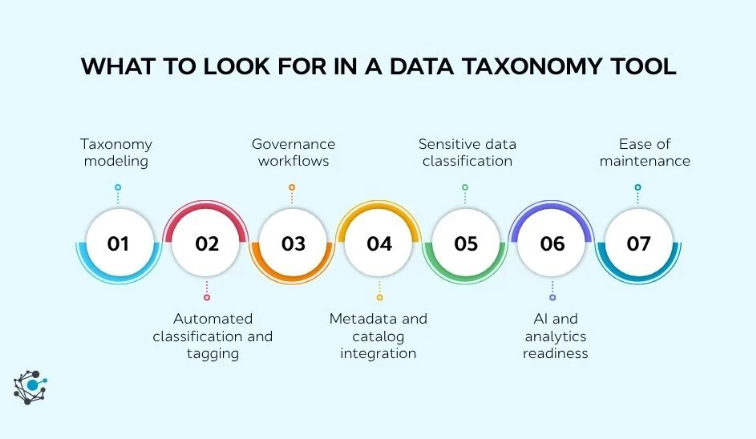
Different data taxonomy tools solve different problems. Some are designed for creating and publishing controlled vocabularies, while others focus on governing classifications across enterprise data.
Evaluating the following capabilities will help you choose a platform that aligns with your organization's long-term data governance strategy.
-
Taxonomy modeling: Support for hierarchical taxonomies, polyhierarchies, synonyms, controlled vocabularies, and standards such as SKOS and RDF where interoperability is important.
-
Automated classification and tagging: The ability to automatically discover, classify, and tag data assets at scale while allowing stewards to review and validate classifications.
-
Governance workflows: Approval processes, version control, stewardship, and ownership management that keep taxonomy changes controlled and auditable.
-
Metadata and catalog integration: Integration with data catalogs, business glossaries, lineage, and metadata management tools so classifications remain aligned with live enterprise data. When evaluating this capability, check whether classification metadata syncs automatically or requires a manual export step.
-
Sensitive data classification: Capabilities to identify sensitive information and connect classifications with governance policies, access controls, masking, and regulatory compliance.
-
AI and analytics readiness: Taxonomies that provide consistent classifications and trusted business context for AI applications, search, data discovery, and analytics.
-
Ease of maintenance: Features such as ownership tracking, change management, monitoring, and versioning that help keep taxonomies accurate over time.
The right platform should not only help you build a taxonomy but also make it easy to keep classifications accurate as your data and business evolve.
How to build and manage a data taxonomy?
Building a data taxonomy is a five-step process: define the scope, build the category structure, assign owners, connect it to live data, and review it on a set schedule. Here's what each step involves:
-
Define what the taxonomy needs to organize
Decide the scope up front, such as customer data, financial records, or sensitive information, so categories map to real business domains instead of generic labels.
-
Build the category structure
Set categories, subcategories, and terms, keeping the hierarchy shallow enough that a steward can place a new dataset in seconds, not minutes.
-
Assign owners and stewards
Every category needs a named owner responsible for keeping it accurate and a steward who reviews change requests.
-
Connect the taxonomy to live data
A taxonomy that lives in a spreadsheet drifts from the database, catalog, and reports it is meant to describe. Tag actual tables, columns, and reports with taxonomy terms so classification updates when the underlying data changes.
-
Review on a governed schedule
Set a quarterly or biannual review, retire terms nobody uses, and merge duplicates before they spread across teams.
OvalEdge expert insight: Sergei Vandalov, Senior Manager of Data Governance & Analytics at Bedrock, says auto-lineage inside a connected governance layer "saves us months of work" compared to manually tracing taxonomy changes across systems.
Data taxonomy vs. data catalog, classification, and ontology
A data taxonomy often gets confused with three adjacent concepts: data catalog, data classification, and ontology. A catalog inventory where data lives, classification tags data by sensitivity, and ontology maps how concepts relate. Taxonomy organizes them into categories and hierarchies.
|
Term |
What it is |
How it differs from a data taxonomy |
|
Data catalog |
An inventory of an organization's data assets, with metadata, search, and discovery built in |
A catalog lists and describes datasets. A taxonomy is the classification scheme the catalog uses to group them |
|
Data classification |
The process of labeling data by sensitivity or type, such as public, internal, or restricted |
Classification is usually one dimension inside a taxonomy, not the whole structure |
|
Ontology |
A model of concepts and the relationships between them, built on formal logic |
A taxonomy organizes concepts into a hierarchy. An ontology also defines how concepts relate to each other, not just where they sit |
Teams that get this right usually settle ownership before selecting a platform. Business teams define and own the vocabulary, and technology enters only after that agreement is in place, since tooling without buy-in rarely sticks. The same sequencing applies to picking a data taxonomy platform: settle ownership and process first, then choose the tool that fits it.
Why is a taxonomy tool only as good as the governance behind it?
A taxonomy stays valuable only if it evolves with the business, from data sources to regulations. Without governance, classifications drift and lose trust. Three elements determine whether a taxonomy remains effective over time:
-
Clear ownership: Assigning data owners and stewards ensures taxonomy categories are reviewed, updated, and applied consistently as business requirements change.
-
Policy alignment: Connecting taxonomy with data governance and compliance policies helps organizations apply classification standards consistently for privacy, retention, and access management.
-
Ongoing maintenance: Regular reviews, change management, and governance workflows keep classifications relevant instead of letting them become outdated.
At OvalEdge, our experts believe taxonomy is most effective when it is continuously governed rather than treated as a one-time implementation. OvalEdge's data governance solution gives teams the ownership tracking, stewardship workflows, and policy enforcement needed to keep classifications accurate as business needs evolve.
How to choose the right data taxonomy tool?
Every organization has different taxonomy requirements, and the right platform depends on the primary business objective rather than the number of features on offer.
Start by deciding whether a standalone taxonomy tool fits or whether taxonomy needs to sit inside a broader governance strategy, since that call narrows the shortlist early. From there, weigh how the taxonomy will be maintained and owned, how well the platform fits the existing data ecosystem, whether it can support future business growth, and how easily existing taxonomies can be migrated without losing classifications.
Choosing the right data taxonomy tool ultimately means finding a platform that aligns with governance objectives, integrates with the existing data ecosystem, and supports long-term data strategy.
Book a demo to see how OvalEdge governs data taxonomies inside its Enterprise Context Graph.
.png?width=1081&height=173&name=Forrester%201%20(1).png)
.png?width=1081&height=241&name=KC%20-%20Logo%201%20(1).png)