.jpg)
Taxonomy and ontology are often mentioned together, but they solve different problems. Understanding the difference has become increasingly important as organizations build data governance programs and AI applications that depend on trusted business context.
A February 2026 arXiv paper, “LLM-Driven Ontology Construction for Enterprise Knowledge Graphs,” reported a 0.724 fuzzy-match F1 score for an LLM-driven ontology pipeline in the Data domain while highlighting ongoing challenges with scope definition and hierarchical reasoning.
Those findings reinforce that effective AI depends on both clear classification and well-defined semantic relationships.
This guide explains how taxonomy and ontology differ, where each fits, and how they complement one another in modern data governance.
Ontology vs taxonomy: the short answer
A taxonomy organizes information into a hierarchy of categories and subcategories. An ontology defines concepts, relationships, properties, and rules that explain how information connects across a domain. In data governance and AI, taxonomy improves discovery and classification, while ontology adds context, meaning, and reasoning.
Think of taxonomy as the structure behind a data catalog or business glossary. It helps teams group assets, terms, and reports so users can find them faster. Ontology goes further by connecting those assets to owners, policies, quality rules, lineage, systems, and AI models.
What is a taxonomy?
A taxonomy is a hierarchical classification system that organizes data, business terms, reports, documents, or other assets into categories and subcategories. Its primary purpose is to make information easier to discover, browse, and manage consistently.
In data governance, taxonomies commonly support data catalogs, business glossaries, navigation structures, tags, and search filters by providing a shared organizational framework.
A simple taxonomy for enterprise data assets may look like this:
|
Parent category |
Subcategories |
|
Customer data |
Customer profile data, customer transaction data |
|
Finance data |
Revenue data, forecasting data |
|
Operations data |
Inventory data, vendor data |
OvalEdge expert opinion: Taxonomy is the right starting point when the challenge is organizing information consistently. If users cannot agree where assets belong, establishing clear categories and naming conventions should come before more advanced semantic modeling.
When to use taxonomy?
Use a taxonomy when the primary objective is organizing information rather than modeling complex relationships.
Taxonomy is useful when:
-
A team needs simple classification across data domains.
-
Catalog filters, tags, and browsing paths need improvement.
-
Approved business terms need to be grouped in a glossary.
-
Users need to find data without studying complex relationships.
-
A team is starting with practical catalog organization before expanding into semantic governance.
What is an ontology?
An ontology is a semantic model that defines concepts, relationships, properties, and business rules within a domain. Rather than simply organizing information into categories, it explains how people, data, systems, policies, and business concepts relate to one another.
These relationships provide the context needed for semantic search, knowledge graphs, AI applications, governance, and automated reasoning.
OvalEdge expert opinion: Ontology should not be treated as the automatic first step for every AI program. Start by finding where meaning breaks. If the problem is definitions, begin with a glossary. If the problem is categorization, begin with taxonomy. If the problem is relationships, constraints, policies, risks, or safety-critical context, ontology becomes core infrastructure.
When to use ontology?
Ontology is appropriate when understanding relationships is more important than simply organizing information.
It is especially valuable when:
-
Connecting business and technical metadata
-
Modeling policies, lineage, quality, and ownership
-
Building knowledge graphs or semantic search
-
Supporting AI with governed business context
-
Explaining how data should be interpreted and used
Ontology vs taxonomy vs thesaurus vs knowledge graph
Taxonomy and ontology are often discussed with controlled vocabulary, thesaurus, and knowledge graph. They are related, but each one solves a different part of the meaning and discovery problem. When comparing a business glossary and data catalog, this distinction helps clarify what belongs in definitions, categories, synonyms, semantic relationships, and connected data models.
Use this table to separate the terms clearly:
|
Concept |
Meaning |
Best for |
|
Controlled vocabulary |
Approved list of terms |
Consistent naming |
|
Taxonomy |
Hierarchical structure |
Classification and navigation |
|
Thesaurus |
Synonyms and related terms |
Search expansion |
|
Ontology |
Concepts, relationships, and rules |
Semantic meaning and reasoning |
|
Knowledge graph |
Connected data and relationships |
AI, analytics, and semantic search |
For example, a thesaurus may connect “PII,” “personal data,” and “sensitive customer data.” A taxonomy may group them under “privacy-regulated data.” An ontology can connect that data to consent rules, policies, owners, and AI models. A knowledge graph can represent all of these as connected, searchable relationships.
Ontology vs taxonomy: key differences
A taxonomy answers, “Where does this belong?” An ontology answers, “How is this connected?” That difference matters because enterprise data is not only stored in categories. It is also connected through systems, reports, owners, policies, quality rules, access controls, and AI models.
Use this table as the core ontology vs taxonomy comparison:
|
Dimension |
Taxonomy |
Ontology |
|
Function |
Classification |
Knowledge representation |
|
Structure |
Tree |
Network |
|
Relationship type |
Parent-child |
Multiple relationship types |
|
Example |
Customer data > transaction data |
Transaction data feeds revenue report |
|
Main value |
Findability |
Context |
|
Complexity |
Lower |
Higher |
|
Best fit |
Organization and navigation |
Meaning, reasoning, and governance context |
If the goal is simply to organize assets into business domains or categories, taxonomy is often sufficient. However, when organizations need to understand how datasets relate to owners, policies, lineage, quality, downstream reports, and AI use cases, ontology provides the richer context required for governed decision-making.
Taxonomy vs ontology in data governance
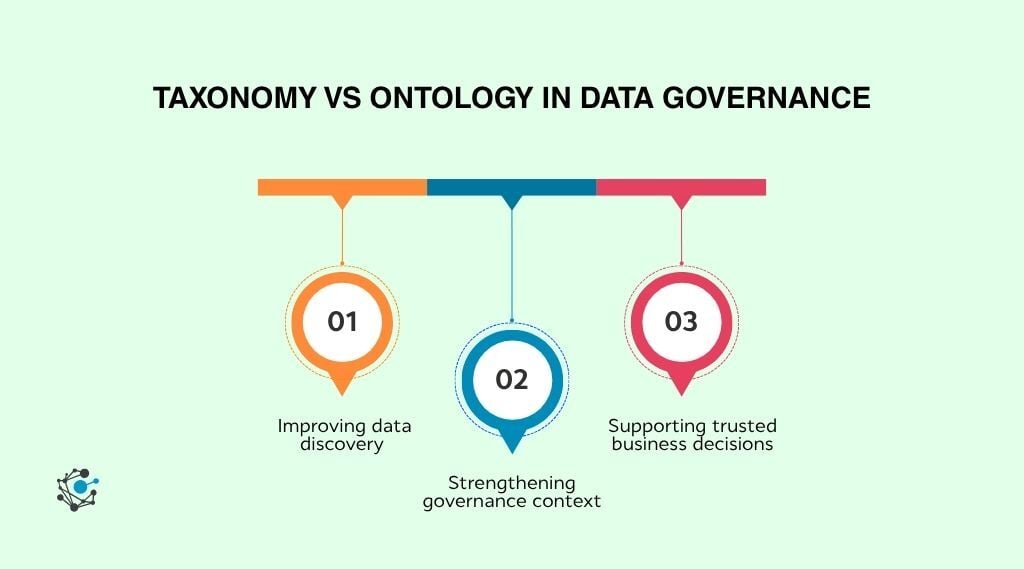
Both taxonomy and ontology play distinct but complementary roles in data governance. Taxonomy provides the organizational structure that helps users find information, while ontology enriches that structure with the business context needed to govern data consistently across the enterprise.
1. Improving data discovery
Taxonomy organizes data assets into logical categories, making them easier to search, browse, and discover. A consistent classification structure reduces duplicate terms, improves navigation across data catalogs and business glossaries, and helps users locate relevant information without relying on inconsistent naming conventions.
2. Strengthening governance context
Ontology connects datasets with business definitions, ownership, policies, lineage, quality rules, and compliance requirements. Modeling these relationships helps users understand how data should be interpreted, whether it can be trusted, and how governance policies or upstream changes affect downstream assets.
3. Supporting trusted business decisions
Together, taxonomy and ontology transform data discovery into governed decision-making. Taxonomy helps users find the right data, while ontology provides the context needed to validate its quality, ownership, and approved use. This combination supports consistent reporting, regulatory compliance, and enterprise AI initiatives built on trusted business context.
The same foundation that enables trusted governance also helps AI systems interpret enterprise data consistently. As organizations adopt AI-driven analytics, taxonomy and ontology extend beyond governance to support accurate retrieval, semantic reasoning, and explainable AI.
Ontology and taxonomy in AI
For AI, taxonomy improves retrieval by giving assets consistent categories, tags, and metadata. Ontology improves reasoning by representing relationships, business rules, context, risks, and approved usage. This becomes essential when AI systems need to understand business meaning rather than match keywords.
For example, if a user asks, "Can this dataset be used for customer segmentation?" taxonomy may identify it as customer data. Ontology can determine whether the dataset contains sensitive information, whether customer consent exists, its lineage, quality status, certification, approved purpose, and previous model usage.
This connected context enables a governed semantic layer of AI, more reliable AI responses, and stronger responsible AI governance by ensuring models use data within approved business and regulatory boundaries.
How to use taxonomy and ontology together
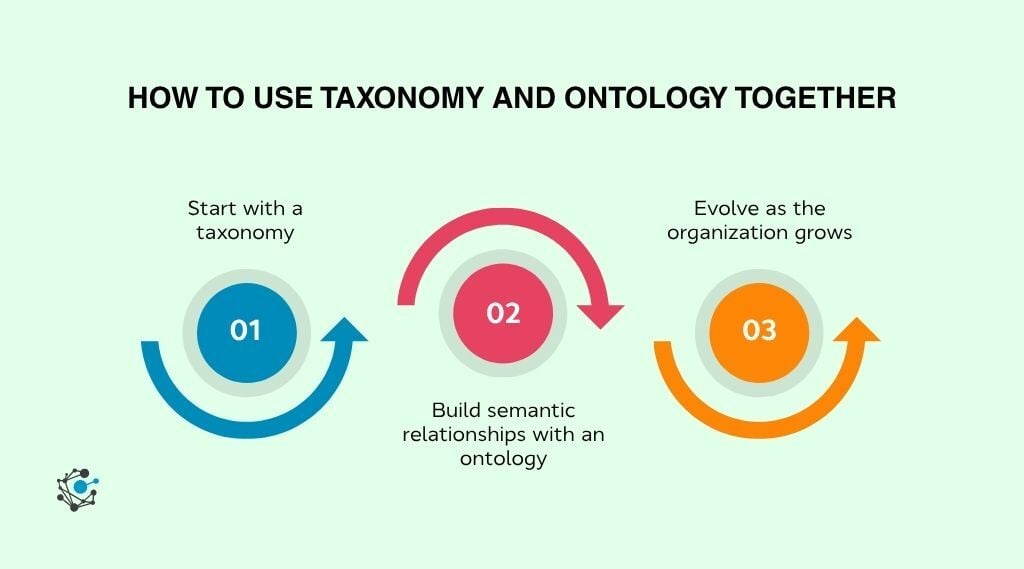
Taxonomy and ontology are not competing approaches. Most organizations achieve the best results by introducing them in stages. A taxonomy establishes a consistent classification framework, while an ontology builds on that foundation by adding semantic relationships and business meaning. As governance matures, both evolve together to support new business requirements and AI initiatives.
1. Start with a taxonomy
Begin by organizing business terms, datasets, reports, and other data assets into a logical hierarchy. A clear taxonomy creates a shared language across the organization, making information easier to classify, discover, and manage consistently.
Starting with a simple structure also makes it easier to gain adoption before introducing more advanced governance concepts.
2. Build semantic relationships with an ontology
Once a consistent classification exists, enrich it with an ontology by connecting assets to business definitions, owners, policies, systems, and related concepts.
These relationships provide the context needed to understand how data is connected, how it should be interpreted, and how it supports business processes.
3. Evolve as the organization grows
Taxonomies and ontologies should evolve alongside the business. As organizations introduce new data domains, regulatory requirements, acquisitions, or AI use cases, they should refine classifications, add new relationships, and retire outdated concepts.
Treating both as living governance assets helps maintain consistency, accuracy, and business relevance over time.
Example in practice
A taxonomy may classify customer email under customer data. Ontology then enriches that classification by identifying customer email as personal data, linking it to its CRM source, associating it with consent policies, and connecting it to related business concepts.
Together, these layers help users understand not only where the data belongs but also what it means and how it should be used.
Roles and responsibilities in taxonomy and ontology governance
Taxonomy and ontology governance need clear ownership. Organizations need people who define terms, approve categories, validate relationships, maintain metadata links, and review changes as business needs shift. Without ownership, taxonomies become messy, and ontologies become hard to trust.
Use this role breakdown to assign clear accountability:
|
Role |
Responsibility |
|
Data governance lead |
Sets standards for taxonomy and ontology design |
|
Data steward |
Maintains terms, categories, definitions, and relationships |
|
Data owner |
Approves critical business terms, data domains, and usage rules |
|
Business SME |
Validates business meaning and domain-specific relationships |
|
Data architect |
Makes sure the ontology structure can scale across systems |
|
Metadata manager |
Connects taxonomy and ontology elements to technical metadata |
|
Compliance or privacy lead |
Validates policy, access, and regulatory relationships |
|
AI governance lead |
Checks that models, training data, risks, and controls are represented correctly |
Taxonomy ownership usually sits closer to business glossary, catalog, and stewardship teams. Ontology ownership needs closer work across governance, architecture, metadata, compliance, privacy, and AI teams. Approval workflows, stewardship tasks, review cycles, and change tracking through tools such as an automation engine help keep the model accurate after publication.
How OvalEdge helps operationalize taxonomy and ontology
Building a taxonomy and ontology is only the first step. Organizations also need a way to keep classifications, relationships, and business context accurate as data, regulations, and AI initiatives evolve.
OvalEdge provides a unified governance platform that helps teams manage both. Business glossaries and cataloging capabilities organize terms and assets into consistent taxonomies, while metadata management, lineage, and relationship mapping enrich those classifications with the semantic context needed for governance and AI.
Data Certification Manager helps users identify trusted assets for reporting, analytics, and AI, ensuring governed information is easy to discover and use with confidence.

As organizations expand AI initiatives, OvalEdge's askEdgi Agentic Analytics whitepaper explores how governed metadata, lineage, business definitions, and semantic context help AI systems interpret enterprise data more accurately and consistently.

Book a demo now to see how it can help you.
Conclusion
As AI use grows, the real challenge is not choosing taxonomy or ontology. It is a building-governed meaning that systems and users can trust. Taxonomy gives organizations the structure to find data. Ontology gives them the context to understand, govern, and apply it safely.
The next phase of data governance will depend on how well organizations connect classification, relationships, policies, ownership, quality, and AI use into one trusted foundation. Teams that treat taxonomy as a discovery layer and ontology as a context layer will be better prepared for semantic search, agentic analytics, explainable AI, and policy-aware data use.
If AI initiatives are moving faster than governance processes,schedule a demo with OvalEdgeto build a data foundation that is easier to trust, safer to use, and ready for reliable analytics and AI.
.png?width=1081&height=173&name=Forrester%201%20(1).png)
.png?width=1081&height=241&name=KC%20-%20Logo%201%20(1).png)