.png)
Most enterprises already have some version of a business glossary and a data catalog. The problem is not absence; it is misalignment. Teams either treat the two as interchangeable or invest heavily in one while ignoring the other entirely.
The consequences show up quickly. Sales and Finance define “active customer” differently, so dashboards contradict each other. Analysts cannot identify which dataset is trusted, current, or properly governed. Governance breaks down at the point of use.
The distinction is simpler than many organizations make it. A business glossary creates consistency in business language and definitions. A data catalog helps teams discover trusted data and understand its operational context, including lineage, ownership, and quality.
When organizations treat them as interchangeable, they either end up with documented definitions nobody uses or searchable data assets with no shared understanding of what the data actually means.
This article explains what each tool does, how they differ, when enterprises need one versus both, and what to evaluate in modern governance platforms.
What is a business glossary?
A business glossary is a governed collection of business terms, definitions, owners, rules, and relationships that helps teams use consistent language across the organization.
It contains business terms, definitions, synonyms, related terms, owners, stewards, approval status, business rules, and linked policies. Consider "active customer" without a formal definition, Sales, Finance, and Operations may each apply a different interpretation, producing conflicting numbers from the same underlying data. A glossary entry resolves this with one approved definition, a governing business rule, an assigned owner, and related terms.
Business glossaries are used by stewards, business owners, analysts, and compliance teams, anyone who needs to interpret data consistently.
How a business glossary supports data governance
A business glossary anchors governance by making business definitions explicit and accountable:
-
Consistent reporting definitions — ensures the same term means the same thing across every dashboard and business unit
-
Shared KPI ownership — assigns accountable business owners to critical metrics
-
Data literacy — gives analysts and business users a single reference point for interpreting data
-
Compliance interpretation — ensures regulated terms carry consistent meaning across policies and audit submissions, a baseline requirement under frameworks like GDPR.
-
Formal stewardship accountability — assigns stewards to critical terms, keeping definitions current and enforced.
Why business glossaries fail without operational integration
A business glossary is only as useful as its connection to the systems and workflows people actually use. Without that connection, even well-structured glossaries lose value quickly.
Definitions become stale when no workflow exists to review or retire terms. Adoption drops when glossary terms are disconnected from actual datasets, and analysts do not consult a reference that does not connect to where they work. Governance ownership breaks down without enforced stewardship, and terms accumulate without accountable owners.
The most significant gap is practical: a definition alone does not tell users where trusted data lives, whether it is current, or who is responsible for it.
A 2026 Gartner report notes that active metadata management practices are becoming a key differentiator, enabling organizations to analyze, alert, and automate decision-making across their data assets, something a standalone glossary, without catalog integration, cannot support.
That is the problem a data catalog is built to solve.
What is a data catalog?
A data catalog is an organized inventory of data assets, enriched with the metadata context needed to discover, evaluate, and trust data across systems.
It contains technical, operational, business, and governance metadata: lineage, quality signals, sensitivity classifications, ownership, and linked glossary terms. Consider a "Customer Transactions" table. A catalog entry shows its source systems, owner, linked glossary terms, lineage, PII flag, and completeness score. An analyst knows immediately whether it is the right dataset and whether they can use it.
Data catalogs serve analysts, data engineers, data scientists, and governance teams, anyone who needs context beyond a table name.
How a data catalog supports data discovery
Without a catalog, data discovery depends on who you know. A catalog converts that tribal knowledge into a searchable, governed asset inventory:
-
Self-service discovery — users find trusted datasets without depending on engineers or data teams
-
Lineage tracing — shows where data comes from and where it flows downstream
-
Quality-based trust signals — users evaluate data fitness before querying it
-
Sensitivity classification — governance teams identify and protect regulated data
-
Reduced time-to-data — less time hunting for data, more time using it with confidence
Business glossary vs data catalog: key differences
Many organizations assume that a glossary and a catalog are interchangeable because both manage metadata. That assumption is where governance investments go wrong. A glossary answers "what does this term mean?" A catalog answers "where is this data, how is it used, and can it be trusted?" They operate at different layers: the glossary at the semantic layer, the catalog at the asset and operational layer, and conflating them leaves gaps in both.
|
Category |
Business Glossary |
Data Catalog |
|
Main purpose |
Standardizes business terms and definitions |
Organizes, surfaces, and contextualizes data assets |
|
Primary users |
Business users, stewards, analysts |
Analysts, engineers, scientists, stewards, governance teams |
|
Metadata type |
Business metadata |
Business, technical, operational, and governance metadata |
|
Core question answered |
"What does this term mean?" |
"Where is this data, and can I trust it?" |
|
Governance role |
Aligns definitions across teams and reports |
Links definitions to assets, lineage, quality, and access policies |
|
Implementation scope |
Can start with one domain or team |
Requires integrations across warehouses, BI tools, and governance systems |
|
Ownership model |
Business-owned; stewards maintain term accuracy |
Shared across data, IT, and business teams |
|
Relationship to data dictionary |
Defines the business meaning of terms |
May link to field-level technical context |
|
AI and analytics readiness |
Provides business context for data consumers |
Provides technical, lineage, and quality context for responsible data use |
|
Typical output |
Approved, searchable term library |
Searchable, trusted data asset inventory with enriched metadata |
How business glossaries and data catalogs work together
Modern governance platforms increasingly combine glossary, catalog, lineage, quality, stewardship, and policy context into a connected governance layer, rather than separate tools. When these layers work together, a business term does not just define meaning; it anchors trusted, discoverable, policy-aligned data across the enterprise.
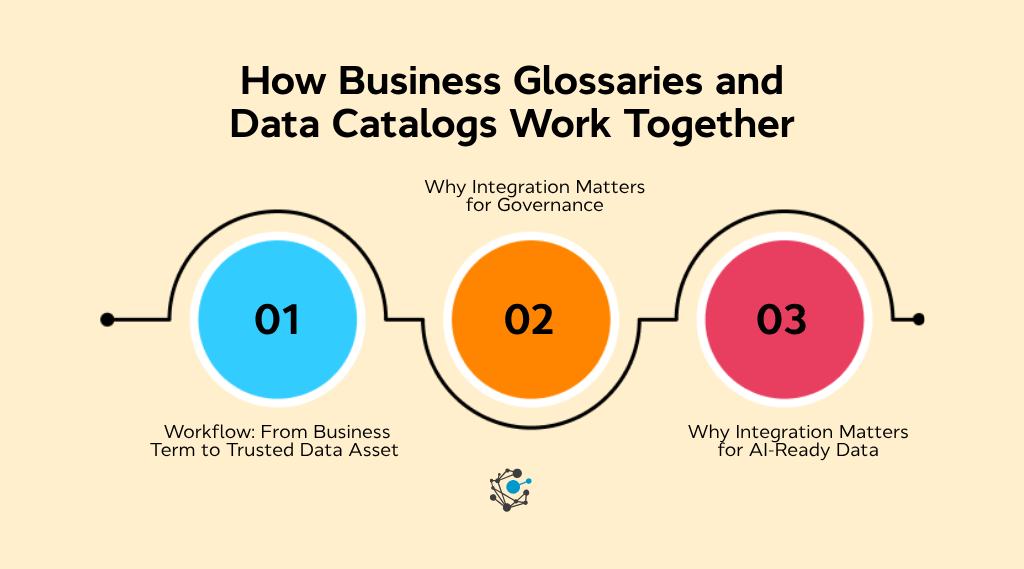
Workflow — from business term to trusted data asset
-
Steward drafts the term — definition, rules, synonyms, and related terms are created in the glossary
-
Business owner approves via workflow — accountability is assigned before the term becomes official
-
Term is linked to catalog assets — the approved definition connects to tables, dashboards, and reports
-
Catalog surfaces lineage — users see the full data flow from source to consumption
-
Data users review trust signals — quality scores, ownership, sensitivity labels, and freshness are visible
-
Analysts use approved data with approved definitions — no ambiguity, no competing metric versions
Why integration matters for governance
- Fewer metric conflicts — one approved definition connected to one trusted asset
- Clearer stewardship accountability — ownership is visible at both the term and asset level.
- Stronger policy mapping — governance policies connect to real data assets, not just documentation.
- Propagating definition changes — updates to glossary terms reflect across all linked catalog assets
Why integration matters for AI-ready data
AI systems depend heavily on semantic consistency. Without shared business definitions, AI assistants, retrieval systems, and analytics copilots may retrieve technically correct but contextually misleading information, a risk that grows as more teams deploy AI on enterprise data.
AI teams need both layers: the glossary to interpret what a field means, and the catalog to confirm whether data is complete, current, and appropriately sourced. Separated tools create context gaps that surface as model errors, compliance risks, or misinterpreted outputs.
For example, an enterprise AI assistant responding to a revenue query may retrieve multiple definitions of “customer” from different domains. Finance may define a customer as a billed account, while Product includes trial users and inactive subscriptions. Without glossary alignment and catalog-level context showing which datasets are approved for reporting, the AI system can return inconsistent answers depending on which source it retrieves first. The issue is not model accuracy alone. The deeper problem is disconnected business meaning across enterprise data systems.
As enterprise AI adoption accelerates, these governance gaps become harder to ignore. According to McKinsey's 2024 AI survey, 65% of respondents said their organizations regularly use generative AI, nearly double the share from ten months earlier, making trusted metadata, lineage, and business context core governance requirements, not optional additions.
When do you need each or both?
The right starting point depends on where governance is breaking down, not on organization size. Match the tool to the symptom.
Decision framework
|
Your situation |
Best starting point |
|
Teams use different definitions for the same term |
Business glossary |
|
Users cannot find or trust data assets |
Data catalog |
|
KPI disputes slow reporting cycles |
Business glossary |
|
Data teams need lineage and quality context |
Data catalog |
|
Compliance teams need end-to-end traceability |
Both |
|
AI teams need trusted, contextualized data |
Both |
|
Enterprise governance needs operational workflows |
Both |
If the dominant complaint is semantic, start with a glossary. If it is discovery and trust, start with a catalog. When both coexist, which is common past the early governance stage, integration becomes the priority.
Maturity-based recommendation
|
Data maturity stage |
Recommended approach |
|
Early governance |
Start with critical glossary terms in priority domains |
|
Growing analytics team |
Add a data catalog for discovery and lineage |
|
Enterprise governance |
Connect glossary, catalog, data dictionary, lineage, and workflows |
|
AI-ready data program |
Integrated platform with glossary, quality, lineage, and policy context |
Two common mistakes undermine both investments: cataloging everything before agreeing on core definitions, and building a glossary that never connects to real data assets. Both create governance work without enough business value to show for it.
What to look for in a business glossary and data catalog tool
Not all glossary and catalog tools are built for governance at scale. The distinction that matters is between tools that document data and tools that operationalize governance through workflows, ownership, lineage, and policy context.
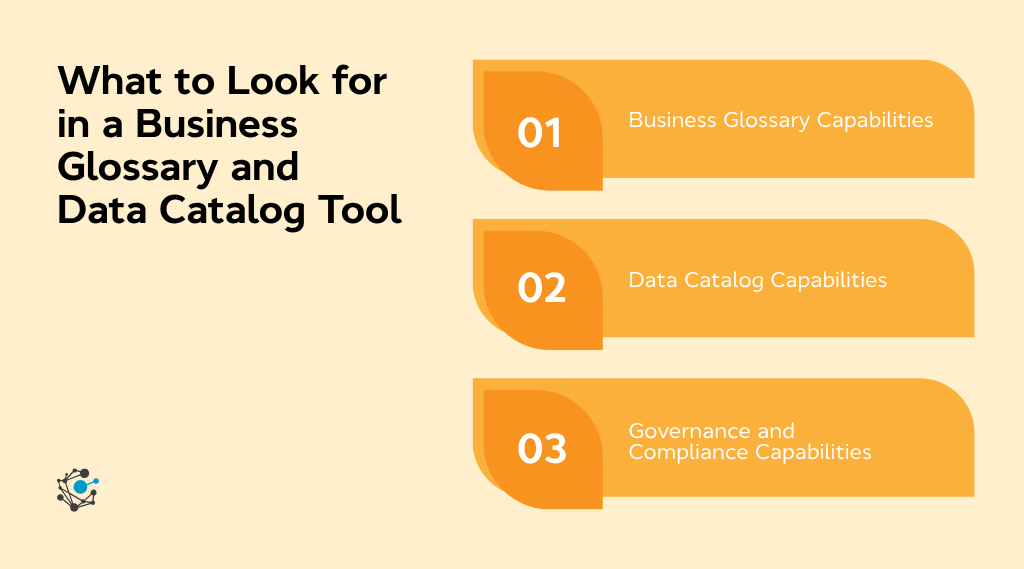
Business glossary capabilities
-
Term approval workflows — definitions move through structured review and sign-off, not free edits.
-
Stewardship and ownership assignment — every critical term has an accountable steward and business owner.
-
Synonyms and related terms — enables cross-team recognition even when language varies by department.
-
Domain-level organization — terms grouped by business domain for navigability across large glossaries
-
Version history — audit trail of how definitions have changed over time
-
Policy mapping — terms link to the compliance frameworks or data policies they inform
Data catalog capabilities
-
Automated metadata scanning — manual cataloging does not scale; ingestion should be automated across source systems
-
Search and discovery — business and technical users find assets using natural language, not system paths.
-
Data lineage visualization — end-to-end lineage from source to consumption, with upstream impact analysis
-
Data quality context — completeness, freshness, and accuracy signals visible at the asset level
-
Sensitive data classification — PII, financial, and regulated data automatically flagged and tagged.
-
Native glossary integration — catalog assets link directly to approved glossary terms, not through manual workarounds.
Governance and compliance capabilities
-
GDPR and CCPA alignment — sensitivity tagging, data subject mapping, and retention policy links
-
Audit trails — traceable history of term changes, ownership updates, and access decisions
-
Access-policy context at the asset level — governance is visible where data is used, not only in a separate IAM system.
-
Stewardship workflows — routing, escalation, and review are built into the platform, not managed offline.
How OvalEdge connects glossary and catalog in one platform
Managing a business glossary and data catalog in separate tools creates governance overhead that compounds quickly. Definitions don't propagate to catalog assets, assets lack business context, and stewardship workflows exist outside the platforms where users search for data.
OvalEdge embeds business glossary management, data catalog, lineage, data quality, and stewardship workflows within a single platform. Teams can define and approve business terms through structured workflows, then connect those terms directly to catalog assets such as tables, dashboards, and reports.
Governance workflow benefit
Glossary terms, stewardship workflows, ownership assignments, and approvals operate within the same governance environment as cataloged assets. This helps definition changes propagate to linked datasets and reduces the risk of teams using outdated or conflicting business terminology.
Discovery and context benefit
From any glossary term, users can navigate directly to related datasets, lineage, ownership details, and data quality signals. Business users get semantic context alongside technical metadata, helping analysts identify which assets are trusted and appropriate for reporting or AI use cases.
Audit and compliance benefit
Approval history, stewardship actions, ownership updates, and governance changes remain traceable across glossary and catalog workflows. This creates clearer audit trails for compliance teams and supports governance programs that require accountability, policy alignment, and change tracking.
OvalEdge is best suited for mid-to-large enterprises operationalizing governance, particularly those building AI-ready data programs where business context, lineage, quality, and stewardship need to function as one connected system.
Conclusion
A business glossary defines meaning. A data catalog connects that meaning to data assets with lineage, quality, ownership, and governance context. The distinction matters because most governance failures do not come from one missing tool; they come from broken connections between language, systems, ownership, and usage.
As enterprises scale self-service analytics and AI initiatives, business glossaries and data catalogs are evolving from documentation tools into operational trust systems that combine semantic understanding, metadata visibility, and governance context. Organizations that treat them as separate investments will continue to close gaps manually. Those that connect them operationally will build governance that scales.
The goal is not a glossary or a catalog. It is governed, trusted, discoverable data that people and systems can use with confidence, and both tools are part of getting there.
Book a demo with OvalEdge to explore how glossary, catalog, lineage, quality, and stewardship workflows connect in one platform.
FAQs
1. What is the difference between a business glossary and a data catalog?
A business glossary standardizes what business terms mean. A data catalog inventories data assets and adds metadata, lineage, quality, and ownership context. The glossary defines meaning; the catalog connects meaning to data.
2. Is a business glossary part of a data catalog?
In some platforms, yes, glossary functionality is embedded within a broader catalog product. In others, they are separate tools. Either way, glossary terms should link directly to catalog assets to be operationally useful.
3. What is the difference between a business glossary and a data dictionary?
A business glossary defines terms at the business concept level: what "churn" or "active customer" means organizationally. A data dictionary operates at the field level, documenting column names, data types, and technical constraints within a specific system.
4. What is the difference between a data dictionary and a data catalog?
A data dictionary documents the technical structure of a specific dataset. A data catalog is broader; it inventories assets across systems and adds business context, lineage, quality, ownership, and discoverability. A dictionary is a reference document; a catalog is a governance platform.
5. Do I need both a business glossary and a data catalog?
If teams disagree on definitions, start with a glossary. If users cannot find or trust data, start with a catalog. For enterprise governance, compliance readiness, or AI-ready data programs, both are needed.
6. Who owns a business glossary?
Ownership is distributed. Individual terms are owned by the business stakeholder accountable for that concept. For example, Revenue Operations owns "active customer." A data steward or governance team maintains the glossary as a whole, managing workflows, approvals, and cross-domain consistency.
.png?width=1081&height=173&name=Forrester%201%20(1).png)
.png?width=1081&height=241&name=KC%20-%20Logo%201%20(1).png)