AI decision lineage is no longer a governance aspiration. It is a regulatory expectation. In 2026, AI systems approve loans, flag insurance claims, filter job applicants, and adjust financial controls at a speed and scale no human reviewer can match in real time.
The question regulators and auditors now ask is not whether an AI made a decision, but why it made that specific decision, and whether the organization can prove it.
For AI governance leads, compliance teams, and data leaders, every consequential automated decision needs a defensible, traceable record that connects inputs, policies, reasoning, and outcomes. Not a log dump. Not a model accuracy score. A connected chain of evidence that holds up when someone with authority demands proof.
What is AI decision lineage?
AI decision lineage is the end-to-end record that connects every element involved in an automated decision: the triggering input, the data and context evaluated, the policies applied, the reasoning path followed, and the final outcome produced. It answers a single question at any point in time: why did this specific decision happen the way it did?
A complete lineage record typically captures:
-
Triggering event and inputs (the request, application, or data point that initiated the decision)
-
Context evaluated (data sources queried, features used, external signals pulled in)
-
Policies and rules applied (underwriting thresholds, compliance rules, risk limits)
-
Reasoning path (model logic, agent steps, scoring rationale)
-
Authority (whether the decision was fully automated or escalated for human approval)
-
Outcome and downstream actions (what happened next, who was notified, what systems were updated)
This is fundamentally different from data lineage, which tracks where data moved and how it was transformed. That distinction matters enough to unpack.
AI decision lineage vs. data lineage
Data lineage answers the question “where did this data come from, and what happened to it along the way?” It traces movement and transformation across pipelines, tables, and reports.
Decision lineage sits on top of that foundation and answers a different question entirely: "given all the data and rules available at that moment, why was this particular outcome produced?" One tracks the journey of data. The other tracks the logic of a choice. Decision lineage does not replace data lineage. It extends it.
AI decision lineage vs. AI decision audit trail vs. explainable AI
These three terms show up together constantly, but they refer to different things:
|
Concept |
What it captures |
Primary use |
|
AI decision audit trail |
The immutable, timestamped record of a decision and its metadata |
Evidence and compliance documentation |
|
AI decision lineage |
The connected chain within that record linking inputs, reasoning, policies, and outcomes |
Root-cause analysis, reproducibility, and regulatory defense |
|
Explainable AI (XAI) audit trail |
The human-interpretable reasoning behind a model's output (via methods like SHAP, LIME, or attention maps) |
Transparency and stakeholder communication |
The audit trail is the container. Decision lineage is the connective structure inside it. Explainability is the method that generates the reasoning component. A robust AI accountability program needs all three working together.
Why AI decision lineage matters in 2026
Risk, regulation, and defensibility are converging at the same time. Organizations that treated AI governance as a future problem are now facing audits, enforcement actions, and legal challenges with no traceable record to fall back on.
The regulatory pressure behind AI decision lineage
The regulatory landscape in 2026 is not ambiguous. Multiple frameworks now explicitly require traceability for automated decisions, and enforcement is active:
|
Regulation |
What it requires |
Lineage implication |
|
GDPR Article 22 |
Right to explanation for fully automated decisions with legal or significant effect |
Organizations must produce the reasoning chain behind any challenged decision, not just the outcome |
|
SOX (Sarbanes-Oxley) |
Internal controls must be traceable and auditable |
Any AI system touching financial reporting or reconciliation needs a documented approval chain |
|
Basel III / SR 11-7 |
Model risk governance with full documentation of model inputs, assumptions, and outputs |
Banks must maintain decision-level records for every model used in credit, trading, or risk scoring |
|
EU AI Act, Article 12 |
Automatic logging and record-keeping for high-risk AI systems |
Systems in scope must generate lineage records by design, not as an afterthought |
The trajectory is clear: more jurisdictions, more specificity, and less tolerance for gaps in traceability for automated decisions.
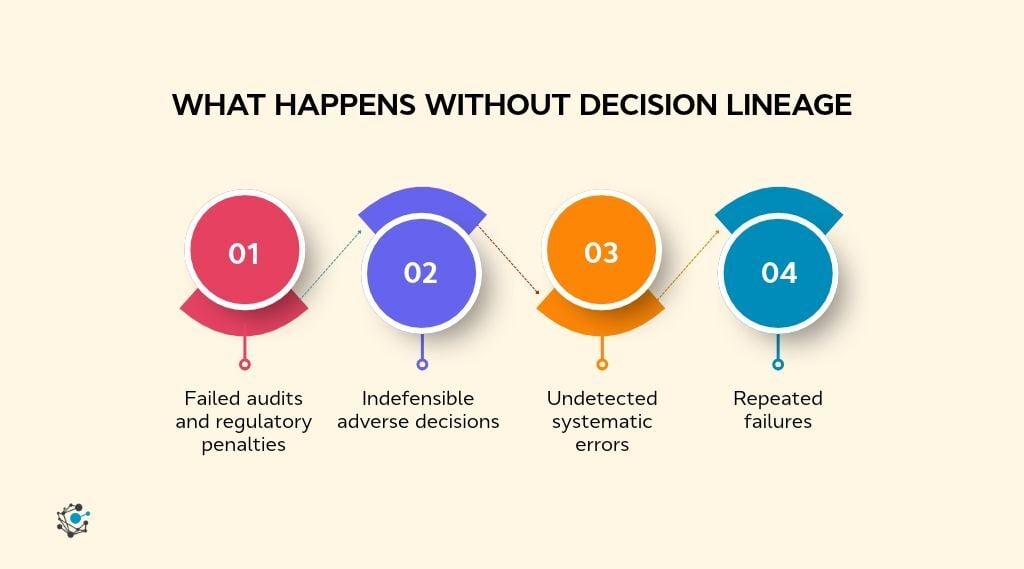
What happens without decision lineage
-
Failed audits and regulatory penalties. Without a connected lineage record, organizations cannot demonstrate compliance. The result is findings, fines, or consent orders.
-
Indefensible adverse decisions. "The model scored them below the threshold" is not an explanation. It is a restatement of the outcome.
-
Undetected systematic errors. A flawed policy or biased feature can drive thousands of similar bad decisions before anyone notices, compounding legal exposure.
-
Repeated failures. Without lineage, root-cause analysis is impossible. The same failure pattern recurs because no one can trace it to the specific policy, data source, or model version that caused it.
The core components of an AI decision lineage record
The definition above names six elements. Here is what each one actually captures, illustrated through a single running example: an automated loan approval decision.
|
Component |
What it captures |
Example (loan approval) |
|
Triggering event and inputs |
The request or data point that initiated the decision |
Applicant submits a mortgage application with income, employment, and property details |
|
Context and data sources evaluated |
Every internal and external source the system queried before deciding |
Credit bureau score pulled from Experian, internal payment history from the bank's CRM, property valuation from a third-party API |
|
Policies and rules applied |
The specific regulatory, business, and risk rules checked during execution |
Underwriting policy v3.2, fair-lending rules (ECOA), debt-to-income ratio threshold of 43% |
|
Reasoning path and model version |
The logic the model or agent followed to reach its output, including which version ran |
Scoring model v2.7 weighted debt-to-income at 35%, credit history at 40%, employment stability at 25%; composite score: 74 out of 100 |
|
Authority and approval chain |
Whether the decision was fully automated or required human review, and who approved it |
Score exceeded auto-approval threshold (70+); no human escalation triggered; policy engine authorized final approval |
|
Outcome and downstream actions |
What happened as a result, and which systems were updated |
Application approved; offer letter generated; applicant notified via email; loan origination system updated; compliance log entry created |
That entire chain, captured as a single connected record at decision time, is the lineage. Remove any one component and the record cannot answer the "why" question a regulator, auditor, or affected individual will eventually ask.
At OvalEdge, we believe every lineage record should stamp the version number of every policy and model that touched the decision. Policies change, and models get retrained. Six months later, knowing a decision ran against underwriting policy v3.2 and scoring model v2.7 is the difference between a defensible answer and an ambiguous one.
How AI decision lineage works in practice
Understanding what a lineage record contains is the first step. The harder question is how it actually gets generated, and that is where most implementations either hold up under scrutiny or fall apart.
1. Captured at decision time vs. reconstructed after the fact
This is the single most important architectural distinction in decision lineage. Lineage must be generated as the decision executes, not pieced together from scattered logs after someone asks for it.
When a decision runs, the system has access to the exact state that produced the outcome: the specific data values queried, the policy version in effect, the model weights active at that moment, and the full reasoning path. Once the decision is complete, that state begins to decay. Data gets updated. Policies get revised. Models get retrained. Logs from different systems fall out of sync or get overwritten.
Reconstructed lineage introduces gaps, assumptions, and timing mismatches. It is not evidence. It is an approximation. And approximations do not survive regulatory scrutiny.
Did You Know? According to the 2024 AI Benchmarking Survey by ACA Group and NSCP, only 32% of financial services firms using AI have established a formal AI governance group, and just 12% have adopted an AI risk management framework.
This gap between AI deployment speed and governance maturity is one of the primary drivers behind the push for automated, real-time lineage capture over manual reconstruction.
2. Decision lineage for models vs. AI agents
The complexity of lineage depends heavily on what is making the decision.
|
Dimension |
ML model |
AI agent |
|
Inputs captured |
Feature vector, input data, model version |
Initial prompt or trigger, plus all intermediate inputs gathered during execution |
|
Reasoning path |
Single inference pass: input → score → output |
Multi-step chain: reasoning steps, tool calls, API lookups, intermediate decisions |
|
Policy checks |
Typically applied before or after the model runs |
Runtime policy checks at each step; the agent may evaluate rules dynamically as it acts |
|
Lineage complexity |
Relatively contained; one model, one version, one pass |
Significantly higher; each tool call and reasoning step adds a node to the lineage graph |
An agent that queries three APIs, applies two policy checks, and makes an intermediate judgment call before producing a final output needs every one of those steps recorded. Missing a single node means the lineage is incomplete, and incomplete lineage is functionally equivalent to no lineage when an auditor asks for the full picture. This is where AI governance extends beyond traditional data governance into decision-level traceability.
Where AI decision lineage becomes non-negotiable: key use cases
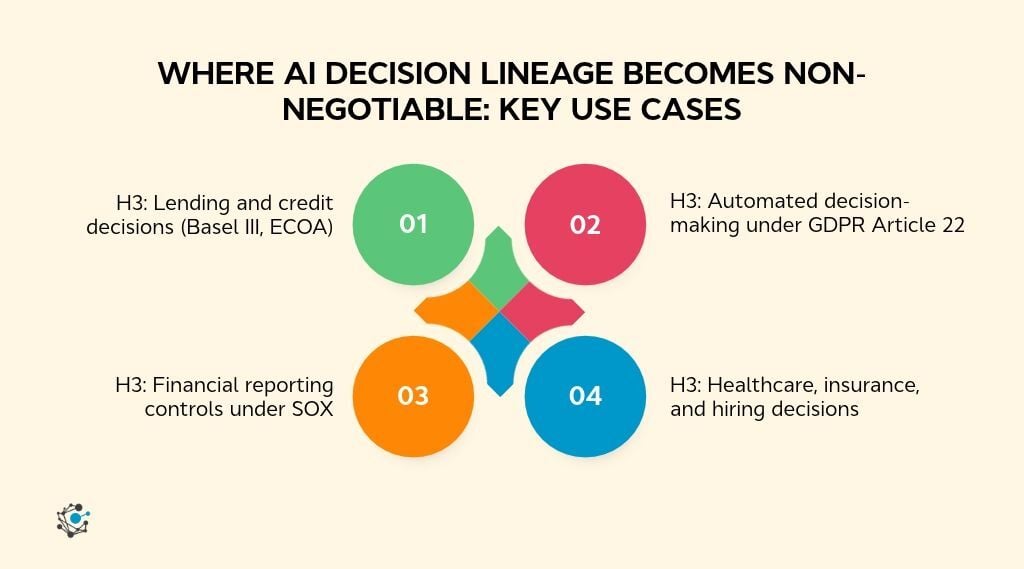
These are the specific decision types that regulators, auditors, and legal counsel scrutinize most.
1. Lending and credit decisions (Basel III, ECOA)
Under the Equal Credit Opportunity Act (ECOA), a lender that denies a loan is legally required to provide the applicant with the actual factors that drove the denial, not a generic rejection letter.
Without decision lineage, producing those reasons is guesswork. The compliance team has to reverse-engineer which features the model weighted most heavily, which policy thresholds applied, and whether any fair-lending rules were triggered. With lineage, the record already exists: the model version, the input features, the policy in effect, and the specific factors that pushed the score below the threshold.
For example: A lender denies a mortgage because the applicant’s debt-to-income ratio exceeded the 43% threshold under underwriting policy v3.2. Without lineage, the adverse action notice says “debt-to-income ratio.” With lineage, it traces to the exact inputs, the policy version, and the scoring model that produced the denial.
Basel III's model risk governance framework (operationalized through the Fed's SR 11-7) adds another layer. Banks must document model inputs, assumptions, limitations, and outputs for every model in production. Decision lineage is how that documentation stays connected to actual decisions rather than sitting in a static model card.
2. Automated decision-making under GDPR Article 22
When an EU data subject contests a fully automated decision, GDPR Article 22 requires a "meaningful explanation of the logic involved." That means the organization needs to produce the specific data points considered, the rules applied, and the reasoning that led to the outcome. Decision lineage is the infrastructure that makes this possible at scale. Without it, every Article 22 request becomes a manual investigation.
3. Financial reporting controls under SOX
SOX Section 404 requires that internal controls over financial reporting be traceable and auditable. When an AI system flags anomalies or adjusts financial entries, auditors need to see what triggered the adjustment, what logic the system applied, who authorized it, and what downstream entries were affected. If the lineage record does not exist, the finding goes into the report.
4. Healthcare, insurance, and hiring decisions
Decision lineage is becoming a baseline expectation in any domain where automated decisions carry material consequences for individuals, reinforcing why AI data governance is no longer optional for regulated organizations.
A health insurer's AI system that denies a prior authorization needs a traceable record of why. An AI-powered hiring tool that screens out a candidate needs to document which criteria drove the rejection.
AI decision traceability checklist
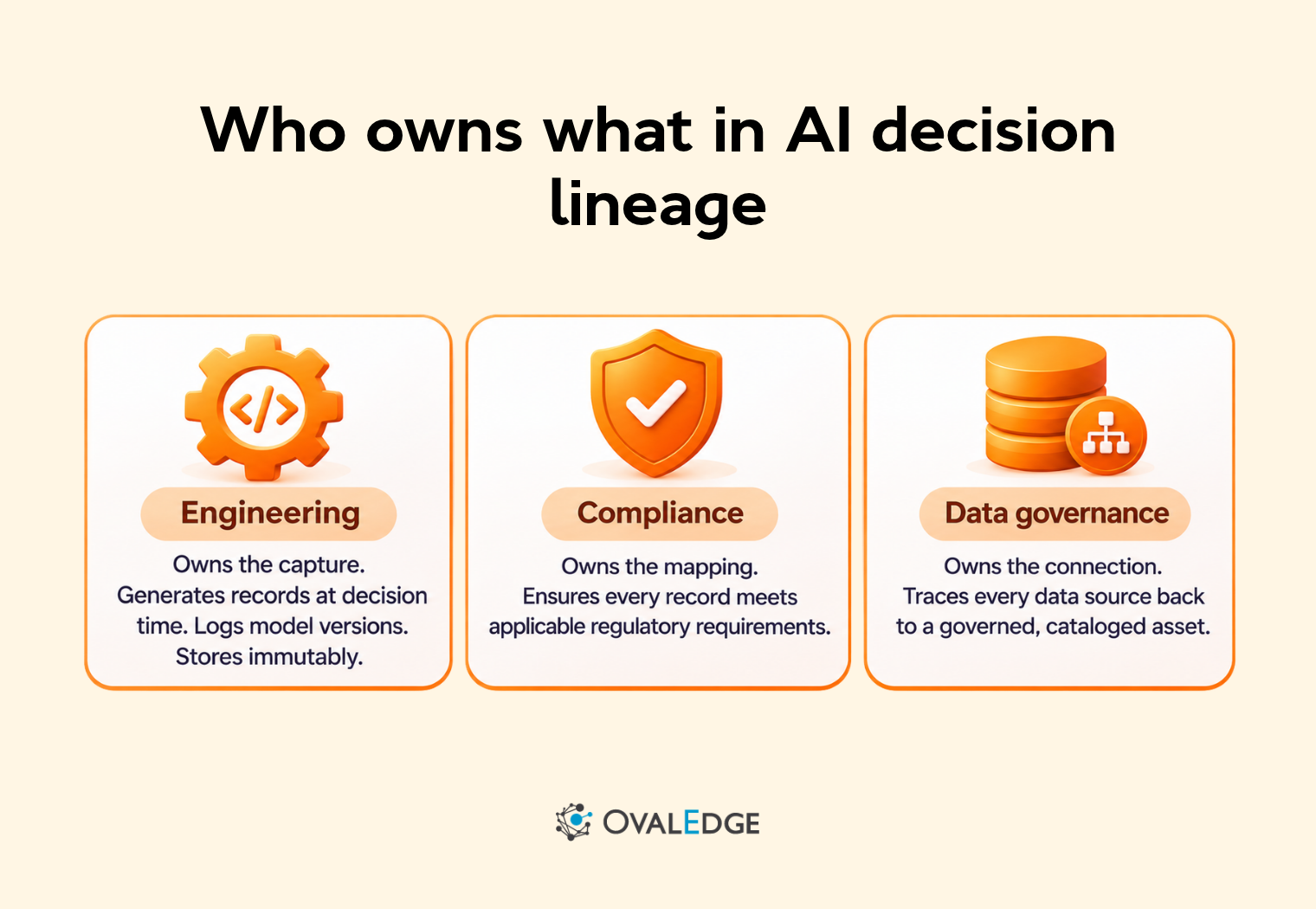
Every requirement discussed above converges here. This is the consolidated reference: what to capture, and who owns it.
|
Requirement |
What to capture |
Owner |
|
Triggering event identification |
The specific input, request, or data point that initiated the decision, with a timestamp |
Engineering |
|
Input data provenance |
Every data source queried, including version, freshness, and source system |
Engineering / Data Governance |
|
Policy and rule documentation |
The exact policies, thresholds, and business rules applied, including version numbers |
Compliance / Risk |
|
Model or agent version tracking |
The specific model version or agent configuration active at decision time |
Engineering |
|
Reasoning path capture |
The logic, scoring rationale, or step-by-step agent reasoning that produced the output |
Engineering / Data Governance |
|
Authority and escalation logging |
Whether the decision was fully automated or escalated, and who approved it |
Compliance / Risk |
|
Outcome and downstream action logging |
The final decision, all downstream system updates, and any notifications sent |
Engineering |
|
Immutability and tamper evidence |
Append-only storage with integrity verification; no post-hoc editing of records |
Engineering / Compliance |
|
Retention and retrieval readiness |
Records stored per applicable regulations and retrievable within audit timelines |
Compliance / Legal |
|
Adverse action explainability |
For decisions with individual impact, the ability to produce a human-readable explanation on demand |
Compliance / Data Governance |
At OvalEdge, we believe lineage coverage should be re-validated quarterly, not treated as a one-time exercise. Policies change, models get retrained, and new data sources appear. A program completed six months ago can have gaps today if no one is checking.
The ownership column matters as much as the requirements. Decision lineage fails most often because no one clearly owns each piece. Engineering assumes compliance is tracking policy versions. Compliance assumes engineering is logging reasoning paths. The gaps between those assumptions are where audit findings live.
Common mistakes that break AI decision lineage
These are the failure modes that surface repeatedly during audits.
-
Logging outputs without reasoning. A log entry that says "application denied, score: 42" is not lineage. It is a result. Without the reasoning path, policy version, and input context, that entry cannot answer a single regulatory question.
-
No policy-version tracking. A risk threshold that was 70 in January might be 65 by June. If the lineage record does not stamp the specific policy version active at decision time, there is no way to determine whether a decision was correct under the rules that applied at that moment.
-
Mutable, editable logs. If a lineage record can be modified after the fact, it is not evidence. Defensible lineage requires append-only, tamper-evident storage.
-
Siloed lineage across disconnected tools. Decision data lives in the model serving platform. Policy logs live in the compliance tool. Input provenance lives in the data catalog. Without a connected context layer linking these elements into a single traceable chain, root-cause investigations require manual assembly across multiple systems, and the full picture never comes together fast enough to satisfy an auditor's timeline.
-
Quick self-audit: Can the team produce the full reasoning path for any decision made in the last 90 days within 24 hours? Do records include the policy and model version active at the time? Are logs append-only? Can one person walk the complete chain without switching between more than two systems?
What to look for in decision lineage software
These are the capabilities that separate tools built for this problem from tools that bolt lineage onto something else.
-
Automated capture over manual logging. The tool should capture lineage as a byproduct of decisions running. According to Gartner's 2024 Market Guide for AI Governance, organizations relying on manual documentation report coverage gaps in over 60% of production models.
-
Tamper-evident, immutable records. Append-only storage with integrity verification. Non-negotiable for SOX, Basel III, and GDPR defensibility.
-
Explainable AI audit trail capabilities. The tool should capture why a decision was reached in a format translatable into a human-readable explanation on demand.
-
Connection to your existing catalog and governance stack. This is where most standalone tools fall short. Decision lineage does not work in a silo. A lineage record that references "data source X" is only useful if someone can trace that source back to a governed entry with known ownership, quality scores, and transformation history.
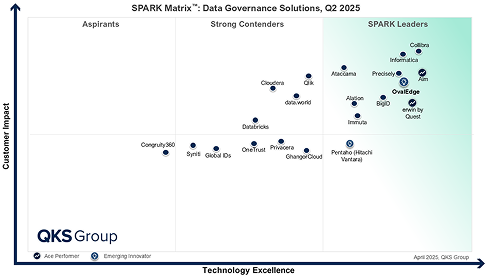
Platforms like OvalEdge close this gap by connecting decision lineage records directly to the data catalog, business glossary, data lineage, quality scores, and policy layer through a single governed structure. Every trace in a decision record resolves to a known, governed asset rather than an opaque reference requiring a separate investigation to verify.
Without that connection, lineage records answer the “what happened” question but leave the “can we trust the data behind it” question open. The second question is the one auditors always ask next.
Conclusion
The difference between asserting that an AI decision was sound and proving it comes down to whether the lineage record exists. Every regulation, audit framework, and legal challenge discussed in this guide asks the same question. Can the organization trace a specific decision from trigger to outcome and explain why it happened?
AI decision lineage is the infrastructure that makes that answer possible. Without it, organizations defend automated decisions with assertions. With it, they have evidence.
Every trace in a lineage record eventually points back to a data source, a business definition, a quality score, or an access policy. OvalEdge connects and activates an organization’s existing data governance foundation through the Enterprise Context Graph, so when a decision record references a data source, that reference resolves to a governed, cataloged asset with known ownership and documented lineage rather than an opaque entry requiring a separate investigation.
Book a demo to see how OvalEdge strengthens the governed data layer that decision lineage depends on.