-2.png)
As businesses expand their data environments across cloud, hybrid, and on-premises systems, the complexity of tracking data movement, transformations, and dependencies increases.
This is where data lineage becomes crucial; it’s the process of mapping data from its source to its final destination, ensuring transparency, accountability, and compliance. However, with the rise of big data, real-time processing, and distributed architectures, maintaining clear visibility into how data flows across systems is a growing challenge.
A recent Gartner report reveals that 80% of data governance initiatives will fail by 2027 due to fragmented processes and poor alignment between teams.
This highlights the growing need for businesses to adopt a structured approach.
In this blog, we will explore the most common data lineage challenges organizations face today and offer practical solutions for overcoming them.
Whether you're a privacy professional, DPO, or part of a compliance team, this blog will equip you with the knowledge to tackle data lineage challenges and improve data governance across your organization.
What is data lineage, and why do challenges arise?
Data lineage is the process of tracking and visualizing the flow of data as it moves through systems, applications, and processes within an organization. It helps organizations map out the entire lifecycle of data, from its source to its final destination, providing insights into how data is collected, transformed, and used.
By understanding data lineage, businesses ensure transparency, maintain data integrity, and meet compliance requirements, all of which are critical for informed decision-making and regulatory adherence.
However, several factors complicate the implementation of data lineage.
-
Distributed architectures: Data is often spread across multiple systems, such as cloud, hybrid, and on-premise environments, making it difficult to track its movement and transformations accurately.
-
Rapid data growth: As the volume, variety, and velocity of data increase, managing its lineage becomes increasingly complex.
-
Evolving data pipelines: With frequent updates to systems, tools, and data integrations, maintaining an up-to-date lineage map becomes a continual challenge.
-
Metadata inconsistency: Inconsistent or incomplete metadata across different tools and platforms makes it hard to create a unified view of data movement.
|
Example: A global retail company processes customer data across cloud, on-premise, and third-party systems. Tracking data lineage becomes challenging due to the complex transformations and inconsistent metadata. Maintaining accurate lineage is difficult as systems and data flows evolve. |
Common data lineage challenges
Data lineage is essential for understanding how data flows across your systems, but various challenges can arise during implementation and maintenance. Below are some of the most common challenges organizations face when mapping and managing data lineage.
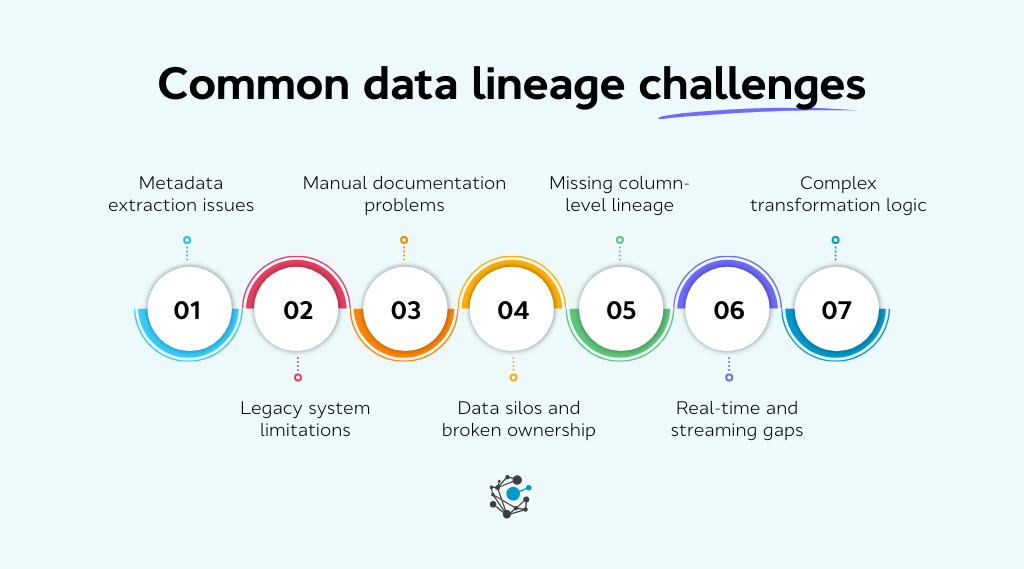
Metadata extraction issues
Extracting accurate metadata is one of the most significant hurdles in data lineage implementation. Metadata is the foundation of data lineage, but inconsistencies or missing metadata can result in gaps in lineage tracking.
-
Missing or incomplete metadata: Metadata might not be captured during data transformations or integrations, leading to incomplete lineage maps.
-
Metadata across multiple platforms: Different systems and tools may store metadata in different formats or structures, making it hard to consolidate and track lineage across the entire organization.
-
Fragmented tools: If you’re using various tools for data processing, tracking metadata consistently across all platforms can become extremely challenging.
|
Do you know: At Gartner’s IT Symposium, analysts emphasized that to prove data is ready for initiatives such as AI, you must have metadata for source lineage and observability to understand data origins and transformations across pipelines, a cornerstone of trustworthy data lineage |
Legacy system limitations
Older, legacy systems often lack the capabilities to support modern data lineage tracking, creating significant gaps in data visibility.
-
No APIs or lineage-export features: Legacy systems might not have APIs or the necessary features to export lineage data, making it impossible to track how data moves within these systems.
-
Limited integration: Integrating legacy systems with newer data lineage tools may be complex or even impossible due to compatibility issues.
-
Manual interventions: As a result, legacy systems often require manual data lineage documentation, which is prone to errors and inefficiencies.
|
Example: A financial services firm faced challenges in tracking data lineage across legacy systems and cloud platforms, resulting in incomplete data maps and missed compliance. The lack of standardized metadata led to discrepancies in data processing, making audits difficult and exposing the company to potential fines and reputational risks. |
Manual documentation problems
Relying on manual documentation for data lineage is a common problem, especially in environments with complex data processes. This method can’t keep up with dynamic data environments.
-
Static and outdated diagrams: Manual lineage diagrams can become outdated quickly as data processes and systems evolve, leaving gaps in the lineage tracking.
-
Human error: Manual tracking increases the risk of mistakes, such as missing transformations or misrepresenting data flows.
-
Lack of scalability: As your data infrastructure grows, manually managing data lineage becomes unsustainable and resource-intensive.
Data silos and broken ownership
Data silos occur when data is stored and managed in separate, unconnected systems, making it difficult to have a unified view of your data lineage.
-
Fragmented teams: Different departments or teams may manage separate systems, leading to disconnected data processes and poor communication regarding data ownership.
-
Inconsistent policies: Without a central governance model, data policies and practices can vary across teams, leading to gaps in tracking and securing data lineage.
-
No unified data ownership: With unclear ownership, tracking data lineage across multiple systems and teams becomes a challenge.
Missing column-level lineage
Capturing granular details about data transformations, particularly at the column level, is crucial for ensuring accurate lineage tracking.
-
SQL script limitations: Data transformations embedded in SQL scripts or custom ETL jobs are often difficult to trace at the column level.
-
ETL tool challenges: ETL and ELT tools sometimes fail to provide detailed lineage information for every column and field in the data pipeline.
-
Data model complexity: Mapping transformations within complex data models can also make it hard to pinpoint specific column-level changes.
Real-time and streaming gaps
As more organizations adopt real-time data processing, ensuring accurate data lineage for these fast-moving data streams becomes increasingly difficult.
-
High-velocity data: Streaming data pipelines process information at an accelerated rate, and many traditional lineage tools are not built to track such rapid data changes.
-
Latency issues: Real-time data needs to be processed with minimal latency, which complicates the task of tracking lineage while ensuring the data is up-to-date.
-
Limited tool support: Many data lineage tools struggle to provide accurate lineage for real-time and streaming data without sacrificing performance or accuracy.
|
According to Gartner’s prediction, by 2027, more than 40% of AI‑related data breaches will arise from misuses of generative AI, underscoring the need for robust data governance and lineage practices to manage risk in modern environments. |
Complex transformation logic
Complex or opaque data transformations add another layer of difficulty to data lineage tracking.
-
Nested transformations: When transformations occur inside multiple layers of ETL jobs, notebooks, or custom code, tracing them becomes increasingly difficult.
-
Dynamic logic: Custom or dynamically generated code makes it hard for tools to consistently capture and map the logic behind data transformations.
-
Lack of visibility: Without clear documentation or automated tracking, understanding and visualizing the transformation logic across various tools becomes a challenge.
Implementation challenges in data lineage programs
Implementing a successful data lineage program involves much more than just identifying data flows. Organizations often encounter several hurdles when trying to establish comprehensive and accurate data lineage tracking across complex data ecosystems.
Here are the most common implementation challenges organizations face when setting up a data lineage program:
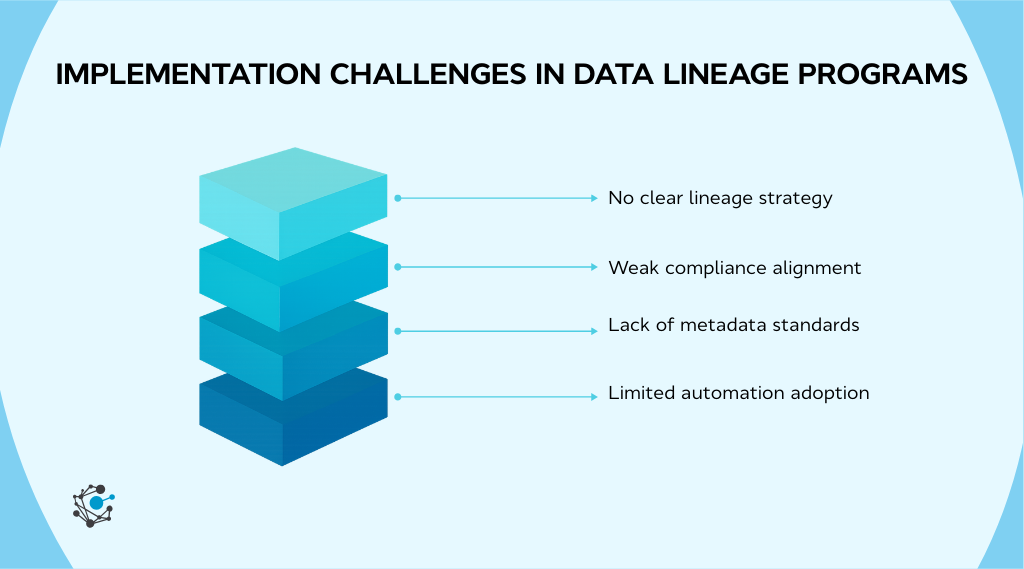
No clear lineage strategy
Without a clear plan, organizations often struggle to establish scope, identify key data assets, and set realistic goals.
-
Lack of scope definition: Many organizations jump into data lineage without defining the boundaries, leading to incomplete or fragmented lineage maps.
-
Unclear outcomes: Organizations often do not set clear goals for what they want to achieve with their lineage program, such as improving compliance, data quality, or risk management.
-
Missed alignment with business objectives: Without a solid strategy, data lineage efforts might not align with broader business or regulatory needs, leading to inefficiencies.
Weak compliance alignment
Aligning data lineage efforts with compliance requirements is crucial for ensuring that data is managed in accordance with regulatory standards.
-
Lack of understanding of regulatory requirements: Many organizations struggle to link data lineage directly with regulatory compliance frameworks, leading to gaps in their audit readiness.
-
Inadequate documentation: Insufficient documentation of lineage data for regulatory requirements can result in non-compliance during audits or investigations.
-
Missed compliance deadlines: Failure to align lineage with compliance deadlines can expose organizations to significant legal risks.
Lack of metadata standards
Data lineage relies heavily on consistent metadata to track the flow and transformations of data. Unfortunately, many organizations lack standardization in how they handle metadata, leading to incomplete or inaccurate lineage.
-
Inconsistent naming conventions: Different teams or systems may use inconsistent metadata terminology, making it difficult to track data consistently across the organization.
-
Lack of standardized tagging: Without clear and consistent tags, it’s challenging to categorize and track data across systems, leading to fragmented lineage tracking.
-
Poor documentation practices: Without standardized metadata documentation processes, organizations can find it difficult to maintain an accurate, up-to-date lineage over time.
Limited automation adoption
Manual processes for tracking and mapping data lineage are not only inefficient but also prone to errors. Automation is key to overcoming the complexity of modern data environments and ensuring accurate lineage capture.
-
Overreliance on manual tracking: Many organizations still rely on manual data mapping, which is time-consuming and prone to human error.
-
Inconsistent updates: Without automation, updating lineage information whenever data flows change can become difficult, leading to outdated or inaccurate lineage.
-
Slow adoption of automated tools: Many companies hesitate to invest in automated lineage tools, often due to the upfront cost or complexity of implementation, leading to missed opportunities for improvement.
Poor glossary and stewardship linkage
A successful data lineage program needs to be closely integrated with a business glossary and data stewardship processes. This linkage helps ensure that everyone in the organization understands the data and its transformation, especially when it comes to business context.
-
Lack of integration: Without a clear connection to business glossaries, data lineage can lose context, leading to confusion about data definitions and usage across teams.
-
Unclear data ownership: Without clear stewardship, it’s difficult to assign ownership of lineage data, making it challenging to keep data updated and accurate.
-
Data ambiguity: When lineage is disconnected from the business glossary, there can be confusion about the meaning and value of specific data elements, impacting decision-making and reporting.
How to overcome major data lineage challenges
By adopting the right tools, processes, and practices, you can streamline data lineage management, ensure compliance, and build trust across your organization. Here are some actionable steps to address the most common data lineage challenges.
1. Automate lineage capture
One of the biggest challenges in data lineage is the manual mapping of data transformations, which is time-consuming and prone to human error. Automating lineage capture eliminates the need for manual tracking and ensures that data flows are accurately and consistently tracked.
-
Automate data mapping: Use automated tools that can capture data lineage from data pipelines, SQL scripts, ETL processes, and custom code. This reduces the risk of missing or incomplete data.
-
Minimize human error: Automated lineage extraction ensures that data flows are mapped accurately, reducing the potential for mistakes or outdated information.
-
Improve scalability: As your data grows, automation allows you to scale lineage capture efforts without adding manual overhead.
2. Standardize metadata rules
Inconsistent metadata can lead to fragmented data lineage, making it difficult to track data across systems. By establishing standardized metadata rules, organizations can ensure consistency and accuracy in their data lineage maps.
-
Create consistent naming conventions: Define standardized terms for data elements, transformations, and processes across all teams to avoid confusion and improve communication.
-
Set ownership and accountability: Assign ownership of metadata and lineage tracking to specific roles or teams, ensuring clear responsibility for maintaining consistency.
-
Implement uniform tagging: Apply consistent metadata tags across all systems to make it easier to track data lineage in a standardized way.
3. Choose integrated tools
Using a variety of disconnected tools can create gaps and inconsistencies in your data lineage tracking. To improve the accuracy and efficiency of your lineage program, select integrated tools that work well across different data systems and workflows.
-
Ensure cross-system integration: Choose tools that support integration across on-premises, cloud, and hybrid environments to provide a unified view of data lineage. Platforms such as OvalEdge are designed to connect technical lineage with governance metadata, helping teams avoid fragmented lineage views across tools.
-
Support multiple workflows: Ensure that the tools you choose support key data workflows like ETL, SQL, BI, and governance to provide a holistic view of data movement and transformations.
-
Leverage impact analysis: Use tools that enable impact analysis to assess how changes in one part of the data pipeline affect other parts, ensuring you can make informed decisions.
4. Build cross-functional ownership
Data lineage is not just the responsibility of one team; it's a cross-functional effort. Assigning ownership of different aspects of data lineage across engineering, analytics, governance, and compliance teams can help ensure that all areas of data management are covered.
-
Assign clear ownership: Designate responsible individuals or teams for different parts of the data pipeline, ensuring accountability across systems.
-
Encourage collaboration: Foster communication between teams to ensure data lineage is tracked across all systems and processes, and there is no fragmentation.
-
Integrate lineage into governance: Make data lineage part of your broader data governance framework to ensure that privacy, security, and compliance requirements are consistently met.
5. Validate lineage continuously
Lineage should not be a one-time effort; it requires continuous validation to ensure that it remains accurate and up to date. Regular audits and testing workflows are essential to avoid drift and ensure that your lineage tracking reflects any changes in data flows.
-
Conduct regular audits: Schedule periodic audits to verify that data lineage maps are accurate and complete. This helps identify gaps or inaccuracies early on.
-
Set up automated testing: Implement automated tests to continuously validate lineage during updates or changes in your data pipelines, ensuring real-time accuracy.
-
Monitor for lineage drift: Use automated alerts and monitoring tools to detect changes in data flows and transformations that could lead to lineage drift, and take action immediately.
Technology and tooling considerations
It's essential to choose platforms that not only support your organization's specific needs but also integrate well with your existing data infrastructure. Here are key factors to consider when selecting data lineage tools
Key features to evaluate
To ensure your data lineage tools meet your organization's requirements, consider the following features:
-
Automation: Choose tools that automate lineage extraction across multiple data sources to reduce manual effort and errors.
-
Multi-level lineage: The tool should provide granular, column-level lineage to capture all details of data transformations.
-
Impact analysis: Tools should be capable of conducting impact analysis to track how changes affect downstream processes.
-
Scalability: The tool must be scalable to handle increasing data volumes and complex systems as your organization grows.
-
Ease of use: A user-friendly interface is essential for teams to quickly adopt and use the tool effectively.
|
Pro Tip: Evaluating these features across vendors can be time-consuming. To simplify the process, download our Data Lineage Features Comparison Guide, which breaks down key lineage capabilities across leading tools to help teams make informed, side-by-side decisions. |
Integration with catalogs
Your data lineage tools should seamlessly integrate with existing metadata repositories, business glossaries, and data quality systems. This helps ensure that your lineage data is aligned with overall data governance processes.
-
Linking with metadata catalogs: Lineage should be linked to your metadata repositories, ensuring all data transformations are tracked consistently.
-
Business glossary integration: Integration with your business glossary helps provide context to lineage data, ensuring the meanings and purposes of data elements are clear across teams.
How OvalEdge addresses challenges
OvalEdge simplifies data lineage by automating extraction, providing detailed column-level mapping, and integrating with your existing governance framework. With OvalEdge, you can:
-
Automate lineage capture: Quickly map data across your ecosystem.
-
Ensure governance alignment: Integrate with metadata catalogs and quality systems to maintain consistent governance.
-
Simplify impact analysis: Identify the downstream impact of data changes in real-time, ensuring better decision-making.
OvalEdge’s data lineage techniques streamline compliance, improve data governance, and reduce the complexity of managing lineage in multi-system environments.
| Also read: Top 25 Data Lineage Tools for Reliable Analytics Governance |
Conclusion
Tackling data lineage challenges is not just about improving governance—it's about unlocking the full potential of your data, ensuring compliance, and driving smarter business decisions with confidence.
By addressing common issues like metadata inconsistencies, legacy system limitations, and manual tracking, organizations can create a clear and reliable map of their data flows.
Implementing strategies such as automating lineage capture, standardizing metadata rules, and adopting integrated tools ensures a scalable and effective lineage program.
Tools like OvalEdge simplify these processes by automating data lineage extraction and integrating with existing systems, making compliance easier and more accurate.
Start taking proactive steps today to establish a robust data lineage framework.

Book a demo with OvalEdge to see how we can help you streamline your data lineage efforts and improve governance across your organization.
FAQs
1. What causes inconsistencies in data lineage across different systems?
Inconsistencies often stem from mismatched metadata formats, fragmented documentation practices, and disconnected tools. Standardizing metadata rules and integrating lineage with catalogs helps maintain uniformity across all systems.
2. How can organizations ensure trustworthy lineage in rapidly changing pipelines?
Teams can implement automated lineage capture, enforce version control, and schedule frequent validation checks. This ensures lineage remains accurate even when pipelines, schemas, or transformation logic frequently evolve.
3. Is manual data lineage ever reliable for enterprise environments?
Manual lineage may work for small datasets, but it becomes unreliable at scale due to complexity and human error. Automation, standardized documentation, and metadata-driven processes offer far more dependable results.
4. How does poor lineage impact analytics and reporting accuracy?
Inaccurate lineage affects data trust, introduces reporting errors, and slows root-cause analysis. Reliable lineage ensures analysts understand data origins, transformations, and dependencies, improving decision-making quality.
5. What should teams look for when selecting tools to reduce lineage challenges?
Teams should evaluate automation capabilities, integration support, column-level mapping, real-time tracking, and metadata management features. Tools must fit existing architecture and governance workflows to deliver long-term value.
6. Can data lineage challenges affect regulatory compliance?
Yes. Missing or inaccurate lineage makes it difficult to prove data accuracy, traceability, and control, which are key requirements in GDPR, HIPAA, and financial regulations. Strong lineage strengthens audit readiness and compliance confidence.
.png?width=1081&height=173&name=Forrester%201%20(1).png)
.png?width=1081&height=241&name=KC%20-%20Logo%201%20(1).png)