AI initiatives keep failing for the same reason. Models reach production, deliver results, and gain executive confidence, until an auditor, regulator, or customer asks a question nobody prepared for: where did this data come from, who approved its use, and can the decision be explained?
That gap between AI innovation and data accountability is where risk quietly builds.
According to a Deloitte CDO survey, data governance ranked as the top priority for 51% of Chief Data Officers (CDOs) in 2025, precisely because the disconnect between AI speed and governance readiness has become impossible to ignore.
AI data governance addresses this by establishing policies, standards, and automated controls for how data is classified, secured, tracked, and ethically used across the AI lifecycle. It shifts governance from a periodic review into a continuous, pipeline-embedded discipline that keeps pace with the systems it protects.
This guide covers what AI data governance is, how it differs from traditional and agentic approaches, its core components, the challenges enterprises face, and a practical framework for building governance that scales with AI adoption.
What is AI data governance?
AI data governance is the set of policies, processes, and controls that govern how data is managed, protected, and used across AI models and systems. It covers data quality, privacy, security, lineage, and ethical use throughout the entire lifecycle, from training data collection through model inference and ongoing monitoring.
The discipline exists because AI operates differently than traditional analytics. AI systems ingest massive volumes of structured and unstructured data, learn continuously, and influence decisions in real time.
These characteristics create governance challenges that standard data management practices were never designed to handle: bias embedded in training data, unexplainable automated decisions, unclear lineage across distributed pipelines, and regulatory exposure tied directly to AI-driven outcomes.
At an operational level, AI data governance creates alignment across three groups. Data teams gain clarity on which datasets are approved and trusted. AI teams understand what data is safe and appropriate for specific models. Business leaders know who is accountable when AI-powered decisions affect customers or operations.
Did You Know? A 2025 Evanta leadership survey found that 65% of data leaders are investing in AI, while 44% are investing in data governance and 41% in data quality. Data leaders increasingly see governance and AI as interconnected priorities, not separate initiatives.
Governance at this level requires a platform-level approach, not scattered tools. Unified governance platforms like OvalEdge consolidate data catalog, lineage, quality, and access controls into a single operating layer, making it possible to enforce governance across the entire data estate without fragmenting oversight across disconnected tools.
How does AI data governance differ from traditional and agentic governance?
Traditional data governance was designed for a slower, more predictable data environment. Governance teams manually classify data, review quality rules, and approve access requests through scheduled processes. This approach works when data changes gradually, and usage patterns remain stable.
AI data governance shifts the operating model. AI systems consume large volumes of data, evolve continuously, and influence decisions in real time. Manual reviews cannot keep pace. Classification, lineage tracking, quality checks, and policy enforcement need to operate continuously, embedded directly in pipelines rather than applied as periodic checkpoints.
Agentic AI governance introduces a third layer. When AI agents pull data from multiple sources, reason across it, and trigger downstream actions, governance must control what information the agent receives for a specific task, under specific policies, before it reasons or acts. This is the core of context engineering: data governance becoming operational for AI agents.
|
Dimension |
Traditional Data Governance |
AI Data Governance |
Agentic AI Governance |
|
Primary focus |
Enterprise data assets |
Data used by AI systems |
Operational context and controlled action |
|
Unit of control |
Tables, files, pipelines |
Training data, model inputs, retrieval |
Task-scoped, entity-scoped live context |
|
Timing |
Before use, in stable flows |
Before and during AI use |
At runtime, before reasoning and action |
|
Main concern |
Quality, privacy, access, lineage |
Trustworthy and compliant AI inputs |
Correct information before reasoning |
|
Policy enforcement |
At the data store and access layer |
At the AI input and usage layer |
Before reasoning and before action |
|
Risk of failure |
Bad reporting, compliance gaps |
Poor outputs, data leakage |
Wrong decisions, unsafe automated actions |
The distinction matters because the unit of governance changes at each stage. In traditional environments, the focus is the data asset itself. In AI, it expands to model inputs and retrieval. In agentic AI, the real control point is the live context assembled for a specific task.
Three categories of governance capability reflect this progression. Existing capabilities such as catalog, lineage, quality, and access controls remain foundational; they do not need to be reinvented for AI.
The business glossary must evolve from a human-readable dictionary into an AI-ready meaning system that supports taxonomy, ontology, and semantic mappings. Genuinely new capabilities, including agent permissions, context assembly, and Model Context Protocol (MCP) integration, require a new architecture entirely.
What are the core components of AI data governance?
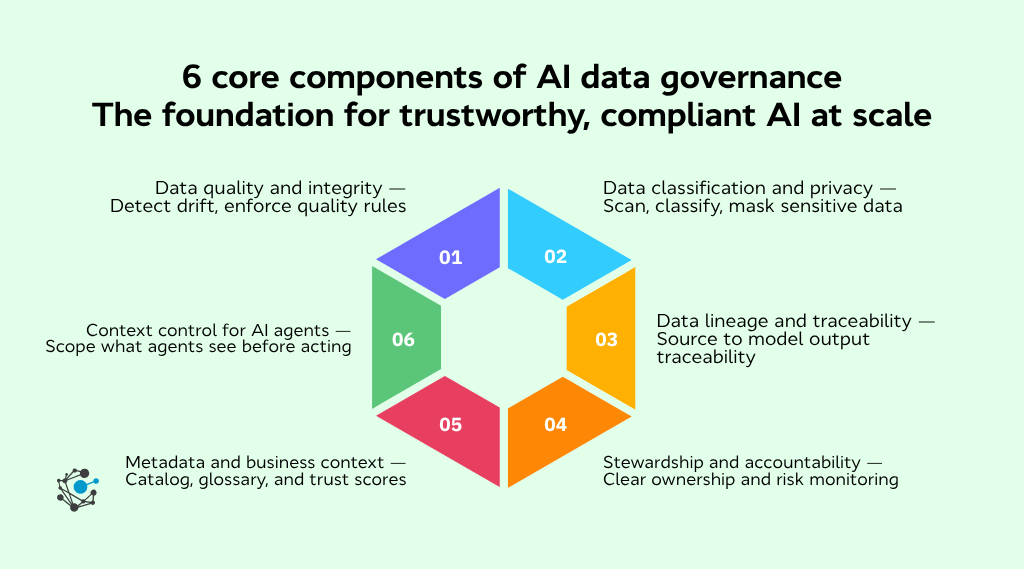
AI data governance works only when it is built into everyday data and AI operations. The six components below form the foundation that keeps data trustworthy, compliant, and ready for AI use at scale.
Data quality and integrity
AI models inherit the flaws of the data they learn from. Incomplete, inconsistent, or stale data produces unreliable outputs regardless of model sophistication. Governance must enforce quality checks across both historical (legacy) datasets and live operational data flowing through AI pipelines.
Continuous monitoring detects drift, schema changes, and anomalies before they degrade model performance. Automated quality rule engines analyze data profiles, identify inconsistencies across enterprise systems, and recommend technical quality rules based on schema patterns and steward input, reducing the manual effort of maintaining data integrity at scale.
Data classification and privacy
AI systems consume structured and unstructured data, including documents, logs, images, and customer records. Without automated classification, sensitive or regulated data can enter training pipelines undetected.
Governance establishes automated scanning that identifies and classifies sensitive data (Personally Identifiable Information, Protected Health Information, financial data) early in the lifecycle, then applies masking, encryption, and access governance consistently during both training and inference.
Pro Tip: Classification should happen before data enters any AI pipeline, not after. Retroactive classification after a model has already trained on sensitive data creates regulatory exposure that is extremely difficult to unwind.
Data lineage and traceability
Lineage shows how data moves from source systems into training datasets, features, and model outputs. This traceability becomes critical when models produce unexpected or disputed outcomes. Teams need to identify which data influenced a decision, trace transformations across pipelines, and provide auditors with evidence of responsible data handling.
Automated column-level lineage derived from source code parsing provides ground-truth visibility across SQL, ETL, BI tools, and programming languages without manual mapping. Source Code Intelligence enables this by reading the actual code that moves and transforms data, not by inferring lineage from runtime logs.
Stewardship and accountability
Clear stewardship defines who owns data, who approves its use in AI contexts, and who monitors associated risks. Even when AI agents automate governance actions, accountability remains with human decision-makers. Defined ownership improves collaboration across data, AI, and business teams. When responsibility sits in a clear place, gaps during incidents and audits shrink considerably.
Metadata and business context
An AI-ready data catalog provides a centralized inventory of available datasets and their readiness for AI use. Paired with a governed business glossary, it creates a shared semantic layer so that every human analyst and AI agent operates from the same definitions.
Misinterpreted terms lead to flawed model outputs. A mature glossary prevents that risk and supports explainability when AI decisions require justification. Certified datasets with trust scores give both humans and agents a clear signal about which data is safe to use for analytics, reporting, and AI model training.
Context control for AI agents
This is the component traditional governance does not address. When AI agents retrieve data, reason across it, and trigger actions, governance must control what information enters the agent's working context for a specific task.
The Enterprise Context Graph continuously links ontology, glossary, lineage, catalog, quality, and policy into a single graph, so every agent works from trusted, governed context rather than unfiltered access to the entire data estate. Without this control layer, the same agent that resolves a billing dispute could inadvertently access unrelated customer records, stale data, or sensitive information it has no business seeing.
What are the AI data governance challenges enterprises face?
Data leaders are not short on awareness about governance risks. The real challenge is that AI surfaces governance gaps faster than traditional programs can close them.
Here are the most common failure points and how to address them.
Bias embedded in training data
Bias rarely originates in the model architecture. It starts in the data: historical datasets reflecting past discrimination, incomplete sampling, or skewed labeling. Governance introduces checks that evaluate datasets for representational balance and statistical fairness before they enter training pipelines.
Automated classification flags protected attributes and demographic proxies during data preparation, catching bias at the source rather than discovering it in production outcomes.
Unclear lineage across AI pipelines
When a model produces a disputed output, teams need to trace which data influenced the decision. In most organizations, that lineage is incomplete. Data passes through multiple transformations across ETL, feature engineering, and model training with gaps at every handoff.
Responsible AI data governance fills these gaps by enforcing end-to-end lineage tracking, from source system to model output, across the full pipeline.
Regulatory complexity at scale
The European Union's (EU) AI Act, the National Institute of Standards and Technology (NIST) AI Risk Management Framework (RMF), and sector-specific regulations such as the Health Insurance Portability and Accountability Act (HIPAA) and the General Data Protection Regulation (GDPR) now require demonstrable governance controls, not just written policies. Organizations need automated policy enforcement, documented lineage, and audit trails that prove compliance in real time.
The intersection of AI governance and data governance has become a regulatory requirement, not an organizational preference.
Did You Know? Ireland's Data Protection Commission reported 7,781 valid breach notifications in 2024, an 11% increase over 2023, signaling that regulatory scrutiny around data handling continues to intensify across jurisdictions.
Sensitive data exposure in generative AI
Generative AI models increase data reuse across training, fine-tuning, retrieval-augmented generation (RAG), and inference. Each stage introduces privacy risks. Without automated scanning, personal or proprietary data can enter model contexts undetected.
Governance establishes safeguards that detect and classify sensitive data using machine learning (ML) classifiers and configurable policies, then enforce masking and access restrictions before data reaches any model.
Governance adoption stalling before delivering value
CDOs consistently report that governance programs stall before delivering measurable business results. The root cause is typically complexity: too many tools, too many manual processes, too little adoption from business teams. Programs succeed when governance is embedded into existing workflows rather than imposed as an additional layer.
AI-driven governance automation reduces manual overhead by handling classification, cataloging, quality checks, and stewardship assignments through AI agents, keeping humans in the loop for review and escalation rather than routine execution.
How to build an AI data governance framework?
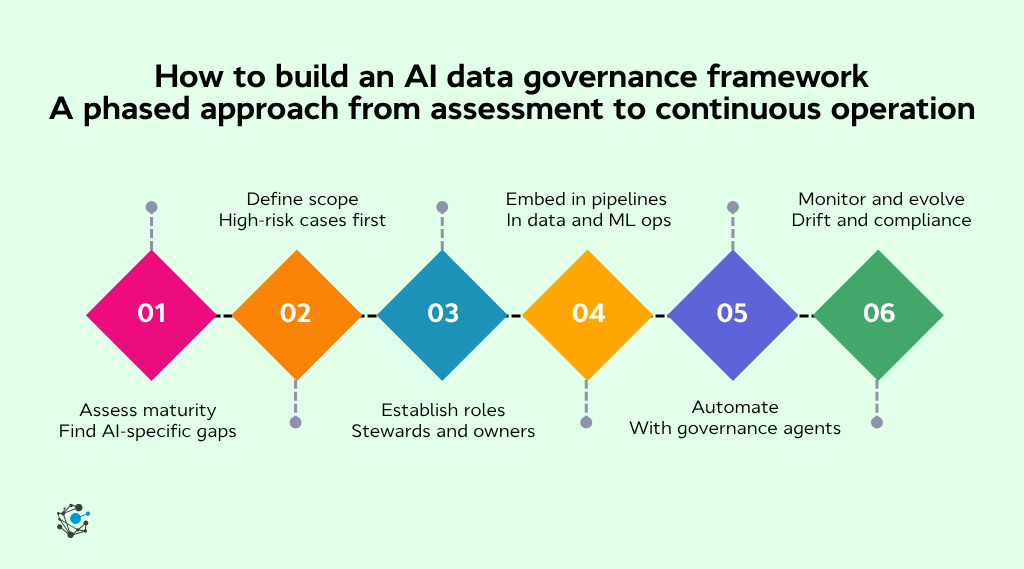
Building AI data governance does not require a complete overhaul on day one. The practical approach is to create a structure that fits the organization's AI maturity and risk profile, then expand as use cases grow.
Here are six steps to build an AI data governance framework that scales with AI adoption.
Step 1: Assess current governance maturity
Audit existing data governance practices against the specific demands of AI workloads. Identify gaps in lineage coverage, quality monitoring, bias assessment, and data accountability. This assessment establishes a realistic baseline and helps prioritize actions based on risk exposure rather than trying to govern everything at once.
Step 2: Define scope around high-risk AI use cases
Regulated or high-impact use cases (credit scoring, clinical diagnostics, fraud detection) require stronger controls than experimental or internal-only applications. Defining scope early prevents unnecessary friction and keeps governance aligned with business risk. Focus governance effort where AI decisions carry the most weight in terms of regulatory, financial, or reputational exposure.
Step 3: Establish governance roles and stewardship
Effective governance requires clear ownership. Define responsibilities across data stewards, AI ethics leads, compliance teams, and model owners. Each role should know which decisions they own and when to escalate. Automated stewardship assignment, which identifies appropriate owners using organizational structures and usage patterns, accelerates this process and ensures accountability survives team changes.
Step 4: Embed governance into data and AI pipelines
Governance that sits outside workflows gets bypassed. The most effective approach embeds quality checks, classification, lineage tracking, and policy enforcement directly into data engineering and ML operations pipelines. When governance runs in the background, teams adopt it more naturally. It becomes part of how AI systems are built, not an extra approval step that slows delivery.
Step 5: Automate with AI agents and tooling
Manual governance cannot scale to the volume and velocity of enterprise AI. AI-powered governance agents automate catalog enrichment, sensitive data classification, quality rule creation, glossary standardization, and data certification. This follows the Crawl, Curate, Consume model: connect data sources, reports, and metadata first (Crawl); let AI perform curation while stewards validate recommendations (Curate); then enable humans and agents to find, trust, and act on governed data (Consume).
Natural-language interfaces such as askEdgi allow data consumers to query across systems and receive answers that trace back to governed, certified sources. With 170+ pre-built connectors, the initial connection phase covers both modern and legacy systems without heavy engineering effort.
According to Forrester's Total Economic Impact (TEI) analysis, this approach reduces cataloging and lineage effort by up to 40% and cuts the time required to find, tag, and secure sensitive data by up to 75%.
Step 6: Monitor, audit, and evolve
AI systems change over time, and governance must change with them. Continuous monitoring detects data drift, quality degradation, and policy violations early. Regular audits ensure governance remains effective as new AI use cases, regulations, and data sources emerge. AI readiness is not a one-time assessment; it is an evolving measure of how well governance keeps pace with AI adoption.
IBM reports that approximately 13% of IT budgets were allocated to data strategy in 2025, up from 4% in 2022, reflecting the shift toward governance as a funded, operational priority rather than a side initiative.
Conclusion
Most governance programs fail because they exist as policies on paper rather than as operational systems that enforce rules in real time. AI amplifies that failure because models, agents, and automated workflows move faster than any manual review process can follow.
The organizations scaling AI confidently in 2026 treat governance as an operating layer, not a checkpoint. They have clarity across their data estate. They have context that makes data meaningful for both humans and agents. They have control that enforces policy without creating bottlenecks. They have adoption, because governance works the way their teams already operate.
The right platform makes this transition practical without a multi-year rollout.
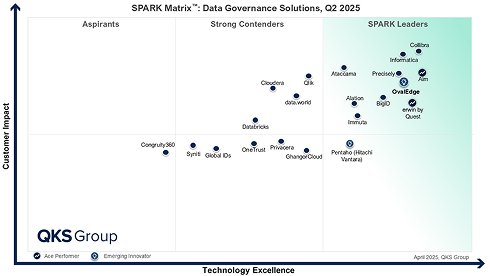
OvalEdge, recognized in the Gartner Magic Quadrant (MQ) 2025 for Data and Analytics Governance and as a SPARK Matrix 2026 Leader, delivers unified data governance with catalog, lineage, quality, access, and agentic automation in a single system, operational in weeks.
Book a demo to see how AI data governance works in practice across training, inference, and agentic workflows.
.png?width=1081&height=173&name=Forrester%201%20(1).png)
.png?width=1081&height=241&name=KC%20-%20Logo%201%20(1).png)