.png)
Organizations don't struggle because they lack data. They struggle because they can't find data they trust when it matters. Reports conflict, dashboards raise more questions than they answer, and teams burn hours validating numbers instead of acting on them.
Research from Dresner Advisory Services found that 68% of organizations have difficulty finding reliable data and analytic content.
The usual fix people reach for is another tool, but the real gap is structure. Without clear ownership, standards, and processes, data stays fragmented no matter how many tools you add.
That is what a data governance framework template gives you. On this page, you can see the full template and download it, plus a filled RACI matrix, real framework examples, and a step-by-step way to put it to work.
The data governance framework template (Free download)
A data governance framework template is a fill-in-the-blanks blueprint for how your organization owns, manages, protects, and measures its data. Instead of starting from a blank document, you get a ready structure with every core section already laid out: mission and scope, roles, policies, quality rules, workflows, compliance controls, and tools. You customize it to your business, industry, and data maturity, and you have a working framework in hours instead of weeks.
Get the template free in Word, PDF, and Excel, so you can fill it in wherever your team already works.
Note: The template isn't tied to any one platform. You can fill it in and run it regardless of the tools in your stack.
What's inside the data governance framework template?
The template is built around nine sections: seven that build the framework and two that keep it running over time. Together they cover everything you need to govern data without gaps, and each one scales to your size, industry, and maturity.
Here is the full structure, with a sample entry in every row, so you see exactly what you are downloading before you fill it in.
|
S.No |
Template section |
What to define |
Owner |
Sample entry (filled) |
|
1 |
Mission & scope |
Why governance exists, the objectives it supports, and which data domains it covers |
Executive sponsor |
"Keep customer, financial, and operational data accurate, secure, and compliant for decision-making." |
|
2 |
Roles & responsibilities (RACI) |
Who is responsible, accountable, consulted, and informed for each activity |
Executive sponsor |
Six activities mapped across five roles (full RACI below) |
|
3 |
Policies & standards |
Classification levels, access control, retention, and acceptable use |
Data owners |
"PII classified as Restricted. Access approved by the data owner. 36-month retention." |
|
4 |
Data quality rules & metrics |
Critical data elements, quality dimensions, rules, and targets |
Data stewards |
"Completeness above 98%. Duplicate customer records below 2%." |
|
5 |
Processes & workflows |
Onboarding, change management, issue escalation, and exceptions |
Data stewards |
"New data intake, then steward review, then publish. Issues escalate to Level 2 after 48 hours." |
|
6 |
Compliance & security controls |
Applicable regulations, security controls, and consent and audit needs |
Compliance / legal |
"GDPR and CCPA. Role-based access, encryption, and audit logging." |
|
7 |
Technology & tools alignment |
The systems that enforce and scale governance |
IT / data engineering |
"Data catalog, quality tool, lineage, access management, and reporting." |
|
8 |
Communication & training |
How governance is communicated and who gets trained |
Data steward |
"Updates via the governance portal. Steward training runs quarterly." |
|
9 |
Review & continuous improvement |
Review cadence, the owner, and the change approval process |
Review owner/committee |
"Quarterly review. Owner and next review date logged each cycle." |
Fill each section in order, and don't try to perfect it on the first pass. Start with what you know, assign an owner to every section, and refine as the framework meets real data. Smaller teams can combine roles. Regulated industries will spend more time on the compliance section.
Also Read: To understand the reasoning behind each component, see our guide to the pillars of data governance.
The data governance RACI matrix (Filled in)
Governance stalls the moment ownership is unclear. The RACI matrix fixes that by naming, for every governance activity,
- who is Responsible for doing it,
- who is Accountable for the outcome,
- who gets Consulted and,
- who is kept Informed.
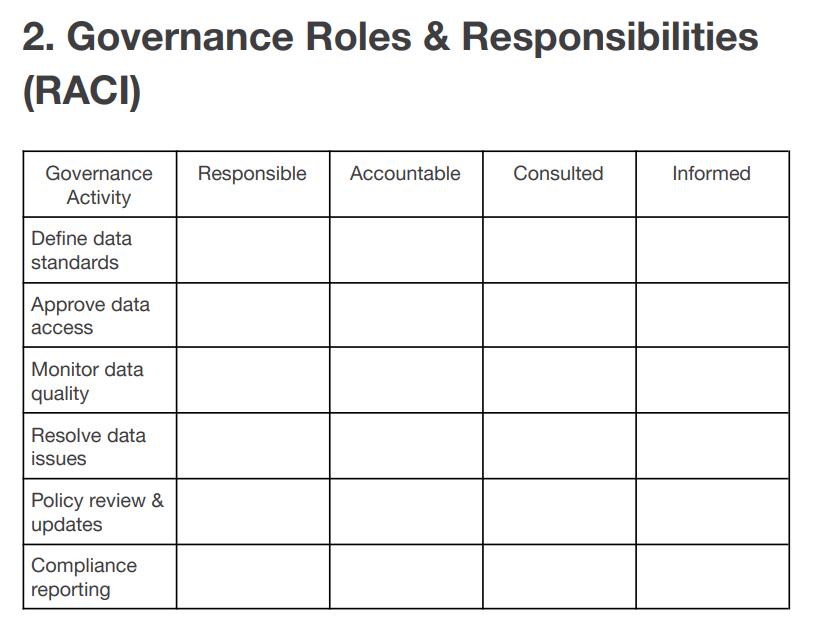
Here is a filled starting point you can drop into your framework and adjust.
|
Governance activity |
Responsible |
Accountable |
Consulted |
Informed |
|
Define data standards |
Data steward |
Data owner |
IT / data engineering |
Executive sponsor |
|
Approve data access |
IT / data engineering |
Data owner |
Compliance / legal |
Data steward |
|
Monitor data quality |
Data steward |
Data owner |
IT / data engineering |
Executive sponsor |
|
Resolve data issues |
Data steward |
Data owner |
IT / data engineering |
Compliance / legal |
|
Policy review and updates |
Data owner |
Executive sponsor |
Compliance / legal |
Data steward |
|
Compliance reporting |
Compliance / legal |
Executive sponsor |
Data owner |
Data steward |
Read each row across, not down: one clear owner in the Accountable column per activity, so accountability never splits. Use real job titles when you fill it in, and have each department lead confirm their assignments before you publish.
The downloadable data governance framework template has this same table blank, ready for your names.
Data governance framework examples to model yours on
You don't have to invent a framework from scratch. Most teams base their template on one of the established models below, then adapt it. Use this to pick the closest fit, then fill in the template above to make it real for your organization.
|
Framework |
Best for |
Detail level |
What it brings to your template |
|
DAMA-DMBOK |
Building a full data management program |
Very high |
A shared vocabulary and defined knowledge areas that keep large programs consistent |
|
DGI (Data Governance Institute) |
Ownership clarity and decision rights |
High |
A structured set of who, what, how, and when components |
|
McKinsey |
An executive-friendly, flexible structure |
Medium |
A three-tier operating model that is quick to stand up |
|
DCAM (EDM Council) |
Regulated industries and financial services |
High |
Maturity scoring and a phased implementation roadmap |
|
NIST / COBIT |
Risk, controls, and audit readiness |
High |
Control mapping that plugs straight into your compliance section |
There is no single best one. Pick the model that matches your industry, maturity, and how tightly you need to control access, then use the template to put it into practice.
A data governance framework example
Templates are easier to fill in when you can see one that's already done. Below is this template completed for a hypothetical mid-size retailer, Northwind Trading, setting up governance for its customer data. Treat it as a reference for the level of detail to aim for, then adapt the specifics to your own business.
Governance mission and scope
Mission: keep customer data accurate, secure, and compliant, so marketing, sales, and support all work from one trusted view of the customer. Business objectives supported: better campaign targeting, duplicate customer records below 2%, and GDPR audit readiness. Scope: customer data across the CRM and marketing platform, covering EU and UK operations.
Key roles
Executive sponsor: VP of Data. Data owner: Head of CRM. Data steward: Customer Data Analyst. IT / data engineering: Data Engineering lead. Compliance / legal: Data Protection Officer.
Policies and standards (sample)
Classification: customer PII is Restricted. Access granted based on role, with the data owner as approval authority. Retention period: 36 months after last purchase, then anonymize.
Data quality metrics (sample)
|
Metric |
Target |
Owner |
|
Email field completeness |
Above 98% |
Customer data steward |
|
Duplicate customer records |
Below 2% |
Customer data steward |
Filled in like this, the framework stops being a blank document and becomes a working agreement your teams can actually follow. The downloadable template walks the same structure across all nine sections, from mission and scope through review and sign-off.
What the framework looks like
Two pictures make the template easier to put in place: one showing how the framework layers fit together, and one showing who sits where in your governance structure.
The framework builds from the ground up. Governed metadata sits at the base, because you can't set policy on data you can't see or describe. On top of that sit your roles and policies, then your quality and compliance controls, and finally the technology that enforces all of it. Each layer depends on the one beneath it, which is why teams that jump straight to tools without governed metadata underneath tend to stall.
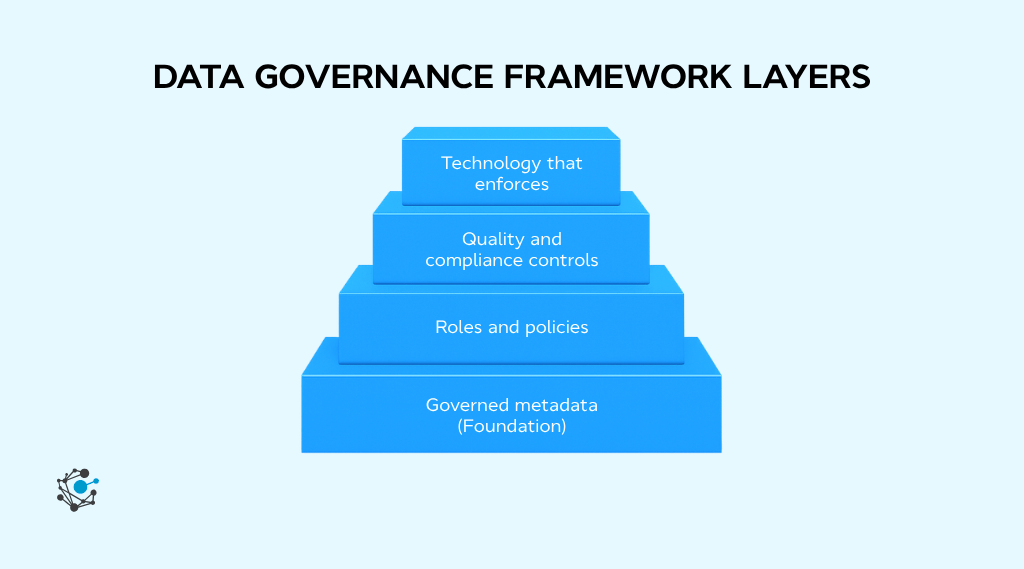
These four layers group the template's nine sections by how they build on each other, from governed metadata at the base up to the tools that enforce it.
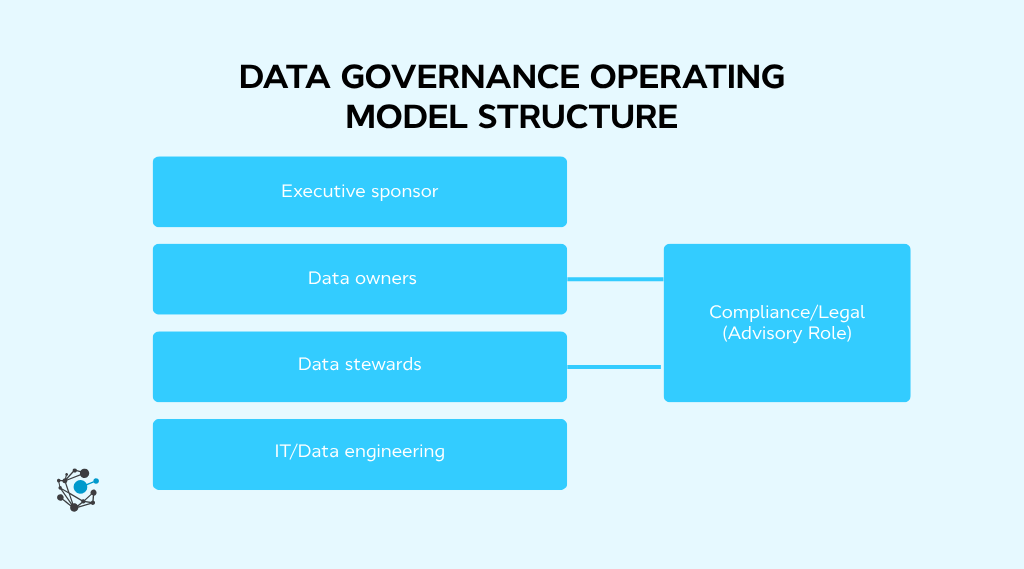
Below the framework sits the operating structure that keeps it running: an executive sponsor sets the mandate, data owners are accountable for their domains, data stewards manage the day-to-day, IT and data engineering handle the technical side, and compliance keeps it audit-ready.
How to use the data governance framework template, step by step
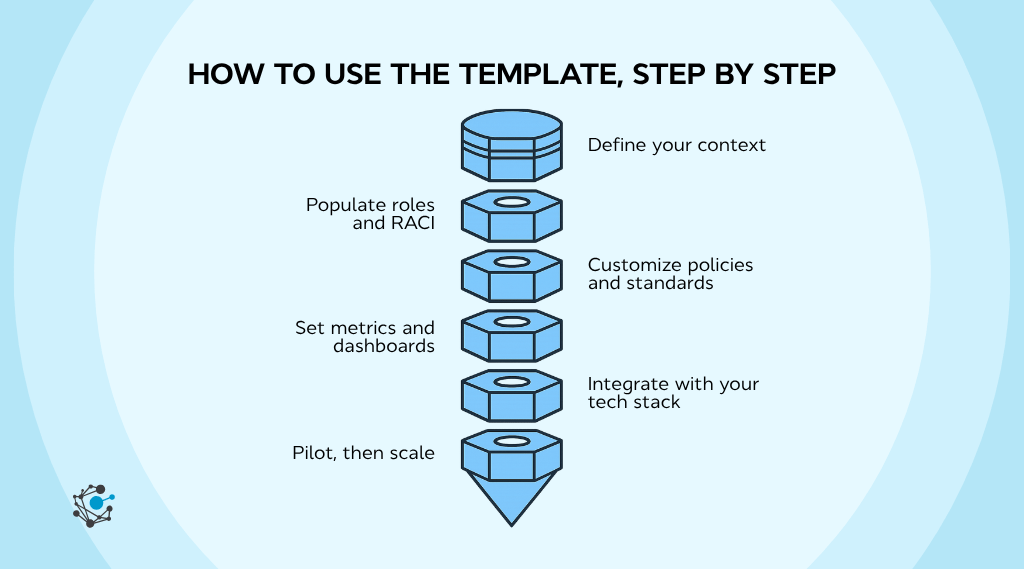
A filled-in template only helps if you put it into motion. Once you've downloaded the template, work through these six steps.
Step 1: Define your context
Before you fill in a single policy, map the environment you're working in: where your data lives, who touches it, and what matters most. This keeps the framework realistic instead of aspirational.
-
Map your stakeholders. List the departments and roles that create, change, or use critical data.
-
Set a clear objective, like "reduce duplicate customer records by 50%" or "be GDPR audit-ready by Q3."
Step 2: Populate roles and RACI
Governance gets diluted or ignored when data governance ownership is fuzzy. Fill in the RACI matrix early so everyone knows their part before the work starts.
- Use real job titles, not abstract personas.
- Have each department lead confirm their assignments before you publish.
Step 3: Customize policies and standards
Start from the template's policies for classification, access, and retention, then adapt them to your industry and legal obligations. The goal is guardrails, not roadblocks.
- Write in plain language your average user can follow, not legalese.
- Tie each policy to a consequence, whether that's a system block, an audit flag, or an escalation.
Step 4: Set metrics and dashboards
If you're not measuring it, you can't manage it. Pick a small set of KPIs for quality, compliance, and resolution speed, and make them visible.
- Start with three to five metrics, like percentage of incomplete records or access violations.
- Use live dashboards rather than static reports so people can see the numbers change.
Step 5: Integrate with your tech stack
Governance shouldn't sit in a separate document. Wire the framework into the tools your teams already use so it runs on its own.
- Audit what already manages metadata, quality, or access, and find the gaps.
- Automate where you can, like auto-flagging invalid records or expired permissions.
Step 6: Pilot, then scale
Start small. A pilot lets you test the framework and fix what resists before you expand. Then roll it out in phases with feedback loops, because governance is a cycle, not a one-time launch.
- Choose a low-risk pilot, like customer contact data in one or two teams.
- Schedule quarterly reviews to adjust for new tools, teams, or regulations.
In practice: How Gousto governs data at scale
Gousto, a UK meal-kit company, ships over 500 recipes a month, and a single data error can hit pricing, nutrition, or allergen information that customers rely on. That data changes constantly and has to stay accurate across their buying, product, and digital teams.
Using a framework like the one above, powered by OvalEdge, Gousto assigned data stewards across recipes and ingredients, set up automated quality checks that catch issues before recipes go live, and standardized definitions in a central catalog to create one source of truth.
The result: more accurate pricing and allergen data, lower compliance risk, and teams that trust the numbers they work from.
Conclusion
A template gives you the structure: the roles, the policies, the metrics, all in one place. But a document doesn't enforce itself. Left on its own, it becomes the thing everyone agreed to once, and no one checks against.
That's the gap OvalEdge closes. It starts with governed metadata, so you can actually see and describe your data, then layers policy enforcement, quality checks, and lineage on top, turning the framework you just filled in into something that runs every day instead of sitting in a folder.
Fill in the template to set your structure, then put OvalEdge behind it to keep it alive. Book a demo with OvalEdge today.
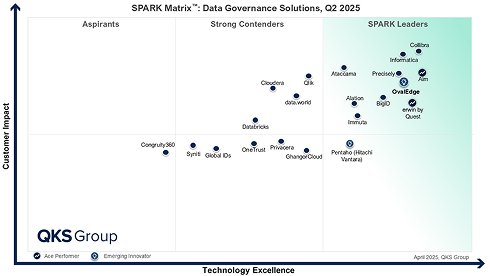
.png?width=1081&height=173&name=Forrester%201%20(1).png)
.png?width=1081&height=241&name=KC%20-%20Logo%201%20(1).png)