.jpg)
Healthcare data governance solutions help organizations classify, protect, and manage patient data under policies that keep it compliant, traceable, and usable across departments. But for healthcare IT leaders and compliance teams evaluating these platforms in 2026, the concept itself is not the hard part. The hard part is the category confusion.
PHI discovery tools, enterprise data catalogs, and healthcare-native compliance platforms all position themselves under the same "governance" umbrella, yet they solve fundamentally different problems.
A platform built to find and lock down sensitive data is not the same as one designed to document lineage, maintain shared definitions, and make data discoverable across the organization. Buying the wrong category does not just waste budget. It leaves the actual governance gap wide open.
This guide breaks down what healthcare data governance software does, compares eight solutions across three distinct platform categories, explains what is driving the urgency in 2026, and walks through how to match the right solution to your organization's specific gap.
What is healthcare data governance software?
Healthcare data governance software is a platform that enforces policies for how patient and organizational data is classified, accessed, shared, and retained across a health system. It establishes who owns each data domain, what rules apply, and how compliance is documented, creating a single auditable layer of control over data that would otherwise be scattered across EHRs, billing systems, data warehouses, and third-party integrations.
Data governance vs. data management in healthcare
These two terms show up interchangeably in vendor marketing, but they are sequential, not competing. Governance sets the rules: who owns a data domain, what policies apply, which definitions are authoritative, and how changes get approved.
Management is the operational execution of those rules, including the ETL pipelines, storage infrastructure, data quality checks, and integration workflows that move and maintain data day to day. Without governance, data management runs on assumptions. Without management, governance stays on paper.
Data governance vs. data security in healthcare
Governance defines who is allowed to do what with data, and why. Security is the technical enforcement layer that makes those rules stick through encryption, access controls, threat detection, and monitoring.
A security platform can lock down a dataset, but it cannot tell you whether the data inside is classified correctly, who should own it, or whether it means the same thing in radiology as it does in billing.
That distinction is exactly what separates the vendor categories covered next: some platforms lead with enforcement and discovery, while others lead with policy, cataloging, and shared context.
Best healthcare data governance solutions in 2026 (Compared)
.jpg?width=1024&height=569&name=Best%20healthcare%20data%20governance%20solutions%20in%202026%20(Compared).jpg)
The platforms below were evaluated on compliance and audit depth, PHI discovery and classification capability, access control granularity, integration with clinical systems, and key limitations. They are grouped into three categories because these products solve different problems rather than competing head-to-head.
Enterprise governance platforms
These platforms treat governance as policy, cataloging, and stewardship infrastructure. They are built for organizations that need broad data documentation, lineage, and glossary management across the enterprise.
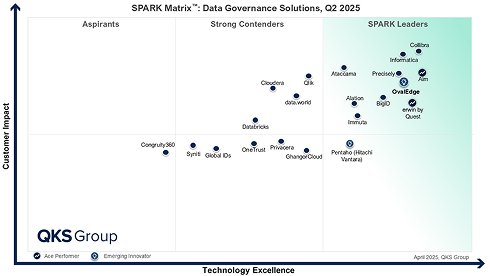
1. OvalEdge
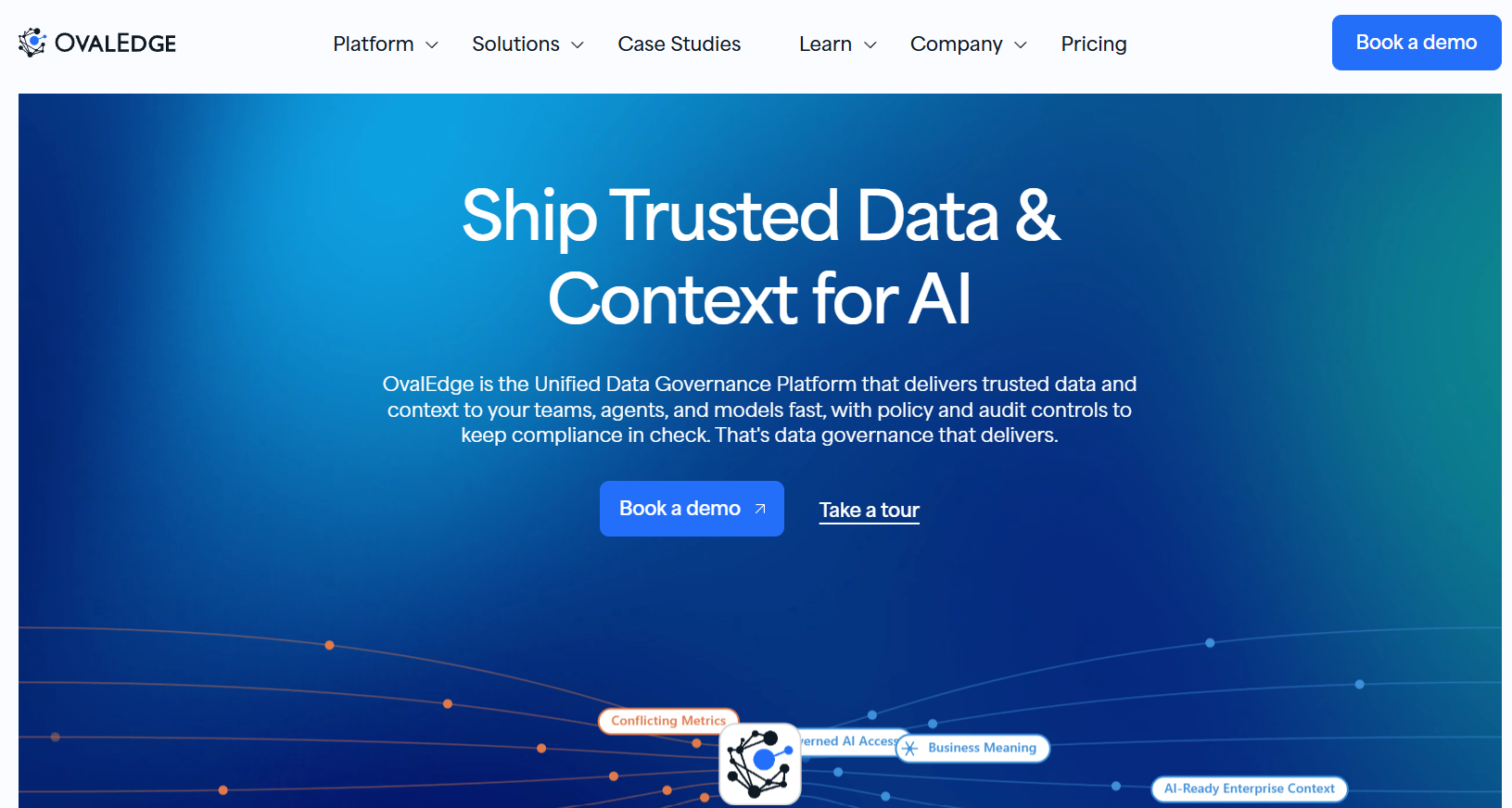
OvalEdge is a unified data governance and cataloging platform built for regulated industries. It connects metadata management, business glossary, data lineage, sensitive-data classification, and access governance into a single environment, with 170+ pre-built connectors covering EHR systems, BI tools, cloud, and on-premises sources.
Key features
-
Data catalog and metadata management: Crawls clinical, financial, and operational systems to create a centralized, searchable inventory of every data asset.
-
Business glossary: Standardizes term definitions across departments and facilities, eliminating inconsistent KPIs caused by mergers or siloed teams.
-
Automated data lineage: Maps data flow from source systems through transformations to downstream reports, critical during EHR upgrades and compliance audits.
-
Sensitive data classification: Uses AI-driven pattern recognition to discover and classify PHI and PII automatically across connected systems.
-
AI governance readiness: Provides the governed metadata layer that AI tools and clinical copilots need to produce trustworthy outputs.
Pros
-
Easy to use for both IT and business users with minimal learning curve
-
Highly customizable modules, workflows, and governance policies
-
Exceptional customer support, rated among the best by Gartner reviewers
Best for: Health systems that need broad internal data access without losing compliance control.
How a large hospital system improved data discovery with OvalEdge
Michigan's largest hospital chain, built through acquisitions and running on Epic for electronic medical records, faced two persistent governance problems.
-
First, every quarterly Epic upgrade required manual impact analysis across dozens of custom downstream systems and reports, a process that either delayed the upgrade or risked breaking downstream reporting.
-
Second, years of acquisitions left the organization with inconsistent KPI definitions across facilities, making cross-unit comparisons unreliable.
OvalEdge crawled their Epic, Clarity, QlikView, Tableau, and SAP Business Objects environments and built automated data lineage from source systems to reporting layers. Impact analysis that previously took weeks now runs in a fraction of that time, and a unified business glossary brought consistency to data definitions across the organization.
Read the full case study here.
OvalEdge is built to give healthcare organizations governed, auditable access to clinical and operational data without sacrificing compliance control.
If you are evaluating governance platforms for PHI classification, audit readiness, or AI-ready data infrastructure, book a demo with OvalEdge to see how the platform handles your specific clinical and compliance workflows.
2. Collibra
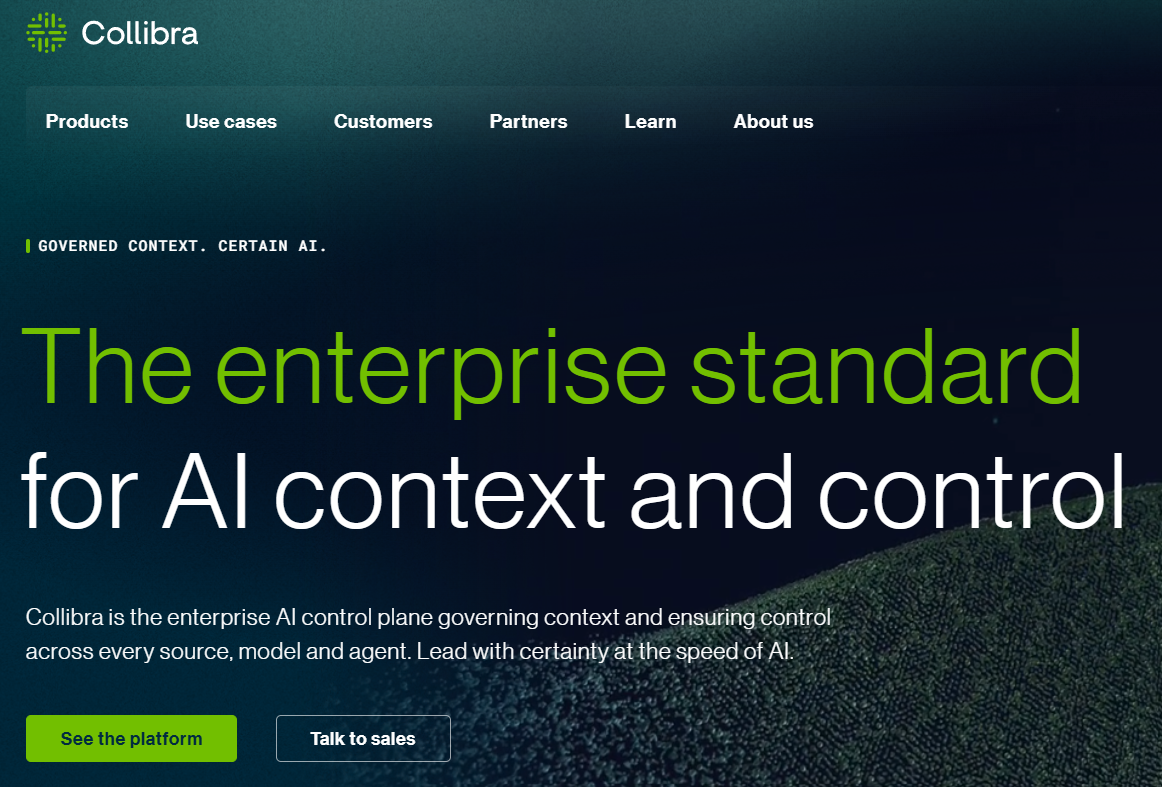
Collibra is an enterprise data governance platform that unifies data cataloging, business glossary, stewardship workflows, data quality, and AI governance across hybrid and multi-cloud environments. It is widely adopted in healthcare, financial services, and government.
Key features
-
Data marketplace: Enables self-service data discovery so clinical and business users can find, understand, and request access to governed datasets.
-
Business glossary and stewardship workflows: Assigns ownership, enforces definitions, and routes governance approvals through configurable workflows.
-
Unified data and AI governance: Catalogs, assesses, and monitors AI use cases alongside traditional data assets through the AI Command Center.
-
100+ native integrations: Connects across cloud, on-premises, and SaaS environments, including healthcare-relevant sources.
Pros
-
Comprehensive governance platform that centralizes policies, quality, and cataloging in one place
-
Intuitive onboarding with pre-packaged governance templates that reduce setup time
Cons
-
Costly, with a pricing model that is difficult to justify for mid-size organizations
Best for: Large health systems already running enterprise governance programs that need unified governance across data and AI.
3. Atlan
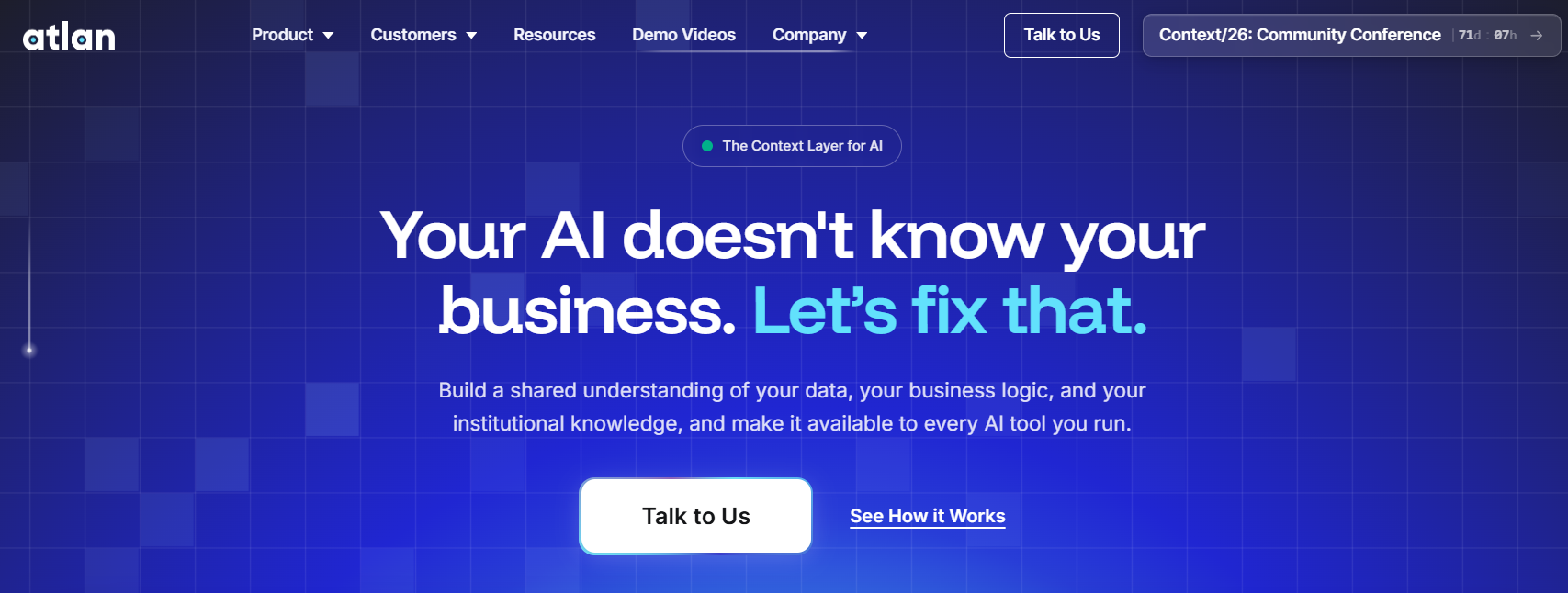
Atlan is an active metadata platform that unifies data discovery, lineage, quality signals, and governance policies into a collaborative workspace. It positions itself as a context layer for enterprise AI, using an Enterprise Data Graph to connect assets, definitions, and policies.
Key features
-
Active metadata platform: Metadata flows bidirectionally across 80+ connectors, triggering automations rather than sitting in a static catalog.
-
Collaborative workspace: Chat-native workflows allow engineers, analysts, and business stakeholders to discover, document, and govern data in one interface.
-
AI-assisted policy suggestions: Policies propagate in real time. When a column is classified as PHI, masking and access restrictions cascade to downstream consumers.
-
Data quality signals: Surfaces quality issues alongside catalog entries so users see trust indicators before working with a dataset.
Pros
-
Users highlight the intuitive interface and cross-team collaboration capabilities
-
Users note strong price-to-performance ratio compared to larger enterprise alternatives
Cons
-
HIPAA-specific controls are not pre-configured and may require additional setup for healthcare environments
Best for: Data teams wanting a catalog adopted by both engineers and clinical or business stakeholders, particularly in organizations prioritizing fast deployment.
4. Alation

Alation is an AI-powered data catalog and governance platform focused on enterprise data discovery. It uses agentic AI to automate metadata harvesting, documentation, and compliance management, and offers pre-built connectors across cloud and on-premises environments.
Key features
-
AI-powered data discovery: Automated search and curation help users find governed, certified datasets across departments without manual cataloging effort.
-
Lineage visualization: Traces data flow across pipelines, transformations, and reports for audit readiness and impact analysis.
-
Curation automation: Agentic AI enforces metadata completeness and consistency rules, reducing manual stewardship work.
-
Certified dataset surfacing: Flags datasets that meet governance and quality standards, so analysts can distinguish trusted data from ungoverned sources.
Pros
-
Strong adoption in large enterprises; reviewers consistently note that it reduces time spent searching for reliable data across departments
-
Strong connector library and integration ecosystem
Con
-
Typically requires pairing with a separate security or compliance layer for PHI-specific controls, as native HIPAA enforcement is not the platform's primary focus
Best for: Large health systems where the main barrier is finding governed clinical data across departments.
5. Arcadia
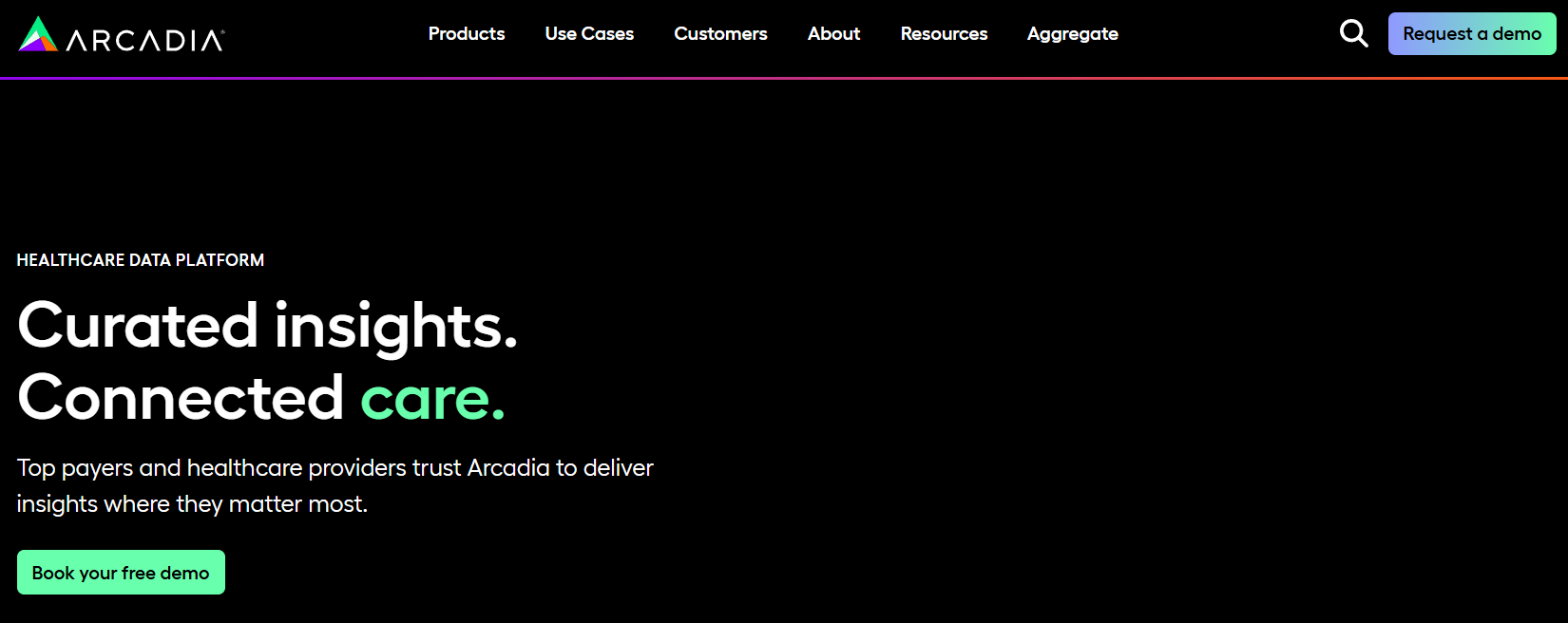
Arcadia is a healthcare-native data platform that bundles governance, analytics, and data aggregation into a single environment. Built on an open lakehouse architecture, it aggregates clinical, financial, risk, and claims data and manages over many patient records.
Key features
-
Unified data aggregation: Normalizes and integrates data from EHRs, claims feeds, social determinants of health, and remote monitoring into one governed layer.
-
Automated compliance support: Built-in governance formats and row-level permission controls reduce the complexity of provisioning users and managing access.
-
Real-time dashboards: Population health, value-based care, and operational performance analytics sit on top of the governed data layer.
-
Healthcare-specific data model: Pre-built for clinical and financial use cases rather than requiring custom configuration from a general-purpose governance tool.
Pros
-
Purpose-built for healthcare, so clinical data types, coding standards, and payer structures are handled natively rather than through workarounds
-
Governance and analytics live in the same platform, reducing tool sprawl for organizations that need both capabilities
Con
-
Governance is embedded within a broader analytics platform, so it suits a different buyer than dedicated catalog and governance tools
Best for: Health systems wanting governance bundled with analytics rather than as a standalone tool.
PHI Discovery and Security Platforms
These platforms lead with finding, classifying, and locking down PHI. They are built for organizations whose primary focus is understanding where sensitive data lives and who can access it.
6. Varonis
Varonis is a data security platform that leads with PHI and PII discovery, classification, and access lockdown. It scans cloud, SaaS, and on-premises environments to identify where sensitive data lives, who can access it, and whether permissions are appropriate.
Key features
-
PHI discovery and classification: Automatically identifies and classifies sensitive data using pattern matching and AI, covering PHI, PII, and PCI across connected environments.
-
Permissions lockdown: Continuously audits access permissions, flags over-exposed files and datasets, and remediates excessive access at scale.
-
Threat detection and user behavior analytics: Establishes baselines for normal user behavior and alerts on anomalous activity.
-
Access monitoring and reporting: Maintains detailed audit trails of who accessed what data and when.
Pros
-
Security-first approach that directly addresses one of healthcare's most common HIPAA exposure risks: over-permissioned access to patient data
-
Enables safer AI copilot deployment by ensuring sensitive data is locked down before tools like Microsoft 365 Copilot crawl the environment
Con
-
Not a governance or catalog platform, so it does not handle business glossary, lineage, stewardship workflows, or shared data definitions
Best for: Organizations whose primary exposure is open or over-permissioned access to sensitive patient data.
Healthcare-Specific Identity and Compliance Platforms
These platforms are built natively for clinical and regulatory workflows, covering access enforcement, EHR-integrated authentication, and audit logging designed around HIPAA rather than general enterprise use.
7. Imprivata
Imprivata is a healthcare-native identity and access management platform. It handles clinical authentication, EHR single sign-on, access certification, and HIPAA-compliant audit logging, all designed around the realities of shared workstations, mobile devices, and fast-paced clinical workflows.
Key features
-
Clinical workflow-aware authentication: Delivers No Click Access for shared workstations through badge-tap, proximity cards, and biometrics like palm vein scanning, eliminating password friction at the point of care.
-
EHR single sign-on: Lets clinicians log in once and access Epic, Cerner, and other clinical applications without re-entering credentials at every system switch.
-
Access certification and audit logging: Logs all elevated account activity and provides AI-driven explanations of user behavior for HIPAA, HITECH, and CMS reporting requirements.
-
Agentic identity management: Secures AI agents deployed across clinical systems by authenticating them as managed identities.
Pros
-
Built specifically for clinical environments, so authentication workflows account for shared devices, shift changes, and time-sensitive care delivery
-
Deep EHR integration means access controls sit inside clinical workflows rather than being bolted on from outside
Con
-
Not a catalog, lineage, or data governance platform; it handles identity and access, so organizations still need a separate governance tool for metadata management and data documentation
Best for: Organizations where point-of-care identity and access control is the primary compliance gap.
8. ER/Studio
ER/Studio, developed by Idera, is an enterprise data modeling and architecture tool that approaches governance from the data model layer. It is used to design, document, and manage complex data structures across relational and NoSQL platforms, with built-in glossary, lineage, and compliance documentation capabilities.
Key features
-
Enterprise data modeling: Build logical and physical data models that document how patient information flows across EHR systems, claims databases, and downstream reporting.
-
Standardized glossaries and data dictionaries: Create shared definitions at the model level so terminology conflicts between departments or merged facilities are resolved before data reaches the catalog.
-
Lineage mapping: Tracks dependencies between data elements, reports, and processes, supporting impact analysis when upstream structures change.
-
Integration with catalog tools: Connects with Collibra, Microsoft Purview, and other governance platforms via REST APIs, so model-level definitions flow automatically into the broader catalog.
Pros
-
Strong foundation for organizations that want governance embedded in data architecture rather than layered on after the fact
-
Model-level retention policies tag data elements with classification and retention schedules at creation, automating disposal and archival rules
Con
-
Stronger on modeling and documentation than on real-time PHI monitoring, discovery, or access enforcement
Best for: Organizations building governance from the data-architecture layer up.
Benefits of strong governance vs. risks of getting it wrong
The case for investing in a governance platform comes down to two sides of the same argument: what it enables when done right, and what it costs when it is missing.
What you gain with the right governance solution
-
Stronger clinical and strategic decision-making, because teams work from consistent, trusted definitions rather than conflicting spreadsheets
-
Operational efficiency through automated stewardship workflows, access approvals, and compliance documentation that would otherwise consume staff hours
-
Cleaner revenue cycle performance, with fewer billing errors and claim denials caused by inconsistent data across departments
-
Reduced risk exposure through documented access controls, audit-ready lineage, and PHI classification that holds up under regulatory scrutiny
What's at stake without one
-
Regulatory fines and enforcement actions from HIPAA, HITECH, and state-level privacy laws that penalize undocumented access and poor data handling
-
Data breaches and PHI exposure that damage patient trust and carry significant financial consequences
-
Operational bottlenecks caused by siloed, ungoverned data that blocks cross-department analytics and population health initiatives
-
Fragmented data that undermines AI readiness, because models trained on inconsistent or poorly classified data produce unreliable outputs
Did You Know?
Healthcare data breaches cost an average of $6.64 million per incident in 2026, marking the industry's 13th consecutive year as the costliest sector for breaches, according to the IBM/Ponemon Cost of a Data Breach Report 2026.
The platforms compared above address different pieces of this risk. The right choice depends on which gap is most exposed in your organization.
Why healthcare organizations need dedicated governance solutions now
When a HIPAA audit requires tracing how a specific patient record moved from an EHR to a billing report to a third-party analytics dashboard, ungoverned organizations spend days or weeks reconstructing that path manually. That delay is not theoretical.
According to IBM's 2025 Cost of a Data Breach Report, healthcare breaches take an average of 279 days to identify and contain, five weeks longer than the global average, largely because organizations lack the governed lineage and access documentation to trace exposure quickly.
That gap is being pressured from three directions simultaneously.
Governed PHI is the foundation for trustworthy clinical AI
AI tools inherit whatever governance exists in the underlying data. If PHI is poorly classified, inconsistently defined, or accessible to the wrong roles, any AI model trained on that data carries those problems into its outputs. This applies to clinical decision support, administrative automation, predictive models, and agentic workflows equally.
The IBM/Ponemon Cost of a Data Breach Report 2026 found that 92% of organizations that suffered an AI-related breach did not have proper AI-access controls in place.
For healthcare organizations evaluating governance platforms, "can this make our data AI-ready?" should be treated as a top-tier requirement alongside compliance and access control.
Regulatory scrutiny is increasing compliance costs
Audit frequency is rising, penalty exposure is expanding, and manual compliance documentation is becoming unsustainable at scale. Organizations that rely on spreadsheets and tribal knowledge to reconstruct audit trails face longer response times and greater exposure during investigations.
Interoperability mandates are exposing data quality gaps
Federal data-sharing requirements between providers, payers, and patients are surfacing exactly the inconsistencies that governance platforms are built to fix: conflicting term definitions, incomplete metadata, and undocumented data flows between systems that were never designed to talk to each other.
What to look for in a healthcare data governance solution
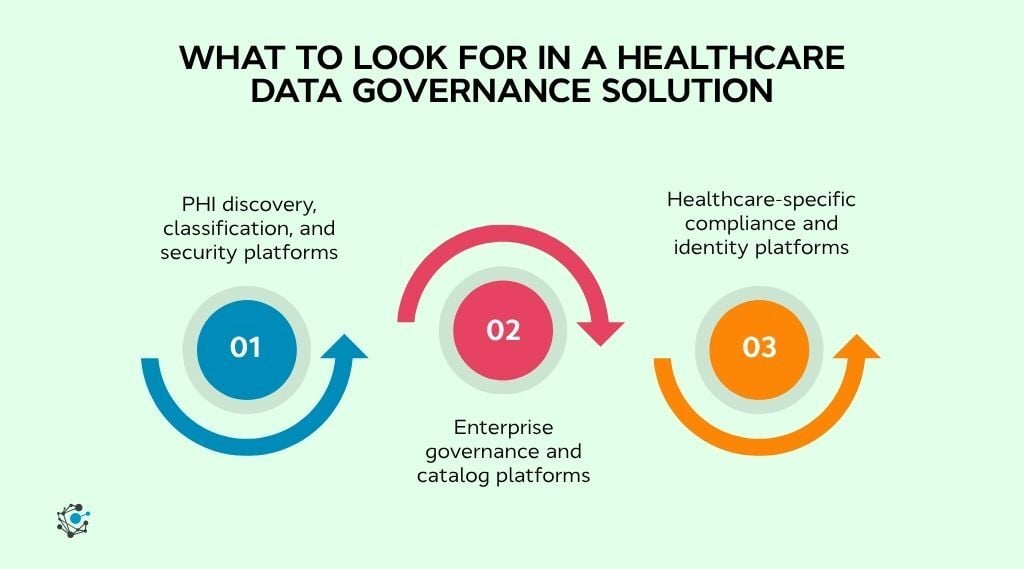
"Healthcare data governance solution" spans three distinct product categories, and buyers should know which one they actually need before comparing vendors. Buyers should evaluate whether a platform gives them trusted business context (glossary, metadata, lineage) in addition to PHI protection.
PHI discovery, classification, and security platforms
These platforms focus on finding sensitive data, classifying it, auditing permissions, detecting threats, and enforcing retention or de-identification controls. They are built for organizations whose primary gap is knowing where PHI lives, who can access it, and how long it should be kept or masked.
Enterprise governance and catalog platforms
These platforms handle metadata cataloging, business glossary, lineage, stewardship workflows, and AI governance readiness. They are built for organizations that need broad data use to be documented, traceable, and defensible in an audit, with shared, trusted definitions of key terms across departments rather than just locked-down data.
Healthcare-specific compliance and identity platforms
These platforms cover clinical workflow-aware access control, HIPAA-specific audit logging, and EHR-integrated authentication. They are built for organizations where point-of-care access enforcement, not cataloging, is the gap.
Before evaluating specific vendors, measure every platform against these six criteria:
-
Audit-ready documentation that can produce compliance reports on demand, not after weeks of manual reconstruction
-
PHI-specific classification that distinguishes protected health information from generic PII
-
Business glossary, metadata, and lineage for trusted, shared context on what data actually means, not just who can access it
-
Integration with existing EHR and data warehouse infrastructure
-
Scalability from a single-department pilot to enterprise-wide deployment
-
AI governance readiness to ensure governed data flows into models, copilots, and agentic workflows
How to choose the right solution for your organization
Before evaluating any platform, document what is actually failing. Is the problem PHI visibility? Audit preparation that takes too long? Over-permissioned access? Inconsistent data definitions across departments? AI readiness? The answer determines which platform category to evaluate first, and skipping this step is how organizations end up buying the wrong tool.
Decision matrix: Match your problem to the right platform category
-
Audit readiness or compliance documentation gap → Healthcare-Specific Compliance and Identity Platforms
-
PHI exposure or over-permissioned access → PHI Discovery and Security Platforms
-
Fragmented data, no shared definitions, poor lineage → Enterprise Governance and Catalog Platforms
-
Preparing data for AI or copilot deployment → Enterprise Governance and Catalog Platforms, with AI governance readiness as the deciding factor
-
Point-of-care identity and access control gap → Healthcare-Specific Compliance and Identity Platforms
Organizations with more than one gap should use this matrix to prioritize the most urgent problem first, rather than searching for one platform that claims to do everything.
Evaluate compliance, integration, and scalability
When requesting demos, ask for a full audit-response workflow: locate the data, show its lineage, and produce a compliance report. A generic dashboard walkthrough does not reveal whether the platform can handle what an actual audit demands. Also verify that the platform integrates with your existing EHR and data warehouse stack without requiring a rip-and-replace.
Pilot with a high-risk data domain
Run the pilot on a real, high-exposure domain like billing PHI or a specific EHR feed, not a generic vendor-supplied dataset. Define success criteria upfront: audit prep time reduced, unauthorized access incidents caught, time to classify new data sources. These benchmarks make it possible to evaluate the platform against your actual environment, not a controlled demo.
Conclusion
A healthcare data governance solution helps organizations classify, secure, and document patient data so it stays compliant and trustworthy at scale. The starting point is identifying your primary bottleneck, whether that is PHI exposure, audit readiness, or point-of-care access control. Most organizations will need a combination of governance, security, and identity capabilities rather than a single platform that does everything.
What ties it all together is the governed data layer underneath: a catalog that documents what exists, a glossary that standardizes what it means, and lineage that traces where it came from. Without that foundation, compliance reports take weeks, security tools lock down data no one can find, and AI models inherit whatever inconsistencies exist in the underlying data.
OvalEdge brings cataloging, lineage, sensitive-data classification, and AI governance readiness into one platform built for regulated industries.
If your organization is evaluating governance solutions for healthcare, book a demo with OvalEdge to see how the platform handles your specific compliance and clinical data workflows.
.png?width=1081&height=173&name=Forrester%201%20(1).png)
.png?width=1081&height=241&name=KC%20-%20Logo%201%20(1).png)