A data governance strategy creates value only when it translates into consistent operational practices. Executive approval, governance frameworks, councils, policies, and RACI matrices provide the foundation, but they do not automatically create accountable ownership, trusted data, or effective stewardship.
The execution gap remains significant.
Only 23% of organizations report using formal data governance or quality frameworks, according to Conversational Geek Stats’ Data Governance Stats for 2026.
This highlights the challenge of moving governance from strategy into day-to-day operations.
Implementation requires more than policies. It involves selecting priority domains, activating data owners and stewards, establishing workflows, deploying governance technology, addressing data quality issues, and measuring business impact.
This article provides a phased roadmap for turning an approved data governance strategy into an operational program, from initial pilot to enterprise-wide rollout.
What is data governance implementation?
Data governance implementation is the process of translating a governance strategy and framework into operational workflows, assigned ownership, deployed tooling, and measurable outcomes. It covers pilot domain selection, stakeholder onboarding, platform rollout, policy enforcement, and success tracking. In short, it is everything that happens after the data governance strategy document is signed off and the data governance framework is approved.
What implementation includes:
-
Pilot domain execution and first governance cycles
-
Role activation (data owners, stewards, council members)
-
Tooling deployment and platform configuration
-
Workflow operationalization (issue routing, quality monitoring, access governance)
-
KPI tracking and governance scorecard reporting
What it does not include: strategy formation, framework design, or policy authoring. Those are prerequisites. Implementation is where the program either becomes operational or stays a shelf document.
The rest of this article walks through a phased roadmap for making that transition.
Data governance implementation steps: A phased rollout plan
This is the section most governance teams are looking for. The reason most programs stall is not a lack of ambition; it is an excess of it. Trying to govern everything at once, across every domain and every system, is the fastest way to overwhelm stewards, lose executive attention, and produce nothing measurable in the first six months.
A phased data governance implementation roadmap, starting with one domain and expanding on proof, is how successful programs survive their first year. Here is what that looks like in practice, broken into three phases.
Phase 1: Pick a pilot domain and run first governance cycles (weeks 1 to 8)
This phase is about proving that governance works in one domain before asking anyone to scale it.
-
Select the pilot domain using the criteria in the next section. The domain should be painful enough to matter, small enough to govern quickly, and visible enough that success gets noticed.
-
Assign a data owner and two to three data stewards for that domain. Make responsibilities explicit: who resolves quality issues, who is accountable for the domain, who is consulted on definitions, who is informed of changes.
-
Catalog assets in the pilot domain. Tables, reports, dashboards, glossary terms. Get them into the data catalog so the team has a shared inventory to work from.
-
Define and document 5 to 10 critical data elements (CDEs) with business definitions in the business glossary. These are the data points the business depends on most heavily.
-
Run the first governance cycle. Identify one data quality issue, assign it to a steward, resolve it, and document the resolution workflow. This is the proof that governance produces action, not just documentation.
-
Present the pilot results to the governance council and executive sponsor. Show what was cataloged, what was defined, what was resolved, and what the next phase looks like.
Phase 2: Expand to adjacent domains and operationalize workflows (months 3 to 6)
Phase 1 delivered a working proof of concept. Phase 2 is about repeating the pattern in two to three more domains and hardening the workflows.
-
Select two to three additional domains based on business priority and pilot learnings. Focus on two to three high-impact domains initially rather than attempting enterprise-wide rollout.
-
Onboard new data owners and stewards. Run responsibility-mapping workshops for each domain so every participant knows exactly what they own.
-
Expand the data catalog and business glossary to cover new domains. Build on the templates and standards established during the pilot.
-
Automate governance workflows. Issue assignment, quality rule monitoring, and access request approvals should move from manual tracking to automated routing.
-
Establish a regular governance council review cadence, monthly or bi-weekly, to track progress across domains.
-
Document and publish governance policies for the active domains. These should be living documents, not static PDFs.
Phase 3: Scale enterprise-wide and shift to continuous improvement (months 7 to 12)
With three to four domains governed and workflows running, the program has earned the credibility to expand enterprise-wide.
-
Extend governance to remaining high-priority domains using the playbook from Phases 1 and 2.
-
Integrate the governance platform with the broader data stack, including BI tools, ETL pipelines, and cloud environments.
-
Shift from project mode to operating mode. Governance becomes a continuous function, not a time-bound initiative.
-
Build dashboards to track governance KPIs across all domains. This is covered in detail in the Measuring Success section below.
-
Run quarterly maturity reviews to identify process gaps and expand scope.
This is the phase where tooling gaps become impossible to work around manually. A governance program managing four or more domains needs platform-level support for cataloging, quality monitoring, lineage tracing, and stewardship workflows.
How to select the right pilot domain
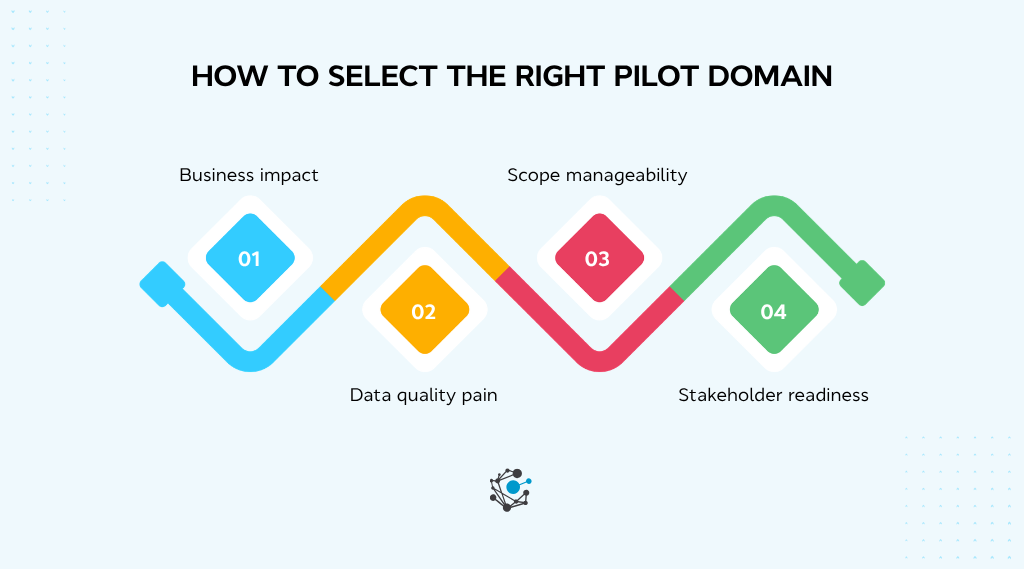
The right pilot domain should be painful enough to matter, small enough to govern quickly, and visible enough that success gets noticed. Getting this choice right determines whether the program builds momentum or stalls before it starts.
Four selection criteria:
1. Business impact
The domain should connect to a measurable business outcome, whether that is revenue reporting, regulatory compliance, or customer experience. Governing an obscure internal dataset teaches nothing about stakeholder engagement. A good test: can the team draw a direct line from this domain to a KPI that leadership already tracks?
2. Data quality pain
Pick a domain where quality issues are already causing friction. Stewards and owners are more willing to participate when governance solves a problem they already feel. A pilot domain with known quality pain makes governance value tangible from day one.
3. Scope manageability
The domain should have 10 to 30 critical data elements, not 300. The goal is a win in six to eight weeks, not six months. Narrow scope does not mean low value. Some of the strongest pilot outcomes come from governing a single high-friction process, like broker onboarding or vendor data intake, where improvements are immediately measurable.
4. Stakeholder readiness
At least one business-side owner in the domain should be willing to participate and champion the pilot. Governance imposed without a willing participant rarely sticks.
If a domain does not score well on at least three of these four criteria, the problem is not domain selection. It is organizational readiness. Address buy-in first.
Building stakeholder buy-in during rollout
Buy-in is not a one-time event at program kickoff. It erodes at every phase unless the team actively maintains it with visible results and clear accountability. This section focuses on buy-in during implementation, not during strategy formation (the strategy blog already covers that).
Understanding how to implement data governance means understanding that the hardest part is not technical. It is organizational.
Securing executive sponsorship that lasts beyond kickoff
The common failure pattern: an executive signs off on the governance initiative, then disengages. Six months later, budget gets reallocated, and the program quietly dies. A governance program that does not enable prioritized business outcomes will not survive its first budget review.
Sustaining executive sponsorship requires three things. First, tie governance milestones to business metrics the sponsor already reports on: data quality scores in board decks, compliance audit results, reporting accuracy. Second, schedule monthly 15-minute briefings, not quarterly reviews.
Short, frequent updates keep governance visible without consuming executive calendars. Third, give the sponsor a concrete role. They chair the governance council or sign off on domain expansion decisions. Passive sponsors drift.
At one mid-market insurer, the CDO stopped attending governance reviews after month two. The program stalled until the team restructured the reviews to show the sponsor exactly which regulatory risks had been mitigated. Suddenly, attendance became non-negotiable.
Activating data stewards through workflow ownership
Data stewards are the execution layer of governance. If they do not understand their responsibilities or see governance as extra work on top of their day job, the program stalls at Phase 1.
Activation starts with clarity. Each steward should know exactly which data quality issues they own, which definitions they maintain, and what their escalation path looks like. Publish this mapping and review it during onboarding.
Second, embed governance tasks into existing workflows, not as a parallel process. A steward should resolve a quality issue through their normal ticketing system, not a separate governance portal. Adoption sticks when governance fits into how people already work, not when it requires a separate tool or process on top of their existing responsibilities.
Third, recognize and reward stewardship. Public acknowledgment in governance council meetings, inclusion in domain-level decision-making, and career development credit all reinforce the role.
Deploying a data governance platform
Tooling is not the starting point. It is what operationalizes the workflows validated during the pilot. Teams that buy a platform before running a single governance cycle end up configuring a tool for a process that does not exist yet. The data governance rollout for tooling should mirror the phased rollout of the program itself.
What the tooling stack needs to cover
The platform should support six core capabilities:
-
Data catalog and discovery. Automated scanning and cataloging of data assets across sources, so stewards do not build inventories manually.
-
Business glossary. A shared, searchable repository of business definitions and CDEs, connected to the catalog.
-
Data lineage. Column-level lineage tracing from source to consumption, so quality issues can be traced to their origin.
-
Data quality monitoring. Automated rule execution and quality scoring, with alerts when thresholds are breached.
-
Policy enforcement and access governance. Role-based access controls, classification-driven policies, and audit trails for compliance.
-
Workflow automation. Issue assignment, approval routing, and stewardship task management integrated with existing tools.
A unified platform that covers all six reduces integration overhead and keeps governance context in one place instead of scattered across point solutions. OvalEdge is the Unified Data Governance platform that brings catalog, glossary, lineage, quality, access, and policy together in one system, with 170+ native connectors across modern and legacy environments and OvalEdge Agents that handle discovery, classification, and quality with humans in the loop.
Phased tooling rollout vs. big-bang deployment
Most governance platforms fail not because of the tool, but because of the rollout approach.
Phased rollout (recommended). Deploy the catalog and glossary first to support Phase 1. Add quality monitoring and lineage in Phase 2. Roll out policy enforcement, access governance, and full workflow automation in Phase 3. Each capability is validated before the next is added. Stewards learn one layer at a time.
Big-bang deployment. Everything goes live at once. The risk: it overwhelms stewards, produces a backlog of configuration work, and creates the impression that "the tool is too complex." Big-bang deployment is only appropriate when an organization has a mature governance team with prior platform experience.
Match the tooling rollout to the phased implementation plan. If the program is in Phase 1, the platform should be in Phase 1 too.
Measuring data governance implementation success
Governance programs that cannot prove their impact get defunded. Measurement is not a reporting exercise. It is how the program survives budget reviews. A strong data governance implementation plan includes measurement from day one, not as an afterthought in month nine.
Two tiers of metrics tell the full story:
|
Metric Type |
Examples |
When to Start Tracking |
|
Operational KPIs (governance activity) |
Domains governed, CDEs defined, stewardship issues resolved, catalog coverage %, glossary adoption rate |
Phase 1 |
|
Business Outcomes (governance impact) |
Reduction in data quality incidents, time saved on report reconciliation, compliance audit pass rate, data-driven decision confidence score |
Phase 2 to 3 |
Operational KPIs demonstrate that governance is running. Business outcomes demonstrate that it is working. Both are needed, but operational KPIs come first because business impact cannot be shown until the program has been running for a few months.
Governance scorecard. Build a simple quarterly scorecard with five to six metrics, color-coded (green/yellow/red), presented to the governance council and executive sponsor. Scorecard dimensions should include: catalog coverage, glossary completeness, stewardship SLA compliance, data quality score trend, domain expansion progress, and policy adoption rate.
Track stewardship SLA compliance from Phase 1. If quality issues sit unresolved for weeks, that signals a process problem, and no amount of Phase 3 tooling will fix it.
Common data governance implementation pitfalls (and how to avoid them)
.png?width=1024&height=569&name=Common%20data%20governance%20implementation%20pitfalls%20(and%20how%20to%20avoid%20them).png)
-
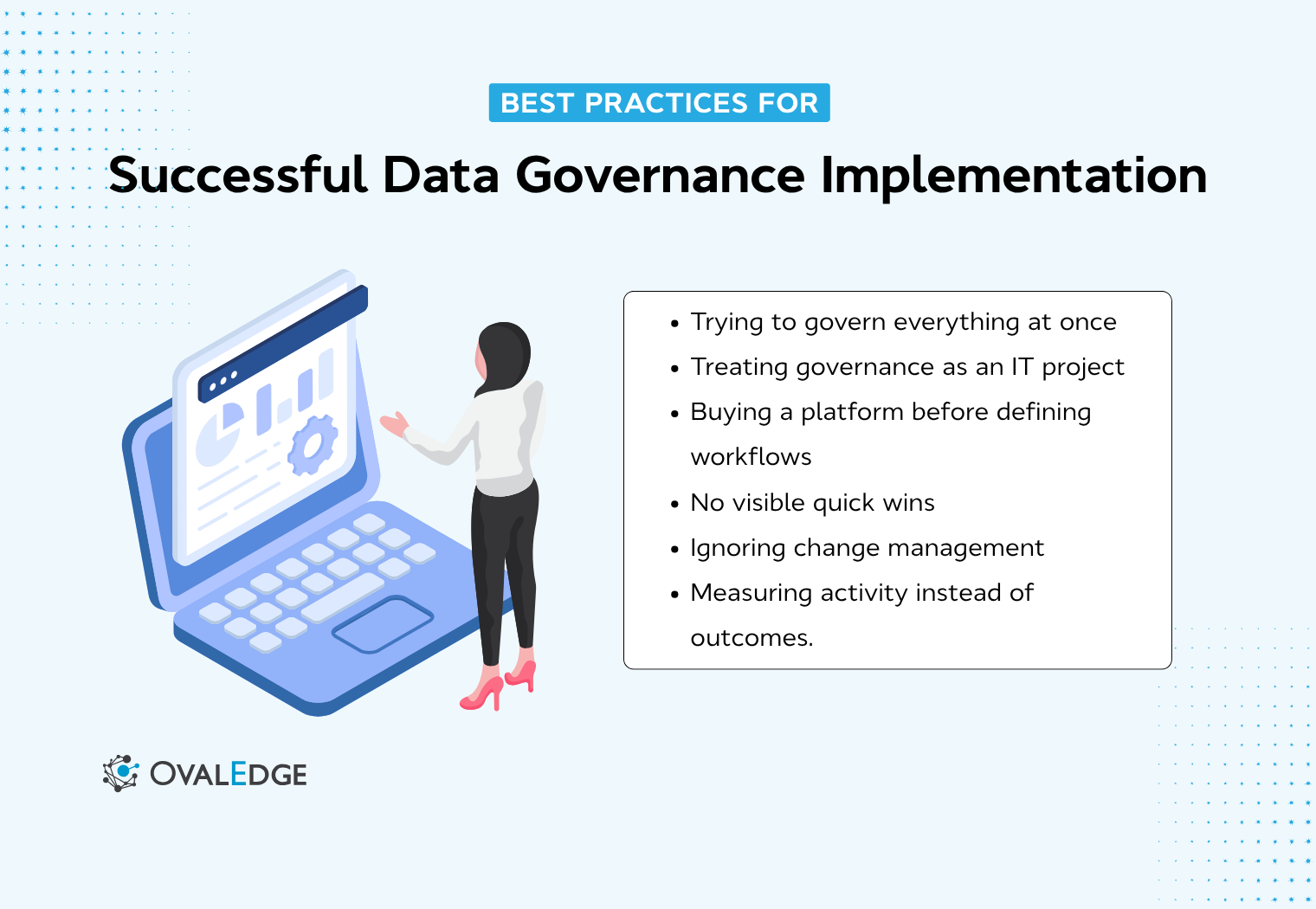
Trying to govern everything at once. This is the most common reason governance programs collapse in year one.
The fix: start with one pilot domain and expand only after proving value. -
Treating governance as an IT project. Governance is a business function. When IT owns it without business partnership, stewardship becomes a compliance checkbox instead of an operational discipline.
The fix: co-ownership between business and IT from day one.
-
Buying a platform before defining workflows. The tool should operationalize governance processes that already work manually.
The fix: run at least one governance cycle manually before configuring any platform. -
No visible quick wins. If the program cannot show measurable results within 60 days, executive attention drifts and steward motivation drops.
The fix: choose a pilot domain with known pain points that can be resolved quickly. -
Ignoring change management. Governance changes how people work with data. Without communication, training, and reinforcement, adoption stalls at the pilot team. Change management is often the most overlooked element in governance rollouts.
The fix: treat change management as a continuous activity, not a kickoff presentation. -
Measuring activity instead of outcomes. Tracking how many CDEs were defined is useful early, but if governance activity never connects to business results, leadership will question the investment.
The fix: layer business outcome metrics onto operational KPIs by Phase 2.
Conclusion
Data governance implementation is not a one-time project. It is the transition from governance as a document to governance as an operating discipline, one that runs in daily workflows, assigns clear ownership, and proves its value through measurable outcomes. Success comes from starting small, proving value in one domain, and expanding on evidence rather than ambition.
OvalEdge is the Unified Data Governance platform that operationalizes each phase of this roadmap. Its Enterprise Context Graph continuously links ontology, glossary, lineage, catalog, quality, and policy into a single, evolving graph, making the entire governance foundation searchable through AI using natural language.
OvalEdge governance agents handle discovery, classification, and quality with humans in the loop, so stewards spend time on decisions, not manual curation.
Book a demo with OvalEdge to see how a governance program can move from strategy on paper to an implementation that runs in production.
.png?width=1081&height=173&name=Forrester%201%20(1).png)
.png?width=1081&height=241&name=KC%20-%20Logo%201%20(1).png)