-2.png)
A data team once operated pipelines that appeared flawless on the surface. Every job completed on schedule, dashboards refreshed without errors, and business users continued relying on the outputs. Yet confidence in the data was quietly eroding.
When a single revenue metric showed different values across reports, three teams spent nearly two full days tracing the issue across fragmented transformations, with no clear ownership or visibility.
This reflects a broader challenge. Building ETL pipelines is no longer the hardest part. Trusting them is. Data issues surface silently, compliance gaps remain hidden, and debugging becomes slow and reactive.
According to the 2024 State of Reliable AI Survey by Wakefield Research and Monte Carlo, two-thirds of data teams experienced a data incident costing over $100,000 in just six months.
In this guide, the focus is on how data governance for ETL pipelines can be embedded directly into workflows, enabling pipelines that are reliable, auditable, and scalable without slowing down development.
What does data governance for ETL pipelines mean in practice
A retail company once found a pricing transformation bug that went unnoticed for a week, leading to incorrect discounts across regions and days of reprocessing to fix it.
The issue wasn’t in reporting; it was in transformation. Most data failures originate during this stage, not consumption. This shifts the focus of governance from where data is used to where it is actually shaped.
This section clarifies what governance looks like when applied to pipelines, moving beyond abstract policies into concrete engineering practices.
How governance shifts from downstream control to in-pipeline enforcement
Traditionally, governance sat at the end of the data journey. Data landed in a warehouse, and only then did teams validate it using dashboards or BI tools. If something broke, it was discovered late, often after business decisions were already made.
This approach creates friction. Fixing issues after ingestion takes more time, increases costs, and makes root cause analysis difficult.
Modern data governance in data pipelines changes this model. Governance is embedded directly into ingestion, transformation, and loading stages, making validation continuous rather than periodic.
The impact is immediate and measurable:
-
Issues are detected earlier in the pipeline lifecycle
-
Data drift and inconsistencies are reduced
-
Engineering teams spend less time troubleshooting and more time building
Core governance controls in ETL and ELT pipelines
In practice, ETL pipeline governance comes down to a set of controls integrated into the pipeline itself rather than applied externally.
These controls typically include:
-
Data quality checks that validate accuracy, completeness, and consistency
-
Metadata capture that documents schemas, transformations, and ownership
-
Data lineage in ETL pipelines that tracks how data moves and evolves
-
Access and security controls that enforce permissions and data masking
-
Audit logging that records actions for traceability and compliance
Each of these controls operates within the pipeline. Schema enforcement can occur at ingestion, while transformation logic can include automated validation rules that prevent bad data from progressing downstream.
Without these controls, pipelines fail silently, bad data flows unchecked, ownership becomes unclear, access risks increase, and teams are left debugging issues long after they impact the business.
Why governance must be enforced inside ETL pipelines
As data pipelines grow in complexity, governance applied outside the pipeline becomes ineffective. Downstream controls fail to catch issues at the source, leading to delayed detection and a higher risk. Embedding governance within ETL pipelines ensures data is validated, secure, and traceable before it impacts decisions.
Limitations of post-processing governance
When governance is applied only after data reaches the warehouse or BI layer, it introduces avoidable inefficiencies. Errors are detected late, often after the data has already been consumed by reports or operational systems.
This creates several challenges:
-
Delayed debugging cycles, where teams spend time tracing issues backward through multiple transformations
-
Duplicate validation efforts across teams, with each layer attempting to enforce its own checks
-
High costs associated with reprocessing and correcting data after it has propagated
Without visibility into upstream transformations, identifying root causes becomes difficult. Governance at this stage reacts to problems rather than preventing them.
|
Strengthening validation at the source Practices like data quality testing help shift detection closer to the source, reducing downstream impact and improving overall pipeline reliability. |
Impact on data quality, trust, and compliance
Weak governance directly impacts the consistency and reliability of data. Metrics begin to vary across reports, creating confusion and reducing confidence among stakeholders.
Over time, this leads to a breakdown in trust. Business teams start questioning outputs and often build parallel logic or manual workarounds to compensate. This fragmentation further complicates data environments.
Compliance risks also increase when governance is not enforced within pipelines. Regulations such as GDPR and HIPAA require clear control over how data is processed, accessed, and stored. Without embedded controls, demonstrating compliance becomes complex, and audit readiness is compromised.
The broader impact includes:
-
Inconsistent decision-making due to unreliable data
-
Increased exposure to regulatory and operational risks
-
Slower business agility as teams hesitate to rely on data
Risks of missing controls during transformation
Transformation stages introduce the highest level of complexity within ETL pipelines. Data is joined, aggregated, filtered, and reshaped across multiple steps, increasing the likelihood of errors.
Without governance controls at this stage, common risks include:
-
Data corruption caused by incorrect joins or logic errors
-
Loss of sensitive data protections due to missing masking or filtering rules
-
Schema drift that breaks downstream dependencies and pipelines
These issues often go unnoticed until they surface in reports or downstream systems, making them harder to detect and resolve.
Embedding governance checks directly into transformation logic ensures that issues are caught early. This includes validation rules, standardized transformation patterns, and continuous monitoring of data integrity.
How governance controls are enforced across the ETL pipeline stages
Governance in ETL pipelines is most effective when applied across every stage, from ingestion to transformation to consumption. Instead of relying on a single checkpoint, mature pipelines embed controls throughout the data lifecycle to detect and prevent issues early.
|
Example: Retail data pipeline failure at ingestion
Sales data flows from multiple POS systems into a warehouse. A small schema change, such as a missing discount field, can distort revenue metrics if not caught at ingestion. |
Governance at data ingestion
The ingestion stage sets the foundation. If poor-quality or unexpected data enters the pipeline, every downstream layer inherits the problem.
Governance at this stage focuses on enforcing structure and trust early:
-
Schema validation ensures incoming data matches expected formats
-
Source certification verifies that only approved systems feed the pipeline
-
API-level validation enforces rules before ingestion
Data contracts play a critical role here. They define expectations between upstream producers and downstream consumers, reducing unexpected schema changes and data inconsistencies.
Key checks typically include:
-
Data completeness
-
Format validation
-
Duplicate detection
Catching issues at ingestion prevents them from propagating, significantly reducing downstream correction effort.
Governance during data transformation
Transformation is where governance becomes more critical and more complex. Multiple joins, aggregations, and business rules increase the likelihood of silent failures.
Effective ETL data quality governance at this stage includes:
-
Rule-based validation embedded directly into transformation logic
-
Standardized transformation patterns to ensure consistency
-
Unit testing for transformation scripts
Version control strengthens governance by making every change traceable and reversible, similar to software development practices.
Lineage tracking is essential here. Capturing field-level transformations provides visibility into how data evolves across the pipeline. This makes debugging faster and more precise.
Governance at data loading and consumption
Before data is loaded into a warehouse or lakehouse, final validation checks ensure it meets defined quality thresholds.
At the consumption layer, governance shifts toward control and accountability:
-
Role-based access control to restrict data access
-
Data masking to protect sensitive information
-
Usage monitoring to track how data is accessed and used
Audit trails capture every query, access event, and change, providing transparency and supporting compliance requirements.
|
How OvalEdge strengthened ETL pipeline governance in financial services
A financial services organization faced challenges with inconsistent reporting and limited visibility into how data moved across its ETL pipelines. Data transformations were difficult to trace, and identifying the root cause of discrepancies required significant manual effort. This lack of transparency reduced trust in data and slowed down decision-making. By implementing OvalEdge, governance was embedded directly into their data workflows rather than treated as a separate layer. Key improvements included:
This highlights how embedding governance within ETL pipelines transforms them from simple data movement systems into reliable, auditable data foundations. |
How to embed data governance into ETL pipelines step by step
Moving from reactive governance to proactive, embedded control requires integrating governance directly into pipeline design and execution. Instead of treating it as an afterthought, governance becomes part of how ETL workflows operate. This roadmap outlines how to build reliable, traceable, and well-governed pipelines at scale.
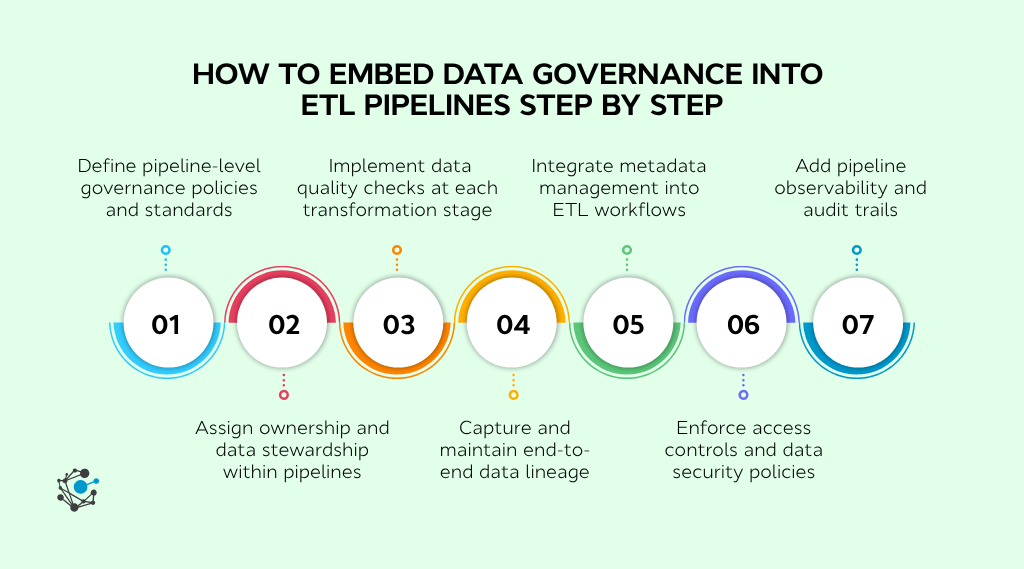
Step 1: Define pipeline-level governance policies and standards
Start by defining clear, enforceable policies that guide how data behaves inside pipelines. These include data quality thresholds, naming conventions, and compliance requirements.
Policies typically fall into three categories:
-
Security
-
Quality
-
Compliance
Align these policies with business objectives so governance directly supports outcomes like accurate reporting and regulatory adherence.
Step 2: Assign ownership and data stewardship within pipelines
Governance requires clear accountability. Define roles at both the dataset and pipeline levels:
-
Data owners are responsible for the business context and usage
-
Data stewards responsible for quality and compliance
Ownership embedded into metadata and pipeline definitions ensures faster issue resolution and better cross-team collaboration.
Step 3: Implement data quality checks at each transformation stage
Data quality checks should be automated and integrated directly into transformation logic.
Common checks include:
-
Null value validation
-
Range checks
-
Referential integrity
These checks run as part of pipeline execution.
|
What does this look like in practice?
A transformation step validating transaction data can automatically flag or stop processing if values fall outside expected thresholds. This ensures issues are caught early and do not propagate downstream. |
Step 4: Capture and maintain end-to-end data lineage
Lineage enables traceability from source to consumption and is essential for debugging and compliance.
In practice, lineage is captured automatically as pipelines execute. When a metric is derived from multiple source tables, lineage tracking shows each transformation step involved, making it easier to trace discrepancies.
|
Do you know? OvalEdge’s data lineage capabilities help visualize dependencies across pipelines and quickly identify where issues originate, reducing debugging time and improving transparency. |
Step 5: Integrate metadata management into ETL workflows
Metadata provides context for data and pipelines. It includes:
-
Technical metadata, such as schemas
-
Business metadata, such as definitions
-
Operational metadata, such as pipeline performance
Capturing metadata during execution improves discoverability and usability across teams.
Step 6: Enforce access controls and data security policies
Security controls must be embedded into pipelines to ensure consistent enforcement.
These include:
-
Role-based access
-
Attribute-based access
-
Data masking and encryption
Integration with identity management systems ensures policies are applied uniformly across environments.
Step 7: Add pipeline observability and audit trails
Observability ensures pipelines remain reliable, while audit trails provide transparency.
Key capabilities include:
-
Real-time alerts
-
Anomaly detection
-
Performance monitoring dashboards
In practice, observability tools track metrics like data freshness and pipeline failures. If a pipeline processes fewer records than expected, alerts are triggered immediately.
Common challenges in implementing ETL pipeline governance
Implementing pipeline-level governance requires changes across systems, tools, and teams. Most challenges arise when governance is introduced into environments that were not originally designed for it.
-
Technical complexity in legacy pipelines: Existing pipelines often lack structure and standardization, making it difficult to embed governance controls like validation, lineage, and monitoring without significant rework.
-
Tool fragmentation and integration gaps: Separate tools for data quality, metadata, and lineage create silos, making it hard to achieve unified governance across ETL workflows.
-
Lack of ownership and accountability: Without clearly defined data owners and stewards, governance efforts become inconsistent, and issues take longer to resolve.
-
Resistance to governance processes: Teams may view governance as additional overhead, leading to low adoption and inconsistent implementation across pipelines.
-
Scalability across multiple pipelines: As the number of pipelines grows, maintaining consistent governance policies and controls becomes increasingly complex without automation.
-
Alignment with existing ETL frameworks: Integrating governance into established ETL workflows requires careful planning to avoid disrupting existing processes and performance.
Overcoming these challenges requires a shift from ad hoc fixes to a more structured approach. The next section outlines practical best practices to build governed ETL pipelines that scale without slowing down development.
Best practices for building governed ETL pipelines
Building governed ETL pipelines is not about adding more controls, but about designing systems where governance is naturally enforced as part of engineering workflows. The goal is to create pipelines that maintain quality, consistency, and compliance without introducing friction or slowing down development.
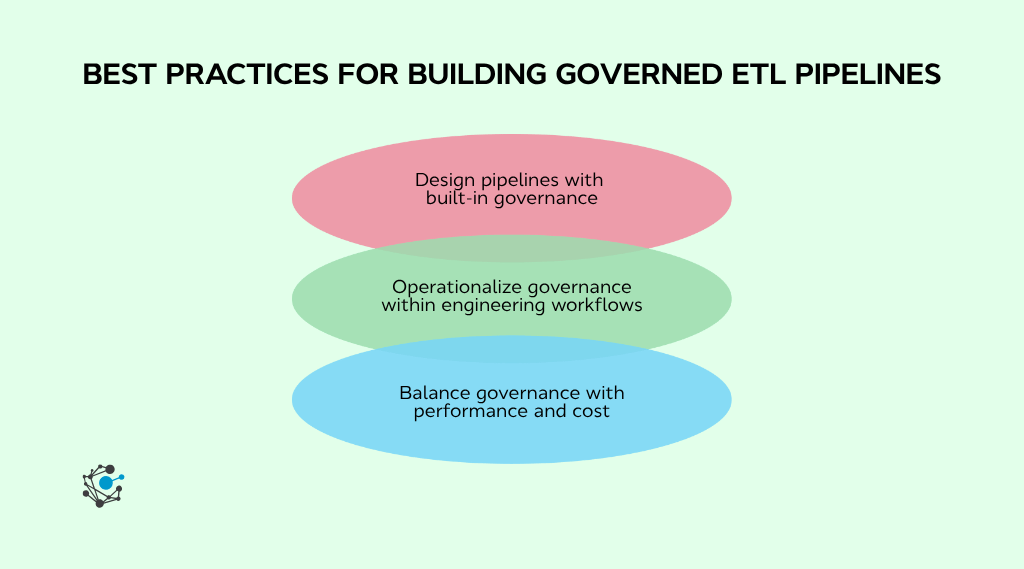
1. Design pipelines with built-in governance
Governance is most effective when embedded at the design stage. Instead of retrofitting controls later, pipelines are built with validation rules, schema expectations, and quality thresholds from the start.
Reusable transformation patterns and data contracts reinforce consistency across pipelines and reduce variability in how data is processed. This prevents downstream breakages and simplifies maintenance.
In practice, this means:
-
Defining validation rules and schema expectations upfront
-
Using reusable transformation templates
-
Establishing data contracts between producers and consumers
This leads to more consistent outputs, less debugging, and faster onboarding of new pipelines.
2. Operationalize governance within engineering workflows
Defining controls is not enough. Governance must be consistently enforced during development and deployment.
Integrating governance into CI/CD pipelines ensures that checks for data quality, schema changes, and policy compliance are automatically validated before deployment. This allows teams to catch issues early while maintaining development speed.
Collaboration between data engineers and governance teams ensures that controls remain practical and are consistently applied across pipelines.
|
Implementation tip: Platforms like OvalEdge support this alignment by embedding cataloging, lineage, and policy enforcement directly into ETL workflows, making governance a seamless part of everyday operations rather than a separate process. |
3. Balance governance with performance and cost
Governance controls add overhead. Validation checks, lineage tracking, and audit logging all consume compute and can increase pipeline latency if not designed carefully.
The goal is to apply controls selectively based on data criticality.
In practice, this means:
-
Applying strict validation to business-critical datasets (e.g., revenue, compliance data)
-
Using sampling or lightweight checks for high-volume, low-risk data
-
Running expensive validations asynchronously where possible
This approach ensures pipelines remain performant while still maintaining trust where it matters most.
Conclusion
Data governance for ETL pipelines is not about adding layers of process, but about building trust directly into how data flows. When governance is embedded within pipelines, data becomes reliable, issues are detected earlier, and compliance is easier to maintain.
The shift from reactive fixes to proactive design starts with evaluating existing pipelines, identifying gaps in validation, lineage, and ownership, and prioritizing high-impact areas.
The next step is to operationalize governance through integrated tools that unify metadata, lineage, and policy enforcement.
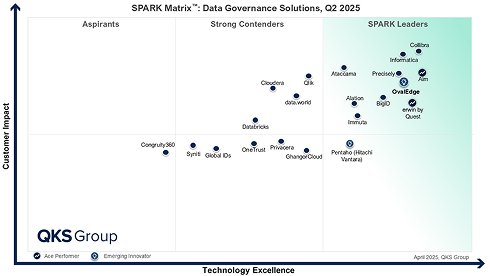
OvalEdge helps bring these capabilities into everyday workflows, making governance scalable without slowing teams down.

Schedule a demo and get a clearer view of how these controls work in practice and how they fit into current data environments.
Strong, governed pipelines do not just move data; they create confidence in every decision built on top of it.
FAQs
1. How can ETL pipeline governance improve data reliability across distributed systems?
ETL governance standardises validation, monitoring, and ownership across distributed environments. By enforcing consistent rules at each pipeline stage, teams reduce discrepancies between systems, ensure uniform data definitions, and improve cross-platform reliability, especially in multi-cloud or hybrid data architectures.
2. What are the best tools to automate governance in ETL pipelines?
Automation tools typically include data catalogs, lineage trackers, and pipeline observability platforms. Solutions like OvalEdge combine metadata management, lineage, and policy enforcement, helping teams embed governance directly into workflows without manual intervention or fragmented tooling.
3. How do data contracts support governance in ETL workflows?
Data contracts define agreed schemas, formats, and expectations between producers and consumers. They prevent unexpected changes from breaking pipelines, enable early validation at ingestion, and create accountability between teams, making governance proactive rather than reactive.
4. How can small data teams implement ETL governance with limited resources?
Small teams can start by prioritising critical pipelines, applying lightweight validation checks, and assigning clear ownership. Using unified platforms reduces tool sprawl. Gradual implementation, focusing on high-impact areas, allows governance to scale without overwhelming limited engineering capacity.
5. What metrics should be tracked to measure ETL governance effectiveness?
Key metrics include data quality scores, pipeline failure rates, schema change frequency, and data incident resolution time. Tracking these indicators helps teams evaluate governance maturity, identify weak points, and continuously improve pipeline reliability and compliance.
6. How does ETL governance support regulatory compliance requirements?
Governance ensures sensitive data is handled according to policies through controlled access, audit trails, and traceability. It enables organisations to demonstrate compliance during audits by providing clear visibility into data movement, transformations, and usage across pipelines.
.png?width=1081&height=173&name=Forrester%201%20(1).png)
.png?width=1081&height=241&name=KC%20-%20Logo%201%20(1).png)