-3.png)
Ask three teams what active customer means, and you will often get three answers, each feeding a different report. Nobody wrote the definition down, nobody captured the lineage, and the person who knew has moved on.
Metadata management best practices exist so that context stays reliable as systems change. They keep compliance defensible and turn your governed foundation into an Enterprise Context Graph that Analytical AI can query with confidence. AI agents raised the stakes further, since an agent cannot infer what a column means or whether it is safe to use.
This guide covers eight practices that hold up in 2026, how to roll them out across domains, and the common mistakes that quietly undo most programs after go-live.
What is metadata management?
Metadata management is the practice of defining, capturing, standardizing, and maintaining the context that describes your data, so every dataset carries enough information for a person or an AI agent to use it correctly.
That context spans schema, lineage, business definitions, ownership, sensitivity classifications, and quality signals. Done well, it becomes the Enterprise Context Graph that analysts and AI agents query in plain language.
A working program covers four things: definitions everyone can find, lineage that traces to the column, ownership with names attached, and a review cadence that catches decay before users notice.
For a breakdown of the different types of metadata and where each one lives in your stack, see our full guide to the types of metadata, including behavioral metadata.
8 metadata management best practices
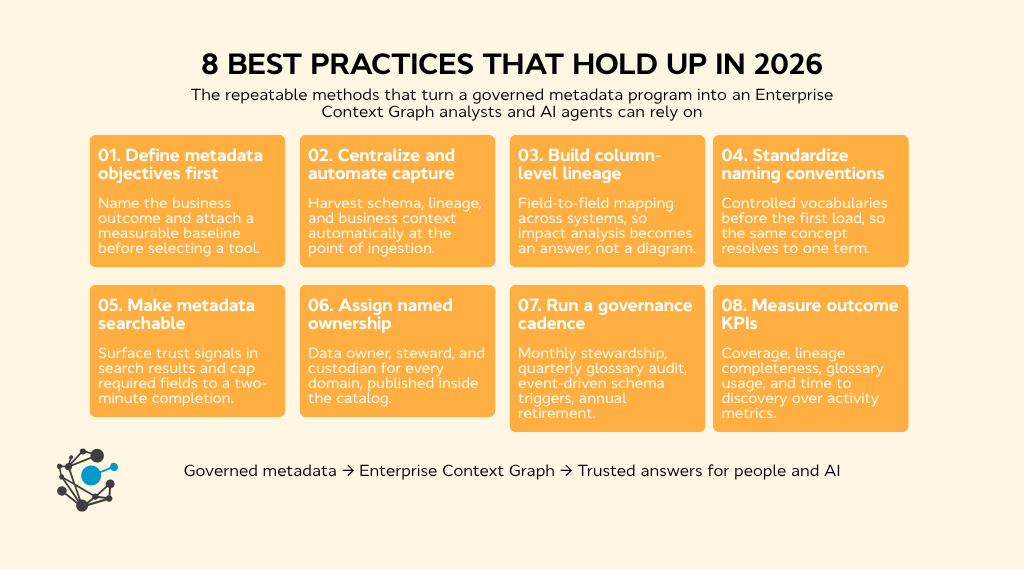
Metadata management best practices are the repeatable methods teams use to define, capture, standardize, and maintain context about their data.
The eight best practices below cover objectives, automated capture, lineage, naming, ownership, review cadence, and measurement. Start with whichever one matches where your program is currently breaking.
1. Define metadata objectives first
Metadata objectives mean naming the business outcome, attaching a measurable baseline today, and picking one domain to prove it in, before any platform enters the room. Most programs run in reverse. Gartner predicts organizations will abandon 60% of AI projects unsupported by AI-ready data through 2026. Tooling without an objective joins that group.
Your objective definition should cover four things:
-
Outcome: Cutting audit prep from six weeks to two is an objective. Better data quality is a wish.
-
Scope: Rank domains by regulatory exposure and query volume, not by which source connects most easily.
-
Required properties: Every field an asset must carry needs a reason tied to the outcome, or it becomes a column nobody fills.
-
Consumption surface: Catalog search, a tooltip inside Power BI, or an API call from an agent.
To scope your first domain in a week: export an asset inventory, score each domain on regulatory exposure and query volume, and record one baseline number before any work starts.
2. Centralize and automate capture
Centralizing metadata capture means harvesting schema, lineage, and business context automatically at ingestion across every connected system. Every tool ships its own metadata store, so fragmentation is structural. Manual entry does not solve it either, since a spreadsheet updated quarterly goes stale the first time a schema changes.
Automate at four points:
-
Capture at ingestion: Harvest schema, data type, and source system on first load. Anything recorded later is a reconstruction.
-
Parse the transformation layer: SQL, dbt, Spark, and ETL logic already contain the column mappings. Reading the code beats asking engineers to document it.
-
Connect the BI layer: Dashboard and field dependencies are what carry lineage through to the report an executive actually opens.
-
Resolve duplicates on arrival: When two systems define active customers differently, surface the conflict for a steward rather than storing both silently.
Pro tip: Connect sources in this order: warehouse, transformation layer, BI tools, everything else. Each stage extends the graph built in the one before it.
3. Build column-level lineage
Column-level lineage tells an engineer which specific report breaks when a field changes from integer to string on Thursday. Table-level lineage only confirms two tables are related. During an incident, the difference between a diagram and an answer is the difference between minutes and hours.
Make lineage usable for impact analysis with four practices:
-
Map field to field: Column-level mappings turn lineage from a diagram into a change-impact answer an engineer can act on before merging.
-
Store the transformation logic: An auditor asking how a revenue figure was derived needs the expression, not a line between two boxes.
-
Follow lineage across system boundaries: Lineage that stops at the warehouse edge hides the CRM origin and the downstream dashboard, which is the part regulators ask about.
-
Refresh on every change: Lineage rebuilt quarterly documents a system that no longer exists.
OvalEdge expert insight: Lineage derived from source code parsing stays accurate through refactors. Lineage drawn by hand starts decaying the day it is published.
Complete lineage is also what lets an agent trace an answer back to its origin inside the Enterprise Context Graph, which is the difference between a plausible response and a defensible one. See our guide to column-level data lineage for a deeper walkthrough.
4. Standardize naming conventions
Standardizing naming conventions means agreeing on how assets, columns, and business terms are named before the first load, then enforcing controlled vocabularies for tags and classifications. Two systems calling the same thing by different names is the most common reason a catalog quietly stops being trusted.
Four rules cover most of it:
-
Set naming conventions before the first load: Systematic names by function beat sequential numbering, which carries no meaning and cannot be searched.
-
Build controlled vocabularies for tags and classifications: Free-text tagging reliably produces a dozen spellings of the same concept within a quarter.
-
Define required versus optional fields explicitly: Everything optional means everything empty.
-
Adopt only the external standards you will enforce. ISO/IEC 11179, ISO 8000-210, and W3C DCAT v3 each cover different scopes. The full breakdown is in the standards section below.
Consistent naming is also what lets the same concept resolve to a single node in the Enterprise Context Graph when an analyst or an AI agent asks for it.
Did you know? Most metadata programs run heavily weighted toward schema and lineage, with business definitions in the glossary lagging behind. That imbalance is what leaves AI agents guessing at meaning even when technical metadata is complete.
5. Make metadata searchable
Make metadata easy to search by surfacing trust signals like certification, quality score, and usage popularity, and simple to fill in by capping required fields at two minutes for a steward. Adoption breaks when either half fails. A well-designed enterprise data catalog treats discovery and stewardship as one workflow.
Four practices carry most of the load:
-
Surface trust signals in search: Certification, quality score, and usage popularity tell a user which of six similar tables is safe to query.
-
Match fields to how teams actually search: Business process, source system, and data product name get used. Abstract taxonomy fields do not.
-
Cap required fields at a two-minute completion time: Everything beyond that gets skipped or filled with placeholder text.
-
Retire fields with low completion rates: Review the schema quarterly and cut what nobody fills in or searches on.
For example: A finance analyst searching revenue should see the certified board-reporting dataset first, with its owner, freshness, and quality score visible before they click. Natural-language discovery raises the ceiling further, letting someone ask a question in plain English instead of learning the catalog's structure.
6. Assign named ownership
Metadata ownership needs named people, not teams. A data owner approves definitions and access decisions with budget authority, a steward maintains glossary accuracy and validates lineage, and a custodian implements access controls. Accountability that belongs to a team belongs to nobody.
Your governance structure needs four defined roles:
-
Data owner: Approves definitions and access decisions for a domain. Needs budget authority, or decisions stall at the first cross-department disagreement.
-
Data steward: Maintains glossary accuracy and validates lineage. Works best as a business person who knows the process, rather than a DBA who knows the schema.
-
Data custodian: Implements access controls, manages the repository, and keeps connectors running.
-
Existing contributors: Catalog activity already shows who documents datasets and answers questions. Formalize those people instead of appointing someone cold.
At OvalEdge, we believe: Governance works when the person accountable for a definition is visible to everyone using it. Ownership recorded in a slide deck is not ownership.
Publish these names inside the catalog, next to each asset, where users encounter them at the moment they have a question. Ownership recorded this way also travels into the Enterprise Context Graph, so an AI agent surfacing a dataset also surfaces the person accountable for it.
7. Run a governance cadence
A governance cadence that catches metadata decay runs on four cycles: a monthly stewardship review, a quarterly glossary audit, an event-driven schema change trigger, and an annual retirement pass. Schemas evolve, systems get decommissioned, and definitions shift with the org chart. Metadata follows none of it automatically.
The four cycles:
-
Monthly stewardship review: Stewards clear the queue of unowned assets, undefined terms, and flagged conflicts. Thirty minutes, same slot each month.
-
Quarterly glossary audit: Check definitions against actual usage. Terms nobody has referenced in two quarters get retired rather than maintained.
-
Schema change trigger: Every schema change opens a review of affected metadata automatically. Event-driven, since calendar reviews always lag the change that caused the problem.
-
Annual retirement pass: Archive metadata for decommissioned systems so search results stay clean.
Pro tip: Give each review an owner and a fixed calendar slot before the catalog goes live. Cadences added after decay appears rarely survive the first busy quarter.
8. Measure metadata management with outcome KPIs
Measuring metadata with outcome KPIs means tracking coverage, lineage completeness, glossary usage, and time to discovery, so leadership sees whether the program made anything easier to use. Only outcome metrics survive a budget review. Without a baseline, activity numbers like assets cataloged reward volume, not progress.
Four outcome KPIs matter most:
-
Metadata coverage: Percentage of assets carrying every required field. Clear 90% within scoped domains before expanding.
-
Lineage completeness: Percentage of critical datasets with documented end-to-end lineage, measured against a named list rather than the full estate.
-
Glossary usage: Searches and references per month. Flat usage means people do not trust the definitions, regardless of what the coverage number says.
-
Time to discovery: Median time from first search to approved access.
To baseline coverage in an afternoon: export the asset inventory, define the required field set, compute percentage complete by domain, and publish the number before any work begins.
How do AI, ML, and automation change metadata management?
AI and machine learning shift capture, classification, and lineage from manual tasks that decay to continuous processes that update as systems change. That closes the gap between the catalog and production. Agents read the same metadata analysts do, so a wrong catalog produces a wrong answer with no obvious tell.
Four capabilities do most of the work:
1. Auto-classification of sensitive data
OvalEdge's Sift agent uses pattern matching and metadata context to label columns for PII, PHI, and financial identifiers without a steward opening each table. Reviews shift from tagging every asset to auditing edge cases.
2. Lineage reconstruction from source code
Parsing SQL, dbt, Spark, and ETL logic rebuilds column-level lineage from the code the pipeline already runs on. It stays accurate through refactors. Manual diagrams start decaying the day they are published.
3. Trust scoring based on usage and quality signals
OvalEdge's Notary agent combines certification, quality checks, usage frequency, and lineage completeness into one signal a user sees in search results. See metadata analytics for how these signals feed decisions rather than dashboards.
4. Active metadata rather than passive
Schema changes, failed quality checks, and broken dashboards emit events that trigger downstream workflows automatically, rather than waiting for someone to open the catalog.
See what a governed metadata foundation looks like when AI agents can query it in plain language. Book a demo to see OvalEdge in action.
What does metadata governance look like in practice?
Metadata governance decides who owns definitions, which policies apply to which assets, and how often the catalog gets reviewed against reality. Management captures the context. Governance keeps it accurate as systems change.
Ownership answers who is accountable. Governance answers what happens when a definition is disputed, or a policy needs to reach 400 assets. A working governance layer runs on three pieces.
1. The stewardship model
Federated stewardship works better than a central team owning every domain. Domain experts hold definitions for their own area. A central team maintains the standards and the escalation path. Fully central teams become bottlenecks. Fully decentralized programs produce inconsistent definitions.
2. The policy framework
Policies belong inside the catalog, not in a separate PDF. Sensitivity classifications trigger access rules automatically, retention attaches to asset types, and approvals route to named owners.
3. The review cadence
Quarterly governance reviews check the standards themselves: which fields nobody fills, which policies get overridden, which definitions get disputed. The cadence is what keeps the Enterprise Context Graph accurate over time, so trust in AI-driven answers does not drift with the catalog.
Which metadata management standards should you adopt?
Metadata management standards fall into three groups: general-purpose standards that define the structure of a metadata record, web and open-data standards that make catalogs interoperable, and industry-specific standards that carry domain semantics for regulated sectors.
Pick the ones you will actually enforce. Standards adopted without enforcement produce more inconsistency than no standard at all.
|
Group |
Standard |
When to adopt |
|---|---|---|
|
General purpose |
Dublin Core (15 core elements) |
Baseline for any catalog. |
|
General purpose |
ISO/IEC 11179 (metadata element structure) |
When multiple teams define their own fields and need consistency. |
|
General purpose |
ISO 8000-210 (data quality rules) |
When quality signals need to travel with the asset. |
|
Web and open |
W3C DCAT v3 (catalog exchange) |
When you publish data to partners, regulators, or public catalogs. |
|
Web and open |
Schema.org Dataset (search and AI crawlers) |
When dataset discoverability outside your organization matters. |
|
Industry-specific |
HL7 FHIR (healthcare) |
Healthcare, life sciences, PHI exchange. |
|
Industry-specific |
FIBO (finance ontology) |
Banking, capital markets, regulatory reporting. |
Adopt the minimum that covers your compliance surface, and encode the standard inside the catalog rather than in a policy document. Standards that live only in PDFs get ignored within a quarter. Standards encoded inside the catalog are also what let the Enterprise Context Graph stay interoperable when AI agents traverse it.
What kinds of metadata management tools should you evaluate?
Metadata management tools fall into five categories. Programs rarely need one from each, and stitching several together is where most of the operational cost lives. Evaluate against the practices above, not against feature checklists.
|
Category |
What it does |
Fits when |
|
Data catalogs |
Central inventory, search, business context |
Discovery and adoption are the primary gaps |
|
Integration and lineage tools |
Parse SQL, dbt, Spark, ETL for column-level lineage |
Impact analysis and audit trails are the primary gaps |
|
Governance suites |
Policies, workflows, stewardship, access |
Regulatory or cross-domain policy enforcement is the primary gap |
|
Cloud-native catalogs |
Native to one cloud warehouse or lakehouse |
The estate is single-cloud and stays that way |
|
Open source options |
Extensible catalog or metadata store |
An in-house engineering team will maintain it |
A unified platform closes the gaps between these categories automatically, which is why most enterprises consolidate after running two or three point tools in parallel. Our full breakdown of metadata management tools covers the specific vendors in each category.
The result is that the section order becomes: Standards → Metadata tools (new) → Lifecycle → Rollout.
What are the stages of the metadata lifecycle?
The metadata lifecycle has five stages: creation, processing, distribution, archiving, and deletion. Programs that manage all five stay accurate. Those that stop after the first two accumulate stale records.
-
Creation: Metadata is captured at ingestion, harvested from source systems, or generated by parsing transformation code. Anything created later is a reconstruction.
-
Processing: Classifications, sensitivity tags, quality scores, and business definitions get applied. Reviews catch conflicts before the record goes live.
-
Distribution: The record appears in catalog search, API responses, and BI tooltips where users and agents actually consume it.
-
Archiving: When an asset is decommissioned, its metadata gets archived rather than deleted, so lineage history and audit trails stay intact.
-
Deletion: Retention policies eventually remove archived records, driven by regulatory or storage rules.
A managed lifecycle is what keeps the Enterprise Context Graph clean, so search and AI queries return current, in-scope assets rather than nodes from systems that no longer exist.
How do you roll out metadata management across the organization?
Rolling out metadata management means picking a pilot domain where the pressure is real, involving domain experts before design freezes, running change management alongside the technical work, and feeding usage back into the standards. Programs that skip any of these stall at the second domain.
McKinsey's 2025 State of AI survey found 88% of organizations use AI in at least one function, while only about a third have scaled it enterprise-wide.
A few practices carry a metadata program from one working domain to the next. Pilot where regulatory exposure or a live analytics deadline creates urgency. Bring domain experts in before standards freeze, because rules written without their maintainers get rewritten within a quarter.
Explain why metadata matters to someone's own work before showing the interface, and let the governance cadence adjust the schema to what people actually fill in. Each new domain extends the same governed foundation that makes an Enterprise Context Graph useful across the business.
What are the common metadata management mistakes and how do you fix them?
Most metadata programs fail on the same handful of mistakes, and each one has a recognizable symptom before it becomes a full stall. The fixes below are ordered by how early in the program they usually surface.
Tooling bought before strategy
-
Symptom: the platform is live, and adoption is flat six months in.
-
Fix: work backwards to a stated objective with a baseline number, rescope to one domain, and measure against the objective before expanding.
Siloed tools and conflicting definitions
-
Symptom: two dashboards report different revenue for the same quarter.
-
Fix: route conflicts to a named steward with authority to settle them, rather than storing both definitions and letting users pick.
Manual capture and low adoption
-
Symptom: coverage stalls around 40% and stewards stop filling in forms.
-
Fix: automate capture at ingestion and cut required fields to what a steward completes in two minutes.
Governance in a slide deck
-
Symptom: the org chart shows owners, but the catalog does not surface names next to assets.
-
Fix: publish owner names inside the catalog where users encounter them at the moment they have a question.
Decay after go-live
-
Symptom: users find entries describing systems that no longer exist.
-
Fix: put the four reviews from Practice 7 on the calendar before launch, with named owners and fixed slots.
Teams quietly abandon catalog tools within six months of go-live once definitions start conflicting, because nobody trusts what they can't verify.
OvalEdge expert insight: Most catalogs fail on trust, not coverage. One wrong definition found early costs more adoption than a hundred missing ones.
Where does OvalEdge automate the metadata work that decays first?
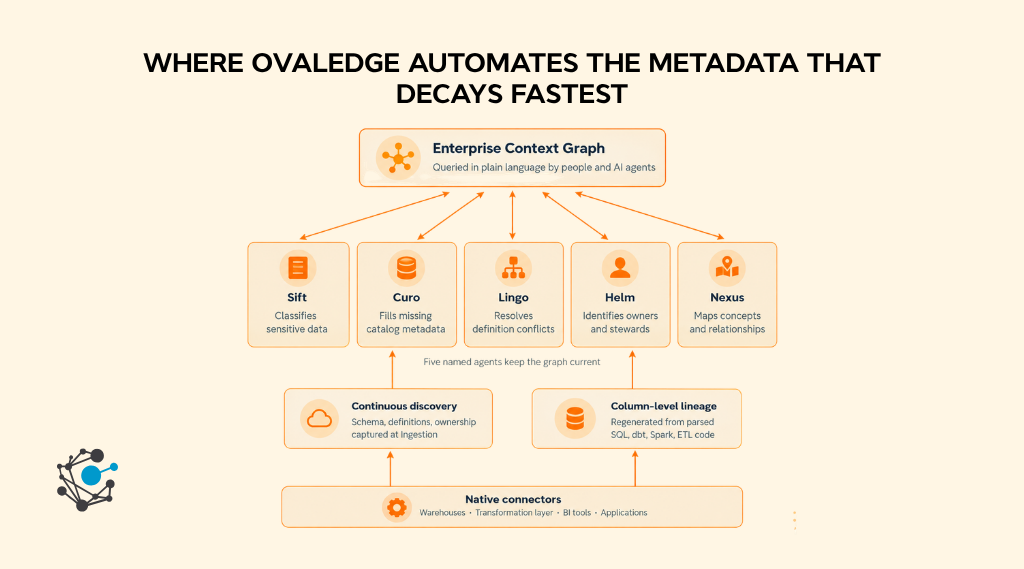
OvalEdge closes the gap between the eight practices above and a running program by automating the parts that decay first. Discovery runs continuously across native connectors to warehouses, transformation layers, BI tools, and applications.
Column-level lineage regenerates from parsed source code rather than manual diagrams, and five named agents keep the rest of the graph current:
-
Sift classifies sensitive data automatically.
-
Curo fills in missing catalog metadata.
-
Lingo discovers business terms and resolves conflicting definitions.
-
Helm identifies the right owners and stewards.
-
Nexus maps concepts and relationships into the semantic layer.
The point is not that a platform replaces stewardship or governance. It is that the agents handle the mechanical work so stewards spend their time on the judgment calls automation cannot make: which conflicts to escalate, which definitions to standardize, which policies need updating.
A Forrester Total Economic Impact study commissioned by OvalEdge documented faster audit prep, higher analyst productivity, and reduced classification effort as the primary drivers of return on a governed metadata program.
Together, these capabilities form the Enterprise Context Graph that people and AI agents query in plain language.
Turn metadata management best practices into a governed AI foundation
Metadata management works when the ordinary things stay done. Definitions get written before the person who knew them leaves. Lineage refreshes when a schema changes. Owners have names, and reviews have dates on the calendar.
Pick the practice that matches where your program is breaking. If coverage stalls, automation is the constraint. If coverage looks fine and nobody uses the catalog, the problem is trust. That is also the difference between a metadata program and an Enterprise Context Graph AI can rely on.
See how OvalEdge builds the Enterprise Context Graph AI can rely on. Book a demo.
.png?width=1081&height=173&name=Forrester%201%20(1).png)
.png?width=1081&height=241&name=KC%20-%20Logo%201%20(1).png)