.png)
By 2026, Gartner predicts 60% of AI projects will be abandoned because the data behind them isn't AI-ready. The fix isn't more data; it's better metadata. Specifically, AI-generated metadata: machine-learned tags, lineage, and semantic context that turns raw text, images, audio, and video into assets a model can actually use.
This is what most teams underestimate. Catalog quality, lineage depth, and consistent classification are no longer governance hygiene. They are the determinants of whether your AI agents, RAG pipelines, and ML models behave the way you expect them to.
This guide explains what AI metadata is, how it differs from traditional metadata, how to roll it out, and where it tends to break. It also covers the OvalEdge approach to automating enrichment, lineage, and governance so teams stop maintaining catalogs by hand.
What is AI metadata?
AI metadata is data about data, generated automatically by machine learning. It tags and links text, images, audio, and video with entities, topics, sentiment, timestamps, and lineage so that data becomes searchable, governable, and ready for AI workflows. Unlike traditional metadata, which describes basic file attributes, AI metadata captures meaning and updates as content changes.
Unlike traditional metadata, which captures basic file attributes such as title, author, or format, AI metadata interprets meaning, identifies patterns, and provides rich semantic context that manual tagging cannot scale to.
This helps teams:
-
Understand data faster
-
Improve search accuracy
-
Strengthen governance and compliance
-
Increase model training quality
-
Reduce manual preparation work
| Gartner's 2025 Press Release notes that 63% of organizations either lack or are unsure if they have the data-management practices needed for AI, highlighting why AI-driven metadata is essential for improving data reliability and reducing preparation effort. |
AI Metadata vs Traditional Metadata: Full Comparison Table
Traditional metadata relies on static, manually created descriptors that offer only surface-level information about an asset, such as title, author, format, or timestamps. This approach was sufficient when data volumes were small and mostly structured.
However, modern data ecosystems involve high-volume, multimodal, and continuously changing information that traditional metadata cannot accurately describe or maintain.
AI metadata introduces automation, semantic understanding, and cross-modal intelligence. It uses machine-learning models to analyze content, infer meaning, detect relationships, and update metadata dynamically as data evolves. This provides deeper context, higher accuracy, and enterprise-scale consistency.
Key differences at a glance
The table below shows how traditional metadata and AI-powered metadata compare across core criteria that affect scale, quality, and long-term data reliability.
|
Criteria |
Traditional Metadata |
AI-Powered Metadata |
|
Creation method |
Manual tagging, rule-based labeling |
Automated using NLP, CV, ASR, LLMs, embedding models, and graph-based techniques |
|
Contextual depth |
Shallow (file-level attributes) |
Deep semantic understanding: entities, relationships, sentiment, temporal events, domain concepts |
|
Scalability |
Limited; cannot keep up with large datasets |
Scales across billions of assets using ML pipelines and vectorization |
|
Accuracy |
Highly dependent on human inputs and subjective interpretation |
Learns patterns, reduces human error, and improves with retraining |
|
Adaptability |
Static; requires manual updates |
Dynamic; updates metadata when content, schema, or relationships change |
|
Multimodal support |
Mostly text; limited and inconsistent across media |
Supports text, images, audio, video, logs, and structured/unstructured data |
|
Governance |
Prone to inconsistency and drift |
Standardized taxonomies, policy-based metadata tagging, automated lineage graphing |
|
Semantic linking |
Minimal; relies on manual relationships |
Cross-modal linking using knowledge graphs + embeddings |
|
Real-time capabilities |
Usually batch-based |
Real-time enrichment via streaming pipelines (Kafka, Flink, Spark) |
|
Cost & effort |
High operational burden; slow updates |
Lower long-term cost through automation and continuous learning |
These differences demonstrate why traditional metadata cannot keep up with modern data volumes, while AI metadata provides the automation and semantic depth required for enterprise-scale governance.
Want to see this comparison in your own data? OvalEdge runs a free metadata maturity assessment that maps your current state to the 5-level model and flags the highest-leverage gaps.

Book a quick walkthrough.
Business impact: Traditional vs AI metadata
AI-powered metadata improves how organizations find, manage, and use information across digital asset systems, content platforms, and data warehouses. It supports faster decisions, stronger governance, and better analytics.
Key business outcomes include:
-
Faster discovery and retrieval: Teams locate assets quickly in DAM, CMS, and data warehouses because AI adds richer context and more accurate tags.
-
Higher operational efficiency: Analysts and engineers spend less time labeling data and more time focusing on insights and model development.
-
Better personalization and recommendations: Enriched metadata helps companies deliver more relevant content and product recommendations. Deloitte research shows that organizations using advanced data enrichment frameworks are more likely to exceed revenue goals and improve customer loyalty.
-
Automated compliance and security tagging: AI identifies sensitive information, applies consistent labels, and supports risk scoring across regulated environments.
-
Improved model-training quality: Machine-learning workflows benefit from cleaner, more consistent metadata, which helps reduce drift, improve lineage visibility, and strengthen model performance.
AI-powered metadata delivers scale, accuracy, and consistency that manual methods cannot match, especially in data-heavy and compliance-driven environments.
|
For the broader distinction between cataloguing and metadata management as a discipline, see data catalog vs metadata management. |
Why AI metadata is a foundational layer in modern data architectures
AI metadata strengthens modern data architectures by giving every dataset, document, asset, and model a consistent, machine-readable context. As organizations scale cloud platforms, build AI workflows, and integrate diverse data sources, this contextual layer becomes essential for discovery, governance, quality, and reliable analytics.
AI metadata fits into core architecture components such as:
1. Data Lakes
AI metadata organizes massive volumes of structured and unstructured data by adding tags, entities, categories, and relationships. This improves search, reduces duplication, and accelerates onboarding for analysts and engineers.
2. Data Catalogs
Modern catalogs depend on rich metadata to surface the right assets, show lineage, and provide context. AI-generated metadata enhances search relevance, updates classifications continuously, and improves trust in shared data.
|
Pro Tip: For a deeper look at how these layers fit together in production architectures, see our breakdown of the metadata layer for AI. |
3. Data Observability Platforms
AI metadata captures quality signals, anomalies, freshness indicators, and lineage flow. This enables earlier incident detection, faster debugging, and higher data reliability across pipelines.
4. ML & MLOps Workflows
AI metadata documents training inputs, feature definitions, data dependencies, and model versions. This improves reproducibility, reduces model drift, and strengthens explainability and audit documentation.
Accenture found that metadata-rich data platforms accelerate time-to-insight by up to 40% and cut processing time by more than 70%, proving how foundational metadata is to performance, scalability, and trust.
5. The Active Metadata Layer
Most metadata systems are passive: they store information until someone queries it. Active metadata flips that pattern; it pushes signals into the systems that need them. When a column changes, downstream dashboards, models, and access policies update automatically. Gartner refers to this as the "active metadata" market category, and it's the foundation of every credible AI-ready data platform.
OvalEdge supports active metadata through automated lineage tracking, change events, and policy propagation across catalogs, BI tools, and ML pipelines.
How AI enhances metadata: Core concepts and capabilities
AI enhances metadata by automating how information is identified, labeled, enriched, and connected across text, images, audio, and video. Instead of relying on manual tagging or fixed rules, AI extracts semantic meaning, detects patterns, and applies consistent metadata at a scale impossible for human teams.
This improves accuracy, reduces manual effort, and gives organizations deeper, more trusted insight into their data.
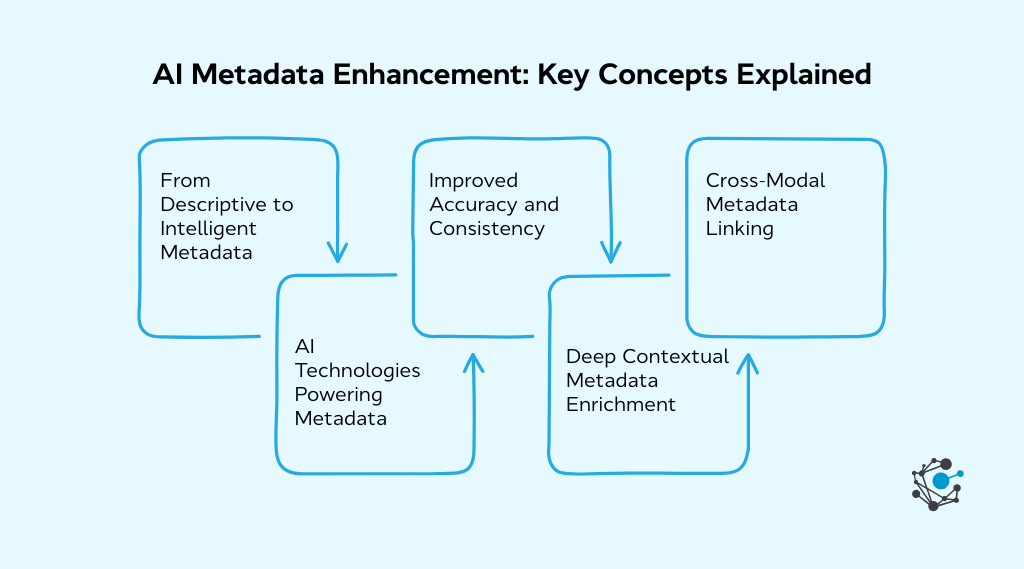
1. From descriptive to intelligent metadata
Traditional metadata captures basic attributes such as file names, authors, formats, or timestamps. AI transforms metadata into intelligent, meaning-rich context.
AI-powered metadata includes:
- Emotional tone in customer conversations
- Sentiment across reviews or feedback
- The intent behind user queries or support interactions
- Actions and events detected in videos or transcripts
- Entities and relationships that connect concepts across documents
This enriched metadata helps teams interpret information faster and improves search relevance across large content libraries and data stores.
2. AI technologies powering metadata enhancement
AI-powered metadata relies on several core technologies that work together to interpret content at scale.
-
Natural Language Processing (NLP): NLP extracts entities, keyphrases, topics, and intent from text. It helps teams understand documents, emails, transcripts, and product content without manual review. Gartner notes that NLP is now a core feature in modern data catalogs.
-
Computer Vision (CV): CV identifies objects, scenes, text, and even facial expressions in images and videos. This helps teams tag visual content accurately and support search across digital asset libraries.
-
Automatic Speech Recognition (ASR): ASR converts audio into text and adds context to spoken content. This supports call analysis, meeting transcription, and compliance monitoring.
-
Large Language Models (LLMs): LLMs interpret meaning, summarize content, and disambiguate similar terms. These models improve metadata quality across complex or ambiguous content.
-
Knowledge graphs: Knowledge graphs link metadata across people, topics, assets, and entities. McKinsey reports that graph-based metadata improves search accuracy because it reflects real relationships within an organization’s data.
|
Ever wondered how AI improves metadata? AI improves metadata through:
|
3. Improving metadata accuracy and consistency
AI improves metadata quality by reducing human error, removing duplication, and maintaining consistent terminology across data sources. It learns from previous tags, adapts to new content, and updates tagging rules over time.
Accenture highlights that AI-driven metadata improves compliance and governance because teams can track lineage, apply consistent labels, and maintain clear audit trails. This reduces the risks that come from incomplete or inconsistent metadata.
Key improvements include:
-
Standardized tags across all systems
-
Higher accuracy in sensitive or regulated data
-
Better support for search and compliance requirements
-
Continuous quality improvement through retraining
4. Deep contextual metadata enrichment
AI adds context that goes beyond simple keywords or categories. It identifies complex signals that describe content at a deeper level.
Examples include:
-
Temporal tagging, which records what happens at specific moments in audio or video
-
Sentiment and tone analysis for reviews, feedback, or internal communications
-
Contextual metadata, such as location, environment, or mood
-
Predictive metadata, which anticipates user needs based on past behaviors
Deloitte notes that organizations use these enrichment techniques to improve customer insights, enhance personalization, and support better analytics.
5. Cross-modal metadata linking
Cross-modal metadata linking connects information across text, images, audio, and video to create a unified understanding of content. It helps teams move beyond isolated files and work with complete, context-rich records that show how assets relate to each other.
AI supports cross-modal linking by:
-
Connecting images with detected objects, text, and associated transcripts
-
Matching audio or video files with speaker profiles, topics, and sentiment
-
Linking documents with relevant multimedia assets
-
Combining structured and unstructured data into a single metadata graph
This approach mirrors how people understand information. Gartner notes that modern data catalogs now rely on cross-modal metadata to improve asset discovery and reduce time spent searching across disconnected systems.
A common example is an enterprise webinar. AI can link the video, transcript, speaker information, slide content, and related documents into one searchable record that improves reuse, analysis, and governance.
Cross-modal linking gives organizations a clearer picture of their information landscape. It supports better analytics, strengthens compliance, and helps teams interpret data with more accuracy and confidence.
Best practices for implementing AI metadata at scale
AI metadata delivers value only when teams implement it with the right structure, quality checks, and ongoing improvements. Many organizations move too quickly into automation without building the foundations that keep metadata accurate and scalable. The practices below help teams avoid these gaps and succeed with AI metadata at enterprise scale.
1. Start with metadata governance and use case alignment
Strong governance keeps AI metadata consistent, predictable, and aligned with business goals. It tells AI how to label, organize, and standardize information across systems. Teams that require a deeper framework for building metadata governance, including roles, policies, and review structures, can download the OvalEdge white paper “How to Implement Data Governance - Best Practices.”
It offers practical templates and examples that help teams apply governance with more confidence.
Key steps:
Effective governance relies on clear alignment across business and technical teams.
-
Clarify the primary use cases, including discovery, compliance, and MLOps.
-
Document clear naming conventions, taxonomies, and approval workflows.
-
Assign ownership to data stewards, architects, and reviewers who maintain quality.
|
Pro tip: Have you seen what happens when metadata governance scales? Gartner reports that organizations with active metadata management reduce the time required to deliver new data assets by up to 70 percent. Strong governance is the structure that makes this efficiency possible. |
Bayview used OvalEdge to centralize metadata across financial systems and standardize definitions for critical data elements. The team reported that this governance-first approach reduced the time analysts spent searching for information and improved confidence in regulatory reporting. This outcome shows how clear governance accelerates adoption and reduces friction during AI metadata rollout.
2. The 5-Level AI Metadata Maturity Model
Most metadata programs sit between Level 2 and Level 3. The leap to Level 4, where AI handles enrichment at scale, requires deliberate sequencing, not more tooling. Use the model below to locate where your team is and what to invest in next.
For the underlying practices that hold up at every level, see metadata management best practices.
Maturity levels:
-
Level 1 - Ad hoc tagging: Metadata appears inconsistently and relies on unstructured, manual labels.
-
Level 2 - Manual taxonomies: Teams maintain structured taxonomies, but tagging remains manual and time-intensive.
-
Level 3 - Semi-automated tagging: AI assists with basic tagging, yet human review remains essential across most assets.
-
Level 4 - AI-enriched metadata: Machine-learning models classify, enrich, and standardize metadata across formats with higher accuracy.
-
Level 5 - Active metadata ecosystem: Metadata updates in real time, connects across systems, and supports governance, lineage, and ML workflows automatically.
Teams review tools, storage, integrations, and metadata quality. This assessment ensures AI metadata has a stable foundation and prevents generating inaccurate or fragmented tags.
3. Combine AI automation with human-in-the-loop validation
AI scales tagging, but humans keep it accurate. Human-in-the-loop validation strengthens metadata quality and helps models improve faster.
Recommended approach:
-
Review initial AI-generated tags to identify errors and inconsistencies.
-
Allow subject matter experts to correct edge cases that AI may misinterpret.
-
Use expert feedback to retrain and improve models over time.
-
Increase automation only when AI demonstrates consistent accuracy.
This balance is essential for industries that manage sensitive or regulated information.
4. Define KPIs to guide accuracy and adoption
KPIs tell teams whether AI metadata improves findability, quality, and operational efficiency.
Useful KPIs include:
-
Metadata coverage measures how much of your data includes complete, meaningful metadata.
-
Tag accuracy reflects how often AI-generated tags match verified labels.
-
Lineage completeness tracks whether teams can trace data sources and transformations.
-
Time-to-discovery measures how quickly users can find the information they need.
-
Reduction in manual tagging hours shows how effectively AI reduces operational effort.
These metrics support transparency and ensure metadata contributes to AI, analytics, and governance outcomes.
5. Monitor, improve, and evolve metadata continuously
Metadata quality changes as systems grow and new content enters the ecosystem. Ongoing monitoring keeps metadata reliable.
Recommended actions:
-
Conduct regular review cycles to assess metadata quality and detect drift.
-
Update taxonomies when business needs, products, or regulations change.
-
Retrain models with new examples to maintain accuracy.
-
Validate tags on newly ingested or transformed data to prevent quality gaps.
This approach keeps AI metadata aligned with real business needs and protects long-term reliability.
How AI metadata supports machine-learning workflows
AI metadata strengthens machine-learning workflows by improving traceability, quality, and reproducibility at every stage of the lifecycle. Models perform better when teams have clear context about datasets, features, parameters, and outcomes.
When metadata stays complete and consistent, teams understand how a model behaves and why specific results appear.
1. Why does machine learning need metadata to scale and stay reliable?
Machine-learning systems create large volumes of datasets, features, experiments, and model versions. Without strong metadata, teams lose visibility into what changed, when it changed, and why it changed.
AI metadata supports machine-learning reliability in several ways:
-
It provides a clear model lineage that shows which datasets, features, and parameters contributed to each version.
-
It creates reproducible experiments by documenting training inputs, tuning cycles, and environment details.
-
It improves feature understanding by capturing source information, transformation logic, and usage patterns.
-
It supports explainability frameworks by showing how specific inputs influence outputs.
Debugging a model becomes significantly more difficult when the underlying training dataset is unknown. Most engineers discover that missing metadata turns routine investigations into lengthy, risky exercises.
|
Interesting fact: Teams often spend more time figuring out which data trained a model than tuning the model itself. Strong metadata flips that pattern by making every decision traceable. |
2. How does metadata strengthen feature stores and experiment tracking?
Feature stores rely on metadata to document every feature’s purpose, origin, and transformation. This consistency prevents duplicate engineering, reduces drift, and protects model performance.
AI metadata supports feature stores effectively because:
-
It records each feature’s source tables, data types, and relationships.
-
It captures transformation rules that explain how features evolve from raw data.
-
It tracks data freshness and detects drift that may affect accuracy.
-
It identifies dependencies to prevent downstream errors.
Experiment tracking tools, including MLflow, Vertex AI, and Kubeflow, depend on metadata to log:
-
Model parameters that define each experiment.
-
Performance metrics that help teams compare results.
-
Training datasets that influence model behavior.
-
Version histories that protect consistency across development cycles.
Why does this matter?
Because comparison only works when teams know exactly what changed. Accenture reports that organizations with strong experiment metadata reduce deployment delays because engineers can retrace every decision without repeating work.
3. How does AI metadata create visibility across the ML lifecycle?
AI metadata improves visibility from ingestion to monitoring by keeping each workflow stage connected and transparent.
Key ML lifecycle checkpoints include:
-
Data ingestion, where metadata logs sources, formats, and quality checks.
-
Feature engineering, where metadata documents transformations and logic.
-
Model training, where metadata stores hyperparameters, windows, and inputs.
-
Model registry, where metadata records versions, release dates, and controls.
-
Model serving, where metadata captures real-time performance signals.
-
Monitoring, where metadata detects drift, anomalies, and quality issues.
Maintenance becomes significantly smoother when every change is documented and traceable. That is the value of AI metadata. It turns complex pipelines into clear, traceable processes that teams can manage with confidence.
|
Lineage is the spine that holds these checkpoints together. See our roundup of automated data lineage tools for the platform options |
Risks, limitations, and metadata governance challenges
AI metadata delivers significant value, but it also introduces risks that organizations must understand and manage early. Metadata travels across systems, teams, and workflows, which makes it powerful and sensitive at the same time. Recognizing these risks builds trust and ensures AI metadata supports accuracy, compliance, and long-term scale.
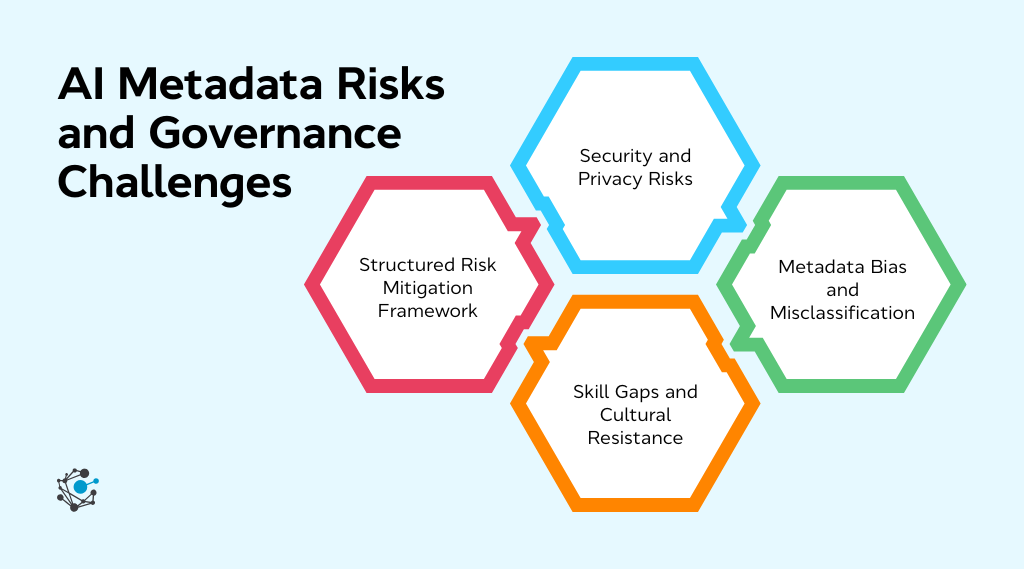
1. Security and privacy risks in metadata
Metadata often contains sensitive attributes, including personal identifiers, access paths, and internal classifications. These details can appear harmless, yet they expose information that requires strict handling.
Metadata fields often contain hidden identifiers that may not be immediately visible during routine review. Most teams overlook this because metadata feels secondary, even though it often reveals more than the underlying file.
Recommended safeguards:
-
Use role-based access control so only authorized users can view or modify sensitive metadata.
-
Apply encryption to sensitive metadata fields to protect personal or regulated information in storage and transit.
-
Use masking rules to hide identifiers and reduce exposure in shared or downstream systems.
-
Limit metadata retention when details are no longer needed to meet compliance or operational requirements.
AI metadata is now regulated content. Under GDPR (Article 30 records), HIPAA (audit logs for PHI), SOX (data lineage for financial reporting), and the EU AI Act (training data documentation for high-risk models), metadata sits inside the same compliance perimeter as the source data. Three implications:
-
Lineage is mandatory, not optional. Auditors increasingly request the upstream-to-output trail for any AI-driven decision.
-
Classification needs to be machine-applied and human-reviewable. The combination of automation for scale and review for defensibility is what holds up in audit.
-
Retention rules apply to metadata, too. Deleting a record but keeping the metadata that describes it can itself be a violation.
|
For the broader governance framework that wraps these controls, see AI data governance. |
2. Metadata bias and misclassification from AI
AI models can mislabel content, misclassify documents, or apply inconsistent tags when training data contains gaps or bias. These errors impact search, governance, and downstream decisions, especially in sensitive workflows.
Ever considered what happens when an important file is mislabeled or when AI assigns the wrong permission category? Small metadata errors can produce large operational risks.
Recommended safeguards:
-
Use transparent tagging rules so teams understand how AI assigns labels.
-
Conduct regular metadata reviews to detect recurring misclassification patterns.
-
Retrain models with corrected examples to reduce systematic bias or drift.
-
Assign human oversight for high-risk, regulated, or customer-facing content.
These practices help teams control errors and improve the reliability of AI-generated metadata across the organization.
3. Skill gaps and cultural resistance
Metadata programs often slow down because teams lack a clear understanding of what metadata represents, why it matters, and how AI improves it. Skill gaps appear across analysts, engineers, and business teams, and cultural resistance follows when people do not see immediate value.
Adoption slows significantly when organizations treat metadata as an added task rather than a core part of their data foundation. This is one of the most common sources of resistance in enterprise programs.
Recommended actions:
-
Host internal workshops that explain metadata concepts and demonstrate clear use cases.
-
Create simple onboarding guides that outline tagging rules, lineage expectations, and quality standards.
-
Use structured change-management plans to address resistance and reinforce benefits.
-
Show practical wins so teams understand how metadata reduces effort and improves outcomes.
Education and visibility build momentum and help teams adopt AI metadata with confidence.
4. Risk mitigation framework
A structured mitigation framework helps organizations strengthen metadata reliability and protect quality across complex environments.
Recommended steps:
-
Validate AI-generated tags regularly to confirm accuracy and alignment with standards.
-
Involve data stewards during key review stages to maintain governance and quality controls.
-
Automate alerts for metadata drift so teams can respond before errors spread across systems.
-
Maintain audit logs that record changes, decisions, and user activity to support compliance and transparency.
These steps create a strong governance foundation and reduce operational risks as metadata expands across platforms.
Future Trends in AI Metadata
The future of AI metadata centers on automation, connected data relationships, and open standards that support flexible, scalable architectures. The trends below show how metadata systems are evolving and how teams can prepare for more intelligent, self-maintaining ecosystems.
1. Rise of agentic AI for metadata
Agentic AI refers to autonomous systems that generate, maintain, and refine metadata without human intervention. This trend increases automation and reduces manual overhead.
What’s changing:
-
Agents generate structured metadata as JSON, XML, or YAML based on content and context.
-
Agents monitor data changes and update metadata in real time.
-
Agents identify missing tags, inconsistencies, or policy violations and recommend corrections.
When metadata updates itself as new content appears, the workload shifts from manual cleanup to strategic oversight. Agentic AI makes this transition achievable.
|
This is the same pattern we cover in detail in our breakdown of AI agents for data governance automation. |
2. Graph metadata and knowledge-based discovery
Graph metadata represents data as interconnected nodes and relationships instead of isolated fields. This approach improves search, discovery, and contextual understanding.
What’s changing:
-
Graph structures map relationships across datasets, models, and business concepts.
-
Knowledge-based queries allow teams to explore connected information, such as finding all datasets related to customer churn in LATAM.
-
Graph-driven discovery produces more accurate and relevant search results because it reflects real context.
This trend helps organizations move from keyword search to relationship-driven insights.
3. Open standards and composable metadata infrastructure
Metadata infrastructure is shifting toward open, modular architectures that improve interoperability and reduce vendor dependency.
What’s changing:
-
Metadata-as-code enables version-controlled metadata management through repositories.
-
OpenMetadata, DCAT, and schema registries support common formats across tools.
-
Composable architectures allow teams to assemble metadata components that integrate smoothly with existing systems.
These standards create flexible metadata ecosystems that scale with data growth, not against it.
Conclusion
AI metadata is becoming a critical layer in modern data ecosystems because it improves clarity, accuracy, and trust across everything from analytics to machine-learning operations. Teams move faster when metadata stays complete, consistent, and intelligent enough to evolve with new data. The organizations that invest in metadata now build stronger foundations for automation, governance, and AI-driven decision making.
If your team wants reliable metadata at scale, the next step is choosing tools that support automation, strong governance, and enterprise-grade integration. OvalEdge helps organizations centralize metadata, improve lineage, and automate tagging so teams spend less time searching for information and more time using it.
If you want to explore proven strategies that help organizations scale metadata programs, you can download the OvalEdge white papers library. Each guide offers real examples, governance models, and checklists that support teams building AI-ready metadata foundations.
Ready to see how AI can streamline your metadata operations?

Book a demo and explore how OvalEdge supports automated metadata enrichment and book a demo to get started.
FAQs
1. What is AI metadata lineage?
AI metadata lineage shows how data moves, changes, and influences model outputs. It records sources, transformations, and dependencies, which helps teams verify accuracy, track model inputs, and troubleshoot issues. Strong lineage improves trust, supports audits, and strengthens responsible AI practices.
2. How do you improve AI metadata quality?
Teams improve AI metadata quality by defining standards, validating tags regularly, retraining models, and ensuring consistent terminology across systems. Quality increases when metadata stays complete, accurate, and updated as data evolves. These steps support better search, stronger governance, and more reliable machine-learning workflows.
3. What is active AI metadata?
Active AI metadata updates itself as data changes. It uses machine-learning techniques to generate new tags, detect drift, and maintain context automatically. This continuous approach helps teams keep metadata accurate, supports real-time analytics, and improves model performance in fast-changing environments.
4. How does AI metadata reduce manual data preparation?
AI metadata automates tagging, classification, and content understanding across text, images, audio, and video. These automated steps reduce manual review, eliminate inconsistent labels, and speed up data preparation. Teams spend less time cleaning information and more time improving analytics and AI models.
5. What role does AI metadata play in compliance?
AI metadata supports compliance by identifying sensitive content, tracking lineage, and applying consistent labels across systems. It helps teams document decisions, control access, and respond to audits quickly. Accurate metadata reduces regulatory risks and strengthens data-governance programs at scale.
6. How does AI metadata support data discovery?
AI metadata improves data discovery by adding detailed context about content, relationships, and meaning. It enriches assets with tags, topics, entities, and intent, which makes search results more accurate. This helps teams locate information quickly and understand how assets connect across systems.
7. How does AI metadata improve video and audio search?
AI metadata enriches video with timestamped events, speaker IDs, and detected entities, and enriches audio with transcript, sentiment, and topic shifts. Search then runs against meaning, not file names. A user can find "the moment our CFO mentioned EBITDA" instead of scrubbing through 90 minutes of recording.
8. Can AI automatically tag contracts and other documents?
Yes. Modern systems extract entities (parties, dates, amounts), clause types (indemnity, termination, jurisdiction), and risk language directly from PDFs and Word documents. The output is structured metadata that flows into contract management, legal review queues, and risk dashboards. Accuracy is high enough for triage; sensitive clauses still warrant human review.
9. What does AI metadata mean for data products and the data mesh?
Data products require their own metadata: ownership, SLAs, schema contracts, lineage, and consumer documentation. AI metadata automates the tedious parts, populating descriptions, detecting schema drift, and linking products to upstream sources. Hence, data product owners spend their time on contracts and use cases instead of catalog hygiene.
.png?width=1081&height=173&name=Forrester%201%20(1).png)
.png?width=1081&height=241&name=KC%20-%20Logo%201%20(1).png)