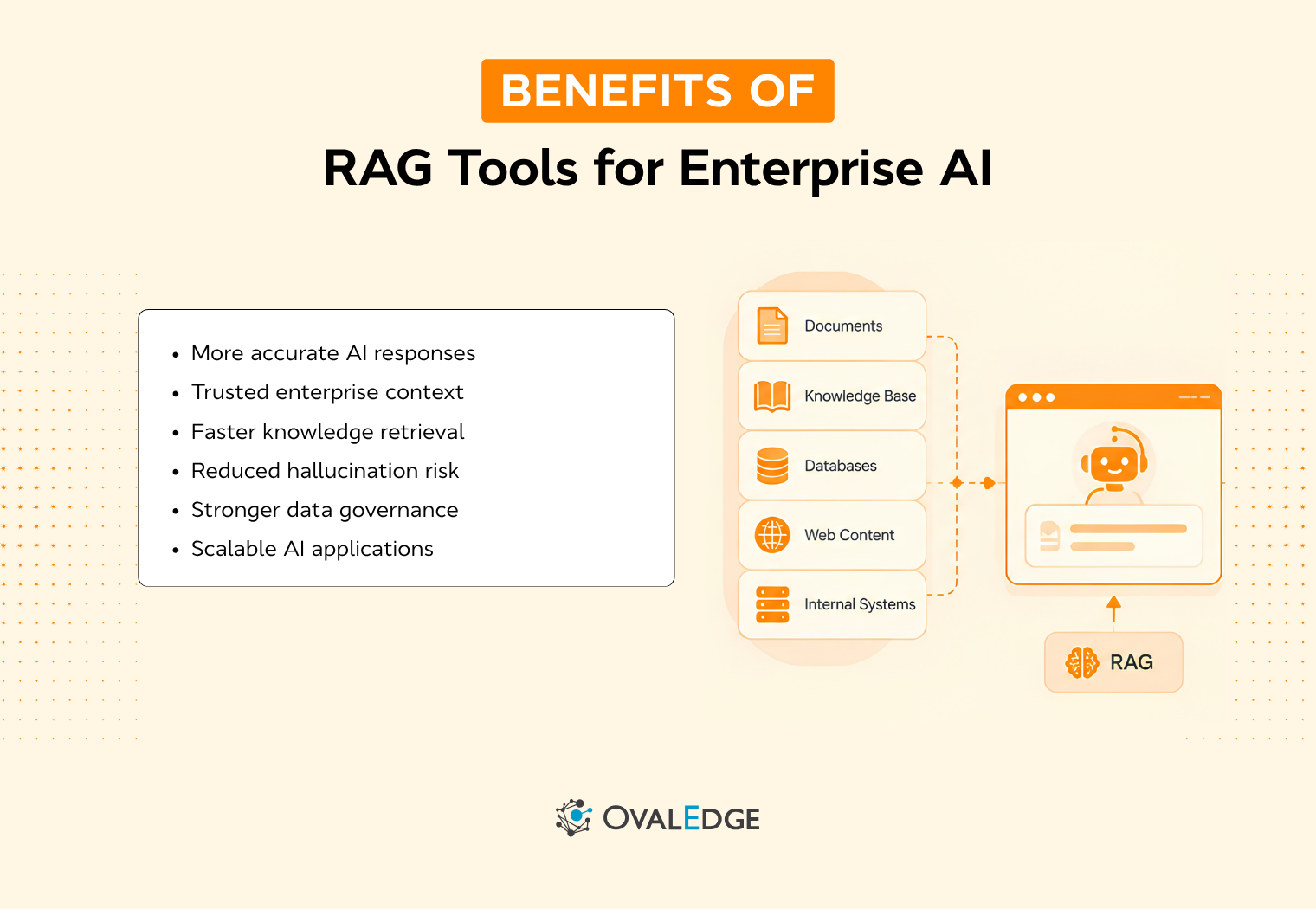
A product team rolls out an internal AI assistant. The retrieval layer pulls from a vector database. The orchestration runs through an open-source framework. The LLM generates answers. Within weeks, the assistant starts surfacing outdated pricing data, referencing deprecated policies, and pulling from datasets that only the finance team should access.
The retrieval worked. The generation worked. What failed was context, governance, and trust. This is the gap most enterprise teams discover after their first RAG deployment.
According to a Markets and Markets report from 2025, the RAG market reached $1.94 billion in 2025 and is projected to hit $9.86 billion by 2030 at a 38.4% CAGR. The tools are multiplying.
The real question is which part of the retrieval pipeline an organization needs to build, replace, or govern.
This guide compares leading RAG tools based on their role in the stack, deployment model, enterprise fit, retrieval capabilities, governance, and ideal use cases.
What are RAG tools?
RAG tools are software platforms, frameworks, databases, and services used to build retrieval-augmented generation systems. They help AI applications retrieve relevant information from external data sources and supply that context to a large language model before it generates a response.
The term "RAG tools" is an umbrella category. It covers several distinct layers of the retrieval pipeline:
-
Data ingestion and document parsing
-
Embedding generation
-
Vector and hybrid search
-
Retrieval orchestration
-
Reranking
-
LLM integration
-
Evaluation and monitoring
A typical enterprise RAG pipeline flows through these stages sequentially:
Enterprise data → Parse and chunk → Embed → Index → Retrieve → Re-rank → LLM → Evaluate
RAG software, RAG platforms, and RAG tools all refer to products within this pipeline. The difference lies in how much of the pipeline a single product covers. A vector database handles indexing and retrieval.
A data orchestration framework manages the end-to-end workflow. A governance platform ensures the data flowing through the pipeline is trusted, classified, and policy-compliant.
Best RAG tools at a glance
RAG architectures rely on specialized tools, with each platform addressing a distinct requirement in moving enterprise data from source to AI-generated response.
|
RAG tool |
Primary role |
Best for |
Enterprise differentiator |
|
OvalEdge |
Unified data governance |
Trusted data and context for enterprise AI |
Enterprise Context Graph, lineage, quality, semantics, ownership, access, policy, 150+ connectors |
|
LangChain |
RAG orchestration |
Custom RAG pipelines |
Extensive integrations |
|
LlamaIndex |
Data/RAG framework |
Data-centric RAG |
Ingestion and indexing |
|
Pinecone |
Vector database |
Managed retrieval |
Scalable vector search |
|
Weaviate |
Vector database |
Hybrid retrieval |
Vector + keyword search |
|
Qdrant |
Vector database |
Flexible retrieval |
Open-source vector search |
|
RAGFlow |
RAG platform |
End-to-end RAG |
Integrated workflow |
|
Haystack |
RAG framework |
Production pipelines |
Modular architecture |
|
Unstructured |
Data ingestion |
Complex documents |
Parsing and preparation |
|
Ragas |
RAG evaluation |
Quality measurement |
RAG-specific evaluation |
These products solve different layers of the RAG pipeline. A vector database like Pinecone is not a direct substitute for a governance layer like OvalEdge, and an orchestration framework like LangChain does not replace a dedicated evaluation tool like Ragas. Enterprise teams evaluating RAG software should map each tool to the specific pipeline layer it addresses before comparing features.
Types of RAG tools in the modern RAG stack
Not all RAG tools compete with each other. Understanding these categories helps teams compare tools based on the specific role they play in the RAG stack.
1. RAG orchestration frameworks
Manage end-to-end retrieval and generation workflows by connecting data sources, retrievers, and LLMs into a unified pipeline.
Tools: LangChain, LlamaIndex, Haystack
2. Vector databases and retrieval engines
Store embeddings and execute similarity searches, providing the retrieval backbone for RAG applications.
Tools: Pinecone, Weaviate, Qdrant
3. Data ingestion and document processing tools
Extract, clean, chunk, and prepare enterprise documents before they enter the retrieval layer.
Tools: Unstructured, LlamaParse
4. Reranking and retrieval optimization services
Rescore initial search results to improve the relevance of context passed to the LLM.
Tools: Cohere Re-rank
5. RAG evaluation and observability tools
Measure retrieval quality, faithfulness, and context relevance to identify degradation and improve RAG performance over time.
Tools: Ragas
6. End-to-end RAG platforms
Combine ingestion, retrieval, orchestration, and generation capabilities within a single integrated system.
Tools: RAGFlow
Best RAG tools for enterprise AI
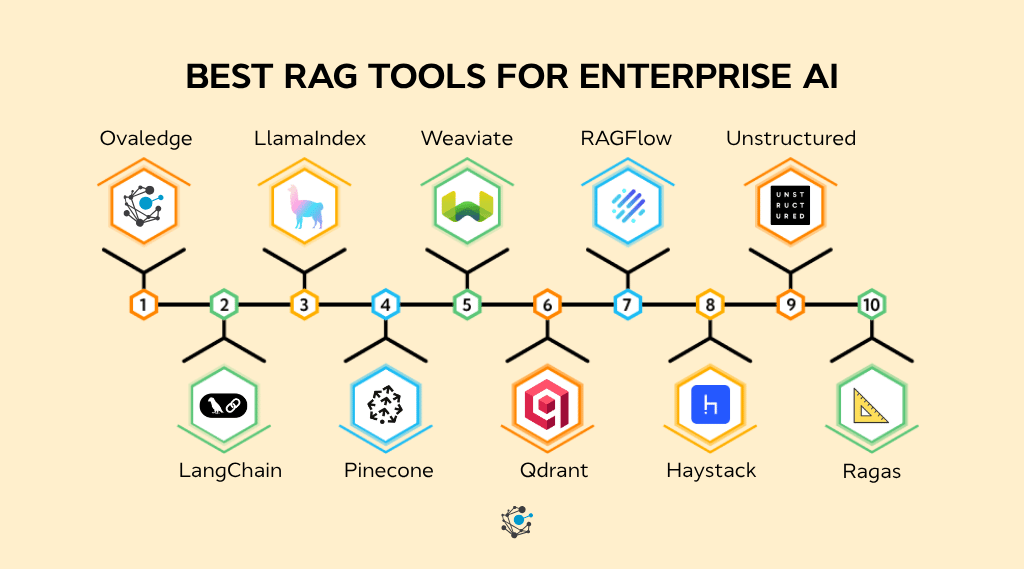
Enterprise RAG rarely depends on a single platform. The tools below address different parts of the stack, from governed context and data preparation to retrieval, orchestration, and evaluation.
1. OvalEdge: best for governance-led enterprise RAG
OvalEdge is a unified data governance platform that brings metadata management, governance, quality, access, and policy controls into one operating layer. For enterprise RAG, it provides the governed context retrieval systems need to interpret and use organizational data appropriately.
The platform's Enterprise Context Graph connects technical metadata with business definitions, semantics, ontology, lineage, quality, ownership, and policies. This creates a machine-readable context layer that users and AI systems can query when finding, interpreting, and using enterprise data.
Key features:
-
Enterprise Context Graph: Creates connected, machine-readable context from governed enterprise metadata.
-
OvalEdge Agents: Built-in AI agents such as Curo, Lingo, Helm, Sift, and Notary automate discovery, classification, lineage, quality, and ownership with human oversight.
-
Source Code Intelligence: Reads SQL, ETL, BI reports, stored procedures, and notebooks to uncover business logic, definitions, and lineage from production code.
-
170+ native connectors: Connects modern cloud platforms, enterprise applications, databases, and legacy systems.
-
Business glossary and ontology: Standardizes terminology and maps relationships between business concepts.
-
Data quality and certification: Monitors quality, detects anomalies, and provides trust signals for data assets.
-
Access governance and policy enforcement: Supports fine-grained RBAC, sensitive-data classification, and access request workflows.
-
MCP server and open context API: Delivers enterprise context to AI assistants, custom agents, BI platforms, and other applications.
-
AskEdgi: Lets business users discover data and perform cross-system analytics through natural-language questions.
Pros:
-
Connects governance with AI retrieval
-
Adds business context to enterprise data
-
Supports governed AI and agent workflows
Cons:
-
Broader than a standalone RAG framework
-
Greater value in governance-mature environments
Why OvalEdge matters for enterprise RAG:
Most RAG evaluations focus on the retrieval and generation layers. OvalEdge addresses what typically breaks after the first deployment: the data itself. When retrieval pipelines surface outdated definitions, pull from uncertified datasets, or return results the requesting user should not have access to, the failure is not in the vector database or the LLM. It is in the absence of governance.
OvalEdge's Enterprise Context Graph gives AI systems the business meaning, lineage, quality signals, ownership, and policy controls they need to retrieve and act on the right data. This makes it relevant to any enterprise RAG architecture, not as a replacement for the retrieval layer, but as the governance foundation that makes retrieval trustworthy.
RAG role: Governance and enterprise context layer
Deployment: Cloud, on-premises, hybrid
Enterprise fit: High
See how governed context can strengthen enterprise RAG and AI workflows. Schedule an Enterprise Context Graph demo.
2. LangChain
LangChain is a RAG orchestration framework for connecting LLMs, retrievers, vector stores, and enterprise data sources. LangGraph supports multi-step agent workflows, while LangSmith adds tracing and observability for production applications.
Best for: Building highly customized RAG pipelines and agent workflows.
Key features:
-
Retrieval orchestration: Connects retrieval and generation components.
-
LangGraph workflows: Supports stateful, multi-step agent workflows.
-
Broad integrations: Connects LLMs, vector stores, and data sources.
-
LangSmith observability: Provides tracing, evaluation, and monitoring.
-
Agent orchestration: Coordinates tools, models, and agent actions.
Pros:
-
Highly flexible
-
Large integration ecosystem
-
Strong agent orchestration
Cons:
-
Steeper learning curve
-
Requires infrastructure assembly
RAG role: RAG and agent orchestration
Deployment: Self-hosted, cloud
3. LlamaIndex
LlamaIndex focuses on connecting enterprise data to LLM applications through ingestion, indexing, and query engines. Its composable architecture supports multiple retrieval approaches across structured and unstructured data.
Best for: Building RAG applications that require flexible data ingestion and retrieval.
Key features:
-
Data connectors: Integrates structured and unstructured sources.
-
Document ingestion: Prepares enterprise content for retrieval.
-
Flexible indexing: Supports multiple indexing strategies.
-
Query engines: Coordinates retrieval and response generation.
-
Hybrid retrieval: Combines vector, keyword, and metadata filtering.
Pros:
-
Strong data integration
-
Flexible retrieval options
-
Good document support
Cons:
-
Requires technical expertise
-
Production architecture can become complex
RAG role: Data ingestion, indexing, and retrieval orchestration
Deployment: Self-hosted, cloud
4. Pinecone
Pinecone is a managed vector database designed for production similarity search and retrieval. It supports dense and sparse retrieval, metadata filtering, and real-time index updates for large-scale RAG applications.
Best for: Managed vector retrieval for scalable production RAG systems.
Key features:
-
Vector search: Retrieves semantically similar content.
-
Hybrid retrieval: Combines dense and sparse search.
-
Metadata filtering: Narrows results using contextual attributes.
-
Real-time updates: Keeps vector indexes current.
-
Managed infrastructure: Reduces database operational overhead.
Pros:
-
Easy to operate
-
Built for scale
-
Strong production support
Cons:
-
Limited self-hosting flexibility
-
Adds managed-service dependency
RAG role: Vector database and retrieval layer
Deployment: Managed cloud
5. Weaviate
Weaviate is a vector database that combines semantic vector retrieval with keyword-based search. It supports both open-source self-hosting and managed cloud deployment, giving teams flexibility in how they operate their retrieval infrastructure.
Best for: RAG applications combining semantic and keyword retrieval.
Key features:
-
Vector search: Finds semantically related content.
-
Keyword search: Supports BM25-based retrieval.
-
Hybrid retrieval: Combines vector and keyword results.
-
Metadata filtering: Filters retrieval using structured attributes.
-
Flexible deployment: Supports cloud and self-hosted environments.
Pros:
-
Open-source option
-
Strong hybrid search
-
Flexible deployment
Cons:
-
Self-hosting adds complexity
-
Requires tuning at scale
RAG role: Vector and hybrid retrieval layer
Deployment: Cloud, self-hosted
6. Qdrant
Qdrant is an open-source vector database designed for high-performance similarity search and advanced filtering. It supports cloud, self-hosted, and on-premises deployments for teams that need greater control over retrieval infrastructure.
Best for: Flexible vector retrieval with strong infrastructure control.
Key features:
-
Vector search: Enables high-performance similarity retrieval.
-
Payload filtering: Applies granular filters to vector searches.
-
Hybrid queries: Supports multiple retrieval approaches.
-
Metadata support: Adds structured context to vector retrieval.
-
Deployment flexibility: Supports cloud, self-hosted, and on-premises setups.
Pros:
-
Open source
-
Strong filtering
-
Flexible deployment
Cons:
-
Requires surrounding RAG components
-
Self-hosting adds operational work
RAG role: Vector database and retrieval layer
Deployment: Cloud, self-hosted, on-premises
7. RAGFlow
RAGFlow combines document ingestion, retrieval, orchestration, and grounded response generation within one RAG platform. Its integrated architecture reduces the number of separate components teams need to assemble and manage.
Best for: Teams seeking an integrated retrieval-to-generation RAG workflow.
Key features:
-
Document ingestion: Processes content for downstream retrieval.
-
Document parsing: Extracts structured information from complex files.
-
Retrieval: Finds relevant context for user queries.
-
RAG orchestration: Coordinates retrieval and generation workflows.
-
Grounded responses: Generates answers based on retrieved content.
Pros:
-
Integrated RAG workflow
-
Strong document processing
-
Open-source availability
Cons:
-
Less modular than component stacks
-
Smaller ecosystem than established frameworks
RAG role: End-to-end RAG platform
Deployment: Cloud, self-hosted
8. Haystack
Haystack by deepset provides a modular framework for building production RAG and AI pipelines. Its component-based architecture lets teams combine retrievers, document stores, generators, and other components while maintaining control over individual pipeline stages.
Best for: Modular, production-grade RAG pipelines requiring fine-grained control.
Key features:
-
Modular pipelines: Builds workflows from reusable components.
-
Retrievers: Supports multiple retrieval strategies.
-
Document stores: Connects different retrieval backends.
-
Model integrations: Works with multiple LLM providers.
-
Agent workflows: Supports tool-using and routed AI workflows.
Pros:
-
Modular architecture
-
Production focused
-
Open source
Cons:
-
Requires engineering expertise
-
Smaller ecosystem than LangChain
RAG role: RAG pipeline orchestration
Deployment: Self-hosted, cloud
9. Unstructured
Unstructured prepares complex enterprise documents for downstream RAG pipelines. It extracts and structures content from PDFs, Word documents, HTML, and other formats before the data reaches indexing and retrieval systems.
Best for: Parsing and preparing complex enterprise documents for RAG.
Key features:
-
Document parsing: Extracts content from multiple file formats.
-
Layout detection: Identifies document structures and elements.
-
Chunking: Divides documents into retrieval-ready segments.
-
Metadata extraction: Captures useful document attributes.
-
Content extraction: Processes text, tables, images, and other elements.
Pros:
-
Strong document support
-
Handles complex formats
-
Improves ingestion quality
Cons:
-
Does not provide full RAG stack
-
Requires retrieval infrastructure
RAG role: Document ingestion and processing
Deployment: Cloud, self-hosted
10. Ragas
Ragas is an open-source evaluation framework designed to measure the quality of RAG pipelines. It provides RAG-specific metrics that help teams assess retrieval performance, grounding, and response quality throughout development and production.
Best for: Evaluating and continuously improving RAG pipeline quality.
Key features:
-
Retrieval evaluation: Measures retrieved context quality.
-
Faithfulness testing: Checks whether answers reflect retrieved evidence.
-
Context precision: Measures relevance of retrieved information.
-
Answer evaluation: Assesses generated response quality.
-
Continuous evaluation: Supports repeated testing as pipelines evolve.
Pros:
-
RAG-specific evaluation
-
Open source
-
Supports continuous testing
Cons:
-
Not a retrieval platform
-
Requires RAG stack integration
RAG role: RAG evaluation and testing
Deployment: Self-hosted, cloud integrations
How to choose the right RAG tools for enterprise AI
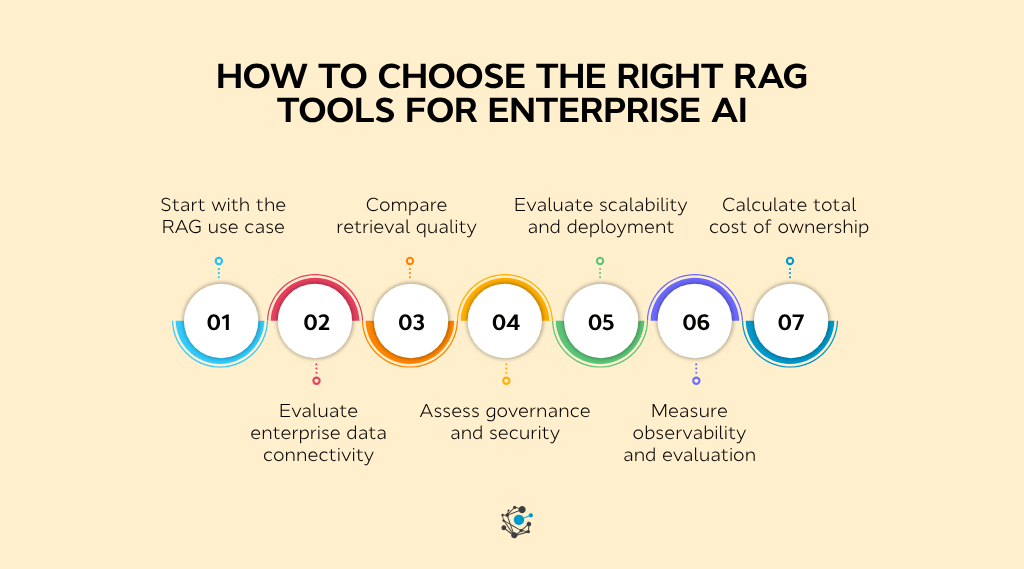
Selecting the right RAG software is not a single decision. It is a stack decision. Each layer of the pipeline requires evaluation against the organization's data, security requirements, and use cases.
1. Define the RAG use case
Internal knowledge search, document Q&A, customer support automation, analytics copilots, and autonomous agents each place different demands on retrieval quality, latency, and governance. A customer support deployment prioritizes response speed and citation accuracy. An analytics copilot needs structured data retrieval and permission-aware responses.
2. Map the enterprise data landscape
The mix of structured, unstructured, cloud, SaaS, warehouse, and document sources determines which ingestion and indexing capabilities are required. Organizations working with scanned PDFs, multi-page contracts, or legacy reports may also need robust document processing before retrieval can work effectively.
3. Evaluate retrieval quality
Vector search, keyword search, hybrid retrieval, metadata filtering, reranking, and graph retrieval serve different query patterns. Evaluate which methods fit the use case and how effectively they return precise, relevant context rather than relying on LLM quality alone.
4. Evaluate governance and context
Enterprise RAG needs more than search relevance. Business definitions, lineage, ownership, certification status, quality signals, classifications, permissions, and policies determine whether retrieved information can be trusted and used appropriately.
This is where context engineering for AI becomes important. It helps ensure AI systems receive the business meaning and governance signals required to interpret retrieved data correctly. OvalEdge's Enterprise Context Graph supports this approach by connecting metadata, semantics, lineage, quality, ownership, and policies into context that AI systems can use.
5. Assess security and deployment
SaaS, VPC, self-hosted, and on-premises deployment models carry different implications for security, compliance, data residency, and operational control. Evaluate access controls, authentication, auditability, and where sensitive enterprise data will be processed and stored.
6. Measure RAG performance
Precision, recall, relevance, faithfulness, latency, failure rate, and cost per query should be monitored continuously. Evaluation and observability capabilities help teams identify retrieval problems, detect performance degradation, and determine whether the RAG pipeline continues to meet its quality targets.
7. Calculate total cost of ownership
The full cost includes software licensing, compute, embedding generation, vector storage, LLM inference, engineering time, monitoring, and governance. Managed services can reduce operational burden but increase vendor dependency, while open-source frameworks may lower licensing costs but require greater engineering investment.
For enterprise deployments, evaluate the RAG architecture as a stack rather than selecting one tool in isolation. Retrieval, ingestion, orchestration, evaluation, security, and governance need to work together to deliver reliable enterprise AI outcomes.
Conclusion
Enterprise RAG also requires trusted data, governed context, permissions, and policy enforcement. Without these, retrieval systems can surface outdated, unauthorized, or misleading information at scale.
OvalEdge is the unified data governance platform that connects catalog, lineage, quality, business definitions, ownership, and access controls into a single operating layer. Its Enterprise Context Graph makes governed enterprise context queryable by users and AI, so every answer traces back to trusted, governed data.
For RAG architectures, this means the data entering retrieval pipelines is defined, certified, and permitted before it ever reaches the LLM.
Schedule a demo with OvalEdge to see how the Enterprise Context Graph delivers trusted data and governed context for enterprise AI and analytics.
.png?width=1081&height=173&name=Forrester%201%20(1).png)
.png?width=1081&height=241&name=KC%20-%20Logo%201%20(1).png)