Every AI-driven credit decision, fraud alert, and regulatory report in banking carries a simple question: can you trace this output back to its governed source? Regulators are already asking. BCBS 239, SOX, and the EU AI Act all require that data-driven outputs connect to certified, classified sources. Yet most AI agents in financial services operate without that connection.
They pull raw data without knowing what it means, where it came from, or who is authorized to use it. The result is AI output that cannot be audited, cannot be explained to regulators, and carries compliance risk that scales with every new use case. The data exists. The governance programs exist.
What is missing is the architecture that connects them and makes governed context available to AI agents when they need it. A context layer for financial services provides that architecture.
What is a context layer for financial services
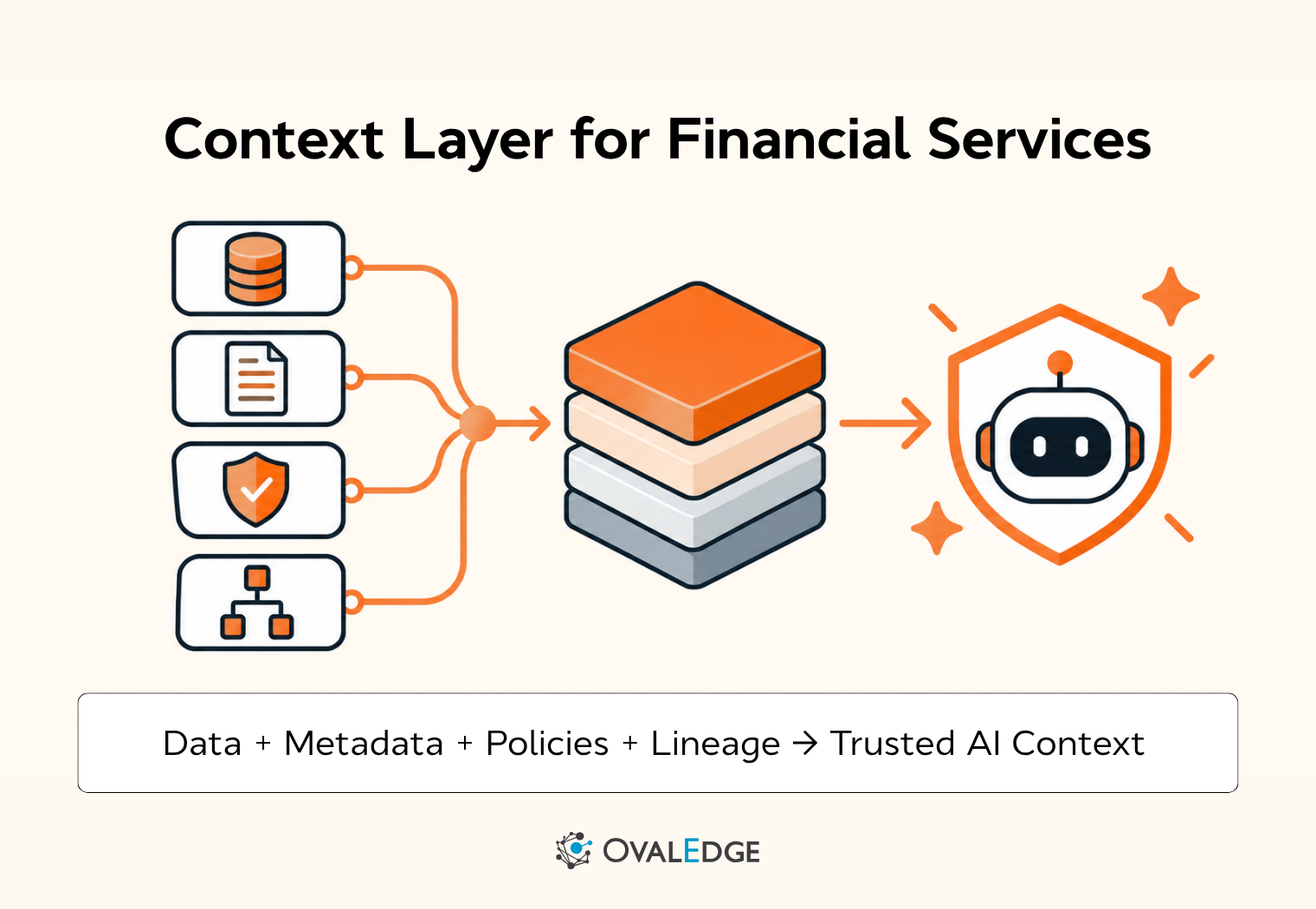
A context layer for financial services is an architectural layer that connects governed metadata, business definitions, regulatory classifications, data lineage, and access policies into a single, queryable structure that AI agents can consume at runtime. It sits between enterprise data sources and AI applications, providing the business meaning, trust signals, and governance rules that make AI outputs reliable and auditable in regulated environments.
The distinction from a data layer or integration layer matters:
-
A data layer moves and stores data
-
An integration layer connects systems
-
A context layer adds meaning, governance, and policy on top of raw data access
A context layer tells AI agents not just what the data is, but what it means, who certified it, and who is authorized to use it. In the language of context engineering, a context layer is where the discipline of designing, governing, and delivering enterprise context for AI becomes operational infrastructure.
Financial services firms already maintain business glossaries, data catalogs, lineage maps, and classification rules across their organizations. A context layer connects these existing governance artifacts into a unified architecture that AI agents can query, with definitions, provenance, and access controls attached to every response.
Why financial services firms need a governed context layer
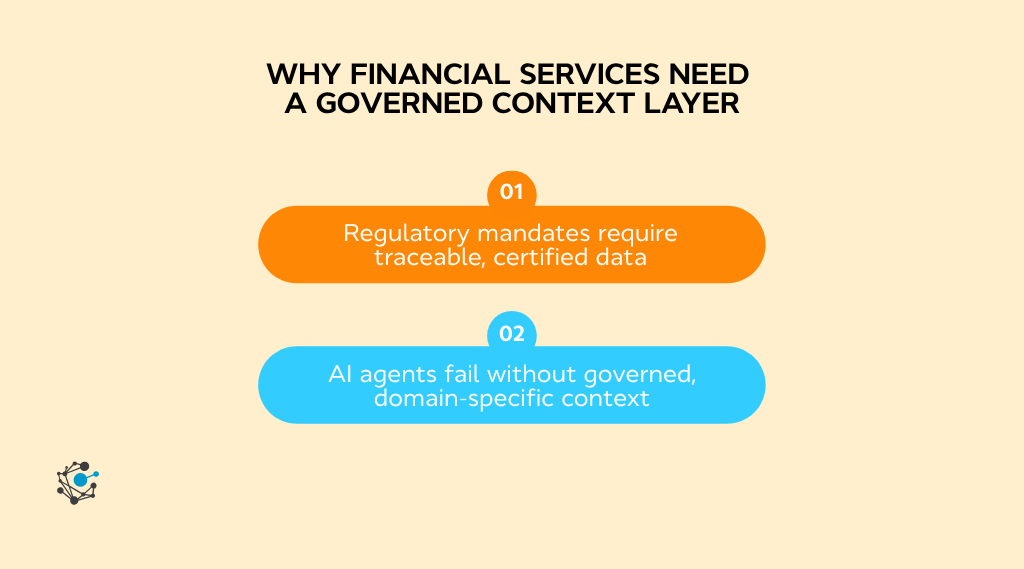
Financial services firms face two forces that make a governed context layer essential. Regulators require that every data-driven decision traces back to certified, classified sources. AI agents, which are rapidly replacing manual processes in fraud, compliance, and credit, fail without the governed, domain-specific context that only a purpose-built architecture can provide.
1. Regulatory mandates require traceable, certified data
Multiple regulatory frameworks converge on the same requirement: traceable, certified data behind every output.
- BCBS 239 requires banks to trace risk data from report to source with accuracy, completeness, and timeliness
- SOX mandates internal controls over financial data used in reporting
- The EU AI Act, with high-risk system obligations taking effect in August 2026, classifies credit scoring and insurance risk assessment as high-risk AI, requiring conformity assessments and human oversight. Penalties reach up to 35 million euros or 7% of global annual turnover
- MiFID II requires best-execution reporting with auditable data
- GDPR, GLBA, and DORA mandate classification, access controls, and digital operational resilience for financial data
The regulatory cost of falling short is not theoretical.
In July 2024, Bloomberg Law reported that Citigroup was fined $136 million by the Federal Reserve and OCC for insufficient progress remediating data quality management problems.
The Deloitte BCBS 239 Benchmark Survey found that most of the 50+ banks surveyed cannot precisely quantify their BCBS 239 spending because costs are buried across data, risk, and IT programs.
The common thread: the data feeding AI and analytics must be classified, lineage-traced, access-controlled, and certified. A governed context layer enforces this at the infrastructure level rather than through periodic manual audits.
OvalEdge expert insight: Regulatory compliance is not a checkbox exercise. BCBS 239, SOX, and the EU AI Act all require that data-driven outputs trace back to classified, certified sources. A context layer turns this requirement into an infrastructure capability rather than a manual process.
2. AI agents fail without governed, domain-specific context
Generic RAG retrieves documents. Financial services AI agents handling fraud alerts, credit decisions, or data lineage for regulatory reporting need context that goes far beyond document retrieval:
-
Approved business definitions
-
Regulatory classifications
-
Data quality scores
-
Column-level lineage
-
Role-based access policies
Without governed context, AI agents in banking hallucinate definitions, surface uncertified data, or combine fields they should not have access to.
The risk is real. An AI agent processing an AML alert that retrieves an unapproved customer risk score is a compliance liability, not a productivity gain. Most financial services firms have the data. The problem is that the data lacks the governance signals AI agents need to produce trustworthy outputs:
-
Which definition is approved?
-
Which dataset is certified?
-
Which classification tags apply?
-
Who is authorized to see this result?
A governed context layer fills this gap by attaching business meaning, trust signals, and access policies to enterprise data so AI agents can reason over governed context, not just raw fields. The result is AI output that is explainable, auditable, and compliant by architecture rather than by manual review.
Core components of a financial services context layer
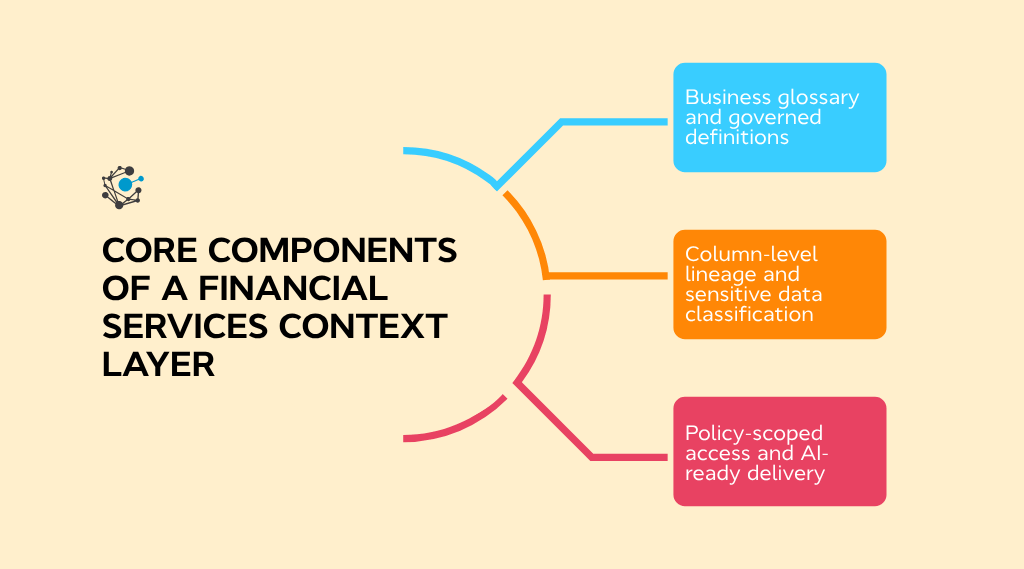
A financial services context layer is not a single tool. It is an architecture built from several connected components, each providing a specific governance capability. Together, they create a queryable structure that AI agents and analytics can consume.
1. Business glossary and governed definitions
Financial services firms operate with terms that carry different meanings across departments. "Exposure" means one thing to the trading desk and another to the credit risk team. "Counterparty" has regulatory definitions that differ from operational ones. "Material" has legal thresholds that vary by jurisdiction.
A governed business glossary addresses this by:
-
Standardizing definitions across the organization
-
Mapping each term to the data assets it describes
-
Assigning ownership and tracking version history
-
Providing AI agents with the approved definition, its owner, and its approval date at query time
Without a governed glossary, every AI-generated metric or report risks using an unofficial definition. In regulated environments, that translates directly to compliance exposure.
The glossary is not just a reference tool. It is the semantic foundation of the context layer: the single source of truth for what every term means across the organization.
2. Column-level lineage and sensitive data classification
Regulators require proof of where data came from and how it was transformed before it reached a report, a model, or an AI agent's answer. Column-level lineage traces this path from source to consumption, making every output auditable.
Sensitive data classification identifies PII, MNPI, and regulated data elements automatically across data sources, supporting GDPR, GLBA, and CCPA obligations while ensuring AI agents do not surface classified fields without authorization.
Together, lineage and classification create the trust infrastructure of the context layer:
-
Lineage answers: where did this data come from and how was it transformed?
-
Classification answers: what type of data is this, and what rules govern its use?
For financial services, these are not optional components. They are regulatory requirements that the context layer makes enforceable at the infrastructure level rather than through periodic audits.
OvalEdge expert insight: Column-level lineage and sensitive data classification are the trust infrastructure of any context layer. Lineage proves provenance. Classification enforces protection. Without both connected at the column level, AI agents cannot distinguish governed data from ungoverned data.
3. Policy-scoped access and AI-ready delivery
Fine-grained access control ensures AI agents only retrieve data they are authorized to use. In financial services, access policies vary by:
-
Role and department
-
Geography and regulatory jurisdiction
-
Data sensitivity classification
A context layer enforces these policies at query time, not after the fact.
AI-ready delivery means serving governed context to AI agents through standards like MCP (Model Context Protocol) and APIs. Instead of requiring data engineers to manually prepare context packages for each AI application, the context layer makes governed metadata, definitions, lineage, and access policies available to AI agents through a standardized interface.
The glossary, lineage, and classification components provide the governed foundation. Policy-scoped access and AI-ready delivery make that foundation consumable by AI agents at runtime.
At OvalEdge, we believe a context layer that cannot deliver governed context to AI agents at runtime is just another metadata repository. The architecture becomes operational when business definitions, lineage, classification, and access policies are all queryable through standards like MCP.
How a financial services context layer differs from a semantic layer and data catalog
Most financial services firms already have a semantic layer for BI and a data catalog for metadata management. The natural question is how a context layer differs and whether it replaces these existing investments. The short answer: a context layer extends and connects what these platforms already provide, rather than replacing them.
|
Dimension |
Semantic layer |
Data catalog |
Context layer |
|
Primary purpose |
Standardize BI metrics and KPIs |
Inventory and describe data assets |
Connect governed metadata, meaning, and policies for AI agents |
|
Data types served |
Structured, analytical (cubes, metrics, measures) |
All data types (structured and unstructured metadata) |
All data types plus business definitions, lineage, classification, and access policies as a connected structure |
|
Primary consumers |
BI tools, analysts, dashboards |
Data teams, stewards, governance leaders |
AI agents, LLMs, analytics applications, and data teams |
|
Governance scope |
Metric consistency |
Asset discovery, ownership, documentation |
End-to-end: definitions, lineage, classification, quality, access policies, and delivery to AI |
|
AI readiness |
Not designed for AI agent consumption |
Limited; metadata is cataloged but not queryable by agents at runtime |
Purpose-built for AI agent consumption through MCP and APIs |
The semantic layer ensures BI tools and dashboards use consistent metric definitions. It was not designed for AI agent consumption and does not carry lineage, classification, or access policies. The data catalog discovers, documents, and organizes data assets across the enterprise, but catalog metadata alone does not make data AI-ready.
The context layer connects these investments. It draws from the catalog's metadata, the glossary's definitions, and the semantic layer's standardized metrics, then adds lineage, classification, access policies, and AI-ready delivery. Financial services firms that have invested in catalogs and semantic layers already have the raw material. The context layer is an evolution, not a replacement.
Context layer use cases in financial services
A governed context layer changes how financial services firms approach three high-stakes operational areas. In each case, the value is not just better data access. It is trustworthy AI output backed by governed, traceable context.
1. Fraud detection and anti-money laundering
A context layer improves fraud detection and AML accuracy by giving AI agents access to governed data with full trust signals attached. Without governed context, fraud models produce excessive false positives because they operate on inconsistent customer definitions and ungoverned risk scores. An AML agent that pulls an unapproved sanctions list or an outdated customer risk classification creates a compliance liability, not operational efficiency.
With a context layer, the agent retrieves:
-
The certified customer risk score
-
The approved sanctions reference
-
The classified transaction data
-
Lineage and access policies enforced at query time
Every alert the model generates traces back to governed sources.
For example: An AML monitoring agent queries the context layer for a customer's transaction history, risk classification, and sanctions status. The response includes the certified risk score, its lineage back to the source system, the classification tags on each field, and the access policy that authorized the retrieval.
2. Regulatory reporting and compliance automation
A context layer enables trusted regulatory reporting by ensuring that every metric in a submission traces back through lineage to certified source data. Auditors can verify the complete chain from report to source.
BCBS 239 requires that risk data aggregation is accurate, complete, timely, and traceable. A context layer makes this verifiable at the infrastructure level: each reported figure connects to a governed definition, a certified dataset, and a documented transformation path.
Compliance automation becomes possible when the context layer makes regulatory classifications, data quality scores, and lineage available to AI agents. Instead of manual data preparation for each regulatory filing, agents assemble compliant reports by querying governed context directly. The enterprise context layer turns what was a labor-intensive audit preparation process into an infrastructure-level capability.
For example, a core banking team renames a source field during a system migration. Downstream, regulatory reports depend on that field for risk data aggregation. Without a context layer, the break surfaces weeks later during a BCBS 239 submission review. With a context layer, column-level lineage traces every downstream dependency instantly, flagging every affected regulatory report before the rename goes live.
3. Credit decisioning and risk assessment
A context layer strengthens credit decisioning by ensuring that AI models pull applicant data, financial ratios, and risk scores with approved business definitions and current certification status attached.
Credit models that operate on ungoverned data produce decisions that are difficult to explain and impossible to audit. Every denied loan must trace back to specific data inputs, their definitions, and their provenance.
With a context layer, the credit decisioning agent retrieves:
-
The approved definition of "debt-to-income ratio"
-
The certified source table from the data catalog
-
The quality score of the underlying data
The decision becomes explainable because every input is governed and traceable.
For example, a credit risk team prepares for the annual model validation review. The regulator asks whether the decisioning model was trained on the approved dataset and whether that dataset is still certified. Without a context layer, the team spends weeks assembling evidence manually.
With a context layer, the agent retrieves the training dataset’s certification status, its lineage back to source, and the approved business definitions used in the model, all in a single query.
How to evaluate a governed context layer for financial services
Financial services teams evaluating context layer platforms need criteria that go beyond generic feature checklists. The following evaluation dimensions reflect the specific requirements of governed AI in regulated environments.
-
Governance and compliance readiness. Does the platform enforce regulatory requirements (BCBS 239, SOX, EU AI Act, GDPR) at the infrastructure level? Can it trace every AI output back to a certified source through column-level lineage?
-
Deployment flexibility for regulated environments. Does it support on-premises, customer-managed cloud, SaaS, and hybrid deployments? Many financial institutions cannot use SaaS-only platforms for classified data workloads.
-
Connector coverage for financial services data sources. Does it connect to the databases, data warehouses, cloud platforms, and BI tools that financial services firms actually use? Breadth of connectors determines how much of the enterprise the context layer can govern.
-
AI agent delivery through MCP and APIs. Can the platform serve governed context to AI agents (Claude, ChatGPT, custom agents) through standardized protocols? Platforms that require manual context preparation for each AI use case do not scale.
-
Lineage depth and classification automation. Does it provide column-level lineage (not just table-level)? Does it automate sensitive data classification rather than requiring manual tagging? In financial services, both depth and automation are requirements, not features.
Governed context layer platforms like OvalEdge connect business glossaries, column-level lineage, sensitive data classification, and fine-grained access policies into an Enterprise Context Graph that AI agents can query through MCP. Instead of rebuilding governance from scratch, financial services teams can activate the governance foundation they already have.
At OvalEdge, we believe evaluation criteria for a financial services context layer should start with governance depth, not feature count. The right platform connects existing governance investments into a queryable architecture rather than asking teams to rebuild what they already have.
Conclusion
Financial services firms deploying AI agents face a fundamental gap. The data exists. The governance programs exist. The connection between governed data and AI agents at runtime does not, without a context layer.
Most financial services organizations have invested years in business glossaries, data catalogs, lineage mapping, classification rules, and access policies. These investments already provide the raw material for a governed context layer. The next step is connecting and activating this existing foundation so AI agents can query governed context at runtime.
OvalEdge's Enterprise Context Graph brings these governed artifacts together into a connected, queryable structure purpose-built for financial services AI. The result is AI-driven fraud detection, regulatory reporting, and credit decisioning that every stakeholder can trust, because every output traces back to a governed, certified source.
What would change in your organization if every AI-driven decision could be traced back to a certified, governed source in seconds rather than days?
For financial services teams ready to connect their existing governance investments to AI agents, request a demo to see how OvalEdge makes it operational.