.jpg)
AI agents can retrieve thousands of enterprise assets in seconds, yet one unresolved question can undermine the entire response: which information should the agent trust? A revenue figure may exist across a warehouse, dashboard, spreadsheet, and departmental report, each carrying different definitions, owners, permissions, and levels of freshness.
This is where context engineering becomes critical.
According to a 2025 Gartner article, “Lack of AI-Ready Data Puts AI Projects at Risk,” Gartner predicts that through 2026, organizations will abandon 60% of AI projects that are not supported by AI-ready data.
In practice, AI systems can generate answers that conflict with trusted business reporting, even when the underlying data exists. Context engineering addresses this gap by ensuring AI systems operate with trusted, governed, and business-relevant context, not just more information.
This guide explains how to engineer that governed context across seven layers and deliver it reliably at runtime.
What is context engineering?
Context engineering is the practice of designing, governing, and delivering the information an artificial intelligence (AI) system needs at the moment it reasons. It determines what context enters the model, where that context comes from, and whether it is relevant, trustworthy, and permitted for use.
For example, if a finance agent is asked, “What was enterprise revenue last quarter?”, context engineering ensures it receives the approved definition of revenue, the certified financial dataset, relevant lineage and quality signals, and the requesting user's access permissions. Without those signals, the agent could retrieve a technically relevant but outdated or unofficial figure.
Enterprise context can include user intent, business definitions, metadata, organizational knowledge, prior interactions, policies, and outputs from connected tools. These inputs give an AI system the company-specific knowledge it cannot derive from the model alone.
Context engineering has become more important as AI moves from answering questions to taking actions. An agent that updates customer records, routes approvals, or triggers workflows needs context that establishes not only what is relevant, but also what is authoritative, current, and safe to use.
Why prompt engineering stopped scaling
Prompt engineering earned its place when phrasing alone could swing the quality of an answer. It stopped scaling the moment a single instruction had to carry the policies, approved definitions, and source-of-truth decisions an agent needs across hundreds of workflows. No amount of rewording fits an enterprise glossary into a system prompt.
The core principles of context engineering start from the opposite direction: build the context supply chain first, then let the prompt do the small job it is actually good at.
Context engineering vs prompt engineering
Prompt engineering instructs the model. Context engineering informs it. The two work together, and the second one is where enterprise reliability is won or lost.
|
Dimension |
Prompt engineering |
Context engineering |
|
Core job |
Tells the model what to do |
Determines what the model knows |
|
Input type |
Mostly static instructions |
Dynamic, retrieved, governed information |
|
Optimizes for |
Response phrasing and format |
Decision quality and traceability |
|
Scope |
A single prompt or session |
Enterprise knowledge, metadata, and policy |
|
Failure mode |
Vague or poorly formatted output |
Confident output built on the wrong source |
|
Typical owner |
Prompt writer or AI engineer |
Data, governance, and AI teams together |
The distinction that matters most sits in the failure mode row. A bad prompt produces an obviously poor answer that is easier to catch. Bad context can produce a fluent, well-formatted, but incorrect answer because the model was given outdated, conflicting, or untrusted information.
Context engineering is not one discipline
Most coverage of this topic describes a single universal architecture. That framing breaks the moment an enterprise tries to apply it, because different agents operate on entirely different information assets.
Every journey needs a map, and the map depends on the journey. A pilot needs an aviation chart, a ship needs a nautical chart, and a driver needs a road map. All three are maps. None is interchangeable.
|
Agent type |
Information asset |
What its context design must solve |
|
Coding agent |
Source code |
Pulling the right slice of a repository: relevant files, stack traces, dependencies, failing tests |
|
Testing agent |
Application behavior |
Test cases, defect history, user journeys, expected behavior, edge cases |
|
Customer-service agent |
Customer interaction history |
Profile, prior tickets, entitlements, service level agreements, resolution playbooks |
|
Document agent |
Enterprise documents |
Chunking, versioning, source authority, permission awareness, citation |
|
Data-centric agent |
Governed enterprise data |
Approved definitions, certified sources, lineage, quality, ownership, access policy |
The useful diagnostic question is simple: what information asset does the agent operate on? A coding agent needs source code, dependencies, and test results. A data-centric agent needs business definitions, certified data, lineage, quality, ownership, and access controls. Applying the same context architecture to both creates unnecessary complexity and weakens results.
Data governance becomes especially important for AI analysts and data-centric agents, where the quality of an answer depends on whether the agent can identify authoritative, governed enterprise data. This makes context engineering for AI analysts particularly dependent on business definitions, lineage, quality, ownership, and access controls.
OvalEdge Expert Insight: Most enterprises will eventually run multiple context architectures, with different owners, tools, and success measures for each agent family.
The Enterprise AI Context Lifecycle: Seven layers of governed context
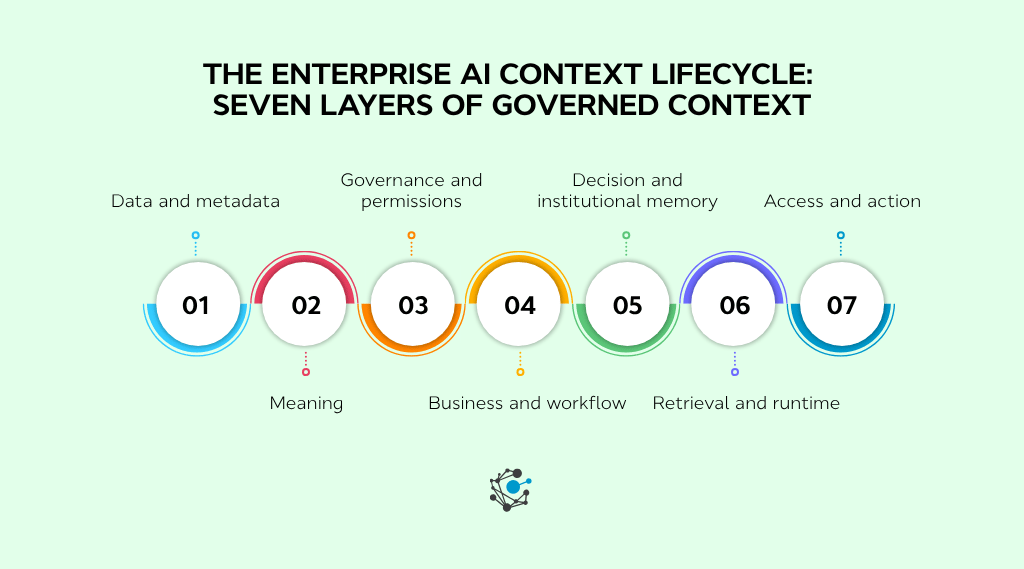
Enterprise context does not become usable by AI in a single step. It moves through seven connected layers that establish what information exists, what it means, how it is governed, and what an agent can ultimately do with it.
The Enterprise AI Context Lifecycle organizes that journey into seven layers:
1. Data and metadata: Establish what exists
The foundation identifies available data, where it lives, who owns it, how fresh it is, and whether its quality is sufficient. Catalogs, metadata, lineage, and quality signals establish this baseline.
2. Meaning: Establish what it means
Business glossaries, taxonomies, ontologies, and semantic mappings give technical assets business meaning. This layer helps an agent distinguish an approved revenue metric from another field with a similar name.
3. Governance and permissions: Establish what can be used
Policies, classifications, privacy requirements, and access controls determine which information is appropriate for a particular user, agent, and purpose.
4. Business and workflow: Establish the situation
The same information can mean different things depending on the task. Workflow context connects data to the process, role, objective, and business event behind the request.
5. Decision and institutional memory: Establish what happened before
Past decisions, approvals, exceptions, and outcomes give agents access to organizational precedent rather than forcing every interaction to begin without history.
6. Retrieval and runtime: Assemble the right context
At runtime, retrieval selects and prioritizes the definitions, data, policies, history, and other information needed for the current task. This is where the AI context layer for agents turns the preceding layers into usable context.
7. Access and action: Control what happens next
The final layer determines which tools and systems the agent can access and what actions it can perform, including where human approval is required.
Together, the seven layers move context from available → understood → governed → situated → remembered → retrieved → actionable. For most enterprises, however, implementing this lifecycle does not mean building seven new capabilities.
Key takeaway:
-
Already exists: Data, metadata, governance, and permissions provide the foundation.
-
Must evolve: Business definitions, glossaries, and semantics need to become machine-readable and usable at runtime.
-
Genuinely new: Workflow context, institutional memory, runtime retrieval, and controlled agent actions require new capabilities.
-
Priority: Connect these layers so trusted, governed context can reach AI agents when they reason and act.
Context engineering techniques that decide what enters the window
Once the context layers are in place, four techniques determine what reaches the model at runtime:
-
Selection and retrieval scoping: Filters context by relevance, certification, freshness, and user permissions.
-
Compression and summarization: Reduces token usage while preserving essential information.
-
Isolation: Keeps context separated across agents or workflow stages to prevent irrelevant information from carrying over.
-
Ordering and recency: Prioritizes the most important and current context within the model’s window.
Together, these context engineering techniques help AI systems receive the right context at the right time without overloading the context window.
Five ways enterprise context fails in production
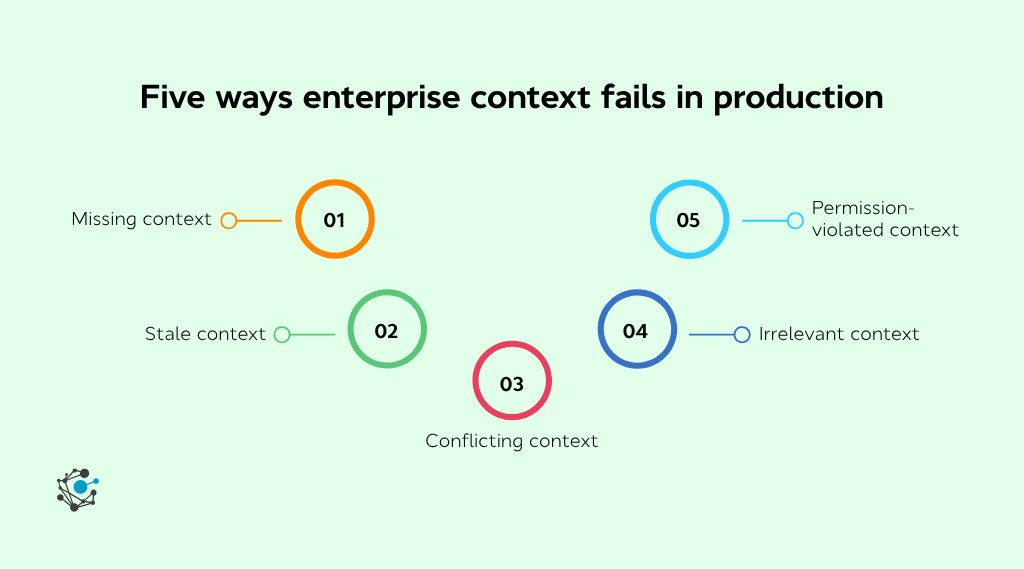
Context failures become easier to diagnose when each is tied to its business risk and the control that prevents it.
1. Missing context
The agent lacks critical information, increasing the risk of incomplete or fabricated answers.
Fix: Improve catalog coverage and discoverability.
2. Stale context
Outdated data or definitions produce answers that no longer reflect the business.
Fix: Monitor freshness and deprecate outdated assets.
3. Conflicting context
Multiple definitions or sources leave the agent without a clear authority.
Fix: Certify trusted sources and approved definitions.
4. Irrelevant context
Low-value information crowds the context window and weakens the useful signal.
Fix: Apply retrieval scoping and ranking.
5. Permission-violated context
Restricted information reaches an unauthorized user or agent.
Fix: Enforce access policies during retrieval.
Why retrieval alone does not produce trusted context
Retrieval-augmented generation (RAG) helps AI access relevant, organization-specific information, but relevance alone does not establish trust. Retrieval cannot determine whether a source is approved, current, accurate, or permitted for a specific user.
Governance provides those missing signals through certification, ownership, lineage, quality, and access policies. Graph-based retrieval can then connect these signals to the data an agent retrieves, giving it richer context for reasoning.
An enterprise context graph brings these relationships together by connecting business definitions, metadata, lineage, quality, ownership, and governance policies into context AI agents can use at runtime.
OvalEdge Expert Insight: RAG provides relevance. Governance provides trust. Reliable enterprise AI requires both.
How to build a context engineering framework
Building a context engineering framework starts with the AI use case and works backward to the information, governance, and controls the agent needs. The goal is to create a repeatable path from enterprise data to trusted runtime context.
Step 1: Define the use case
Identify what the agent needs to accomplish, which information assets it depends on, and what level of accuracy or control the task requires. A finance agent, for example, may need certified financial data, approved metric definitions, and reporting policies.
Step 2: Crawl the relevant systems
Connect the data, metadata, documents, reports, and other sources the agent may need. This creates visibility into what information exists and where it comes from.
Step 3: Curate the context
Add business meaning, ownership, classifications, and certification so agents can distinguish trusted information from everything else.
Do you know? OvalEdge Governance Agents can automate parts of this work, including discovering business terms, classifying sensitive data, evaluating assets for certification, and building enterprise ontology.
Step 4: Apply governance
Attach policies, permissions, quality signals, and access controls to context so governance can be enforced when information is retrieved.
Step 5: Deliver context at runtime
Make governed context available through retrieval pipelines, APIs, or MCP so the agent receives the right information for each task rather than a static collection of enterprise knowledge.
Step 6: Measure and improve
Track context quality, retrieval accuracy, source usage, and agent outcomes. Use those signals to refine certification, ranking, and context selection over time.
Related reading: For a deeper look at building the architecture, governance, and runtime context AI agents need, explore Context Engineering Frameworks: The AI Missing Layer.
Context engineering platforms: five categories and how to compare them
Context engineering platforms solve different parts of the context lifecycle. Most enterprise architectures combine multiple categories rather than relying on one platform.
|
Category |
Primary role |
|
Retrieval and vector infrastructure |
Finds and ranks relevant information |
|
Memory and state management |
Maintains context across interactions |
|
Orchestration and agent frameworks |
Coordinates agents, tools, and workflows |
|
Governance and metadata platforms |
Provides trusted definitions, lineage, quality, and access controls |
|
Evaluation and observability |
Measures context quality and agent performance |
When comparing platforms, focus on how well they connect to enterprise systems, enforce permissions, identify trusted sources, support lineage, and deliver context to agents at runtime. The right combination depends on which context capabilities already exist and where the gaps remain.
Governed context is what separates a demo from production
Production AI introduces a requirement that retrieval alone cannot address: authority. An agent needs to know what information it can access, what it can expose, and which actions it is authorized to perform.
Permission to know does not automatically grant permission to act. An agent may retrieve a customer record without being allowed to expose it, draft a response without sending it, or recommend an approval without granting it. Governed autonomy matches each action to its business risk, with some actions automated, some requiring human approval, and others blocked.
The business case extends beyond risk control.
A Forrester Total Economic Impact study reported up to 40% less effort to catalog metadata and compile lineage, 75% less effort to find, tag, and secure sensitive data, and a 30% improvement in analyst productivity.
These efficiencies make the governance foundation easier to operationalize as AI moves from experimentation into production.
Conclusion
Enterprise AI succeeds when definitions, lineage, quality signals, ownership, and access policies are structured so machines can use them at runtime. Much of this foundation already exists inside enterprise governance programs. The challenge is activating and connecting it so AI agents can access trusted context when they reason and act.
A unified data governance platform brings that metadata, meaning, trust, and control together as an operating layer for AI. OvalEdge helps enterprises turn existing governance foundations into governed context that can reach AI agents through retrieval, APIs, and MCP.
Book an Enterprise Context Graph demo to see how OvalEdge connects metadata, business meaning, lineage, quality, and governance into trusted context for enterprise AI.
.png?width=1081&height=173&name=Forrester%201%20(1).png)
.png?width=1081&height=241&name=KC%20-%20Logo%201%20(1).png)