Banks are filing more reports than ever, with less time to do it. Regulatory volume keeps climbing, examiners now want real-time lineage on top of accurate numbers, and compliance headcount has not kept pace with either.
The pressure goes beyond correct filings. Examiners want to see how every figure was produced, which systems it touched, and who signed off, all on demand. That shift has turned compliance reporting from a periodic exercise into a continuous documentation problem.
For compliance officers, risk leaders, and IT teams, AI automation for banking compliance reporting has moved from pilot to serious operating decision.
This guide covers what AI compliance automation does today, where it earns regulator trust, and how to sequence a rollout examiners will accept.
What is AI automation for banking compliance reporting?
AI automation for banking compliance reporting is the use of machine learning, rule engines, and workflow automation to pull data from source systems, apply regulatory logic, flag anomalies, and generate filings with a traceable audit trail. It replaces the manual reconciliation and spreadsheet work that dominates most compliance cycles today.
Human reviewers still make the final judgment calls. What changes is that data assembly, validation checks, and documentation now happen automatically instead of by hand.
A production-grade AI compliance automation stack typically includes:
- Automated data aggregation from core banking, GL, AML, and KYC systems
- Pattern-based transaction monitoring for AML, fraud, and sanctions screening
- Rule-based mapping of source fields to schemas like FFIEC Call Report, CCAR, and BSA
- Anomaly and exception detection before submission
- Immutable audit trail capture with model version, dataset snapshot, and approver identity
- Human sign-off workflow with approval gates at defined thresholds
Adopting AI compliance automation only works if the underlying data can answer an examiner’s question on the spot. Examiners now expect AI governance for banking built into the pipeline from the start, with lineage and approvals visible on demand instead of reconstructed after the fact.
Why manual compliance reporting is breaking down in banking
Manual compliance reporting worked when filings were quarterly and data sat in a few systems. Today, overlapping deadlines, rising exception rates, and analyst time consumed by data assembly leave little room for judgment work, and the burden falls hardest on smaller institutions. Two structural problems drive most of this pressure:
1. Fragmented data across core banking and GRC systems
Compliance data lives across several disconnected systems, each with its own identifiers and refresh cycles:
- Core banking platforms
- Loan origination systems
- Payment rails
- AML monitoring tools
- Standalone GRC applications
The same field is often labeled differently across systems. Modern data catalogs can resolve these naming inconsistencies automatically, but only when the underlying definitions are governed consistently.
Before every filing cycle, analysts spend days reconciling extracts and chasing discrepancies, often pulling multiple teams into a thread just to confirm one number.
2. Rising regulatory scrutiny and real-time lineage expectations
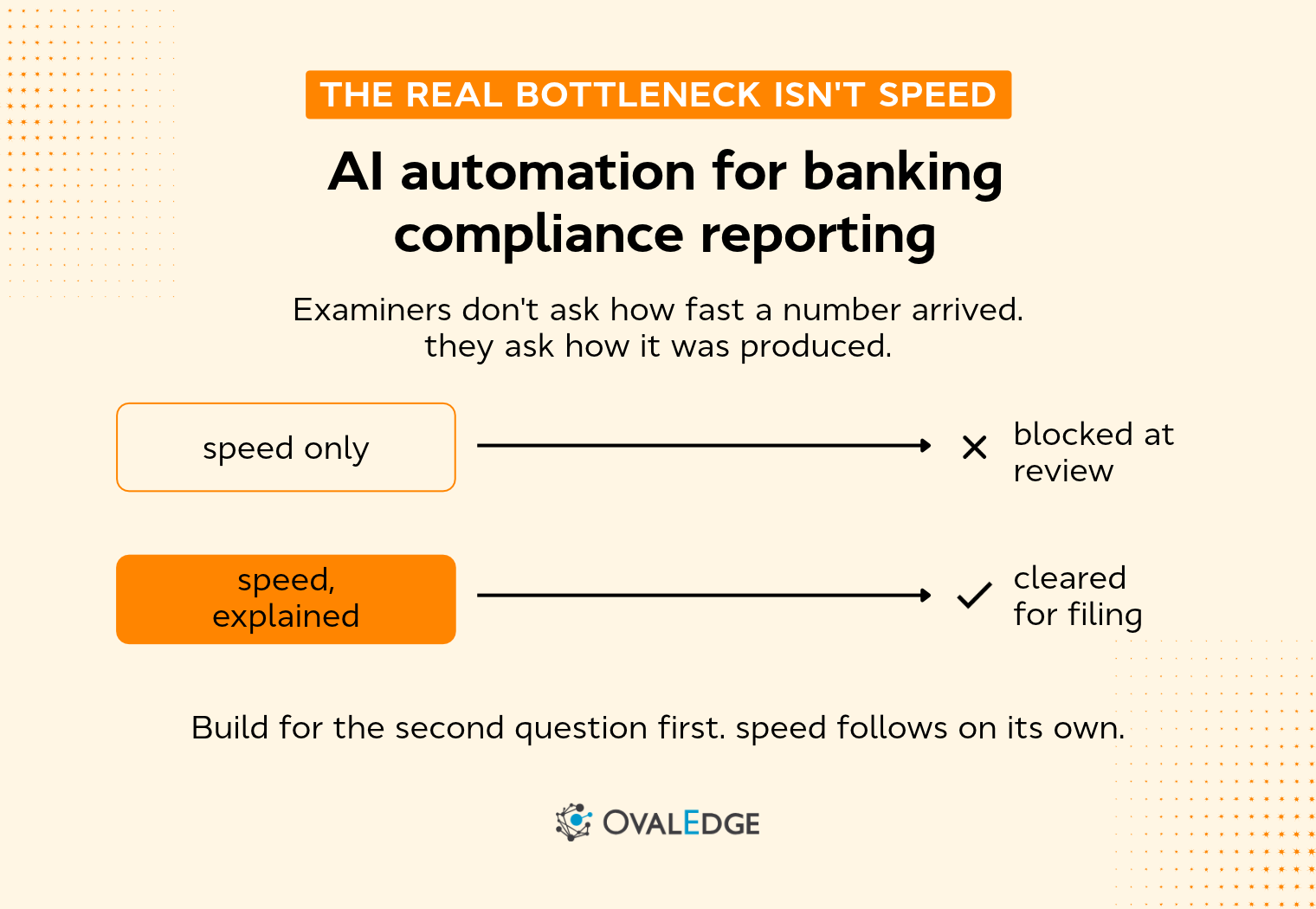
Correct end-state numbers are no longer enough; regulators now want to see how a figure was produced and who signed off.
As per BCG's 2025 study, "Risky Times and Cost Pressure Call for Innovation in Bank Compliance," early adopters of automated alert handling tripled the speed of Level 1 alert reviews and doubled the speed of Level 2 alert handling, largely by producing lineage on demand instead of scrambling for it during an exam.
Manual reconciliation rarely holds up when an examiner asks that question on the spot, and reconstructing data lineage after the fact is where most manual processes break.
Expert insight: The gap between “correct numbers” and “traceable numbers” is where most banks underestimate the work involved. You can have accurate data and still fail an examination if you cannot reconstruct how that data moved from source to filing on demand.
How AI automates the compliance reporting lifecycle
AI now touches every stage of the reporting lifecycle, from source data pull through post-filing audit. Some capabilities are mature and low-risk; others still require significant human oversight.
1. Automated data aggregation and reconciliation
Automated compliance reporting starts with pulling data from core banking, general ledger, loan origination, payment, and AML/KYC systems, then standardizing it into a common model.
AI-driven pipelines handle schema translation, deduplicate customer and account records across systems, and reconcile balances that differ across sources. Work that used to take an analyst several days per cycle can run overnight, with mismatches flagged for review instead of buried in a spreadsheet.
Example: When a mid-size bank renames a source field in its core banking platform, every downstream Call Report and BSA filing that references that field can silently break. Without column-level lineage connecting the renamed field to its downstream consumers, the break only surfaces when an examiner flags a mismatch, after the filing has already been submitted.
None of this holds up, though, if the bank can't trace where each figure came from in the first place, which is a governance problem before it's an automation problem.
Compliance automation fails most often not because the automation itself is wrong, but because the data it pulls from was never governed consistently across source systems. A data catalog that connects to lineage, business definitions, and quality rules is what lets a bank trace every reported figure back to its source before an examiner asks.
2. AML/KYC monitoring and regulatory rule mapping
Transaction monitoring remains the highest-volume AI use case in banking compliance. ML models score payments, wires, and account activity against patterns linked to structuring, layering, and sanctions evasion.
Newer systems combine supervised learning from confirmed SARs with unsupervised anomaly detection to catch emerging typologies and reduce rule-based false positives.
AI also supports customer due diligence by checking sanctions lists, adverse media, and beneficial ownership data, then recalculating risk as new information emerges. It handles pattern matching and prioritization, while investigators retain the SAR decision.
Alongside monitoring, rule engines map source fields to CCAR, FFIEC Call Reports, BSA/AML, and Basel III schemas, with flexibility to update mappings as regulations change.
3. Anomaly and exception detection
Beyond transaction monitoring, ML models scan the reporting output itself for anomalies before submission. Missing fields, unusual account-level movements, entries that fall outside historical ranges, and records that fail cross-schema validation all get surfaced for review.
The bar for a flag can be tuned per report type, so a Call Report gets tighter thresholds than an internal risk dashboard. Anomaly detection only works when the underlying data quality is high enough for the model to distinguish real outliers from routine noise.
For example, an ML model reviewing a Call Report draft might flag a large quarter-over-quarter jump in a single loan category as a likely data-mapping error worth reviewing before submission.
Expert insight: Pre-submission anomaly detection catches what quality rules miss, but only when the data entering the pipeline has already passed classification and governance gates upstream. Catching a bad number at the filing stage means something earlier in the pipeline did not hold.
4. Audit trails, filing workflow, and AI copilots
The last stage of the lifecycle is where AI regulatory reporting solutions typically converge on similar features.
Immutable audit logging that captures dataset version, model output, and approver identity; filing workflow with configurable approval gates; and NLP-driven copilots that let a compliance officer ask questions like “show me the lineage for row 47 of this quarter’s Call Report” without opening a query tool. Copilot accuracy depends on whether the underlying data governance layer carries certified definitions, trusted sources, and enforceable access rules; without those signals, natural-language queries return confident answers from ungoverned data.
Copilot capabilities are the newest and least mature layer, so most banks treat them as an internal aid instead of an external-facing control. Audit trail depth carries directly into the governance discussion below.
AI governance and risk management for regulatory reporting
Every efficiency gain from AI regulatory reporting adds exposure if the bank cannot explain how the model reached its conclusion or prove who signed off. AI governance for banking has to be designed into the pipeline from day one, because retrofitting controls after an examiner finding is significantly more expensive.
Explainability vs. auditability: why regulators require both
Explainability answers how and why a model reached a specific conclusion, showing which features drove the score and what weight each carried. Auditability answers what actually happened: which model version ran, which dataset snapshot it used, and which human approved the result.
Regulators require both because either one alone leaves a gap.
An auditable pipeline with an opaque model may satisfy record-keeping while failing an ECOA adverse-action review or an examiner's line of questioning about a specific SAR.
Example: A regional bank’s annual model review requires validating that its credit decisioning model was trained on the approved dataset, not an ad hoc analyst extract. With a governed data catalog tracking dataset versions, sources, and certification status, the validation team can confirm lineage in minutes instead of reconstructing it over several days.
AI risk management banking programs that treat these as one requirement usually satisfy neither well.
What a defensible audit trail must contain
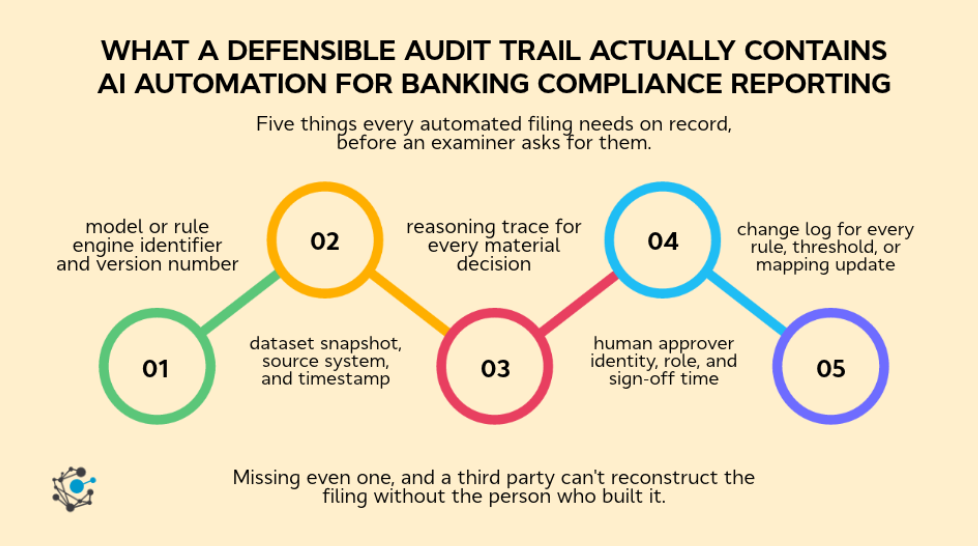
A defensible audit trail should let a third party reconstruct a filing without access to the person who produced it. The minimum record includes:
- Model or rule engine identifier and version number
- Snapshot of the input dataset used, with source system and timestamp
- Reasoning trace or feature-contribution output for each material decision
- Human approver identity, role, and sign-off timestamp
- Change log for every modification to rules, thresholds, or mappings
The record must be tamper-evident, retained for the full examination lookback window, and searchable without a database engineer.
Financial data governance programs that meet this bar anchor the audit trail in a connected governance layer, not a single tool: catalog for what the data is, lineage for where it came from, glossary for what it means, and policy for who’s allowed to touch it. That connected layer is what turns “the model decided” into an answer with a paper trail.
Human-in-the-loop and regulatory framework mapping
AI handles data assembly, pattern detection, and validation; humans retain the interpretive calls that carry legal weight, including SAR determinations, risk exceptions, and adverse-action decisions. The three lines of defense framing still applies: the first line owns the model output, the second line challenges it, and the third line audits both.
Expert insight: Regulators are not asking banks to stop using AI for compliance. They are asking for accountability at every step: who trained the model, which data it used, who reviewed the output, and who signed off. The three-lines-of-defense framework already gives banks this structure. The question is whether the bank can document it automatically.
Framework mapping matters because AI compliance work spans several regimes:
- SR 26-2 (Fed/OCC/FDIC, April 2026): replaced SR 11-7; most relevant to $30B+ institutions, with a risk-based approach and an explicit carve-out for generative and agentic AI
- Basel III: credit risk model governance and capital calculations
- GDPR Art. 22 / ECOA: right to explanation for adverse automated decisions
- EU AI Act: high-risk system documentation, including for credit scoring
- BCBS 239: risk data aggregation and reporting principles for G-SIBs
Each framework changes what has to be documented, so the governance layer needs to satisfy them without rebuilding the pipeline for each one.
Which regulatory reports should banks automate first?
Sequencing regulatory reporting automation follows filing frequency and manual-effort intensity.
The reports that consume the most analyst hours and repeat the most often are usually the best first candidates, even when they look less strategically important than annual submissions.
|
Report Type |
What Gets Automated |
Typical Impact |
|
Transaction monitoring, customer risk scoring, alert triage, filing preparation |
Cuts false-positive review time; SAR narrative drafts pre-populated |
|
|
Data aggregation across GL, loan, and deposit systems; schema mapping; cross-schedule validation |
Reduces cycle time from weeks to days; catches mapping errors before submission |
|
|
Scenario data assembly, model input validation, results reconciliation |
Frees quant teams from data prep; shortens submission cycle |
|
|
RWA calculation inputs, exposure classification, capital ratio validation |
Improves consistency across legal entities; supports faster what-if analysis |
|
|
Loan application data validation, geographic coding, demographic field completeness checks |
Catches data quality issues pre-filing; supports fair lending analysis |
Consistent with BCG's findings above, Ghimire's 2025 study, "AI-Powered Anomaly Detection for AML Compliance in US Banking: Enhancing Accuracy and Reducing False Positives," found that AI-driven models can reduce false positives by up to 70% while improving detection of genuinely high-risk activity by up to 30% over traditional rule-based systems.
BSA/AML usually comes first because its volume and frequency deliver the fastest ROI, with transaction monitoring being the most established AI use case. Call Reports are a common second step for community and regional banks, while CCAR and Basel III typically come later due to stricter model governance and validation requirements under SR 26-2.
How to implement regulatory reporting automation: a 6-step framework
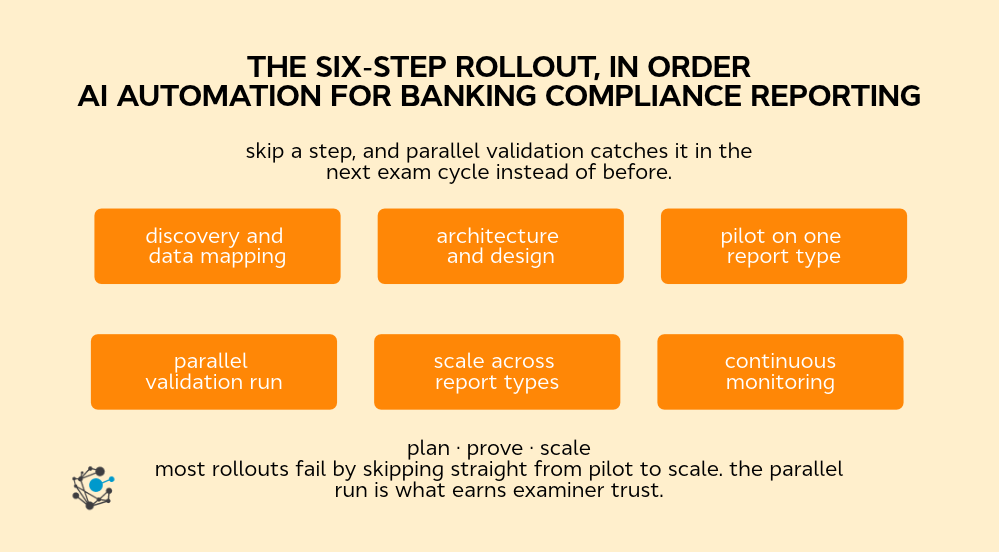
Automation programs that survive their first exam cycle share a common rollout shape.
Step 1: Discovery and data mapping
Audit every existing reporting workflow, source system, and regulatory obligation. Map which fields flow into which reports, who owns each, and where reconciliation currently happens.
Step 2: Architecture and compliance design
Design the integration and control architecture jointly with risk, IT, and compliance stakeholders. Involve internal audit early so validation requirements are baked into the design instead of retrofitted later.
Step 3: Pilot on one report type
Validate the pipeline against historical filings for a single report, most often the Call Report or SAR. A narrow pilot proves the model works before scope expands.
Step 4: Parallel validation run
Run AI-generated and manual reports side by side for at least two full cycles before cutover. The parallel run is what earns examiner and internal-audit trust; skipping it usually shows up in the next MRA.
Step 5: Scale across report types
Extend incrementally, one report type at a time, using lessons from the pilot. Big-bang rollouts almost never survive first contact with an actual filing deadline.
Step 6: Continuous monitoring and rule updates
Maintain rule engines against evolving requirements. Version the rules, log every change, and re-validate whenever a regulator updates a schema or examiner expectations shift.
Working through discovery, design, pilot, parallel validation, staged scale-out, and continuous monitoring in that order is the sequencing that holds up under examiner review. Banks that map this against a broader data governance roadmap tend to move through these six steps faster, since ownership and lineage questions are already answered before automation work begins.
Manual vs. AI-automated compliance reporting
The gap shows up most clearly in the day-to-day work of a compliance team, not in the final report itself.
|
Dimension |
Manual Process |
AI-Automated Process |
|
Data aggregation time |
Days to weeks per cycle; analysts pull extracts and reconcile by hand |
Hours; pipelines refresh continuously with exceptions flagged for review |
|
Error and rework rate |
High; mapping errors and manual entry mistakes surface late in review |
Low; validation runs pre-submission with anomaly detection on the output |
|
Audit trail completeness |
Reconstructed after the fact from emails, shared drives, and spreadsheets |
Captured automatically with model version, dataset snapshot, and approver identity |
|
Regulatory update turnaround |
Weeks; each schema change triggers manual rework across templates |
Days; rule engine updates deploy without touching the pipeline |
|
Analyst time allocation |
Weighted toward data assembly, with limited time left for review and judgment |
Weighted toward judgment and exception handling, with data assembly largely automated |
Industry surveys consistently show that data professionals spend the majority of their time on data preparation rather than analysis. Compliance teams report a similar pattern: analyst hours are disproportionately consumed by data assembly, reconciliation, and formatting, with limited time left for the judgment and review work that regulators actually value.
The shift is one of role, not headcount. AI-automated compliance reporting moves analysts from spreadsheet work to the interpretive calls where their expertise actually matters, which is exactly what examiners want to see when they ask who reviewed a specific SAR determination or exception.
Risks and pitfalls to avoid
The pitfalls below are where automation programs most often fail after go-live, and where competitor content tends to go quiet.
1. Over-automating judgment-based decisions
Automating data assembly carries little risk. What does carry risk is automating decisions without human sign-off, including:
- Final SAR determinations
- Risk exception approvals
- Adverse-action decisions
Regulators expect a named human on the record for any decision that materially affects a customer or a filing, and "the model decided" is not a defensible answer.
2. Poor data quality at the source
Automation amplifies upstream data problems instead of fixing them. A pipeline that pulls from ungoverned source systems generates perfectly formatted reports full of incorrect classifications and mismatched customer IDs.
The failure mode looks worse under automation because volume masks the errors until an examiner catches them. A governed, cataloged data foundation is what keeps this from happening; without it, automation just produces bad numbers faster and with more confidence.
3. Vendor lock-in and integration debt
Rule engines tightly coupled to one vendor's schema get harder to adapt as requirements shift or core systems get replaced. Every custom mapping written against a proprietary format has to be rewritten when the vendor changes its data model.
The vendors that lock banks in hardest are often the ones pitching "end-to-end" automation, since end-to-end frequently means proprietary schemas at every layer. When evaluating a vendor, check:
- How easily their rule engines can be modified in-house
- Whether audit trails export in an open format
Vendors that resist either question are usually the ones building the lock-in they won't admit to.
Turn existing governance into compliance automation with OvalEdge
AI automation for banking compliance reporting is an ongoing capability that evolves with regulatory change, not a one-time project. Automation built on a governed data foundation accelerates good results. Without it, automation accelerates errors instead.
Most regulated banks already have a significant part of this foundation. Years of regulatory work have produced business glossaries, data owners, lineage maps, quality rules, and access policies. The gap is rarely that the work has not been done. It is that these artifacts sit in disconnected systems and cannot answer an examiner's question on the spot.
OvalEdge’s Enterprise Context Graph connects and activates this existing foundation through purpose-built agents: Sift classifies regulated data across source systems, Curo confirms governance status, and Notary enforces access gates at each approval step, bringing it into a single governed layer that compliance automation can build on and examiners can audit.
Book a demo to see how the Enterprise Context Graph powers compliance reporting automation built for examiner review.