AI compliance software becomes necessary when enterprises cannot identify their AI systems, owners, data, or approval history across internal environments, SaaS products, vendors, and employee workflows.
According to McKinsey’s 2025 global survey on AI risk, 47% of respondents said their organizations had experienced at least one negative consequence from generative AI use.
Fragmented ownership, inconsistent reviews, and evidence gaps make it difficult to prove whether controls operated before or after an incident.
AI governance software, AI risk management tools, and a responsible AI platform should connect assets with owners, risk classifications, controls, lifecycle reviews, monitoring, exceptions, and evidence rather than merely store policies.
This guide compares the capabilities, platform categories, and criteria enterprise buyers should assess when selecting AI compliance software.
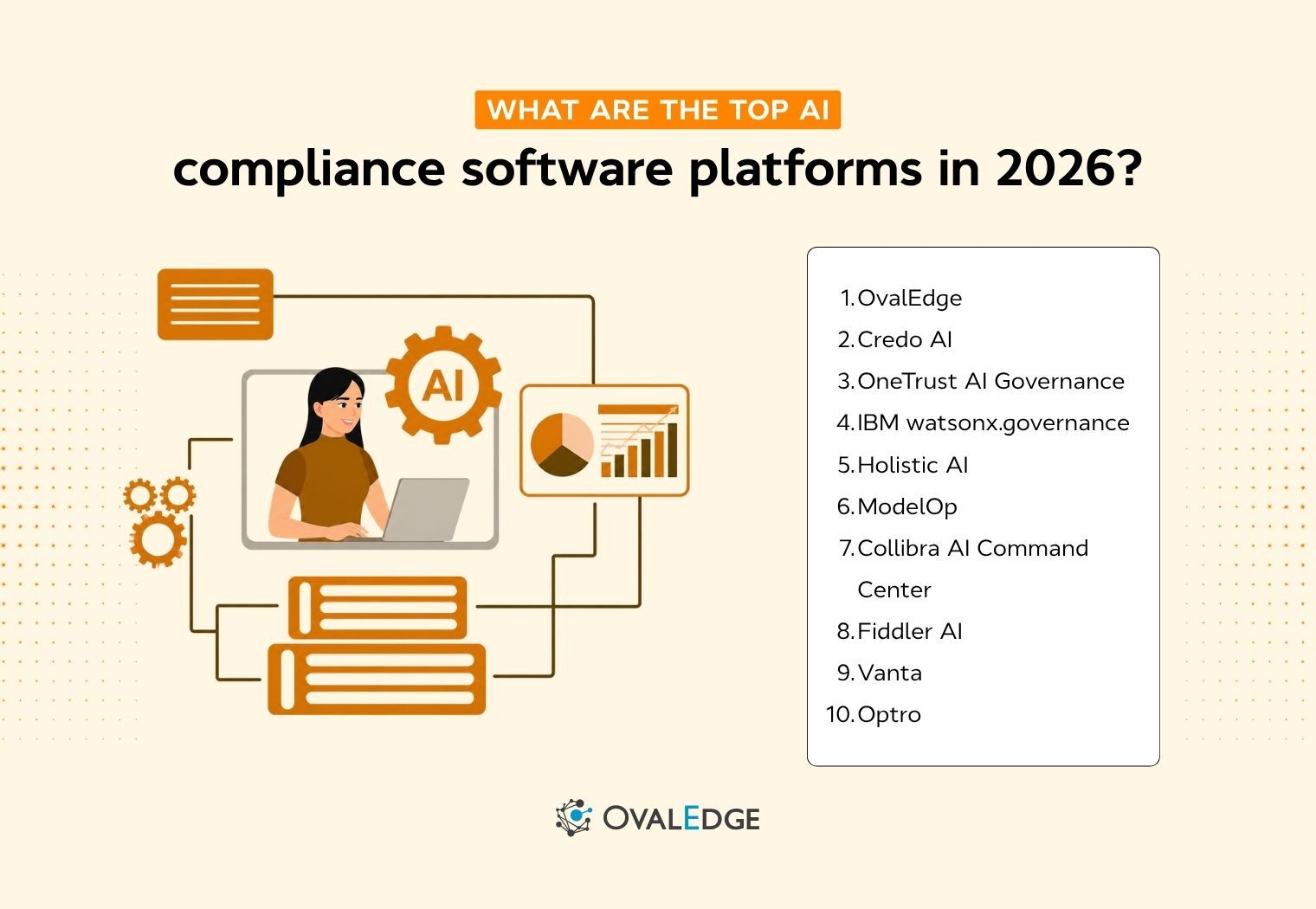
What are the top AI compliance software platforms in 2026?
The market includes data governance platforms, AI systems of record, lifecycle tools, observability products, and GRC systems. These overlapping categories support different control and evidence needs.
They are not always substitutes. An enterprise may use separate systems for data governance, model assurance or runtime monitoring, and GRC evidence and audits.
Each platform is reviewed through its overview, key features, pros, and cons.
|
Platform |
Best for |
Governance focus |
Main strength |
|
OvalEdge |
Data-led AI governance |
Data and metadata governance |
Lineage, quality, privacy, ownership, and access |
|
Credo AI |
Policy-led AI oversight |
AI governance system of record |
Policies, assessments, and regulatory mapping |
|
OneTrust |
Privacy-connected governance |
AI governance and GRC |
Privacy, third-party risk, and workflows |
|
IBM watsonx.governance |
Model-intensive enterprises |
Model lifecycle governance |
Evaluation, monitoring, and explainability |
|
Holistic AI |
Continuous AI assurance |
Purpose-built AI governance |
Discovery, testing, enforcement, and monitoring |
|
ModelOp |
AI portfolio governance |
AI lifecycle governance |
Inventory, risk tiers, approvals, and reporting |
|
Collibra |
Metadata-led AI governance |
Data and AI intelligence |
AI relationships, lineage, and ownership |
|
Fiddler AI |
Production AI oversight |
Runtime observability |
Monitoring, explainability, and guardrails |
|
Vanta |
Compliance-led programs |
GRC automation |
Frameworks, controls, evidence, and audits |
|
Optro |
AI governance within GRC |
Risk and assurance |
AI risks, controls, evidence, and audit workflows |
1. OvalEdge
OvalEdge is an AI-powered data catalog and governance platform for enterprises whose AI compliance gap begins with data. It connects metadata, ownership, lineage, quality, privacy, access, and certification, helping teams prove which data supports an AI system and whether that data is trusted and permitted.
Key features
-
Data Catalog: Centralizes technical, operational, and business metadata across more than 150 connectors.
-
Business Glossary: Aligns AI use with approved terms, metrics, definitions, and owners.
-
End-to-End Lineage: Traces data from source systems through transformations and downstream AI use.
-
Data Quality and Certification: Monitors reliability and identifies approved assets for AI.
-
Privacy and Access Governance: Classifies sensitive data and connects it with policies, approvals, and audit records.
-
Automated Governance: Supports discovery, classification, issue routing, and stewardship workflows.
Pros: Provides a connected, modular foundation for data-led AI governance.
Cons: Specialized model testing, observability, and runtime guardrails may require complementary tools.
OvalEdge stands out when compliance depends on proving which data trained, tested, grounded, or operated an AI system and whether that data was owned, trustworthy, permitted, and policy-aware.

Book a demo now to see how OvalEdge can help you.
2. Credo AI
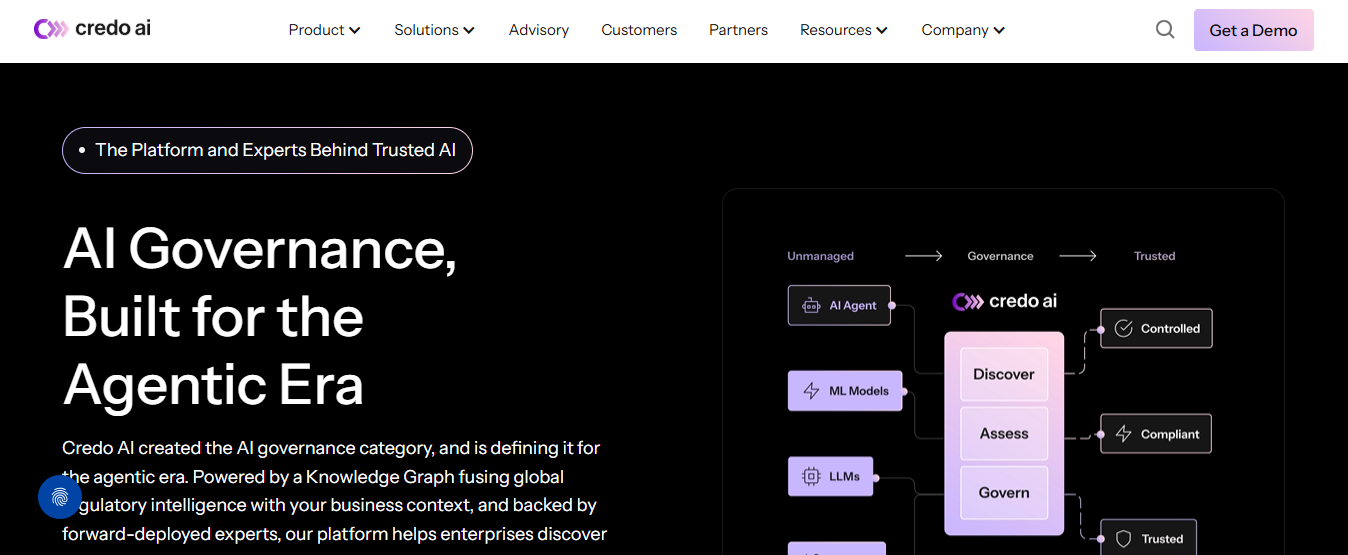
Credo AI is an AI governance system of record for enterprises coordinating policies, assessments, approvals, and evidence across models, applications, agents, datasets, and vendors.
Key features
-
Enterprise AI Registry: Centralizes AI models, applications, agents, use cases, datasets, and third-party systems.
-
Risk and Impact Assessments: Evaluates systems against business impacts, risk scenarios, and governance requirements.
-
Policy Packs and Regulatory Mapping: Maps frameworks such as the EU AI Act, NIST AI RMF, and ISO/IEC 42001 to controls.
-
Evidence and Approval Workflows: Connects reviews, assigned actions, approvals, and audit-ready evidence.
Pros: Strong policy-led governance and broad coverage across internal and third-party AI.
Cons: Technical evidence may depend on integrations, while data governance and production monitoring require other tools.
3. OneTrust AI Governance
OneTrust AI Governance connects AI oversight with privacy, data protection, third-party risk, and existing trust programs.
Key features
-
AI Inventory: Centralizes AI systems, models, applications, vendors, agents, and use cases.
-
Risk and Impact Assessments: Evaluates privacy, compliance, security, ethical, and third-party risks.
-
Policy Enforcement Workflows: Connects initiatives with policies, reviews, approvals, responsibilities, and remediation.
-
Monitoring and Documentation: Maintains governance records as AI systems change.
Pros: Strong alignment between AI, privacy, and third-party risk, especially for existing OneTrust users.
Cons: Deep model testing may require specialist tools, while lineage may not match a dedicated metadata platform.
4. IBM watsonx.governance
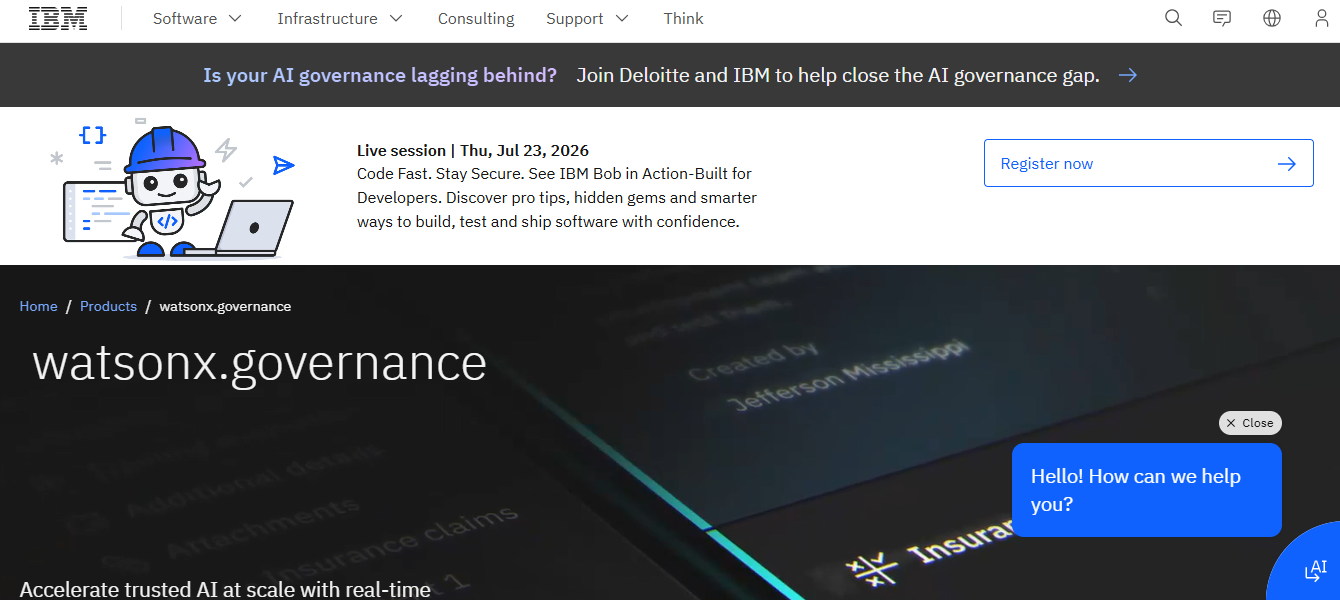
IBM watsonx.governance supports model-intensive enterprises managing predictive, generative, and third-party AI from development through production.
Key features
-
Model and AI Inventory: Centralizes facts about models across development and production environments.
-
Lifecycle Governance: Tracks systems through request, evaluation, approval, deployment, monitoring, and retirement.
-
Model Evaluation and Monitoring: Monitors performance, drift, quality, safety, and defined thresholds.
-
Explainability and Compliance Reporting: Connects model evidence, explanations, risk reviews, controls, and reporting.
Pros: Strong technical model oversight for regulated, multi-model environments.
Cons: Implementation can be complex and may require additional IBM products or integrations.
5. Holistic AI
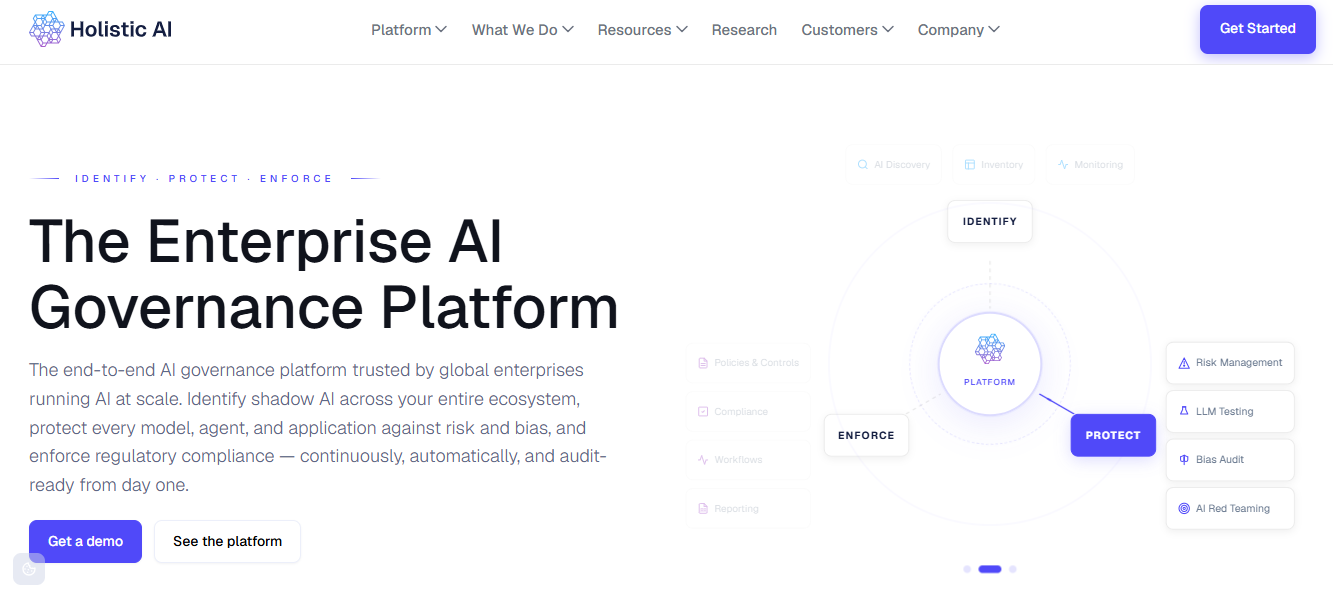
Holistic AI combines AI governance, technical assurance, and runtime oversight for enterprises managing deployed, third-party, and shadow AI.
Key features
-
AI Discovery and Inventory: Identifies models, applications, agents, APIs, pipelines, vendors, and shadow AI.
-
Risk and Bias Testing: Supports risk assessments, bias audits, safety evaluations, and technical testing.
-
Regulatory Compliance Mapping: Connects systems with policies, requirements, assessments, and evidence.
-
Continuous Monitoring and Enforcement: Monitors deployed systems and applies policy controls across models and agents.
Pros: Broad coverage across governance, testing, monitoring, and emerging regulatory requirements.
Cons: Buyers should assess integration with existing data governance systems and implementation demands.
6. ModelOp
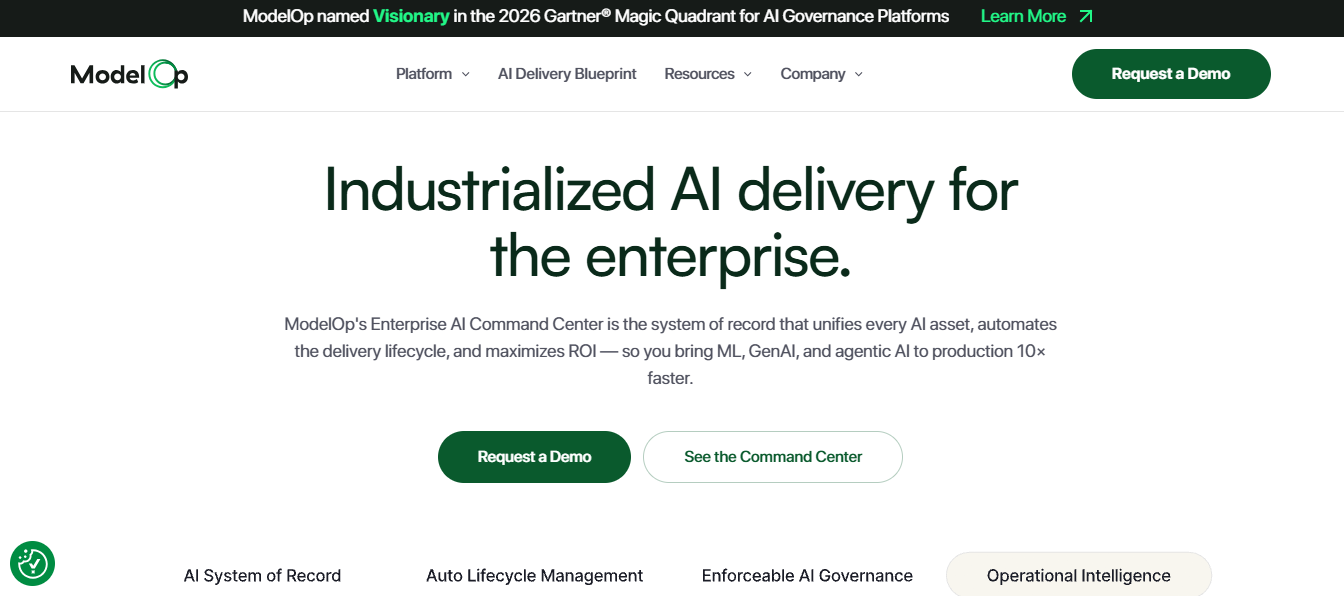
ModelOp is an enterprise lifecycle governance platform for internally developed, embedded, predictive, generative, agentic, and third-party AI.
Key features
-
AI System of Record: Centralizes governed AI systems across the enterprise.
-
Automated Risk Tiering: Classifies use cases and assigns required governance activities, evidence, and approvals.
-
Lifecycle and Approval Workflows: Coordinates intake, validation, approval, monitoring, reassessment, and retirement.
-
Portfolio Reporting: Gives executives visibility into ownership, usage, risk, performance, cost, and value.
Pros: Strong system-of-record approach with portfolio-level oversight for regulated organizations.
Cons: Separate data cataloging and additional runtime security or guardrails may still be required.
7. Collibra AI Command Center
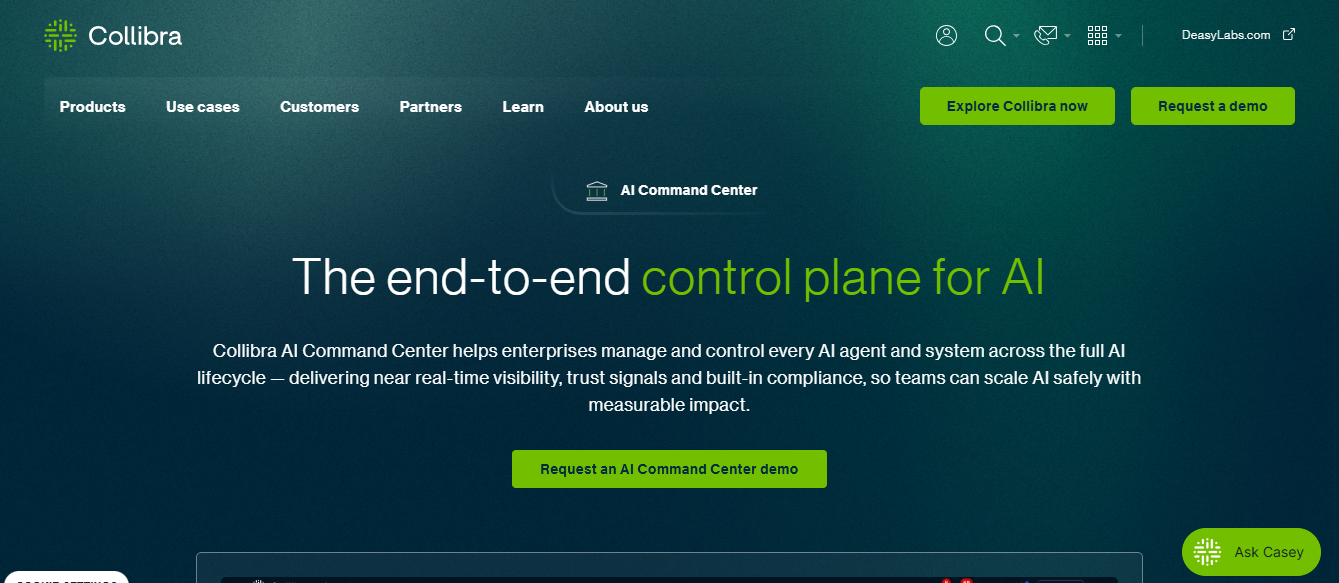
Collibra AI Command Center connects AI oversight with enterprise metadata and governance context, particularly for existing Collibra users.
Key features
-
Model and Agent Registries: Standardizes inventories for models, agents, use cases, and documentation.
-
Data and Model Lineage: Connects AI systems with supporting datasets, transformations, and applications.
-
Ownership and Lifecycle Context: Records owners, lifecycle status, documentation, and governance responsibilities.
-
Governance and Risk Assessments: Links use cases, models, agents, metadata, and risks under common standards.
Pros: Strong connection between AI systems, enterprise metadata, and business context.
Cons: Deployment and licensing may be complex, while production observability may require another platform.
8. Fiddler AI
Fiddler AI focuses on production observability and runtime governance for predictive models, generative AI applications, and agents.
Key features
-
Model and Agent Observability: Monitors models, generative applications, and agents in production.
-
Performance and Drift Monitoring: Tracks quality, behavior changes, drift, and operating conditions.
-
Explainability and Root-Cause Analysis: Investigates why outputs changed or performance declined.
-
Guardrails and Runtime Controls: Applies policy-based controls and records runtime activity.
Pros: Strong production evidence, root-cause analysis, and model and agent monitoring.
Cons: It does not replace an enterprise AI system of record; broader policy, data, and lifecycle governance require integrations.
9. Vanta
Vanta helps security and compliance teams manage AI requirements within wider trust, control, and audit programs.
Key features
-
AI Governance Framework Support: Supports frameworks such as NIST AI RMF and ISO/IEC 42001.
-
Control Mapping: Connects requirements with controls, policies, owners, tests, and evidence.
-
Automated Evidence Collection: Organizes evidence from connected systems for reviews and audits.
-
Risk and Audit Workflows: Supports assessment, remediation, monitoring, reporting, and audit preparation.
Pros: Strong compliance automation, control reuse, and familiar security workflows.
Cons: Model-level testing is limited compared with observability products, while lineage and metadata governance require dedicated tools.
10. Optro
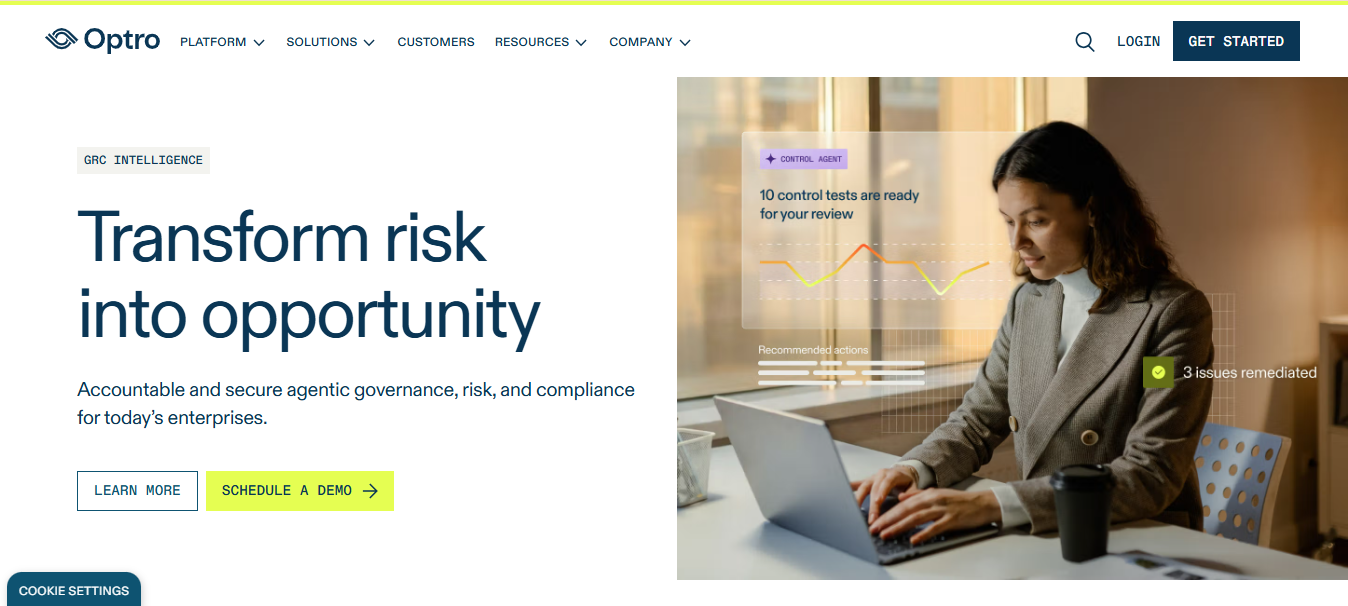
Optro, formerly AuditBoard, places AI governance within a broader governance, risk, and compliance operating model.
Key features
-
AI and Agent Inventory: Records AI applications, models, agents, vendors, owners, and use cases.
-
AI Risk Management: Connects AI assets with risk registers, scoring, owners, and mitigation.
-
Framework and Control Mapping: Maps requirements across NIST AI RMF, ISO/IEC 42001, and the EU AI Act.
-
Evidence and Audit Workflows: Links controls with evidence, findings, remediation, and internal audit.
Pros: Connects AI risk with enterprise GRC, remediation, and centralized reporting.
Cons: Buyers should verify model-monitoring depth, while lineage and quality governance may require separate platforms.
What features should AI compliance software include?
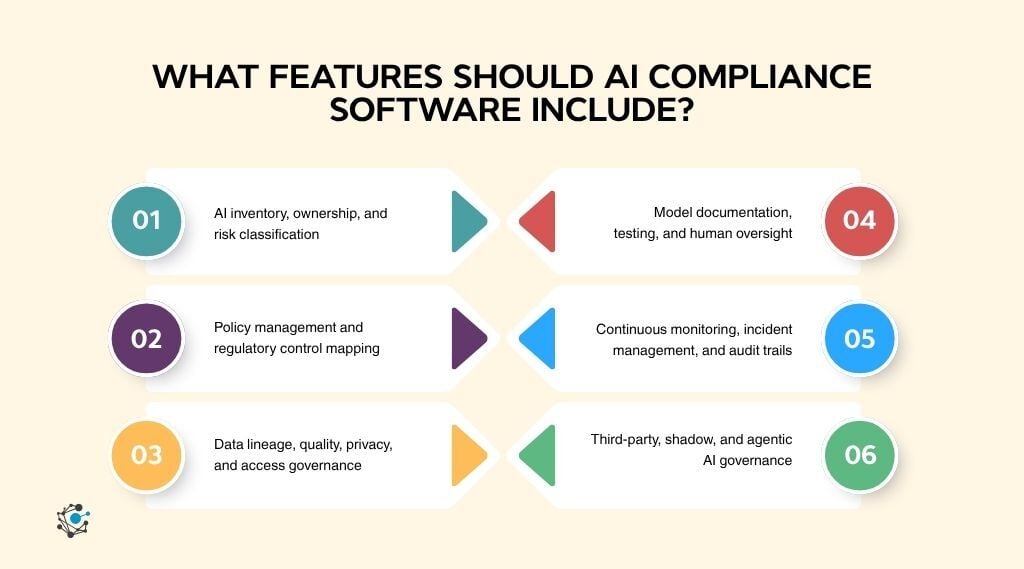
AI compliance software should connect:
AI asset → accountable owner → risk and policy requirements → governance decision → verifiable evidence.
Inventory, policies, testing, monitoring, and reporting must remain linked so reviewers can verify approval conditions.
IBM’s 2025 AI at the Core research found nearly 74% of surveyed organizations had only moderate or limited coverage across technology, third-party, and model risks, reinforcing the need to connect risks, controls, owners, and evidence rather than maintain a static repository.
1. AI inventory, ownership, and risk classification
The platform should maintain an evergreen inventory of models, applications, agents, datasets, vendors, and use cases, capturing owners, lifecycle status, deployment context, and jurisdictions through automated discovery and manual intake.
Risk classification should use data sensitivity, decision impact, autonomy, affected individuals, and potential harm to set assessments, approvals, monitoring frequency, and human oversight.
For example: A customer-support chatbot and an autonomous agent that approves refunds may use the same model but require different risk tiers because their decision authority, financial impact, and human-intervention requirements differ.
2. Policy management and regulatory control mapping
AI governance software should turn regulatory and internal requirements into assigned actions through policy libraries, control mapping, named owners, cross-framework reuse, and versioned exceptions.
It should support the EU AI Act, NIST AI Risk Management Framework, ISO/IEC 42001, ISO/IEC 23894, privacy rules, sector requirements, and internal policies. NIST uses Govern, Map, Measure, and Manage, while the EU AI Act applies risk-based obligations. Frameworks matter only when tied to assets, controls, owners, and evidence.
3. Data lineage, quality, privacy, and access governance
AI compliance requires visibility into the data used to train, test, validate, ground, and operate systems. The software should connect AI assets to governed datasets, end-to-end lineage, business definitions, owners, quality rules, classifications, privacy conditions, and access policies.
Definitions must remain tied to approved datasets and permitted uses so valid data is not applied under the wrong meaning or policy context. Buyers should be able to trace each dataset’s origin, certification, owner, and permitted use.
For example: A claims model may be trained on historical customer data, validated using a separate warehouse extract, and grounded at runtime with policy documents. If those sources are not connected to their owners, quality status, access conditions, and permitted uses, reviewers cannot verify whether the deployed system is operating within approved governance boundaries.
4. Model documentation, testing, and human oversight
Each AI system needs a version-specific governance record covering system cards, dataset documentation, intended and prohibited uses, limitations, validation, bias and explainability tests, safety evaluations, and approvals.
Evidence must remain tied to the reviewed model, dataset, configuration, prompt, or application version and record who evaluated it, accepted residual risk, approved deployment, and may intervene or suspend the system.
5. Continuous monitoring, incident management, and audit trails
Approval is not the end of AI compliance. The platform should connect drift, bias, unsafe content, unauthorized use, model changes, and agent actions to incident severity, owners, deadlines, remediation, and outcomes.
IBM’s 2026 Tech Leader Study found that 59% of surveyed technology executives cited security and compliance concerns as leading barriers, while organizations averaged 54 agent-related incidents requiring human correction in the previous year.
Monitoring becomes governance when these events trigger accountable action and leave a time-stamped response and outcome.
6. Third-party, shadow, and agentic AI governance
The governed AI estate includes public tools, embedded SaaS capabilities, open-source models, employee workflows, vendors, and autonomous agents. The platform should support vendor due diligence, shadow AI discovery, incident tracking, agent identities, permissions, tool access, delegated authority, and human-intervention thresholds.
For agentic systems, these controls must determine what agents may access or call, when human review is required, and which actions must be logged. Governance must cover actual use, not only formally registered systems.
When AI tools and agents need access to sensitive enterprise data, OvalEdge Data Privacy and Compliance connects sensitive-data classification with lineage, role-based access, approval workflows, and audit logging. This strengthens the data-governance foundation for AI use while agent-specific runtime permissions and action controls remain part of the broader AI architecture.
How to choose the right AI compliance software for you
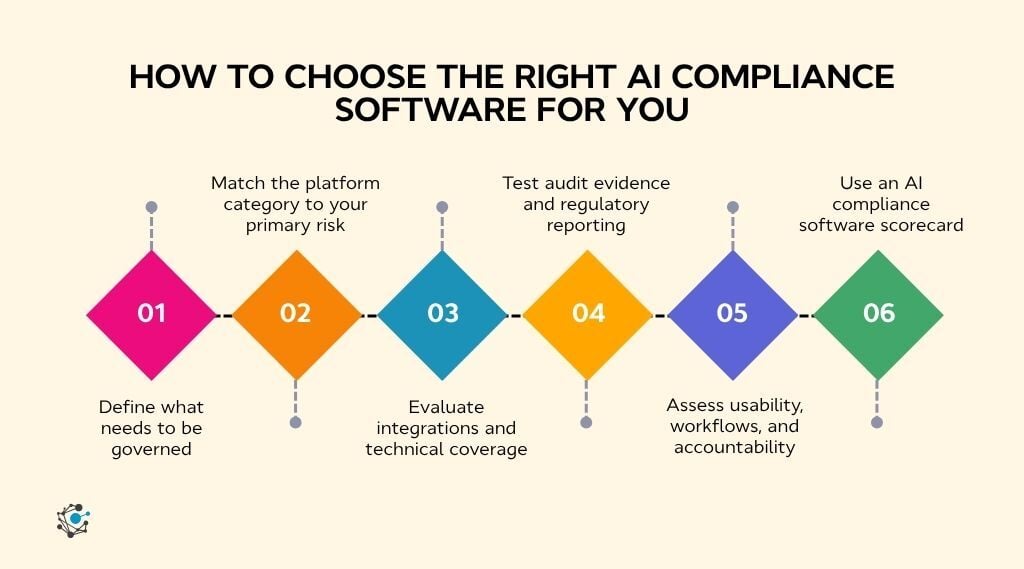
Choose the platform category that matches the governance gap preventing reliable evidence, rather than the longest feature list.
1. Define what needs to be governed
Before evaluating vendors, map internal models, agents, copilots, datasets, third-party systems, embedded SaaS AI, open-source components, and employee workflows. Record whether each is developed, deployed, purchased, integrated, or used, then classify its business impact, data sensitivity, autonomy, affected users, geographic scope, and regulatory exposure. Scope should follow potential impact, not technical sophistication.
2. Match the platform category to your primary risk
Choose a data governance platform for gaps in ownership, lineage, quality, privacy, access, or permitted use. An AI system of record addresses fragmented inventories, policies, assessments, and accountability; lifecycle tools support validation and approvals; observability platforms monitor production behavior; and GRC products organize controls, evidence, and audits.
Mature programs may combine categories, but should avoid duplicating inventories, owners, assessments, or evidence.
3. Evaluate integrations and technical coverage
Map existing evidence across data catalogs, model registries, cloud platforms, MLOps tools, ticketing systems, security products, procurement workflows, and GRC software. Ask what each connector collects, how often it updates, and which relationships it preserves.
Test whether integrations capture versions, lineage, evaluations, incidents, owners, approvals, and runtime events rather than merely copying asset names. Also assess APIs, identity propagation, exports, and support for custom or legacy systems.
When governance work spans ticketing and enterprise applications, OvalEdge APIs and integrations connect governance processes with tools such as Jira, ServiceNow, and DevOps, helping teams route tasks to responsible users while keeping work within existing operational workflows.
4. Test audit evidence and regulatory reporting
Use one real AI system during the proof of concept. Ask the vendor to show its owner, data sources, intended use, risk classification, controls, approvals, production version, monitoring results, findings, exceptions, and exportable evidence.
Verify who made each decision, what evidence informed it, and whether approval conditions remain satisfied. A platform that cannot reconstruct this chain for one system is unlikely to support regulatory review, internal audit, customer assessments, or incident investigations at scale.
Implementation tip: Test one high-risk production system and one lower-risk third-party AI tool during the proof of concept. Use the same evidence checklist for both to confirm that the platform can adjust controls by risk tier without creating separate governance processes.
5. Assess usability, workflows, and accountability
Test the platform with business owners, developers, data stewards, privacy, legal, security, model validation, compliance, and audit teams. Each role should see only its relevant tasks, evidence, and decisions.
Review role-based views, approvals, reminders, escalation, exceptions, reassessment, delegation, and overdue tasks. Controls fail when responsibilities are unclear or workflows allow accountability to shift without a named owner.
6. Use an AI compliance software scorecard
A weighted scorecard helps buyers compare different platform categories without letting one impressive demonstration dominate the decision.
|
Evaluation area |
Weight |
|
Ownership and governance model |
15% |
|
AI inventory and discovery |
15% |
|
Data and model traceability |
15% |
|
Risk and regulatory alignment |
15% |
|
Controls, evidence, and auditability |
15% |
|
Monitoring and technical assurance |
10% |
|
Integrations |
5% |
|
Usability and adoption |
5% |
|
Cost and implementation support |
5% |
Define three non-negotiable requirements before scoring and remove any platform that fails one, regardless of its weighted total.
At OvalEdge, we believe buyers should test whether a tool strengthens the existing governance foundation or creates another isolated inventory that requires reconciliation.
Conclusion
AI compliance software is governance infrastructure, not a policy library. The right platform connects AI assets, owners, data, controls, lifecycle decisions, monitoring, and evidence.
The next step is to identify the primary governance gap. Some enterprises need stronger policy oversight, others need model assurance, and others need better lineage, quality, privacy, access, and ownership around the data supporting AI.
For organizations whose primary AI compliance gap begins with data, OvalEdge provides the governance foundation for connecting trusted metadata, lineage, ownership, quality, privacy, access, and certification to AI oversight. Model assurance, runtime guardrails, and broader GRC controls may remain in complementary systems.
Ready to evaluate whether your data governance foundation supports AI compliance?
Schedule a data governance demo to see how OvalEdge connects metadata, lineage, quality, privacy, access, and certification to enterprise AI oversight.
.png?width=1081&height=173&name=Forrester%201%20(1).png)
.png?width=1081&height=241&name=KC%20-%20Logo%201%20(1).png)