.jpg)
AI adoption often moves faster than the controls designed to govern it. Teams may see strong performance yet still struggle to prove that AI actions are authorized, compliant, and traceable. As AI use expands, these blind spots make every decision harder to defend.
AI governance monitoring brings those risks into view by continuously overseeing how AI systems operate and act. It helps organizations keep AI use and behavior compliant and within approved risk limits. It also makes decisions traceable and accountability clear as data, users, and permissions evolve.
That visibility is becoming business-critical as adoption accelerates.
McKinsey’s 2025 global survey found that 88% of respondents said their organizations regularly used AI in at least one business function.
Yet many teams monitor performance without knowing whether individual AI actions are permitted or defensible. This guide covers what and when to monitor, program design, and platform evaluation.
What is AI governance monitoring?
AI governance monitoring is an operating process that continuously evaluates AI systems against policies, risk thresholds, legal obligations, ownership rules, and evidence requirements. It watches the complete decision context, including the model, data, user, purpose, permissions, tools, outputs, and downstream actions.
A system can remain accurate and observable while violating an approval condition or using data outside its permitted purpose.
|
Discipline |
What it answers |
Typical owner |
When you need it |
|
Governance monitoring |
Was the AI action authorized, accountable, traceable, and policy-compliant? |
AI governance, risk, legal, compliance, and business owners |
Across every lifecycle stage, especially approvals, material changes, incidents, and audits |
|
Model monitoring |
Is the model still accurate, stable, and performing within technical thresholds? |
ML engineering, data science, and MLOps |
During validation and production operations |
|
AI observability |
What happened inside the AI stack, and where did behavior, cost, latency, or execution change? |
Engineering, platform, SRE, and security teams |
During production operations, diagnosis, and incident response |
Governance monitoring vs. model monitoring
Governance monitoring determines whether an AI action followed approved purpose, data, ownership, policy, and review conditions. On the other hand, model monitoring measures accuracy, errors, data drift, concept drift, and other technical signals. They share evidence, but their decisions, owners, and escalation paths differ.
Pro tip: The AI governance guide explains how data governance contributes the lineage, quality, privacy, and ownership context needed for broader AI oversight.
Governance monitoring vs. AI observability
AI observability captures operational evidence, including logs, traces, metrics, prompts and responses, tool calls, latency, costs, and failures. Governance monitoring turns that evidence into oversight. It evaluates AI activity against policies, flags and routes exceptions, assigns accountability, and maintains an audit trail. With this distinction clear, the next question is practical: What should teams monitor, and when should they monitor it across the AI lifecycle?
Why continuous AI governance monitoring matters now
An AI agent reads a customer record, delegates research, calls an external tool, and initiates a refund. Yet the organization sees only the final outcome, with no clear record of the authority granted, data used, decision path followed, or controls applied. The agent may have performed exactly as designed, while the governance framework failed to provide oversight, accountability, and evidence.
The risks become clearer when we examine the specific governance gaps that continuous monitoring must address.
The shift from periodic audits to continuous oversight
Continuous AI governance turns oversight into a live control loop. A quarterly assessment can verify the system that reviewers saw that day; it cannot account for tomorrow’s dataset, prompt update, integration, permission change, or new business use.
Monitoring therefore needs event-based triggers as well as scheduled reviews. A new data source, model version, vendor release, user group, deployment region, or decision scope should reopen the relevant assessment automatically.
How agentic AI raises the stakes
Agentic systems add planning, memory, tool use, and delegation. Their permissions may also change during execution. Hence, evidence must connect the initiating user and purpose with delegated actions, tools, data, credentials, policy checks, human interventions, and the final outcome.
Traditional application logs rarely present that chain as one accountable record. Without correlation across agents and tools, a team sees fragments instead of a decision.
The cost of getting it wrong
A prohibited action can create regulatory exposure even when no technical outage occurs. Under the EU AI Act’s penalty provisions, certain prohibited-practice violations can draw fines of up to 7% of worldwide annual turnover, subject to the regulation’s conditions. Operational costs can also include deployment freezes, manual investigations, customer remediation, and a loss of trust that outlasts the incident.
The core pillars of AI governance monitoring
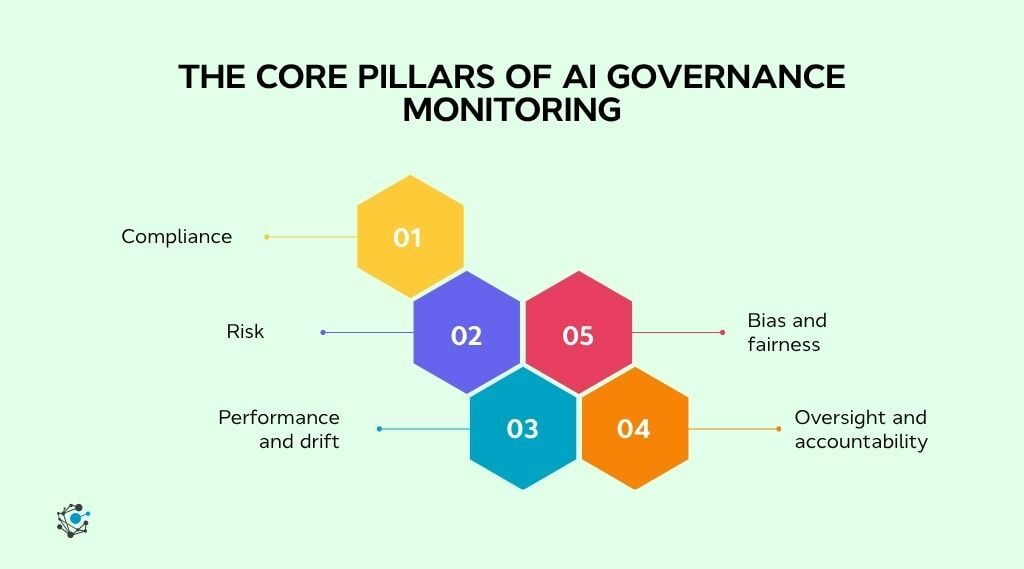
Effective monitoring combines five disciplines. Each watches a different failure path, and together they turn policy into evidence and action.
|
Pillar |
What it tracks |
Why it matters |
|
Compliance |
Applicable obligations, approved use, control execution, and evidence |
Shows whether requirements remain satisfied |
|
Risk |
Systemic, operational, legal, security, and reputational exposure |
Directs attention to material changes and exceptions |
|
Performance and drift |
Accuracy, reliability, data drift, concept drift, and degradation |
Reveals when technical change alters business risk |
|
Bias and fairness |
Outcome differences, representation, proxy effects, and human bias |
Detects harm that can emerge after deployment |
|
Oversight and accountability |
Ownership, review, overrides, escalation, and remediation |
Keeps decision authority clear and enforceable |
1. Compliance monitoring
Compliance monitoring connects AI activity to internal policies, contractual commitments, regulatory obligations, and approved-use conditions. It verifies that assessments, notices, approvals, access rules, documentation, and reviews remain current.
As a result, audit readiness becomes an everyday operating requirement instead of a periodic exercise. Each control should produce retrievable evidence showing what was checked, which policy version applied, who made the decision, and how any exception was resolved.
2. Risk monitoring
While compliance monitoring focuses on obligations, AI risk monitoring tracks broader systemic, operational, legal, security, financial, and reputational exposure. Because risk varies by use case, a decision engine and an internal writing assistant should not operate under the same thresholds.
Therefore, teams should define triggers for each risk category. These may include a material decline in accuracy, the introduction of sensitive data, an unapproved tool call, geographic expansion, rising complaint rates, or changes to vendor terms. Every trigger should have a designated owner, response time, and escalation route.
3. Performance & drift monitoring
Beyond policy and risk, teams must determine whether an AI system continues to perform as intended. Performance and drift monitoring tracks accuracy decay, data drift, concept drift, robustness, latency, and production failure rates.
At this stage, governance and AI model monitoring intersect. Technical telemetry identifies that a change has occurred, while governance determines its impact, the appropriate response, and the evidence that must be retained.
4. Bias & fairness monitoring
Bias and fairness monitoring examines systemic patterns, statistical disparities, proxy effects, representation gaps, and human cognitive bias in labels or review decisions.
But baselines must be refreshed as populations, use cases, and operating conditions evolve. A fairness test passed before launch cannot guarantee fair outcomes six months later.
5. Oversight & accountability (human-in-the-loop)
Oversight and accountability define when people review, approve, challenge, override, pause, or retire an AI system. Responsible AI monitoring works only when reviewers have useful context and real authority. Risk-based queues help humans focus on material exceptions; blanket approval steps often encourage rubber-stamping.
Clear ownership also makes remediation faster. The enterprise context graph connects definitions, lineage, ownership, quality, and policy context. It helps people and AI systems interpret governance signals against the same business understanding.
Monitoring AI across the full lifecycle
The pillars describe what to watch. Lifecycle monitoring defines where those checks belong, from the first proposal through the last retained record.
The following stages show how monitoring priorities and controls should evolve throughout the AI lifecycle.
1. Development & pre-deployment
First, register each use case before production. Record its purpose, owner, affected people, model or vendor, data, users, autonomy, decision impact, and prohibited uses. Then, use the risk tier to determine validation, fairness testing, security review, and evidence requirements.
2. Deployment & approval gates
Next, convert the risk tier into routing logic. Low-risk, fully evidenced changes may auto-approve. Moderate-risk changes may require review, while policy-conflicting deployments should be blocked and escalated. Each gate needs criteria, an approver, a decision record, and reassessment conditions.
3. Production & runtime
Once deployed, monitor approved scope and technical behavior. A system can become noncompliant when a prompt, dataset, tool, credential, region, audience, or business purpose changes mid-execution. Therefore, correlate telemetry with identity, access, lineage, policy, security, and outcome signals.
4. Retirement & decommissioning
Retirement closes obligations but does not erase them. Disable endpoints and credentials, revoke access, update inventories, address retained data, notify dependent owners, and preserve the audit trail for the required period. Also, confirm that downstream workflows no longer call the retired component.
5. Third-party & external AI systems
Across every stage, extend the inventory to SaaS AI, foundation models, copilots, APIs, and vendor agents. Record data flows, subprocessors, contractual limits, change notices, evidence rights, geographic processing, and exit plans. Although vendor assurances help, the enterprise still needs an accountable owner and usage controls.
How to build an AI governance monitoring program
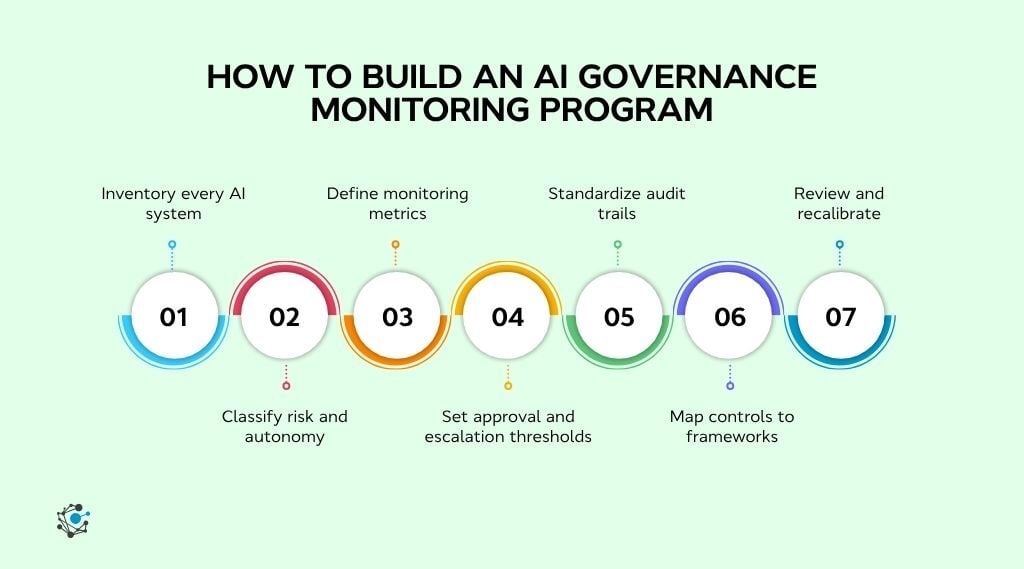
A practical AI governance monitoring program can be built in seven steps:
-
Inventory every AI system: Identify approved and shadow AI using procurement, expense, browser, API, cloud, model registry, and stakeholder evidence. Then, assign business and technical owners.
-
Classify risk and autonomy: Score each system by decision impact, data sensitivity, affected population, regulatory exposure, reversibility, and ability to act without human confirmation.
-
Define monitoring metrics: For each governance pillar, combine technical measures with overdue reviews, policy exceptions, unexplained outputs, override rates, evidence completeness, and remediation time.
-
Set approval and escalation thresholds: Define what can proceed automatically, what requires review, and what must stop. Then, assign a decision-maker and response deadline to every material trigger.
-
Standardize audit trails: Capture versions, lineage, approvals, tests, exceptions, runtime events, and remediation actions. Regularly test whether teams can reconstruct a decision quickly.
-
Map controls to frameworks: Connect each control and its evidence to relevant obligations. At the same time, preserve every framework’s wording, scope, and accountable owner.
-
Review and recalibrate: Use fixed review schedules for stable systems and event-driven assessments for material changes, incidents, complaints, drift, regulatory updates, or expanding autonomy.
Mapping monitoring to compliance frameworks
Major frameworks use different languages. Yet many converge on risk classification, clear accountability, documented controls, ongoing measurement, change management, and retrievable evidence, such as:
|
Framework |
What ongoing monitoring should support |
|
For applicable high-risk systems, documented post-market monitoring, logging, human oversight, incident processes, and evidence of continuous compliance throughout the system’s lifetime. |
|
|
An iterative Govern, Map, Measure, and Manage process with risk tracking, defined tolerances, feedback, and reassessment across the lifecycle. |
|
|
Monitoring, measurement, internal review, corrective action, and continual improvement of the AI management system. |
|
|
Evidence that relevant controls over security, availability, processing integrity, confidentiality, and privacy are suitably designed and operating; SOC 2 is not an AI-specific governance framework. |
One well-designed control can support several mappings. For example, a material-change workflow might capture the modified model or data, lineage impact, risk reassessment, test results, approver, decision, and deployment status. Consequently, this evidence can support EU AI Act documentation, NIST measurement and management outcomes, ISO management-system reviews, and relevant SOC 2 controls.
However, reuse should reduce duplicated evidence collection without collapsing different obligations into one checkbox. Instead, maintain a control library linking each requirement to its shared control, evidence object, owner, frequency, and unresolved gap.
A trusted AI governance framework connects policies, roles, controls, documentation, and lifecycle decisions through a unified operating model.
What to look for in an AI governance monitoring platform
The right platform should support faster, defensible decisions. Test one low-risk model, one high-impact use case, one agent, and one external AI service.
Here is what to examine across the platform’s capabilities, controls, integrations, and operational fit.
-
Coverage across AI types: Confirm support for ML, generative AI, retrieval systems, agents, copilots, and third-party services. The inventory should connect models, use cases, data, tools, owners, vendors, and dependencies.
-
Enterprise integration: Check connections to model registries, MLOps, catalogs, lineage, IAM, SIEM, DLP, GRC, ticketing, procurement, and runtime telemetry. Test integration depth because connector count alone can mislead.
-
Compliance mapping: Evaluate reusable controls, jurisdiction and use-case mappings, versioned policies, evidence, exceptions, and reassessment triggers. Teams should see why a control applies and what remains incomplete.
-
Runtime policy enforcement: Ask which actions the platform can detect, challenge, block, or route. Verify latency and fail-safe behavior. Connected guardrails, IAM, or security tools may perform the technical enforcement.
-
Auditability: Require tamper-resistant, time-stamped, retrievable records that connect versions, data, policy checks, approvals, tool calls, overrides, and remediation. Run an evidence-retrieval drill during the proof of concept.
-
Scalability and operating fit: Test federated ownership, role-based views, workflows, APIs, event volumes, data residency, and separation of duties. Support central standards and domain execution.
-
Time to value: Measure the time required to inventory a use case, connect evidence, configure a policy, route a review, and answer an audit question. Include implementation effort and ongoing administration in the decision.
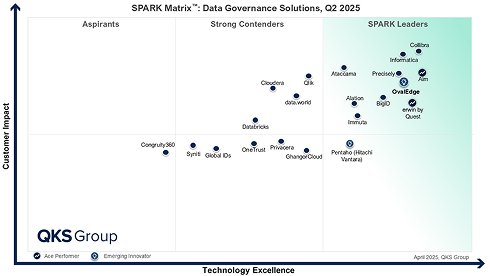
OvalEdge can serve as the metadata-driven governance and evidence layer by connecting AI systems with business purpose, data lineage, ownership, policies, and risk-based workflows.
Its contextual AI governance approach also makes an important boundary clear: model evaluation, red teaming, runtime guardrails, IAM, and security monitoring may require complementary capabilities. That clarity helps buyers design an effective architecture instead of expecting one tool to perform every control.
Common mistakes in AI governance monitoring
Even well-designed monitoring programs can fail when responsibilities, coverage, and response processes remain unclear. Avoid these common mistakes to ensure governance signals lead to timely, accountable action.
-
Combining governance, monitoring, and observability: Shared telemetry does not create shared accountability. Define each team’s decisions, thresholds, evidence requirements, and handoffs.
-
Requiring approval for every event: When every event demands review, reviewers begin approving by habit. Route high-impact exceptions to people with enough context, time, and authority to challenge them.
-
Monitoring only approved tools: Procurement records miss employee subscriptions, embedded features, API experiments, and vendor updates. Combine technical discovery with recurring business attestations and clear reporting channels.
-
Treating risk assessment as a one-time exercise: Data, models, vendors, permissions, and use cases change. Establish event-driven triggers and scheduled reassessments from the start.
-
Prioritizing audits over operations: A polished evidence pack cannot compensate for slow detection or unclear action. Track control health, overdue decisions, remediation time, and repeat exceptions as operational metrics.
Finally, remember that more alerts do not mean stronger oversight. Without business context, severity, ownership, and an action path, monitoring creates noise while material risks remain hidden.
Turn AI governance into continuous assurance
AI systems never stay the same for long. Models evolve, data changes, permissions expand, and new vendors enter the picture. AI governance monitoring helps teams keep pace by making every system observable, accountable, compliant, and easier to defend. It turns responsible AI from a policy on paper into evidence teams can use when decisions matter.
OvalEdge connects risk classification, compliance mapping, lineage, ownership, workflows, and audit-ready context across models, agents, applications, vendors, and data.
Book a demo to explore how these controls can work together within one connected governance system.
.png?width=1081&height=173&name=Forrester%201%20(1).png)
.png?width=1081&height=241&name=KC%20-%20Logo%201%20(1).png)