AI systems are making consequential decisions across hiring, lending, healthcare, and fraud detection. The risks are growing with them.
According to Gartner's 2026 predictions for data and analytics, by 2030, 50% of AI agent deployment failures will result from insufficient governance enforcement at runtime, and ungoverned decisions made using large language models will cause financial or reputational loss for enterprises in the near term.
AI governance provides the structure to prevent these failures before they reach production. It spans the full lifecycle, from training data quality through model monitoring, regulatory compliance, and agent behavior at runtime.
This guide covers the core principles, the four regulatory frameworks shaping enterprise programs in 2026, the value chain model that separates AI governance from data governance, and how to govern agentic AI systems that operate with limited human oversight.
What is AI governance?
AI governance is the framework of policies, processes, controls, and standards that ensures AI systems are safe, ethical, compliant, transparent, and aligned with business objectives. It applies across the full AI lifecycle, from data collection and model training through deployment and ongoing monitoring.
This definition covers two major categories of risk.
-
Compliance risks arise when AI systems violate laws, industry regulations, data protection standards, or ethical guidelines. In May 2024, the European Data Protection Board found that OpenAI's measures to ensure ChatGPT complied with the General Data Protection Regulation (GDPR) were insufficient, highlighting how even well-resourced AI companies face regulatory gaps.
-
Business risks are failures that harm customers, damage the brand, or create financial exposure. In November 2021, Zillow abandoned its AI-driven home valuation tool after it consistently overpriced homes, leading to a $304 million inventory write-down. The root cause was weak monitoring combined with poor-quality input data.
AI governance exists to prevent both categories of failure before they reach production. For enterprises deploying AI across multiple teams, workflows, and customer-facing systems, governance determines whether AI creates value or accumulates risk.
Why AI governance matters
Organizations that deploy AI without governance face regulatory fines, biased outputs, and operational failures that escalate quickly. Here are three pressure points that make governance urgent in 2026.
Bias and fairness
AI models inherit the biases present in their training data. In 2018, Amazon discontinued an internal AI recruitment tool after it began systematically favoring male applicants, a direct consequence of training the model on a decade of resumes dominated by male candidates. AI governance frameworks require organizations to test for bias before deployment, monitor outputs for discriminatory patterns, and maintain diverse, representative training datasets.
Regulatory enforcement
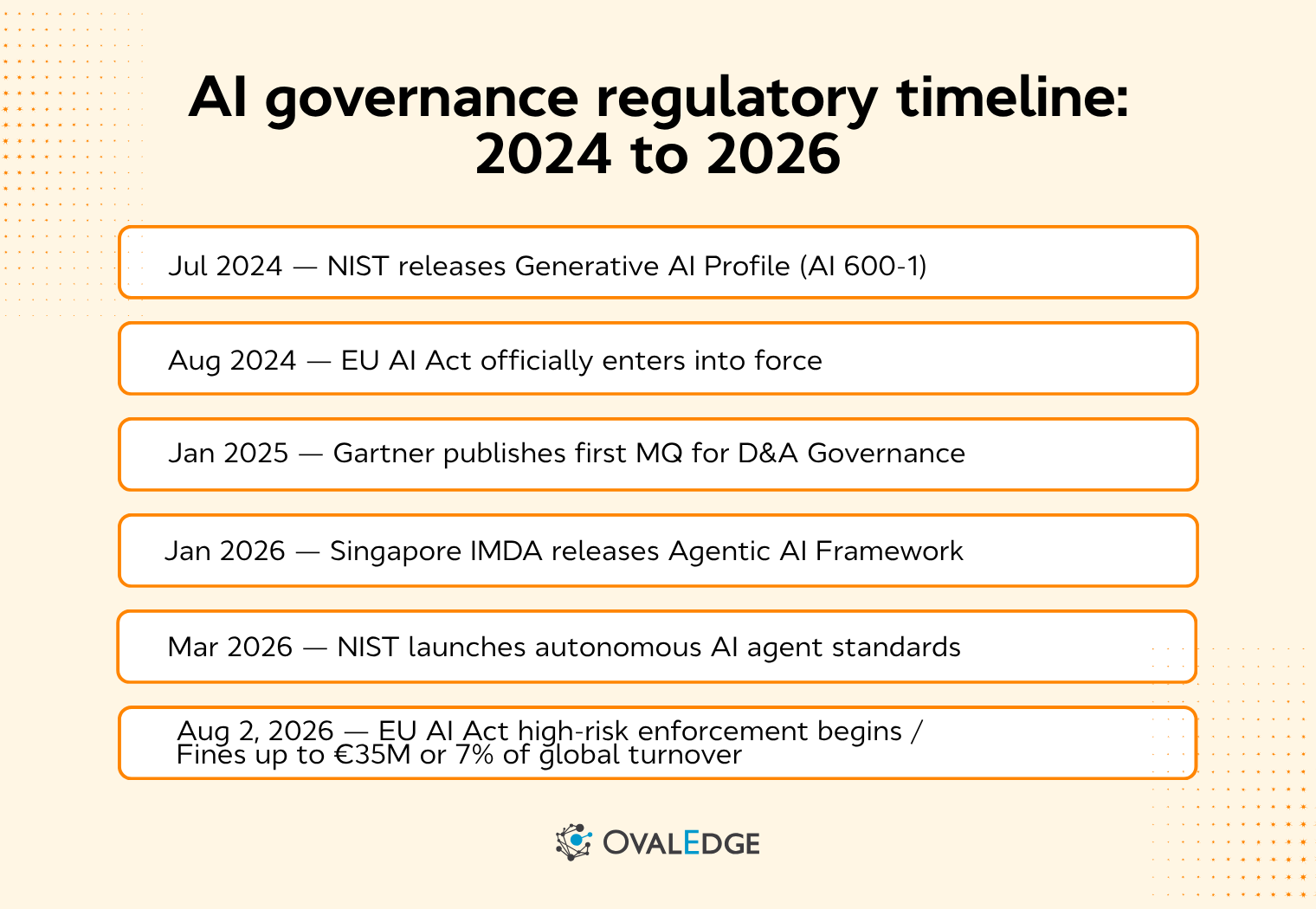
Regulation has moved from guidance to enforcement. The EU AI Act's high-risk provisions take effect on August 2, 2026, requiring conformity assessments and documentation for AI systems used in hiring, credit scoring, healthcare, and law enforcement. Violations carry fines of up to €35 million or 7% of global annual turnover. In the United States, the National Institute of Standards and Technology (NIST) launched a dedicated initiative in February 2026 to develop standards for autonomous AI agents. Organizations operating across jurisdictions face overlapping compliance obligations that demand a coordinated governance approach.
Brand and operational risk
Public AI failures spread quickly. A Canadian court ruled that Air Canada was responsible for incorrect policy information provided by its chatbot, establishing that organizations cannot disclaim liability for AI-generated misinformation. Meanwhile, AI adoption is outpacing governance in most enterprises. Teams deploy AI tools, embed vendor models in SaaS platforms, and build internal copilots without formal review, creating shadow AI with no visibility into what data these systems access or whether they comply with internal policies. Governance provides the structure to manage both external-facing AI risk and internal ungoverned deployment.
Core principles of AI governance
Every AI governance strategy addresses six foundational principles that translate directly into policies, controls, and technical requirements.
Fairness
AI must produce outputs free from discrimination. This requires diverse training datasets, systematic bias testing before and after deployment, and regular output monitoring to detect discriminatory patterns.
Transparency and explainability
Organizations must be able to explain how their AI systems work, what data they use, and how decisions are made. Explainability is becoming a standard operational requirement for high-risk applications in credit scoring, insurance, healthcare, and fraud prevention.
Accountability
Clear ownership must exist for every AI system. Accountability structures define who is responsible for performance, who approves deployment, who monitors outputs, and who intervenes when something goes wrong.
Data security
AI systems are vulnerable to prompt injection, data manipulation, model poisoning, and adversarial attacks. Security governance ensures that access to AI models and their underlying data follows the principle of least privilege, with continuous monitoring for anomalous behavior.
Privacy
AI systems consume massive volumes of data, including personally identifiable information (PII), protected health information (PHI), and financial records. Privacy governance ensures encryption, role-based access, data access controls, and data minimization across every AI workflow. Compliance with privacy regulations (including the GDPR, California Consumer Privacy Act (CCPA), and Health Insurance Portability and Accountability Act (HIPAA)) requires continuous enforcement, especially when AI agents process sensitive records autonomously.
Human oversight
AI exists to support human decision-making. Governance ensures human override capability, defined ethical boundaries, and human review of AI outputs in high-stakes decisions. The agent should never have more authority than the user, role, or workflow it represents.
AI governance vs data governance
A clear way to understand the difference is through the value chain. Each business value-chain activity has six primary components:
-
Inputs (data) that drive decisions
-
Models that use the inputs and generate decisions
-
Outputs in the form of decisions or actions
-
Systems (software and hardware) that run the business activity
-
Processes that define how the activity operates
-
Policies that guide, oversee, and override decisions
Data governance focuses on two of these six components: inputs and outputs. It ensures data is high-quality, centralized, classified for privacy and bias, and that metadata is well-curated. AI governance spans all six. Models must be monitored for accuracy and ethical output. Systems need guidelines on what information an AI will provide, to whom, and how. Processes require workflows for testing, deploying, and retiring AI. Policies must include the ability to oversee and override AI decisions.
|
Dimension |
Data governance |
AI governance |
|
Scope |
Inputs (data) and outputs (decisions) |
All six value-chain components |
|
Focus |
Data quality, classification, metadata, lineage |
Models, systems, processes, policies, ethics, risk |
|
Key controls |
Access control, encryption, quality monitoring |
Bias testing, explainability, human oversight, drift monitoring |
|
Regulatory drivers |
GDPR, CCPA, HIPAA |
EU AI Act, NIST AI RMF, ISO 42001 |
-2.png?width=1024&height=569&name=Info%202%20(2)-2.png)
The AI governance vs data governance relationship is complementary: data governance provides the trusted foundation; AI governance covers everything else. Data governance is the prerequisite, not a parallel initiative. Three categories define what organizations need to get the foundation right.
Category 1: Existing governance foundation. Data catalog, lineage, quality, certification, ownership, classifications, access controls, and audit trails. These capabilities do not need to be reinvented for AI. They need to be trusted, complete, and ready to be activated. A data catalog that provides a unified, searchable inventory of every dataset, dashboard, and pipeline establishes the asset map that AI agents will eventually need.
Category 2: Must evolve. The business glossary must grow from a human-readable dictionary into an AI-ready meaning system. A smarter agent cannot reliably infer enterprise-specific definitions from general language. The glossary must support taxonomy, ontology, and semantic mappings between terms, metrics, and data assets.
Category 3: Genuinely new. Retrieval-augmented generation (RAG), context assembly, Model Context Protocol (MCP) servers, agent permissions, tool-use governance, and institutional memory. These require a new architecture that did not exist before AI agents became data consumers.
Unified governance platforms like OvalEdge address all three categories. AI-powered classification automatically scans connected systems to detect and classify sensitive data (PII, PHI, PCI) at scale, using ML classifiers and configurable policies. Certified datasets receive a trust score so humans and agents know what is safe to use. Automated column-level data lineage derived from source code parsing maps the flow of data from source to consumption without heavy engineering hours.
Also read: AI data readiness vs traditional data quality
AI governance regulations and standards
Four regulatory frameworks shape the majority of enterprise AI governance programs in 2026.
EU AI Act
The world's first comprehensive AI law uses risk classification to distinguish prohibited practices, high-risk AI systems, and transparency obligations. High-risk enforcement takes effect on August 2, 2026, requiring conformity assessments, technical documentation, and human oversight for AI systems in healthcare, hiring, credit, law enforcement, and critical infrastructure. Fines for prohibited practices reach €35 million or 7% of global annual turnover.
NIST AI Risk Management Framework
The NIST AI RMF 1.0 remains the primary operational reference for AI risk management in the United States, organized around four functions: Govern, Map, Measure, and Manage. NIST added the Generative AI Profile (AI 600-1) in July 2024, adapting the framework for LLM-specific risks. In February 2026, NIST launched an initiative to develop standards for autonomous AI agents, addressing agent identity, authentication, and tool-use permissions.
ISO/IEC 42001
This international standard provides a certifiable AI management system. Where NIST AI RMF structures how teams do governance work, ISO 42001 produces the audit-ready certification that procurement departments and regulators increasingly require. Many global organizations use both: NIST as the operational playbook and ISO 42001 as the certifiable framework.
GDPR and privacy regulations
The GDPR requires data minimization, strict consent rules, and the right to explanation for automated decisions. These requirements intersect directly with AI governance, particularly for AI systems that process personal data or profile individuals. Privacy compliance requires continuous enforcement across every AI workflow.
AI governance framework for enterprises
An effective enterprise AI governance framework includes six interconnected components.
Strategy and risk tolerance. Define business goals for AI adoption, identify specific use cases, and set risk tolerance.
Policies and controls. Establish enforceable rules for bias testing, privacy protection, security requirements, and human oversight. Policies must translate into technical controls embedded in AI workflows.
Data governance foundation. Ensure training data and operational data meet quality, accuracy, and representativeness standards. Sensitive data must be classified, metadata must be organized, and data quality must be continuously monitored.
Model governance. Cover documentation, versioning, explainability, and drift monitoring for every AI model in production. Maintain audit-ready records that connect data inputs to model outputs.
Operational governance. Set guardrails for deployment, access control, and incident response.
Continuous monitoring. Track output correctness, bias, performance degradation, and security vulnerabilities. AI governance monitoring must be continuous because AI systems can degrade or drift between scheduled reviews.
Implementation is where most governance programs stall. The most common barriers are opacity of AI models (making explainability difficult), shadow AI spreading faster than governance can track, regulatory fragmentation across jurisdictions, and governance that exists on paper without translating into operational controls.
A Crawl-Curate-Consume model works well:
-
Connect data sources and let AI build an inventory of assets, lineage, and relationships (Crawl)
-
AI agents handle most curation while stewards validate recommendations (Curate)
-
Teams find, trust, access, and analyze data using governed workflows (Consume)
Governing agentic AI
Agentic AI changes the governance equation. When AI agents make decisions, take actions, and interact with enterprise systems autonomously, governance must extend beyond model oversight to cover agent behavior at runtime.
Traditional AI governance was built for a world where humans reviewed recommendations and flagged errors. Agentic AI operates differently. Agents read customer records, delegate tasks, call external tools, and make sequential decisions with limited human oversight. The organization often sees only the final outcome, with no clear record of the authority granted, data accessed, or controls applied.
This creates three new governance requirements.
-3.png?width=1024&height=569&name=info%201%20(1)-3.png)
Agent identity and permissions. Every agent must operate under a defined identity with explicit permissions. Singapore's IMDA framework, released in January 2026 as the world's first agentic AI governance standard, codifies this through Agent Identity Cards and a five-tier autonomy taxonomy.
Governed autonomy. Governed autonomy means matching the level of automation to the level of risk. Low-risk actions proceed autonomously; high-risk actions require human review. Every governed action becomes a decision trace for future audit.
Tool-use governance. MCP and tool calling enable agents to interact with enterprise systems. These protocols do not remove the need for governance; they make governance executable. An MCP integration that exposes governed enterprise context (glossary definitions, lineage, quality scores, certifications) to Claude, ChatGPT, and custom agents ensures agents operate on trusted data within policy guardrails. The Enterprise Context Graph links ontology, glossary, lineage, catalog, quality, and policy into a single graph so every agent works from the same trusted context.
Comclusion
AI governance is an operational discipline. Organizations that treat it as an afterthought inherit ungoverned AI systems embedded in critical processes, with mounting regulatory and financial exposure.
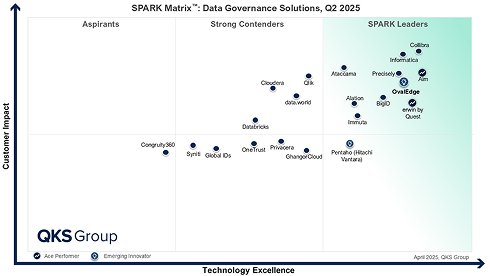
The foundation is data: trusted, classified, traceable, and governed. From there, governance extends to models, systems, processes, policies, and agents. OvalEdge delivers clarity, context, control, and adoption across the full data estate, making it possible to stand up a governance program that produces results in weeks, backed by recognition in the Gartner MQ 2025, the SPARK Matrix 2026 Leader ranking, and validated results from Forrester TEI.
Book a demo to see how a unified governance platform supports AI governance, compliance, and trusted data access.
.png?width=1081&height=173&name=Forrester%201%20(1).png)
.png?width=1081&height=241&name=KC%20-%20Logo%201%20(1).png)