Core point of the blog
Most enterprise AI failures in analytics aren't caused by bad models. They're caused by ungoverned context: wrong definitions, stale data, missing access checks. The irony is that governance teams already own the artifacts that fix this (glossaries, lineage maps, classification policies); they just aren't connected in a way AI can read. An AI contextual governance solution bridges that gap by making existing governance artifacts machine-readable, so every piece of context AI reasons over is approved, current, traceable, and permissioned before it reaches an answer.
Introduction
A finance VP asks an AI assistant for last quarter's EMEA revenue. The answer comes back in seconds, confident and wrong. The AI pulled from an uncertified table where "revenue" still meant gross bookings instead of the net recognized figure the board reports use. Nobody caught it until the deck was already circulated.
The failure had nothing to do with model accuracy or prompt engineering. The AI retrieved exactly what it was pointed at. The problem was ungoverned context: a wrong definition, from an uncertified source, without any business rules attached. It is the kind of failure an AI contextual governance solution is designed to reduce.
Most enterprise AI governance today focuses on how AI is used: risk scoring, bias testing, usage monitoring. A growing number of failures, though, point to a different gap entirely. The context AI reasons over (definitions, lineage, data quality, and access controls) remains ungoverned.
What follows is a definition of what the solution involves, the core capabilities to require, and a buyer checklist with red flags worth catching early.
What is an AI contextual governance solution?
An AI contextual governance solution governs the context that AI applications reason over. It ensures every definition, dataset, lineage path, and access policy AI relies on is approved, current, traceable, and permissioned before any AI application consumes it.
For analytical AI use cases, this means governing the data context behind insights and recommendations, including business definitions, quality signals, lineage, ownership, and access policies. The goal is governed AI context: context that has passed through business-owned controls and can be trusted by people and machines alike.
In practice, "context" breaks down into six categories. Most enterprises already govern each one, just not in a way AI can read.
|
What gets governed |
The question it answers |
Where it already lives |
|
Business meaning |
Is this the approved definition? |
Business glossary |
|
Relationships |
How does this data connect to other assets, terms, and owners? |
Data catalog and semantic models |
|
Trust |
Is the data fresh, certified, and quality-checked? |
Data quality and certification workflows |
|
Provenance |
Where did this data come from, and how was it transformed? |
Data lineage |
|
Access |
Who is allowed to see this data? |
Access control and classification policies |
|
Policy |
Which rules and regulations apply? |
Compliance and governance frameworks |
Most of these controls already exist as governance artifacts across separate tools and teams. An Enterprise Context Graph connects these existing artifacts and their relationships into a machine-readable context layer that AI applications can use.
Context governance vs AI use-case governance
Use-case governance decides whether an AI application is allowed, how risky it is, and what oversight it needs. Context governance decides what information that application can rely on. The two are complementary: a contextual governance framework sets how much oversight each AI use case requires, while a context governance solution governs the context those use cases depend on.
Context engineering is a closely related upstream practice. It focuses on creating, structuring, and maintaining useful context through modeling, mining, enrichment, and curation. Context governance ensures that this context remains approved, current, traceable, and permissioned before AI applications rely on it.
Why AI answers go wrong without governed context
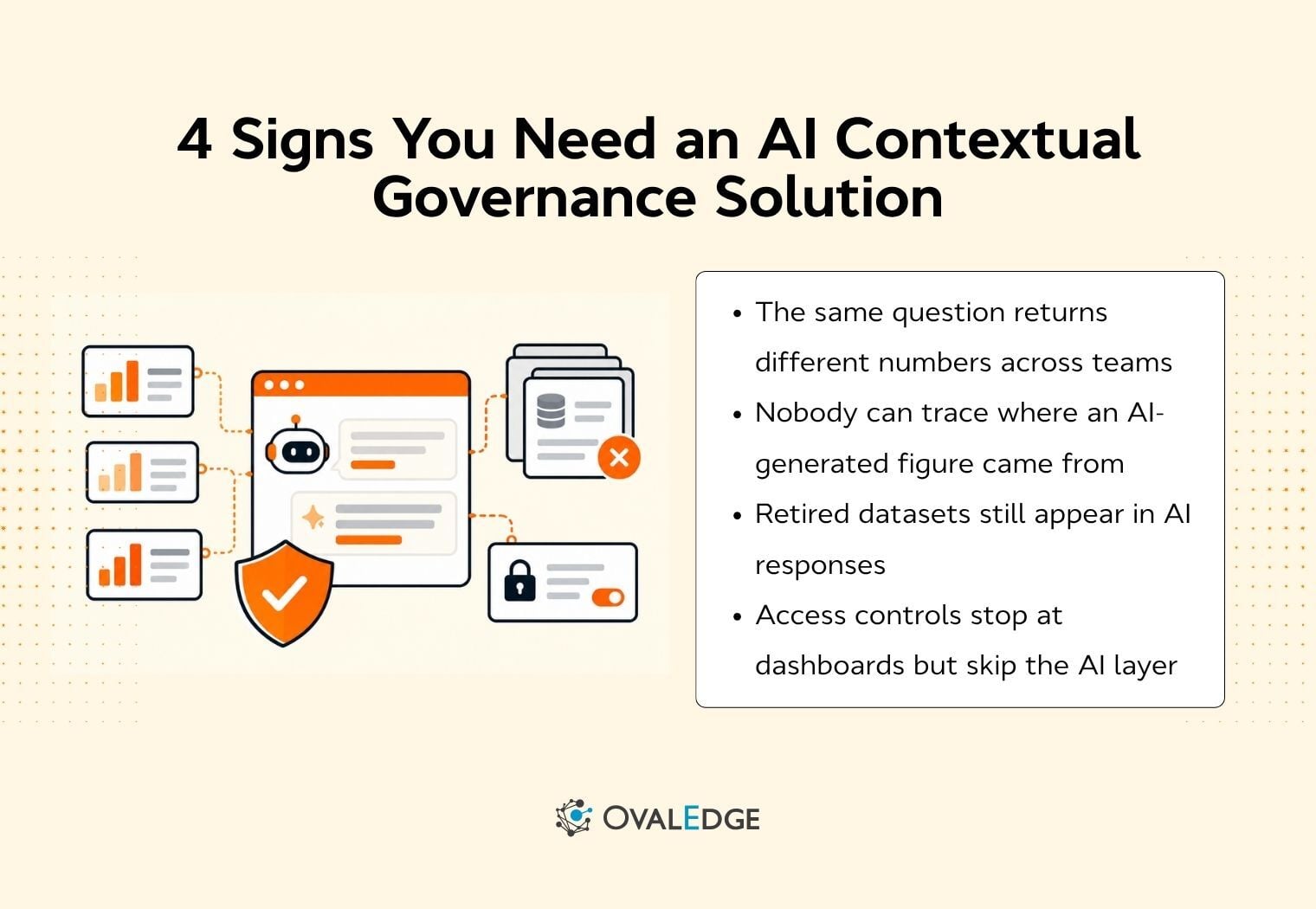
Most enterprise AI failures in analytics trace back to ungoverned inputs. The model does exactly what it is designed to do: retrieve data, apply logic, and return an answer. When that answer is wrong, the root cause is almost always upstream: a missing definition, a stale dataset, or an access gap the AI was never told about.
The scale of this problem is growing.
Gartner's May 2026 AI agent governance report projects that by 2027, 40% of enterprises will demote or decommission autonomous AI agents due to governance gaps identified only after production incidents.
Organizations are discovering what their AI agents lacked only after something breaks.
Three failure modes come up again and again, and each one maps to a governance control most enterprises already have:
-
Conflicting definitions produce confident wrong answers. "Revenue" means three things across finance, sales, and product. AI picks one silently. Without a governed glossary that assigns a single certified definition per term, there is no way for AI to know which "revenue" the question is actually about.
-
Stale or uncertified data gets treated as fact. AI cannot tell a deprecated table from a certified one unless trust signals (freshness, certification status, quality scores) travel with the data. A dashboard built on a table that was retired six months ago looks perfectly valid to an AI agent without context governance.
-
Sensitive data reaches AI without a policy check. PII or regulated fields reach AI because classification and access policies are never connected to the AI channel. The controls exist in the catalog, but nothing enforces them when an AI agent queries the warehouse.
OvalEdge expert insight: Every one of these failures maps to an artifact governance teams have already built: a glossary, a certification workflow, a classification policy. The gap is connecting them so AI can read them.
Governance teams already hold most of the context AI needs in glossaries, lineage maps, and classification policies. Enterprise context governance means making that context machine-usable. An Enterprise Context Graph connects these artifacts into an enterprise context layer that AI applications and agents can use when retrieving and reasoning over information.
Core capabilities of an AI context governance platform
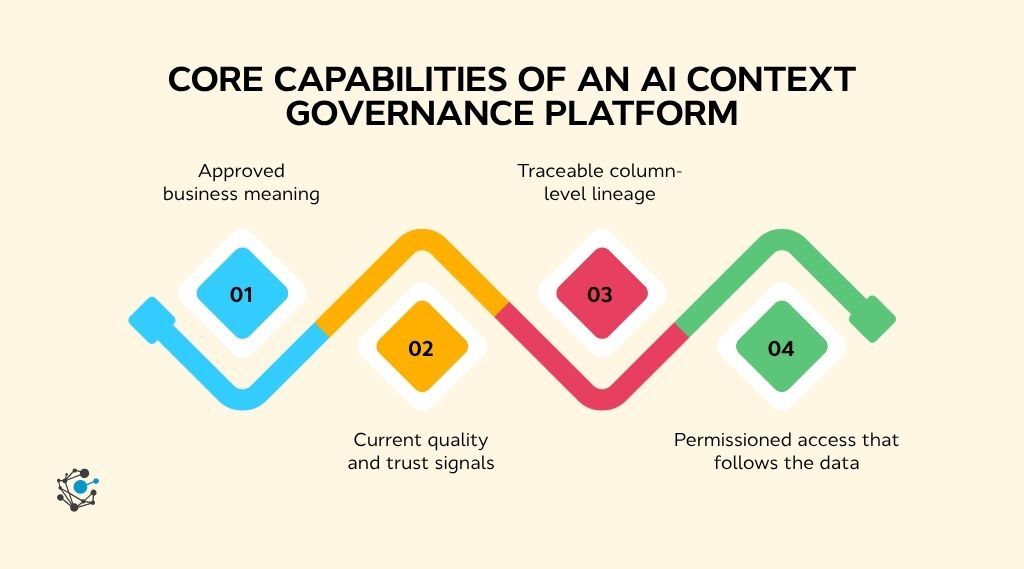
A strong AI context governance platform makes sure every piece of context AI uses is approved, current, traceable, and permissioned. These four controls are the minimum. Any governed context platform that skips one leaves a gap AI will silently exploit.
The capabilities below map directly to the failure modes in the previous section, and most build on governance artifacts enterprises have already created through their enterprise AI context platform.
1. Approved business meaning
When an analyst asks for "gross margin" and a product manager asks for "gross margin," are they getting the same definition? In most enterprises, they are not. Finance defines it one way, sales defines it another, and product uses a third version. AI picks whichever definition it encounters first, with no mechanism to flag the conflict.
Passing this test means every business term carries a single certified definition, a named owner, and conflict detection that prevents AI from silently choosing between competing meanings. A governed glossary with certified definitions and named stewards is what makes this work. Platforms like OvalEdge provide this through a business glossary that connects approved terms directly to the datasets they describe.
2. Current quality and trust signals
Without trust signals traveling with the data, AI treats a certified production dataset and a deprecated copy exactly the same. The test is straightforward: is the data fresh, quality-checked, and certified for production use?
Failure looks like an AI assistant confidently reporting numbers from a table that was retired six months ago, with no indication anything is wrong. Freshness checks, schema drift detection, anomaly monitoring, and certification status that AI can read are the capabilities that close this gap. OvalEdge's data quality module attaches these trust signals directly to catalog assets so AI can evaluate data reliability before returning an answer.
3. Traceable column-level lineage
Every AI-generated number should be traceable to its source table and every transformation along the way. When finance cannot verify where a figure came from, they recalculate it by hand. The recalculation cost multiplies across every AI-generated report that lacks a source trail.
Column-level lineage parsed directly from source code (SQL, Python, Spark, ETL jobs, BI tools) is the capability that solves this. The critical word is "parsed." Lineage that is manually mapped falls out of date the moment a pipeline changes. Automated parsing from source code is the only approach that keeps lineage accurate as systems evolve.
OvalEdge expert insight: Lineage answers the hardest AI trust question: where did this number come from? Without it, every AI-generated figure requires manual verification.
Permissioned access that follows the data
Every person and every AI agent querying a dataset needs verified permission to see every field behind the answer. A restricted field appearing in an AI-generated response is a compliance incident, and one that is hard to detect after the fact.
Automated sensitive data classification (PII, PHI, PCI) combined with column-level and row-level access control and masking is what makes this test pass. The same classification and access policies that protect data for people should govern what AI can see. When classification is disconnected from the AI channel, sensitive fields reach AI responses without any policy check, regardless of how strict the controls are for human users.
How an AI contextual governance solution works in practice
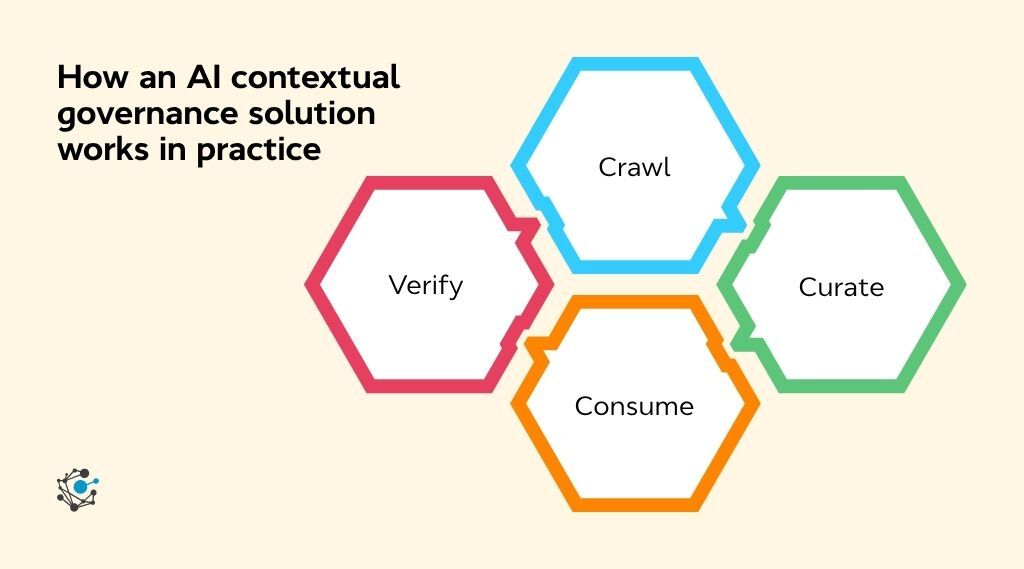
A governed AI context pipeline follows four steps. Each one maps to a capability from the previous section, and together they form the operating model behind an AI context management platform.
-
Crawl. Connect warehouses, BI tools, code repositories, and metadata sources to build an automated inventory and lineage map. The platform scans source code (SQL, Python, Spark, ETL) to parse column-level lineage without manual mapping.
-
Curate. AI agents draft definitions, assign owners, and suggest classifications through context mining and enrichment. Stewards validate every change before it becomes certified context. AI accelerates the curation; people approve it.
-
Consume. The Enterprise Context Graph connects all approved context, and a context layer delivers it to users and AI through natural language and MCP. AI agents query governed context the same way analysts do: by asking a question.
-
Verify. Stewards review every automated curation change on an ongoing basis. Lineage and access records show how each AI answer was produced, giving governance teams a clear audit trail from question to source.
Consider a finance analyst who asks an AI assistant why EMEA gross margin dropped last quarter. Each step in the answer depends on a governance artifact the team has already built:
-
Which "gross margin"? The approved glossary term, certified by finance.
-
Which dataset? The certified production table, not the deprecated copy.
-
Where did the number come from? Column-level lineage tracing back to the source ERP table.
-
What can this analyst see? Cost-center fields masked by classification and access policy.
-
Can the answer be verified? Returned with its full source trail.
Every check was answered by something the governance team had already created. The governance foundation already existed across the catalog, glossary, and lineage systems; the challenge was connecting those artifacts so AI could use them consistently.
The payoff is clearest in financial and KPI reporting, customer churn and revenue analysis, and risk and compliance reporting where lineage shows exactly how an AI-assisted figure was produced. Practically, that means fewer disputes over whose number is right, less time spent recalculating AI figures by hand, and a first governed use case that goes live in weeks when the glossary and lineage already exist.
How to evaluate AI context governance software
The fastest way to evaluate an AI context governance software vendor is to ask eight questions, each one designed to separate platforms that govern context end-to-end from those that cover only part of the pipeline.
|
Criterion |
Question to ask the vendor |
Red flag |
|
System coverage |
How many source systems can you connect to out of the box? |
Requires custom connectors for common warehouses or BI tools |
|
Lineage depth |
Is lineage parsed from source code or mapped manually? |
Manual mapping, or lineage at dataset level only |
|
Definition control |
Can stewards certify, version, and assign ownership to business terms? |
Flat glossary with no certification workflow or conflict detection |
|
Classification and access |
Does classification auto-detect PII/PHI/PCI and connect to column-level access policies? |
Classification runs separately from access enforcement |
|
AI delivery |
How does governed context reach AI agents and LLMs at query time? |
Requires custom API integration with no standard protocol |
|
Human oversight |
Do stewards approve every automated curation change before it becomes certified? |
Automated curation publishes without human review |
|
Deployment |
Can the platform run on-premises, in our cloud, or as SaaS? |
SaaS-only with no customer-managed option |
|
Time to value |
How quickly can we go live using governance artifacts we have already built? |
Requires re-implementation of glossary, lineage, and classification from scratch |
OvalEdge expert insight: The time-to-value question reveals the most about a vendor's architecture. If a context governance platform cannot ingest your existing governance artifacts, it is asking you to rebuild what you already own.
Where use-case risk tools fit
Model risk scoring, bias testing, and AI usage monitoring tools govern the AI application itself. A context governance platform governs what that application consumes. Mature programs run both: one controls the model's behavior, the other controls the model's inputs.
Organizations typically operationalize regulatory frameworks like the EU AI Act, NIST AI RMF, and ISO 42001 through use-case risk tooling. Context governance supplies the lineage and access records those programs draw on. The two layers are complementary, and evaluating them as a single purchase leads to a tool that does neither well.
How OvalEdge delivers governed context for AI analytics
Context governance requires every definition, dataset, lineage path, and access policy to be approved, current, traceable, and permissioned. OvalEdge connects and activates this foundation through the Enterprise Context Graph, which links catalog metadata, glossary terms, semantic definitions, column-level lineage, data quality signals, ownership records, and access policies into a connected, machine-readable context layer. Every artifact in the graph is data-driven and quantitative.
The Crawl, Curate, Consume model described earlier is the operating model behind the platform. OvalEdge connects to 170+ source systems through pre-built connectors to crawl metadata and parse lineage automatically.
Built-in AI agents accelerate curation by drafting definitions, suggesting classifications, and proposing owners, while stewards review and certify every change. A context layer then delivers the connected context to AI agents through natural language and MCP, supporting Claude, ChatGPT, and custom agents.
Source Code Intelligence is what sets the lineage apart. OvalEdge parses column-level lineage directly from SQL, Python, Spark, and ETL code rather than relying on manual mapping. When pipelines change, lineage updates automatically.
askEdgi brings governed context to end users through natural-language analytics where every answer is traced to certified sources and governed by the same access policies that protect the underlying data.
Deployment options cover SaaS, customer-managed cloud, on-premises, and hybrid configurations.
At OvalEdge, we believe the governance foundation you already own is the fastest path to trusted AI analytics. The Enterprise Context Graph does not replace what you have built; it connects and activates it.
Conclusion
AI analytics is only as reliable as the context behind it. A model can be accurate, well-tuned, and properly deployed, and still return wrong answers when it reasons over conflicting definitions, stale data, or fields the user should never have seen.
An AI contextual governance solution closes this gap by ensuring every piece of context is approved, current, traceable, and permissioned before AI relies on it. The four capabilities covered in this post (governed definitions, trust signals, column-level lineage, and permissioned access) are the minimum bar for any platform in this space.
The encouraging reality for most governance leaders is that much of this context already exists. Glossaries, lineage maps, classification policies, and certification workflows are built and maintained by data governance teams every day. The challenge is connecting these artifacts into an Enterprise Context Graph that AI applications can use as governed context.
See how OvalEdge connects your existing data governance foundation into an Enterprise Context Graph that supports trusted AI analytics. Schedule a demo →
.png?width=1081&height=173&name=Forrester%201%20(1).png)
.png?width=1081&height=241&name=KC%20-%20Logo%201%20(1).png)