.png)
Enterprise AI is rapidly evolving from answering questions to executing business tasks. Today's AI agents retrieve information, interpret business requests, recommend decisions, and automate workflows.
As these responsibilities grow, organizations are discovering that successful AI depends not only on powerful models but also on a trusted foundation of enterprise knowledge.
This challenge is becoming more visible as enterprise AI adoption grows.
According to McKinsey's The State of AI 2025 report, 72% of large enterprises had deployed at least one AI-powered tool in production, yet two-thirds remained stuck in pilot or experimentation phases without scaling enterprise-wide impact.
One of the biggest barriers is not the AI model itself but the enterprise's ability to provide consistent, trusted business context.
This guide explains how enterprise AI context platforms work, how they compare with adjacent technologies, and what capabilities to evaluate when choosing a platform for production AI.
How does an enterprise AI context platform work?
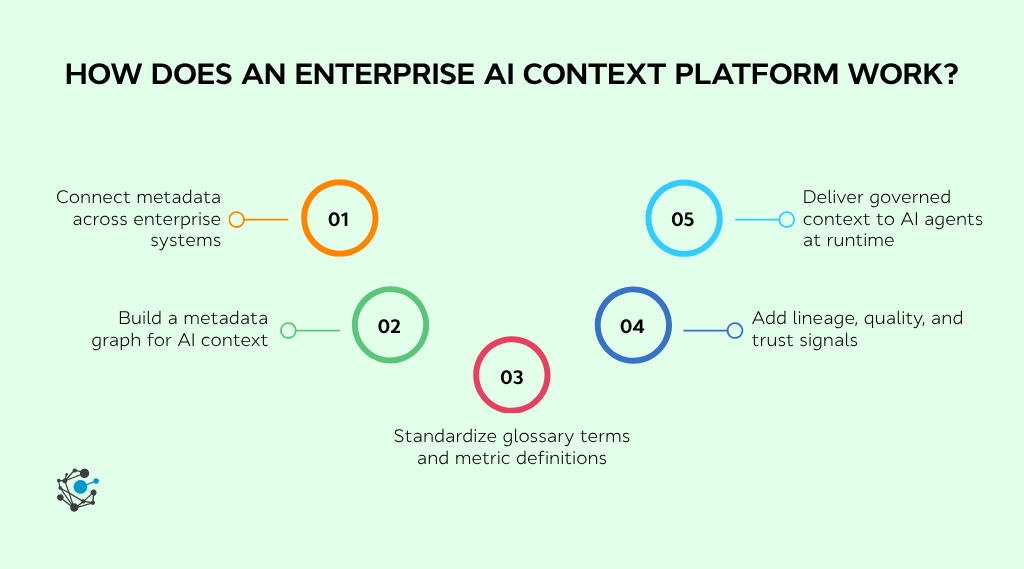
An enterprise AI context platform transforms enterprise metadata into governed, AI-ready context. It connects business knowledge, governance signals, and technical metadata into a unified foundation that AI agents can access throughout their workflows. The process typically follows five key steps that ensure AI can retrieve, interpret, and apply enterprise context consistently.
1. Connect metadata across enterprise systems
An enterprise AI context platform starts by collecting metadata from data warehouses, lakehouses, BI tools, ETL pipelines, SaaS applications, business glossaries, and AI assets. Bringing these sources together creates a unified view of enterprise knowledge instead of leaving information scattered across systems.
Example: An AI assistant answering a sales query can combine CRM, ERP, and dashboard metadata to understand the complete business context.
2. Build a metadata graph for AI context
The platform connects related assets into a metadata graph, linking business terms, datasets, reports, lineage, ownership, and policies. This helps AI understand how enterprise knowledge is connected instead of retrieving isolated pieces of information.
Example: Before answering a KPI question, an AI agent traces the metric to its approved definition, source dataset, and lineage.
3. Standardize glossary terms and metric definitions
Business glossaries ensure AI agents interpret enterprise terminology consistently. Approved definitions, KPIs, business rules, and synonyms are linked to physical data, reducing ambiguity across departments.
As organizations mature their semantic strategy, they often complement business glossaries with ontologies that model relationships, constraints, and business rules, managed through dedicated ontology management tools.
Example: When asked about "revenue," the platform identifies whether the request refers to gross, net, or recurring revenue based on approved business definitions.
4. Add lineage, quality, and trust signals
The platform enriches metadata with lineage, quality scores, certification, ownership, and freshness indicators. These governance signals help AI prioritize trusted data and explain where answers originate.
Example: An AI agent selects a certified dataset with recent quality checks instead of an outdated report.
5. Deliver governed context to AI agents at runtime
When an AI agent receives a request, the platform assembles the relevant business definitions, governance policies, trust signals, lineage, and access permissions for that specific task. The AI does not retrieve raw enterprise data alone. It receives governed context that helps it interpret information correctly, explain its reasoning, and remain compliant with enterprise policies.
Example: An end-to-end AI agent workflow
An operations manager asks: "Which suppliers are delaying our highest-priority customer orders, and should we expedite shipping?"
The enterprise AI context platform helps the AI agent:
- Interpret the request using approved business definitions.
- Retrieve trusted data from certified, governed sources.
- Apply governance through access controls and policies.
- Reason over context by combining business rules and operational data.
- Recommend an action with an explainable, policy-compliant response.
This runtime orchestration enables AI agents to retrieve trusted information, reason with business context, and execute actions that are accurate, explainable, and policy-aware.
Best enterprise AI context platforms to evaluate
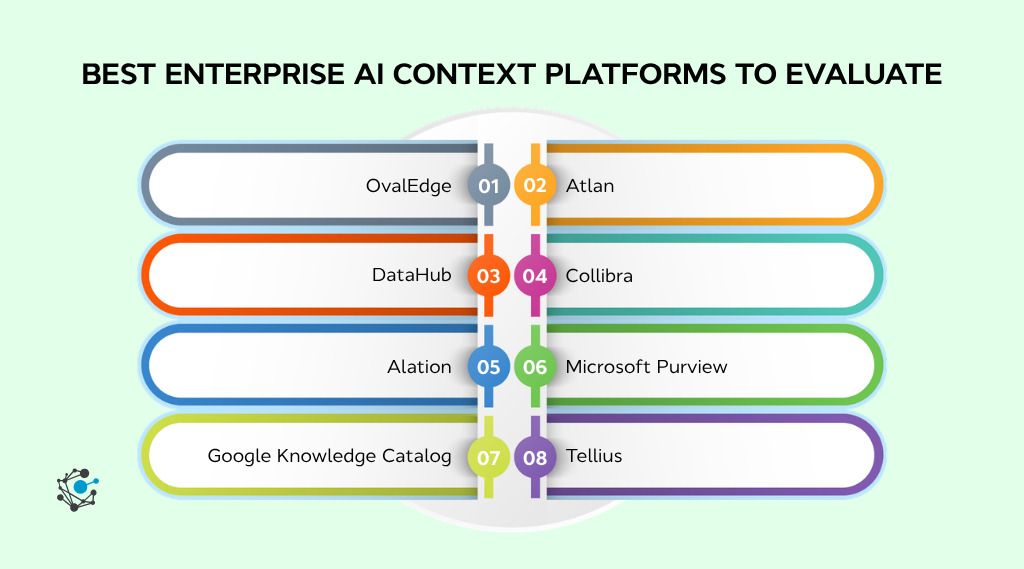
As enterprise AI adoption grows, vendors are expanding beyond traditional data governance and metadata management to deliver AI-ready business context. The right platform depends on your governance maturity, AI use cases, integration requirements, and the level of context your AI agents need to operate safely and accurately.
|
Platform |
Primary focus |
AI readiness |
Deployment |
AI context capabilities to evaluate |
|
OvalEdge |
Unified data governance and AI-ready context |
High |
Cloud, On-premises, Hybrid |
Runtime context delivery, governed metadata, agent orchestration, MCP readiness |
|
Atlan |
Active metadata and collaboration |
High |
Cloud |
AI context layer, agent integrations, metadata activation |
|
DataHub |
Open metadata and context graph |
High |
Cloud, Self-managed |
Context graph, GraphRAG foundation, APIs, extensibility |
|
Collibra |
Enterprise governance and compliance |
High |
Cloud |
AI governance, policy enforcement, metadata orchestration |
|
Alation |
Data intelligence and data catalog |
Moderate |
Cloud |
AI search, metadata intelligence, governed discovery |
|
Microsoft Purview |
Microsoft data governance |
Moderate |
Cloud |
Microsoft AI integration, Purview Data Map, governance |
|
Google Knowledge Catalog |
Google Cloud governance |
Moderate |
Cloud |
Vertex AI integration, metadata enrichment, cloud AI |
|
Tellius |
Conversational analytics |
Moderate |
Cloud |
Natural language analytics, AI insights, embedded AI |
1. OvalEdge
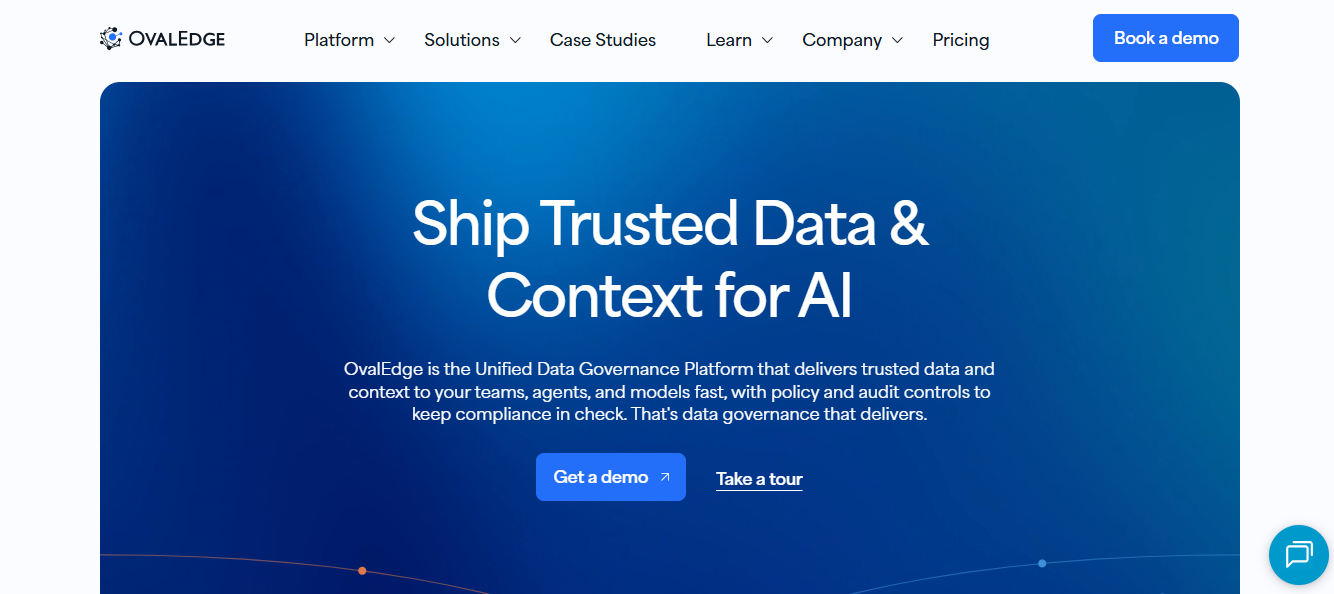
OvalEdge is an AI-powered data governance and catalog platform that helps organizations build governed, AI-ready business context. It unifies metadata, governance, and AI capabilities in a single platform, enabling organizations to operationalize trusted context for analytics and enterprise AI.
Best fit: Organizations looking for a unified platform to operationalize governed AI context across data governance, analytics, and enterprise AI.
Key features
- Runtime context delivery: Assembles governed business context for AI agents during execution.
- Enterprise Context Graph: Connects metadata, glossary, lineage, ownership, and trust signals.
- AI governance: Applies policies, certifications, and access controls to AI workflows.
- MCP-ready integrations: Connects AI agents with enterprise systems through open interfaces.
- askEdgi: Enables conversational analytics using governed enterprise context.
Pros
-
Purpose-built for governed enterprise AI
-
Supports cloud, on-premises, and hybrid deployments
-
Strong governance and AI orchestration capabilities
Why OvalEdge stands out
OvalEdge extends traditional data governance into enterprise AI by transforming metadata into governed business context that AI agents can understand and apply. Instead of relying on disconnected metadata or raw enterprise data, it brings together catalog, glossary, lineage, quality, certification, privacy, and AI governance into a unified context foundation.
This approach is reflected in the AskEdgi Agentic Analytics whitepaper, which describes how AI agents are grounded using governed metadata, business definitions, lineage, and governance rather than raw data alone.
By separating discovery, validation, business logic, and execution, askEdgi helps deliver AI responses that are more accurate, explainable, and auditable, enabling organizations to scale enterprise AI with greater confidence.
Book a demo to see how OvalEdge delivers governed, AI-ready business context for enterprise AI.
2. Atlan
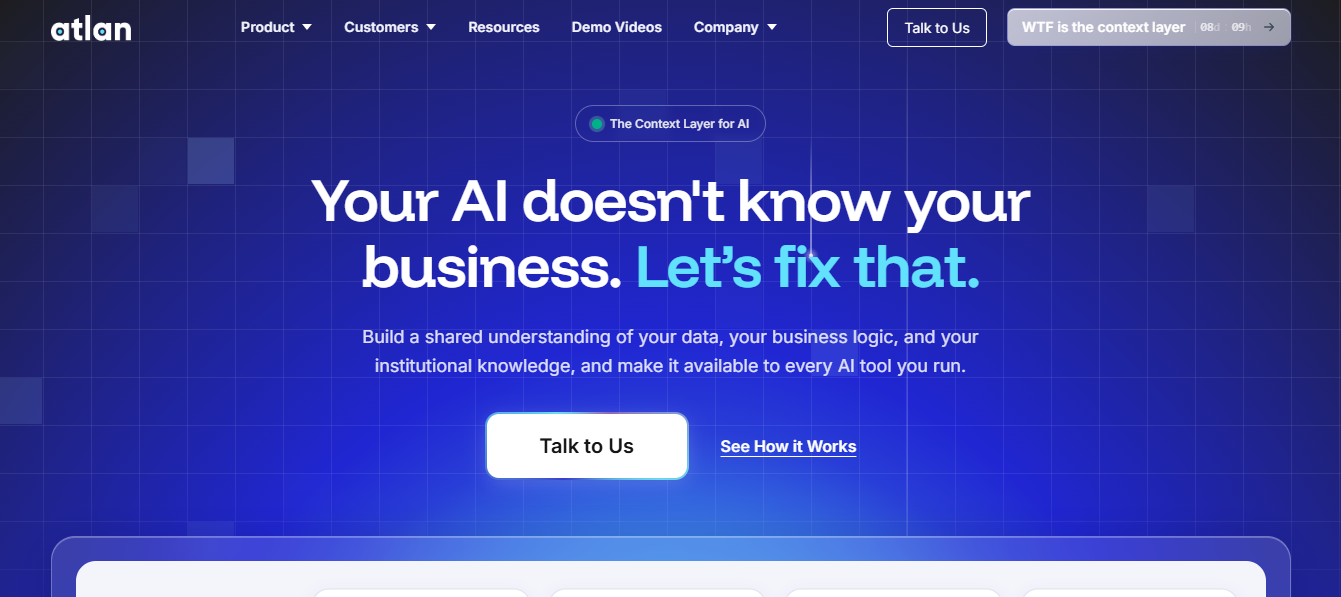
Atlan is a cloud-native data and AI governance platform that helps organizations activate metadata for analytics and AI. Its AI context layer connects metadata, business definitions, lineage, and governance information, making trusted context available to AI agents and business users.
Best fit: Cloud-first organizations looking to operationalize active metadata and deliver AI-ready context across modern data platforms.
Key features
-
AI context layer: Makes governed metadata available to AI applications.
-
Active metadata: Continuously enriches and updates enterprise context.
-
Business context: Connects glossary terms, lineage, and metadata.
-
Agent integrations: Provides APIs for AI and automation workflows.
-
Cloud ecosystem: Integrates with modern cloud data platforms.
Pros
-
Strong metadata activation
-
Modern cloud-native architecture
-
Broad ecosystem integrations
Cons
-
Limited on-premises deployment options.
-
Governance depth should be evaluated for complex enterprise requirements.
3. DataHub
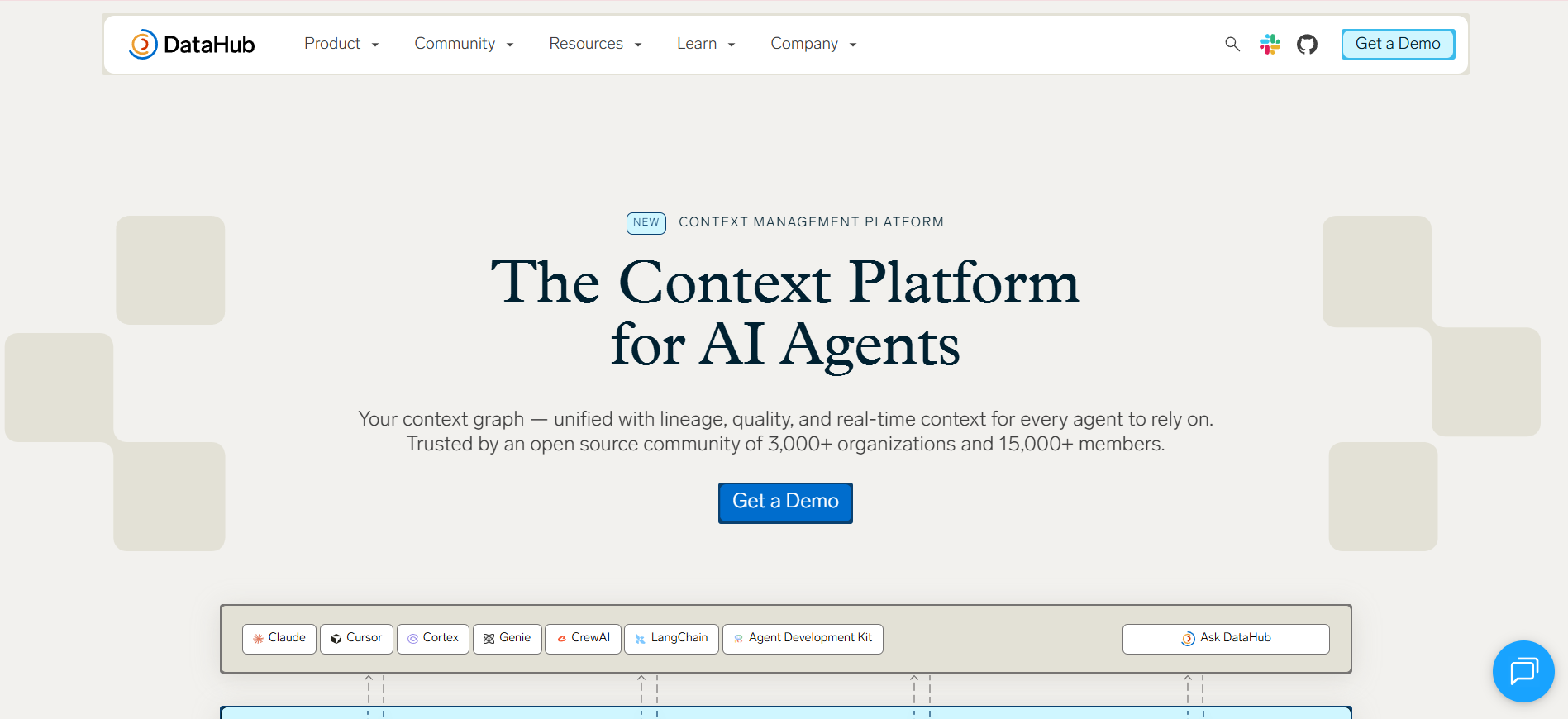
DataHub is an open-source metadata platform designed to help organizations discover, govern, and activate metadata across their data ecosystem. It emphasizes metadata graphs and context graphs to provide AI agents with connected business and technical context.
Best fit: Engineering-led organizations building open, metadata-driven foundations for enterprise AI.
Key features
-
Context graph: Links datasets, lineage, ownership, and business metadata.
-
GraphRAG foundation: Supports connected metadata for AI retrieval.
-
Metadata APIs: Exposes context to AI applications and services.
-
Event-driven metadata: Keeps enterprise context continuously updated.
-
Open architecture: Enables extensible AI integrations.
Pros
-
Strong context graph capabilities
-
Flexible API-first architecture
-
Open-source ecosystem
Cons
-
Requires technical expertise
-
Advanced enterprise capabilities require the commercial edition
4. Collibra
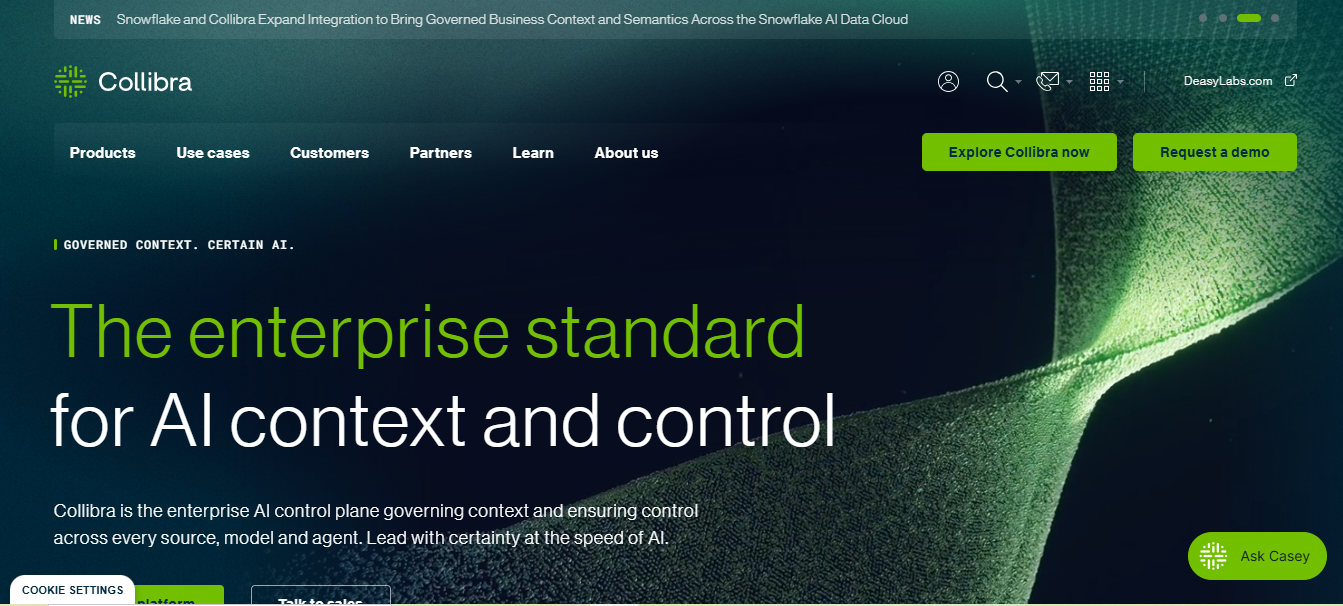
Collibra is an enterprise data governance platform that helps organizations manage data quality, stewardship, compliance, and AI governance. It focuses on establishing trusted data and governance processes across complex enterprise environments.
Best fit: Large enterprises with mature governance, compliance, and regulatory requirements.
Key features
-
AI governance: Supports responsible AI policies and governance workflows.
-
Policy orchestration: Applies governance controls across enterprise assets.
-
Trusted metadata: Combines glossary, lineage, and stewardship information.
-
Stewardship workflows: Assigns ownership and approval responsibilities.
-
Compliance support: Helps align AI initiatives with regulatory requirements.
Pros
-
Mature governance capabilities
-
Strong compliance support
-
Enterprise-scale stewardship
Cons
-
Resource-intensive implementation
-
Best suited for mature governance programs
5. Alation
Alation is a data intelligence platform that combines data cataloging, governance, and collaboration to help organizations discover and use trusted data. It emphasizes metadata-driven search and business-friendly data discovery for analytics and AI initiatives.
Best fit: Organizations focused on data intelligence, self-service analytics, and trusted data discovery.
Key features
-
AI-powered discovery: Helps users find trusted enterprise data.
-
Business context: Connects business terms with technical metadata.
-
Natural language search: Simplifies data discovery through AI.
-
Metadata intelligence: Improves relevance with usage insights.
-
Governance workflows: Supports stewardship and policy management.
Pros
-
Intuitive user experience.
-
Strong data discovery capabilities.
-
Mature collaboration features.
Cons
-
AI context remains catalog-centric
-
Limited runtime context orchestration
6. Microsoft Purview
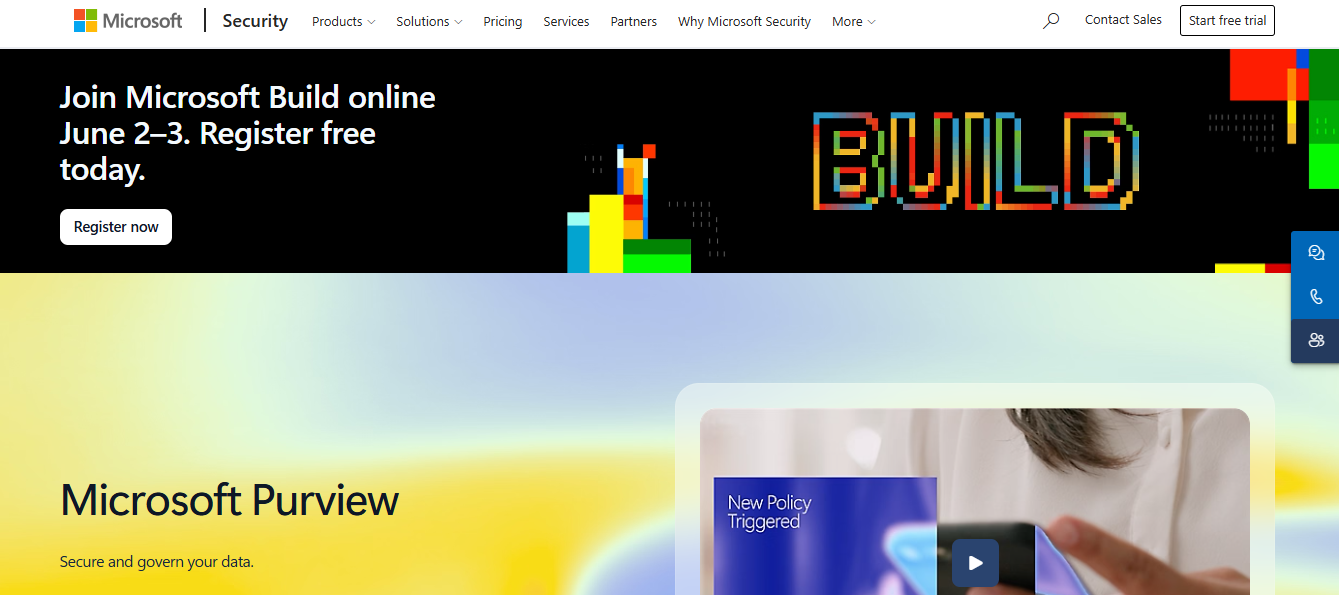
Microsoft Purview is Microsoft's unified data governance platform that helps organizations discover, govern, and protect data across Microsoft and multi-cloud environments. It combines metadata management, data cataloging, compliance, and security capabilities to support analytics and AI initiatives.
Best fit: Organizations with significant investments in the Microsoft data and AI ecosystem.
Key features
-
Microsoft AI integration: Supports Azure AI and Microsoft ecosystem services.
-
Data Map: Organizes enterprise metadata for discovery and governance.
-
Governance controls: Applies classifications and access policies.
-
Metadata discovery: Automatically scans enterprise data assets.
-
Hybrid connectivity: Supports cloud and hybrid environments.
Pros
-
Strong Microsoft ecosystem integration.
-
Comprehensive governance capabilities.
-
Automated metadata discovery.
Cons
-
Best suited for Microsoft-centric environments.
-
Cross-platform AI capabilities should be evaluated
7. Google Knowledge Catalog
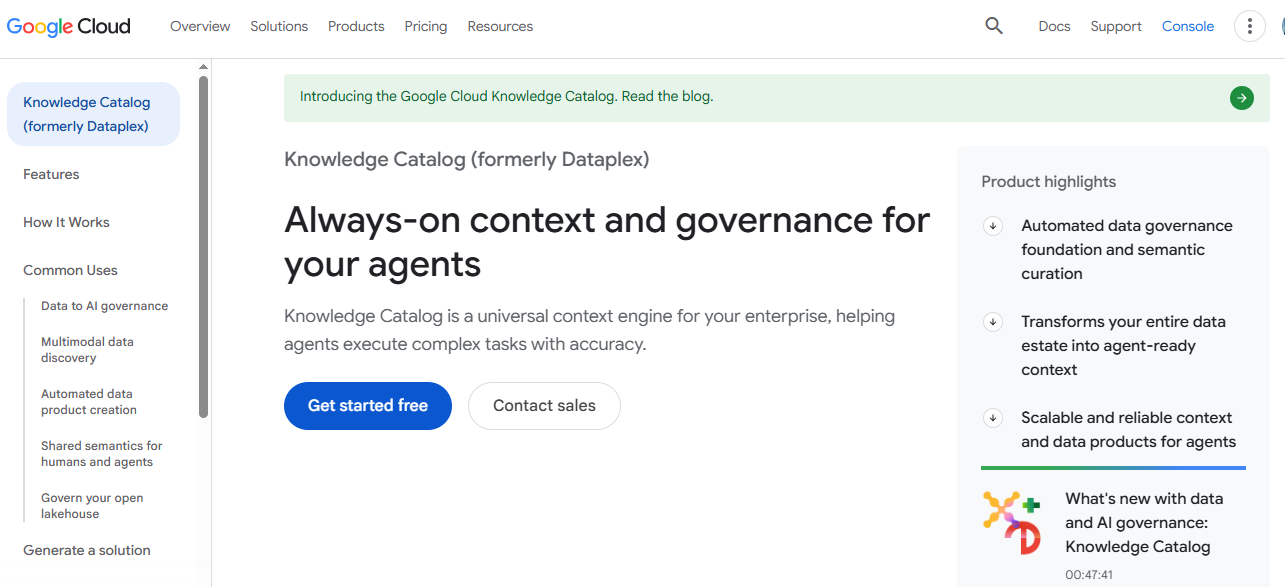
Google Knowledge Catalog is Google Cloud's AI-powered data catalog that helps organizations discover, organize, and govern enterprise data across their Google Cloud environment. It enriches metadata with business context to improve data discovery and support AI-driven workloads.
Best fit: Organizations running analytics and AI workloads primarily on Google Cloud.
Key features
-
Vertex AI integration: Connects metadata with Google AI services.
-
Metadata enrichment: Improves enterprise context with AI assistance.
-
Knowledge discovery: Makes business metadata easier to search.
-
Governance controls: Supports access management and policies.
-
Cloud-native architecture: Optimized for Google Cloud workloads.
Pros
-
Native Google Cloud integration
-
Strong metadata automation
-
Cloud-native scalability
Cons
-
Best for Google Cloud environments
-
Multi-cloud AI support should be evaluated
8. Tellius
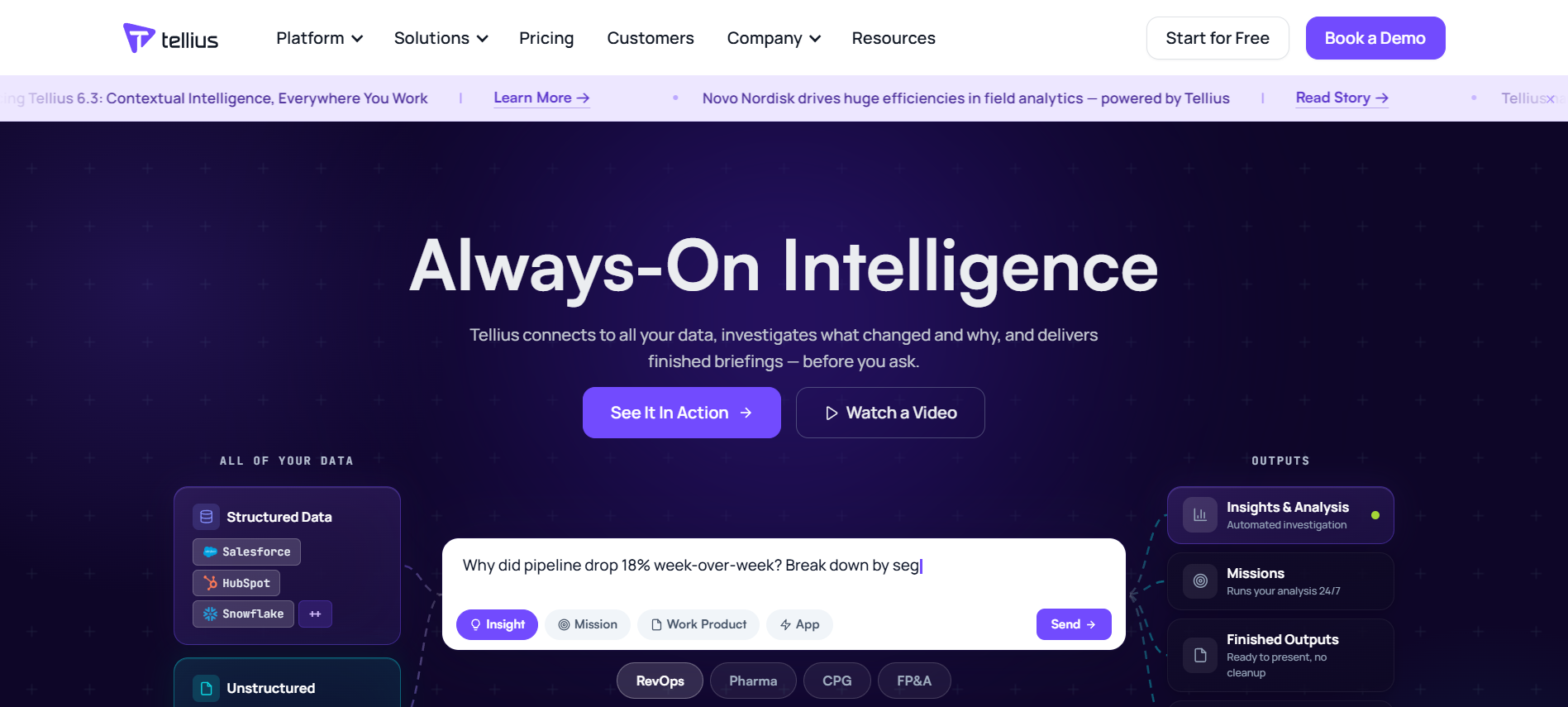
Tellius is an AI-powered analytics platform that enables users to explore data through natural language, automated insights, and augmented analytics. While it supports AI-driven data exploration, its primary focus is conversational analytics rather than comprehensive enterprise data governance.
Best fit: Organizations looking to accelerate self-service analytics and AI-powered business insights.
Key features
-
Conversational analytics: Enables natural language data exploration.
-
AI-generated insights: Automatically identifies trends and patterns.
-
Natural language queries: Simplifies business analysis.
-
Embedded analytics: Integrates AI insights into business applications.
-
Self-service BI: Helps users analyze data without technical expertise.
Pros
-
Intuitive AI experience
-
Fast insight generation
-
Strong self-service analytics
Cons
-
Limited governance capabilities
-
Not designed as a comprehensive enterprise AI context platform
Why enterprises need governed context for AI agents
As AI agents evolve from answering questions to executing business tasks, they need more than access to enterprise data. They must understand business meaning, identify trusted information, follow governance policies, and explain how decisions are made. Without this foundation, AI can retrieve relevant information but still produce inaccurate, inconsistent, or non-compliant outcomes.
Enterprise AI context platforms transform governance into machine-readable context that AI agents can consume at runtime. By connecting business definitions, trust signals, and governance controls, they enable AI to retrieve, interpret, and apply enterprise knowledge consistently across business workflows.
|
AI agent challenge |
Governed context |
|
Conflicting business definitions |
Standardized glossary terms and metrics |
|
Wrong data selection |
Certified assets with lineage and trust signals |
|
Compliance risks |
Policy-aware access and governance |
|
Poor explainability |
Lineage, ownership, and provenance |
|
Low user trust |
Quality indicators and certification |
As enterprise AI moves from experimentation to production, governed context becomes the operational foundation that enables AI agents to reason, retrieve, and act with confidence.
How OvalEdge supports enterprise AI: OvalEdge's AI-powered data governance platform transforms governance into AI-ready business context by unifying metadata, business glossary, lineage, quality, governance, and AI capabilities.
This enables AI agents to retrieve trusted enterprise context for accurate, explainable, and policy-aware decisions.
Enterprise AI context platform vs data catalog, semantic layer, knowledge graph, and MCP
Enterprise AI context platforms are often compared with data catalogs, semantic layers, knowledge graphs, and MCP. While these technologies are complementary, each addresses a different aspect of enterprise AI.
Understanding their roles helps organizations build a complete AI-ready architecture rather than relying on a single solution.
|
Category |
What it does |
Limitation |
Role in enterprise AI |
|
Data catalog |
Discovers and documents enterprise data assets |
Does not provide complete runtime context for AI |
Foundation for metadata discovery |
|
Semantic layer |
Standardizes business metrics and definitions |
Limited governance, lineage, and policy management |
Provides consistent business meaning |
|
Knowledge graph |
Models entities and relationships |
May lack governance workflows and trust signals |
Connects business concepts and relationships |
|
MCP |
Connects AI agents to enterprise tools and systems |
Does not govern business meaning, quality, or permissions |
Delivers context and tool access |
|
Enterprise AI context platform |
Unifies metadata, glossary, lineage, quality, policies, ownership, and trust |
Requires governance processes and integrations |
Delivers governed, AI-ready context for production AI |
These technologies are not competing alternatives. A data catalog helps AI discover information, a semantic layer standardizes business logic, a knowledge graph models relationships, and MCP enables communication with enterprise systems.
An enterprise AI context platform brings these capabilities together with governance, enabling AI agents to retrieve, interpret, and apply trusted business context consistently across enterprise workflows.
How enterprise AI context platforms complement RAG
RAG helps AI retrieve relevant enterprise information, but it does not determine whether that information is trusted, governed, or appropriate for the user's access. RAG solves retrieval, not enterprise context.
An enterprise AI context platform complements RAG by orchestrating governed business context around retrieval. It enriches retrieved content with business definitions, lineage, quality signals, governance policies, and permissions so AI can interpret and use information correctly.
Rather than replacing RAG, the platform makes it enterprise-ready by providing trusted, explainable, and policy-aware context.
How to choose the right enterprise AI context platform
Selecting an enterprise AI context platform depends on more than metadata management. The right solution should align with your AI strategy, governance maturity, deployment model, and long-term scalability. Focus on capabilities that support production AI, not just data discovery.
1. Start with your AI use cases
Don't evaluate platforms in isolation. Identify whether your primary goal is conversational analytics, AI agents, GraphRAG, enterprise search, compliance, or governed self-service analytics. The platform should support your highest-value AI initiatives.
2. Assess governance depth
Look beyond cataloging capabilities. Evaluate how the platform manages business glossary, lineage, data quality, privacy, stewardship, certification, and AI governance to deliver trusted business context.
3. Validate integration and deployment
Ensure the platform integrates with your existing data warehouses, lakehouses, BI tools, ETL pipelines, cloud platforms, and AI ecosystem. Also confirm whether it supports your preferred deployment model, whether cloud, on-premises, or hybrid.
4. Evaluate AI readiness
Determine how the platform delivers context to AI agents. Look for capabilities such as runtime context delivery, metadata graphs, policy-aware retrieval, explainability, APIs, and support for MCP or similar AI integration frameworks.
5. Consider adoption and scalability
A successful platform should be easy for both technical and business users to adopt. Evaluate implementation effort, governance workflows, collaboration features, and the ability to scale across domains as AI initiatives expand.
The best enterprise AI context platform is one that not only connects enterprise metadata but also transforms it into governed, trusted, and explainable business context. By evaluating platforms against your AI goals, governance requirements, and technology landscape, you can select a solution that supports enterprise AI today while scaling for future use cases.
Conclusion
Enterprise AI is changing the role of data governance. Instead of serving only human users, governance must now provide AI agents with the trusted business context they need to retrieve information, reason accurately, and act within organizational policies.
As you evaluate enterprise AI context platforms, look beyond standalone capabilities such as data catalogs, semantic layers, knowledge graphs, or MCP integrations. The right solution should unify governance, business meaning, trust, and runtime context into a connected foundation that scales across analytics and enterprise AI.
OvalEdge helps organizations build this foundation by operationalizing governed business context for production AI.

 Book a data governance demo to see how OvalEdge enables trusted, explainable, and AI-ready enterprise workflows.
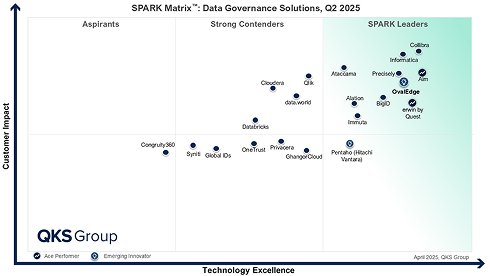
.png?width=1081&height=173&name=Forrester%201%20(1).png)
.png?width=1081&height=241&name=KC%20-%20Logo%201%20(1).png)