.png)
Metadata management is the process of collecting, organizing, and governing information that describes your data so teams can find it, understand it, and trust it. In practice, it works in five steps: inventory what you have, assign ownership, enrich the data that matters most, connect lineage to governance policies, and measure metadata health over time.
Most organizations already generate metadata across dozens of systems. The problem is not a lack of metadata but a lack of management.
According to the EDM Association's 2026 Enterprise Data Management survey, 89% of organizations have an active data management initiative, yet fewer than 40% have reached maturity in data governance capabilities.
The result: two dashboards that disagree on revenue, a compliance request that turns into a weeks-long search, or analysts spending more time decoding column names than analyzing data.
This guide walks through the five-step metadata management process, explains the four types of metadata you need to manage, and shows how metadata management supports effective data governance. Whether you are building a metadata program from scratch or trying to fix one that has stalled, the process below gives you a clear path forward.
What is Metadata management?
Metadata is data that describes other data. A photo carries the date, camera model, and GPS coordinates. An email has a sender, timestamp, and subject line. These descriptors sit alongside the content and make it searchable and understandable.
At enterprise scale, metadata covers far more ground. It includes table schemas, column definitions, business glossary terms, pipeline schedules, data quality scores, and usage patterns. Without it, a data warehouse becomes a collection of tables named things like cust_fnl_v3_new with no indication of what they contain or which version to trust.
Metadata management is the practice of collecting, organizing, maintaining, and governing all of this information so that every data asset in the organization can answer five questions:
-
What is this? A clear business definition that users can understand.
-
Where did it come from? The source systems, transformations, and pipelines that produced it.
-
Who owns it? The person accountable for its definition, quality, and use.
-
Who can use it? The access policies and sensitivity classifications governing the data.
-
Can it be trusted? Its freshness, quality status, certification, and other trust signals.
The key challenge is keeping this information current. Most organizations already generate metadata across database schemas, pipeline logs, BI tools, and documentation. Without active management, that metadata fragments, drifts, and becomes unreliable as underlying systems change.
A column gets renamed in a pipeline but not in the glossary. An owner leaves the company, and nobody reassigns their datasets. A dashboard gets rebuilt on a different source table, but the lineage still points to the old one. These small gaps accumulate until nobody is sure what to trust.
How it connects to data governance and data catalogs
Metadata management, data catalogs, and data governance solve different parts of the same problem. Metadata management supplies the context about data. A data catalog organizes that context and makes it searchable. Data governance uses it to assign accountability and enforce policies.
Problems show up when one exists without the others. A well-documented catalog with no governance has no accountability for keeping metadata accurate. A governance program without reliable metadata leaves teams with policies they cannot consistently apply because they cannot identify the affected data across systems.
The four types of metadata
Enterprise metadata falls into four types. You need all four to build a complete picture of any data asset.
|
Type of metadata |
What it describes |
Common examples |
Primary users |
|
Technical |
The structure of the data |
Table schemas, column names and data types, file formats, primary keys, transformation logic |
Data engineers, architects |
|
Business |
What the data means |
Glossary definitions, business rules, data ownership, sensitivity and privacy classification |
Analysts, business users, stewards |
|
Operational |
What happens to the data |
Pipeline run times, refresh schedules, row counts, job failures, data volume trends |
Platform and operations teams |
|
Usage |
How people interact with the data |
Query frequency, most-used tables, popular joins, ratings, comments, certification status |
Data consumers and governance teams |
These categories become most useful when they are connected rather than managed in isolation. Technical metadata can be captured automatically, but structure alone does not tell users whether an asset is relevant or trustworthy. Adding business context, operational signals, and actual usage patterns turns a technical inventory into something people can use for discovery and decision-making.
Usage signals are particularly valuable for prioritization. When an organization has tens of thousands of assets, governance teams cannot document everything at once. Understanding which datasets are actively queried, reused, or relied on downstream helps focus stewardship effort where it has the greatest impact.
For example, a table that appears in 200 analyst queries per week matters more for enrichment than one that has not been accessed in six months, even if the unused table sits in a production schema.
How to do metadata management: A five-step process
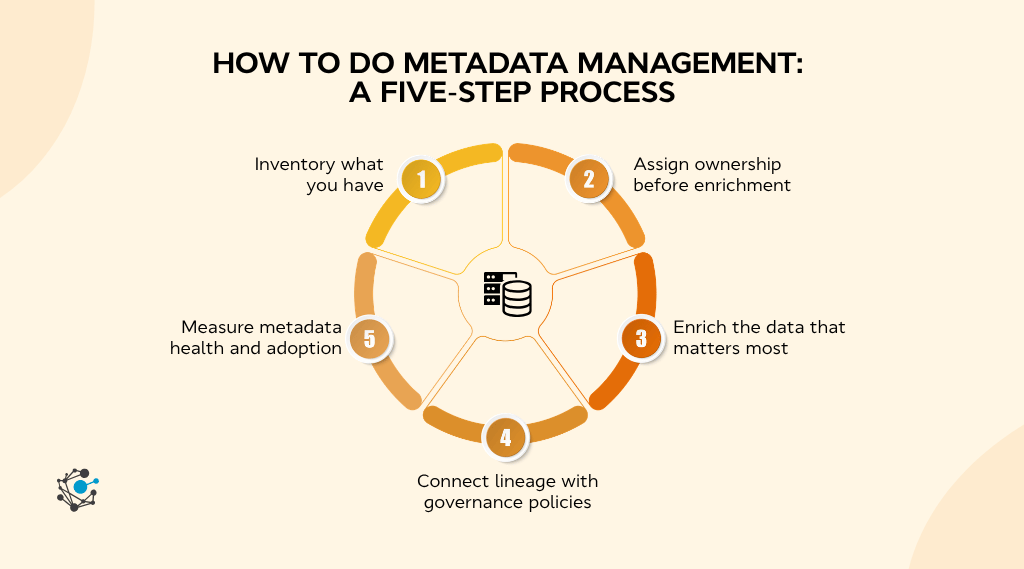
Effective metadata management follows a clear sequence: discover what exists, establish accountability, enrich priority assets, connect lineage to governance, and measure whether the program stays useful. The goal is to build trusted metadata around the data that matters most before expanding coverage.
Step 1: Inventory what you have
Start by connecting every system that creates or stores data to build a single inventory. A typical enterprise scan covers:
-
Relational databases (PostgreSQL, SQL Server, Oracle, MySQL)
-
Cloud warehouses (Snowflake, BigQuery, Redshift, Databricks)
-
BI and reporting tools (Tableau, Power BI, Looker)
-
Data lakes and object stores (S3, ADLS, GCS)
-
ETL/ELT pipelines (dbt, Airflow, Informatica, SSIS)
-
File shares and collaboration tools (SharePoint, Google Drive)
At this stage, focus on discovery rather than documentation. Automated crawling reveals duplicate datasets, forgotten copies, and legacy reporting tables that teams may not realize still exist. The resulting inventory provides a baseline for deciding which assets should be governed, enriched, consolidated, or retired.
Automated discovery tools connect to data sources across the stack and capture technical metadata, including schemas, column types, relationships, and refresh schedules, without manual entry.
Example: A finance team discovers five customer revenue tables across three systems. Usage and dependency data reveals that only two are actively queried in production. The team documents those two and retires the remaining three rather than spending time on obsolete copies.
Best practice: Automate metadata collection and schedule recurring scans so new assets and schema changes are captured without relying on manual updates. Most metadata drift happens silently when a pipeline adds a column or a warehouse migration renames a schema. Recurring scans catch these changes before downstream teams notice something is off.
Step 2: Assign ownership before enrichment
Once the inventory exists, establish accountability for the data domains that matter most. A data owner should be accountable for the domain, while a data steward manages ongoing definitions, classifications, and metadata quality. Understanding the difference between data governance and data stewardship helps clarify who is accountable for what.
Responsibilities should be clear:
-
CDOs and executives: Establish metadata standards, classification requirements, and accountability structures.
-
Data stewards: Maintain definitions, resolve terminology conflicts, and curate business context.
-
Data users: Surface missing or inaccurate metadata through everyday catalog usage and feedback.
Clear ownership prevents metadata from becoming stale when business definitions, schemas, or processes change.
Example: A customer data domain could have a business leader as its owner and a designated steward responsible for maintaining agreed definitions for terms like "active customer" and "churned customer." When a product team later introduces a new customer segmentation model, the steward reconciles it with existing definitions rather than letting a parallel terminology emerge.
Best practice: Start ownership at the domain and critical-data level. Assigning individual owners to every discovered asset too early creates unnecessary administrative overhead and leads to ownership fatigue, where people are nominally responsible for hundreds of assets but actively managing none of them.
Step 3: Enrich the data that matters most
Prioritize enrichment rather than trying to document everything at once. A practical prioritization framework weighs four factors:
-
Usage frequency: Which tables, dashboards, and reports are queried most often? Start here because these assets affect the most people.
-
Business criticality: Does this asset feed executive reporting, regulatory filings, or revenue calculations? Critical assets need metadata even if they are rarely queried.
-
Sensitivity and risk: Does the asset contain PII, financial data, or health records? These need classification and access governance regardless of usage.
-
Downstream dependencies: How many other assets, reports, or pipelines depend on this one? A single source table feeding 50 dashboards should be enriched before an isolated staging table.
For priority assets, add business definitions, ownership, sensitivity classifications, PII tags, and certification status. Automated classification tools scan column names, data patterns, and values to suggest PII tags and sensitivity labels. Stewards review and approve rather than labeling every column by hand.
Example: If a small group of tables supports most executive reporting and analytics queries, those tables should receive complete metadata before thousands of rarely accessed assets.
Best practice: Do not rely on usage alone. Regulatory, financial, or sensitive datasets may require priority governance even when they receive relatively few queries.
Step 4: Connect lineage with governance policies
Once critical assets have context, map how their data moves across the organization. End-to-end lineage should connect sources, transformations, downstream datasets, dashboards, and applications.
Column-level lineage provides the detail needed for impact analysis and compliance. Teams can determine which downstream assets will be affected by a schema change or trace exactly where a sensitive field has been replicated across systems. This kind of impact analysis is particularly valuable for data governance and compliance requirements, where teams need to demonstrate where sensitive data lives and how it moves.
Lineage is equally critical for AI governance. As models and agents consume enterprise data, organizations need to trace which datasets feed AI outputs and verify that training data meets quality and compliance standards.
Example: Before modifying a net_revenue calculation, an engineer uses column-level lineage to identify that the field feeds three executive dashboards, a quarterly forecasting model, and two regulatory reports. Without lineage, that change would have gone to production and broken downstream outputs that nobody connected to the source until the next reporting cycle.
Best practice: Derive lineage automatically from transformation logic wherever possible. Manually maintained lineage becomes unreliable as pipelines and dependencies change, and most teams stop updating lineage diagrams within a quarter.
Step 5: Measure metadata health and adoption
Metadata management requires continuous maintenance. Definitions become outdated, owners change roles, new assets appear, and previously important datasets become obsolete.
Track a focused set of KPIs:
-
Percentage of critical assets with approved definitions and owners
-
Percentage of sensitive data classified
-
Catalog searches and active usage
-
Time required to complete lineage or impact analysis
-
Ratio of certified, uncertified, and deprecated assets
These metrics should show both metadata quality and whether people actually use it.
Example: If 94% of critical assets have assigned owners but only 61% have approved definitions, the next improvement cycle can focus specifically on business metadata completion rather than treating the entire program as underperforming.
Best practice: Measure coverage and adoption together. A fully documented catalog provides limited value if users bypass it, while strong adoption eventually declines if metadata becomes inaccurate.
Review these metrics quarterly and tie them to specific stewardship actions rather than treating them as passive health checks.
What your metadata management process needs to scale
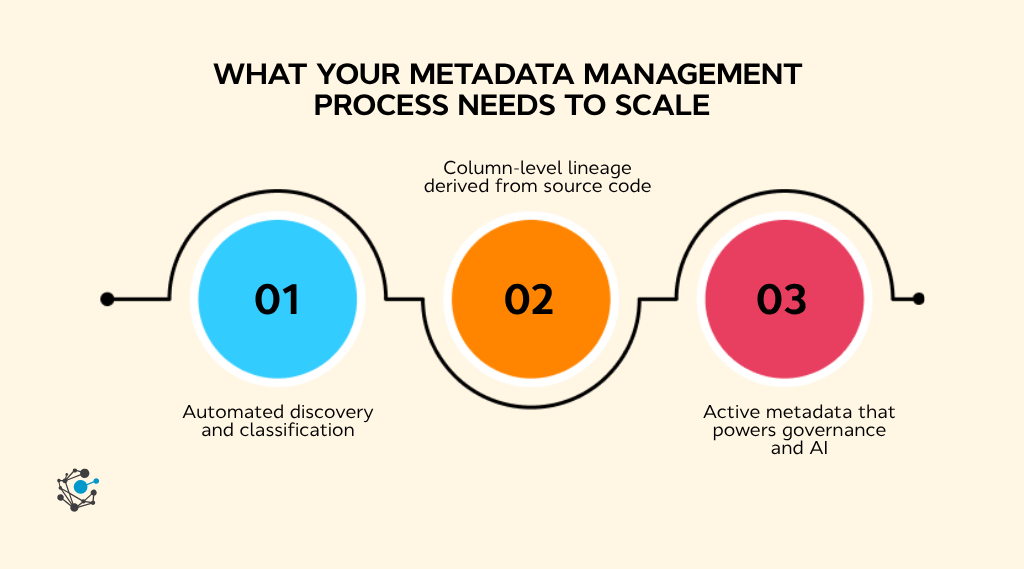
The five steps above work manually for a small data environment. At enterprise scale, three capabilities make the difference between a metadata program that stays current and one that falls behind.
1. Automated discovery and classification
Manual metadata tagging does not scale past a few hundred assets. Automated scanning captures new tables, schema changes, and pipeline additions as they happen. AI-powered classification identifies PII, sensitive fields, and business terms without requiring stewards to label every column by hand.
A unified data governance platform like OvalEdge takes this further with purpose-built AI agents. Classification agents detect and tag sensitive data across 150+ native connectors. Catalog curation agents identify missing metadata and capture tribal knowledge from the right people. Ownership agents recommend steward assignments based on usage patterns and domain expertise.
2. Column-level lineage derived from source code
Table-to-table lineage shows which systems are connected. Column-level lineage shows exactly how a specific field moves through transformations, which downstream reports depend on it, and what breaks if it changes.
The most reliable lineage comes from parsing actual source code (SQL, ETL jobs, BI models, stored procedures) rather than inferring connections from query logs. Code-derived lineage captures conditional logic and transformation paths that log-based approaches miss entirely.
3. Active metadata that powers governance and AI
Rather than storing metadata passively in a catalog, active metadata pushes quality warnings, classification changes, and certification signals into the tools where people actually work. When a new column is classified as PII, downstream masking rules and access restrictions can trigger without waiting for a steward to manually update each system.
Active metadata also serves as the context layer for AI. When metadata is connected into a knowledge graph rather than stored as isolated documentation, AI agents can pull governed context directly, reducing hallucinations and improving decision quality.
OvalEdge unifies all three in a single platform. Its Source Code Intelligence engine derives column-level lineage from actual code. Its Enterprise Context Graph connects metadata, definitions, lineage, quality, and policies into one layer that humans and AI agents can query. And its open context API makes that governed context available to Claude, ChatGPT, and custom agent frameworks.
According to Forrester's Total Economic Impact study, this approach reduced effort to catalog metadata and compile lineage by up to 40%, and cut the effort of finding and securing sensitive data by up to 75%.
Conclusion
Metadata management does not require full coverage to start delivering value. It starts with a specific problem: tracing the data behind a revenue dashboard, locating sensitive customer information, or identifying which version of a dataset is trusted. The five-step process builds outward from there: inventory, ownership, enrichment, lineage, and measurement.
As the program matures, automated discovery, business context, lineage, and usage signals keep metadata accurate as systems and data change. The result is a metadata environment that supports everyday analytics while providing the trusted foundation that governance, compliance, and AI initiatives depend on.
OvalEdge combines automated metadata management with data governance to help organizations move from scattered metadata to governed, AI-ready context in weeks, not months.
Book a metadata management demo to see how it works across a live data environment.
.png?width=1081&height=173&name=Forrester%201%20(1).png)
.png?width=1081&height=241&name=KC%20-%20Logo%201%20(1).png)