-1.png)
Ontology management is no longer a niche modeling problem. As enterprise knowledge graphs grow larger and AI systems depend on structured meaning, ontologies need governance, ownership, and lifecycle control.
The challenge is that the ontology tool market mixes very different products. A free OWL editor, an RDF database, a semantic suite, and an enterprise knowledge graph platform may all appear in the same search results, but they do not solve the same problem. Some help teams author models. Others operationalize semantics across governance, data catalogs, AI workflows, and production systems.
The right choice depends on the job the ontology must support and whether the organization needs modeling, storage, governance, or all three.
What are ontology management tools?
Ontology management tools are platforms for creating, versioning, governing, and maintaining ontologies across a domain. An ontology is a formal model of concepts, relationships, properties, and rules that helps systems understand meaning, not just terms.
These tools give teams a structured way to build and manage semantic models. Most ontology management software includes ontology editors, OWL and RDF support, reasoning engines, validation, collaboration, versioning, and integration with knowledge graphs or AI systems. Some tools are lightweight authoring editors for model design. Others are enterprise platforms that connect semantics to governance workflows, data catalogs, retrieval systems, and AI reasoning.
Ontology management tools are often grouped together, but they do not all solve the same problem. Authoring editors help create and refine models. RDF databases store and query graph data. Full knowledge-graph platforms connect ontology, data, governance, analytics, and AI workflows in production.
Ontology vs taxonomy vs business glossary
Business glossary, taxonomy, and ontology all help organize meaning, but they work at different levels. A business glossary defines approved terms. A taxonomy groups those terms into categories and hierarchies. An ontology adds relationships and rules between concepts so systems can interpret context more precisely.
The table below separates the three layers:
|
Layer |
What it does |
Example |
|
Business glossary |
Defines approved terms and their meaning |
"Net revenue" means total revenue minus returns, discounts, and allowances |
|
Taxonomy |
Groups terms into categories and hierarchies |
Net revenue sits under Revenue, which sits under Financial Metrics |
|
Ontology |
Adds formal relationships and rules between concepts |
Net revenue is calculated from gross revenue, is owned by the Finance team, and must use the approved exchange-rate source when reported across regions |
The distinction matters because these layers often work together. A glossary gives us shared language, taxonomy adds structure, and ontology connects concepts through formal relationships. The deeper the relationship logic becomes, the more important ontology management becomes.
What to look for in an ontology management tool
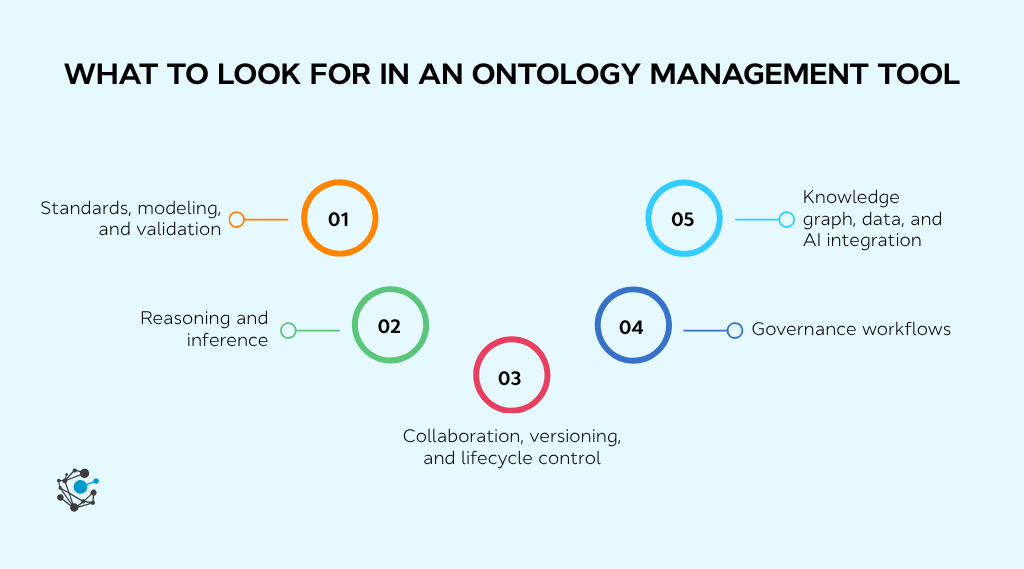
Ontology management tools should give teams the capabilities to build, manage, validate, govern, and connect semantic models. The core feature set usually depends on whether the tool is built for ontology authoring, enterprise governance, RDF storage, knowledge graph operations, or AI grounding.
The following capabilities are worth checking when comparing ontology management software:
-
Standards, modeling, and validation: The tool should support standards such as OWL, RDF, SKOS, and SHACL, along with the ability to create classes, properties, relationships, constraints, and rules. These capabilities help teams build interoperable ontologies, reuse existing vocabularies, avoid duplicate concepts, and validate whether the model follows the expected structure.
-
Reasoning and inference: Reasoning allows the tool to infer new relationships and check whether the ontology is logically consistent. For example, if “cardiologist” is a type of “doctor,” and “doctor” is a type of “clinician,” the system can infer that a cardiologist is also a clinician.
-
Collaboration, versioning, and lifecycle control: Ontology work often involves domain experts, data stewards, architects, compliance teams, and engineers. Shared workspaces, comments, role-based access, review flows, draft states, publishing controls, rollback, and change history help teams manage ontology changes without uncontrolled edits or silent drift.
-
Governance workflows: Governance features include ownership, provenance, audit trails, approvals, stewardship tasks, and policy alignment. These features matter when ontology changes affect reporting, compliance, AI outputs, or regulated business decisions.
-
Knowledge graph, data, and AI integration: The ontology should connect to RDF stores, triplestores, data catalogs, enterprise data sources, knowledge graph platforms, and AI workflows. This helps the ontology act as a working layer of enterprise meaning for semantic search, RAG, GraphRAG, AI agents, analytics, and governed data products.
OvalEdge expert insight: Governance workflows are where ontology management breaks down silently. Without visible ownership, approval controls, and audit trails tied to the actual data, a model can drift from the meaning the business approved without anyone catching it.
The best ontology management tools
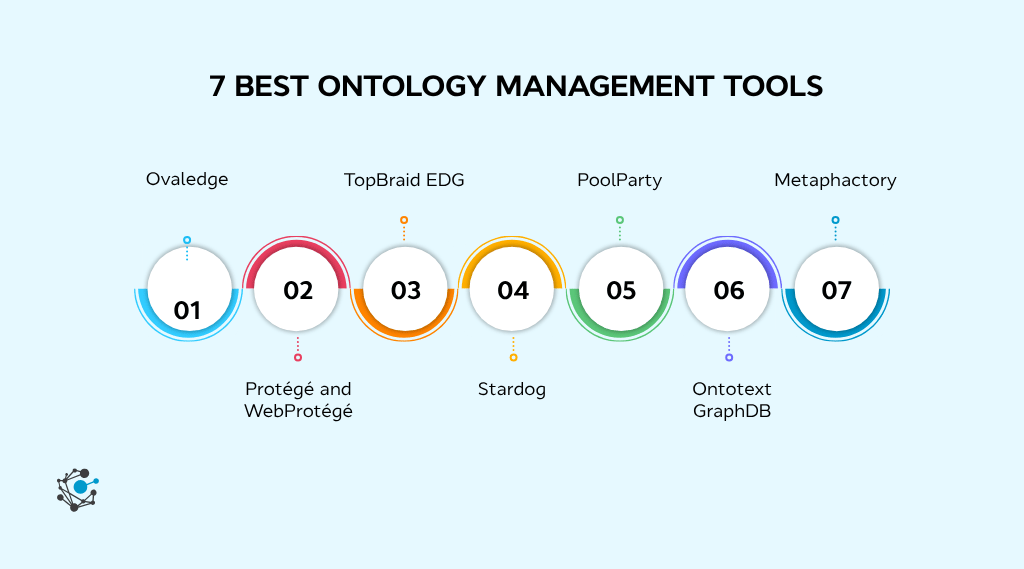
The best ontology management tools are not interchangeable. Some help teams author OWL ontologies. Some store and query RDF graphs. Others connect semantic modeling with governance, metadata, lineage, AI, and enterprise data workflows.
For a useful comparison, we should first separate the tools by job. The table below compares the main ontology management software options by type, standards, reasoning support, and best-fit use case.
|
Tool |
Type |
Best for |
Standards |
Reasoning |
Open-source or commercial |
|
OvalEdge |
Data governance and catalog platform |
Connecting existing governance assets for semantic models, glossary, lineage, ownership, and trusted metadata |
Metadata, glossary, classification, lineage, governance workflows |
Supports governed context for AI and semantic work |
Commercial |
|
Protégé and WebProtégé |
Authoring editor |
Modeling, research, and OWL ontology work |
OWL 2, RDF ecosystem |
Yes, through reasoners |
Free, open-source |
|
TopBraid EDG |
Enterprise knowledge graph platform |
Governed taxonomy and ontology management |
Semantic web standards, SKOS support |
Yes |
Commercial |
|
Stardog |
Enterprise knowledge graph platform |
Semantic layer, AI grounding, and data products |
RDF, SPARQL, SHACL, GraphQL |
Yes, query-time inference |
Commercial |
|
PoolParty |
Semantic suite |
Taxonomy, tagging, and semantic metadata |
RDF, SKOS, semantic web standards |
Yes, semantic enrichment |
Commercial |
|
Ontotext GraphDB |
RDF database |
RDF storage, SPARQL querying, and graph scale |
RDF, SPARQL, formal semantics |
Yes |
Commercial |
|
Metaphactory |
Knowledge graph platform |
Visual modeling and governed semantic applications |
OWL, SHACL, SKOS, DCAT |
Yes, via semantic models |
Commercial |
These classifications are based on official product pages and project documentation from OvalEdge, Protégé, TopQuadrant, Stardog, PoolParty, Ontotext, and Metaphacts.
1. OvalEdge: Unified data governance platform for connecting enterprise context
OvalEdge is a unified data governance and catalog platform that connects business definitions, metadata, ownership, lineage, data quality, certification, classification, and access governance in one platform.
It is not a standalone OWL ontology editor. Instead, OvalEdge helps enterprises activate the governed data foundation they have already built through their data governance programs, making that context usable for ontology, semantic modeling, knowledge graph, and AI work.
Best for: Enterprises that already have a data governance foundation and need to connect governed definitions, trusted metadata, lineage, ownership, classification, and catalog context for ontology, knowledge graph, AI, or semantic governance programs.
Key Features
-
Governed business glossary: Standardize business terms, definitions, classifications, roles, responsibilities, and associated data so semantic models are built from approved meaning.
-
Integrated data catalog: Connect metadata from enterprise systems into a searchable catalog where teams can understand data assets, business context, usage, ownership, and relationships.
-
Automated lineage: Map data flows across BI, SQL, and streaming systems down to the column level, helping teams understand where data comes from and what downstream assets may be affected.
-
Classification and governance workflows: Use auto-classification, PII detection, stewardship assignment, approvals, and workflow controls to keep governed metadata accurate and accountable.
-
AI-ready context: Support governed AI and retrieval workflows through catalog context, policies, permissions, sensitive data classification, and askEdgi, OvalEdge’s AI assistant.
Why OvalEdge stands out
OvalEdge stands out when the real barrier to ontology work is not modeling but connecting the governed context the enterprise already has.
That is what OvalEdge helped Bedrock achieve. The organization needed more consistent definitions, stronger reporting confidence, and better governance with a lean team. By connecting business glossary, data catalog, lineage, and data quality through the Enterprise Context Graph, OvalEdge activated the governance assets Bedrock already had and made them usable for semantic and analytical work.
Complex ontology relationships need approved business terms, visible ownership, and traceable data flows. When those governed assets are connected through the Enterprise Context Graph, ontology work builds on trusted enterprise meaning rather than raw, inconsistent metadata.
Things to consider
Not an ontology authoring tool. Teams that need OWL modeling, formal reasoning, or direct RDF editing will need a dedicated ontology editor alongside OvalEdge.
Strongest value comes when the organization already has an established governance foundation. Teams without existing glossary, catalog, or lineage programs may need to build that foundation before the semantic connection pays off.
2. Protégé and WebProtégé
Protégé is a free, open-source OWL ontology editor from Stanford. It supports ontology modeling, reasoning, querying, and collaboration across the ontology development lifecycle. WebProtégé adds browser-based collaborative editing for teams that need shared ontology workspaces.
Best for: Research teams, ontology engineers, academic groups, and organizations that need a free, extensible starting point for OWL ontology development.
Key Features
-
OWL ontology editing: Build and manage formal ontology models using OWL 2, including classes, properties, relationships, and constraints.
-
Reasoning support: Check logical consistency and infer relationships in the ontology through supported reasoners.
-
Querying and exploration: Search, inspect, and analyze ontology structures during modeling and review.
-
Plugin ecosystem: Extend Protégé for specialized workflows, research needs, and domain-specific ontology work.
-
Collaborative editing with WebProtégé: Use a browser-based environment when multiple users need to contribute to ontology modeling and review.
Things to consider
-
Learning curve for non-technical domain users.
-
Limited enterprise governance, identity, deployment, and operational controls out of the box.
3. TopBraid EDG
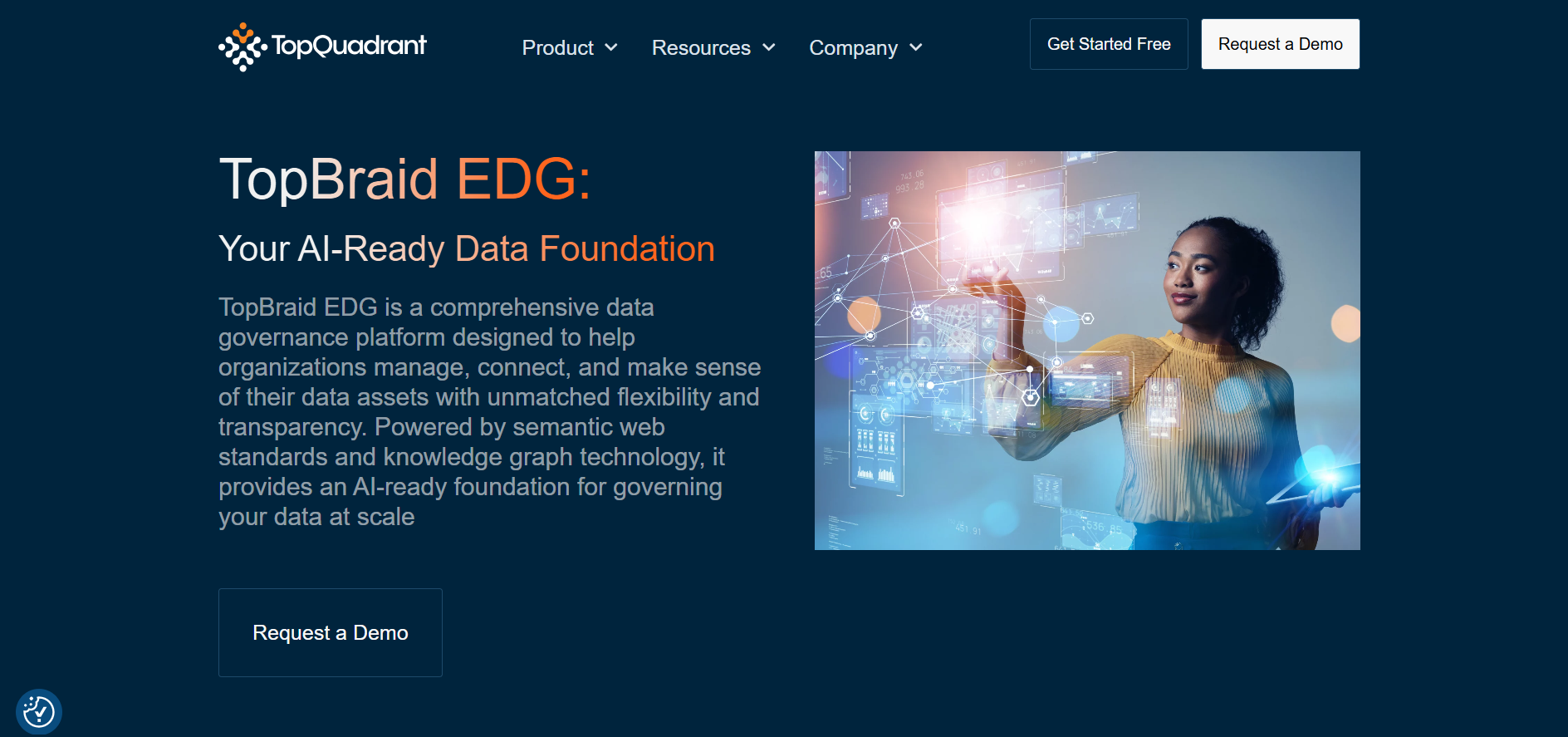
TopBraid EDG is an enterprise data governance and knowledge graph platform built on semantic web standards. It supports semantic modeling with taxonomies and ontologies, policy-as-code, provenance, collaboration, workflows, and AI-ready data foundations.
Best for: Enterprises that need governed taxonomy, ontology, glossary, metadata, and stewardship workflows across domains.
Key Features
-
Semantic modeling with taxonomies and ontologies: Build controlled vocabularies, business glossaries, taxonomies, and ontology models in a standards-based environment.
-
Knowledge graph foundation: Connect semantic assets to enterprise data so teams can understand relationships across systems and domains.
-
Governance workflows: Manage stewardship, review, approvals, lineage, provenance, and audit needs for regulated data work.
-
Inference and reasoning: Use automated connections and semantic rules to support deeper data understanding.
-
Catalog and integration support: Bring metadata, data products, and semantic assets into a unified knowledge graph with connectors across enterprise systems.
Things to consider
-
Best suited for mature semantic and governance programs.
-
Maybe more platform than needed for teams that only need lightweight ontology authoring.
4. Stardog
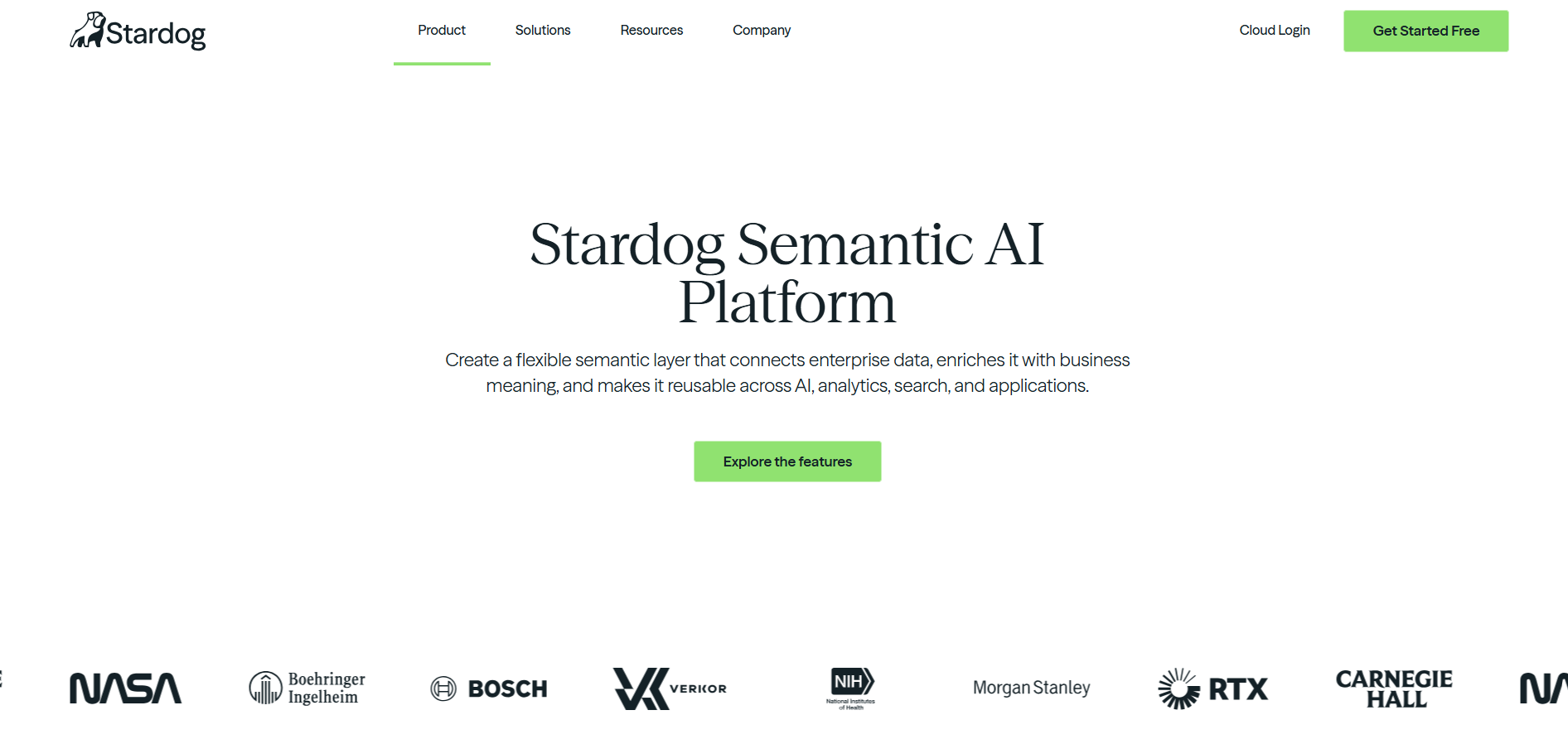
Stardog is an enterprise semantic AI and knowledge graph platform. It creates a semantic layer that connects enterprise data, adds business meaning, and makes that meaning reusable across AI, analytics, search, and applications.
Best for: Teams that need to operationalize semantics in production systems, especially for search, recommendations, analytics, RAG, and AI grounding.
Key Features
-
Semantic layer for enterprise data: Connect data from different systems and define business meaning across sources.
-
Virtualization and materialization: Access data without always moving or copying it, or materialize data when performance requirements call for it.
-
Inference engine: Apply business and domain rules at query time so the system can infer relationships and explain results.
-
AI and machine learning features: Use LLM-assisted knowledge graph work, similarity search, and predictive analytics for semantic applications.
-
Open standards support: Work with RDF, SPARQL, SPARQL*, GraphQL, and SHACL constraints for graph quality and validation.
Things to consider
-
Requires clear production use cases to justify the platform investment.
-
Works best when the team has semantic engineering, data architecture, and governance capacity.
5. PoolParty
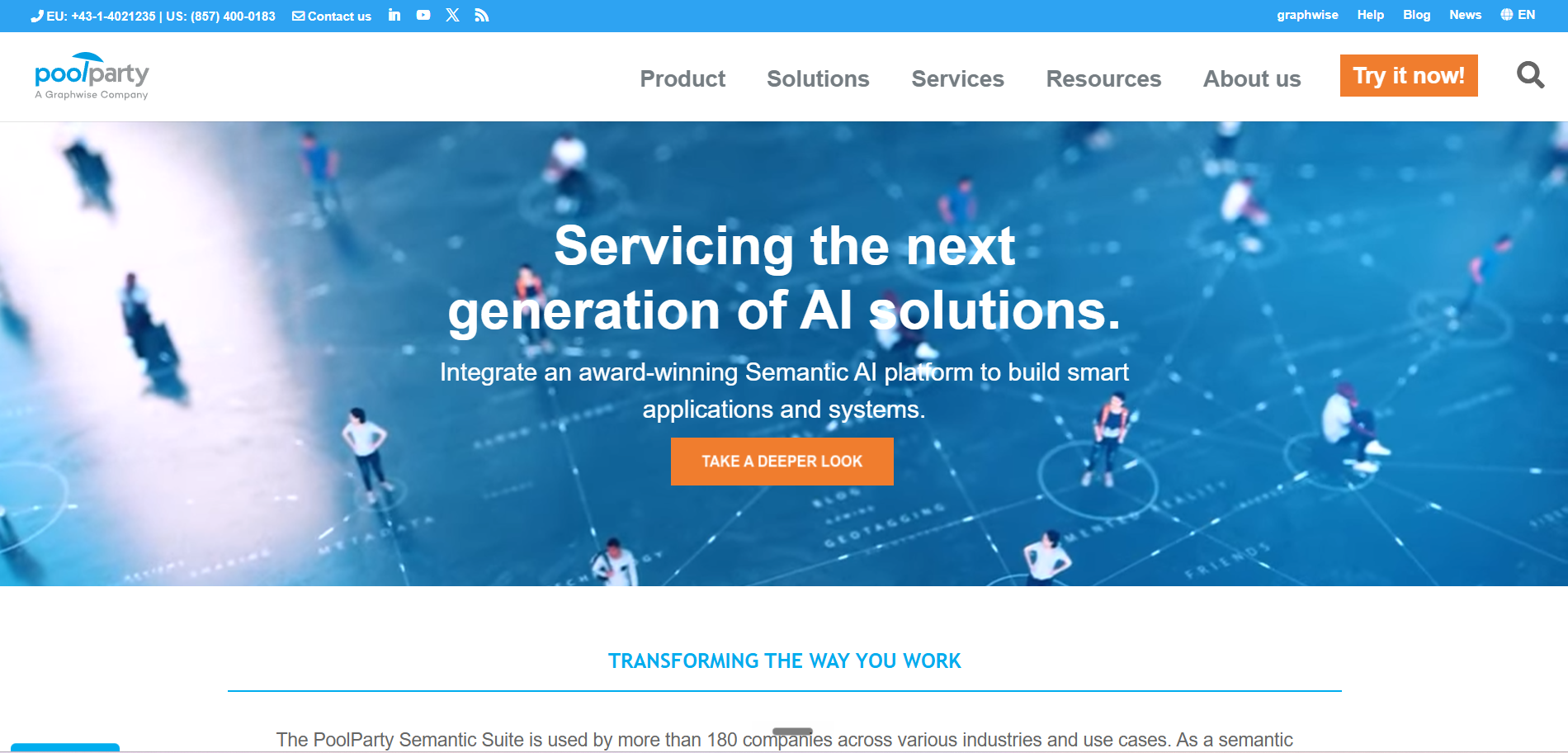
PoolParty is an enterprise semantic platform for taxonomy management, ontology management, graph-based text mining, concept tagging, semantic search, graph grounding, and GraphRAG. It helps organizations structure, enrich, and publish enterprise knowledge for content, search, and AI use cases.
Best for: Organizations that need standards-based taxonomy management, semantic modeling, metadata enrichment, and knowledge graph capabilities.
Key Features
-
Standards-based taxonomy management: Build and maintain taxonomies, thesauri, and controlled vocabularies for consistent enterprise meaning.
-
Ontology and knowledge graph modeling: Create semantic relationships between concepts to support linked data and enterprise knowledge graphs.
-
Semantic AI and classification: Classify content, extract concepts, and enrich metadata for search, content operations, and AI retrieval.
-
Metadata enrichment: Improve content discoverability through semantic tagging, entity recognition, inference tagging, and concept extraction.
-
Enterprise integrations: Connect semantic information to content management systems, search platforms, SharePoint, and enterprise knowledge workflows.
Things to consider
-
Semantic web expertise may be required for deeper implementation.
-
Strongest fit when taxonomy, content classification, search, or GraphRAG adoption is part of the plan.
6. Ontotext GraphDB
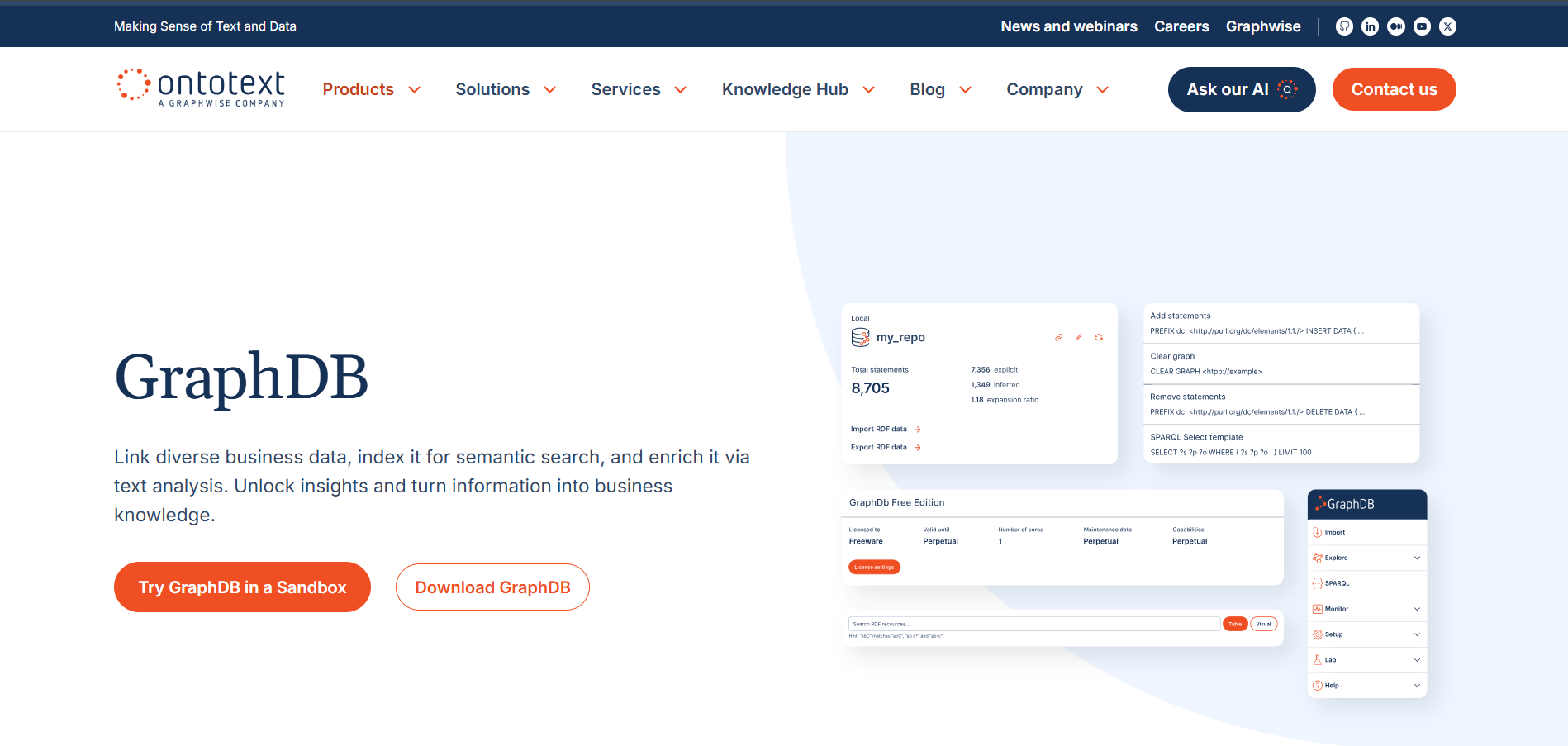
Ontotext GraphDB is an RDF database for building, storing, querying, and governing enterprise knowledge graphs. It supports RDF 1.1, SPARQL 1.1, RDF-Star, SPARQL-Star, standard reasoning rulesets, custom reasoning, consistency checking, and graph-scale performance.
Best for: RDF-first teams that need scalable graph storage, SPARQL querying, semantic reasoning, and knowledge graph infrastructure.
Key Features
-
RDF database foundation: Store and manage linked data using RDF and related Semantic Web standards.
-
SPARQL query support: Query graph-shaped data using SPARQL 1.1, with RDF-Star and SPARQL-Star support for richer graph statements.
-
Reasoning and inference: Use RDFS, OWL 2 RL, OWL 2 QL, custom reasoning, and consistency checking rulesets.
-
Graph performance: Support loading, querying, inference, and retraction of inferred statements at scale.
-
Enterprise deployment options: Use free or enterprise editions, with enterprise options for clustering, high availability, access roles, and support.
Things to consider
-
Primarily a database layer, not a complete ontology governance workspace.
-
Modeling, stewardship, workflow, and business-facing UX may require additional tools around them.
7. Metaphactory
Metaphactory is an enterprise knowledge graph platform for visual semantic modeling, vocabulary and taxonomy management, data catalog integration, collaboration, asset governance, and AI-assisted semantic modeling. It supports ontology work through open standards such as RDF, OWL, SKOS, SHACL, SPARQL, DCAT, and Dublin Core.
Best for: Teams that need business-user-accessible ontology modeling, governed semantic assets, and knowledge graph applications.
Key Features
-
Visual semantic modeling: Create, edit, explore, and document semantic models using a visual interface that supports both technical and domain users.
-
Ontology and vocabulary management: Manage ontologies, vocabularies, taxonomies, and controlled terms in one connected semantic environment.
-
Data catalog integration: Connect dataset metadata with the knowledge graph so semantic models stay tied to the data they describe.
-
Governance and lifecycle workflows: Manage collaboration, review status, change control, and asset governance across semantic models.
-
Git-based versioning: Use Git integration to support model versioning and governance processes.
Things to consider
-
Often works as part of a broader graph stack, so the triplestore and deployment pattern should be confirmed.
-
Best fit when both knowledge graph applications and ontology governance are required.
Which ontology tool fits which use case
The detailed tool entries above explain what each platform does. This section is only for quick routing. Match the tool to the main job the ontology must support, then use the feature details above to narrow the final choice.
|
Use case |
Strong fit |
|
Connecting existing governance assets for semantic models |
OvalEdge |
|
Authoring and modeling OWL ontologies |
Protégé, WebProtégé |
|
Managing governed enterprise taxonomies and ontologies |
TopBraid EDG, Metaphactory |
|
Supporting semantic AI, RAG, and productized knowledge graphs |
Stardog |
|
Storing and querying RDF graphs at scale |
Ontotext GraphDB |
|
Managing content metadata, tagging, and semantic enrichment |
PoolParty |
|
Supporting regulated or domain-heavy semantic programs |
TopBraid EDG, SciBite, Stardog |
|
Starting with free or open-source ontology tooling |
Protégé, WebProtégé, VocBench |
The selection rule is simple: start with the job, not the tool category. If the work is governance-first, begin with governed metadata and glossary foundations. If the work is model-first, use an ontology editor. If the work is production-first, look at RDF databases or enterprise knowledge graph platforms.
Do you actually need a full ontology?
A full ontology is valuable when business decisions depend on complex relationships, constraints, and semantic reasoning. But before investing in one, ask where meaning actually breaks. If the problem is inconsistent definitions or unclear categorization, a governed business glossary or taxonomy often solves it faster than a formal ontology.
When the problem genuinely is relational, the ontology still depends on what sits underneath it. Complex semantic models need approved business terms, visible ownership, traceable lineage, and trusted metadata. Without that governed foundation, an ontology risks formalizing inconsistencies rather than resolving them. Most enterprises already have much of this foundation through their existing data governance programs. The step is connecting and activating it, not rebuilding it.
OvalEdge expert insight: The organizations that get the most from ontology work are the ones that connect their existing governance assets first. When definitions, lineage, and ownership are already governed and linked through the Enterprise Context Graph, the ontology layer adds meaning on top of trust rather than compensating for its absence.
How to choose the right ontology management tool
Choosing the right ontology management tool is a decision framework, not a feature checklist. The right choice depends on the use case, budget, users, deployment model, governance maturity, and vendor fit. A tool that works well for ontology engineers may not work for business stewards, and a platform built for enterprise knowledge graphs may be too heavy for a team that only needs OWL authoring.
Use these questions to narrow the choice:
1. What is the primary use case?
If the goal is model authoring, an ontology editor may be enough. If the goal is semantic search, RAG, AI grounding, or governed data products, a knowledge graph or governance-led platform may be a better fit.
2. Who will use and maintain it?
Technical users may be comfortable with OWL, RDF, SPARQL, and reasoners. Business users need clearer interfaces, workflows, comments, approvals, and stewardship support.
3. What is the organization’s governance maturity?
Teams with weak definitions, unclear ownership, or limited lineage may need to strengthen glossary, catalog, and stewardship foundations before investing in a complex ontology platform.
OvalEdge expert insight: The fastest way to test governance readiness for ontology work is to ask whether the business has one approved definition for its five most-used KPIs, each with a named owner. If that answer takes more than a few minutes to confirm, the governance foundation needs attention before the ontology platform does.
4. What deployment model is required?
Confirm whether the tool supports SaaS, on-premises, private cloud, hybrid deployment, SSO, RBAC, audit logging, and enterprise security requirements.
5. What budget and implementation effort make sense?
Free and open-source tools reduce licensing costs but may require more internal setup and support. Enterprise platforms cost more, but they often include governance, collaboration, integration, and support capabilities.
6. Does the vendor fit the long-term roadmap?
Check whether the vendor supports the standards, integrations, service model, customer support, and roadmap needed for future AI, governance, data product, and knowledge graph work.
Before buying, confirm whether the problem is truly relational. If the issue is definitions or categorization, a governed business glossary or taxonomy may solve it faster than a full ontology platform.
Pick the tool that fits the job
The right ontology management tool depends on the problem, not the category. Authoring editors handle modeling. RDF databases handle storage. Knowledge graph platforms operationalize semantics in production. Governance-led platforms connect ownership, lineage, and stewardship. So start with what the meaning problem actually needs, then pick the tool.
For analytical AI use cases like forecasting, risk analysis, and revenue analytics, the quality and governance of the underlying data are critical. Many enterprises already have a strong data governance foundation providing the business definitions, lineage, quality, and ownership that semantic models depend on. The next step is connecting and activating that foundation.
OvalEdge does this through the Enterprise Context Graph, which connects glossary, catalog, lineage, quality, ownership, and policy in one governed graph. For enterprises pursuing ontology and semantic modeling for analytical AI, this means the governed context they have already built becomes usable, connected, and queryable by both people and AI agents.
Schedule a demo to see how OvalEdge connects your existing governance foundation to analytical AI through the Enterprise Context Graph.
.png?width=1081&height=173&name=Forrester%201%20(1).png)
.png?width=1081&height=241&name=KC%20-%20Logo%201%20(1).png)