-1.png)
Meta title: Business Context in Enterprise Data Governance: AI 202
Enterprise data governance can establish policies, ownership, lineage, and quality controls, yet still fall short when teams interpret the same data differently. That gap is becoming more consequential as AI adoption accelerates.
In the August 4, 2026 ETCIO article “69% of Indian enterprises plan to increase AI investments: Survey,” reporting Dun & Bradstreet’s AI Momentum Survey for India, only 4% of organizations said their enterprise data was fully ready to support AI at scale.
Business context helps close this readiness gap by connecting data with approved definitions, relationships, ownership, trust signals, lineage, and rules for use. As analytics and data-centric AI become more self-service, governance must make meaning, authority, and trust usable across discovery, preparation, validation, and decision-making.
This blog explains how business context strengthens enterprise governance for AI-assisted analytics.
What business context means in enterprise data governance
Business context gives technical data a governed business interpretation.
Technical metadata can identify a table, column, schema, data type, pipeline, or dashboard. But structure alone cannot explain whether REV_AMT represents gross revenue, booked revenue, recognized revenue, or net revenue.
A business glossary establishes approved terminology, while semantics connects those definitions to the technical assets that represent them. Ontology extends that context by defining how business concepts relate to one another.
The distinction is useful:
Semantics connects business meaning to data. Ontology connects business concepts to one another.
For example, a customer may connect to an account, an account may generate revenue, and a revenue metric may depend on several other governed metrics. These relationships provide the context needed to answer business questions that cannot be resolved through an isolated definition.
Business context also determines whether data is appropriate for a particular use. Ownership establishes accountability, certification identifies approved assets, quality results indicate reliability, lineage provides provenance, and policies and access controls govern how information can be consumed.
This is why business glossary alignment matters beyond terminology management. A definition becomes operational when it connects to the reports, tables, transformations, owners, and controls that implement it. A data catalog can organize these connections so approved business meaning is available wherever analytical decisions are made.
OvalEdge expert insight: Data governance has already established much of the context Analytical AI needs. The next step is making that governed context connected and machine-usable so AI can interpret enterprise data with the same definitions, relationships, trust signals, and controls the business relies on.
Business context vs. semantic layer vs. governance layer
Several related terms appear in enterprise data architecture, and treating them as interchangeable creates unnecessary confusion.
|
Concept |
Primary question |
Typical content |
Main role |
|
Technical metadata |
What data exists and how is it structured? |
Schemas, tables, columns, data types, pipelines |
Structural understanding |
|
Semantic layer |
What do business measures and concepts mean? |
Metrics, dimensions, calculations, business definitions |
Consistent analytical interpretation |
|
Business context |
What does this data mean in this business situation? |
Definitions, relationships, ownership, usage, trust, applicable rules |
Governed interpretation |
|
Data lineage |
Where did the data come from and how did it change? |
Sources, transformations, dependencies, downstream reports |
Traceability |
|
Governance layer |
Who can use data, under which standards and controls? |
Ownership, policies, access, classification, quality, certification |
Accountability and control |
|
Enterprise Context Graph |
How can connected governance context become accessible to humans and AI? |
Governed metadata, semantics, ontology, lineage, quality, ownership, and policy relationships |
Machine-usable governed context |
A semantic layer is particularly important when multiple analytics tools need the same metric definitions. The dedicated guide to a governed semantic layer for AI explores that problem in greater depth.
Business context has a wider governance purpose. A revenue definition may specify how a metric is calculated, while context also identifies its owner, approved implementation, lineage, certification status, access requirements, and appropriate business use.
A governance layer adds decision rights and controls. Data governance policies specify responsibilities and permitted behavior, while workflow and access mechanisms put those decisions into practice.
How business context helps govern enterprise data use
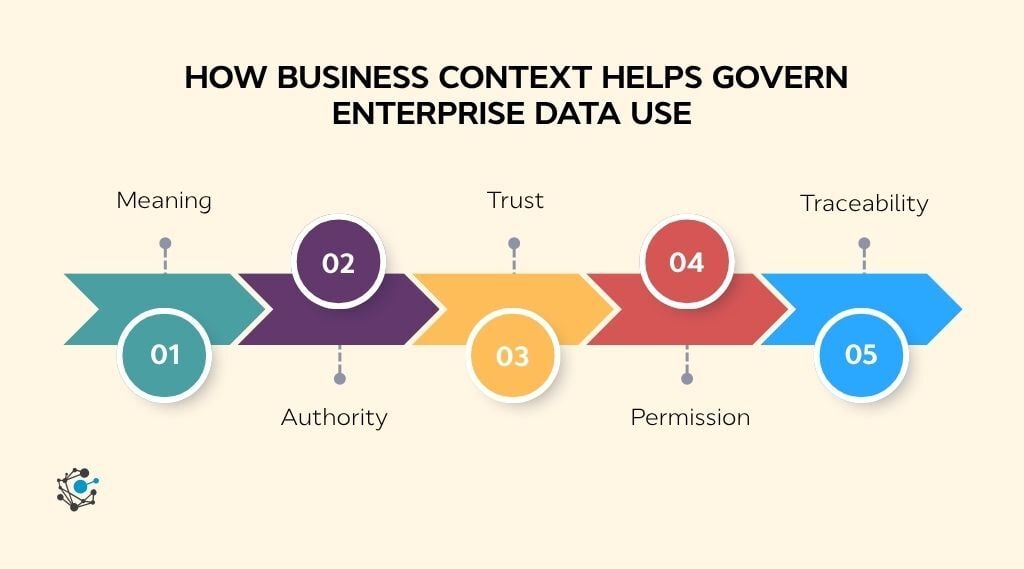
Enterprise data governance becomes operational when it can answer a practical question: What is permitted, trusted, and appropriate for this data use?
Consider a financial analyst preparing an executive revenue report. Finding a revenue table is only the beginning. The analyst may need to determine which revenue definition applies, whether the source is certified, whether recent data-quality checks passed, which transformation created the metric, and who owns the definition.
A governance program should therefore connect five types of decisions.
1. Meaning
Definitions establish how business concepts should be interpreted. Terms such as active customer, net revenue, churn, risk exposure, or order fulfillment need approved meanings that can be mapped to real data.
Organizations building this foundation can use business glossary and data catalog practices to connect human terminology with technical assets.
2. Authority
Governance identifies which definition, source, or calculation carries authority for a particular domain. Two datasets may both be valid while serving different business purposes.
Authority also requires named accountability. Mature enterprise data governance assigns owners and stewards who can approve definitions, resolve conflicts, and address exceptions.
3. Trust
An approved definition cannot compensate for unusable data. Data quality contributes operational trust through rules, results, anomaly signals, and remediation processes.
Certification adds another decision signal by identifying assets that have passed defined governance checks. Trust becomes more useful when it can be evaluated in the same context as meaning and lineage rather than through a separate manual investigation.
4. Permission
Business context also determines whether an otherwise valid asset can be used by a particular person or process.
Data access governance connects requests, approvals, and permissions to governance requirements. Sensitive customer information, financial records, or regulated data may require different treatment depending on user role and analytical purpose.
5. Traceability
A metric may be correctly defined and properly authorized while still being difficult to defend if its origin cannot be traced.
Data lineage reveals upstream sources, transformations, and downstream dependencies. It gives governance teams a way to connect a business result with the technical path that produced it.
Together, these decisions make business context actionable. Governance can then influence data consumption rather than remaining confined to policy documents.
How governance connects warehouses, lakes, pipelines, and BI
Enterprise data rarely remains inside one system. It moves from operational applications into pipelines, data lakes, lakehouses, warehouses, semantic models, dashboards, analytics environments, and AI interfaces.
Business context should remain connected to the data across that path.
|
Data stage |
Technical activity |
Context governance needs |
|
Source systems |
Data is created in applications, databases, or operational platforms |
Ownership, classification, business entity mapping |
|
Pipelines and transformations |
Data is cleaned, joined, aggregated, or reshaped |
Transformation logic, lineage, quality rules, policy inheritance |
|
Lakes and warehouses |
Data is stored and modeled for enterprise use |
Approved definitions, domains, certification, access controls |
|
BI and analytics |
Metrics become dashboards, reports, and analysis |
Consistent calculations, traceable definitions, trusted sources |
|
AI consumption |
Systems discover, interpret, query, or analyze data |
Machine-readable meaning, trust signals, permissions, provenance |
Data lineage best practices are central because transformations frequently change the form of data while business meaning must remain understandable.
A source column may become a curated warehouse measure and later appear as an executive dashboard metric. Governance needs enough traceability to determine which transformations occurred and whether the downstream result still reflects the approved definition.
Business Intelligence also creates its own interpretation point. Self-service environments can multiply local calculations when shared meaning is weak. Self-service analytics becomes safer when analysts can discover approved definitions, ownership, lineage, and trust signals inside the analytical workflow.
The same principle applies to data discovery. Search based only on technical names can surface relevant-looking assets without explaining whether they are appropriate for the task.
A connected context architecture addresses this problem by treating metadata, meaning, lineage, quality, and governance as related information rather than isolated repositories.
Why business context matters more when AI consumes enterprise data
Artificial intelligence introduces a new consumer of data governance.
Historically, governance artifacts were designed primarily for people. An analyst could search a catalog, read a glossary definition, inspect lineage, check data quality, interpret a policy, or contact an owner before deciding whether data was suitable for use.
Data-centric AI changes that interaction model. An AI system answering a business question may need to select a dataset, interpret a metric, understand relationships, generate a query, and determine whether the resulting information is appropriate for the task. To do this reliably, it needs direct access to governed business context.
The context required depends on the AI use case. A coding agent needs repository and debugging context. A customer-service agent needs customer history and support policies. A document agent needs authoritative documents and permissions. A data-centric analytical agent needs governed enterprise data, including its meaning, relationships, provenance, quality, ownership, and usage rules.
That is why context engineering best practices should begin with the use case rather than assuming one context architecture can serve every AI system.
Retrieval solves relevance; governance establishes trust
Retrieval-Augmented Generation (RAG) can help AI find information related to a question. Relevance alone does not establish whether that information is authoritative or appropriate to use.
An outdated dashboard may be relevant. An uncertified metric may be relevant. A table with failed quality checks may be relevant. A restricted dataset may be highly relevant.
AI therefore needs governance signals alongside retrieved information. Certification identifies approved assets, lineage establishes provenance, quality signals indicate reliability, ownership establishes accountability, and permissions determine whether the data can be used for the task.
Put simply: RAG provides relevance. Governance provides trust.
For data-centric AI, the goal is to distinguish between information that could answer a question and governed information that should be used to answer it.
At OvalEdge, we believe data-centric AI needs enough governance context to identify which source carries business authority, whether it can be trusted, and whether it is permitted for a specific task.
The Enterprise Context Graph connects governance context for AI
The Enterprise Context Graph connects catalog metadata, business definitions, semantics, ontology, lineage, quality, ownership, and policies so users and AI can query these relationships together.
This enables a business-question-first interaction. Instead of requiring users or AI systems to navigate governance artifacts individually, a question such as “Why did revenue decline in the Midwest?” can be connected to relevant datasets along with their approved definitions, relationships, owners, lineage, certification, quality signals, and applicable controls.
This connected context helps AI determine which enterprise data is appropriate for answering the question rather than relying on relevance alone.
Business context can support an AI-First DDLC
Making governance context accessible to AI also changes how analytical work can be executed.
The Data Development Lifecycle (DDLC) describes how a business question becomes a trusted analytical output:
Business Question → Discover → Understand and Specify → Prepare → Analyze or Build → Validate → Publish → Improve and Iterate
Traditional analytical development often involves repeated handoffs among business analysts, data engineers, data scientists, governance teams, and production engineering. Definitions, source suitability, ownership, lineage, and policy requirements may need to be rediscovered or clarified at multiple stages.
An AI-First DDLC can use connected business context to reduce that friction. AI can assist with discovery and understanding, identify governed data, support preparation and prototyping, and incorporate quality, lineage, policy, and governance checks throughout the lifecycle.
Human expertise remains essential for validation, security, production engineering, scale, and high-impact decisions. The opportunity is to reduce repeated discovery and coordination so specialists can focus on work that requires their judgment.
How to build business context into enterprise data governance
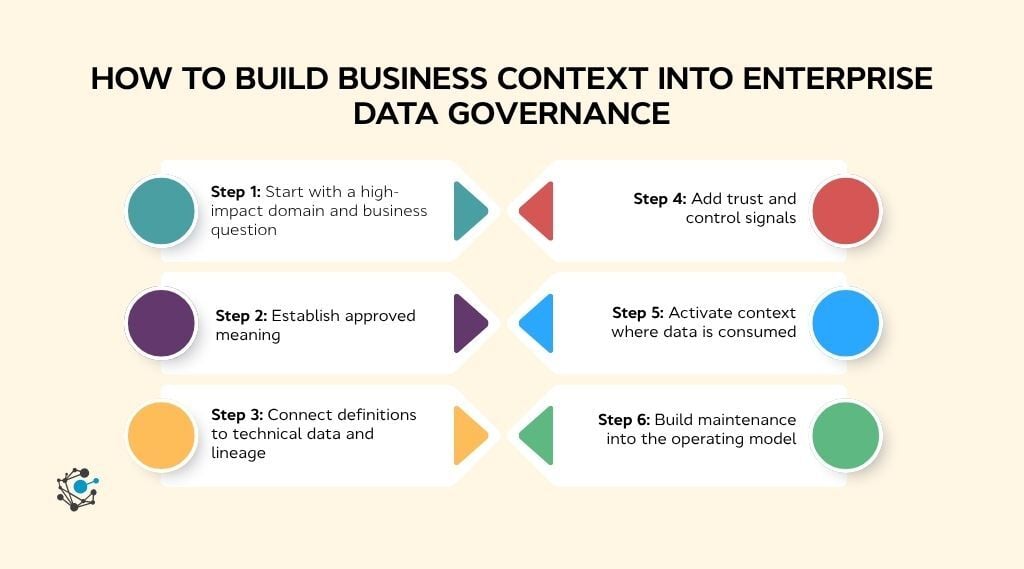
Start with a specific business decision or analytical question. Then connect its meaning, data, lineage, trust signals, and controls. The following steps use revenue reporting as a continuous example.
Step 1: Start with a high-impact domain and business question
Choose a domain where inconsistent definitions or data create measurable problems. Define the question the business needs to answer and scope the required context around it.
Finance might focus on revenue recognition, customer analytics on active-customer definitions, or supply chain on inventory availability. A narrow scope makes ownership, quality, and governance requirements easier to establish.
Example: A finance team starts with one question: “What was recognized revenue by region this quarter?”
Step 2: Establish approved meaning
Define the business terms, metrics, dimensions, and calculation rules required to answer the question. Distinguish between similar concepts and document which definition is approved.
Connect those definitions to related concepts through semantics and, where needed, ontology. Avoid creating conceptual models that cannot be mapped to actual enterprise data.
Example: Finance defines recognized revenue, distinguishes it from booked, gross, and net revenue, and documents the approved calculation and reporting period.
Step 3: Connect definitions to technical data and lineage
Map each governed concept to the tables, columns, transformations, reports, and data products that implement it.
Add lineage to show how source data moves and changes before reaching the final metric. This makes it easier to identify downstream impact when source fields or transformation logic change and to detect differences between documented definitions and production logic.
Example: Recognized revenue is mapped from source columns through transformation logic to the finance model and executive dashboard, with lineage connecting each stage.
Step 4: Add trust and control signals
Attach the governance signals needed to determine whether an asset is appropriate for use. These can include ownership, stewardship, classification, quality results, certification, policies, access requirements, and business rules.
This allows users and AI systems to evaluate data based on authority, quality, and permitted use rather than relevance alone.
Data governance best practices provide a broader framework for applying these controls consistently.
Example: Finance assigns a metric owner, certifies the approved revenue dataset, applies quality checks, and connects relevant accounting and access policies.
Step 5: Activate context where data is consumed
Make business context available inside the workflows where data decisions happen.
Business users may need definitions within reports, analysts may need lineage and quality signals during discovery, and governance teams may need ownership and policies during approval. AI systems can consume governed context through graphs, APIs, or Model Context Protocol (MCP) integrations.
The goal is to make governance context available at the point of use rather than requiring users to find it separately.
Example: Analysts can see the approved revenue definition, lineage, owner, and quality status during discovery, while analytical AI can access the same context when answering revenue questions.
Step 6: Build maintenance into the operating model
Business context must be updated as metrics, data models, pipelines, policies, ownership, and reporting requirements change.
Define owners and triggers for maintenance. A definition change may require owner approval, a pipeline update may trigger lineage review, a quality failure may affect certification, and a regulatory change may require policy updates.
Data curation provides a useful model for continuous review, while a data governance maturity model can help determine which maintenance activities should remain manual and which can be automated.
Example: When revenue-recognition logic changes, the metric owner reviews the definition and affected lineage, certifications, quality rules, and downstream reports are reassessed.
Common failures when business context is treated as documentation
Several failure patterns prevent context from improving governance outcomes.
1. Definitions exist without authority
A glossary can contain several plausible definitions without establishing which one governs a specific business process. Governance should connect definitions with owners, domains, approvals, and implementation.
2. Context is disconnected from technical change
Documentation can remain accurate on paper while pipelines, warehouse models, or dashboards evolve. Lineage and change management are needed to expose when technical implementation diverges from approved meaning.
3. Governance signals live in separate systems
Definitions, quality, lineage, policies, and access decisions lose value when users must reconstruct the relationship manually. Connected governance context makes those signals easier to evaluate together.
4. Context scope becomes unlimited
Enterprise AI may need documents, code, communication history, workflows, and other knowledge depending on the use case. The governance context surrounding enterprise data should remain clearly scoped rather than claiming to represent all organizational knowledge.
This is one reason the broader business context layer and data-centric governance use case should be distinguished from every other form of enterprise context engineering.
5. AI automation gets ahead of governance maturity
Making context machine-readable does not automatically make every downstream AI action safe. Human validation, access controls, production engineering, and task-specific safeguards remain necessary.
A Model Context Protocol server for enterprise data can expose context to approved AI systems, for example, while governance still determines which context is authoritative and permitted.
What changes for data governance leaders
Analytical AI expands the value of existing data governance investments. Catalogs, glossaries, lineage, quality, ownership, policies, and access controls now need to support AI alongside human decision-making.
For governance leaders, the priority is to connect these capabilities so AI can interpret enterprise data using approved definitions, trusted sources, and established controls. This creates a more direct path from governance investment to trusted AI-driven analytics.
How OvalEdge supported Bedrock’s governance transformation
Bedrock used OvalEdge to connect key governance capabilities and strengthen trust in its enterprise data:
-
Connected governance: Brought the business glossary, data catalog, lineage, and data quality into one governance environment.
-
Consistent data understanding: Standardized business definitions and improved data accuracy across teams.
-
Reduced manual effort: Automated lineage replaced manual mapping work, saving the team months of effort.
The result shows how connected governance can establish the trusted business context needed for analytics today and analytical AI as adoption grows.
Conclusion
Business context becomes valuable when it changes how enterprise data is interpreted, governed, and consumed. The next stage for data governance leaders is to turn definitions, lineage, quality, ownership, certifications, and policies into connected context that can support both human analysis and Analytical AI.
That shift protects the value of earlier governance work while extending it into new operating models for discovery, validation, and self-service. A unified governance platform can help teams keep those signals connected as data moves across systems and analytical workflows.
OvalEdge brings that governed context together through its Enterprise Context Graph and related governance capabilities.
Book a data governance demo to see how OvalEdge connects business context with governance and makes trusted enterprise data ready for AI-assisted analytics.
.png?width=1081&height=173&name=Forrester%201%20(1).png)
.png?width=1081&height=241&name=KC%20-%20Logo%201%20(1).png)