.png)
AI agents can only make reliable decisions when they understand enterprise context, not just enterprise data. Simply connecting an AI agent to data sources does not ensure it uses approved business definitions, trusted datasets, or governance policies.
The challenge is growing as enterprise data expands.
According to the G2 Big Data Statistics Report 2026, the world is expected to generate 221 zettabytes of data in 2026, yet nearly 90% of enterprise data remains unused.
This underscores the need for a governed way to expose trusted enterprise metadata to AI.
An Enterprise Model Context Protocol MCP) server for enterprise data addresses this challenge by providing AI agents with trusted enterprise context instead of unrestricted data access. It enables AI applications to understand business meaning, discover reliable information, and operate within enterprise governance boundaries.
This guide explains how to design, secure, implement, and evaluate an enterprise MCP server for production use.
Enterprise requirements for an MCP server
Running an MCP server in production requires more than exposing tools to AI agents. Enterprise deployments must provide governed metadata, enforce security policies, protect sensitive information, and integrate with existing governance processes.
The table below summarizes the core capabilities every enterprise MCP server should support.
|
Requirement |
Purpose |
|
Governed metadata |
Gives AI agents trusted business context. |
|
Authentication |
Verifies users and AI applications. |
|
Access control |
Limits access based on enterprise policies. |
|
Read-only tools |
Reduces the risk of unauthorized changes. |
|
Audit logging |
Tracks AI activity for governance and compliance. |
|
Security protections |
Prevents prompt injection and data leakage. |
|
Enterprise operations |
Supports monitoring, scalability, and reliability. |
What metadata should an enterprise MCP server expose?
An enterprise MCP server should expose the metadata AI agents need to discover, interpret, and trust enterprise information. The goal is not to expose more data but to provide governed context that enables accurate, explainable, and policy-compliant AI responses.
1. Business glossary and business definitions
An enterprise MCP server should expose approved business definitions before AI agents retrieve enterprise data. This ensures every AI application interprets business terms consistently instead of relying on table names, documentation, or model inference.
For example, organizations often maintain multiple definitions for metrics such as Annual Recurring Revenue (ARR) or customer churn. By exposing a governed business glossary through MCP, AI agents can retrieve the approved enterprise definition and use it consistently across analytics, reporting, and AI assistants.
An enterprise MCP server should expose:
-
Approved business terms and definitions
-
Business metrics and KPIs
-
Synonyms and related terms
-
Business owners and stewards
-
Links to certified data assets
Implementation tip: OvalEdge Business Glossary helps organizations manage approved business terms, KPIs, synonyms, and business ownership, making them available as trusted context for AI agents.
2. Technical metadata and data assets
After understanding a business request, AI agents must identify the correct enterprise data assets. An MCP server should expose technical metadata that helps agents discover trusted databases, tables, columns, reports, and dashboards.
For example, Snowflake provides metadata through its Information Schema and catalog capabilities, enabling applications to locate and understand enterprise data assets before querying them.
An enterprise MCP server should expose:
-
Databases, schemas, tables, and columns
-
Data types and schema relationships
-
Reports and dashboards
-
Asset descriptions and tags
-
Source system information
3. Data lineage and provenance
AI-generated answers become more trustworthy when users can verify where the information originated. An enterprise MCP server should expose lineage metadata so AI agents can trace data from its source through transformations to downstream reports and analytics.
For example, Databricks Unity Catalog provides end-to-end lineage across data assets, helping organizations understand data dependencies and improve explainability for AI-driven decisions.
An enterprise MCP server should expose:
-
End-to-end lineage
-
Source-to-target relationships
-
Transformation history
-
Upstream and downstream dependencies
-
Lineage references
4. Ownership, quality, and trust signals
Not every enterprise dataset should be treated as equally reliable. An MCP server should expose ownership and trust metadata so AI agents can prioritize certified, high-quality, and well-governed assets over incomplete or outdated information.
For example, enterprise data governance frameworks commonly recommend combining ownership, stewardship, certification, and data quality indicators to improve trust in analytics and AI outputs.
An enterprise MCP server should expose:
-
Business and technical owners
-
Data quality scores
-
Certification status
-
Data freshness indicators
-
Usage and trust metrics
5. Policies, classifications, and access metadata
Enterprise AI should follow the same governance policies that apply to human users. An MCP server should therefore expose policy metadata so AI agents understand what information users are authorized to access and how sensitive data should be handled.
For example, Microsoft Purview exposes classifications, sensitivity labels, and access policies that help organizations enforce governance consistently across analytics and AI workloads.
An enterprise MCP server should expose:
-
Data classifications
-
Privacy and sensitivity labels
-
Access permissions
-
Retention and compliance policies
-
Approved usage policies
Together, these metadata categories create the enterprise context AI agents need to interpret business requests, justify their responses, and make decisions that align with organizational policies.
They also form a key part of context engineering for data-centric AI agents, providing the trusted business context required for accurate, explainable, and policy-aware AI reasoning.
OvalEdge expert insight: Metadata alone does not make enterprise AI trustworthy. AI agents need connected business context that combines meaning, lineage, quality, ownership, and governance so they can understand not only what data exists, but which information should be trusted for a specific business task.
How to secure an enterprise MCP server
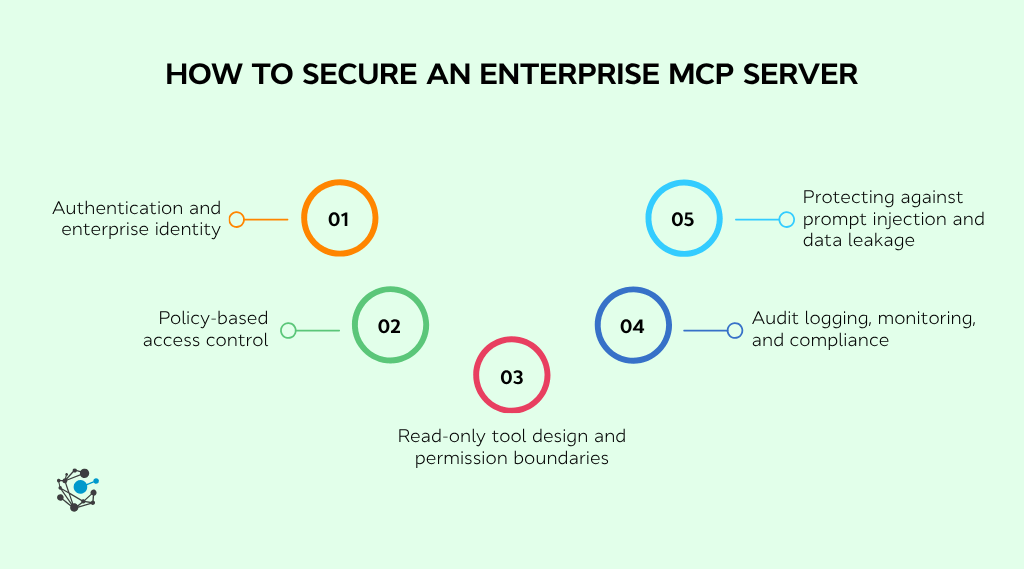
Enterprise MCP servers should enforce security controls that protect enterprise metadata, AI agents, and connected systems. They should also align with an organization's broader AI governance strategy by integrating with existing identity, governance, and compliance frameworks.
This ensures AI interactions remain secure, policy-compliant, and accountable as enterprise AI adoption scales.
-
Authentication and enterprise identity: Verify every user, AI application, and service before granting access to MCP tools. Integrate with enterprise identity providers and support standards such as SSO, OAuth 2.0, and OpenID Connect (OIDC).
-
Policy-based access control: Enforce existing enterprise access policies so AI agents only retrieve metadata users are authorized to access. Support role-based, attribute-based, and policy-driven authorization.
-
Read-only tool design and permission boundaries: Expose metadata through least-privilege, read-only tools wherever possible. Restrict write operations to approved workflows with clearly defined permission boundaries.
-
Audit logging, monitoring, and compliance: Record every MCP request, authentication event, and tool invocation to support governance, compliance reporting, security investigations, and operational monitoring.
-
Protecting against prompt injection and data leakage: Validate tool inputs and outputs, sanitize retrieved metadata, filter sensitive information, and prevent malicious instructions from influencing AI agent behavior.
How to implement an enterprise MCP server
Implementing an enterprise MCP server involves more than deploying the protocol. Organizations should first establish governed metadata, define secure access patterns, and validate that AI agents retrieve trusted enterprise context before moving into production.
Step 1: Identify AI agent use cases
Start by defining the business problems the MCP server will support. The selected use cases determine which enterprise metadata, MCP tools, and governance controls need to be exposed.
Outcome: A prioritized list of AI agent use cases with clear metadata and security requirements.
Example: A customer support AI agent needs business glossary terms and knowledge articles, while an analytics agent requires certified datasets, lineage, and data quality metadata.
Step 2: Prepare governed metadata
Ensure business, technical, and governance metadata is complete, accurate, and continuously maintained before exposing it through MCP. AI agents can only produce trustworthy responses when the underlying metadata is reliable.
Preparing governed metadata is also a critical part of broader AI readiness, ensuring AI agents have trusted enterprise context before moving into production.
Outcome: A trusted metadata foundation that AI agents can use consistently.
Example: A certified sales dataset is linked to its business glossary definition, lineage, owner, and quality score before it is exposed through the MCP server.
Step 3: Expose metadata through MCP tools
Design focused MCP tools that retrieve specific metadata instead of exposing unrestricted access to enterprise systems. Each tool should have a clear purpose and predictable outputs.
Outcome: Standardized MCP tools that AI agents can discover and invoke reliably.
Example: Separate tools return business definitions, certified datasets, lineage information, and governance policies rather than a single generic search tool.
Step 4: Configure security and governance
Integrate the MCP server with enterprise identity, authorization, and governance controls before making it available to AI applications. Existing security policies should apply automatically to every MCP request.
Outcome: Secure and policy-compliant access to enterprise metadata.
Example: An employee can retrieve metadata for datasets they are authorized to access, while restricted assets remain unavailable to both the user and the AI agent.
Step 5: Validate, deploy, and monitor
Before rolling out the MCP server across the enterprise, validate it against real AI agent workflows to ensure it consistently retrieves trusted metadata, enforces governance policies, and returns accurate context. After deployment, continuously monitor performance, security, metadata quality, and usage patterns to maintain reliable AI interactions.
Outcome: A production-ready enterprise MCP server with continuous governance, operational visibility, and trusted AI responses.
Example: Usage monitoring shows AI agents frequently retrieving outdated glossary definitions. Governance teams update the approved definitions, ensuring future AI responses use the latest business context.
OvalEdge experts believe that successful enterprise MCP implementations start with a strong metadata foundation, not the protocol itself. MCP standardizes how AI agents access enterprise context, but reliable outcomes still depend on trusted business definitions, accurate metadata, and effective governance across the organization.
Organizations that strengthen these foundations first are better positioned to deploy reliable, explainable, and policy-compliant AI agents.
Enterprise MCP server comparison
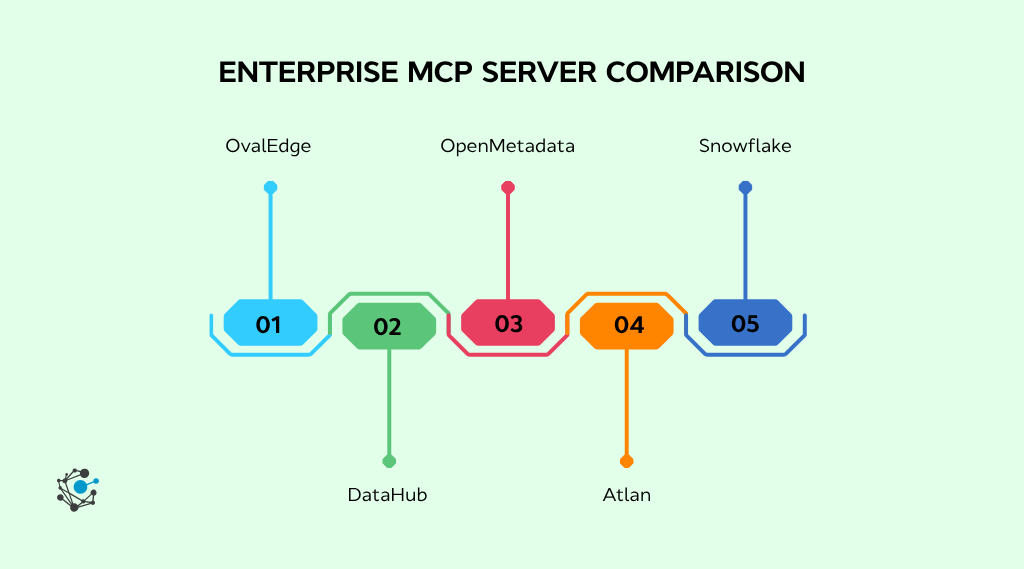
Enterprises can build MCP servers on different metadata and data platforms depending on their AI, governance, and architecture requirements. The right choice depends on whether your priority is governed metadata, open-source flexibility, or integration with an existing cloud ecosystem.
|
Platform |
Primary strength |
Deployment |
Licensing |
|
OvalEdge |
Governance-first enterprise metadata |
Cloud, On-premises, Hybrid |
Commercial |
|
DataHub |
Open-source metadata platform |
Self-managed, Cloud |
Open source + Commercial |
|
OpenMetadata |
Open-source metadata governance |
Self-managed, Cloud |
Open source + Commercial |
|
Atlan |
Collaborative cloud governance |
Cloud SaaS |
Commercial |
|
Snowflake |
Native cloud metadata ecosystem |
Cloud |
Commercial |
1. OvalEdge
OvalEdge is an enterprise data governance platform that serves as the metadata foundation for enterprise MCP deployments. By centralizing business, technical, and governance metadata, it enables AI agents to discover trusted enterprise context, understand business meaning, and generate explainable responses without requiring unrestricted access to enterprise data.
Key capabilities
-
Business glossary: Exposes approved business terms, KPI definitions, synonyms, and business context.
-
Data catalog: Helps AI agents discover databases, schemas, tables, columns, dashboards, and reports.
-
Data lineage: Provides end-to-end lineage, impact analysis, and provenance for explainable AI responses.
-
Data quality and certification: Surfaces quality scores, certification status, and freshness indicators to help AI agents prioritize trusted assets.
-
Ownership and stewardship: Connects data assets with business owners and stewards for accountability.
-
Policies and classifications: Exposes governance policies, sensitivity labels, privacy classifications, and access metadata to support compliant AI interactions.
Best for: Organizations building enterprise AI assistants, agentic analytics, conversational BI, and AI-driven data discovery that require governed metadata instead of unrestricted data access.
Why OvalEdge stands out
OvalEdge extends MCP beyond metadata retrieval by making enterprise governance operational for AI agents. It helps AI applications interpret business context, evaluate trust, and follow organizational policies throughout the entire reasoning process.
1. Governed enterprise context for AI
AI agents need more than access to enterprise data. They need sufficient context to determine which information is approved, trustworthy, and appropriate for a specific task. Through MCP, OvalEdge provides this connected enterprise context, enabling AI agents to identify trusted assets, understand business meaning, and support explainable decision-making.
2. AI workflows powered by trusted metadata
The metadata exposed through MCP supports practical enterprise AI workflows. A business analyst can retrieve the approved revenue definition alongside the certified dataset, while a data engineer can trace downstream lineage to assess the impact of a schema change before deployment.
3. Enterprise-ready deployment
OvalEdge enables organizations to expose governed metadata through secure, read-only MCP tools while preserving existing security controls. Enterprise authentication, role-based access control, audit logging, and governance policies continue to protect AI interactions, making it suitable for production deployments.
Ready to build a governed enterprise MCP server?

Discover how OvalEdge enables AI agents to securely retrieve trusted enterprise context through MCP.

Book a demo to see the platform in action.
2. DataHub
DataHub is an open-source metadata platform originally developed at LinkedIn. It focuses on metadata discovery, cataloging, search, and lineage, making it a popular choice for engineering teams building custom metadata platforms and AI integrations.
Key capabilities
-
Metadata catalog: Discovers and organizes enterprise data assets.
-
Metadata ingestion: Connects with a wide range of enterprise systems.
-
Data lineage: Tracks upstream and downstream dependencies.
-
Search and discovery: Enables metadata search across business and technical assets.
-
Open APIs: Supports extensibility and custom integrations.
Best for: Engineering-led organizations looking for an extensible, open-source metadata platform.
Limitations
-
Requires engineering resources for deployment, upgrades, and ongoing maintenance.
-
Advanced governance capabilities often require additional customization or integrations.
3. OpenMetadata
OpenMetadata is an open-source metadata management platform that unifies cataloging, lineage, data quality, and collaboration. It provides a centralized metadata repository for modern data platforms.
Key capabilities
-
Metadata management: Centralizes business and technical metadata.
-
Data lineage: Tracks data movement across systems.
-
Data quality: Integrates quality tests with metadata.
-
Collaboration: Supports documentation, ownership, and discussions.
-
Connector ecosystem: Integrates with modern data platforms.
Best for: Organizations adopting open-source metadata management with strong engineering ownership.
Limitations
-
Infrastructure, upgrades, and maintenance are managed by the organization.
-
Enterprise governance workflows may require additional configuration.
4. Atlan
Atlan is a cloud-native data catalog and governance platform designed to improve collaboration between business and technical teams. It combines metadata management with governance workflows and cloud integrations.
Key capabilities
-
Data catalog: Centralizes enterprise metadata.
-
Business glossary: Organizes business terminology.
-
Data lineage: Supports impact analysis and traceability.
-
Collaboration: Enables shared documentation and governance workflows.
-
Cloud integrations: Connects with modern analytics platforms.
Best for: Organizations prioritizing collaborative data governance and cloud-native metadata management.
Limitations
-
Best suited for cloud-first deployments.
-
Organizations with highly customized environments may require additional integration effort.
5. Snowflake
Snowflake primarily provides cloud data, analytics, and AI platforms while offering metadata and governance capabilities within its own ecosystems. They can support MCP implementations but are not dedicated enterprise metadata governance platforms.
Key capabilities
-
Metadata services: Manage metadata within their respective ecosystems.
-
Data discovery: Help locate enterprise datasets.
-
Data lineage: Track lineage across supported services.
-
AI integration: Support AI and analytics workloads.
-
Cloud scalability: Provide enterprise-scale infrastructure.
Best for: Organizations standardizing on a single cloud analytics platform.
Limitations
-
Governance capabilities are strongest within each vendor's ecosystem.
-
Multi-cloud environments often require a separate metadata governance platform to provide a unified AI context layer.
How to choose the right enterprise MCP server
Choosing an enterprise MCP server is less about the protocol itself and more about the quality of the metadata foundation behind it. The strongest platforms enable AI agents to interpret business context securely while integrating with existing governance and security controls.
When evaluating enterprise MCP server platforms, consider the following criteria:
-
Metadata coverage: Ensure the platform exposes business glossary, technical metadata, lineage, ownership, quality, policies, and other enterprise metadata required for AI reasoning.
-
Governance capabilities: Look for built-in support for business glossary management, data cataloging, certification, stewardship, policy enforcement, and data quality to help AI agents retrieve trusted information.
-
Security and access control: Verify that the platform integrates with enterprise identity providers and supports role-based or policy-based access control, audit logging, and secure metadata exposure.
-
AI and MCP readiness: Evaluate whether the platform can expose governed metadata through standardized APIs or MCP tools, enabling AI assistants and AI agents to retrieve enterprise context consistently.
-
Deployment flexibility: Consider whether the platform supports cloud, on-premises, or hybrid deployments to align with your enterprise architecture and compliance requirements.
-
Scalability and integrations: Assess connector availability, metadata ingestion capabilities, and integration with your existing data platforms, BI tools, and cloud ecosystem.
The best enterprise MCP server is one that fits your organization's governance maturity, AI strategy, and data architecture. Prioritizing governed enterprise metadata over direct data access will help AI agents deliver more accurate, explainable, and compliant responses as AI adoption grows.
Conclusion
An enterprise MCP server is only as effective as the metadata it exposes. By providing AI agents with governed business context instead of unrestricted data access, organizations can improve the accuracy, explainability, and security of AI-driven decisions.
OvalEdge provides a governance-first foundation for enterprise MCP by unifying business glossary, data catalog, lineage, data quality, and governance metadata in a single platform.
This helps AI agents retrieve trusted enterprise context while continuing to follow existing security and compliance policies.
Ready to build a governed enterprise MCP server?

 Book a Data Governance demo to see how OvalEdge enables secure, metadata-driven AI with trusted enterprise context.
.png?width=1081&height=173&name=Forrester%201%20(1).png)
.png?width=1081&height=241&name=KC%20-%20Logo%201%20(1).png)