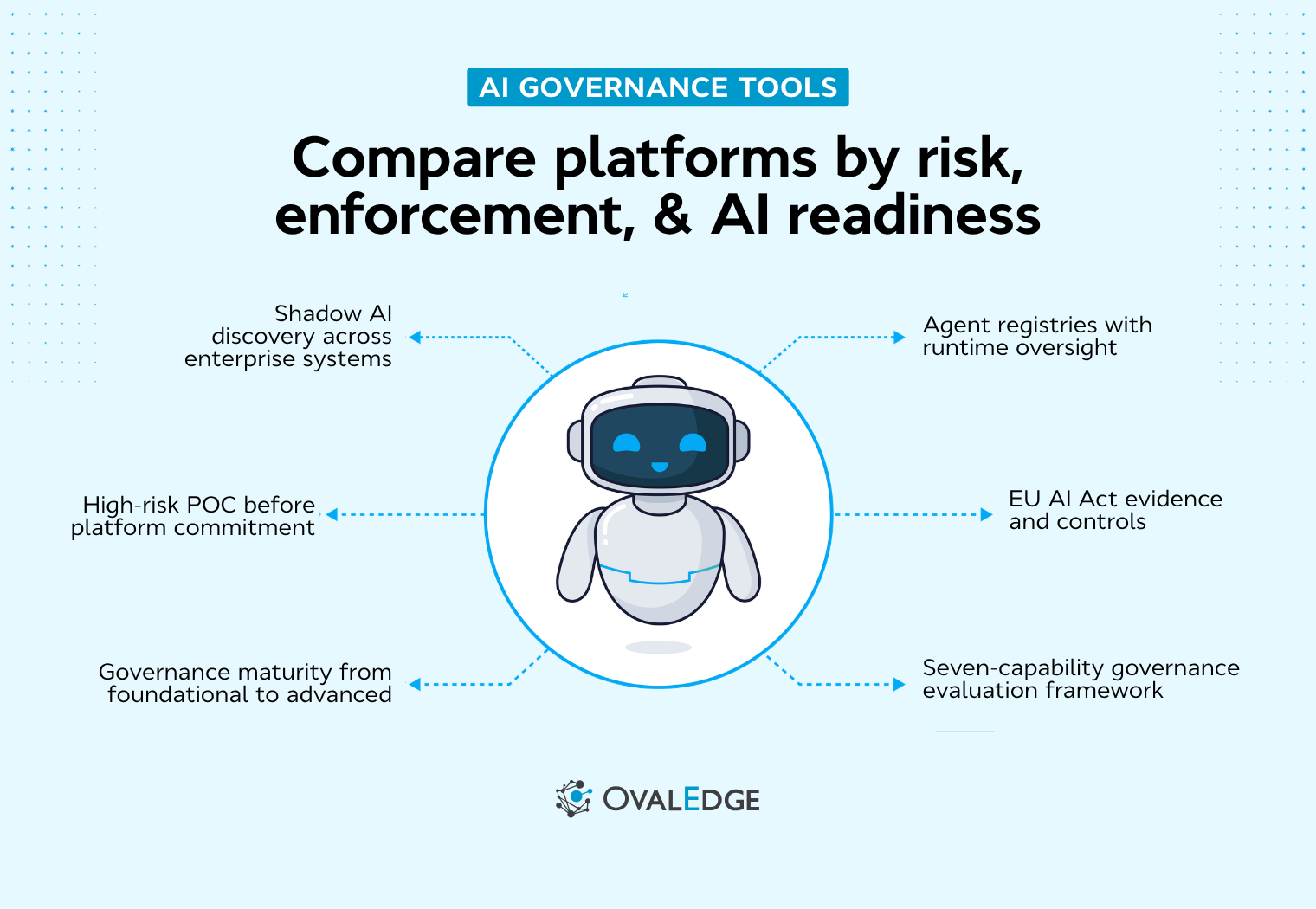
Every compliance leader is being asked the same question this year: “Which AI systems are we actually running, and can we prove they meet the EU AI Act, NIST AI RMF, and ISO 42001?”
Most enterprises can't answer with confidence. Models are scattered across product teams, embedded in SaaS platforms, and built into employee copilots that no one formally reviewed.
AI governance tools close that gap by tracking models across the enterprise, enforcing policy in the pipelines that build them, and producing audit evidence on demand.
This guide compares ten platforms on EU AI Act support, agentic oversight, shadow AI discovery, and integration depth.
Where AI governance tools fit (and where they don't)
AI governance tools discover the AI systems running inside an organization, enforce policies across their lifecycle, and produce the evidence needed for regulatory and internal audits. They give compliance, security, and engineering teams one surface for tracking every model, agent, and embedded AI feature in production.
The reason the category exists: AI now runs in places no one formally reviewed. Product teams ship their own models, vendor AI is embedded in SaaS platforms, and employee copilots multiply faster than anyone can catalog.
The 2026 Enterprise AI Trends Study found only 26% of enterprises say their governance frameworks keep pace with deployment, even as 55% actively deploy AI in production.
The category gets conflated with four adjacent tool types. Each solves a different problem:
-
MLOps tools ship models reliably. Governance sits above this layer to approve, monitor, and produce evidence.
-
Data governance platforms manage data quality, lineage, and access. AI governance depends on them for its inputs but owns model-level oversight. Worth understanding in detail: AI governance vs data governance.
-
AI catalogs and model registries inventory models and their metadata. A component inside a governance platform, not a substitute for one.
-
GRC platforms manage enterprise risk and compliance broadly. AI governance plugs into GRC but handles AI-specific controls it doesn't.
-
DSPM tools discover sensitive data across cloud environments. They surface risk in data stores, not in the models that consume them.
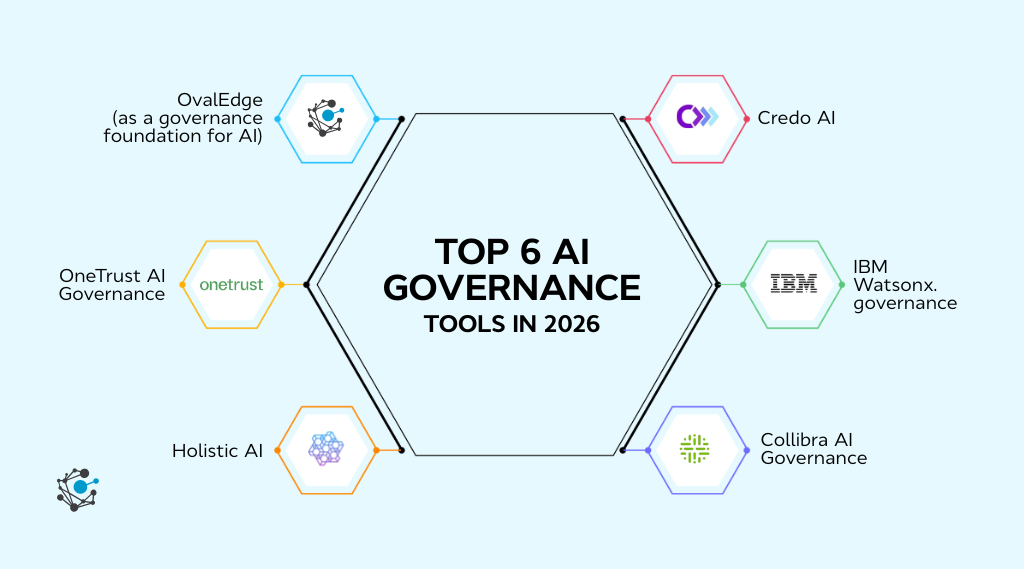
Top 10 AI governance tools compared at a glance
The comparison below covers the ten platforms across the four dimensions buyers actually decide on. The individual write-ups that follow go deeper on each.
|
Platform |
Best for |
Core approach |
Key differentiator |
EU AI Act support |
|
OvalEdge |
Enterprises extending data governance into AI |
Governance-first, unified data and AI oversight |
Governance Agents and Enterprise Context Graph ground AI in cataloged, policy-checked assets |
Maps EU AI Act obligations to AI assets, data, controls, owners, and evidence through the unified governance platform |
|
Credo AI |
Enterprises with diverse AI portfolios needing standardized risk scoring |
Policy-driven governance with AI registry |
GAIA agent governance capability for autonomous systems |
Native EU AI Act policy pack |
|
IBM watsonx.governance |
Large enterprises in the IBM stack with strict compliance needs |
Model factsheets, workflows, and audit trails |
Deep integration with watsonx.ai and IBM cloud |
EU AI Act included in 12 pre-loaded compliance accelerators, with automated conformity assessment documentation |
|
Collibra AI Governance |
Existing Collibra customers unifying data and AI governance |
Extends data catalog to models and agents |
Shared repository for data assets and AI models |
Regulatory framework library includes EU AI Act |
|
Holistic AI |
Regulated industries needing bias auditing and lifecycle risk monitoring |
Continuous risk evaluation across model lifecycle |
Guardian and Sentinel agents for agentic oversight |
EU AI Act conformity assessment tooling |
|
OneTrust AI Governance |
Existing OneTrust customers with privacy-integrated compliance needs |
Privacy-first governance tied to GDPR workflows |
Native alignment with privacy and third-party risk |
EU AI Act module in the compliance suite |
|
Microsoft Purview |
Microsoft-stack enterprises governing AI inside Microsoft 365 and Fabric |
Data + AI governance built into the Microsoft ecosystem |
Native discovery of Copilot and Azure AI usage |
EU AI Act is one of four premium regulatory templates in Compliance Manager, applied to Copilot and Azure AI |
|
Securiti.ai |
Enterprises unifying AI, data, and privacy governance under one platform |
Data command graph tying models to underlying data |
Automated regulatory alignment across 15+ frameworks |
Prebuilt EU AI Act assessment |
|
NeuralTrust |
Runtime security teams governing LLM and agent behavior in production |
Runtime governance with Guardian Agents |
Real-time prompt and response monitoring at the edge |
EU AI Act and ISO 42001 controls in the platform |
|
Fiddler AI |
ML teams needing production observability and explainability |
Runtime monitoring, drift detection, and fairness assessment |
Deep model behavior visibility and bias tracking |
Feeds evidence to governance platforms, not standalone EU AI Act |
10 best AI governance tools in 2026
Here's what the ten platforms look like when compared on governance depth, agentic oversight, and regulatory readiness.
1. OvalEdge
Disclosure: OvalEdge is the publisher of this comparison. We've evaluated it by the same criteria as every other tool on this list.
OvalEdge is a unified data and AI governance platform built on theEnterprise Context Graph, a continuously updated map of an organization's data, business logic, policies, and ownership. AI governance runs as a purpose-built solution on that graph, so every model inventory entry, policy control, and audit log shares the same source of truth as the underlying data.
Brands like Hallmark, Upwork, Gousto, and Naranja X run on the OvalEdge platform. A Forrester Total Economic Impact study found a 337% ROI over three years, with sensitive data classification effort down 75%.
How it governs AI on a unified data foundation
Most tools on this list treat AI governance as a separate control plane. OvalEdge runs it inside the same platform that governs the data underneath, so you can trace a model's output back to the data it used without stitching things together.
-
Models and agents live in the same catalog as datasets, dashboards, and business terms.
-
Source Code Intelligence reads production SQL, dbt, Python, and BI code to see how data actually flows into AI systems.
-
OvalEdge Agents (Curo, Sift, Nexus, Notary) handle cataloging, sensitive data classification, ontology, and certification.
-
AskEdgi, the agentic analytics layer, grounds every generative response in the Enterprise Context Graph.
How it handles regulatory compliance and evidence
Since AI systems, data, ownership, and policies already sit in the same graph, mapping EU AI Act, NIST AI RMF, and ISO 42001 obligations to specific assets and owners becomes a lookup, not a manual exercise. Every access decision, classification, and policy change is time-stamped, so an audit export shows which data was used, who approved it, and what monitoring flagged.
Third-party agents like Copilot, ChatGPT, and Claude can pull those same definitions and access rules from the graph through APIs and MCP, so the rules apply wherever the AI runs.
Where it fits: OvalEdge suits enterprises that already treat data governance as foundational and want AI governance to work the same way. It's especially strong for regulated industries where audit evidence has to trace back to the data itself.
2. Credo AI
Credo AI is an AI governance platform built around a knowledge graph that fuses regulatory intelligence with business context. It gives risk, compliance, and legal teams one system to inventory AI, map policies to regulations, assess risk, and generate audit-ready evidence across models, applications, agents, and third-party vendors.
How it handles agentic AI governance
Credo AI framed the model, agent, and application governance problem earlier than most of the category. The Agent Registry catalogs autonomous agents in production, and GAIA, its own governance agent, automates intake and review work teams typically do by hand.
-
The AI Registry and Agent Registry give one view of every model, agent, application, and third-party vendor in use.
-
Shadow AI discovery pulls unapproved usage into governance workflows.
-
GAIA accelerates intake, though runtime enforcement (blocking a non-compliant call at the point of use) sits on the roadmap.
How it handles regulatory compliance
Policy Packs translate the EU AI Act, NIST AI RMF, ISO 42001, and other frameworks into concrete controls that map back to specific AI systems. Reporting is built for audit defense with continuous evaluation, human-in-the-loop escalation, and audit-ready documentation on every registered system.
Where it fits: Credo AI suits enterprises that need to inventory and document a large AI portfolio against regulations, especially where autonomous agents and third-party vendors are part of the estate. Less of a fit for teams that need runtime enforcement or self-hosted deployment.
3. IBM watsonx.governance
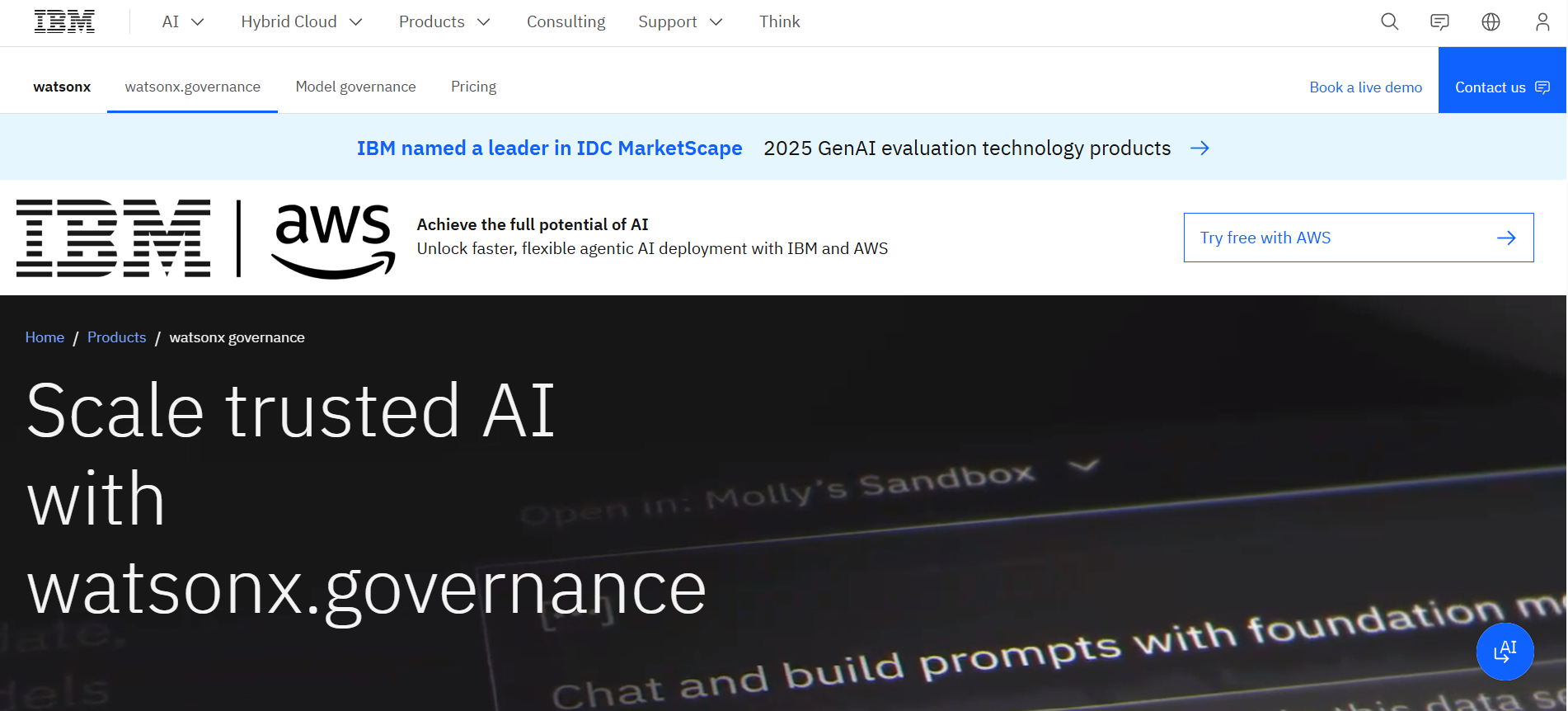
IBM watsonx.governance is an end-to-end AI governance solution for traditional ML, generative AI, and agentic AI across the full lifecycle. It governs models and agents wherever they run, from IBM Cloud and AWS to Azure, Oracle Cloud, and on-premises, without asking teams to re-platform.
How it handles multi-cloud, multi-vendor governance
Watsonx.governance inventories models and agents built anywhere (IBM, OpenAI, AWS, Meta, Azure, open source) inside one registry. Most hyperscaler-native tools only see their own perimeter.
-
AI Factsheets auto-document every model with lineage, ownership, metrics, and approval history.
-
Watson OpenScale monitors drift, fairness, bias, and explainability across the connected estate in real time.
-
Agent Monitoring, added in 2026, tracks accuracy, hallucinations, context relevance, and reasoning traces.
Watsonx.governance is a lifecycle governance platform, not a runtime enforcement point. Blocking non-compliant calls is delegated to companion IBM products like watsonx.ai guardrails and Orchestrate Agentic Control Plane.
How it handles compliance and audit evidence
-
Compliance accelerators ship 12 pre-loaded regulatory frameworks, including EU AI Act, ISO 42001, NIST AI RMF, SR 11-7, and NYC Local Law 144.
-
Each maps obligations to specific AI use cases and generates the conformity assessment documentation regulators expect.
-
Native integration with IBM OpenPages routes findings into GRC workflows and centralizes audit evidence.
-
Particularly useful for banks and insurers running SR 11-7 model risk programs.
Where it fits: Watsonx.governance suits large, regulated enterprises with heterogeneous AI estates, especially those already invested in IBM OpenPages. Reviewers consistently flag high cost, steep learning curve, and setup complexity.
4. Collibra AI Governance
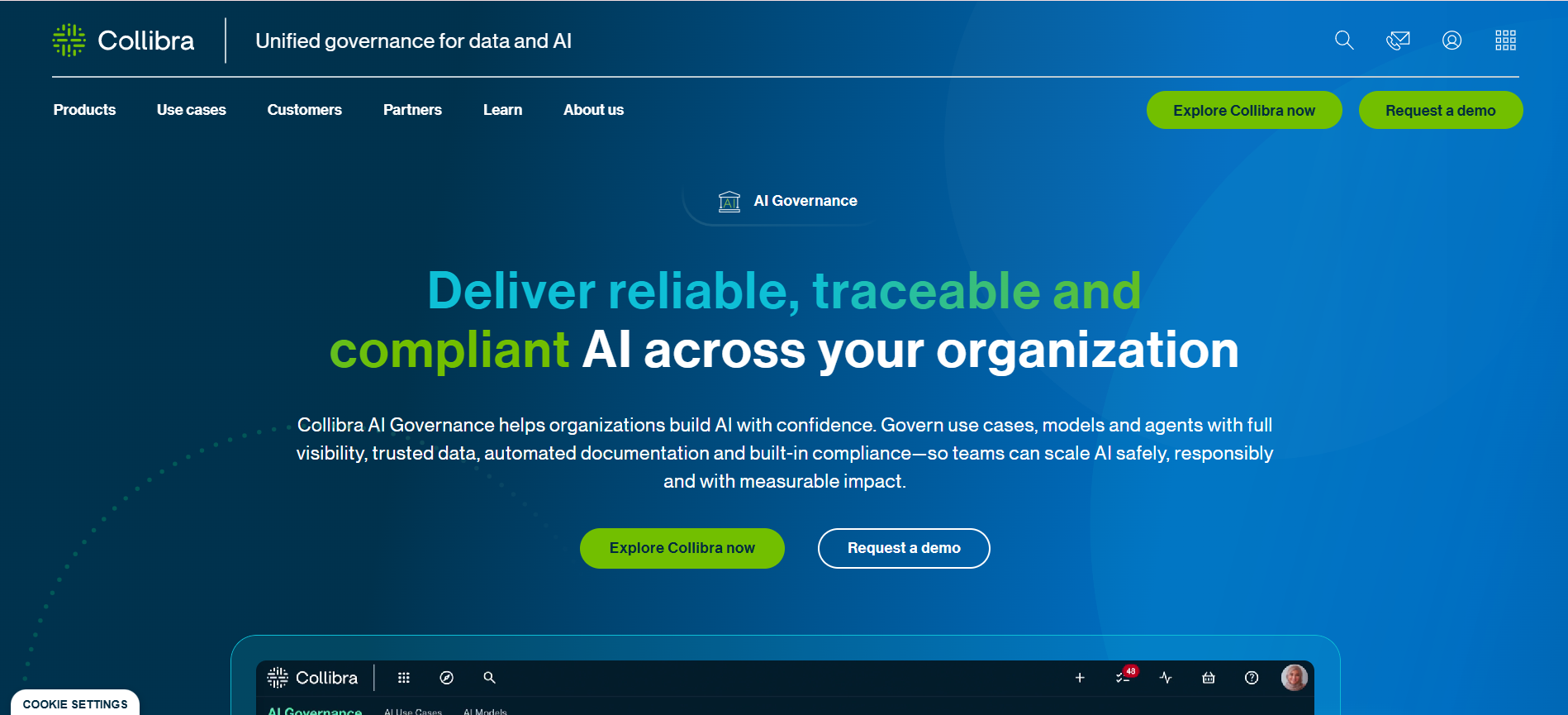
Collibra AI Governance, unified under Collibra's AI Command Center as of May 2026, extends Collibra's data governance and catalog platform into AI. AI use cases, models, and agents inherit lineage, ownership, and policy from the same catalog that already governs the enterprise's data.
How it handles AI in a data-governed environment
Every AI asset lives in the same registry as the datasets it depends on, so the data-to-model-to-decision chain is visible in one place.
-
The unified AI Registry inventories use cases, models, and agents across Vertex AI, SageMaker, Databricks, and Azure.
-
End-to-end lineage links source data through model training, inference, deployment, and downstream decisions.
-
A developer CLI captures AI use cases directly from code, so governance doesn't rely on manual intake forms.
-
The AI Trust Score aggregates governance signals into a readiness view for deploying, remediating, or retiring AI systems.
How it handles regulatory and program-level assessments
Assessment templates ship for the EU AI Act, NIST AI RMF, and (as of May 2026) the AI UC-1 standard for agentic AI compliance. Because assessments are tied to registered assets, evidence is tracked continuously rather than reassembled at audit time.
Policy-driven governance also connects to Collibra Data Privacy and Collibra Protect for sensitive-data controls.
Where it fits: Collibra suits enterprises that already run Collibra for data governance and want AI oversight to inherit from the same platform. Less compelling as a standalone purchase, and reviewers note setup complexity typical of large governance suites.
5. Holistic AI
Holistic AI is an end-to-end AI governance platform built on an Identify, Protect, and Enforce framework. It grew out of algorithmic audit work (NYC Local Law 144, EU Digital Services Act) and is one of the few platforms here that ships genuine runtime enforcement.
How it handles agentic AI oversight
Every module is powered by Guardian Agents, split into two roles that make runtime governance operational rather than aspirational.
-
Sentinel Agents observe AI behavior, catching prompt injection, jailbreaks, data leakage, hallucinations, and toxicity in production.
-
Operative Agents intervene in real time when a threshold is crossed, blocking unsafe requests, revoking access, and activating kill switches.
-
Policies translate directly into runtime enforcement, so approvals carry through to what an agent can actually call, access, or spend.
How it handles bias auditing and regulatory compliance
The audit heritage shows in the compliance depth: EU AI Act conformity assessments, NIST AI RMF, ISO 42001, and NYC Local Law 144 bias audits are built in, alongside adversarial testing and algorithmic fairness evaluation. Audit trails are collected continuously, so evidence is ready on the day of the audit rather than reconstructed weeks before.
Where it fits: Holistic AI suits enterprises whose primary AI risk is fairness, bias, or agent misbehavior in production, particularly where runtime enforcement is a hard requirement. Deployment is SaaS-only on AWS and Microsoft marketplaces, with no self-hosted option documented.
6. OneTrust AI Governance
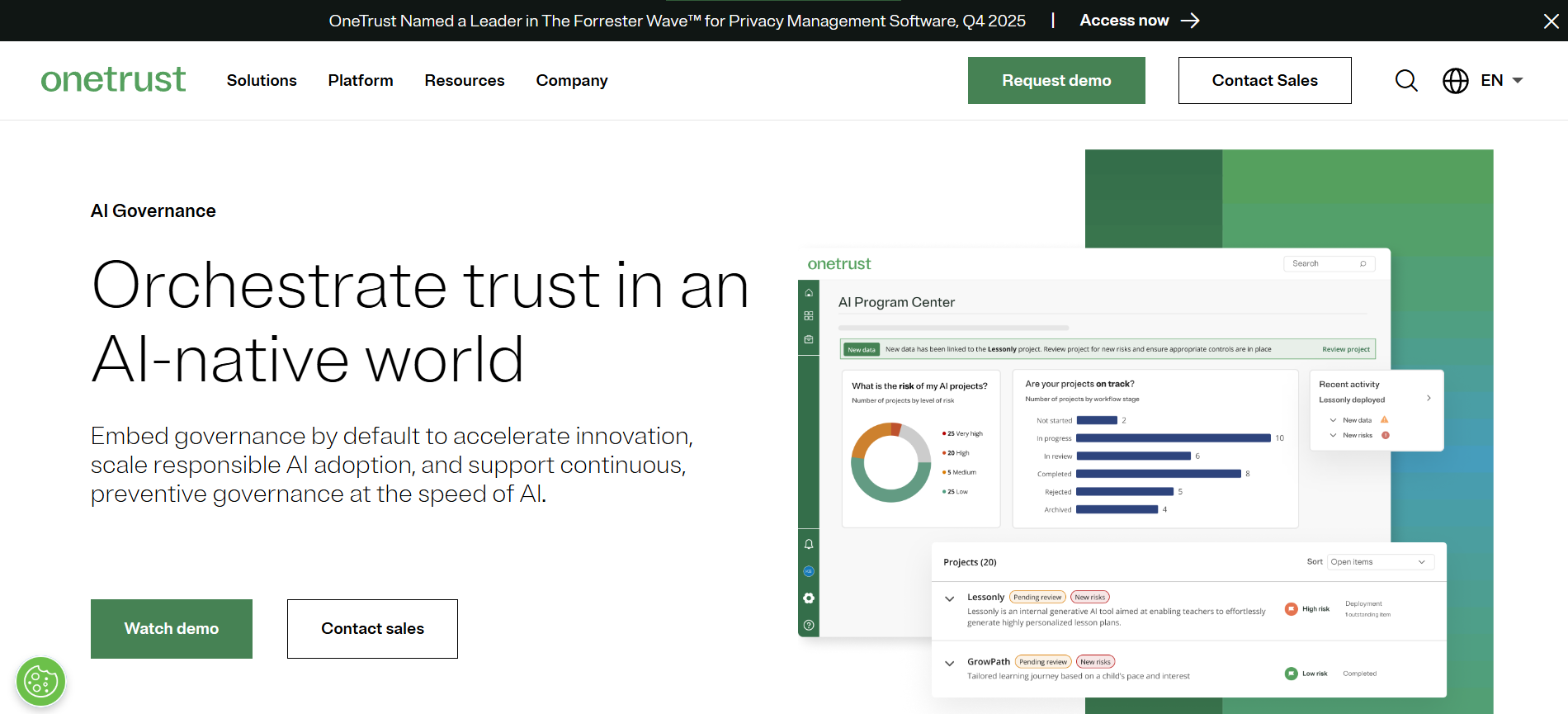
OneTrust AI Governance extends OneTrust's privacy, GRC, and third-party risk platform into AI-specific oversight. Named a Visionary in the 2026 Gartner Magic Quadrant for AI Governance Platforms, it's where compliance-led enterprises consolidate AI oversight into an existing regulatory program.
How it handles AI inside a privacy-first governance stack
AI, privacy, and third-party risk sit in one platform. Because the EU AI Act places obligations on deployers as well as developers, buyers of AI-powered products need to prove they assessed the vendor.
-
Third-party AI vendor risk uses OneTrust's procurement questionnaires and contractual management workflows, which most AI-native tools can't match.
-
The AI Registry classifies systems by EU AI Act risk category and links back to related privacy assessments.
-
Guardian Agents (added March 2026) monitor agent activity at runtime and apply guardrails like prompt filtering and data redaction.
-
300+ data classifiers flag sensitive data flowing through AI systems automatically.
How it handles regulatory alignment
OneTrust ships modules for the EU AI Act, NIST AI RMF, and ISO 42001, alongside GDPR, DORA, HIPAA, and CCPA. Legal and compliance teams work in the same operational structure they use for privacy programs, cutting coordination overhead.
Where it fits: OneTrust suits compliance-led enterprises already running its privacy or third-party risk platform. Less compelling as a standalone AI governance purchase where AI-native depth like bias evaluation and agent runtime enforcement is the primary requirement.
7. Fiddler AI
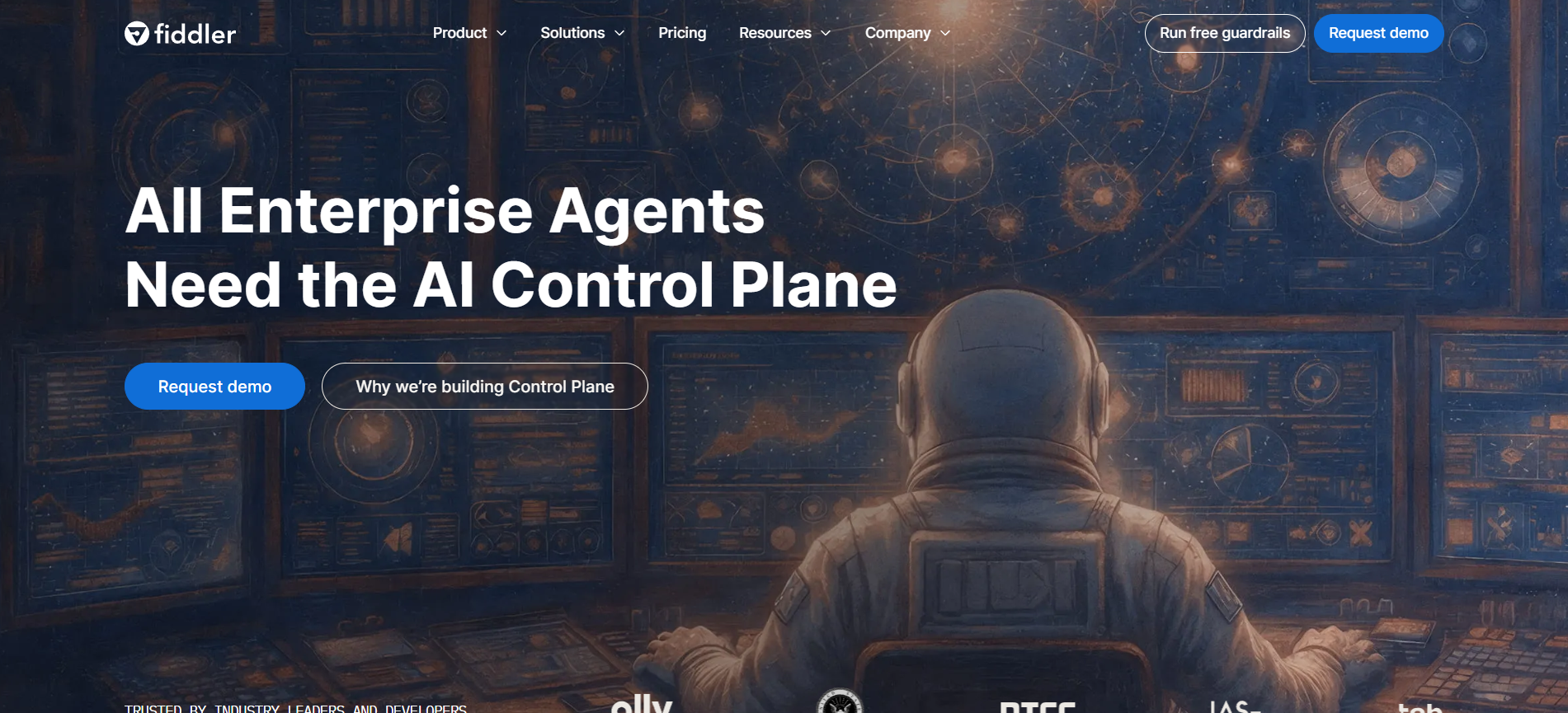 Fiddler AI is an AI observability and security platform for monitoring ML models, LLM applications, and AI agents in production. Rather than a full governance suite, Fiddler focuses on model behavior visibility and runtime protection, feeding the evidence governance platforms depend on.
How it handles model and LLM observability
Fiddler's core competency is the observability layer most governance platforms outsource. Teams get feature-level explainability, drift detection, and behavior monitoring across traditional ML and generative AI in one place.
-
ML observability tracks drift, performance, data integrity, and statistical properties, with root cause analysis that drills from an alert to the feature driving it.
-
LLM observability monitors prompts, responses, embeddings, hallucinations, response quality, and RAG source relevance.
-
Agent observability covers multi-agent interactions, decision paths, and coordination patterns, with hierarchical root cause analysis down to individual agent spans.
-
Local and global explanations expose why a model made a specific decision, which is what regulated industries need for audit defense.
How it handles runtime protection
Fiddler Guardrails moderates prompts and responses at runtime using Fiddler Trust Models, which score for hallucination, safety violations, prompt injection, and jailbreak attempts. The Control Plane for AI Agents adds standardized telemetry, continuous monitoring, and enforceable policy across first-party, third-party, and coding agents.
Where it fits: Fiddler suits ML and platform teams that need deep production observability and runtime security. Best paired with a broader governance platform like OvalEdge or Credo AI, since Fiddler doesn't cover model inventory, regulatory policy mapping, or audit workflow at that depth.
8. Microsoft Purview
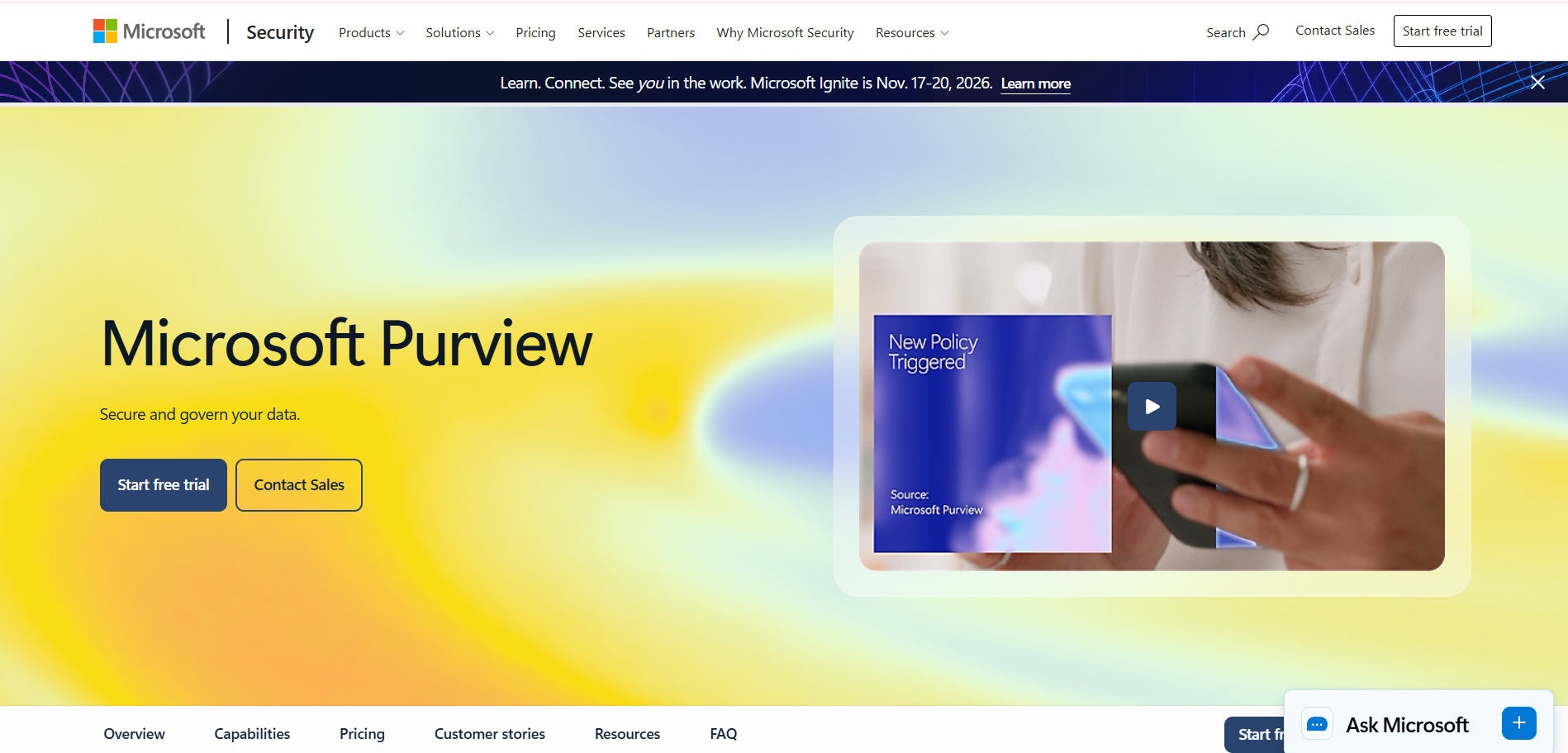
Microsoft Purview is Microsoft's unified data and AI governance platform, spanning discovery, classification, policy enforcement, and compliance across Microsoft 365, Azure, and multi-cloud environments. AI governance runs through three components: AI Hub for discovery and DLP over Copilot, Compliance Manager for regulatory assessments, and Purview Audit for tracking AI activity.
How it handles AI inside the Microsoft ecosystem
Purview's biggest advantage is that AI governance travels with the data and identities Microsoft already controls. For Microsoft 365 Copilot and Azure AI Foundry, oversight is native rather than bolted on.
-
AI Hub ingests Copilot events, applies sensitivity labels to prompts and responses, and blocks restricted content before it reaches the model.
-
DSPM for AI surfaces sensitive-data interactions with AI apps and recommends controls, auto-provisioned with a Copilot license.
-
Purview Audit captures all Copilot interactions for compliance reporting and incident investigation.
-
Multi-cloud discovery extends AI and data governance across Azure, AWS, and on-premises data.
How it handles regulatory alignment
Compliance Manager ships four premium AI templates (EU AI Act, ISO 42001, ISO 23894, NIST AI RMF 1.0) for Copilot, Azure AI Foundry, and other supported apps. Beyond AI, it includes 360+ templates covering GDPR, HIPAA, DORA, and other frameworks, so one team can run AI compliance inside the same structure as everything else.
Where it fits: Microsoft Purview suits enterprises standardized on Microsoft 365, Azure, and Fabric where Copilot and Azure AI Foundry are the primary governance targets. Non-Microsoft AI systems require additional connectors or complementary platforms to reach parity.
9. Securiti.ai
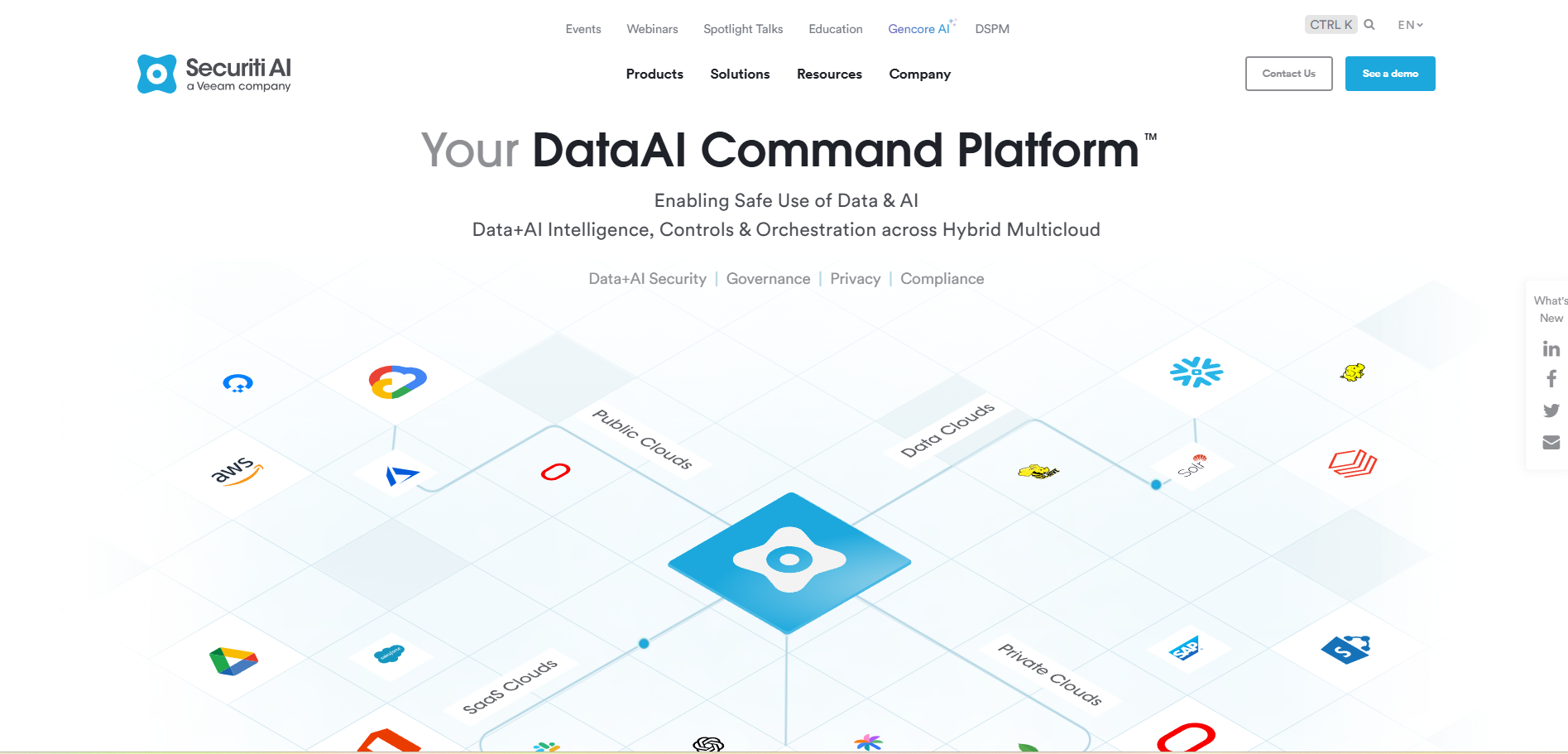
Securiti.ai is a unified data, AI, and privacy governance platform built around the Data Command Graph, which ties AI models, data sources, controls, and policies into a single knowledge layer. AI governance is one workload inside a broader platform that also covers DSPM, privacy, and compliance.
How it ties AI governance to underlying data
Securiti's differentiator is that AI systems are governed alongside the data they consume, produce, and ground in. That connection is the thing purpose-built AI governance tools typically outsource to a separate catalog.
-
AI System Discovery inventories models, agents, and generative AI applications across the enterprise, including shadow AI.
-
The Data Command Graph maps each AI system to the underlying data it trains on, retrieves from, and outputs, giving governance teams a full-context risk view.
-
300+ built-in data classifiers flag sensitive data flowing into and out of AI systems automatically.
-
No-code workflows let legal, compliance, and security teams configure controls without engineering dependencies.
How it handles regulatory alignment and runtime protection
Prebuilt assessments cover the EU AI Act, NIST AI RMF, ISO 42001, GDPR, HIPAA, and 10+ other frameworks. An LLM firewall monitors prompts and responses in real time, blocks policy violations, and logs interactions for audit.
Where it fits: Securiti suits enterprises consolidating AI, data, privacy, and DSPM under one platform. Reviewers note a 3+ week onboarding period to tune classifiers and reach production accuracy.
10. NeuralTrust
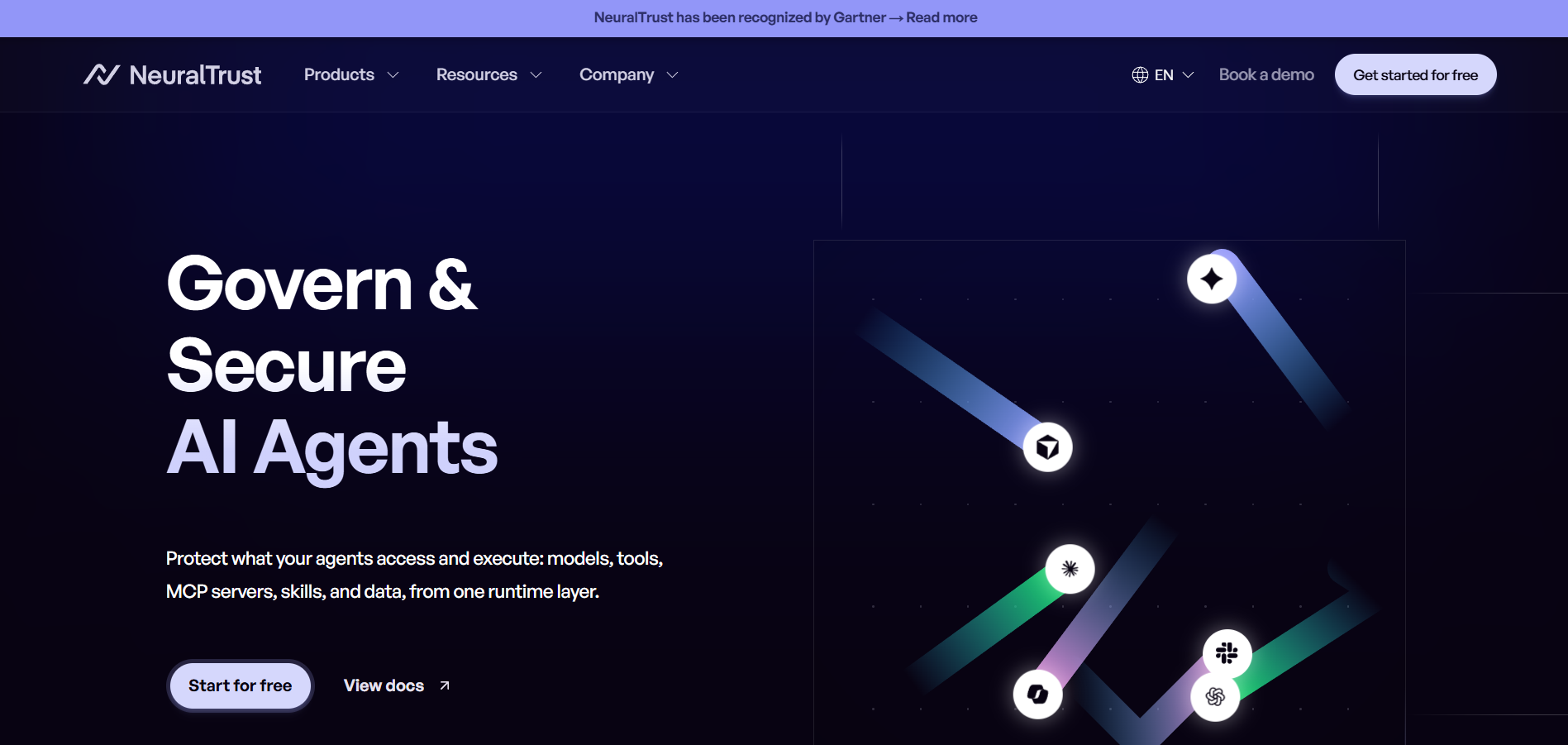
NeuralTrust is a runtime security and governance platform built specifically for large language model applications and AI agents. Its three components (TrustLens for discovery, TrustTest for red teaming, TrustGuard for runtime enforcement) work together to secure AI at the point of inference rather than at the documentation layer.
How it handles runtime security for LLMs and agents
NeuralTrust operates where most governance platforms don't: on live traffic, in real time. Every prompt, response, and agent action is inspected against policy before it lands.
-
TrustLens discovers AI applications across the enterprise, maps data access, and monitors posture against policy.
-
TrustGuard enforces policy in real time on prompts and responses, blocking prompt injection, data leakage, and out-of-policy outputs at the edge.
-
Guardian Agents provide an independent, cross-platform enforcement layer for autonomous agent behavior.
How it handles pre-deployment testing and compliance
-
TrustTest runs automated red-teaming scenarios covering the OWASP LLM Top 10 and MITRE ATLAS, producing risk profiles before deployment.
-
Built-in framework templates for EU AI Act, NIST AI RMF, and ISO 42001 generate exportable, audit-ready evidence.
-
Runtime enforcement decisions translate directly into compliance documentation, so evidence collection is a byproduct rather than a separate task.
Where it fits: NeuralTrust suits security and platform teams governing LLM applications and agents in production, particularly where prompt injection, jailbreaks, and agent misbehavior are active risks. Best paired with a portfolio-level governance platform rather than used as a system of record.
How AI governance tools handle shadow AI
Shadow AI is any AI system operating inside the enterprise that no one formally reviewed, inventoried, or approved. It's a growing governance concern, and it's the reason most compliance teams can't answer a basic regulator question about which AI systems are in use.
Most enterprises can only govern what they can see. The rest surfaces at audit, in incident response, or in a customer complaint about how their data was used.
While discussing unauthorized AI, IT teams also emphasise that blocking tools alone doesn't work without approved enterprise alternatives, DLP, and controls over what data employees can move into AI systems.
What shadow AI actually looks like
Four patterns are showing up in enterprise AI portfolios more than any other:
-
Embedded vendor AI: Copilot features shipping inside SaaS platforms like Salesforce, Notion, and HubSpot that legal teams never assessed as AI deployments.
-
Employee-built copilots: Custom GPTs, Claude Projects, and Copilot Studio agents built by individual employees with access to internal data.
-
Product-team models: Fine-tuned models running in specific product lines that never reached the central AI registry.
-
Personal AI accounts on corporate data: Employees pasting spreadsheets, contracts, and code into consumer AI accounts without a corporate license.
Each of these creates a distinct discovery challenge because the AI itself doesn't announce itself the way traditional software does.
What to look for in a shadow AI discovery capability
Not every governance platform covers this well. When evaluating, three capabilities separate real discovery from marketing claims:
-
Network and SaaS integration inventory that surfaces AI features enabled inside connected apps, not just standalone models registered by the team.
-
Prompt fingerprinting or traffic analysis to detect AI usage patterns even when the underlying tool isn't obviously an AI product.
-
Automatic pull into the governance workflow, so a discovered system triggers assessment, ownership assignment, and risk classification rather than sitting on a dashboard.
Which platforms cover this natively
Credo AI, Holistic AI, OneTrust, Securiti.ai, and NeuralTrust all discover shadow AI out of the box. Microsoft Purview does the same inside the Microsoft ecosystem.
OvalEdge, IBM watsonx.governance, and Collibra handle registered AI systems well, but if shadow AI is the primary concern, these platforms are usually paired with a discovery-first tool. Fiddler focuses on watching AI you already know about, so shadow AI isn't its job.
If a platform can only inventory the AI someone remembered to register, it isn't really solving the shadow AI problem.
How AI governance tools handle agentic AI
Traditional AI governance was built for models that predict, but agentic AI is different. Agents plan, decide, call tools, and take actions on their own, often thousands of times an hour.
A model that mispredicts is a bad output. An agent that misfires is a bad action, and the action might already be irreversible by the time anyone reviews it. Governance has to move from periodic review to continuous, real-time control.
Did you know? Deloitte's 2026 State of AI in the Enterprise found that 74% of enterprises expect to use AI agents at least moderately by 2027, but only 21% have a mature governance model for them today.
Real agentic oversight comes down to four things:
-
An inventory of every agent in production, distinct from the model registry.
-
Control over which tools, APIs, and data each agent can access.
-
Human approval on high-risk actions like financial transactions or data exports.
-
A replayable log of every step the agent took and every tool it called.
Model monitoring alone doesn't cover this. Drift and explainability tell you how the model behaved, but they don't tell you what the agent did next.
Here's how the ten platforms approach it:
|
Approach |
Platforms |
|
Dedicated agent registry alongside the model registry |
Credo AI, Collibra |
|
Runtime enforcement (observe live, intervene when policy thresholds are crossed) |
Holistic AI, NeuralTrust |
|
Agents inherit governance through a context graph |
OvalEdge |
|
Agent-specific monitoring added in 2026, runtime blocking delegated to companion products |
IBM watsonx.governance, OneTrust, Microsoft Purview, Securiti.ai |
|
Deep agent observability, policy enforcement left to the governance layer |
Fiddler |
For most enterprises running agents in production, the right stack is a governance system of record paired with a runtime enforcement specialist. Trying to do both from one platform usually means compromising on one.
Core capabilities of AI governance tools
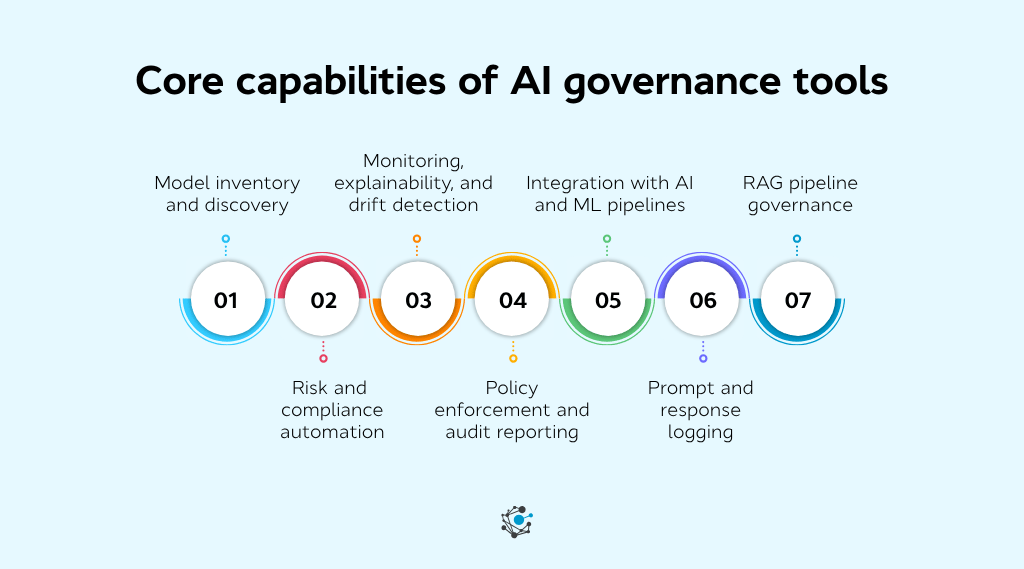
AI governance only works when it's built on repeatable capabilities.
McKinsey's 2025 State of AI survey found that 51% of enterprises reported at least one negative AI-related incident in the past year, and the average organization is now managing four AI-related risks compared to two in 2022.
As AI scales across teams, the platform needs to provide continuous visibility, automation, and enforcement. Here are the seven capabilities that separate a governance tool that scales from one that becomes shelfware.
1. Model inventory and discovery
Governance depends on visibility. Modern enterprises need automatic discovery of every AI model, agent, and service in production because AI now shows up in unexpected places, from embedded SaaS features to internal copilots.
-
Automatic discovery of AI models, agents, and services
-
Centralized registry capturing ownership, use cases, and lifecycle stages
-
Visibility into third-party and embedded AI systems
-
Foundation for risk classification and governance prioritization
-
Support for shadow AI identification and coverage gaps
2. Risk and compliance automation
Manual reviews don't scale as models evolve and regulations change. Continuous evaluation is what lets governance keep pace without slowing the business down.
-
Automated risk scoring aligned to governance frameworks
-
Continuous policy compliance checks
-
Mapping between policies, controls, and AI systems
-
Reduced operational burden for compliance teams
-
Automated alerts for risk threshold breaches
3. Monitoring, explainability, and drift detection
Governance doesn't end at deployment, because models drift, performance degrades, and outputs shift as usage patterns change. Monitoring and explainability tell you when behavior changes and why.
-
Performance and behavior monitoring in production
-
Data and concept drift detection
-
Explainability dashboards for decision transparency
-
Fairness and bias tracking across model updates
-
Incident detection and investigation support
4. Policy enforcement and audit reporting
Policy enforcement is where governance becomes operational. Strong tools embed governance directly into workflows so policies are followed before deployment and evidence is captured automatically along the way.
-
Approval gates before deployment or major updates
-
Automatic evidence capture and audit logging
-
Immutable records for traceability
-
Exportable documentation for audits and internal reviews
-
Centralized repository for governance artifacts
5. Integration with AI and ML pipelines
Without integration, governance becomes stale the day it's deployed. Platforms need to connect to the systems where AI is actually built, deployed, and managed.
-
Integration with MLOps platforms and model registries
-
Connections to data governance and lineage tools
-
Alignment with identity, access, and risk systems
-
Centralized governance across policies, regulations, and standards
-
Support for multi-cloud and hybrid AI environments
6. Prompt and response logging
Prompt and response logging matters because every LLM interaction leaves evidence. Without a complete log, teams can't investigate incidents, prove compliance, or understand how AI is actually being used inside the business. Regulators now expect this level of detail as standard.
-
Full capture of prompts, responses, and RAG source context
-
Immutable, time-stamped logs retained per regulatory requirements
-
User identity, model, and application tagging on every interaction
-
Search and filter across historical interactions for audit response
-
Integration with SIEM and observability pipelines
7. RAG pipeline governance
RAG pipeline governance is what controls the retrieval side of an LLM. As enterprises connect models to internal knowledge bases and vector databases, the retrieval layer becomes as important to govern as the model itself.
What data can be retrieved, by whom, and under what conditions is a distinct governance problem from what the model does with it.
-
Access control on what data can be retrieved by which AI systems
-
Sensitive data filtering before content reaches the model
-
Logging of retrieved chunks alongside the prompts and responses they informed
-
Policy checks on vector database queries and embeddings
-
Governance of both what goes into RAG systems and what comes out
How to evaluate AI governance tools for your organization
Gartner predicts that by 2030, 50% of AI agent deployment failures will trace back to insufficient runtime enforcement in the governance platform underneath.
That's what you're actually buying protection against, so the platform has to fit your regulatory obligations, integrate with your stack, and scale with your program.
Here's how to work through it.
Step 1: Start with your regulatory goals
Define what governance success looks like before shortlisting.
-
Alignment with the EU AI Act, NIST AI RMF, and ISO 42001
-
Policy-to-control mapping that translates regulations into enforceable rules
-
Automated risk scoring for consistent classification
-
Audit-ready logs, documentation, and exportable evidence
Step 2: Check integration depth
Governance that doesn't connect to the underlying stack becomes stale fast.
-
Integration with your MLOps and model registries
-
Support for data catalogs, lineage, and metadata systems
-
Multi-cloud and hybrid environment compatibility
-
Shadow AI discovery to surface unmanaged usage
Step 3: Match the tool to your company size
The right depth depends on where you are.
-
Startup, no compliance team: Prioritize fast setup, prebuilt policy packs, and light-touch workflows.
-
Mid-size: Look for tiered pricing, preconfigured governance workflows, and room to grow.
-
Large enterprise: Full lifecycle governance, deep integrations, and multi-framework compliance depth.
Step 4: Match the tool to your governance maturity
-
Foundational: Basic inventory, policy documentation, and shadow AI discovery.
-
Developing: Automated compliance workflows, intake and approval processes, drift and bias monitoring.
-
Advanced: Agent registries, continuous audit readiness, and on-demand evidence across multiple frameworks.
Step 5: Run a POC on a high-risk use case
Vendor demos show the platform at its best. A POC shows how it holds up in your environment.
-
Pick a high-risk use case with real regulatory exposure
-
Test integration with your MLOps, data catalog, and identity systems
-
Push a policy violation through and see what evidence comes out
-
Involve every future user (data science, compliance, legal, platform)
-
Define success benchmarks upfront so the decision is defensible
Build the stack that fits
A startup without a compliance team needs different tooling than a bank preparing for the EU AI Act. Match the platform to your regulatory exposure, the size of your AI portfolio, and the systems it needs to integrate with. Then run a POC on a real high-risk use case before committing.
For enterprises extending data governance into AI, OvalEdge brings both under one platform. With OvalEdge, AI systems inherit governance from the Enterprise Context Graph, so evidence collection traces back to the same catalog, lineage, ownership, and policy controls that already govern the data underneath.
For teams that fit this profile, book a demo today and see it running against a sample of your own data.
.png?width=1081&height=173&name=Forrester%201%20(1).png)
.png?width=1081&height=241&name=KC%20-%20Logo%201%20(1).png)