-4.png)
AI adoption inside teams often begins with quick wins. We deploy assistants that summarize documents, answer questions, or automate small tasks, and the value feels immediate. Problems surface when workflows demand reasoning across systems, changing inputs, and multi-step decisions. At that point, many AI tools fall apart.
What follows is usually manual oversight layered on brittle rules. Each exception requires reconfiguration, and each change increases risk. Instead of scaling intelligence, we end up scaling supervision, which limits reliability and growth.
Recent findings from McKinsey's state of AI in 2025 highlight this pattern, showing that while AI adoption is accelerating, many organizations struggle to move from isolated use cases to systems that deliver sustained, end-to-end impact.
Agentic AI tools address this gap by enabling goal-driven systems that can plan actions, use tools, evaluate outcomes, and adapt as conditions change. This guide explains how they work and which options help teams move toward dependable, autonomous execution.
What are agentic AI tools?
Agentic AI tools move beyond reactive AI by enabling goal-driven systems that can reason, act, and adapt continuously as they work toward defined objectives within real-world workflows. Analyst definitions consistently emphasize planning, tool use, and dynamic outputs, not fixed scripts.
Definition of agentic AI tools
Agentic AI tools are systems that can plan, decide, and act toward a defined goal with minimal human input. They typically run in an execution loop: interpret the goal, plan steps, take an action with a tool, evaluate results, and continue until completion.
The “tool use” part matters more than it sounds. Tools can mean calling internal APIs, querying databases, running code, searching knowledge bases, or triggering workflows.
How agentic AI tools differ from traditional automation and AI tools
Traditional automation relies on fixed rules. When inputs shift, rules need updates. Agentic systems are designed to make adaptive decisions based on context and to adjust actions dynamically while they execute.
This is also why “agent washing” is becoming a real issue. Some vendors label chatbots or simple workflows as agents, even when there is no real planning loop or decision depth.
Common capabilities across agentic AI tools
Across the category, you will see the same core capabilities show up again and again:
-
Goal definition and execution loops that keep an agent moving toward an outcome instead of stopping at a single response
-
Reasoning and planning that decides what to do next based on context and intermediate results
-
Tool use and function calling to take real actions through APIs, code, or integrations
-
Memory and state, so long-running work does not reset every turn
-
Human oversight patterns like approvals, edits, and interrupts for sensitive steps
One important reality check: as you add autonomy, you also add risk. Prompt injection is widely recognized as a top security risk for LLM applications, and it becomes more dangerous when an agent can take actions across systems.
10 best agentic AI tools to explore
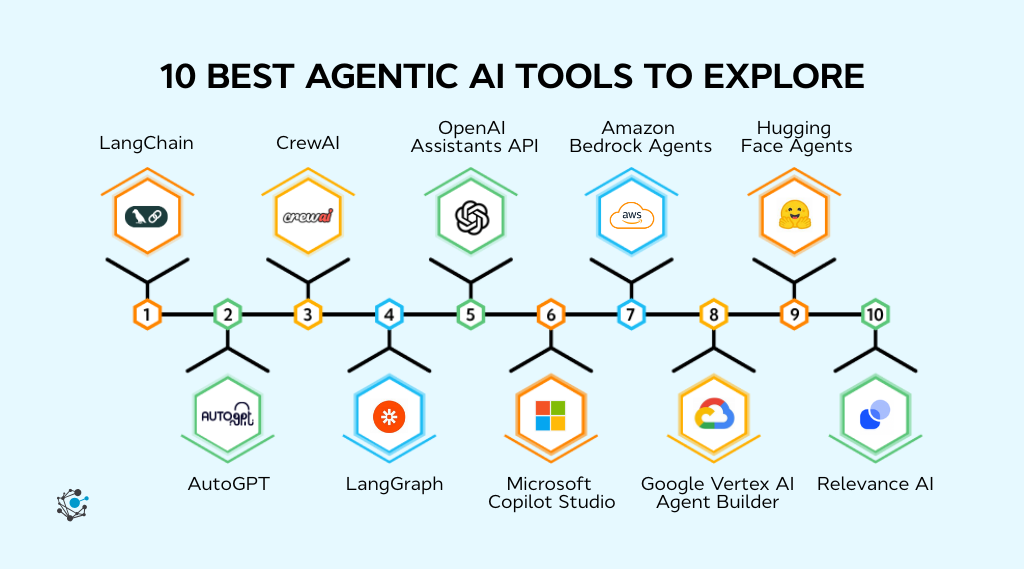
Agentic AI tools vary widely in how they support autonomy, reasoning, and execution across workflows. The tools listed below span open-source frameworks and enterprise-ready platforms, offering practical options for teams looking to build, test, and deploy agent-driven systems.
1. LangChain
LangChain is an open-source framework designed to help teams build agentic AI workflows using large language models, tools, and memory. It is widely used to assemble reasoning-driven agents that operate across multi-step workflows.
Core function and positioning: LangChain positions itself as a foundational framework for agentic AI systems rather than a full execution platform. Its core function is enabling reasoning loops, tool usage, and memory handling within custom workflows. Teams commonly rely on it for experimentation and custom agent development.
Best features
-
Tool calling: Enables agents to invoke APIs, execute functions, and interact with external systems, thereby translating reasoning into real-world actions.
-
Agent abstractions: Provides prebuilt patterns for planning, action selection, and observation loops.
-
Modular chains: Allows workflows to be composed from reusable components, simplifying complex logic.
-
Memory support: Retains context across steps and sessions, supporting long-running tasks.
-
Ecosystem integrations: Connects with a wide range of models, vector stores, and external services.
|
Pros |
Cons |
|
|
Best fit: LangChain is best suited for developers and research teams building custom agentic AI workflows or experimenting with advanced reasoning patterns. It works best when flexibility and extensibility are prioritized over out-of-the-box operational readiness.
2. AutoGPT
AutoGPT is an open-source autonomous agent designed to execute tasks with minimal human input. It became widely known for demonstrating how an AI system could plan and act independently toward a goal.
Core function and positioning: AutoGPT positions itself as an experimental autonomous agent rather than a general-purpose framework or enterprise platform. Its core function is to take a high-level goal, decompose it into tasks, and execute them iteratively without continuous prompting. It is often used to showcase what full autonomy looks like in practice.
Best features
-
Autonomous goal execution: Breaks down a user-defined objective into smaller tasks and executes them in sequence.
-
Self-directed planning loop: Continuously evaluates progress and determines the next action without user intervention.
-
Tool and file access: Can read, write, and modify files as part of task execution.
-
Internet interaction: Supports web searches and information retrieval to support decision-making.
-
Minimal setup: Allows users to experiment with agent autonomy quickly.
|
Pros |
Cons |
|
|
Best fit: AutoGPT is best suited for learning, experimentation, and early-stage exploration of autonomous agents. It is not ideal for teams looking to deploy reliable agentic AI systems in production environments.
3. CrewAI
CrewAI is an open-source framework designed to coordinate multiple AI agents with defined roles working toward a shared objective. It emphasizes collaboration rather than individual agent autonomy.
Core function and positioning: CrewAI positions itself as a multi-agent orchestration framework focused on role-based execution. Its core function is enabling agents to delegate tasks, share context, and coordinate outcomes. It is commonly used to explore collaborative agent patterns rather than single-agent execution.
Best features
-
Role-based agents: Allows each agent to operate with a defined responsibility and expertise.
-
Task delegation: Enables agents to assign work to one another dynamically.
-
Shared context: Supports information exchange between agents during execution.
-
Simple orchestration model: Uses an intuitive mental model for multi-agent workflows.
-
Open-source flexibility: Can be extended and customized for different collaboration patterns.
|
Pros |
Cons |
|
|
Best fit: CrewAI is best suited for teams exploring collaborative agent workflows and delegation models. It works well for experimentation and concept validation rather than production-scale deployment.
4. Zapier agents
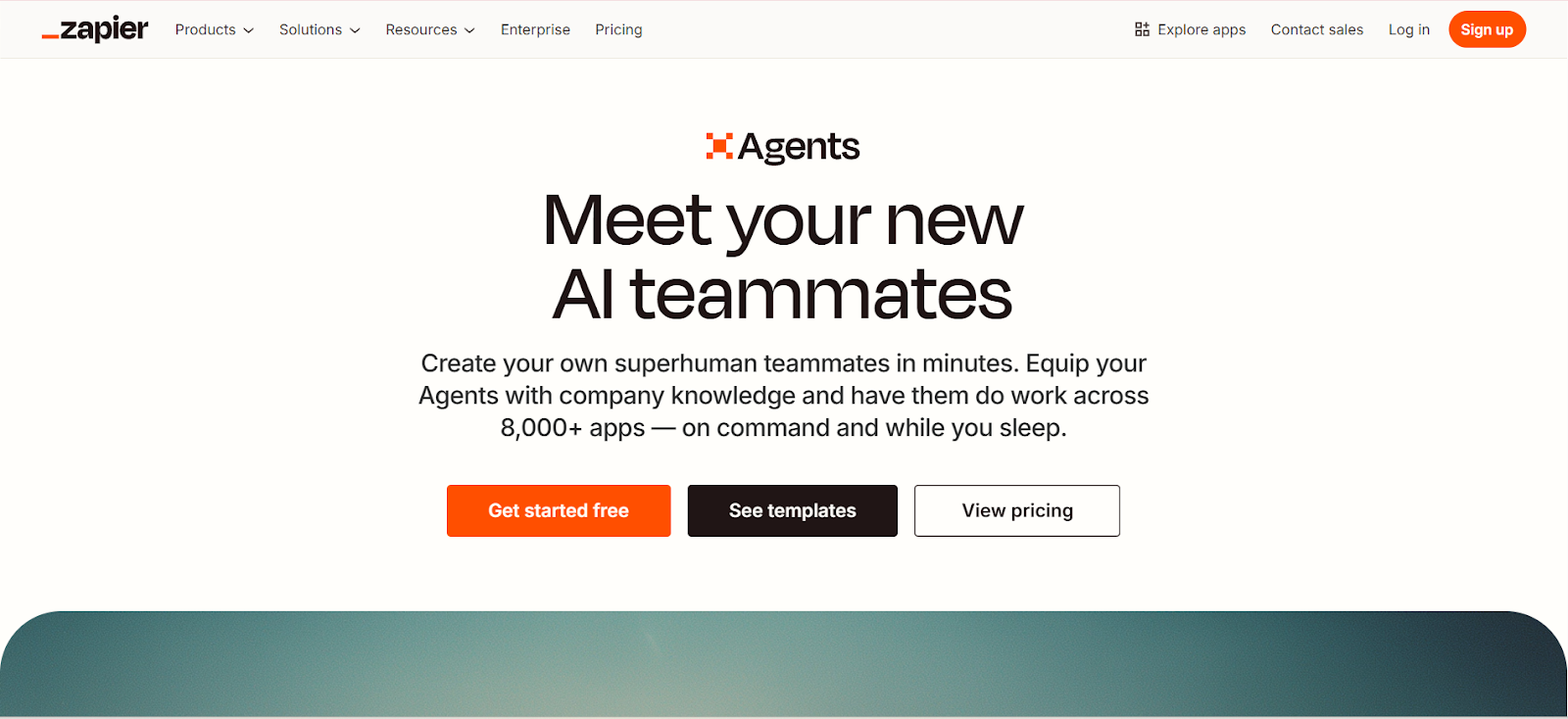
Zapier Agents is an agentic AI capability built on top of Zapier’s automation platform, designed to let AI agents plan actions and execute workflows across thousands of applications. It extends traditional automation by allowing agents to decide which actions to take based on context.
The tool focuses on practical, cross-application execution rather than deep reasoning research.
Core function and positioning: Zapier Agents position themselves as task-executing agents for business workflows. Their core function is enabling agents to interpret goals and trigger multi-step actions across connected apps without manual rule definition. The platform emphasizes accessibility and speed over complex orchestration.
Best features
-
App ecosystem access: Agents can act across thousands of Zapier-integrated applications.
-
Goal-to-action execution: Translates high-level instructions into concrete workflow steps.
-
Low-code configuration: Minimal setup for non-technical teams.
-
Event-driven triggers: Responds to changes across connected systems.
-
Operational reliability: Built on Zapier’s mature automation infrastructure.
|
Pros |
Cons |
|
|
Best fit: Zapier Agents are best suited for teams that want agentic ai capabilities layered onto existing automation workflows. They work well for operational tasks that span multiple SaaS tools and require minimal custom logic.
5. OpenAI Assistants API
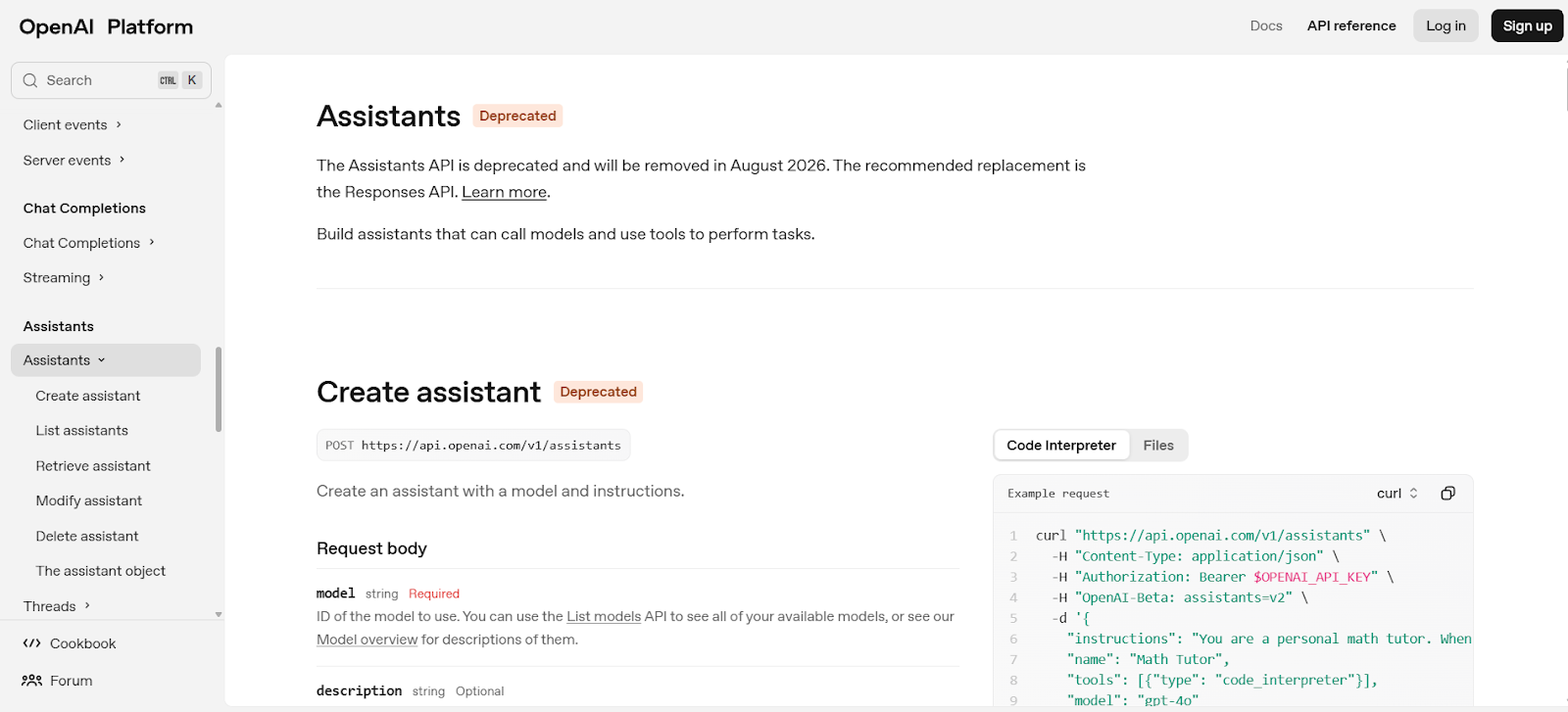
The OpenAI Assistants API provides a hosted way to build task-oriented AI assistants with tool usage and memory. It abstracts infrastructure management and execution complexity.
Core function and positioning: This API positions itself as a managed agent execution layer. Its core function is enabling assistants to call tools, handle files, and maintain conversational context within OpenAI’s infrastructure. It prioritizes simplicity and speed over customization depth.
Best features
-
Hosted runtime: No infrastructure management required.
-
Built-in tool calling: Supports function execution and API interactions.
-
File handling: Enables document upload and retrieval.
-
Persistent context: Maintains memory across interactions.
-
Fast deployment: Reduces time from prototype to production.
|
Pros |
Cons |
|
|
Best fit: The Assistants API is best suited for teams that need quick, hosted agent deployment with minimal operational effort. It works well for task-focused assistants rather than complex agent networks.
6. Microsoft Copilot Studio
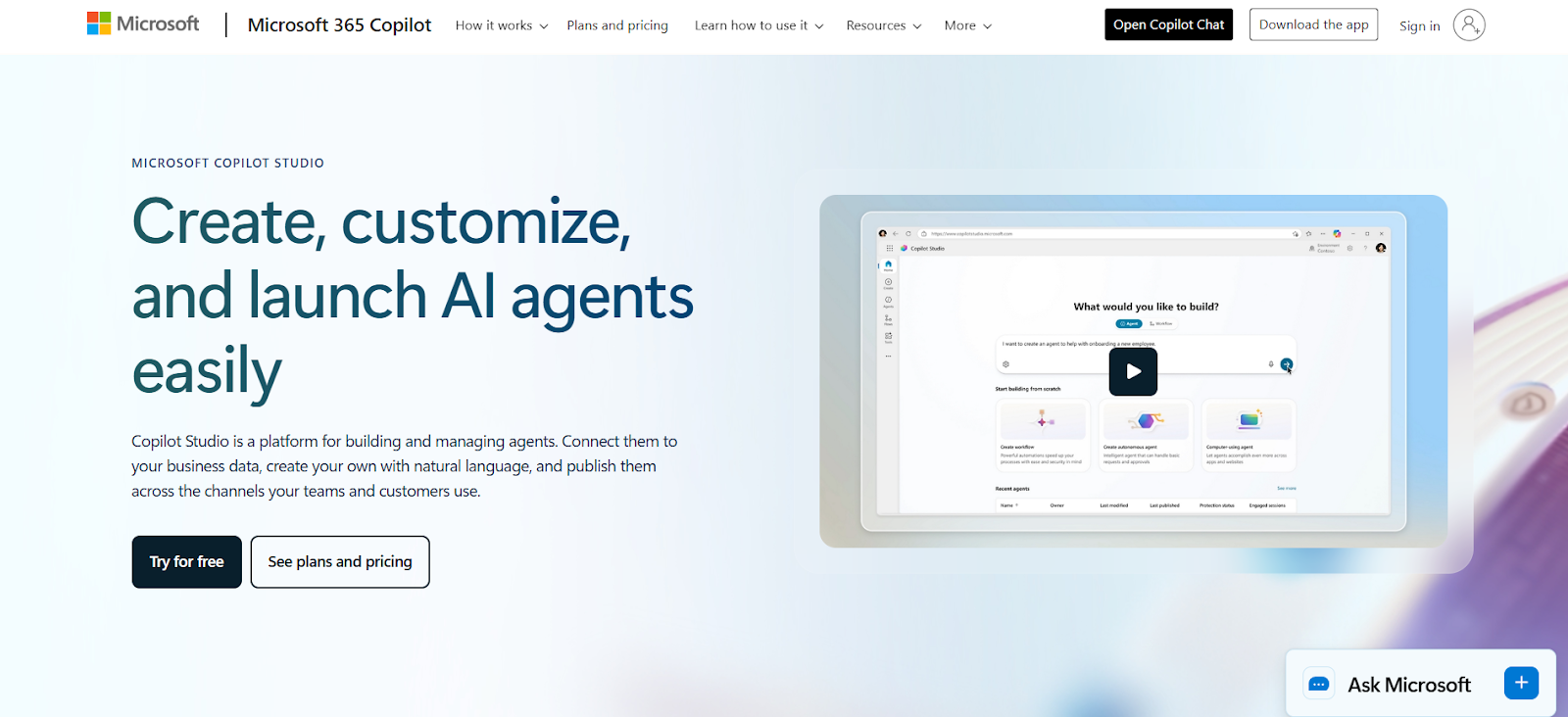
Microsoft Copilot Studio is a low-code platform for building AI-driven copilots and agents. It integrates deeply with Microsoft business tools and workflows.
Core function and positioning: Copilot Studio positions itself as an enterprise-ready agent builder focused on conversational and workflow automation. Its core function is enabling organizations to create governed, role-based agents within the Microsoft ecosystem.
Best features
-
Visual agent builder: Low-code interface for agent creation.
-
Microsoft ecosystem integration: Native support for Microsoft 365 and Power Platform.
-
Built-in governance: Access controls and compliance features.
-
Workflow automation: Connects agents to business processes.
-
Enterprise deployment support: Designed for organizational scale.
|
Pros |
Cons |
|
|
Best fit: Microsoft Copilot Studio is best suited for enterprises building internal agents for productivity and workflow automation, especially those already invested in Microsoft tools.
7. Amazon bedrock agents
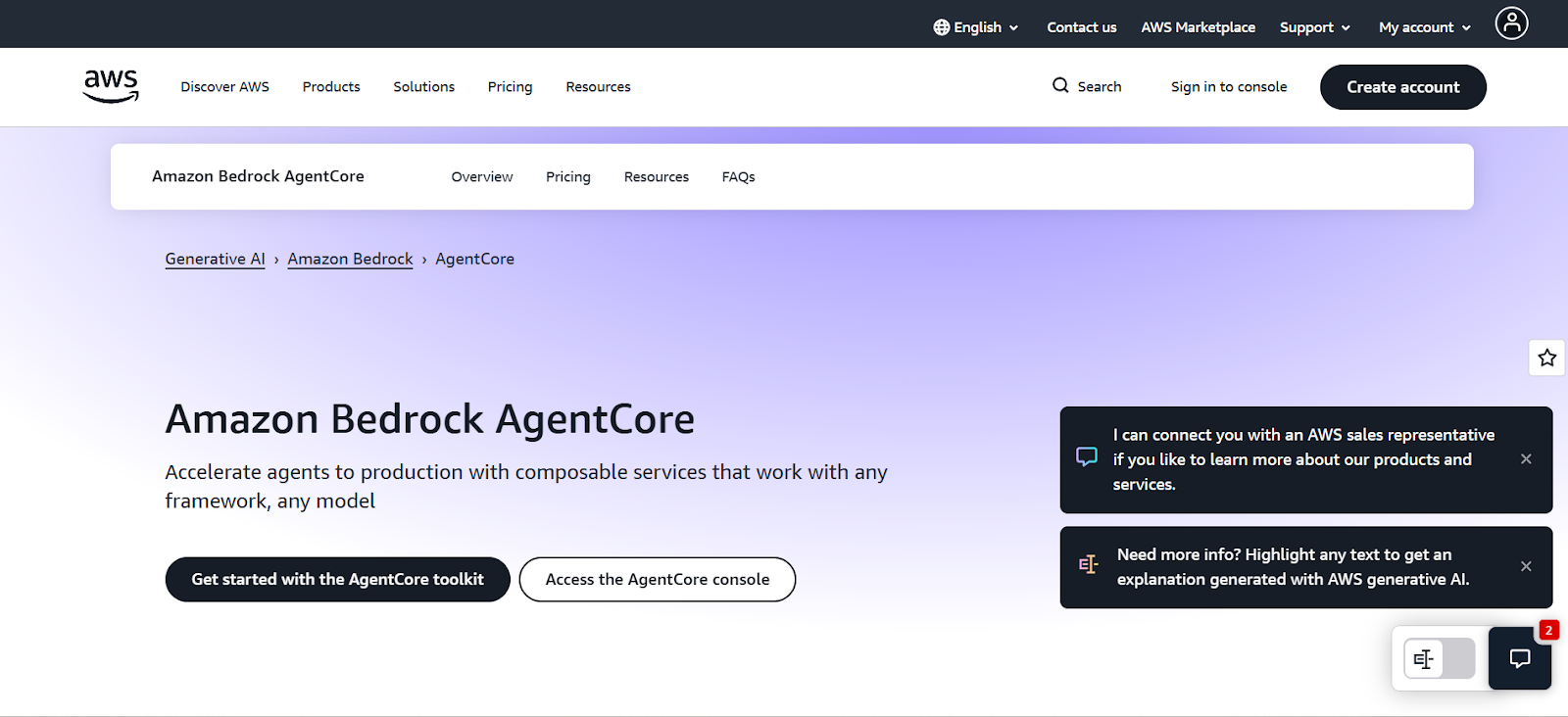
Amazon Bedrock Agents is a managed service for building and running AI agents on AWS. It integrates with Bedrock models and native AWS services. The service emphasizes scalability and security.
Core function and positioning: Bedrock Agents position themselves as an enterprise agent orchestration service. Their core function is enabling secure, scalable agent execution within AWS environments. It is designed for production workloads rather than experimentation.
Best features
-
Managed agent execution: Handles runtime and scaling.
-
AWS service integration: Works with Lambda, S3, and other AWS tools.
-
Enterprise security: IAM-based access control.
-
Model flexibility: Supports multiple foundation models.
-
Operational monitoring: Integrates with AWS observability tools.
|
Pros |
Cons |
|
|
Best fit: Amazon Bedrock Agents are best suited for enterprises operating on AWS that need secure, scalable agentic AI systems in production.
8. Google Vertex AI agent builder
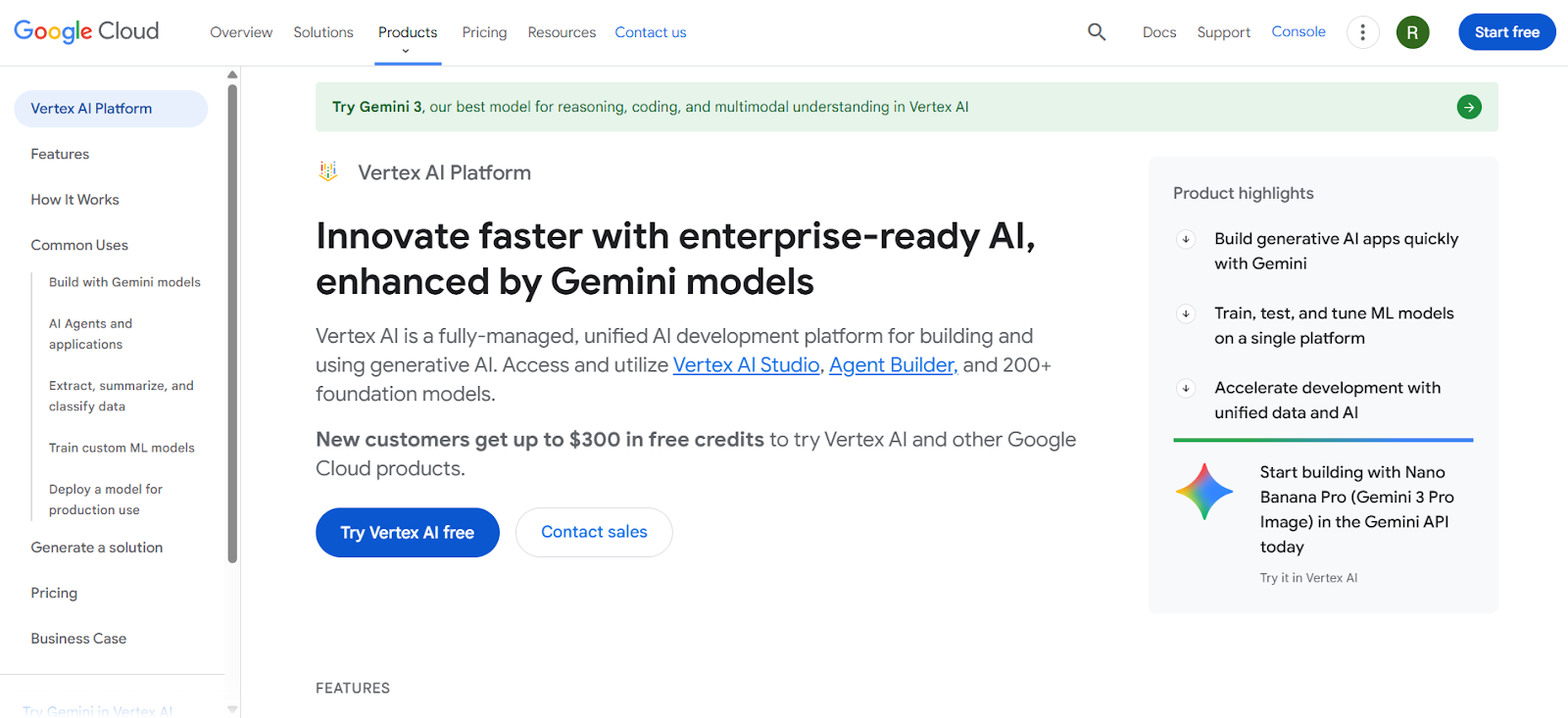
Vertex AI Agent Builder is a cloud-native service for building and deploying AI agents on Google Cloud. It is part of the broader Vertex AI platform. The tool emphasizes governance and observability.
Core function and positioning: The platform positions itself as an enterprise-grade agent builder. Its core function is enabling scalable, governed agent deployment integrated with Google Cloud data and services.
Best features
-
Cloud-native deployment: Built for Google Cloud environments.
-
Monitoring and observability: Tracks agent behavior and outcomes.
-
Data integration: Connects with Google data services.
-
Security controls: Enterprise-grade access management.
-
Scalability support: Designed for large-scale usage.
|
Pros |
Cons |
|
|
Best fit: Vertex AI Agent Builder is best suited for enterprises already using Google Cloud that require governed, scalable agent deployments.
9. Hugging face agents
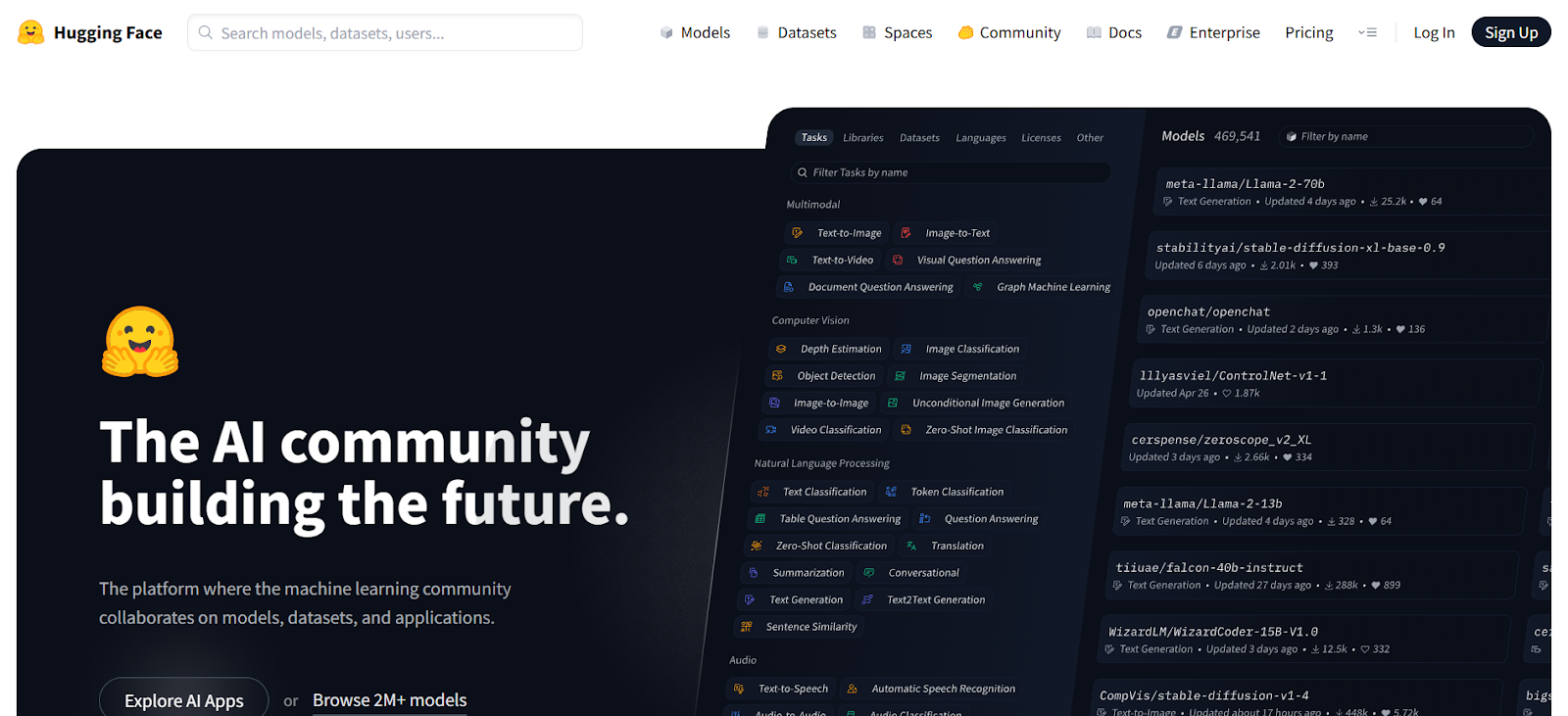
Hugging Face Agents provide open-source tooling for building agents centered around models and tools. They emphasize experimentation and transparency. The approach is model-centric rather than platform-centric.
Core function and positioning: Hugging Face positions its agents as flexible, open frameworks. The core function is enabling agents to reason and act using a wide variety of open and proprietary models.
Best features
-
Open-source tooling: Transparent and customizable.
-
Broad model support: Works across many LLMs.
-
Tool-based reasoning: Enables structured action execution.
-
Community innovation: Rapid experimentation and updates.
-
Research-friendly design: Supports exploratory work.
|
Pros |
Cons |
|
|
Best fit: Hugging Face Agents are best suited for teams prioritizing open-source control, research, and customization over turnkey deployment.
10. Relevance AI
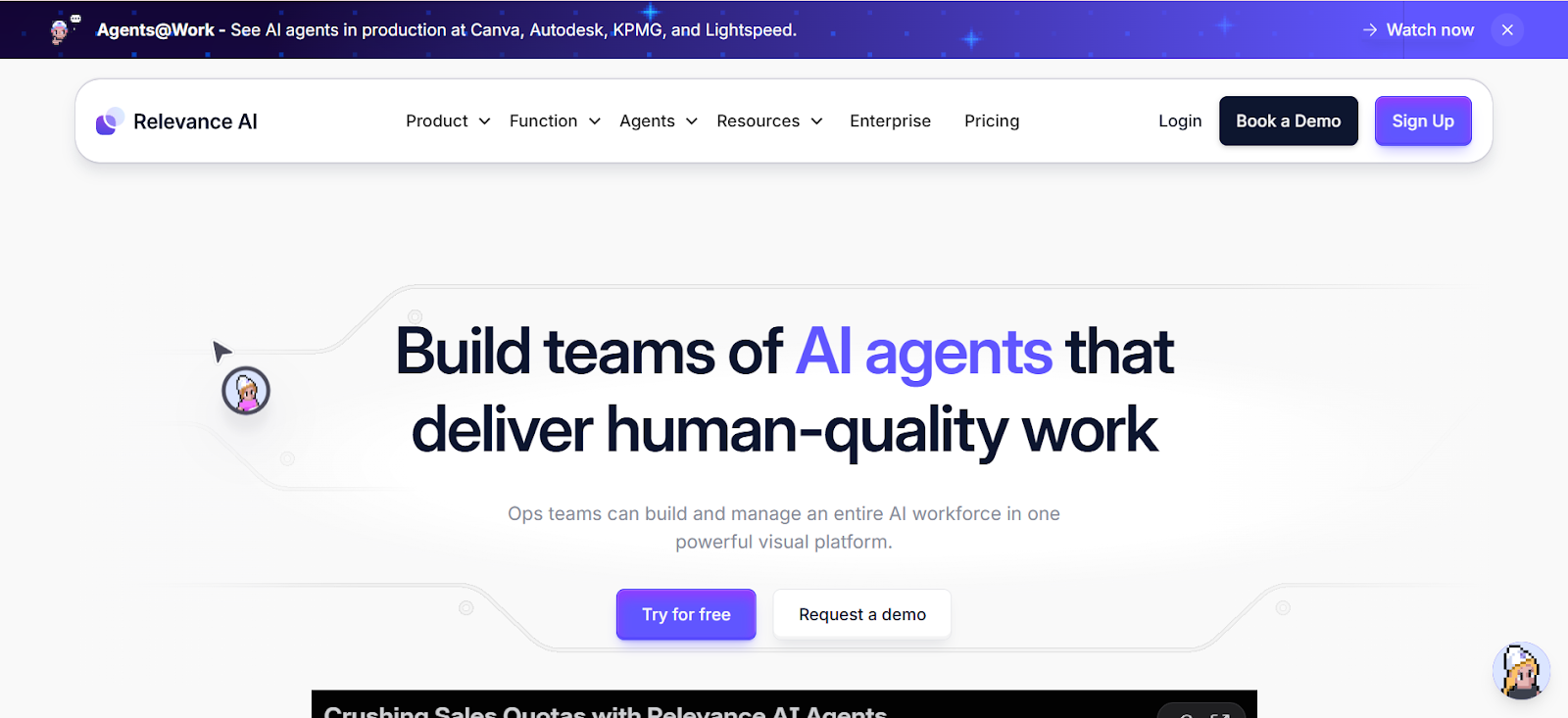
Relevance AI is a platform for building operational AI agents focused on business workflows. It emphasizes applied outcomes over experimentation. The platform targets repeatable operational use cases.
Core function and positioning: Relevance AI positions itself as a business operations agent platform. Its core function is enabling teams to deploy agents that automate workflows and deliver measurable outcomes with minimal setup.
Best features
-
Workflow automation: Designed for operational tasks.
-
Built-in integrations: Connects to common business systems.
-
Operational dashboards: Tracks agent performance.
-
Low-code setup: Reduces engineering effort.
-
Business-focused design: Outcome-driven execution.
|
Pros |
Cons |
|
|
Best fit: Relevance AI is best suited for teams automating repeatable business processes where speed, reliability, and operational visibility matter more than deep customization.
How to choose the right agentic AI tool
Choosing the right agentic AI tool depends on how well it supports goal-driven execution, coordination, and operational control within real workflows, rather than how easily it runs isolated tasks or demonstrations. As agentic systems move closer to decisions and execution, the evaluation criteria must extend beyond model performance.
This matters because agentic AI is rapidly moving from experimentation into enterprise systems of record.
Gartner predicts that by 2028, roughly 33 percent of enterprise software applications will include agentic AI, up from less than 1 percent today, enabling a meaningful share of everyday business decisions to be made autonomously.
As agents move closer to execution, the cost of poor tool selection increases sharply.
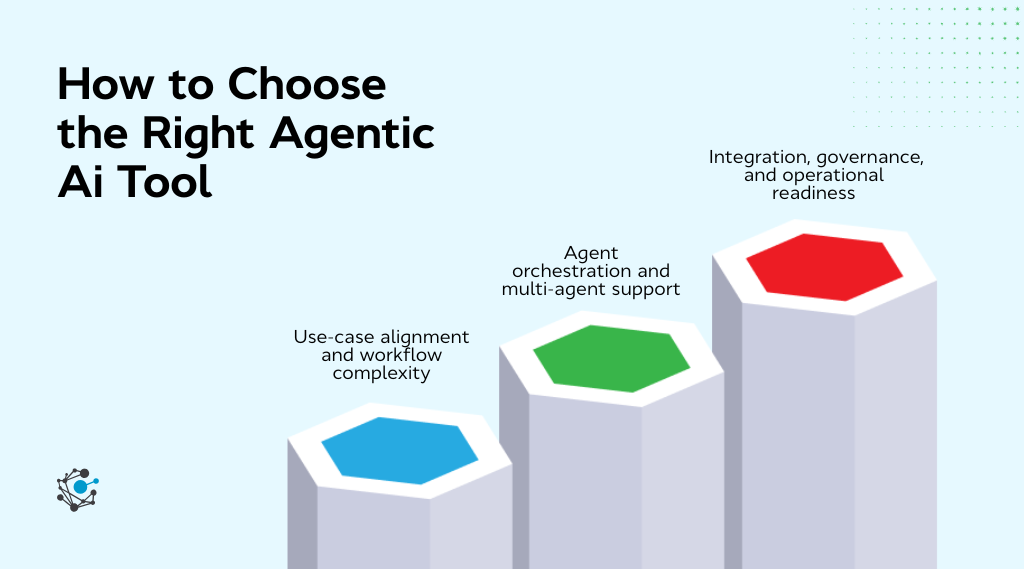
Step 1: Align the tool with your use case and workflow complexity
Start by defining what the agent is expected to accomplish and how dynamic the workflow will be. Not all agentic AI tools are built for the same level of autonomy or decision depth.
-
Determine whether the use case involves simple task automation or complex, goal-driven execution
-
Assess how much autonomy the agent requires and where human oversight is needed
-
Match the tool's flexibility to the team responsible for building and maintaining the system
Step 2: Evaluate agent orchestration and multi-agent coordination
As workflows grow more complex, the ability to coordinate actions across steps or agents becomes critical. Weak orchestration is a common source of failure in agentic systems.
-
Examine how agents share context and manage dependencies
-
Evaluate support for multi-agent workflows and task delegation
-
Understand scalability limits as agent count and workflow complexity increase
Step 3: Ensure integration, governance, and operational readiness
Agentic AI tools must operate within existing enterprise systems while remaining observable and controlled. Governance is not optional once agents influence decisions or actions.
-
Verify integration with required data sources, APIs, and enterprise platforms
-
Assess monitoring, logging, and error-handling capabilities
-
Review governance features such as access control, auditability, and traceability
How OvalEdge supports enterprise agentic AI tools
Enterprise agentic AI tools depend on more than reasoning models and orchestration frameworks. To operate reliably at scale, they require consistent data context, traceability, and governance.
Without these foundations, agents may act on incomplete, outdated, or misinterpreted information, increasing risk as autonomy grows.
OvalEdge supports enterprise agentic AI tools by providing a governed data foundation that allows agents to reason with trusted metadata, maintain decision traceability, and align with enterprise data standards. These principles are also explored in the OvalEdge Active Data Governance guide, which explains how governance shifts from policy into real-time operational workflows.
Providing a governed data context for agent reasoning
Agentic systems reason based on the data context available to them. When data lacks consistent definitions, ownership, or quality signals, agents are forced to infer meaning, which increases the likelihood of incorrect or misaligned decisions.
OvalEdge provides governed metadata that establishes a shared, authoritative understanding of data meaning, structure, and usage across systems. This ensures agents reason against standardized definitions rather than assumptions. By linking technical metadata with business context, agents can distinguish between similar datasets, understand intended usage, and avoid acting on ambiguous inputs.
This governed context reduces the risk of agents amplifying upstream data issues. When quality rules, certifications, and ownership are visible, agents can factor trust signals into their reasoning instead of treating all data as equally reliable.
Enabling reliable and traceable agent-driven workflows
As agentic AI tools move closer to execution, explainability becomes critical. Enterprises must be able to understand not only what decision was made, but also which data, rules, and transformations influenced that outcome.
OvalEdge supports this level of transparency through end-to-end lineage and connected metadata across the data lifecycle. Lineage provides clear visibility into how data flows through systems and transformations, helping teams trace agent-driven decisions back to their upstream sources.
This approach is detailed in the OvalEdge data lineage guide, which outlines practical examples and implementation best practices.
This traceability directly supports trust and operational control. When agents operate within governed workflows, organizations can audit decisions, investigate anomalies, and refine agent behavior without guesswork.
These capabilities are reflected in real-world deployments such as the Saudi Arabia NDMO data governance case study, where OvalEdge enabled enterprise-scale governance across complex regulatory requirements.
Conclusion
Agentic AI tools represent a shift from reactive analytics and automation toward goal-driven systems that can reason, act, and adapt across complex workflows. This makes them well-suited for enterprise use cases, but it also increases the need for control, transparency, and trust.
The effectiveness of agentic systems depends less on autonomous behavior or model performance and more on orchestration, governance, and integration. As agents move closer to decisions and execution, consistent data context, traceability, and standardized definitions become critical for maintaining operational oversight.
AskEdgi by OvalEdge helps enterprises operationalize agentic analytics responsibly by grounding AI-driven decisions in a governed data context and enterprise controls.

If your organization is exploring agentic AI at scale, book a demo to see how trusted data and governance enable reliable, explainable agent-driven workflows.
FAQs
1. Are agentic AI tools suitable for real-time decision-making?
Yes, some agentic AI tools support near real-time decisions, but effectiveness depends on latency, system integrations, and guardrails. Real-time use often requires tight orchestration and monitoring to prevent cascading errors.
2. Can agentic AI tools operate across multiple teams or departments?
They can, but only if agents share standardized data definitions and access controls. Without governance, cross-team agent execution can lead to inconsistent behavior and conflicting outcomes.
3. How do agentic AI tools handle long-running tasks?
Many tools manage long-running tasks through state persistence and checkpointing. This allows agents to resume execution, evaluate progress, and adjust actions without restarting the entire workflow.
4. Do agentic AI tools require continuous human supervision?
Not always. While human oversight is often used during early deployment, mature setups rely on monitoring, alerts, and defined escalation paths rather than constant manual supervision.
5. What risks should enterprises consider before adopting agentic ai tools?
Key risks include uncontrolled actions, data misuse, lack of explainability, and operational drift. These risks increase when agents operate without governance, monitoring, and clear boundaries.
6. How do agentic AI tools evolve after deployment?
Agentic AI tools typically evolve through iterative updates to goals, reasoning logic, and integrations. Continuous evaluation helps teams refine agent behavior as business needs and environments change.
.png?width=1081&height=173&name=Forrester%201%20(1).png)
.png?width=1081&height=241&name=KC%20-%20Logo%201%20(1).png)