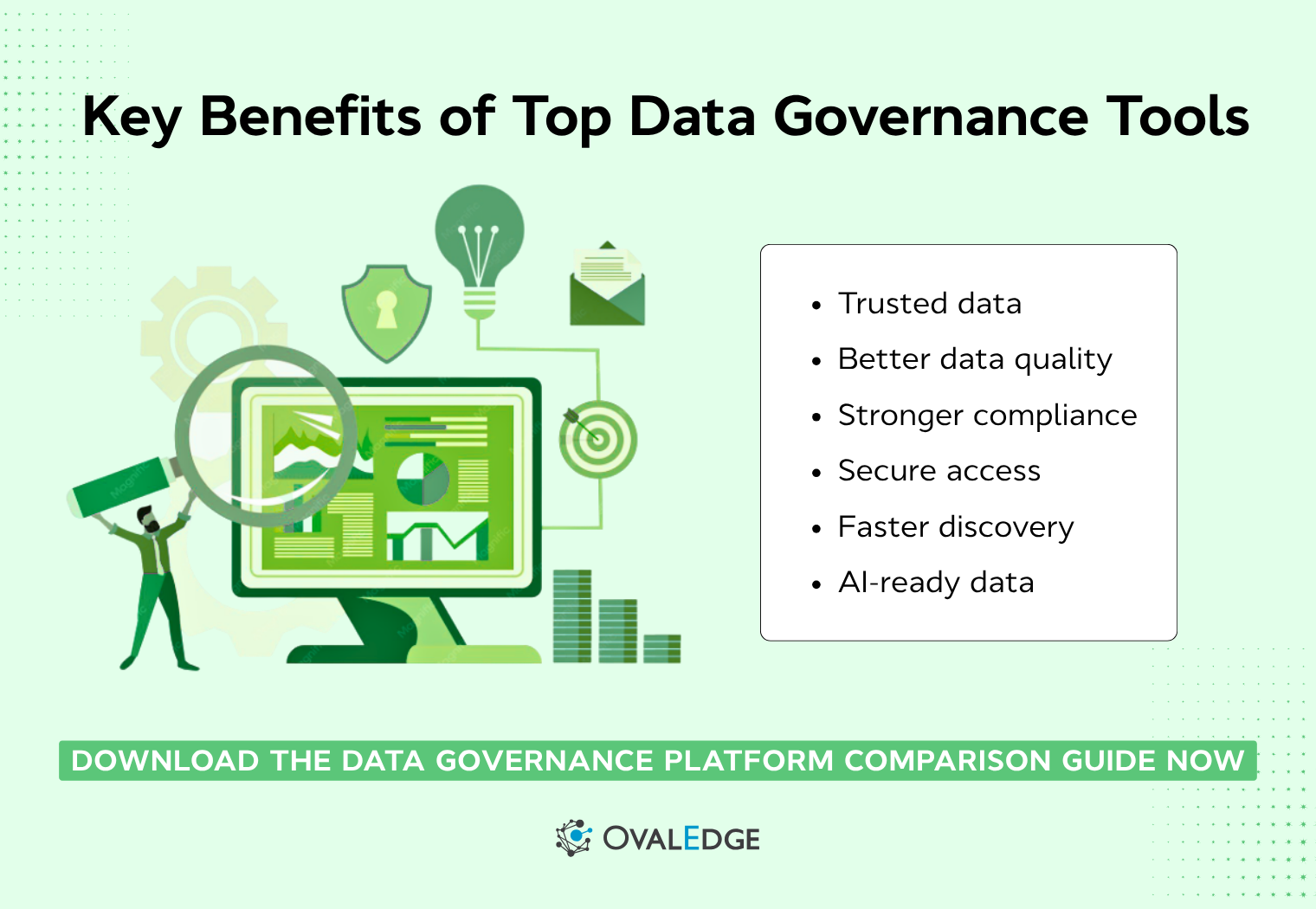
Data governance tools centralize metadata management, access controls, lineage tracking, and compliance workflows so governance runs continuously, not as a one-time project. The strongest platforms combine automated discovery, policy enforcement, and a business glossary in one environment.
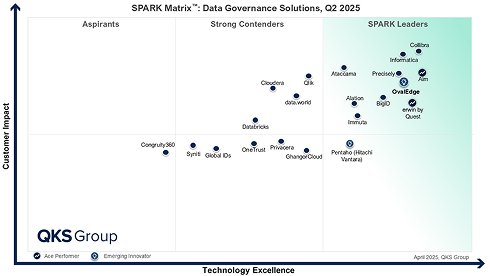
For 2026, leading options include OvalEdge for unified governance powered by AI agents and the Enterprise Context Graph, Collibra for enterprise compliance, Atlan for cloud-native rollouts, Microsoft Purview for Azure-heavy environments, Informatica for hybrid estates, and Alation for user adoption.
This guide breaks down all 13 top tools side by side: what each does best, where users hit walls, deployment timelines, and AI governance readiness as the EU AI Act takes effect.
What are the types of data governance tools?
Data governance tools generally fall into five types, based on what they govern and how broadly they reach across an organization's data estate.
- Catalog-led governance: This type centers on a searchable metadata catalog, data lineage, and a business glossary. OvalEdge, Alation, Collibra, and Atlan all work this way.
- Privacy and sensitive data governance: This focuses on discovering, classifying, and protecting personal data to meet GDPR, CCPA, and similar regulations. BigID is built around this function.
- Access governance: This enforces who can see or use which data, through role-based or attribute-based policies.
- Master data governance: This creates one trusted, deduplicated record for core entities like customers or products across systems. SAP Master Data Governance is a category example.
- Platform-native governance: This type ships inside a cloud data platform and governs only that ecosystem. Microsoft Purview, Snowflake Horizon Catalog, and Databricks Unity Catalog fall here.
Most organizations end up drawing on more than one of these strengths at once. The table below shows the need each tool solves best, so that you can guide your decision accordingly.
Data governance tools compared at a glance
.jpg?width=1024&height=569&name=Info%202%20(5).jpg)
The right data governance tool depends on the problem it needs to solve first, whether that is compliance, privacy, access control, or budget. Here is how the leading platforms line up against each.
|
Tool |
Best for |
Why |
|
OvalEdge |
Controlling exactly who can see or use which data |
Fine-grained, role-based access control built into the same catalog as lineage and quality. |
|
Alation |
User adoption and data culture |
Behavioral metadata and an interface built for business users, not just IT. |
|
Atlan |
Cloud-native teams needing a fast rollout |
Active metadata and roughly a 3-month deployment, faster than most standalone platforms. |
|
Collibra |
Heavy compliance and audit requirements (GDPR, LGPD, banking, government) |
Stewardship workflows and audit-grade reporting built to hold up under regulatory review. |
|
Informatica CDGC |
Data spread across multiple clouds, warehouses, and on-prem systems |
Integrates directly with Informatica's own MDM and data quality suite for hybrid estates. |
|
Apache Atlas |
Small team or tight budget |
Open source with no license cost, though it takes engineering time to run and maintain. |
|
Ataccama ONE |
Data quality is the main blocker, not just governance |
Governance and an integrated quality engine with anomaly detection in one platform. |
|
Microsoft Purview |
Already standardized on Azure and Microsoft 365 |
Native to Fabric, Power BI, and Azure SQL, and bills only for what gets governed. |
|
Snowflake Horizon Catalog |
Already standardized on Snowflake |
Governance enforced inside the query engine itself, with no separate catalog to deploy. |
|
Databricks Unity Catalog |
Lakehouse and ML-centric teams already on Databricks |
One permission model across data, notebooks, models, and AI agents. |
|
BigID |
Protecting sensitive personal data (PII discovery, DSAR, consent) |
Built around privacy and sensitive-data discovery first, governance second. |
|
IBM Knowledge Catalog |
IBM or watsonx and Cloud Pak for Data shops |
LLM-powered metadata enrichment integrated directly into the IBM stack already in use. |
|
erwin Data Intelligence (Quest) |
Teams already on erwin's data modeling tools wanting governance in the same place |
Combines cataloging, governance, and data modeling/architecture in one Quest-owned suite. |
1. OvalEdge
OvalEdge is a unified data governance and cataloging platform that combines metadata management, business glossary, lineage, and data quality in one environment. Named governance agents handle specific jobs: Curo automates discovery and classification, Sift detects and tags sensitive data, and AskEdgi gives business users natural-language access to governed assets.
OvalEdge connects to 170+ data sources, including Snowflake, Tableau, and AWS Redshift.
-
What sets it apart: Fine-grained, role-based access control built into the same catalog as lineage and data quality, with agents like Helm enforcing policies and Nexus mapping lineage across systems, all surfaced through the Enterprise Context Graph.
-
Where it falls short: Getting it live still takes 4 to 12 weeks with a dedicated data steward involved, quicker than most enterprise standalone platforms but still a real setup commitment, not a plug-and-play rollout.
-
Rating: 4.6/5
Book a demo to use OvalEdge on your messiest data source and see what the Enterprise Context Graph surfaces.
2. Alation

Alation combines data cataloging with governance, stewardship, and collaboration through active metadata management, making data discoverable and governed in real time. It offers AI-powered metadata curation and automated quality alerts, though users note the lineage experience can feel underdeveloped and advanced automation often requires paid add-on modules.
-
What sets it apart: AI-assisted metadata curation and a catalog experience built for non-technical users, with strong visibility into who's using which data.
-
Where it falls short: Users report lineage tracking feels less automated than newer platforms, requiring more manual setup to get full value.
-
Rating: 4.6/5
3. Atlan
Atlan positions itself as a modern data workspace built to improve collaboration between data teams and business users, emphasizing context, transparency, and usability across cloud ecosystems. It offers role-based access control and automated lineage tracking, though on-premises deployment is limited and it works best at real scale.
-
What sets it apart: Active metadata and a collaborative workspace that gets teams live in roughly three months, quicker than most standalone governance platforms.
-
Where it falls short: On-premises options are limited, and some users say it only pays off once data volume and team size are already large.
-
Rating: 4.6/5
4. Collibra
Collibra helps organizations standardize governance practices, maintain data quality, and enforce compliance across large, distributed systems through automated stewardship workflows and audit-grade reporting. It delivers deep enterprise functionality but demands heavy operational effort, and users report it becomes an expensive, underused shell without dedicated data owners in place.
-
What sets it apart: Automated stewardship workflows and reporting built to hold up under regulatory audits, across multi-cloud and hybrid systems.
-
Where it falls short: Multiple users describe it becoming an expensive, underused shell without dedicated data owners and stewards already in place before rollout.
-
Rating: 4.3/5
5. Informatica CDGC
Informatica's Axon platform integrates deeply with its broader Data Quality and Master Data Management suite, offering automated metadata discovery, lineage mapping, and AI-powered compliance monitoring. It suits organizations needing high automation and enterprise-level scalability, though users describe a steep learning curve and occasional bugginess in production.
-
What sets it apart: Deep integration with Informatica's existing data quality and master data management suite, useful for teams already on that stack.
-
Where it falls short: Users describe a steep learning curve, and some report needing multiple tools to get a complete governance picture.
-
Rating: 4.3/5
6. Apache Atlas
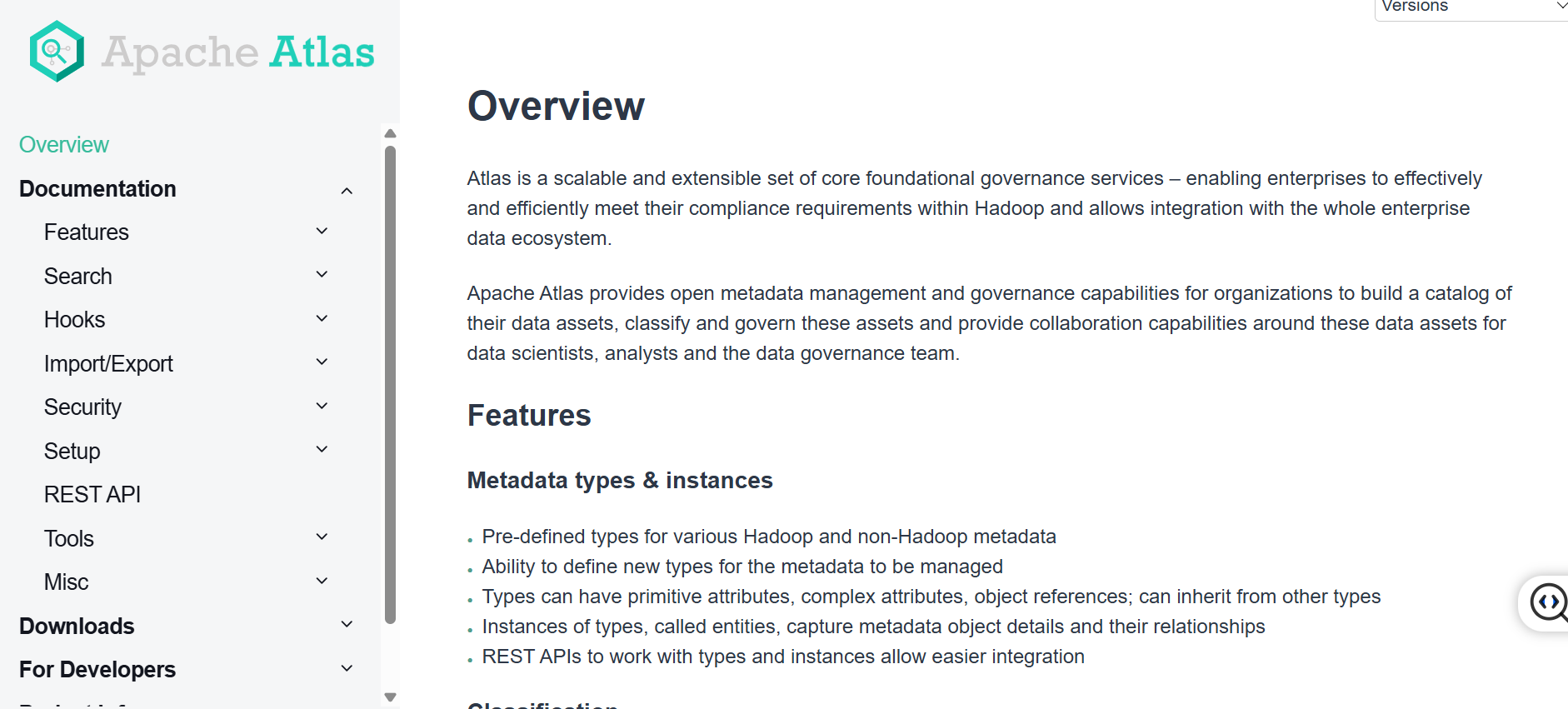
Apache Atlas is an open-source metadata management and governance framework built for organizations running big data ecosystems like Hadoop, Hive, and Spark. It offers metadata classification, lineage tracking, and tag-based security at zero licensing cost, but requires significant technical expertise, and users increasingly call it too complex.
-
What sets it apart: Zero licensing cost and deep integration with Apache Ranger for access control, appealing to teams with in-house engineering capacity.
-
Where it falls short: Requires real technical expertise to configure and maintain, and users increasingly describe it as heavyweight next to newer, lighter catalogs.
-
Rating: 4.5/5
7. Ataccama ONE
Ataccama ONE is an AI-driven data management and governance platform that unifies data quality, metadata cataloging, and anomaly detection in one suite, with flexible cloud, on-premises, and hybrid deployment. It promises an elegant unified experience, but users report the products still feel unstable in enterprise-scale pilots.
-
What sets it apart: An integrated quality engine with anomaly detection sitting inside the same platform as cataloging and governance, instead of a bolt-on tool.
-
Where it falls short: At least one user reported frequent stability issues even during proof-of-concept, describing the product as still experimental in places.
-
Rating: 4.2/5
8. Microsoft Purview
Microsoft Purview delivers scanning, classification, and lineage through its Data Map layer, plus a business-facing Unified Catalog covering governance domains, data products, and quality rules. Pricing is consumption-based and governs only what you attach to a data product, but multi-cloud coverage stays thin, and updates need manual refreshes.
-
What sets it apart: Consumption-based pricing that bills only for what actually gets governed, plus native depth across Fabric, Power BI, and Azure SQL.
-
Where it falls short: Multi-cloud coverage outside Azure is thin, and reports show every user can see all metadata records regardless of role-based permissions.
-
Rating: 4.7/5
9. Snowflake Horizon Catalog
Snowflake Horizon Catalog is Snowflake's built-in governance layer, covering classification, masking, row access policies, lineage, and now AI agent identity and guardrails, all enforced inside the query engine itself. It needs no separate deployment, but coverage outside Snowflake is still an early preview, and it lacks a formal glossary.
-
What sets it apart: Masking and row access policies that propagate to external compute like Spark, plus AI agent identity with its own audit trail as of 2026.
-
Where it falls short: Coverage outside Snowflake itself is still in private preview, and there's no formal business glossary with approval workflows yet.
-
Rating: 4.5/5
10. Databricks Unity Catalog
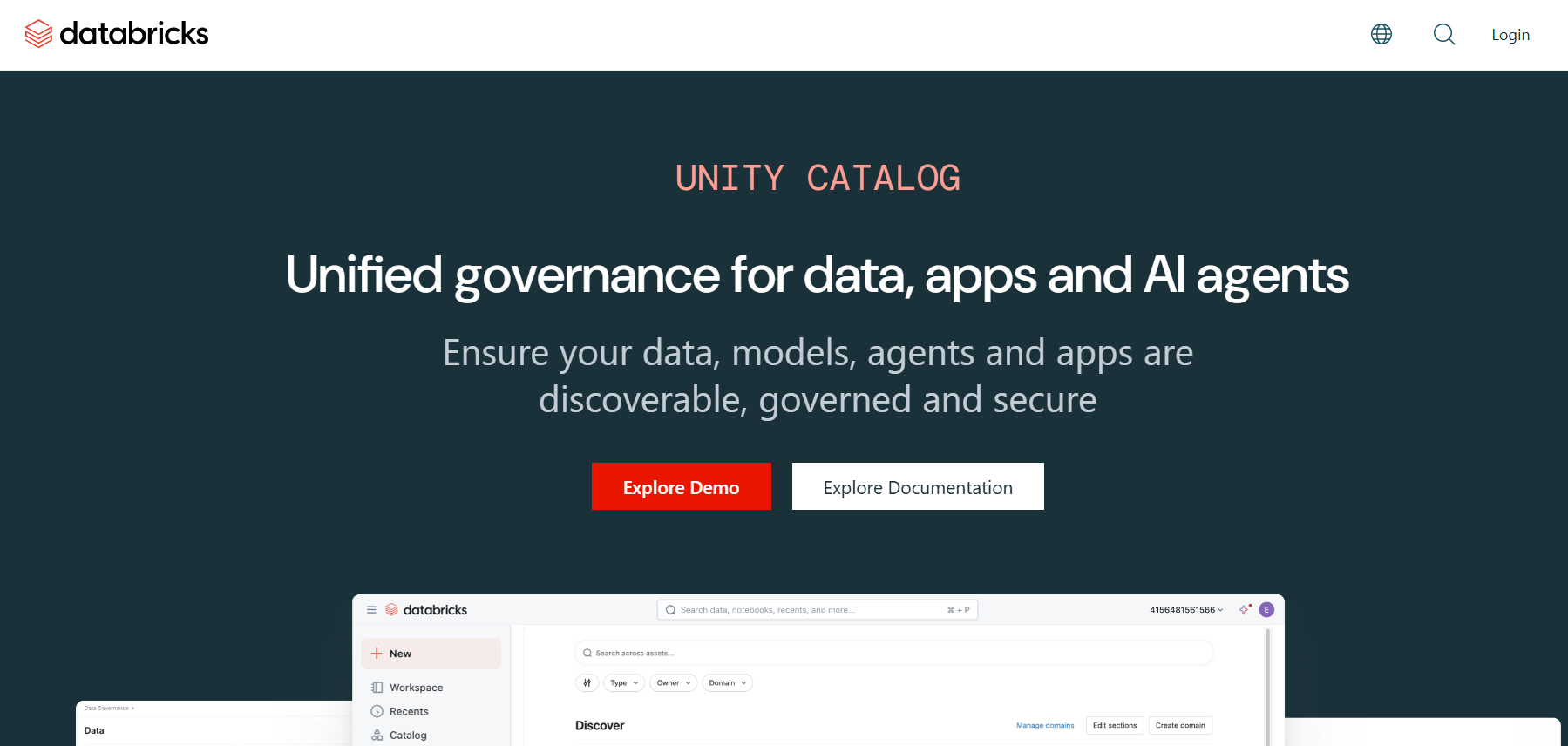
Unity Catalog is the governance layer built into the Databricks platform, applying one permission model across tables, notebooks, models, and AI agents with automatic column-level lineage. It needs no extra integration for existing Databricks users, but policy enforcement stops at the platform boundary, and a glossary is still on the roadmap.
-
What sets it apart: One permission model spanning tables, notebooks, models, and AI agents, enforced automatically with column-level lineage.
-
Where it falls short: Governance stops at the Databricks boundary, and one metastore per region means cross-cloud lineage is still a work in progress.
-
Rating: 4.6/5
11. BigID
BigID is a data security and privacy platform built around deep sensitive-data discovery, classification, and identity correlation, with DSAR automation, consent management, and AI risk modules layered on top. It suits large, complex data estates needing privacy and security posture management, but pricing is modular and adds up fast.
-
What sets it apart: Deep PII discovery and identity correlation across structured and unstructured sources, plus end-to-end DSAR and consent automation.
-
Where it falls short: Pricing is modular, so capabilities buyers assume are included often sit behind separately priced add-ons, and scan reliability draws consistent complaints.
-
Rating: 4.3/5
12. IBM Knowledge Catalog
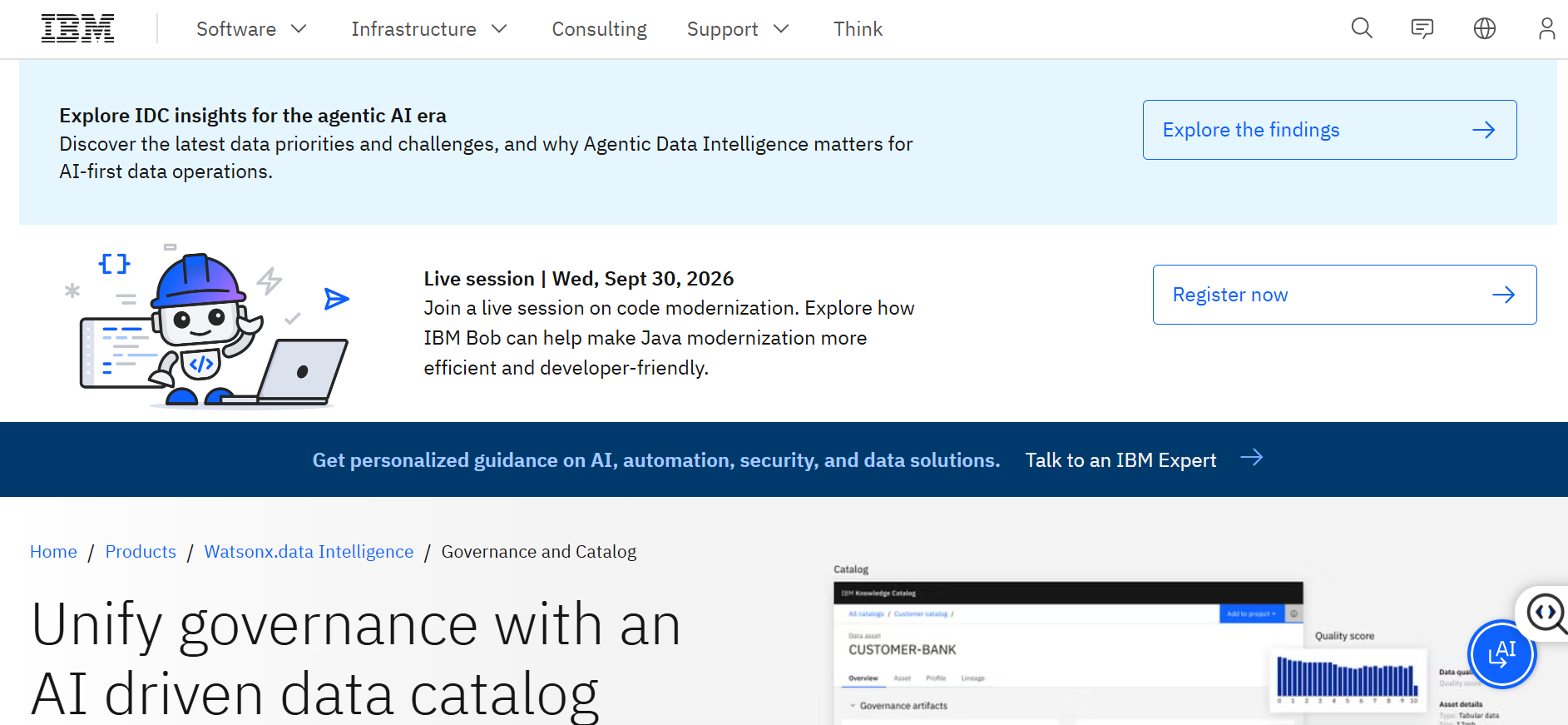
Governance and Catalog is IBM's metadata and governance layer, part of the watsonx.data intelligence suite (formerly branded IBM Knowledge Catalog), delivered through Cloud Pak for Data or as managed SaaS. It uses LLM-powered metadata enrichment to add context and labels across thousands of assets at once, backed by prebuilt governance vocabularies, though pricing isn't published since it's sold as part of a broader IBM deal.
-
What sets it apart: LLM-powered metadata enrichment that adds context and labels across thousands of assets at once, plus prebuilt governance vocabularies.
-
Where it falls short: No public pricing is listed; it's sold through Cloud Pak for Data or watsonx.data, so cost depends on the broader IBM deal.
-
Rating: 4.2/5
13. erwin Data Intelligence (Quest)
erwin Data Intelligence is Quest's governance and cataloging product, built alongside erwin's existing data modeling tools. It combines cataloging, governance, and data modeling and architecture in one Quest-owned product line rather than separate tools, though no public pricing is available and it remains a smaller, less-reviewed platform than most others on this list.
- What sets it apart: Combines cataloging, governance, and data modeling and architecture in one Quest-owned product line, rather than separate tools.
- Where it falls short: No public pricing is available, and it's a smaller, less-reviewed platform than most others on this list.
- Rating: 4.3/5
How fast can each tool actually go live?
Most data governance tools take two weeks to twelve months to show first value. Platform-native options move fastest since they build on existing infrastructure, while full enterprise suites take longer to configure and staff.
|
Tool |
Typical time to first value |
Internal team you need |
|
OvalEdge |
4 to 12 weeks |
1 data steward plus part-time IT |
|
Alation |
3 to 6 months |
Dedicated steward plus data owners |
|
Atlan |
~3 months |
Small data team, cloud-native stack |
|
Collibra |
6 to 12 months |
Dedicated governance team plus data owners |
|
Informatica CDGC |
6 to 12 months |
Dedicated governance team |
|
Apache Atlas |
3 to 9 months |
Engineering team that can maintain it |
|
Ataccama ONE |
3 to 6 months |
Data quality lead plus IT support |
|
Microsoft Purview* |
2 to 4 weeks |
Existing Azure/platform admins |
|
Snowflake Horizon Catalog* |
Days to 2 weeks (features enabled on Enterprise Edition+, not a separate deployment) |
Existing Snowflake admins |
|
Databricks Unity Catalog* |
2 to 6 weeks for new workspaces; longer if migrating an older workspace |
Existing Databricks admins |
|
BigID* |
2 to 6 months (faster if scoped to one module first) |
Privacy or security team plus IT support for source configuration |
|
IBM Knowledge Catalog* |
6 to 12 months |
Dedicated governance team plus IBM Cloud Pak/watsonx platform admins |
|
erwin Data Intelligence (Quest)* |
3 to 6 months |
Data architecture team plus IT support |
Real-world results: who's actually using these tools
A handful of companies have published what these platforms actually delivered, not just what the vendor promises.
- OvalEdge: An OvalEdge-commissioned Forrester TEI study found up to 30% higher analyst productivity, up to 40% reduction in effort to catalog metadata and compile lineage, and up to 75% less effort to find, tag, and secure sensitive data. These gains trace back to the Enterprise Context Graph connecting catalog, lineage, and quality data into a single operational layer.
- NTT DOCOMO + Alation: A tenfold increase in analyst productivity and a 30% cut in analyst workload after rolling Alation out alongside Snowflake, with more than 7,000 registered users and 3,000 active monthly users across the company.
- Telenor + BigID: Used BigID to automate sensitive-data discovery across its systems, cutting the manual work behind privacy audits and building a clearer, auditable record of where customer data actually lives.
- Nationwide Building Society + Collibra: Runs Collibra across its financial services and insurance operations to govern data at the scale a regulated UK institution requires.
How AI governance readiness changes the buying decision
AI regulation has moved from a future consideration to a current one. The EU AI Act's high-risk provisions are already in effect, and providers or deployers of high-risk AI systems that fail to meet its obligations face fines of up to €15 million or 3% of global annual turnover, whichever is higher.
Prohibited practices carry an even steeper penalty: up to €35 million or 7% of global annual turnover, whichever is higher.
AI governance readiness has become a real evaluation criterion for anyone buying a governance platform today. A data governance platform earns that label by ensuring three things: every dataset feeding an AI system is discoverable and its provenance documented; data quality is verified and recorded before consumption; and access controls govern who and what can use sensitive data.
Tools that automate this through a connected governance layer like an Enterprise Context Graph, rather than relying on manual audit trails, reduce the real cost of proving compliance when a regulator asks.
What are the key capabilities to look for in data governance software?
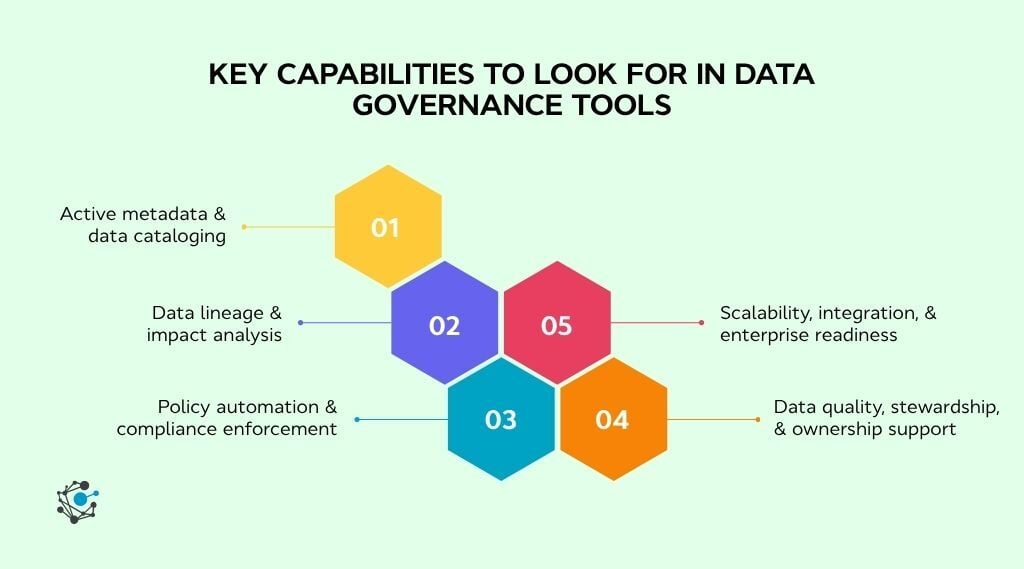
Every vendor claims all five of these. What separates them is how much works without manual configuration, so treat this as a demo checklist rather than a reading list.
- Active metadata and data cataloging
Automates metadata capture, categorization, and enrichment, so the catalog stays current without manual updates. In demos, ask what gets discovered automatically versus what a steward still has to type. See metadata management tools for purpose-built platforms.
- Data lineage and impact analysis
Traces data from origin through every transformation, then flags what breaks downstream before a table changes. Column-level lineage across systems is far harder than table-level lineage inside one, and that's where tools differ most. See data lineage best practices for a starting framework.
- Policy automation and compliance enforcement
GDPR, CCPA, HIPAA, and the EU AI Act require documented policies and audit trails. Manual enforcement rarely survives an audit at scale, so look for automatic enforcement across access, retention, and sharing, plus reporting ready to hand an auditor.
- Data quality, stewardship, and ownership
Quality management covers validation, profiling, cleansing, and monitoring. Stewardship is the human layer: named owners and a workflow for resolving issues. Governance programs fail from unclear accountability more often than missing features.
- Scalability, integration, and enterprise readiness
Check connector coverage for every system in use, support for cloud, on-prem, or hybrid deployment, and a pricing model that scales without penalty. Privacy-heavy buyers should weigh PII discovery and consent handling against dedicated data privacy tools.
How to choose the right data governance tool?
Choosing a data governance tool comes down to being honest about which problem needs solving. A team standardized on one platform often has enough governance built in. A team with data spread across clouds, warehouses, and unmapped systems needs a platform built to govern across all of them.
Fit matters more than feature count. Score each option against maturity and regulatory reality, then pilot it on the messiest data source available. Adoption decides whether the investment pays off, so name owners and budget for training before go-live.
OvalEdge combines that fit with an Enterprise Context Graph, keeping catalog, lineage, and quality data connected and ready for teams and AI agents like AskEdgi alike. Book a demo to see it against real data.
.png?width=1081&height=173&name=Forrester%201%20(1).png)
.png?width=1081&height=241&name=KC%20-%20Logo%201%20(1).png)