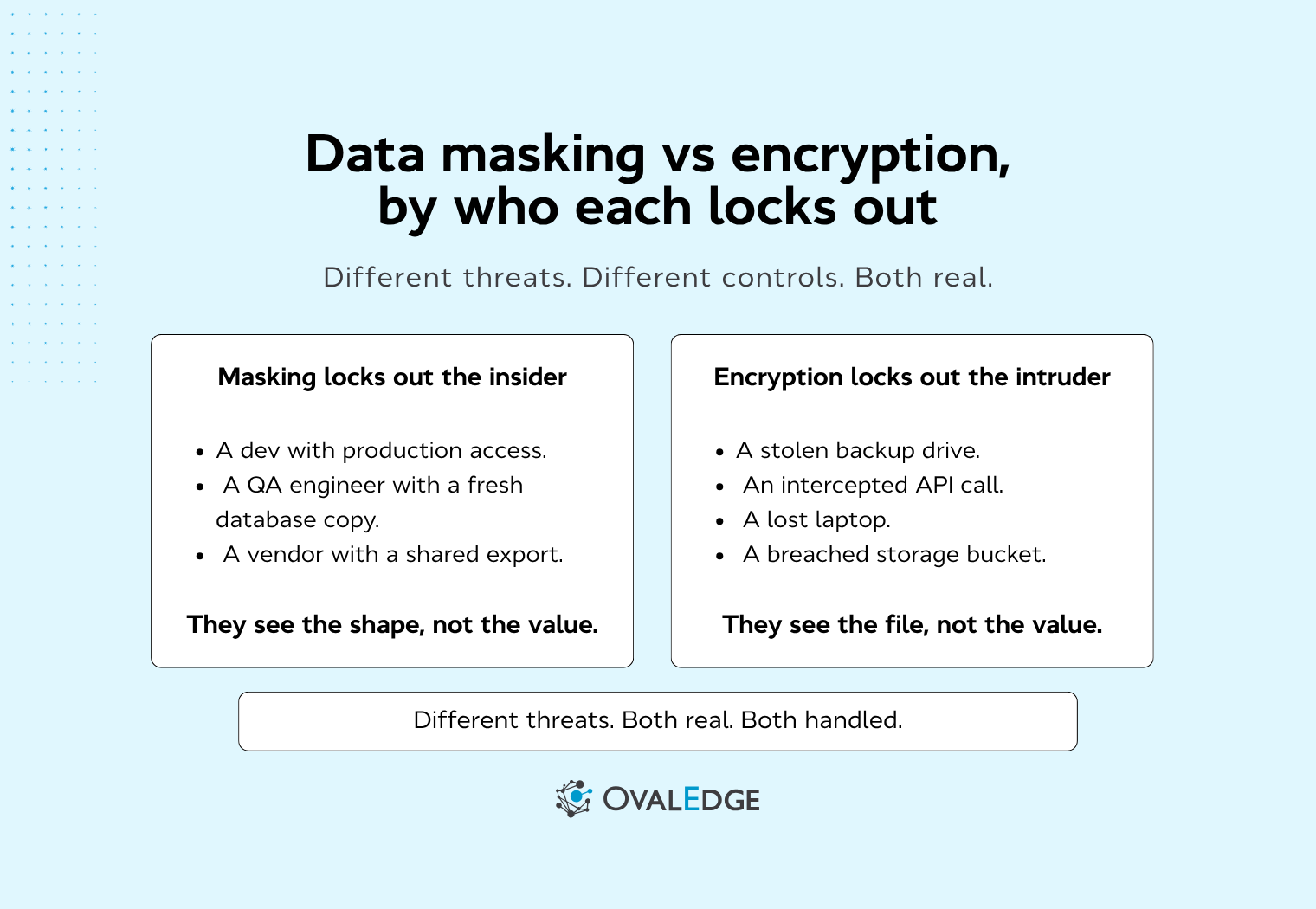
Data masking and data encryption both protect sensitive information, but they belong in different parts of the stack. Encryption sits in the security layer and protects real data on production systems.
Masking sits in the governance layer and replaces real values in non-production systems, so development, testing, and analytics environments never carry the risk of exposure.
This guide compares masking and encryption, along with tokenization, obfuscation, hashing, and scrambling, and covers how mature teams layer them together with a governed data foundation like the Enterprise Context Graph underneath.
What is data masking?
Data masking replaces sensitive values with fictional but realistic ones to reduce exposure while preserving structure and usability. It is generally irreversible, which makes it safer than encryption for non-production environments like development, testing, and analytics.
Data masking is also referred to as data anonymization, data de-identification, or data obfuscation, depending on the technique used.
Types of data masking
-
Static masking: creates a separate masked copy of a production dataset for use in development, testing, or training. The production system stays untouched.
-
Dynamic masking: hides sensitive values at query time based on user role or policy. The underlying data stays intact; visibility changes with access.
-
On-the-fly masking: transforms sensitive fields during data movement between systems, so downstream platforms never store real values.
-
Deterministic and non-deterministic masking: deterministic masking produces the same output for the same input, preserving joins across tables. Non-deterministic masking randomizes each time for stronger anonymization.
-
Tokenization as an alternative: replaces sensitive values with reference tokens stored in a secure vault. Reversible by design, most common in PCI DSS environments.
For example: A customer support agent verifying a payment issue sees only the last four digits of the card number. Finance and compliance roles, with the right permissions, see the full value with an audit log entry.
What is data encryption?
Data encryption converts readable data into ciphertext using cryptographic keys, so only authorized users with the correct key can access the original values. It applies to data at rest, in transit, and end-to-end. Reversible by design, encryption is the standard control for live customer records and payment data.
Types of data encryption
-
Symmetric encryption: uses a single shared key for both encryption and decryption. Fast and efficient, common for large databases and file systems.
-
Asymmetric encryption: uses a public key to encrypt and a private key to decrypt. Foundational to secure web sessions, key exchange, and digital signatures.
-
Encryption at rest: protects data stored on databases, backups, cloud object storage, and virtual machine disks.
-
Encryption in transit: protects data as it moves across networks using protocols like TLS, common for APIs, cloud services, and remote database connections.
-
End-to-end encryption: keeps data encrypted from sender to recipient without any intermediary decryption, common in secure messaging and confidential API exchanges.
-
Field-level and column-level encryption: encrypts specific database columns instead of the whole store, balancing protection and query performance.
For example: A payment processor encrypts stored card numbers at the field level. Even if an attacker gains access to the database, they cannot read the values without the encryption keys, which are held in a separate key management system.
Data masking vs encryption: the core differences
Data masking replaces real values with fictional ones, so non-production systems never hold sensitive data. It is generally irreversible and reduces compliance scope. Whereas data encryption converts real data into ciphertext that authorized users can decrypt with a key, and is often mandated for stored and transmitted data.
|
Common buyer questions |
Data Masking |
Data Encryption |
|
Which one protects live production data? |
Not the right fit |
Yes, encrypt at rest and in transit |
|
Which one is safer for dev, test, or analytics environments? |
Yes, use masked datasets |
Overkill and adds unnecessary key management |
|
Which one is reversible? |
Generally no; values are replaced permanently |
Yes, with the correct key |
|
Which control fits password storage? |
Neither; use hashing instead |
Not recommended; use hashing |
|
Which control fits financial or card data? |
Pair with tokenization for PCI DSS scope |
Yes, encrypt card data in production |
|
Which control fits third-party data sharing? |
Yes, share masked datasets |
Only if the vendor also manages keys securely |
|
Which one supports GDPR data minimization? |
Yes, removes real identifiers |
Partial, encrypted data still counts as personal data |
|
Which one reduces compliance scope in non-production? |
Yes, removes sensitive values entirely |
No, encrypted data stays in scope |
|
Which one is often mandated by HIPAA, PCI DSS, and GDPR? |
Recommended, not usually mandated |
Frequently mandated for stored and transmitted data |
|
Do both controls run together without changing existing systems? |
Yes, layer masking on non-production, encryption on production |
Same, both work in parallel without a rip-and-replace |
The core difference between data masking and data encryption is what happens to the original value. Masking removes real data. Encryption protects real data. Every other difference flows from that one distinction.
The table above maps how it plays out across ten common buyer questions. Below is the reasoning behind those answers, broken down across three axes.
1. What happens to the original value
Data masking removes real data from the working system. Once a value is masked, it cannot be brought back.
Data encryption keeps the original value intact. It converts the value into ciphertext, but the plaintext is recoverable with the correct key.
The practical impact: For a live payment system, encryption is the only option because the business needs the real card number back. For a QA environment testing the payment flow, masking is the safer choice because the original card number is never needed.
2. Can the original value be recovered?
Data masking is generally irreversible. No key to manage, no decryption path, and no way for an attacker to recover the original values from a masked dataset.
Data encryption is reversible by design. Keys must be generated, stored, rotated, and access-controlled through a proper key management system.
The practical impact: masking is safer against breaches because there is nothing to reverse. Encryption is more flexible because the data can be reversed under controlled access. Poor key handling turns a strong algorithm into an exposed one.
3. Where does each method fit, and what does compliance require?
Data masking fits non-production environments: development, testing, analytics, and third-party sharing. On a governed platform, classification agents like Sift identify sensitive columns and policy agents like Helm enforce masking consistently across catalogs. Masking supports GDPR data minimization and reduces compliance scope because masked data is generally not considered personal data.
Data encryption fits production environments and any point where data moves between systems. It is often mandated by HIPAA, PCI DSS, and GDPR.
The practical impact: encrypted data still counts as personal data under GDPR, so encryption reduces breach impact but does not remove compliance obligations. Masking shrinks the footprint by removing real data where it does not need to exist. Both work best in parallel, with governance keeping them consistent as systems change.
Data masking vs other data protection methods
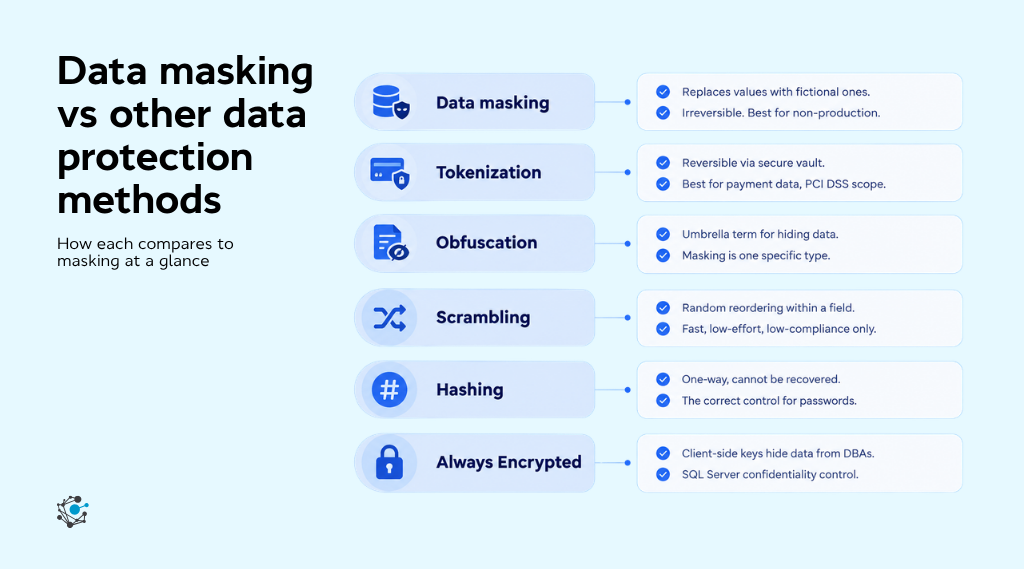
Data masking often gets confused with tokenization, obfuscation, scrambling, and hashing, and comes up alongside SQL Server's Dynamic Data Masking and Always Encrypted.
Practitioners still work through this in production, from broader control comparisons to specific decisions like how to safely share production data with non-production teams.
Here is how each compares.
How masking compares to tokenization, hashing, and obfuscation
The comparison list is shorter than it looks.
-
Tokenization replaces values with vault-stored reference tokens and is the right control for payment data because it shrinks PCI DSS scope across billing, CRM, and analytics.
-
Hashing is a one-way transformation and is the correct control for storing user passwords, not masking or encryption.
-
Obfuscation is the umbrella term for any technique that hides sensitive data, and masking is one specific type.
-
Scrambling randomizes characters within a field and is a low-effort masking technique, useful for internal test data but not for external data sharing.
For a full walkthrough of masking techniques and where each fits, see our guide to data masking techniques.
Dynamic Data Masking vs Always Encrypted
Both are SQL Server features rather than platform-level controls. Dynamic Data Masking hides column values at query time; Always Encrypted encrypts columns client-side. For a full breakdown, see our guide to dynamic data masking tools.
When should you use data masking vs data encryption?
The decision comes down to environment, reversibility, and what the business needs from the data. The table below breaks it down by situation.
|
Situation |
Choose data masking |
Choose data encryption |
|
Where the data lives |
Non-production environments like development, testing, analytics, or training |
Production systems where real customer records must stay accurate |
|
Reversibility need |
The business does not need the original value back |
The business needs the original values back for billing, verification, or transactions |
|
Data movement |
Data is shared with third parties, vendors, or offshore teams |
Data moves across networks, APIs, or cloud services and needs protection in transit |
|
Regulatory driver |
Regulations emphasize data minimization under GDPR or similar frameworks |
HIPAA, PCI DSS, or GDPR mandate encryption for stored or transmitted personal data |
|
Primary security goal |
A realistic data structure is required, but real identifiers are not |
Preventing unauthorized access to active data is the primary security goal |
Most mature strategies do not pick one. Masking applies to non-production environments, encryption applies to production, and both run in parallel without a rip-and-replace.
The decision that governs both, though, is which columns count as sensitive in the first place, and that depends on classification, ownership, and policy metadata sitting in a connected foundation. The section below on how the two work together shows what that looks like in practice.
Masking on non-production, encryption on production, and the ECG keeping both in sync as data, roles, and integrations change. Book a demo to see the layered model in action.
How do masking and encryption work together?
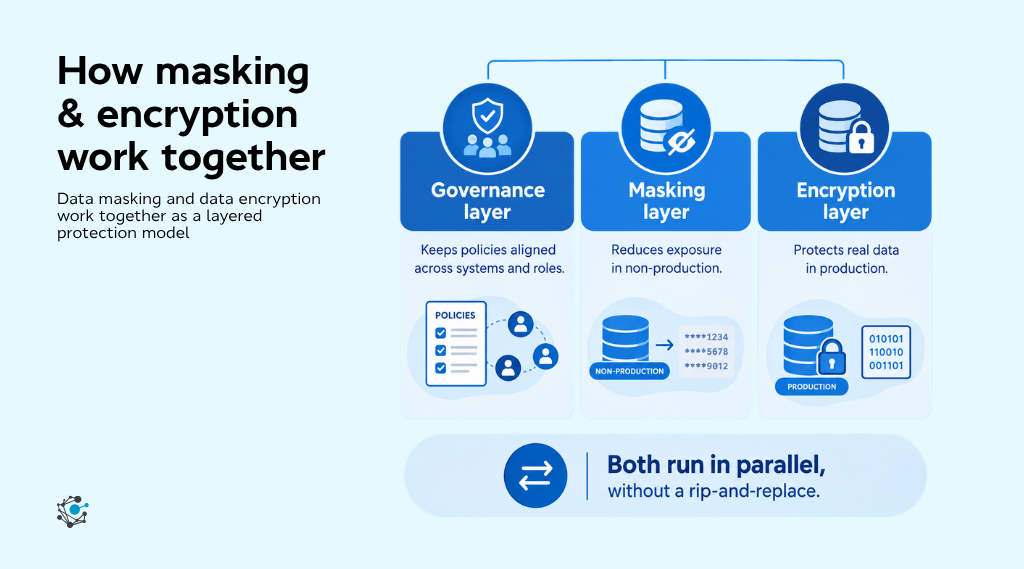
Data masking and data encryption work together as a layered protection model. Encryption protects real data in production. Masking reduces exposure in non-production. Both run in parallel without a rip-and-replace of existing systems.
Most mature strategies run three layers at once:
|
Layer |
What it protects |
Where it applies |
What it prevents |
|
Encryption layer |
Data at rest and in transit |
Production databases, storage, backups, APIs |
Breaches, intercepted traffic, stolen backups |
|
Masking layer |
Visibility and sharing exposure |
Non-production systems, analytics, support screens, third-party sharing |
Leaks through exports, logs, screenshots, tickets |
|
Governance layer |
Policy accuracy and enforcement |
Catalogs, access workflows, audits, role management |
Untracked access, policy drift, uncontrolled columns |
Encryption keeps sensitive data confidential in storage and transit. Masking limits how much sensitive data people see or receive in day-to-day workflows. Governance ties the two together so policies stay accurate as systems, roles, and data assets change.
This is where a connected foundation like the Enterprise Context Graph matters. Platforms like OvalEdge use the ECG to keep sensitive column classifications, ownership, applicable policies, and lineage in one queryable structure, so masking rules and access controls stay consistent even as datasets, roles, and integrations shift underneath.
Choose data masking vs. encryption based on where data lives
Masking and encryption solve different problems. Encryption protects real data on production systems. Masking removes real data from non-production systems. The choice is not one versus the other. Mature strategies run both in parallel, with governance holding the layered model together as datasets, roles, and integrations change.
That governance layer is where the Enterprise Context Graph does the real work, connecting sensitive-data classifications, ownership, lineage, and applicable policies into one queryable foundation, so masking rules and access controls stay accurate as the environment shifts underneath.
See how OvalEdge classifies sensitive data and enforces masking policies across every connected system. Book a demo.
.png?width=1081&height=173&name=Forrester%201%20(1).png)
.png?width=1081&height=241&name=KC%20-%20Logo%201%20(1).png)