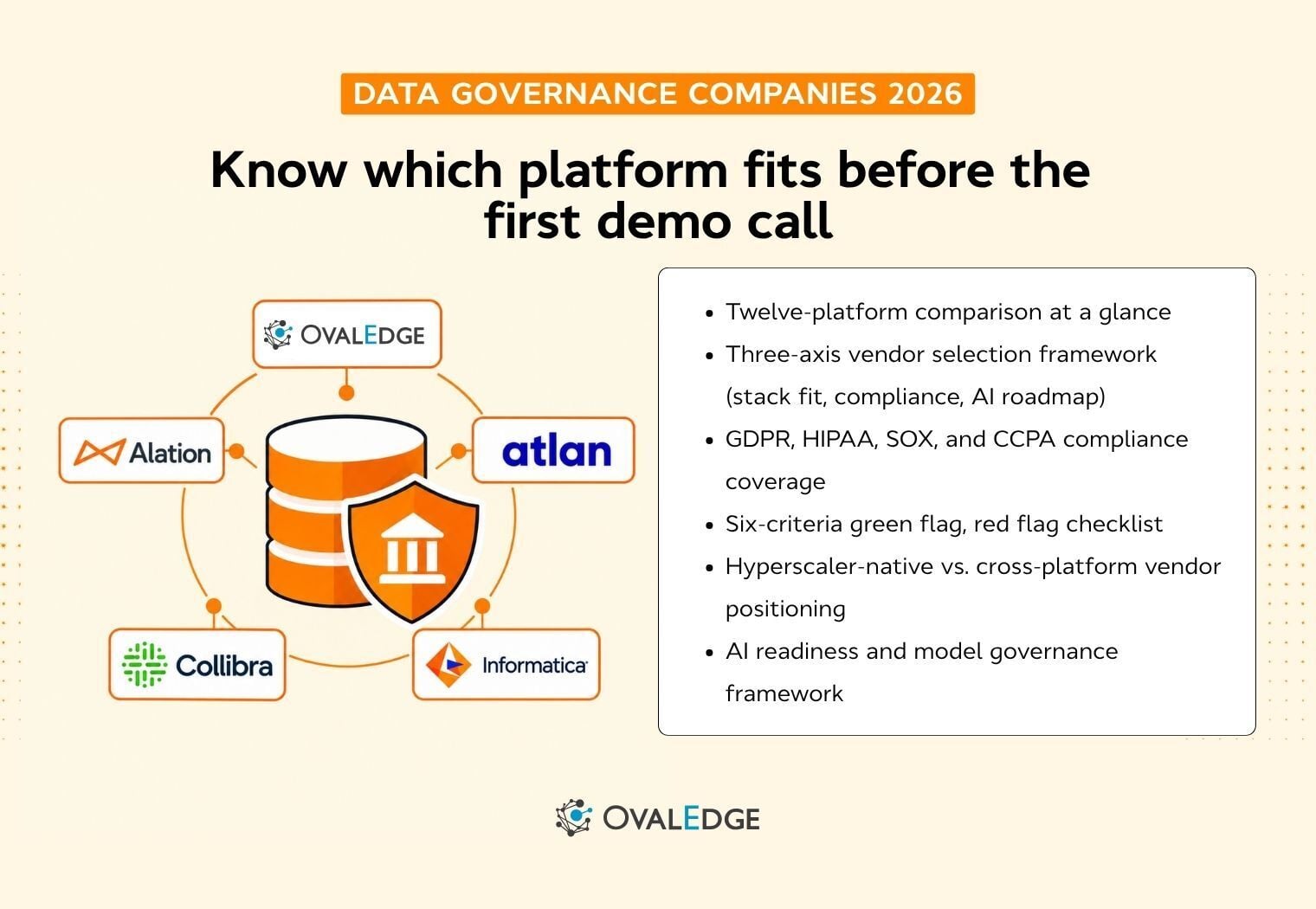
Picking a data governance vendor is harder in 2026 than it was even 18 months ago.
Every platform now claims AI readiness, agentic features, and multi-cloud coverage, but the real test is whether it can enforce GDPR, HIPAA, and SOX controls at enterprise scale without a two-year rollout, and whether it has the metadata depth to support the AI use cases already on the roadmap.
We compared 12 data governance companies on compliance depth, product scope, and real-world fit to make the choice easier for teams balancing regulatory pressure with AI plans.
What is a data governance company?
Data governance companies are vendors that provide the platforms and services organizations use to manage the availability, usability, integrity, and compliance of their data. Most operate through a data catalog, business glossary, lineage tracking, policy enforcement, and access controls.
They help businesses comply with regulations like GDPR, HIPAA, and CCPA by implementing governance frameworks that ensure data privacy, security, and integrity. These companies use advanced technologies to automate processes, mitigate risks, and improve data quality.
Did you know? Governance has moved to the top of the data leadership agenda. Deloitte's 2025 Chief Data Officer Survey found 51% of CDOs name data governance their top priority for the next 12 months, rising to 63% at lower-maturity organizations.
By offering tailored solutions, data governance companies support various industries, ensuring that data is accessible, accurate, and governed in compliance with regulatory standards. Their expertise in data ownership, risk management, and compliance makes them crucial partners for businesses in today’s data-driven world.
Also read: Know all about Automated Data Governance in 2026
Top 12 data governance companies in 2026
Each of the 12 companies below takes a different approach to governance, from governance-native platforms to hyperscaler-built options. The table summarizes primary strength, best fit, and deployment model before the full company breakdowns.
|
Company |
Primary strength |
Best for |
Deployment model |
|
OvalEdge |
Data cataloging and metadata management with automated governance |
Businesses needing compliance tracking and scalable governance without added complexity |
Cloud, on-premises |
|
Alation |
AI-driven metadata management and data discovery |
Enterprises streamlining discovery and compliance across large datasets |
Cloud |
|
Atlan |
Real-time collaboration and workflow automation |
Teams managing complex, multi-cloud data environments |
Cloud, on-premises |
|
Collibra |
Enterprise-grade compliance and data lineage tracking |
Large enterprises with complex, multi-regulatory governance needs |
Cloud, on-premises |
|
Informatica |
End-to-end suite covering cataloging, lineage, quality, and compliance |
Large enterprises needing an integrated, all-in-one solution |
Cloud, on-premises |
|
Talend (now part of Qlik) |
Data integration and quality with compliance tracking |
Organizations wanting a customizable, integration-heavy governance solution |
Cloud |
|
Ataccama |
AI-driven data quality and master data management |
Organizations maintaining data consistency across complex systems |
Cloud, on-premises |
|
Microsoft Purview |
Native governance across M365, Azure, and Fabric |
Organizations standardized on the Microsoft stack |
Cloud |
|
IBM watsonx.governance |
AI model governance paired with data governance |
Regulated, AI-heavy organizations needing model audit trails |
Cloud, hybrid |
|
Databricks Unity Catalog |
Lakehouse-native governance |
Organizations standardized on Databricks |
Cloud |
|
Google Knowledge Catalog (formerly Dataplex) |
Native governance across BigQuery, GCS, and BigLake |
Organizations standardized on GCP |
Cloud |
|
Immuta |
Policy-as-code, dynamic access control |
Organizations scaling access governance across cloud warehouses |
Cloud |
Disclosure: Our platform, OvalEdge, is scored on the same criteria as every other tool.
The comparison above gives a quick snapshot of how these 12 platforms stack up on strength, fit, and deployment. The breakdowns below go deeper into what each platform actually does and where it fits best.
1. OvalEdge
OvalEdge is a data governance and AI context platform built around the Enterprise Context Graph, which connects governed metadata, lineage, and business context so data teams and AI agents work from the same trusted source.
How it handles AI-ready governance
OvalEdge's governance agents work directly against the Enterprise Context Graph:
-
Curo manages data quality rules and triggers remediation when data falls below threshold
-
Sift discovers and auto-classifies sensitive data across connected systems
-
Nexus maps cross-system relationships so lineage and dependencies are visible end to end
-
askEdgi lets business users query governed data in natural language, with every answer traced back to its source
Because the agents draw from the same metadata layer as the rest of the platform, classification, quality, and access decisions stay consistent whether a human or an AI agent is asking the question.
How it handles compliance across regulated industries
-
Real-time compliance tracking and audit trails for GDPR, CCPA, and HIPAA
-
Data lineage tracking that shows how data moves from creation to consumption
-
Role-based access controls and policy enforcement built into the same platform
For example, a pharma team preparing a 21 CFR Part 11 audit trail for an FDA IND submission needs to prove that every data point in the filing is traceable from the lab instrument through LIMS to the final document, with access restricted at each stage. OvalEdge's Enterprise Context Graph surfaces that lineage automatically, while Sift flags regulated data and Notary enforces access gates, so the audit trail is continuous rather than assembled after the fact.
Best suited for: Organizations that want governance and an AI-ready context layer in the same platform, without adding a separate integration project.
2. Alation
Alation is a metadata management and data cataloging platform known for pairing its catalog with behavioral analytics on how data is actually used across the organization. It uses AI to power discovery, governance, and compliance.
How it handles data catalog and usage analytics
Alation's catalog tracks how people actually query and rely on data across the organization, surfacing usage patterns that show data teams which assets matter most and where documentation gaps are slowing adoption.
How it handles compliance reporting and lineage
-
Automated compliance reports that help teams stay audit-ready without manual reporting work
-
End-to-end lineage tracking that shows how data moves and where it originated
Best suited for: Enterprises that need an AI-driven solution to streamline data discovery, governance, and compliance across large datasets.
3. Atlan
Atlan is a data governance platform built for collaboration, giving teams real-time access to curated data sets while automating classification, policy enforcement, and quality checks across complex, multi-cloud environments. Customizable workflows let teams adapt governance to how they actually work.
How it fits multi-cloud and complex data environments
-
Supports both cloud-based and on-premises data environments in the same platform
-
Automates data classification, policy enforcement, and quality checks across those environments
How it handles real-time collaboration and workflows
Atlan's collaborative tools let teams work on data projects together in real time, with governance workflows that can be tailored to match how a specific organization actually operates.
Best suited for: Organizations managing complex, multi-cloud data ecosystems that need flexible, automated governance to support cross-functional collaboration.
4. Collibra
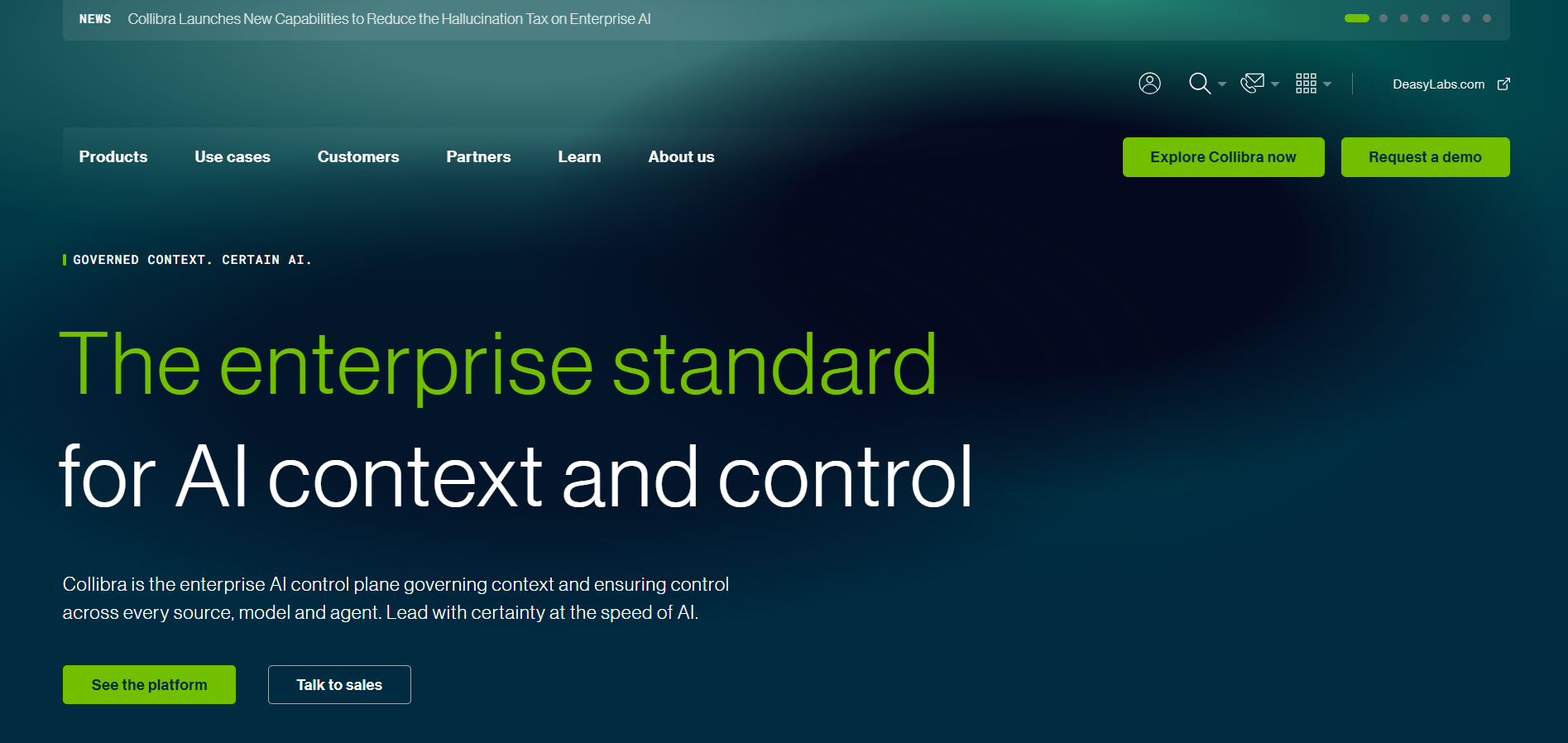
Collibra is an enterprise-grade data governance platform built around compliance, with automated tracking and reporting for regulations like GDPR, HIPAA, and CCPA. Data quality tools and lineage tracking help large organizations keep data accurate and audit-ready.
How it handles regulatory compliance and reporting
-
Automated compliance management with tracking and reporting for GDPR, HIPAA, and CCPA
-
Full data lineage tracking for visibility into how data flows and changes over time
How it handles data quality and cross-team collaboration
Collibra pairs advanced data quality management with collaboration features that let teams working on governance tasks stay aligned, which matters most for enterprises running compliance programs across multiple regulatory environments at once.
Best suited for: Large enterprises with complex data governance and compliance needs, particularly those operating across multiple regulatory environments.
5. Informatica
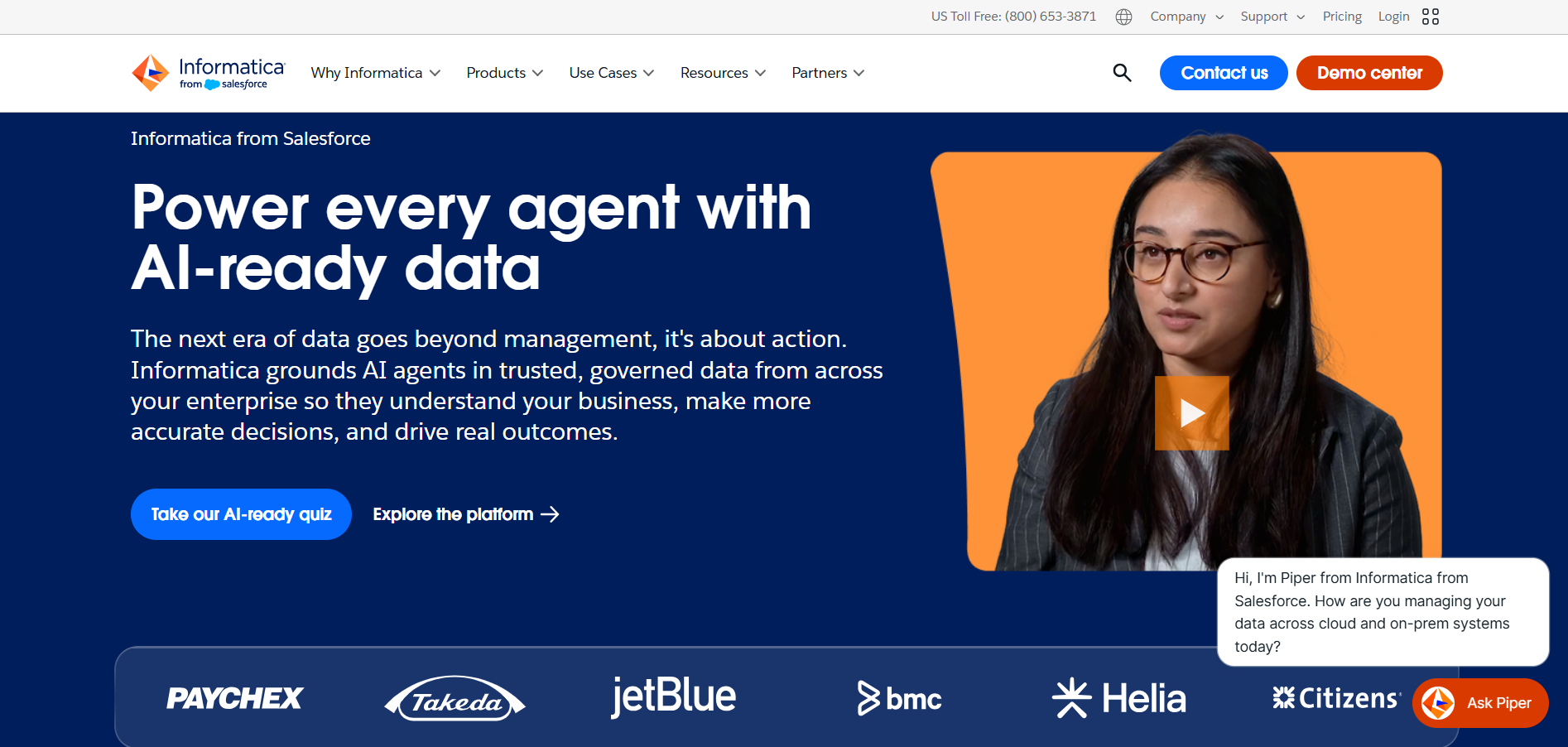
Informatica is a well-established data management vendor offering a comprehensive governance suite that covers cataloging, lineage, quality, and compliance in one platform. Its all-in-one approach suits businesses running large-scale, diverse data environments.
How it handles governance across the full data lifecycle
-
Comprehensive governance covering cataloging, lineage, quality, and compliance management in one suite
-
Automated data quality management that cleanses and validates data for accuracy and reliability
How it fits large, hybrid data environments
Informatica integrates governance across both cloud and on-premises systems, centralizing cataloging, lineage, and compliance for large enterprises running complex, distributed data infrastructure across multiple business units and regions.
Best suited for: Large enterprises that need an integrated, end-to-end data governance solution across complex data environments.
6. Talend (now part of Qlik)
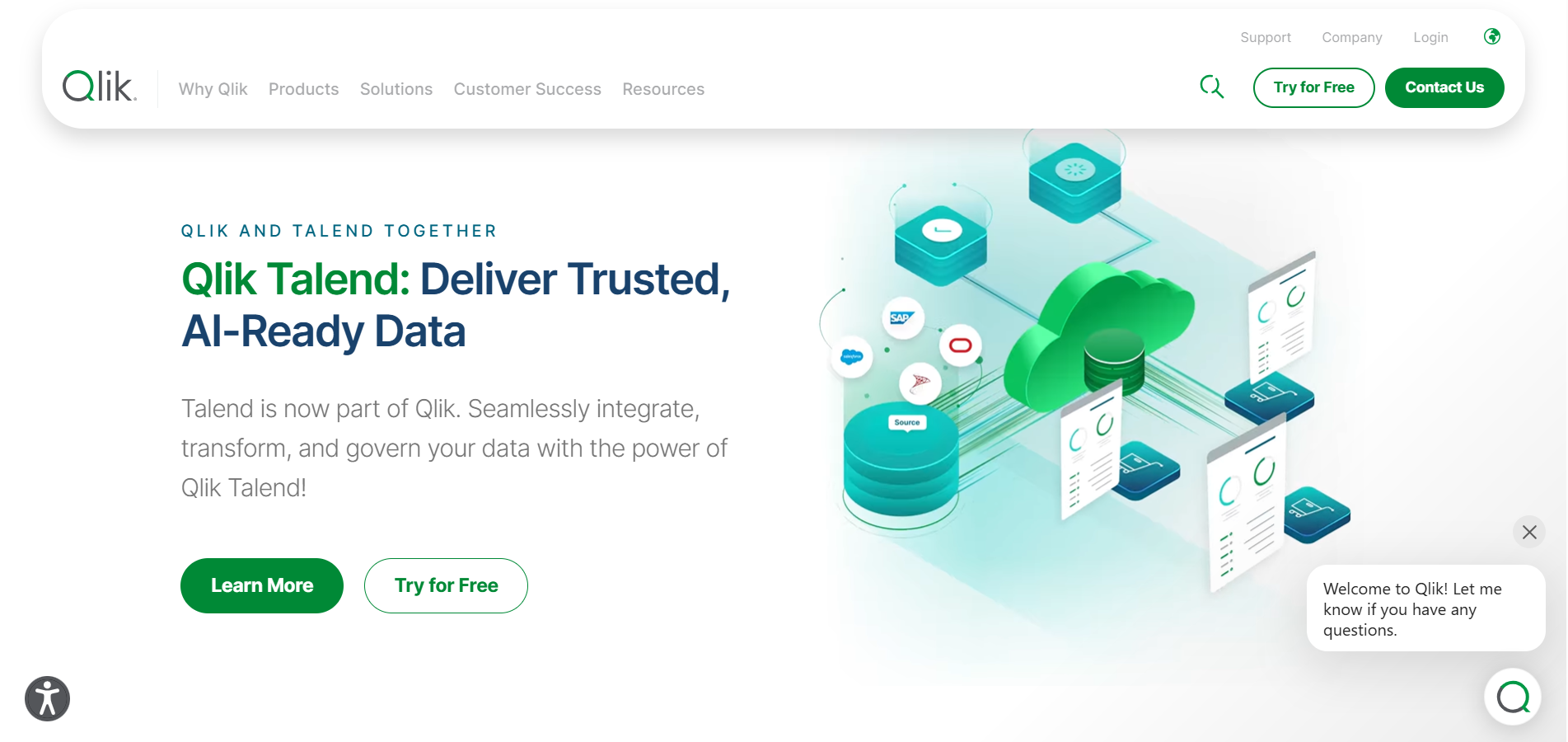
Talend, acquired by Qlik in 2023, is a data integration and quality platform that centralizes governance across multiple systems while tracking compliance with regulations like GDPR and CCPA. Qlik discontinued Talend's open-source edition (Open Studio) in January 2024, so the platform now operates as a commercial product under Qlik Talend Cloud.
How it handles data integration and quality
Talend's integration tools let teams route data across multiple sources, applying quality checks at each step so governance stays unified even across a fragmented system landscape.
How it handles compliance across integrated systems
-
Automated compliance tracking for regulations like GDPR and CCPA
-
Data quality monitoring that flags issues across every connected system
Best suited for: Organizations looking for a commercially supported data integration and governance solution with deep connector coverage and compliance tracking.
7. Ataccama
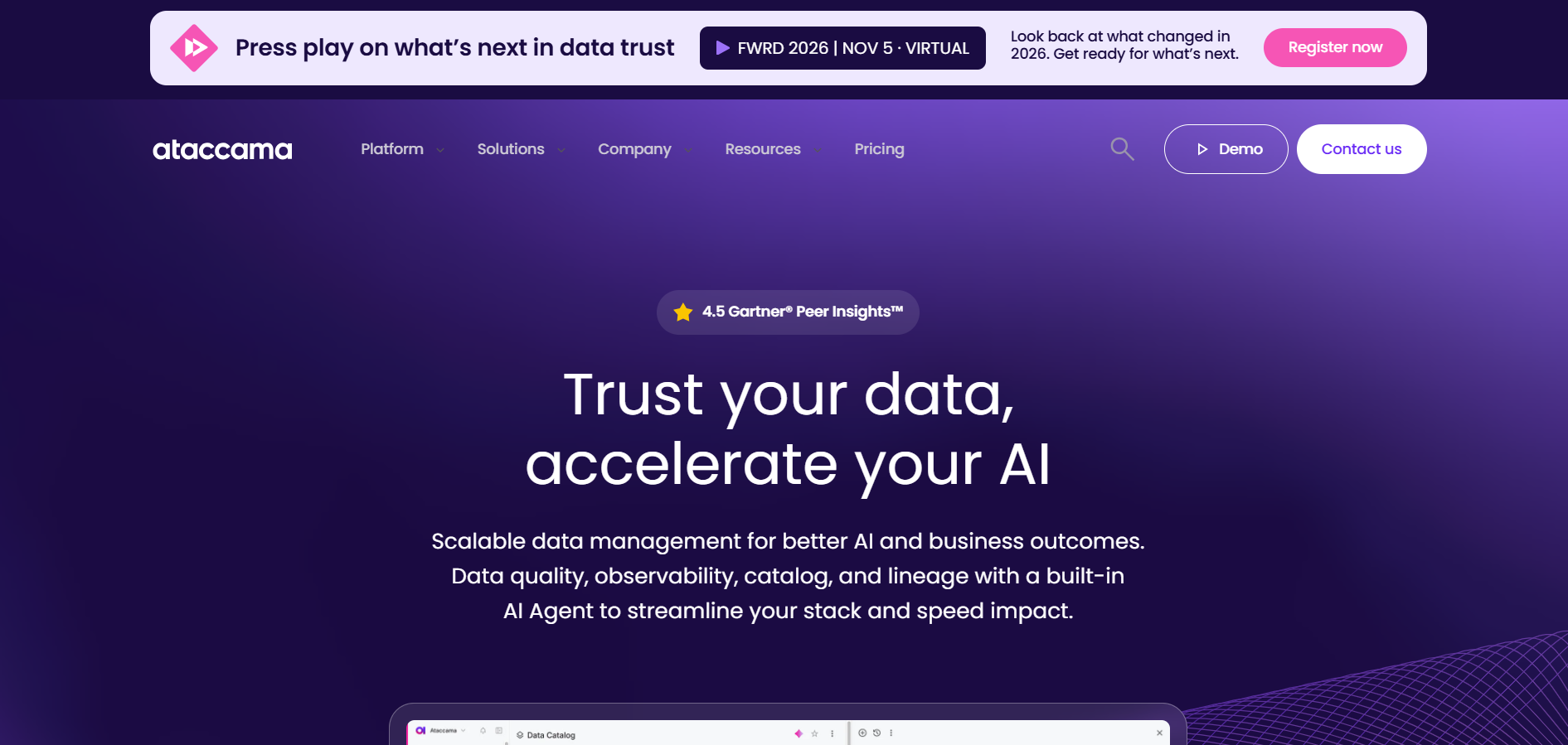
Ataccama specializes in data quality, master data management, and data profiling, giving organizations a robust way to manage data integrity across complex ecosystems. AI-driven automation streamlines governance tasks and keeps quality standards high across the platform.
How it handles data quality and master data management
Ataccama's data profiling tools catch inconsistencies and duplicates before they spread, while its master data management keeps key business records, like customers and products, consistent across every connected system.
How it handles automated governance at scale
-
AI-driven automation that handles data cleansing and policy enforcement
-
Continuous data quality monitoring that tracks and improves standards across systems
Best suited for: Organizations that need to maintain high-quality data across complex systems and ensure consistency in master data management.
8. Microsoft Purview
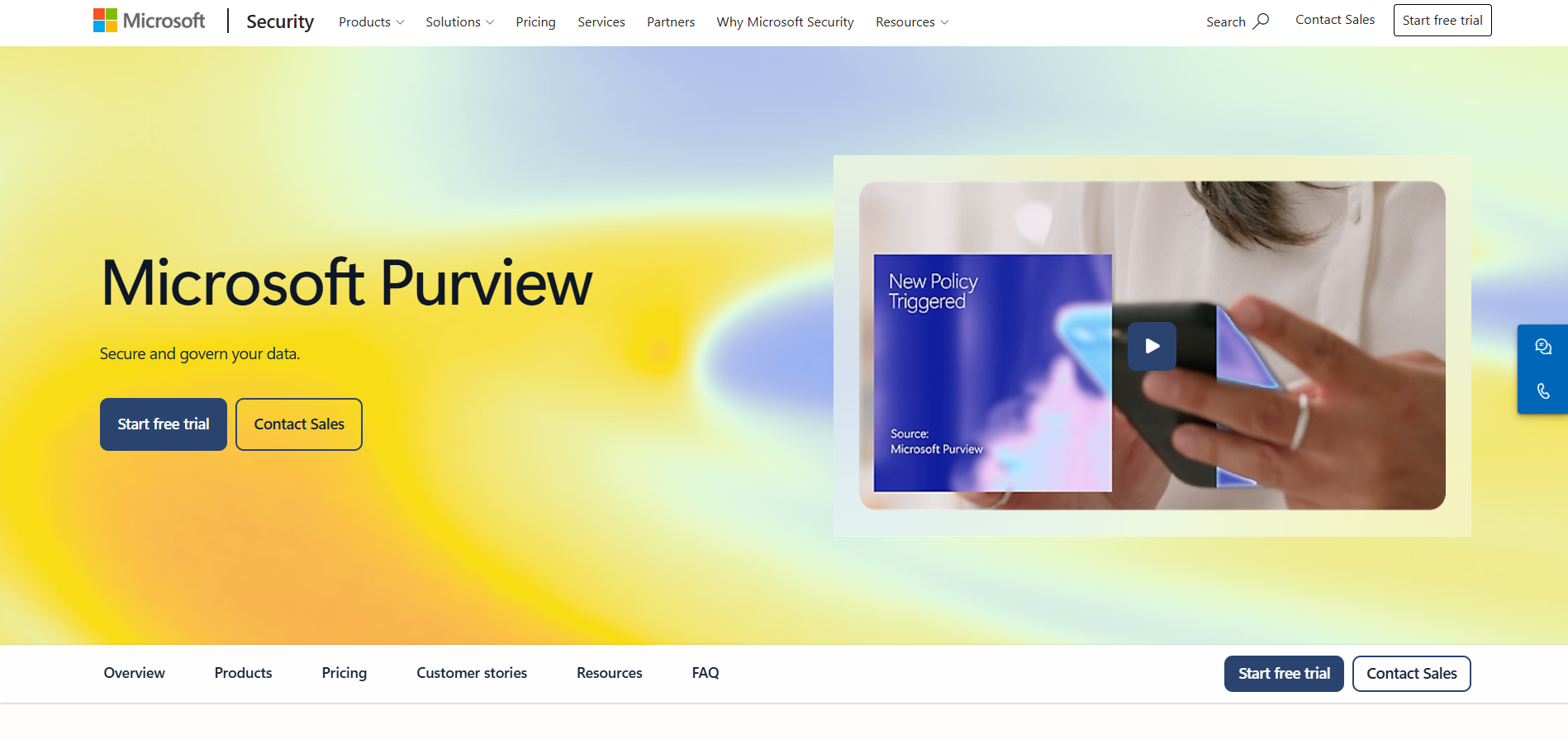
Microsoft Purview is Microsoft's native data governance service, built into Microsoft 365, Azure, and Microsoft Fabric. It combines a unified data catalog, sensitivity classification, and compliance management for organizations already standardized on the Microsoft stack.
How it handles governance across the Microsoft stack
Purview's data map and catalog span Microsoft 365, Azure, and Fabric natively, so classification, sensitivity labeling, and lineage tracking apply consistently across those services without extra connector work.
How it handles compliance and data protection
-
Compliance Manager tracks regulatory risk and gives organizations audit-ready reporting
-
Sensitivity labels and data loss prevention controls carry across Microsoft 365 apps and services
Best suited for: Organizations standardized on Microsoft 365, Azure, or Fabric that want governance built into tools they already use.
9. IBM watsonx.governance
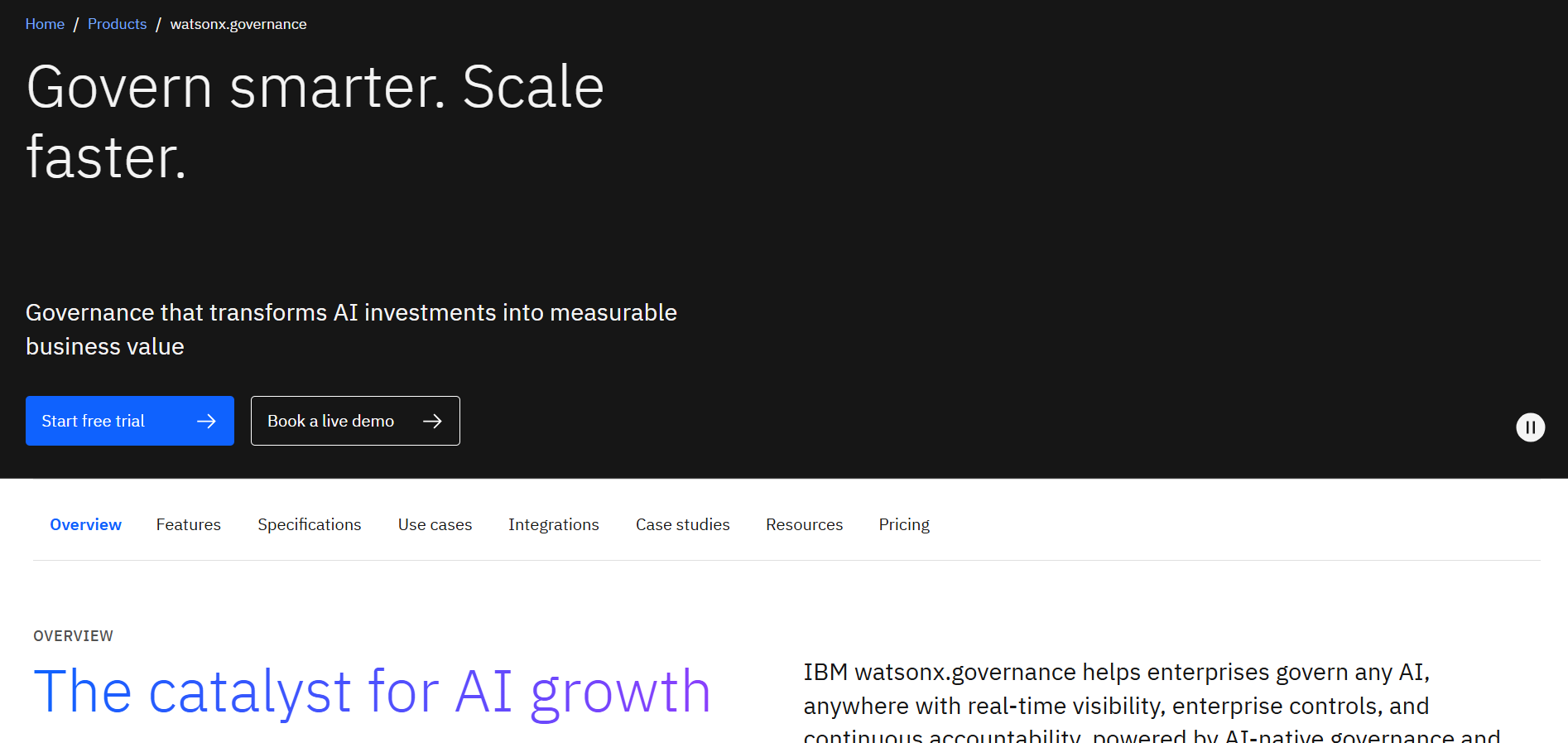
IBM watsonx.governance is IBM's AI governance offering, built to monitor machine learning and generative AI models for risk, fairness, and compliance throughout their lifecycle, alongside data governance capabilities from the broader watsonx and Knowledge Catalog ecosystem.
How it handles AI model governance
Watsonx.governance tracks model risk, fairness, and drift across the AI lifecycle, generating documentation and audit trails that help regulated organizations explain how a model reached a given decision.
How it handles data and AI governance together
-
Connects to IBM Knowledge Catalog for the underlying data cataloging and metadata management
-
Gives compliance teams a single view across both data governance and AI model governance
Best suited for: Regulated, AI-heavy organizations that need model governance and data governance managed under one umbrella.
10. Databricks Unity Catalog
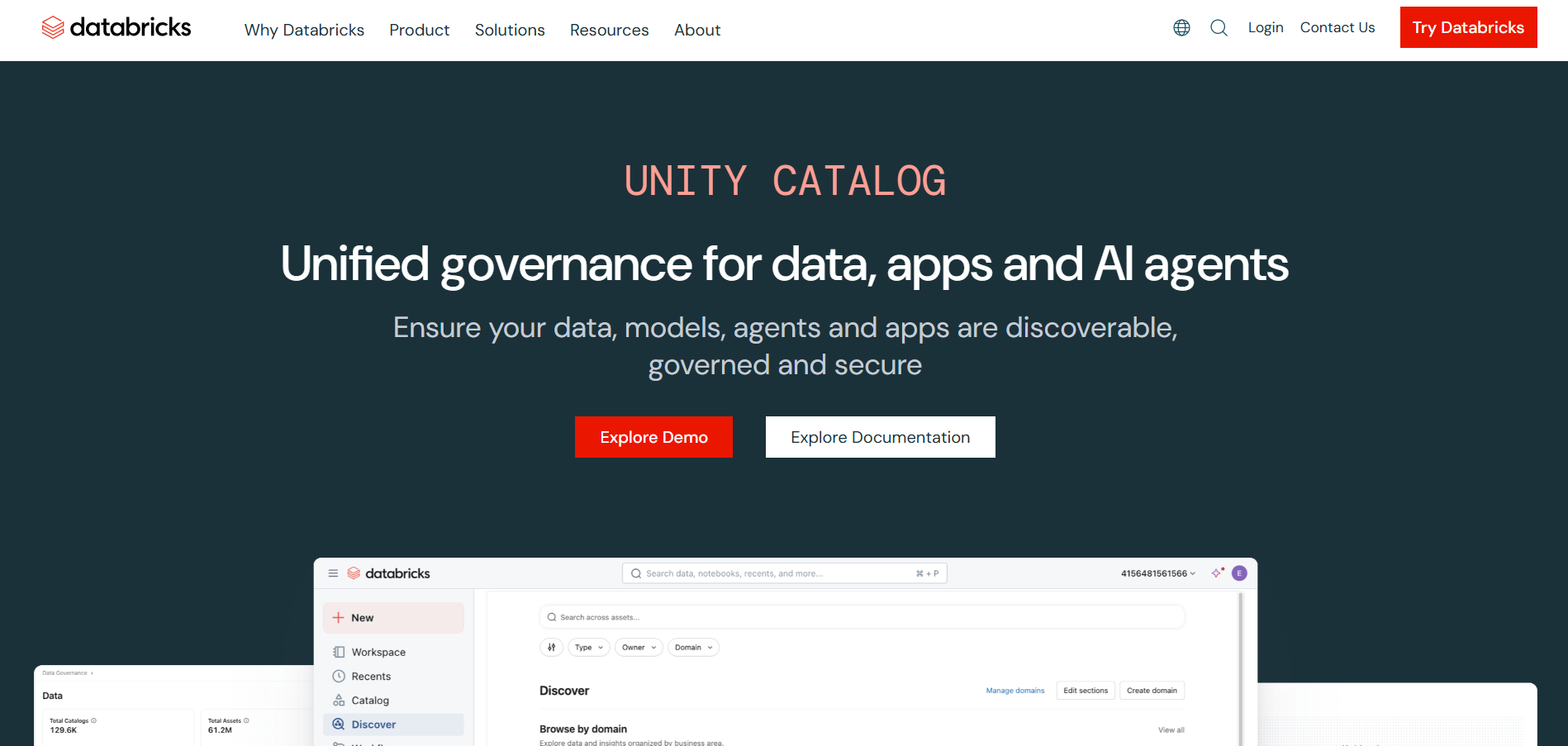
Databricks Unity Catalog is the governance layer built into the Databricks lakehouse, giving organizations a single place to manage data and AI asset permissions, lineage, and auditing across every workspace running on the platform.
How it handles governance inside the Databricks lakehouse
Unity Catalog applies a single permission model across tables, files, and machine learning models in Databricks, so access control and lineage tracking work the same way no matter which workspace or cloud a team is using.
How it fits organizations standardized on Databricks
-
Native to the Databricks platform, so no separate governance tool needs to be layered on top
-
Extends to data and AI assets together, covering both tables and ML models in one catalog
Best suited for: Organizations standardized on Databricks that want governance built directly into their lakehouse workflow.
11. Google Knowledge Catalog (formerly Dataplex)
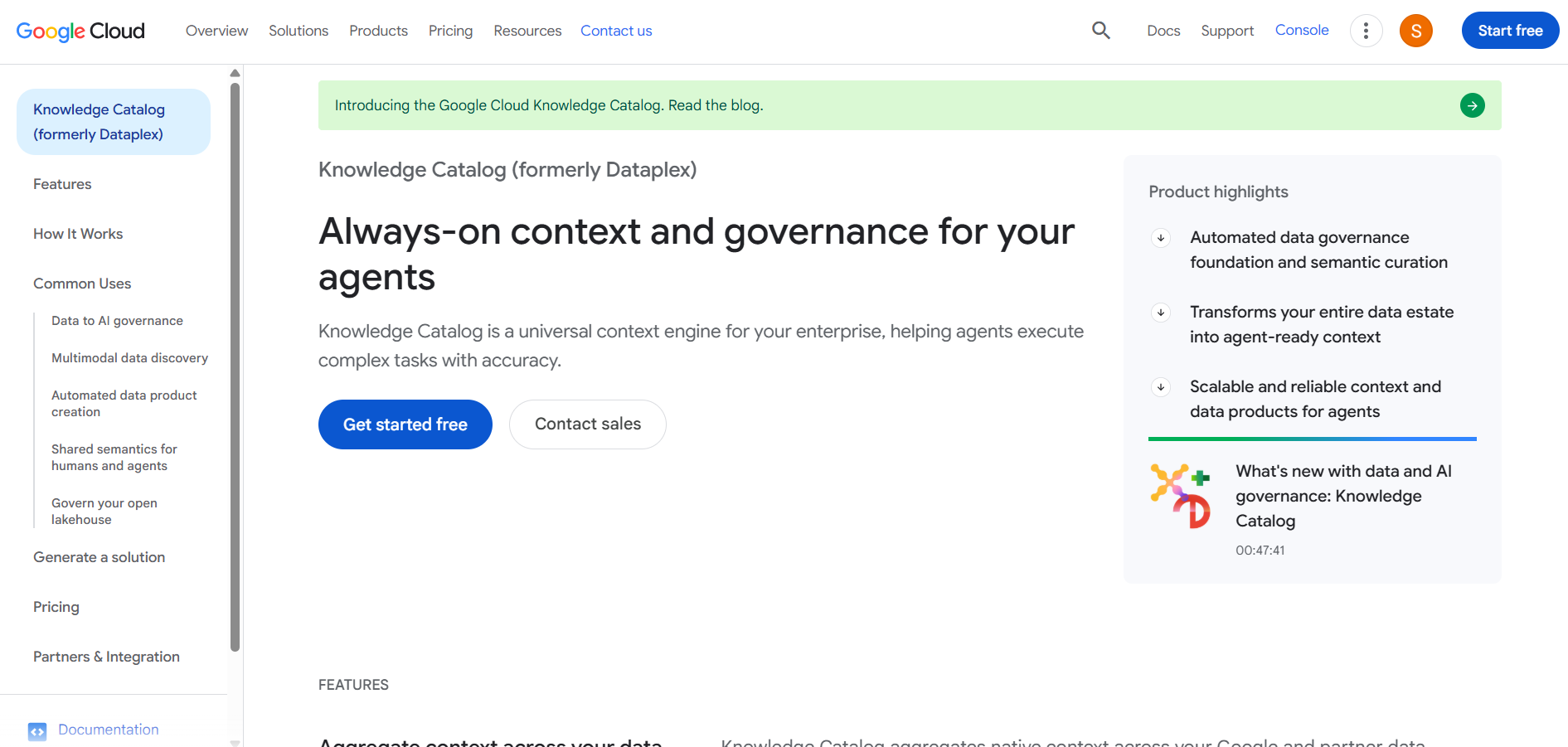
Google Knowledge Catalog (formerly Dataplex) is Google's native data governance service, unifying data across BigQuery, Cloud Storage, and BigLake under a single catalog. It automates data quality checks, lineage tracking, and metadata management for organizations built on Google Cloud.
How it handles governance across BigQuery, GCS, and BigLake
Dataplex applies unified metadata management and automated data quality checks across BigQuery, Cloud Storage, and BigLake, so teams get a consistent governance layer regardless of which Google Cloud storage service they're working from.
How it fits organizations standardized on GCP
-
Native integration with BigQuery, GCS, and BigLake, with no separate governance tool required
-
Automated lineage tracking that follows data as it moves between Google Cloud services
Best suited for: Organizations standardized on GCP that want governance built directly into their existing Google Cloud data stack.
12. Immuta
Immuta is a data access governance platform built around policy-as-code, letting organizations define access rules once and apply them automatically across cloud data warehouses. It specializes in dynamic masking and attribute-based access control at scale.
How it handles policy-as-code access control
Immuta lets teams write access policies once, as code, and apply them automatically across every connected data warehouse, so a single policy change takes effect everywhere at once.
How it handles dynamic data masking and access control
-
Dynamic data masking that adjusts what a user sees based on their role and context
-
Attribute-based access control that scales across large, distributed cloud data warehouses
Best suited for: Organizations scaling access governance across multiple cloud data warehouses that need policy consistency without manual, warehouse-by-warehouse setup.
Data governance consulting and services firms
Some of the same searches also surface systems integrators and consulting firms rather than software platforms. A few names show up consistently in this space:
-
Deloitte: Enterprise-scale governance implementation across regulated industries
-
PwC: Governance and compliance advisory tied to broader risk and audit engagements
-
Protiviti: Hands-on governance program design and execution for mid-size to large enterprises
-
Accenture: Large-scale governance and data modernization programs, often paired with cloud migration work
Platforms suit teams building and running governance in-house, while consulting firms suit teams that want an implementation partner to design and execute the program for them.
Why choose a data governance solution?
A data governance solution gives organizations a single framework to manage data, streamline workflows, and reduce the risk of costly compliance or security failures across the business.
Regulatory compliance across frameworks
Different regulations demand different governance capabilities, and the right platform covers all of them within one system.
The pressure isn't easing either. Gartner's 2026 Audit Plan Hot Spots survey found 97% of chief audit executives have compliance coverage planned for 2026, with data governance close behind at 94%.
-
GDPR: Consent tracking, data subject access requests, and the right to be forgotten, enforced through automated data discovery and deletion workflows
-
HIPAA: Role-based access and audit trails for protected health information, with encryption and masking for sensitive fields
-
SOX: Financial data lineage and change tracking that gives auditors a clear record of who touched what, and when
-
CCPA: Consumer data mapping and opt-out request handling, backed by the same discovery and classification tools used for GDPR
-
BCBS 239: Risk data aggregation and reporting accuracy for banks, supported by lineage tracking that shows exactly how a reported number was calculated
AI readiness and model governance
AI initiatives depend on governed data as their starting point. A Precisely and Drexel University 2025 data integrity survey found that 62% of organizations consider data governance a top challenge for AI initiatives, largely because ungoverned data undermines both model accuracy and compliance.
Platforms like OvalEdge tie this governance foundation directly to AI readiness through their Enterprise Context Graph, so the same governed metadata that supports compliance also supports AI agents.
OvalEdge expert insight: A Forrester Total Economic Impact study found 337% ROI for OvalEdge customers, with analyst productivity improving by up to 30%.
The Forrester Total Economic Impact study was commissioned by OvalEdge.
Data quality and lineage
Data governance tools automatically profile, cleanse, and validate data so it stays accurate and consistent. Catching duplicates, missing values, and outliers before they reach a report keeps decisions grounded in reliable numbers.
Complete, trustworthy data also cuts the time teams spend on manual cleanup, which lowers the overall cost of running analytics.
Access control and risk reduction
Governance platforms centralize access by defining clear roles for who can see, use, or modify specific data.
Role-based access control and attribute-based access control let organizations restrict sensitive information to authorized users while still making everyday data easy to find. Encryption, data masking, and defined retention policies add further protection during storage and transmission.
Together, these controls reduce the risk of breaches, cut down on human error, and give teams a clear audit trail when something needs to be reviewed.
Criteria to evaluate data governance solutions
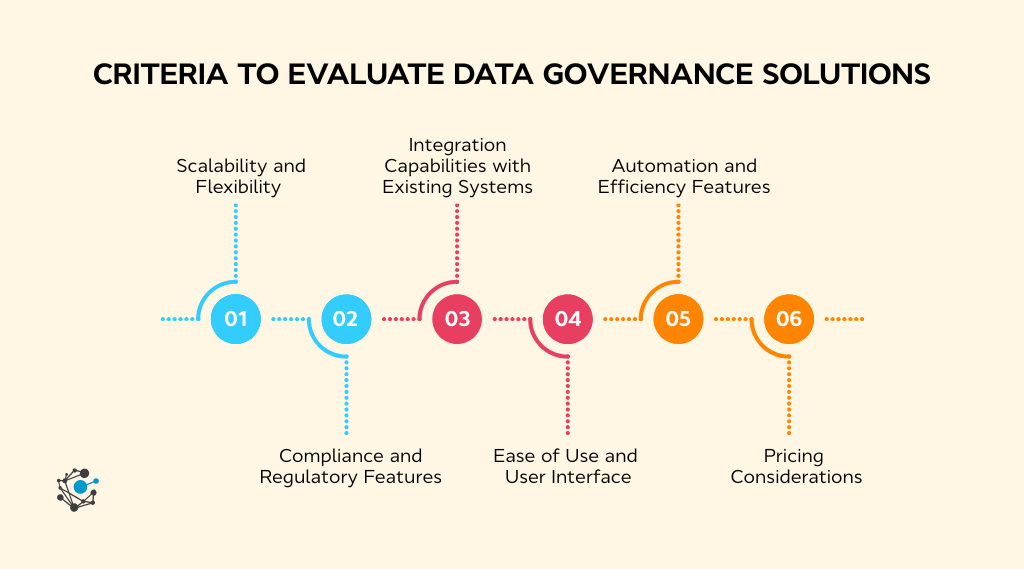
Choosing the right data governance solution comes down to six factors that determine whether it actually fits the business, scales with it, and meets regulatory requirements.
1. Scalability and flexibility
The platform needs to handle data volume growth without a re-architecture, and it needs to support cloud, hybrid, and on-premises deployments as the stack evolves.
-
Green flag: Horizontal scaling, broad connector coverage across cloud and on-premises, published performance benchmarks at enterprise scale
-
Red flag: A single deployment model, a thin connector list, or no reference customers past the terabyte range
2. Compliance and regulatory features
Built-in compliance capabilities run continuously, generating audit trails, compliance reporting, and regulatory monitoring for GDPR, CCPA, and HIPAA without needing to be assembled fresh for each audit.
-
Green flag: Automated audit trails, one-click compliance reporting, and a track record of adding new regulations to the platform quickly
-
Red flag: Manual audit prep, compliance reports that require IT involvement, or no stated process for regulatory updates
3. Integration capabilities with existing systems
A governance platform needs to integrate with existing databases, analytics tools, and cloud platforms without major disruption to become a cohesive part of the data management strategy already in place.
-
Green flag: Pre-built connectors for common databases and cloud platforms, and support for both cloud-first and hybrid models
-
Red flag: Custom integration work required for common systems, or a connector list that skews heavily toward one cloud provider
4. Ease of use and user interface
An intuitive interface that both technical and non-technical users can navigate drives adoption across data engineering, analytics, and compliance teams without requiring deep technical expertise from every user.
-
Green flag: A UI that non-technical stakeholders can use without training, and adoption metrics shared publicly by the vendor
-
Red flag: A steep learning curve that limits usage to a data team, or features that only work through scripting or code
5. Automation and efficiency features
Automation reduces reliance on manual processes for classification, policy enforcement, and quality checks, keeping compliance maintained continuously and freeing teams for higher-value work like analysis and strategy.
-
Green flag: Automated classification and policy enforcement running on a schedule, with clear logs of what changed and when
-
Red flag: Automation limited to alerts without any automated action, or workflows that still require manual sign-off for routine tasks
6. Pricing considerations
Pricing varies by user count, data volume, and feature tier, with some vendors offering subscription models and others tiering by organization size, so total cost includes more than the sticker price.
-
Green flag: Transparent, published pricing tiers and a clear breakdown of what counts as an add-on cost
-
Red flag: Pricing available only through a sales call, or hidden costs for integration, training, and ongoing support that surface after signing
A strong data governance solution scores well across all six: it scales without a re-architecture, meets compliance requirements out of the box, integrates cleanly with existing systems, stays usable for non-technical teams, automates routine governance work, and prices transparently.
OvalEdge expert insight: OvalEdge connects to 160+ data sources out of the box, covering cloud warehouses, BI tools, and on-premises databases, so governance rolls out across the existing stack without custom integration work.
Also read: Roles, structure, and hierarchy of a data governance committee
How to choose the right data governance company
Picking the right platform comes down to three things:
-
What's already running in the stack
-
How much regulatory weight the organization carries
-
Where the AI roadmap is headed
Most shortlists narrow fast once these questions are answered honestly.
Start with stack fit. A single-cloud environment usually already has a governance layer close at hand:
-
Microsoft Purview for Azure and Microsoft 365 environments
-
Unity Catalog for Databricks lakehouses
-
Dataplex for BigQuery and Google Cloud pipelines
A mixed stack spanning multiple clouds, warehouses, and BI tools calls for a platform built for that breadth from day one. OvalEdge, Collibra, Informatica, and Atlan are the names that come up most often here.
Next, factor in regulatory pressure. Banking, insurance, healthcare, and other heavily audited industries need policy automation, lineage, and audit trails that hold up under external review, not just internal reporting.
-
Collibra and Informatica have the longest track record in these environments.
-
OvalEdge and Ataccama bring the same audit-readiness with a lighter deployment footprint, which matters for teams without a large data engineering bench to run it.
OvalEdge expert insight: Organizations using OvalEdge's Enterprise Context Graph report that the same governed metadata powering compliance also feeds their AI agents, cutting the time between governance rollout and first AI use case from months to weeks.
Finally, weigh the AI roadmap. Organizations rolling out AI agents, copilots, or RAG-based tools need governance that extends past static metadata into how context gets accessed, validated, and reused in real time.
The payoff for getting this right is measurable. Gartner's most recent survey of data and AI leaders found organizations with successful AI initiatives invest up to 4 times more, as a share of revenue, in foundational areas like data quality and governance than those with poor AI outcomes.
This is where platforms are starting to pull apart from each other fastest, so it's worth testing any shortlist candidate against a real AI use case rather than a generic demo.
These three axes rarely point in one direction. A team under strict compliance with a fast-moving AI roadmap needs to weight both instead of picking one.
Finding the platform that fits
Data governance is the foundation AI initiatives need to work safely at scale. The 12 platforms above cover different priorities, from Microsoft-native governance to lakehouse-first control, but few combine deep governance with a context layer built for AI agents.
OvalEdge does both. Its Enterprise Context Graph connects governed metadata, lineage, and business context into one working system that data teams and AI agents can query together.
Book a demo with OvalEdge and see how it fits an existing data stack and where it can speed up AI readiness.
.png?width=1081&height=173&name=Forrester%201%20(1).png)
.png?width=1081&height=241&name=KC%20-%20Logo%201%20(1).png)