Data governance often breaks down at the point where responsibility becomes unclear. Finance may define a metric one way, marketing another, while compliance expects both teams to follow consistent controls. Without clear ownership and decision rights, these differences create reporting conflicts, compliance risks, and declining trust in data.
ConversationalGeek’s 2026 Data Governance & Data Analytics Statistics show that only 23% of organizations maintain a formal data governance process with clear roles and accountability, despite governance being widely discussed at the senior leadership level.
That gap shows why governance needs an operational decision-making structure.
A data governance committee provides that structure by bringing business, IT, data, security, and compliance stakeholders together to establish standards, assign ownership, resolve disputes, and enforce accountability. This guide explains its roles, structure, hierarchy, charter, and the steps required to build an effective committee.
What is a data governance committee?
A data governance committee is a cross-functional group responsible for overseeing how data is defined, accessed, protected, and used across an organization. It ensures that data policies and standards align with business strategy, resolves conflicts around data ownership and quality, and enforces accountability for critical data assets.
In simple terms, this committee is the decision-making body that turns scattered data efforts into a unified, governed program.
Here's what it does, at a glance:
-
Purpose: Align data policies with business goals, enforce standards, and resolve disputes across departments.
-
Scope: Covers data quality, metadata, privacy, access controls, and regulatory compliance.
-
Who's involved: Includes leaders from business, IT, security, legal, compliance, and data management functions.
These committees act as the "human glue" between systems and stakeholders, enabling data governance to scale without becoming a bottleneck. They don't just write rules; they help teams follow them consistently.
As your company grows and your data becomes more complex, the need for this kind of coordinated oversight grows too. A data governance committee ensures that no matter who touches the data, everyone is speaking the same language and playing by the same rules.
Why organizations need a data governance committee
Data is often called the "new oil," but without governance, it's more like a spill; valuable but chaotic, difficult to control, and potentially damaging. As organizations scale, the problems tied to mismanaged data grow exponentially: inconsistent reports, compliance risks, operational inefficiencies, and eroding trust in analytics.
When there's no central body to adjudicate definitions, policies, and priorities, data becomes siloed, redundant, and unreliable.
The core problems that arise without a committee:
-
Siloed definitions: Finance defines "active customer" one way, while marketing defines it another way.
-
Unresolved disputes: No clear escalation path when two departments disagree on metrics or access.
-
Compliance gaps: Regulatory requirements like GDPR or HIPAA get missed because no team owns full accountability.
-
Slowed decisions: Teams waste time reconciling data instead of acting on it.
Case study: Delta Community Credit Union
Delta Community Credit Union (DCCU) faced inconsistent data definitions across departments, including differences in how teams defined key terms such as "member."
DCCU established a cross-functional data governance committee involving business, compliance, and IT leaders. Using OvalEdge, it centralized metadata, developed a business glossary, and assigned stewardship roles across functions, creating clearer ownership and more consistent definitions.
Data governance committee vs. steering committee vs. council
Many organizations use data governance committee, steering committee, and council interchangeably, but each operates at a different level. The council sets strategy, the steering committee prioritizes initiatives and resources, and the governance committee handles operational standards and issue resolution. Understanding these distinctions prevents overlapping responsibilities and gaps in accountability.
Let's clarify what each does and where it fits in the governance hierarchy.
|
Governance Body |
Data Governance Council / Board |
Data Governance Steering Committee |
Data Governance Committee |
|
Primary Function |
Strategic leadership & policy setting |
Executive oversight & prioritization |
Operational governance & issue resolution |
|
Decision Level |
Strategic (Board/C-suite) |
Executive (Cross-functional) |
Tactical (Cross-functional & domain) |
|
Key Responsibilities |
Defines data governance vision, principles, and enterprise policies. Approves governance frameworks and ensures alignment with corporate strategy. |
Provides guidance, allocates funding, resolves escalated issues, and ensures governance initiatives align with business priorities. |
Implements governance standards, resolves data definition conflicts, reviews policies, and enforces accountability across domains. |
|
Typical Members |
Chief Data Officer, CIO, Chief Risk Officer, Legal/Compliance Head, Business Executives |
Senior business and IT leaders, data executives, and key stakeholders from major functions |
Data stewards, domain leads, IT/data architects, compliance officers, analysts |
Where the committee sits in your data governance organizational structure
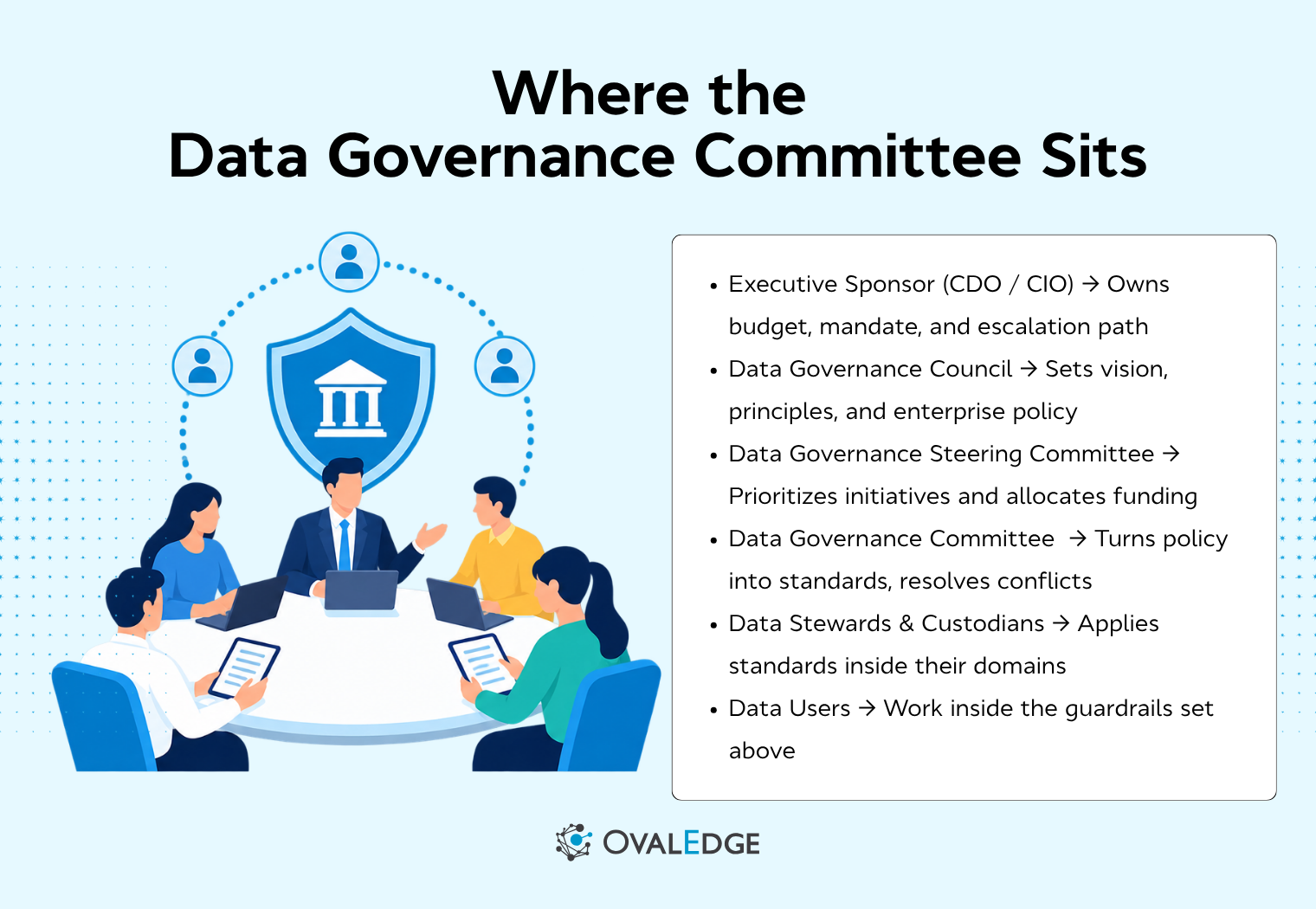
A data governance committee typically sits between strategic governance leadership and the teams responsible for day-to-day data management. A common hierarchy looks like this:
-
Executive sponsor (CDO or CIO): Provides authority, budget, and executive support.
-
Data governance council or board: Sets governance vision, principles, and enterprise policies.
-
Data governance steering committee: Prioritizes initiatives and allocates resources.
-
Data governance committee: Turns policies into standards, resolves issues, and enforces accountability.
-
Data stewards and custodians: Apply governance standards within individual data domains.
-
Data users: Work with data within established governance policies and controls.
Not every organization needs all six layers. Smaller organizations may combine the council and steering committee or have the executive sponsor chair the council. The priority is to maintain clear ownership, decision rights, and escalation paths across the governance structure.
Structure & membership: who should sit on the committee?
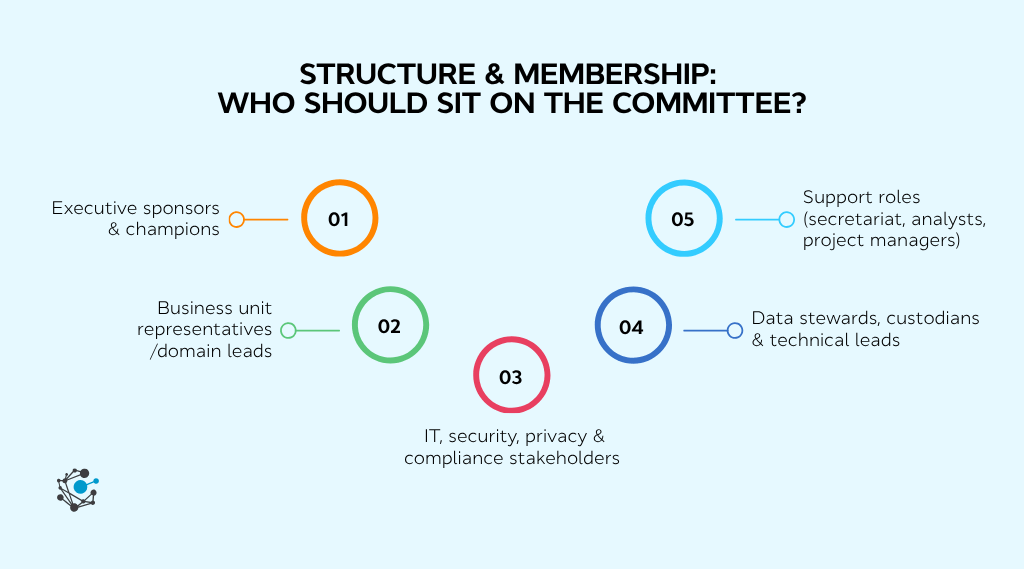
A data governance committee needs three types of participants: leaders with decision-making authority, business experts who understand how data is used, and technical stakeholders who can implement governance decisions.
1. Executive sponsors & champions
A senior executive, typically the Chief Data Officer or CIO, provides authority, budget, and organizational support. The sponsor also serves as an escalation point when governance decisions require executive intervention.
2. Business unit representatives/domain leads
Include leaders from core functions such as finance, sales, marketing, operations, and HR. They bring domain knowledge, define business requirements, and ensure governance policies work in practice.
3. IT, security, privacy & compliance stakeholders
Data architects, security leaders, privacy counsel, and compliance officers ensure governance decisions are technically feasible and meet regulatory and security requirements.
4. Data stewards, custodians & technical leads
Data stewards manage definitions, quality standards, metadata, and business rules within their domains, as covered in our guide to data stewardship. Data custodians and technical leads handle infrastructure, access controls, implementation, and the technical processes required to apply governance decisions.
5. Support roles (secretariat, analysts, project managers)
Secretariat staff, analysts, or project managers coordinate meetings, document decisions, track action items, and maintain governance metrics. They typically support operations rather than hold voting authority.
Roles & responsibilities of a data governance committee
The committee turns governance strategy into enforceable decisions across the organization. Its core responsibilities include:
-
Setting and approving data policies and standards: Establish naming conventions, data quality thresholds, access rules, classification requirements, and other elements of a formal data governance policy.
-
Resolving cross-domain data issues: Decide ownership, definition, quality, or data access disputes that cannot be resolved within individual domains. The committee should define when issues escalate, who has final authority, and how decisions are documented.
-
Prioritizing data initiatives: Determine which governance, data quality, and metadata initiatives require attention and resources.
-
Reviewing technology decisions: Assess new data tools and architecture proposals for alignment with governance requirements.
-
Ensuring regulatory alignment: Oversee how data practices support GDPR, HIPAA, CCPA, SOX, and relevant industry requirements.
Escalation paths and final decision rights should be documented in the committee charter so disputes follow a consistent process.
Charter & governance documents
A data governance committee needs a formal charter to establish its authority and operating rules. The charter should define why the committee exists, what falls within its scope, who has decision-making authority, and how decisions are made and reviewed.
At minimum, a strong data governance committee charter should cover:
-
Purpose and scope: Define the committee's mission, business objectives, and the data domains it governs, such as master data, metadata, analytics assets, and regulated data.
-
Decision rights: Establish who is responsible, accountable, consulted, and informed for policy approval, exceptions, data quality standards, and stewardship assignments. RACI or DACI can formalize these responsibilities.
-
Operating model: Specify meeting frequency, standing agenda items, quorum requirements, voting rules, and escalation procedures.
-
Review process: Set a regular schedule for reviewing and amending the charter as business priorities, systems, and regulatory requirements change.
Example: a one-page data governance committee charter
A practical charter can be kept to one page:
-
Purpose: Oversee how data is defined, protected, governed, and used in line with business and regulatory requirements.
-
Scope: Master data, metadata standards, reporting and analytics assets, and regulated or personally identifiable information.
-
Responsibilities: Approve policies and standards, resolve escalated ownership and access issues, assign stewards, and review data quality and compliance metrics.
-
Composition: Chief Data Officer as chair, representatives from core business units, IT or data architecture leadership, and legal or compliance advisors.
-
Decision rights: Use a RACI model for policy approval, exceptions, stewardship assignments, and other governance decisions.
-
Meetings: Meet monthly with a standing agenda for unresolved issues, policy changes, and governance metrics. Define quorum and voting requirements in advance.
-
Review: Review the charter annually and establish a voting threshold for amendments.
-
Approval: Record approval from the committee chair and executive sponsor, along with the effective date.
The charter should match the organization's size, governance maturity, and regulatory exposure. Smaller organizations can use a lightweight model, while large or highly regulated enterprises may require more formal decision rights and operating procedures.
Tool spotlight: how platforms like OvalEdge empower governance committees
Governance committees define the rules, but to execute them effectively, teams need the right platform. OvalEdge is a purpose-built data governance platform that helps organizations:
-
Build and customize governance frameworks based on business context
-
Curate data catalogs using smart scoping methods (consumption-led, CDE-led, or consolidation-led)
-
Automate workflows for data quality, access approvals, and policy enforcement
-
Enable secure data consumption and in-platform collaboration across business and IT.
With integrations to tools like Jira, ServiceNow, and Power BI, OvalEdge ensures your governance policies don't just live in documents; they're applied in real time across systems.

 Book a demo now to see how you can implement it.
How to set up a data governance committee: step-by-step
If you're dealing with conflicting reports, regulatory pressure, or data ownership confusion, setting up a data governance committee isn't just a good idea; it's essential. But jumping into governance without a plan often leads to stalled progress.
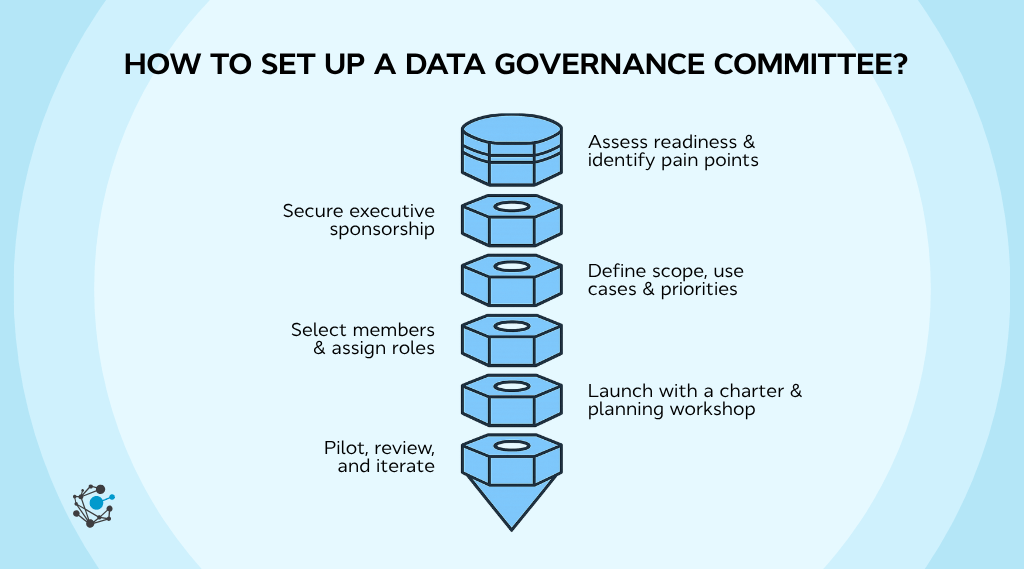
Here's how to do it right, from zero to rollout.
1. Assess readiness & identify pain points
Start by evaluating where your organization struggles with data. Are departments working in silos? Are definitions inconsistent? Are audit requests painful? Run a quick gap analysis across:
-
Data quality (completeness, consistency)
-
Ownership (who's responsible for what?)
-
Compliance risks (are you audit-ready?)
-
Decision-making delays caused by unclear data
Highlight concrete examples that leadership can't ignore. This forms the foundation of your business case.
2. Secure executive sponsorship
Data governance needs air cover. Approach your CDO, CIO, CFO, or other senior sponsor with a focused message: the cost of poor data is real, such as rework, fines, revenue loss, and reputational risk. Use examples from your own org or from research.
Once leadership is aligned, secure:
-
Budget for staffing and tooling
-
Executive time and visibility
-
Endorsement to enforce policies
3. Define scope, use cases & priorities
Avoid boiling the ocean. Start with a defined scope, like customer master data or data privacy compliance. Select use cases with high visibility or high risk.
Clarify:
-
What domains or processes will the committee govern?
-
Initial goals and metrics for success
-
Policy or compliance areas to prioritize (e.g., HIPAA, GDPR)
4. Select members & assign roles
Build a team with representation from across the business, IT, security, and compliance. Be strategic, include people with:
-
Domain knowledge
-
Influence to drive adoption
-
Bandwidth to participate
Assign key roles:
-
Chairperson to lead and escalate decisions
-
Secretary or PM to run operations and documentation
-
Data stewards and custodians for hands-on execution
Map out responsibilities using a RACI/DACI model as discussed in the charter section.
5. Launch with a charter & planning workshop
Organize a kickoff session to:
-
Review the charter and purpose
-
Align expectations and escalation paths.
-
Prioritize first-quarter goals
-
Set cadence and agenda for meetings.
This is your opportunity to create early buy-in and clarity. Capture all decisions and share them widely.
6. Pilot, review, and iterate
Don't try to scale instantly. Run a pilot for 1–2 quarters:
-
Choose a manageable scope
-
Track metrics like data quality or time to resolve issues
-
Solicit feedback from committee members and domain teams
Refine your operating model by adjusting cadence, membership, or charter rules based on what's working (and what's not).
The most successful committees are those that evolve. They start small, learn quickly, and then scale intentionally.
Measuring success: KPIs & metrics for a committee
You can't manage what you don't measure. Once your data governance committee is in motion, it's critical to track the right metrics to continuously improve its performance and show value to the business.
Here are the most meaningful ways to measure success.
1. Adoption & compliance rates
Are teams actually using the policies and standards your committee sets?
Key indicators include:
-
Percentage of data domains with assigned data stewards
-
Adoption rate of approved standards and policies
-
Usage of metadata management tools across departments
Tracking adoption gives you a sense of how well governance is embedded into daily workflows, not just documented in slide decks.
2. Policy exceptions & escalation trends
If everything's being escalated, your model may be too rigid. If nothing is escalated, there may be hidden resistance or a lack of usage.
Track:
-
Number of policy exceptions filed per quarter
-
Frequency of escalations to the committee
-
Average time to resolve escalations
The goal is a decreasing trend over time, indicating that standards are clear and disputes are being resolved at the domain level.
3. Data quality improvements
This is where you begin to show business impact. Work with data teams to track improvements in:
-
Completeness: Are key fields being populated more consistently?
-
Consistency: Are definitions aligned across systems?
-
Accuracy: Are there fewer errors in reporting or audit logs?
If your committee's work results in cleaner, more reliable data, that's a major win.
4. Decision & resolution velocity
Lastly, track how efficiently the committee is functioning.
Key metrics:
-
Average time to approve a new policy or data standard
-
Time from issue escalation to resolution
-
Meeting attendance and quorum rates
These numbers help spot bottlenecks in governance processes, and show leadership that the committee isn't just ceremonial; it's operational.
Conclusion
Most organizations already have enough data. What they lack is agreement on what a number means, who owns it, and what happens when two departments disagree. Dashboards and warehouses cannot fix that alone. Without a governing body behind them, they only make the disagreement visible faster.
A data governance committee builds and enforces that agreement, turning a charter and a RACI matrix from documents nobody reads into decisions that stick and an escalation path people actually use.
None of it works without executive sponsorship. A committee without budget, authority, and a leadership mandate becomes another meeting nobody prioritizes. Pair the structure with real backing, and the payoff shows up in cleaner audits and decisions your teams can stand behind.
The real test is whether decisions get enforced. Build one that passes it.
Ready to put your committee's decisions into practice?

Charters and RACI matrices only work if they're enforced. See how OvalEdge turns committee-approved policies into active workflows, ownership assignments, and access rules across your data estate.

 Book a data governance demo.
.png?width=1081&height=173&name=Forrester%201%20(1).png)
.png?width=1081&height=241&name=KC%20-%20Logo%201%20(1).png)