-Jan-27-2026-10-57-05-9098-AM.png)
Few problems slow a business down faster than not trusting its own data. You may have dashboards, reports, and analytics tools, but if the underlying data is inconsistent, unsecured, or unusable, decision-making grinds to a halt.
Data governance best practices give structure to what otherwise becomes chaos. They define how data is collected, classified, protected, and used across your organization. A mature governance framework ensures that data is not only accurate and secure but also accessible to the right people at the right time.
In fact, 57% of organizations now prioritize data governance to improve data integrity, reflecting rising emphasis on governance for AI readiness, privacy, and compliance.
In this guide, we’ll explore actionable best practices for data governance, focusing on how to align governance strategies with your business goals, ensure compliance, and reduce risks. And for teams seeking a practical way to operationalize these practices, we'll explore how solutions like OvalEdge can help streamline governance.
Why does data governance matter?
Data governance best practices ensure the secure, compliant, and efficient management of data across organizations. These practices involve establishing clear frameworks, policies, and roles to maintain data quality, integrity, and privacy.
Key components include implementing robust security measures, ensuring regulatory compliance (e.g., GDPR, CCPA), and leveraging automation tools to streamline processes.
Effective data governance also focuses on risk management, transparency, and collaboration among stakeholders. By adhering to best practices, organizations can reduce data-related risks and improve decision-making, ensuring that data remains a valuable and protected asset.
Without proper governance, data can quickly become unreliable, untrustworthy, and even hazardous. Data governance is the strategic approach that ensures your organization’s data is accurate, accessible, secure, and compliant.
Here’s why it’s crucial:
-
Trust and accuracy: Data governance ensures that the data you use is accurate and consistent, which is essential for making informed decisions. Trustworthy data empowers employees, management, and teams to make choices based on facts, not assumptions.
-
Regulatory compliance: Compliance with data privacy laws like GDPR, CCPA, and HIPAA is non-negotiable. Proper governance frameworks keep your data practices in line with regulations, helping you avoid costly fines and legal issues.
-
Risk mitigation: Without governance, organizations expose themselves to data breaches, inaccuracies, and operational inefficiencies. Data governance reduces these risks by enforcing policies and security protocols, protecting your organization from costly mistakes.
-
Enhanced decision-making: When your data is well-governed, decision-makers can trust it to drive strategy and growth. Clear, accessible data helps uncover insights that can guide your business forward.
-
Collaboration and efficiency: Good governance practices encourage transparency and collaboration across teams. When everyone is on the same page regarding data ownership, access, and standards, operations run smoothly, and problems are solved more efficiently.
By implementing robust data governance practices, you ensure that your data is a reliable asset, enhancing operational efficiency and minimizing risk across your organization.
|
Stat: According to A-LIGN's 2025 Compliance Benchmark Report, 81% of organizations in 2025 report current or planned ISO 27001 certification, illustrating increased investment in security frameworks tied to governance. |
Core principles & pillars of effective data governance
To build a comprehensive data governance strategy, it’s essential to understand the core principles and pillars that form the backbone of any effective program.
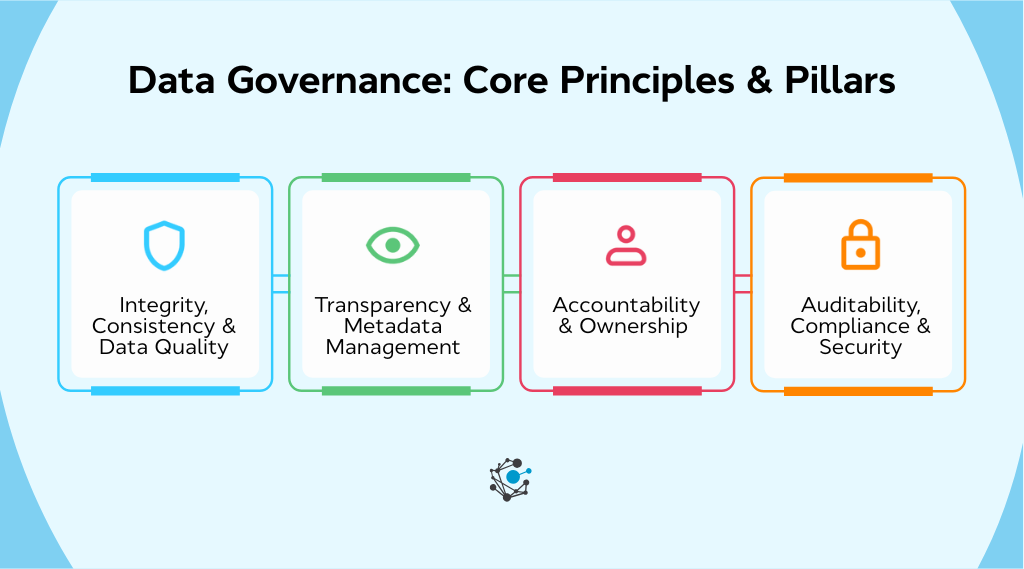
Integrity, consistency & data quality
The cornerstone of data governance is ensuring the integrity and consistency of your data. Data must be accurate, reliable, and complete to make informed business decisions. By establishing data quality frameworks, such as data validation rules and quality monitoring, organizations can enhance the trustworthiness of their data.
For instance, a healthcare provider may implement a data stewardship program to ensure the integrity of patient records, which is critical for delivering quality care. With proper governance, businesses can avoid costly errors, improve operational efficiency, and enhance customer satisfaction.
Transparency & metadata management
Transparency is key to building trust in your data. By maintaining comprehensive metadata, including data lineage and business glossaries, organizations can track the origin and flow of data across systems. A well-maintained data catalog helps users easily access and understand the data, improving data discoverability and fostering organizational alignment.
Data catalogs and metadata management tools, like OvalEdge, support governance efforts by providing a clear view of how data flows and is used, ensuring compliance with internal and external policies.
Accountability & ownership
Accountability drives the success of data governance. Clearly defined roles and responsibilities, such as data stewards and data owners, ensure proper management and oversight of data. Data stewards play a crucial role in implementing data quality standards and ensuring data integrity. By assigning ownership to specific individuals or teams, organizations can drive accountability and improve the sustainability of their governance program.
For example, a large retailer might assign data ownership to department heads who oversee the quality and security of their respective datasets. This approach ensures that each team is responsible for maintaining high-quality, secure data.
Auditability, compliance & security
Effective governance frameworks enable auditability, ensuring that data management processes can be traced and monitored. Implementing access logs, audit trails, and data lineage documentation helps organizations comply with regulations like GDPR. Security is also a critical pillar of governance. Access controls and encryption are essential to safeguarding sensitive data.
For example, a financial institution might implement strict access control mechanisms to comply with industry regulations and prevent unauthorized access to customer data. Audit trails and policies ensure that any changes to the data are tracked and can be reviewed in case of discrepancies or compliance audits.
|
Fun fact: Regulatory compliance isn’t just about avoiding fines! According to a 2025 C-suite survey, 77% of global C‑suite leaders say compliance contributes significantly or moderately to overall business objectives, driving growth, trust, and operational stability. |
Once these principles are clear, the next challenge is turning them into repeatable processes that teams can actually follow every day.
Book a demo with OvalEdge to explore how governance can be operationalized without adding unnecessary complexity
Data governance best practices: A strategic approach
To successfully implement data governance, businesses must adopt a strategic approach. Here are the key best practices for building an effective data governance program.
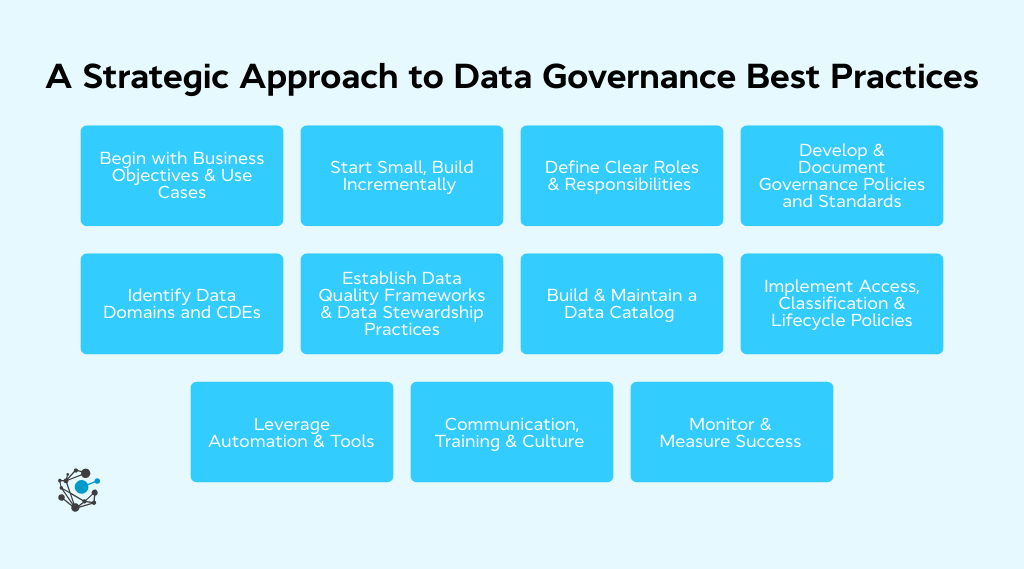
1. Begin with business objectives & use cases
Data governance should always align with your organization’s broader business objectives. Start by identifying key use cases where governance can drive tangible value. Whether it's improving customer insights, ensuring regulatory compliance, or enhancing operational efficiency, aligning your governance strategy with business goals will help prioritize your efforts and demonstrate the direct impact of data governance on organizational success.
-
Business alignment: Ensure that governance efforts address critical business needs like data-driven decision-making or risk management.
-
Identify use cases: Focus on areas where governance can solve problems, such as managing customer data for marketing or ensuring compliance for financial records.
2. Start small, build incrementally
Data governance doesn’t need to be overwhelming. Start small by piloting governance initiatives for critical datasets or specific departments. Over time, you can scale the governance framework to cover more data domains and business functions. This approach allows for faster implementation and easier adoption across the organization.
For example, a company might begin with governance around financial data before expanding to include customer data or operational data. This incremental approach ensures a manageable, sustainable rollout of governance practices.
3. Define clear roles & responsibilities
Establishing a clear governance operating model is essential for ensuring accountability and ownership. Clearly define roles such as data owners, data stewards, and governance boards. This clarity ensures that all data-related responsibilities are assigned and understood, enabling more efficient decision-making and adherence to governance policies.
-
Centralized vs. decentralized: Choose a governance model that best fits your organization’s structure, such as centralized, decentralized, or hybrid, to ensure that roles and responsibilities are distributed effectively.
-
Role clarity: Data stewards manage data quality, while data owners oversee access control and compliance, ensuring that everyone knows their specific responsibilities.
4. Develop & document governance policies and standards
Create documented policies and standards that cover data quality, access, lifecycle, usage, and classification. These policies ensure that data is consistently managed and secured across the organization. Governance policy templates can help streamline this process, providing a foundation for establishing clear, actionable guidelines.
5. Identify data domains and critical data elements (CDEs)
Identify and prioritize data domains and critical data elements (CDEs) based on their value and risk. This targeted approach allows organizations to focus their efforts on managing and securing the most important data. For example, a pharmaceutical company might prioritize governance efforts around clinical trial data, as it directly impacts patient safety and regulatory compliance.
6. Establish data quality frameworks & data stewardship practices
Data quality is the cornerstone of effective data governance. Establish a framework for monitoring and improving data quality across your organization. Assign data stewards to take responsibility for maintaining high standards and addressing any quality issues. These practices ensure that your data is accurate, complete, and fit for purpose.
-
Data Stewardship: Assign data stewards to monitor and improve data quality within their specific domain, ensuring adherence to quality standards.
-
Ongoing Monitoring: Implement regular data quality checks and audits to ensure that data remains accurate, complete, and consistent.
7. Build & maintain a data catalog
A data catalog is essential for improving the discoverability and alignment of data across the organization. It acts as a central repository that provides a clear overview of the data assets available, including metadata, definitions, and usage guidelines.
By maintaining a well-organized data catalog, businesses ensure that all stakeholders can easily access accurate and standardized data, which reduces confusion and promotes consistent decision-making. It also helps with data governance by providing visibility into data ownership and lineage.
8. Implement access, classification & lifecycle policies
Data governance is about controlling who has access to what data and ensuring that it is handled appropriately throughout its lifecycle. Implementing access control, classification policies, and data lifecycle management protocols helps secure sensitive data and ensures that data is only accessible to authorized personnel.
9. Leverage automation & tools
Automating data governance processes can significantly reduce the manual effort involved in managing and enforcing policies. Automation tools for data cataloging, compliance monitoring, and security enforcement help streamline workflows and ensure consistent application of governance rules across the organization.
-
Automated workflows: Reduce the risk of human error by automating repetitive tasks such as data classification, access reviews, and compliance audits.
-
Enforcement tools: Leverage automated tools to enforce governance policies in real-time, ensuring compliance with minimal intervention.
10. Communication, training & culture
Data governance is not just about implementing policies and tools; it’s also about fostering a data-driven culture within the organization. Effective communication and training programs are essential for ensuring that everyone understands their role in governance and is equipped to follow best practices. Regular training sessions, workshops, and clear internal communications help drive awareness and adoption of governance initiatives.
11. Monitor & measure success
To ensure the effectiveness of your data governance program, it’s crucial to monitor and measure its success continuously. Establishing KPIs (Key Performance Indicators) helps assess whether data governance efforts are meeting organizational goals and objectives. These KPIs should track aspects like data quality, compliance levels, access controls, and overall business impact.
-
KPIs for quality: Track data accuracy, completeness, and consistency to ensure that governance practices are delivering the expected outcomes.
-
Compliance metrics: Monitor adherence to regulations such as GDPR and CCPA to avoid compliance risks and penalties.
-
Access and security: Measure the effectiveness of data access management policies and ensure that sensitive data is properly protected.
-
Business impact: Assess how governance practices are driving business results, from improved decision-making to operational efficiency.
By implementing these best practices, organizations can build a robust data governance framework that reduces risks, enhances data quality, and aligns with business objectives. Proper data governance not only protects your organization’s data but also transforms it into a strategic asset that drives growth and informed decision-making.
|
Did you know? The global data governance solutions market, estimated at USD 3.8 billion in 2025, is projected to grow to USD 15.8 billion by 2034, demonstrating strong market growth driven by strategic demand for governance frameworks |
Putting these practices in place is often easier when your teams have a structured approach to operationalizing data governance, rather than managing scattered processes and spreadsheets.
Book a demo with OvalEdge to see how a more structured approach can simplify governance execution
Data governance & compliance: Ensuring security, privacy, and regulatory alignment
When it comes to data governance, compliance isn’t just an add-on; it’s essential. Effective governance not only helps you manage your data but also ensures that it aligns with IT, security, and regulatory policies. This alignment is crucial for protecting sensitive data and keeping your organization compliant with ever-evolving regulations.
Integrating governance with IT/security policy
To make your data governance truly effective, it needs to be integrated seamlessly with your broader IT and security policies. Think of your governance program as the foundation that supports and strengthens your security measures.
By aligning your data governance strategy with IT frameworks, you ensure that your organization has robust security practices in place, like encryption, multi-factor authentication (MFA), and data loss prevention. These security measures protect your sensitive data from unauthorized access and breaches, and they help you maintain trust with clients, customers, and stakeholders.
For example, without data governance policies in place, an IT department might struggle to enforce consistent security standards across all systems and applications. By incorporating governance, you can create a cohesive strategy where security is embedded at every step, ensuring comprehensive protection for your data.
Data privacy, access controls & data classification
Managing data privacy is at the heart of good governance.
In fact, 53% of respondents in PwC’s Global Compliance Survey 2025 highlighted cybersecurity and data privacy as top compliance priorities.
Implementing role-based access controls (RBAC) and data classification schemes ensures that sensitive information is accessible only to those who need it. You can also adopt privacy-by-design principles to make privacy a key consideration throughout the data lifecycle.
Take healthcare, for instance. To comply with HIPAA regulations, a healthcare provider must control who can access patient data. Role-based access ensures that only authorized personnel, like doctors or administrative staff, can view or modify sensitive records, thereby reducing the risk of accidental or malicious breaches.
By defining data sensitivity levels and restricting access accordingly, organizations can uphold data privacy while maintaining smooth operations.
Audit trails, lineage, and data transparency for compliance
One of the most critical aspects of data governance is maintaining clear audit trails and documenting data lineage. This transparency makes it easier to track where data comes from, how it's used, and where it’s going. Having this information readily available supports compliance efforts and provides the documentation needed for audits.
Imagine a financial services firm that needs to prove the accuracy and integrity of its data to regulatory bodies. By maintaining a clear record of data lineage, the company can show exactly how data flows through its systems, from source to final report, ensuring that it meets all legal and regulatory requirements.
This level of visibility not only mitigates compliance risks but also builds trust with auditors and regulatory bodies.
By integrating these best practices into your data governance framework, you’ll be able to safeguard sensitive data, meet regulatory requirements, and maintain the trust of both customers and stakeholders. However, achieving this level of compliance and security across all your data systems can be complex and time-consuming. That’s where OvalEdge comes in.
OvalEdge helps streamline your data governance efforts with a user-friendly platform that integrates data privacy, access control, and audit tracking all in one place. It makes compliance easier to manage, ensuring you stay on top of your security and privacy obligations while automating processes to save time and reduce errors.
|
Also read: The Four Pillars of Data Governance for Modern Enterprises |
Conclusion
Data governance isn’t a one-time task; it’s an ongoing journey that demands strategic planning, alignment with your business objectives, and continuous refinement.
When you follow best practices and establish a strong governance framework, your organization can safeguard its data, boost quality, and ensure compliance with evolving regulations.
As you begin or refine your data governance strategy, remember that the key to success is consistency and improvement over time. That’s where OvalEdge can make a difference.
With its powerful platform, OvalEdge helps streamline your governance efforts by automating processes, improving data transparency, and ensuring compliance across the board. Whether it’s managing data quality, tracking lineage, or maintaining security, OvalEdge makes the complex task of data governance much more manageable.
Ready to make your data governance strategy both secure and compliant? Schedule a free demo with OvalEdge today and see how it can help you maintain control, enhance transparency, and reduce compliance risks.
FAQs
1. What is the biggest barrier to successful data governance implementation?
Lack of organizational alignment is the biggest barrier. Teams often interpret data differently, use inconsistent processes, or resist new governance rules. Overcoming this requires shared goals, transparent communication, and clearly defined expectations across departments.
2. How long does it take to establish a functional data governance program?
Most organizations take 6–18 months to establish a functional program, depending on complexity, data volume, and stakeholder engagement. Quick wins are possible early, but full maturity requires ongoing iteration, cultural adoption, and continuous improvement.
3. What tools help accelerate data governance adoption?
Tools that centralize metadata, automate lineage, streamline quality checks, and manage policies accelerate adoption. Examples include modern data catalogs, data observability platforms, access-control systems, and workflow automation tools designed for scalable governance.
4. How do small businesses approach data governance differently from enterprises?
Small businesses typically focus on lightweight processes, practical data policies, and essential controls instead of large frameworks. Their priority is clarity and consistency, while enterprises require more formal structures, cross-department coordination, and strict regulatory alignment.
5. What metrics indicate that data governance is improving data trust?
Indicators include fewer data-related errors, reduced time spent validating reports, increased self-service analytics adoption, higher data usage confidence scores, and lower instances of conflicting metrics across teams.
6. Can data governance improve AI and analytics outcomes?
Yes. Strong governance ensures training data is consistent, well-documented, and ethically collected. This reduces bias, improves model accuracy, strengthens monitoring, and supports transparent lifecycle management for machine learning and analytics systems.
.png?width=1081&height=173&name=Forrester%201%20(1).png)
.png?width=1081&height=241&name=KC%20-%20Logo%201%20(1).png)