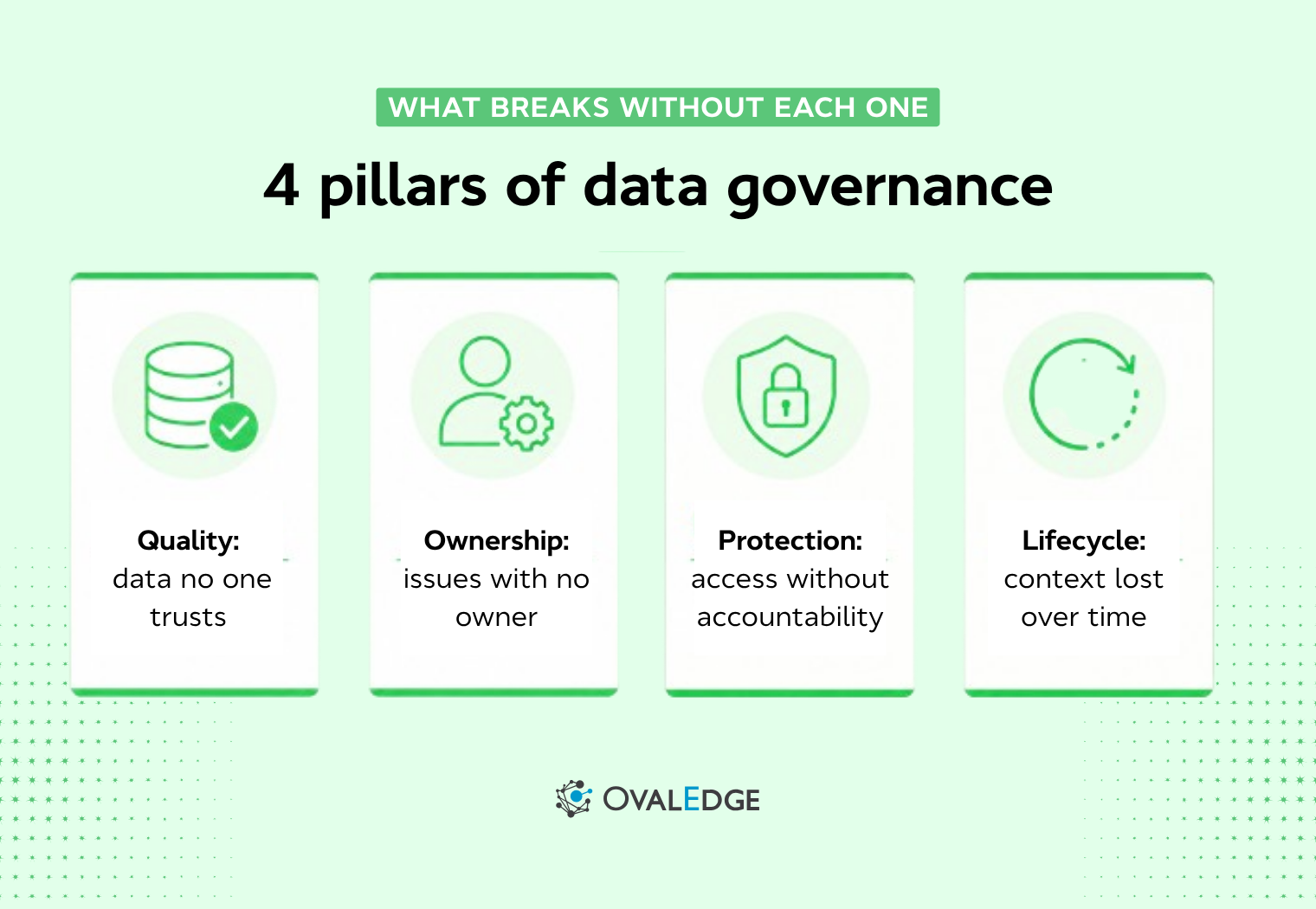
The four pillars of data governance are data quality, data ownership and stewardship, data protection and compliance, and data lifecycle management. Together, they create the controls and accountability needed to keep enterprise data trustworthy, secure, understandable, and usable from creation through retirement.
The cost of getting these fundamentals wrong can be high. A failed rule may have no clear owner, a policy may exist without being enforced, or lineage may show where data moved without explaining what it means to the business.
As AI systems consume more enterprise data, those gaps can also flow into analytics, automated decisions, and AI outputs. A strong governance model connects these responsibilities rather than managing them as separate programs.
This guide explains what each pillar controls, why governance frameworks define them differently, how the four work together, and how organizations can implement and measure them in practice.
What are the four pillars of data governance?
The four pillars of data governance are data quality, data ownership and stewardship, data protection and compliance, and data lifecycle management.
Together, they provide a practical operating model for answering four questions every organization must resolve before it can trust and scale its use of data.
|
Pillar |
Core question |
What it governs |
|
Data quality |
Can this data be trusted? |
Accuracy, completeness, consistency, timeliness, and fitness for use |
|
Data ownership and stewardship |
Who is accountable for it? |
Decision rights, definitions, issue resolution, and ongoing stewardship |
|
Data protection and compliance |
Who can use it, and under what rules? |
Privacy, security, classification, access, and regulatory obligations |
|
Data lifecycle management |
How should it be managed over time? |
Creation, lineage, retention, archival, dependencies, and retirement |
It is important to note that there is no single universally accepted list of data governance pillars. Some frameworks use “data management” as the fourth pillar, while others separate metadata management, architecture, data literacy, or policy management into additional pillars.
None of the four works well in isolation. Quality without ownership leaves issues unresolved. Ownership without context leaves stewards guessing about impact.
Protection without usable access creates workarounds. Lifecycle controls without lineage make it difficult to know what can safely be changed or retired. The goal is not to establish four separate programs. It is to make them operate as a connected system of trust, accountability, control, and context.
What does each data governance pillar cover?
Each pillar solves a distinct governance problem. Here is what that looks like in practice, where organizations commonly get stuck, and how the four connect.
1. Data quality
Data quality determines whether data is fit for the purpose for which it will be used. That requires more than checking whether a field is populated correctly. A dataset can be technically valid and still produce an unreliable decision because it is stale, incomplete, inconsistently defined, or inappropriate for a particular use case.
A practical quality program usually evaluates five core data quality dimensions:
-
Accuracy: Does the value reflect reality?
-
Completeness: Are required values present?
-
Consistency: Does the same data agree across systems and reports?
-
Timeliness: Is it current enough for the decision being made?
-
Validity: Does it conform to the expected format, business rule, or accepted range?
The important governance question is what happens after a quality rule fails. Detecting 4% missing customer IDs is useful, but governance becomes operational only when the organization can identify which critical data element failed, which reports or models depend on it, who owns the issue, what threshold was violated, and when remediation is due.
Start with critical data elements rather than trying to govern every field equally. Define their business meaning and acceptance criteria, profile them continuously, and set a small number of quality indicators that business owners can understand. For example, an order dataset might require 99.5% completeness for customer IDs, less than 0.5% duplicate orders, and no more than a 15-minute freshness delay.
Pro tip: Do not measure data quality only at the source. A source table can pass every rule while a downstream transformation changes a calculation, drops records, or introduces stale data. Connect quality monitoring with lineage so teams can see where the issue originated and what it affects.
For analytics and AI, this distinction becomes even more important. A dataset should not be considered trusted simply because it exists in an approved system. Teams also need quality, freshness, lineage, ownership, and certification signals that show whether it is safe to use for the specific task.
2. Data ownership and stewardship
Ownership answers who has the authority to decide data, while stewardship defines who manages that responsibility in everyday operations.
Organizations often believe they have solved ownership because a spreadsheet lists an owner beside each data domain. That is only the starting point. Effective ownership requires explicit decision rights.
A data owner should be able to approve definitions, determine acceptable quality thresholds, authorize major access or usage decisions, and resolve conflicts within the domain.
A data steward turns those decisions into ongoing stewardship practice by maintaining metadata, reviewing quality issues, resolving definition conflicts, coordinating remediation, and escalating problems when necessary
Technical custodians or engineering teams then implement the required controls in systems and pipelines.
For example, if Finance and Sales calculate “annual recurring revenue” differently, the steward should not simply document both definitions and move on. The governance process needs to identify the authoritative definition, assign someone with the authority to approve it, map it to the affected datasets and reports, and communicate the change to downstream users.
The most useful ownership metrics are therefore operational, such as:
-
Percentage of critical data assets with an accountable owner
-
Percentage with an active steward
-
Average time to resolve governance issues
-
Number of overdue stewardship actions
-
Percentage of critical terms with approved definitions
Did you know? Ownership becomes more important, not less, as governance is automated. An automated system can detect a conflicting definition, recommend an owner, or route an approval, but accountability for consequential business decisions still needs to remain with people.
For AI systems, ownership also provides an escalation path. When an AI agent encounters an ambiguous metric, failed quality threshold, or policy exception, it needs to know who is responsible for validating the answer or approving the next action.
3. Data protection and compliance
-1.png?width=1024&height=569&name=Info%202%20(3)-1.png)
Data protection governs who can access data, under what conditions, and what controls must follow that data wherever it is used.
The first step is knowing what requires protection. Organizations need to discover and classify sensitive data such as:
-
Personally identifiable information (PII)
-
Protected health information (PHI)
-
Payment information
-
Confidential financial data
-
Other regulated or business-sensitive assets
Classification should trigger controls, not sit as a label in a catalog. Depending on sensitivity and purpose, those controls may include:
-
Encryption
-
Masking
-
Row- or column-level access
-
Approval workflows
-
Retention requirements
-
Periodic access reviews
-
Audit logging
This matters financially as well as legally.
IBM's 2025 Cost of a Data Breach Report found that the global average cost of a data breach was $4.99 million. The same research found that 97% of organizations that reported an AI-related security incident lacked proper AI access controls.
Good governance does not mean restricting everything. Excessive controls create their own risk when users bypass slow approval processes, copy data into spreadsheets, or use unauthorized tools. The objective is to make the compliant path the easiest legitimate path.
A mature protection model therefore connects classification, identity, purpose, policy, and workflow. If an analyst requests customer-level data, the system should know its classification, which policy applies, whether the analyst's role permits the requested use, who must approve an exception, and what evidence needs to be retained.
That same principle applies to AI. Governance needs to control not only what an agent can retrieve, but also what it may expose, combine, recommend, or act on.
4. Data lifecycle management
Data lifecycle management governs data from creation and ingestion through active use, sharing, retention, archival, and eventual deletion.
This pillar is broader than storage management. To manage a data asset throughout its lifecycle, teams need enough metadata and context to answer questions such as: Where did it originate? Which transformations changed it? Who owns it? Which applications, dashboards, models, or AI workflows still depend on it? How long must it be retained? When can it be safely retired?
That is why metadata, provenance, and lineage are central to lifecycle governance. NIST's current Data Governance and Management work similarly includes metadata, provenance, lineage, storage, access, and data disposition among lifecycle management activities.
A practical lifecycle policy should specify:
-
The authoritative source and owner
-
Retention period and legal basis
-
Archival conditions
-
Active downstream dependencies
-
Review frequency
-
Deletion or retirement procedure
Consider a customer table scheduled for retirement after a platform migration. Deleting it because it appears unused is risky. Lineage may reveal that an executive dashboard, regulatory report, feature pipeline, or AI application still depends on one of its fields. Lifecycle governance uses that dependency context to assess impact before the asset changes or disappears.
This is also where governance begins to create reusable enterprise context. Definitions, ownership, quality signals, lineage, classifications, and policies should remain connected to the data throughout its lifecycle. Otherwise, every new analytics or AI use case has to reconstruct that context from scratch.
How do the four data governance pillars work together?
The four pillars become effective when a signal in one pillar triggers action in the others. Data quality identifies whether something is wrong. Ownership determines who must decide or remediate. Protection establishes what can be accessed or changed. Lifecycle context and lineage show where the data came from, what depends on it, and what could be affected by the decision.
Consider a revenue dataset that suddenly fails a freshness rule before an executive reporting cycle.
|
Governance step |
Pillar in action |
What happens |
|
Detect |
Data quality |
Monitoring identifies that the dataset has not refreshed within its approved SLA. |
|
Assess impact |
Lifecycle management |
Lineage reveals the dashboards, reports, and downstream models that consume the dataset |
|
Assign accountability |
Ownership and stewardship |
The issue is routed to the responsible steward and data owner for investigation and resolution. |
|
Apply controls |
Protection and compliance |
Access, certification, or usage rules prevent unreliable data from being treated as approved until the issue is resolved. |
|
Restore trust |
All four |
The problem is fixed, affected assets are revalidated, and the governance record captures what happened and who approved the resolution. |
This connected model is more effective than maintaining separate quality dashboards, ownership spreadsheets, policy documents, and lineage maps. When governance signals remain disconnected, teams must reconstruct context manually whenever something changes.
Pro tip: Design governance around decisions and workflows, not just artifacts. A quality score, policy, owner, or lineage map has limited value unless it can influence what happens when someone needs to use, change, approve, or retire data.
The same principle matters as AI becomes another consumer of enterprise data. An AI system needs more than access to a relevant dataset. It also needs signals about whether that dataset is trusted, what it means, who owns it, where it came from, and what rules apply to its use.
Governance becomes operational when those signals work together as a continuous layer of context, accountability, and control.
How to implement the four pillars in practice?
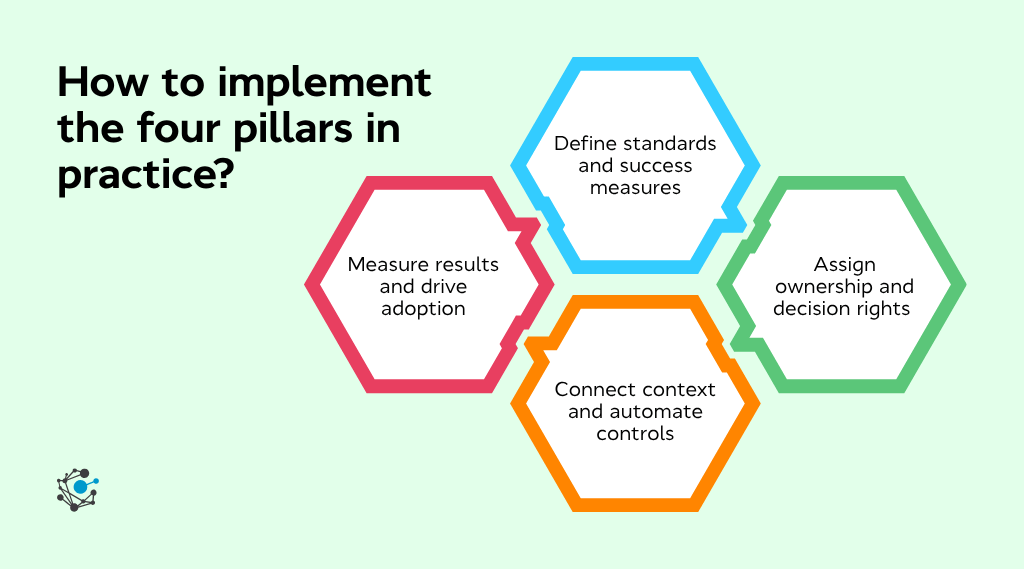
Implementing the four pillars does not mean governing everything at once. Start with a business problem causing real friction, apply the pillars there, then expand from that working governance loop.
A practical rollout looks like this:
1. Define standards and success measures
Start by identifying the critical data elements involved in the business outcome. For each one, define what “governed” means in measurable terms.
That should include:
-
An approved business definition
-
Data quality thresholds and freshness expectations
-
Sensitivity classification and access requirements
-
Retention or lifecycle rules
-
An authoritative source
-
A named owner and steward
For example, if the objective is reliable regulatory reporting, success might mean that every critical reporting field has an approved definition and owner, lineage back to its source, defined quality thresholds, and documented access and retention controls.
Set the measurement criteria before implementation. Otherwise, the program may produce more glossary terms, metadata, and policies without being able to show whether the original business problem improved.
Pro tip: Do not begin by cataloging everything. Start with the assets connected to a high-value business process, establish a working governance loop, prove the outcome, and then expand.
2. Assign ownership and decision rights
A governance program needs more than a list of owners. It needs clear authority.
For each governed domain or critical asset, specify who can approve a definition, set a quality threshold, authorize an exception, approve sensitive access, and decide whether an asset can be deprecated.
The data owner should make consequential business decisions. Stewards should manage day-to-day governance work, monitor issues, maintain context, and coordinate remediation. Technical teams should implement controls without being expected to resolve business ambiguity on their own.
Also define escalation paths and service-level expectations. If a quality failure or conflicting definition remains unresolved for weeks because nobody knows who can make the final decision, ownership exists on paper but not in practice.
3. Connect context and automate controls
The four pillars become difficult to operate when the supporting information is fragmented. A glossary may contain the approved definition, a separate tool may hold lineage, a spreadsheet may list owners, and access approvals may sit in email or ticketing systems. Every handoff creates an opportunity for context to disappear.
Instead, connect the governance signals around the asset: definition, lineage, quality, ownership, classification, policy, access, and usage. A user assessing a dataset should be able to understand not only what it is, but whether it is trusted, where it came from, who owns it, and what rules govern its use.
Automation should then reduce repetitive work such as metadata discovery, classification, lineage generation, quality monitoring, ownership recommendations, and approval routing. However, automation should not remove accountability. Business definitions, exceptions, sensitive access decisions, and other high-impact judgments should remain reviewable and auditable by people.
OvalEdge perspective: This is the principle behind Unified Data Governance. Catalog, glossary, lineage, quality, access, policy, ownership, and workflows operate as one governance layer instead of separate activities. AI agents can handle high-volume governance work, while owners and stewards remain in control of decisions that require business judgment.
4. Measure results and drive adoption
Implementation is not complete when the catalog is populated or the policies are published. Governance becomes operational when people and systems actually use it to make better decisions.
Track metrics across four outcomes:
|
Outcome |
What to measure |
|
Clarity |
Coverage of critical assets, ownership, and lineage |
|
Context |
Approved definitions, certified assets, and resolved quality issues |
|
Control |
Classification coverage, access-review completion, policy exceptions, and audit findings |
|
Adoption |
Use of governed datasets, governed access workflows, stewardship response times, and consumption by analytics or AI systems |
Adoption is the final test. If analysts continue using unofficial spreadsheets, business teams bypass access workflows, or AI applications consume unverified sources, the governance program may be configured, but it is not yet delivering.
The goal is to turn the four pillars into a repeatable operating model that continuously helps the organization find, understand, trust, protect, and use data.
Conclusion
The four pillars of data governance work best when they operate as one connected system. Data quality establishes whether data can be trusted. Ownership and stewardship make accountability explicit. Protection and compliance ensure data is used appropriately. Lifecycle management preserves the context, lineage, and controls needed as data changes over time.
The real challenge is not defining these pillars. It is making them work consistently across systems, teams, and workflows. When governance remains fragmented across spreadsheets, disconnected tools, and manual approvals, policies may exist without being applied, and trusted context can be lost before it reaches analytics or AI.
OvalEdge brings catalog, glossary, lineage, quality, access, policy, and governance workflows together in a Unified Data Governance platform designed to help teams create clarity, build context, stay in control, and drive adoption.
Book a demo to see how OvalEdge helps teams deliver trusted data for analytics, AI, and compliance.
.png?width=1081&height=173&name=Forrester%201%20(1).png)
.png?width=1081&height=241&name=KC%20-%20Logo%201%20(1).png)