.png)
Most enterprise AI pilots fail for the same reason: the agent has access to data but no way to verify whether it is the right data, from the right source, with the right permissions. The missing piece is not a better model. It is a trusted context.
Enterprise AI agents depend on two kinds of context: analytical and operational. Each requires different tooling. For analytical AI use cases, governed analytical context is usually the most practical starting point.
The eight platforms in this guide cover the analytical side. The developer tools section covers the runtime layer through which analytical and operational contexts are retrieved, assembled, and delivered to agents.
Context scope and capability comparison
Before comparing individual platforms, it helps to understand the two categories of context these tools can manage and where each platform falls.
Analytical context vs. operational context
Analytical context is the governed data foundation: approved definitions, certified sources, lineage, data quality, ownership, and access policies. A finance agent answering a revenue question relies on analytical context to confirm it is pulling the right metric from the right table with the right clearance.
Operational context is the process foundation: workflow state, conversation history, documents, decisions, and the actions an agent takes inside a business process. A procurement agent routing an invoice relies on operational context to know where the approval stands and what step comes next.
OvalEdge expert insight: Most teams discover the analytical-operational split the hard way: an agent gives a confident answer, but nobody can tell whether it used a governed metric or a stale pipeline output. Start by mapping which context type each agent depends on before evaluating any platform.
All eight platforms in this guide manage analytical context. None currently manages operational context end to end, though some are beginning to encode adjacent capabilities like procedural knowledge and agent traces. The developer tools covered later form a runtime layer through which either type of context may be retrieved, assembled, and used.
Top context engineering tools compared
The table below maps each platform's context scope alongside the analytical capabilities that differentiate them: metadata coverage, lineage depth, glossary maturity, governance controls, and MCP readiness.
|
Platform |
Context scope |
Metadata, glossary + lineage |
Governance |
MCP readiness |
|
OvalEdge |
Analytical: governed data, definitions, lineage, quality, ownership, access |
Full metadata coverage (170+); strong glossary; column-level lineage |
Strong |
Native server |
|
Atlan |
Analytical: metadata, definitions + Operational: procedural knowledge, agent traces |
Broad metadata; moderate glossary; column-level lineage |
Expanding |
Native server |
|
Databricks Genie |
Analytical: lakehouse metadata, semantic layer, metric definitions |
Lakehouse metadata; moderate glossary; lineage through Unity Catalog |
Unity-tied |
MCP app |
|
DataHub |
Analytical: metadata, lineage, discovery |
Broad OSS metadata; moderate glossary; lineage supported |
Configurable |
Native server |
|
Collibra |
Analytical: definitions, policies + Operational: stewardship workflows |
Broad metadata; strong glossary; lineage supported |
Strong |
Native server |
|
Alation |
Analytical: metadata, curation, tribal knowledge |
Broad metadata; moderate glossary; moderate lineage |
Moderate |
SDK-based |
|
Informatica IDMC |
Analytical: metadata, quality, master data, reference data |
Full metadata coverage; strong glossary; lineage supported |
Strong |
Native server |
|
OpenMetadata |
Analytical: metadata, lineage, discovery |
Broad OSS metadata; moderate glossary; lineage supported |
Configurable |
Native server |
The profiles that follow discuss each platform in detail.
Disclosure: OvalEdge publishes this article and is one of the platforms reviewed below. Verify each vendor's capabilities against its current product documentation before deciding.
The 8 best context engineering tools in 2026
Each profile below opens with its context classification, then covers capabilities, integration, fit, and stack positioning.
1. OvalEdge
Most enterprises have already developed much of the governed data foundation through their data governance programs. OvalEdge connects and activates that existing foundation through the Enterprise Context Graph, making it usable by analytical AI applications and agents.
OvalEdge is a governed context platform that links governance work already in place into a single Enterprise Context Graph, or ECG:
-
Business glossary definitions
-
Column-level data lineage
-
Sensitive-data classification
-
Fine-grained access controls
-
Data catalog metadata
A semantic layer maps a column to its meaning. The Enterprise Context Graph connects that meaning to its certified source, its owner, the lineage path it followed, and the policy governing who can see it, closing the gaps that appear without it: mismatched definitions across teams, lineage traced by hand, and no reliable way to confirm a figure came from an approved source.
What sets OvalEdge apart from other platforms in this list is what it treats as context.
Tools like Atlan and DataHub activate metadata broadly, connecting catalogs, lineage, search, and knowledge to give AI systems access to a wide range of information. OvalEdge focuses on governed enterprise data specifically: the layer where definitions are approved, sources are certified, and access is controlled.
For analytical AI use cases where the business will act on the answer, that governed data layer is the context that matters.
Things to consider
-
MCP readiness: Native MCP server that exposes governed context to AI applications built in Claude, ChatGPT, Copilot, or custom frameworks through a single connection. AskEdgi returns answers traced back to approved definitions and certified sources within the same governed layer.
-
Pricing and deployment fit: Enterprise pricing; best suited for mid-to-large organizations with existing governance programs that need to connect governed context to AI use cases without rebuilding from scratch.
-
Where it falls short: OvalEdge is strongest when an enterprise already has governance foundations in place. Teams starting governance and AI context delivery from zero may face a steeper initial setup compared to lighter catalog-first tools.
-
Best for: Connecting existing governance programs to analytical AI through a governed Enterprise Context Graph.
Stack positioning
OvalEdge operates as the governed context layer underneath AI agents and analytical tools, connecting 170-plus data sources into one graph that carries business meaning, lineage, certification, and access policy together.
Teams running developer-layer tools like LangChain or LlamaIndex for retrieval and orchestration pair them with OvalEdge for the governed business context those tools do not create on their own.
For example, an insurance team retiring a mortality-rating factor needs to know which pricing models depend on it, which definition each uses, and who owns the update. The ECG surfaces those dependencies automatically.
Learn more about how OvalEdge connects governed enterprise context to AI agents.
2. Atlan
Atlan positions itself as "The Context Layer for AI," with Context Agents that auto-generate metadata from query patterns, pipeline code, and BI semantics, and a Context Engineering Studio that adds lifecycle management for business knowledge: build, test, review, deploy, with versioning. It offers broad connector coverage across 80+ systems, column-level lineage, access-policy awareness, and a native MCP server that exposes governed metadata to AI agents.
Atlan also delivers context through three structured types: Knowledge (what terms mean), Expertise (how teams investigate data issues), and Norms (who can access what). Its core remains analytical context, though its procedural knowledge encoding and agent trace analysis touch territory adjacent to operational context.
Things to consider
-
MCP readiness: Native MCP server with governed metadata access and runtime access-policy enforcement.
-
Pricing band + deployment fit: Mid-to-enterprise pricing; best suited for modern cloud data stacks and data teams that want fast metadata activation.
-
Where it falls short: Organizations with deeply customized governance operating models may still need to assess how much workflow depth and policy complexity they can configure without services-heavy implementation.
-
Best for: AI-native metadata activation and MCP-connected enterprise context.
Stack positioning
Atlan works as the catalog layer underneath, feeding governed metadata to orchestration frameworks like LangChain or an MCP server so agents query context that already carries a business definition and lineage trail.
Compliance-heavy enterprises typically pair it with a dedicated governance platform for the controls Atlan is still building out, rather than relying on the catalog alone.
3. Databricks Genie Ontology
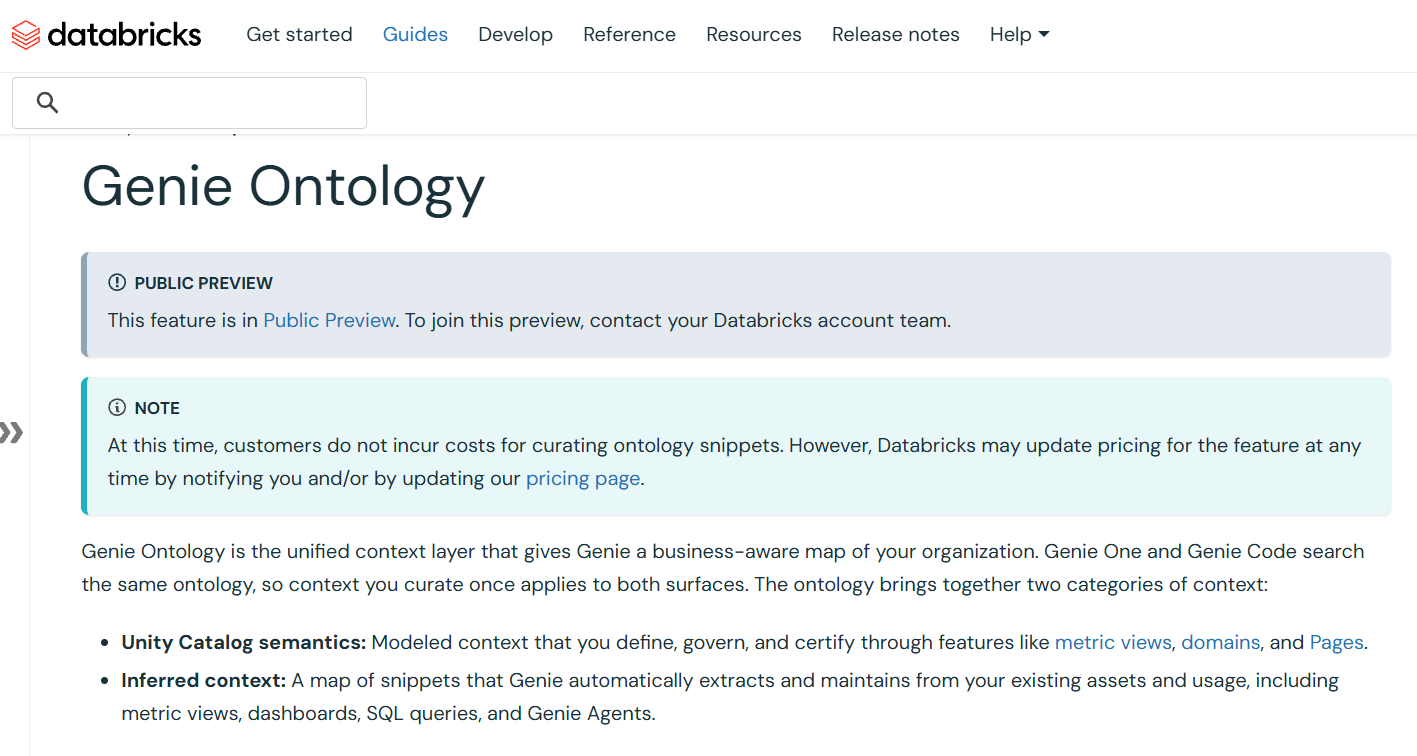
Genie Ontology auto-generates a semantic layer from Unity Catalog metadata, including metric views, table descriptions, and business term definitions. It helps agents understand what data means, without tracking workflow state, decisions, or business process actions.
Genie Ontology is the automatic context layer behind Databricks' Genie AI assistant and Genie Agents. It extracts knowledge from tables, queries, dashboards, pipelines, and connected apps, then organizes it into a living graph of business terms and metric definitions, all without manual curation.
Things to consider
-
MCP readiness: Genie One supports custom MCP connections and a dedicated Genie MCP App, so external agents can draw on the ontology without switching workflows.
-
Pricing band + deployment fit: Bundled into Databricks platform usage; no standalone product to buy outside the Databricks ecosystem.
-
Where it falls short: Genie Ontology is generated automatically from Databricks-native data and activity; it's not a standalone context platform you can point at a heterogeneous, multi-vendor stack the way OvalEdge, Atlan, or Collibra are. Authority is determined algorithmically (a PageRank-style weighting of source, freshness, and usage), which is powerful but offers less manual override than a stewardship-driven glossary.
-
Best for: Teams already on Databricks who want an automatically generated context layer for Genie, without a separate governance platform.
Stack positioning
Genie Ontology sits directly on top of Unity Catalog, so it fits stacks already standardized on Databricks rather than sitting alongside a separate governance platform.
Teams running a mixed environment usually still need a governed context layer that spans warehouses Databricks does not reach, alongside MCP or a retrieval framework for agent access.
4. DataHub
DataHub manages metadata, lineage, ownership, and quality signals through an open-source context graph. It provides the mechanisms for governance-aware context, not the operational workflow state or agent action tracking needed for process automation.
DataHub is a strong fit for data engineering and platform teams that want an open-core metadata platform with a context-graph orientation. Its framing is especially useful for buyers who want agents to reason across datasets, pipelines, dashboards, documents, owners, and business definitions.
Things to consider
- MCP readiness: Native DataHub MCP Server for exposing metadata, lineage, ownership, and context graph signals to AI clients.
- Pricing band + deployment fit: Open-source entry point with commercial DataHub Cloud; best for engineering-led teams that can support technical configuration and platform ownership.
- Where it falls short: Business-facing governance teams may need more enablement and configuration to turn the platform into an adoption-friendly governance operating model.
- Best for: Engineering-led context graphs and open-core metadata infrastructure.
Stack positioning
DataHub sits as the open-source metadata and context graph layer underneath orchestration and retrieval tools, exposing lineage, ownership, and governance signals to agents through MCP or custom integrations.
Teams that need business-facing stewardship workflows often pair it with a dedicated governance platform for definitions, policies, and certification.
5. Collibra
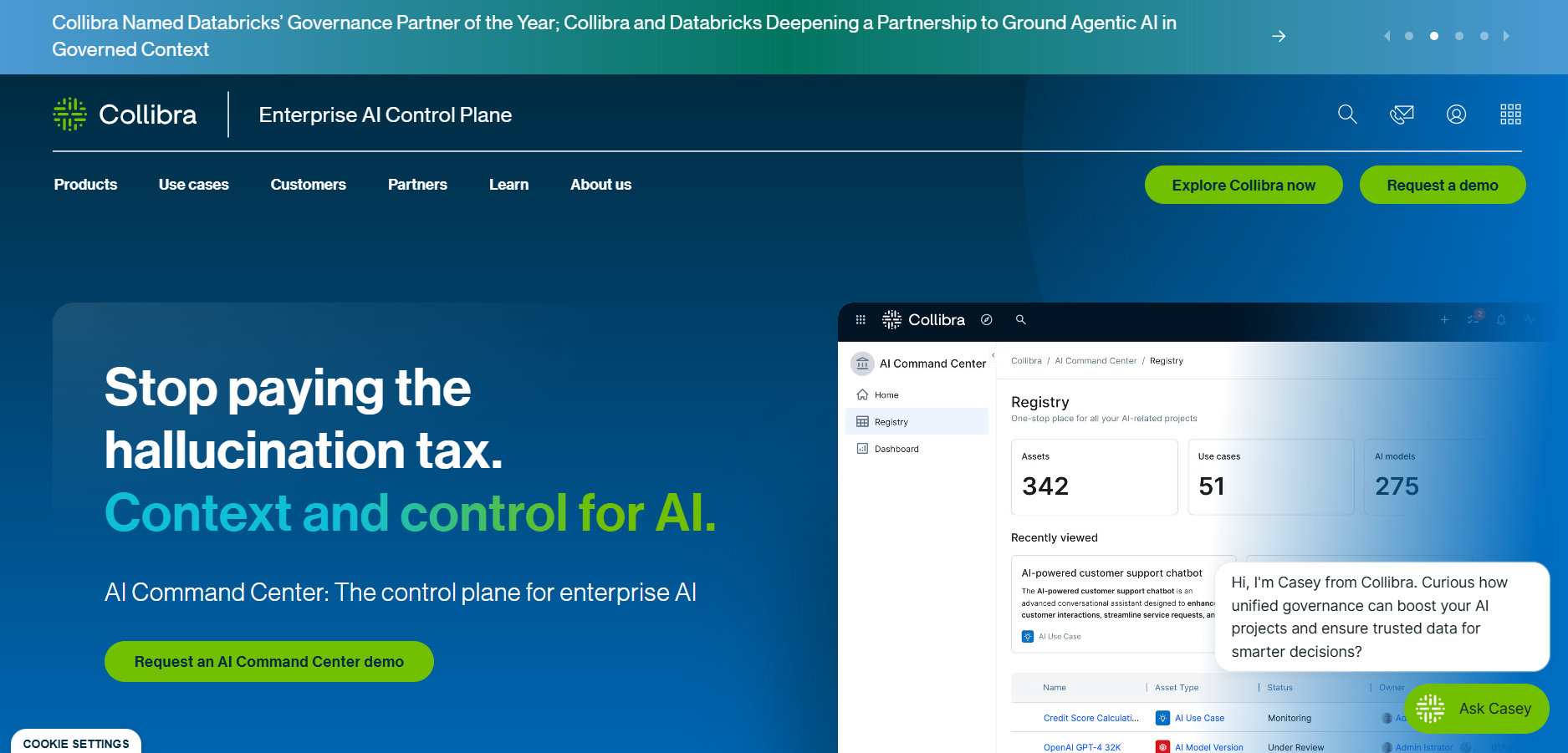
The context type is analytical, with a governance control plane extending into the agentic space. Collibra's Agent Contracts and Guardian Agents define and enforce what AI agents are permitted to access. However, they govern agent behavior rather than supplying the operational context (workflow state, documents, decisions, actions) agents need to execute within business processes.
Collibra remains a strong enterprise governance platform for organizations with mature stewardship, compliance, risk, and policy needs. For large organizations that need context engineering inside a broader governance and AI oversight program, Collibra is a credible option.
Things to consider
-
MCP readiness: Native Collibra MCP Server for delivering governed metadata and business context to AI agents.
-
Pricing band + deployment fit: Higher enterprise pricing; best for large, regulated, and globally distributed organizations with formal governance teams.
-
Where it falls short: Cost, complexity, and implementation effort can be high for teams that need faster time to value or a lighter governance rollout.
-
Best for: Large-enterprise governance, compliance, and policy-heavy data programs.
Stack positioning
Collibra fits as the governance layer above whichever orchestration or retrieval tool moves data to an agent, supplying the approved definitions and policies those tools need to trust.
It works well paired with MCP for agent connectivity, though its formal review cycles suit regulated industries more than fast-moving engineering teams.
6. Alation
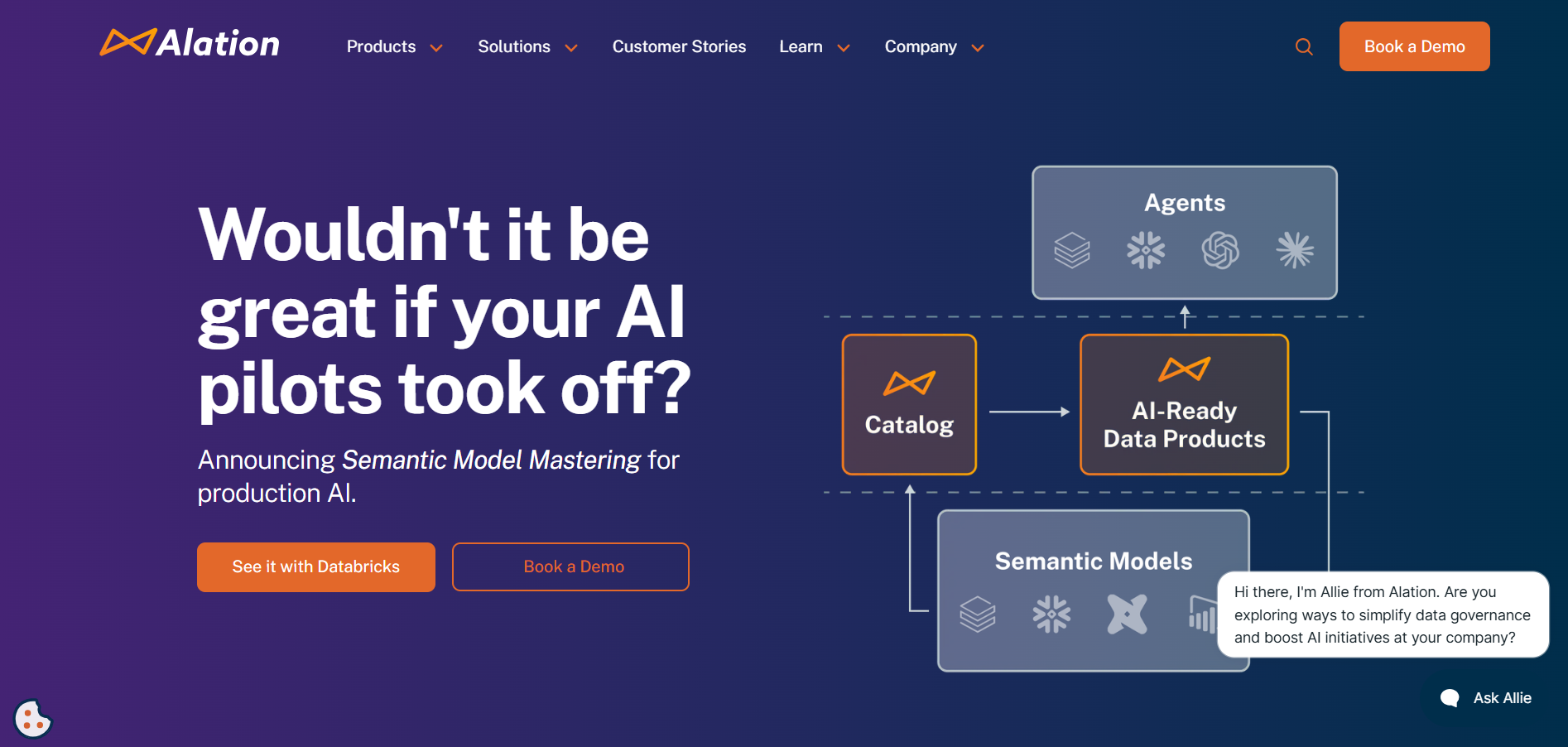
Alation's catalog, lineage, glossary, and SQL agent analytics all operate within an analytical context. Its newer Ontologies feature models business process constraints and relationships, but these map structural rules, not live workflow state or agent actions within running processes.
Alation is well suited for organizations that want a mature data catalog with strong adoption features, active metadata, glossary support, collaboration, and search. For context engineering, Alation is a good fit where business adoption and data intelligence maturity matter as much as technical extensibility.
Things to consider
-
MCP readiness: MCP-ready through Alation AI Agent SDK and MCP-supported integration patterns, rather than only a traditional catalog API approach.
-
Pricing band + deployment fit: Mid-to-enterprise pricing; best for organizations prioritizing data discovery, literacy, and catalog adoption across business and technical users.
-
Where it falls short: Teams looking for deeply technical, open-core context graph infrastructure may find DataHub or OpenMetadata more flexible.
-
Best for: Catalog adoption, active metadata, and business-user discovery.
Stack positioning
Alation increasingly competes for the same role a governed context platform plays, supplying definitions and lineage directly to agents rather than sitting only underneath developer tools.
Teams that already run Alation's search and catalog layer can extend it toward analytical AI without adding a separate governance product first.
7. Informatica IDMC
Informatica IDMC defines four context layers (data, business, user, governance), but every concrete capability maps to analytical context: metadata cataloging, data integration, data quality monitoring, master data management, and lineage. CLAIRE Agent Skills expose governed data to agents without managing workflow state or process actions.
Informatica IDMC is a fit for organizations that already rely on Informatica for data integration, data quality, MDM, cataloging, governance, and lineage. For enterprises that want AI agents grounded in an existing IDMC-managed data layer, Informatica is difficult to ignore.
Things to consider
-
MCP readiness: Native IDMC MCP Server and self-managed MCP options for exposing governed IDMC assets, metadata, lineage, and policies to AI agents.
-
Pricing band + deployment fit: Higher enterprise pricing; best for large hybrid and multi-cloud organizations already invested in Informatica’s platform.
-
Where it falls short: It may be too broad and suite-heavy for teams that only need a focused governed context layer or a lightweight metadata platform.
-
Best for: Enterprises that want context engineering inside a broader data management cloud.
Stack positioning
IDMC works as an all-in-one layer, covering integration, master data management, and governance instead of stitching together separate developer and governance tools.
Enterprises already running Informatica for data movement get the most value from that breadth, though teams needing only a governed context layer for agents may find lighter combinations faster to deploy.
8. OpenMetadata
OpenMetadata manages metadata, lineage, data quality, glossary, and classification through an open-source platform. It provides the same analytical context foundation as commercial alternatives, with the trade-offs of community-driven governance configuration.
OpenMetadata is a strong option for teams that want open-source flexibility across cataloging, metadata, data quality, lineage, glossary, classification, and collaboration. It is especially attractive when engineering teams want control over deployment, customization, and integration patterns.
Things to consider
-
MCP readiness: Native MCP server available to allow AI assistants and MCP clients to interact with the metadata catalog.
-
Pricing band + deployment fit: Open-source entry point with commercial support options; best for technical teams comfortable managing infrastructure and configuration.
-
Where it falls short: Self-managed overhead can become significant, especially for organizations that need enterprise support, workflow maturity, and business-user adoption out of the box.
-
Best for: Open-source metadata management with flexible AI context exposure.
Stack positioning
OpenMetadata plays the same catalog role as DataHub, sitting underneath an orchestration or MCP layer that handles the actual agent connection.
Its open-source model means engineering teams assemble governance controls themselves, which fits teams already owning that infrastructure more than those wanting a managed platform out of the box.
The runtime layer: developer tools to know
While context engineering platforms create the governed foundation AI agents rely on, developer tools help agents retrieve, assemble, and use that context during execution. The developer tools below form the runtime layer through which analytical and operational context are retrieved, assembled, and delivered to agents. Enterprise teams typically run at least one of them alongside a governed analytical context platform.
-
LangChain and LangGraph: They are the default orchestration framework for chaining retrieval, memory, and tool calls into an agent workflow. Strong for building the agent itself; there is no built-in concept of an approved business definition or a lineage trail.
-
LlamaIndex: It is built for retrieval-augmented generation, indexing documents and structured data so agents can pull relevant chunks at query time. It retrieves what exists. It does not verify whether what exists is the approved, governed version.
-
Mem0: It is an agent memory layer that persists facts and preferences across sessions so agents do not start from zero every conversation. Memory here means conversational state, not enterprise metadata or lineage.
-
Zep: It is a memory and context layer similar to Mem0, built around temporal knowledge graphs that track how facts about a user or session change over time.
-
MCP: The Model Context Protocol is not a vendor but a connectivity standard. It defines how an agent requests context or takes an action through a tool, and it is quickly becoming the default interface between agents and enterprise systems.
A few large platform suites genuinely span both analytical and operational context. Palantir AIP fuses data assets with workflow state and decision capture in a single ontology. Microsoft connects Purview (analytical) with Copilot (operational) through shared sensitivity labels and policies. SAP bridges Datasphere (analytical) with Joule agents that execute directly within ERP transactions.
These are broad enterprise platforms rather than focused context engineering tools, which is why they fall outside this comparison.
How to choose the right context engineering tool for your stack
The best context engineering tool is the one that fits where your enterprise context lives, how your AI agents will use it, and how much governance control your organization needs.
Step 1: Identify what your agents need to work
Start by identifying the primary job your AI agents need to perform. The context they require depends on whether they primarily analyze enterprise data, execute business processes, or do both.
-
If agents mainly support analytical AI: Focus primarily on analytical context, including governed metrics, certified data sources, approved definitions, lineage, ownership, data quality, and access policies. For use cases such as revenue analysis, risk reporting, compliance analysis, and business intelligence, you do not need to make operational context a major evaluation criterion.
-
If agents execute business processes: Give greater weight to operational context, such as workflow state, conversation history, pending actions, documents, and process execution.
-
If agents do both: Evaluate how well the platform connects analytical context with the operational systems where actions take place.
For analytical AI use cases, a platform should make trusted enterprise data and its governance context accessible to AI agents. OvalEdge focuses on this analytical context, connecting metadata, business definitions, lineage, quality, ownership, and access controls so agents can work with governed enterprise data.
Step 2: Match your governance bar to your risk profile
Define what "governed context" means based on what happens when an agent is wrong. Regulated industries need column-level lineage and access enforcement before a single agent goes into production.
Lower-stakes internal tools can start lighter and add controls as usage grows.
Step 3: Score platforms against your requirements
Score each finalist on metadata coverage, lineage depth, glossary, governance controls, MCP readiness, deployment fit, and cost. Factor in your team's capacity for managed SaaS versus self-hosted versus open source. A platform that wins on metadata but lacks governance creates a second project, not a shortcut.
OvalEdge expert insight: Before you score any platform, run one test. Take a real business question your team answers today and trace what an agent would need to answer it reliably: the approved definition, the certified source, the lineage path, and the access policy.
The right platform connects those four from the governance you already have. The wrong one asks you to rebuild them.
Conclusion
Reliable AI depends on the context an agent needs for its task. An analytical agent needs approved metrics, clear definitions, lineage, ownership, and access policies to produce a traceable answer. A workflow agent may instead need case status, documents, conversation history, and pending actions. Some agents need both.
For analytical AI, many enterprises already have a governed data foundation. The challenge is connecting that existing work so AI applications and agents can use it while retaining the definitions and controls the business relies on.
OvalEdge connects and activates this foundation through the Enterprise Context Graph. It links the business glossary, data catalog, lineage, classification, and access governance enterprises already maintain into governed context for analytical AI agents and analysts.
Its native MCP server delivers that context to agents built in Claude, ChatGPT, Copilot, or custom frameworks. Its connectors, automated column-level lineage, and AI-assisted glossary conflict detection help carry the relevant definitions, lineage paths, and access policies into an agent’s response.
Schedule a demo with OvalEdge to see how an Enterprise Context Graph can connect your existing governance foundation to trusted AI analytics.
.png?width=1081&height=173&name=Forrester%201%20(1).png)
.png?width=1081&height=241&name=KC%20-%20Logo%201%20(1).png)