.jpg)
A semantic layer was built to make five dashboards agree on one revenue number. It was never built to tell an AI agent which revenue number to trust, for whom, and under what rules.
That gap is the context layer vs. the semantic layer question. A semantic layer standardizes what a metric means across enterprise data. A context layer governs when and how an AI agent can use it, adding lineage, ownership, quality, and sensitivity that the metric definition does not carry.
The thing that changed is the consumer. For years, a person sat between the data and the action, so a clean definition was enough. Now agents read a definition and act on it directly, which means governance has to travel with the metric at the moment of use.
These are different problems, not one problem with two names. This post defines each layer, compares them, weighs which one AI workloads need, and shows where governance fits. The harder question sits underneath both: neither layer creates governed metadata on its own.
What is a semantic layer?
A semantic layer is a business logic layer that sits between raw warehouse data and the tools people use to query it. It maps technical fields to agreed metric definitions, so every dashboard, report, and Structured Query Language (SQL) query returns the same number for the same metric.
In practice, it translates a column like txn_amt into Transaction Amount and cust_id into Customer ID, then attaches the approved formula behind each one. A request for revenue resolves to one governed calculation instead of whatever each analyst types by hand.
Teams build this layer with tools like dbt MetricFlow, Looker (LookML), AtScale, and Cube, or with the native semantic models inside Snowflake and Databricks.
A semantic layer is not a data catalog, a knowledge graph, or a governance platform. It settles how a metric is calculated and stops there. It says nothing about who owns that metric, how long the definition stays valid, or whether the data is safe to expose.
That scope works well for business intelligence (BI) dashboards and key performance indicator (KPI) reporting, where a person reads the result and applies judgment. It becomes one layer among several the moment an AI agent acts on the output with no human in the loop.
What is a context layer?
A context layer is a governance layer that sits above the semantic layer and decides how data can be used, not only what it means. Most of what it needs already exists inside the enterprise as glossaries, lineage maps, ownership records, classifications, and quality rules. The context layer packages that governance into machine-readable signals an agent can read at runtime, which is why it is better understood as existing governance made live than as a brand-new system to procure.
Take the same revenue metric. The semantic layer says how revenue is calculated. The context layer adds where the number came from and who is accountable for it, then carries the sensitivity, quality, and validity rules an agent needs before it acts. A human analyst fills these gaps with judgment. An agent has none, so the context layer supplies them as explicit signals.
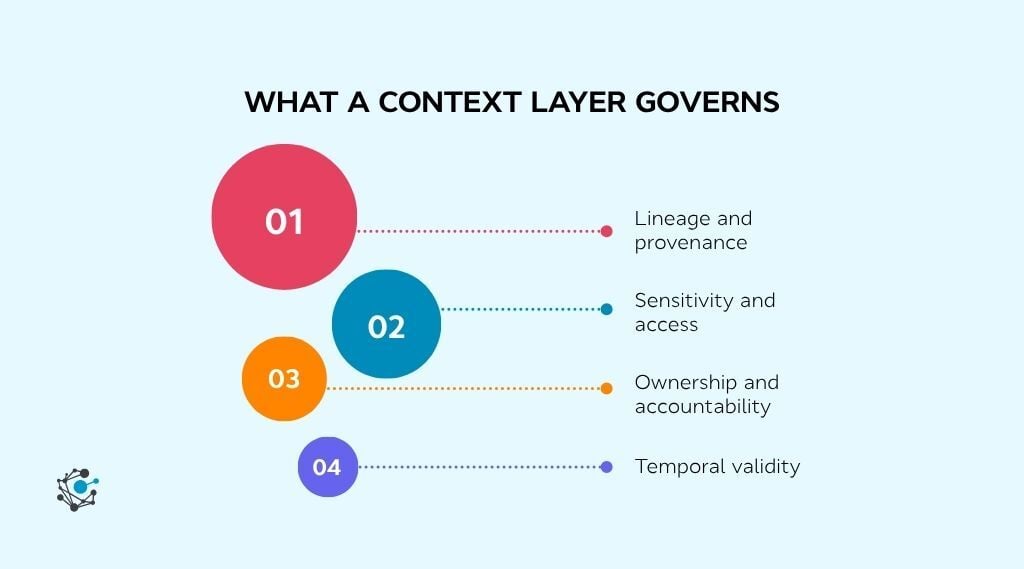
Together, the five signals below answer one question: Can the AI safely use this data? Each covers something the semantic layer leaves open:
-
Lineage: the source systems, transformations, and quality checks behind every metric, so an answer can be traced rather than trusted on faith.
-
Sensitivity: classifications like restricted, internal, or regulated that block an agent from exposing protected data before it reaches output.
-
Ownership: a named owner for every metric and policy, so a person enters the loop when something breaks.
-
Quality: freshness and reliability signals that tell the agent whether to answer with confidence, attach a warning, ask the user for clarification, or hold off entirely. A clean definition of stale data is still a wrong answer waiting to happen.
-
Temporal validity: valid-from dates and version history, so an agent applies the rule that fits the period instead of an expired one.
Put together, these signals do more than describe the data. They shape behavior. A context layer is what lets an agent decide whether it should answer at all, which definition applies, whether the result is trustworthy, whether this user is allowed to see it, and when it should escalate to a person.
A context layer does not replace the semantic layer. It consumes those metric definitions and controls how an agent uses them. That distinction is where most AI data infrastructure decisions go wrong, because teams buy a context layer expecting it to define metrics it was never built to define. The next section breaks the difference down.
Context layer vs semantic layer: the key differences
A semantic layer standardizes what a metric means. A context layer governs how an AI agent can use it. The table below maps the split across the dimensions that matter when you choose one, build one, or run both.
|
Dimension |
Semantic layer |
Context layer |
|
Primary purpose |
Define metrics consistently |
Govern how metrics are used |
|
What it models |
Metric formulas and business logic |
Lineage, ownership, sensitivity, quality, and validity rules |
|
Primary consumers |
BI tools, dashboards, analysts |
AI agents and automated workflows |
|
Governance scope |
Calculation only |
Access, sensitivity, quality, accountability, and time validity |
|
Runtime behavior |
Returns a defined metric |
Decides whether the agent should answer, warn, ask, refuse, or escalate |
|
Relationship |
One input the context layer consumes |
The layer that wraps and governs the semantic layer |
|
Freshness model |
Updates when a definition changes |
Tracks validity windows and versions over time |
|
Failure mode |
Two teams report different numbers |
An agent acts on data it should never have touched |
|
Key technologies |
dbt MetricFlow, Looker, AtScale, Cube |
Data catalogs, policy engines, governance platforms |
Where the two layers overlap
The two layers share the same starting point, which is why they get confused. Both depend on accurate metric definitions, and both cut the guesswork in how data gets used. A semantic layer is one of the inputs a context layer reads from, so a strong semantic layer makes the context layer more reliable.
The overlap ends at the purpose. A semantic layer settles the math and hands off a clean number. A context layer takes that number and decides whether an agent can act on it, for whom, and under which policy. One produces a trusted definition. The other produces a trusted decision.
For years, that second job went unnoticed, because a person did it by instinct; the distinction only started to matter once AI agents began acting on the number with no one in between.
Why the distinction matters now
For a decade, the semantic layer was enough, because a person sat between the data and the action. An analyst saw a number, knew the source looked wrong, and paused. That human check is what kept a loose definition from becoming a bad outcome.
AI agents remove that check. An agent reads a metric and acts on it in one motion, with no instinct that the source is stale or the data is restricted. The semantic layer still gives the agent a correct definition, yet it cannot tell the agent whether using that definition is safe. The context layer exists to close that gap, which is why the question moved from optional to architectural the moment agents started acting on enterprise data without a human in the loop.
OvalEdge's experts believe that AI does not reduce the need for data governance. It raises the cost of weak governance. A semantic layer can tell an agent what "revenue" means. It cannot tell the agent which revenue definition to use, for whom, from which certified source, and under which policy. That missing piece is governed by business meaning, and it is the part that a context layer has to carry.
Which is why the better question is not "which layer do we buy?" It is "which governed knowledge must our agents be able to trust, trace, and act on?" Enterprises that have invested in governance for years are not behind here. They already hold the raw material an agent needs. The work is turning that scattered documentation into a context that an agent can read in the flow of a decision.
A context layer is only as reliable as the governance underneath it. This OvalEdge whitepaper walks through the framework and best practices for building that foundation, from catalog and lineage to ownership and policy.
Semantic layer vs context layer for AI: which one to use when
Use a semantic layer when people consume the output. Add a governed context over the top when AI agents act on it. The deciding factor is not the size of your data. It is who reads the result, and whether anyone checks it before something happens.
A semantic layer is enough when:
-
Analysts and dashboards are the end consumers.
-
A person reviews the number before acting on it.
-
A wrong result means a misread chart rather than an automated action.
You need a context layer on top when:
-
AI agents query data and act with no human reviewing each step.
-
The same metric carries different access rules for different users or teams.
-
A wrong result can trigger a workflow, expose restricted data, or write back to a system.
The gap shows up fast under real conditions. A clean semantic layer hands the agent a correct definition, yet the agent still needs to know which source to trust, what it is allowed to see, and when a definition no longer applies. That is the context layer's job.
Most enterprises never actually pick one. They already run a semantic layer for BI, and they add a context layer once agents start acting on the same data. Building that context layer is a governance job: platforms like OvalEdge connect the catalog, lineage, and access rules that a semantic layer was never meant to hold.
Context layer vs semantic layer in data governance
Inside a governance program, the two layers create different kinds of work. A semantic layer is mostly a definitional asset that a central team maintains, and the whole org consumes. A context layer is an operational one, because the signals it carries have to be owned, enforced, and acted on while an agent is running.
Stewardship: who maintains what
A semantic layer needs a small group of stewards to keep definitions consistent, so the work concentrates. A context layer pushes stewardship outward. Sensitivity classifications belong to security or compliance, quality thresholds belong to the data owners closest to the source, and ownership records have to name a real person for every metric and policy.
The harder governance question is not how to write these rules once. It is how to keep them current as systems, owners, and regulations change, because a context layer reasoning from a stale rule fails in ways a person would have caught.
Policy enforcement: from documented to executable
Most governance policies live as documents that people are expected to follow. A context layer changes the bar, because an agent cannot read a policy PDF and apply judgment. Every rule it needs has to exist as machine-readable metadata: a classification it can check, a threshold it can compare against, and an access rule it can resolve per user.
Governance that was advisory becomes enforceable, and the gap between a written policy and an encoded one becomes the gap between a control that works and one that only looks like it does.
Runtime decision-making: governance at the moment of use
The deepest shift is when governance happens. Traditional governance runs before and after the fact through reviews, audits, and access requests. A context layer moves a slice of it into the moment of the decision, where the agent reads the signals and chooses whether to answer, warn, ask, refuse, or escalate.
Governance stops being a periodic checkpoint and becomes a live input to every automated action, which raises the cost of any rule that is missing, wrong, or out of date.
Why neither layer creates governed metadata on its own
Neither layer produces governance. Both consume it. The glossary, lineage, ownership records, quality rules, and policies each layer reads from have to exist underneath first. When the foundation is weak, both fail quietly. A semantic layer standardizes unreliable numbers with precision, and a context layer reasons from incomplete rules. Both failures look like a tool problem and are actually a metadata problem.
The fix is the same foundation for both: a governed data catalog, a maintained business glossary, end-to-end lineage, and active metadata that updates as upstream systems change. Without that foundation, both layers operate on assumptions, and the agents downstream inherit the gaps.
How the context layer and the semantic layer work together
The two layers are interdependent, not sequential. The semantic layer settles what a metric means. The context layer governs how an agent uses it. Both sit on the same foundation, and skipping that foundation breaks everything above it.
The architecture pattern: how the two layers stack
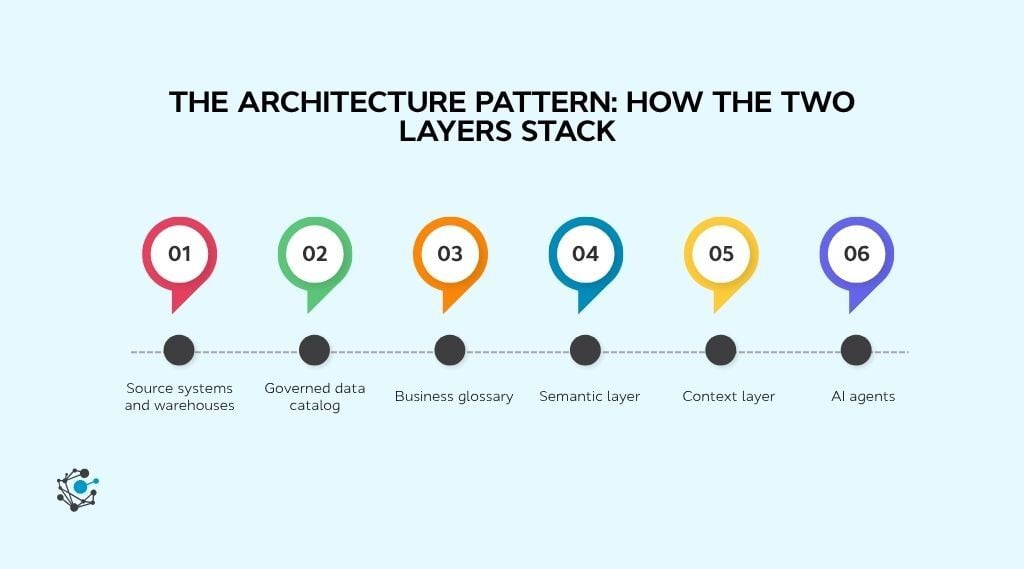
From the bottom up:
-
Source systems and warehouses: Snowflake, Databricks, and operational databases hold the raw data.
-
Governed data catalog: indexes every asset, captures technical and business metadata, and tracks lineage end to end.
-
Business glossary: lives inside the catalog and holds the canonical definitions of business entities.
-
Semantic layer: sits above the catalog, consuming glossary definitions and metric logic through tools like dbt, Looker, AtScale, and Cube.
-
Context layer: wraps the semantic layer and adds the governance signals: lineage from the catalog, ownership from the glossary, sensitivity from the policy engine, quality from the metadata platform, and validity from version history.
-
AI agents: consume the context layer through delivery mechanisms.
Retrieval-Augmented Generation (RAG), the Model Context Protocol (MCP), and application programming interfaces (APIs) are how context reaches the agent. They move context. They do not make it trustworthy.
Point any of them at weak or ungoverned metadata, and the agent gets the wrong context faster. Each layer has one job and one clear input. Skip the catalog or glossary at the bottom, and every layer above reasons from incomplete information.
What sits underneath: catalog, glossary, lineage, metadata governance
The stack only holds if four foundations are in place: a governed data catalog that inventories every asset with its classifications and owners, and a maintained business glossary that domain teams review on a schedule. Underneath both, column-level lineage runs from source to consumption, and active metadata keeps the whole stack current with freshness signals and change events instead of going stale.
Platforms like OvalEdge bring those four together in one place, the governed foundation that both layers read from.
Conclusion
The choice is not which layer to back. It is whether your data is ready for the consumer you are building for. If people read the output, a semantic layer carries you. If agents act on it, you need a context layer over the top, and that is the more decisive investment because a wrong action costs more than a wrong chart.
Both layers stand or fall on the same foundation: a governed catalog, a maintained glossary, end-to-end lineage, and metadata that stays current. Treat it as infrastructure, and your agents hold up in production. The lesson underneath all of it is straightforward: a semantic layer defines what your business data means, while a context layer makes that meaning safe for an AI agent to use.
That foundation is what OvalEdge is built to be, with the catalog, glossary, and lineage that power both layers in one platform.

 See how OvalEdge powers both. Book a demo.
.png?width=1081&height=173&name=Forrester%201%20(1).png)
.png?width=1081&height=241&name=KC%20-%20Logo%201%20(1).png)